New Semester
Started
Get
50% OFF
Study Help!
--h --m --s
Claim Now
Question Answers
Textbooks
Find textbooks, questions and answers
Oops, something went wrong!
Change your search query and then try again
S
Books
FREE
Study Help
Expert Questions
Accounting
General Management
Mathematics
Finance
Organizational Behaviour
Law
Physics
Operating System
Management Leadership
Sociology
Programming
Marketing
Database
Computer Network
Economics
Textbooks Solutions
Accounting
Managerial Accounting
Management Leadership
Cost Accounting
Statistics
Business Law
Corporate Finance
Finance
Economics
Auditing
Tutors
Online Tutors
Find a Tutor
Hire a Tutor
Become a Tutor
AI Tutor
AI Study Planner
NEW
Sell Books
Search
Search
Sign In
Register
study help
physics
particle physics
Principles And Practice Of Physics 2nd Edition Eric Mazur - Solutions
You are in mission control in Florida, supervising a probe on its way to Mars. The most recent report indicates that the probe will soon need to fire a quick burst of its booster rocket to increase its speed by \(5.2 \mathrm{~m} / \mathrm{s}\). You know that the spent fuel is ejected at a speed
You have just launched your new hot-air balloon and are hovering \(30.0 \mathrm{~m}\) above the ground. As you are checking equipment, the burner fails. You know that if you do nothing, the balloon will descend with a constant acceleration of \(1.50 \mathrm{~m} / \mathrm{s}^{2}\), and that the
A single gas molecule of inertia \(m\) is trapped in a box and travels back and forth with constant speed \(v\) between opposite walls A and B a distance \(\ell\) apart. At each collision with a wall, the molecule reverses direction without changing speed. Write algebraic expressions for \((a)\)
Consider a two-stage rocket made up of two engine stages, each of inertia \(m\) when empty, and a payload of inertia \(m\). Stages 1 and 2 each contain fuel of inertia \(m\), so that the rocket's inertia before any fuel is spent is \(5 \mathrm{~m}\). Each stage exhausts fuel at a speed \(v_{\text
What minimum information must be extracted from a video clip of a moving object in order to quantify the object's motion?
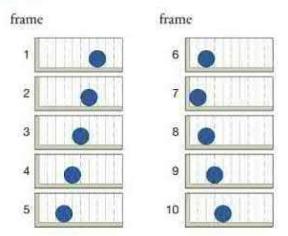
The sequence in Figure P2.2 represents a ball rolling into a wall and bouncing off of it. The ball is \(10 \mathrm{~mm}\) in diameter. Make a graph showing the distance from the leading edge of the ball to the closest part of the wall (using the wall as the origin) as it changes from frame to
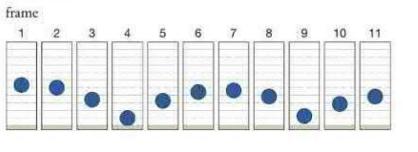
The sequence in Figure P2.3 represents a ball that is initially held above the ground. In the first frame the ball is released. In subsequent frames the ball falls, bounces on the ground, rises, and bounces again. The ball is \(10 \mathrm{~mm}\) in diameter. Make a plot showing the changing height
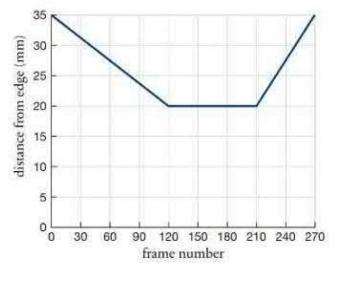
Figure P2.4 shows a graph of position versus frame number from a video clip of a moving object. Describe this motion from beginning to end, and state any assumptions you make.Data from Figure P2.4 distance from edge (mm) 35 30 25 20 15 10 10 5 0 0 30 60 90 120 150 180 210 240 270 frame number
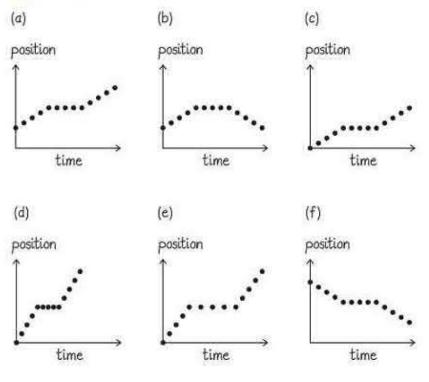
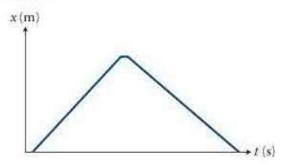
Your class observed several different objects in motion along different lines. Figure P2.5 shows some of the graphs other students made of the events. They have labeled the horizontal axis "time" and the vertical axis "position," but they have not marked any points along those axes and have not
If an object's initial position is \(x_{\mathrm{i}}=+6.5 \mathrm{~m}\) and its final position is \(x_{\mathrm{f}}=+0.23 \mathrm{~m}\), what is the \(x\) component of its displacement?
You walk \(3.2 \mathrm{~km}\) to the supermarket and then back home. What is your distance traveled? What is your displacement?
A \(2000-\mathrm{m}\) race is held on a \(400-\mathrm{m}\) oval track. From start to finish, what is the displacement of the winner?
You are shown a video clip of a dog running in front of a blank wall. The observations are to be plotted using the horizontal and vertical axes labeled with seconds and meters, respectively. How many different graphs of this motion with respect to time could be produced if: \((a)\) No additional
Assume you have a video clip of someone walking from left to right. You draw a position-versus-time graph of the motion and choose your origin to be the left edge of the frame. A friend chooses to take the right edge of the frame as the origin. Both of you choose the positive \(x\) direction to be
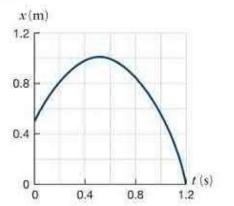
Suppose the vertical axis in Figure P2.11 was calibrated in inches rather than in meters and the horizontal axis in minutes rather than seconds. How would the shape of the curve change?Data from Figure P2.11 x(m) 1.2 0.8 0.4 0 0 0.4 0.8 1.2 t(s)
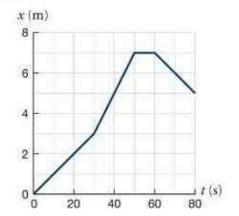
In the graph in Figure \(P 2. 12\), determine (a) the displacement of the object and \((b)\) the distance the object traveled.Data from Figure P2.12 x (m) 8 6 2 0 0 20 20 40 60 80 t(s)
You walk four blocks east along 12 th Street, then two blocks west, then one block east, then five blocks east, then seven blocks west. Let the \(x\) axis point east and have its origin at your starting point. If all blocks are equal in size, what is the \(x\) component of your displacement, in
Figure \(P 2. 15\) shows the position of a swimmer in a race as a function of time. Describe this motion.Data from Figure P2.15 (S) 14 x (m)
In the morning, a hiker at the bottom of a mountain heads up the trail toward the top. At the same instant, another hiker at the top of the mountain heads down the same trail toward the bottom. Each hiker arrives at her destination by the end of the day. Fxplain why, no matter what happens to
Will interpolation between known data points always give an accurate continuous path? If so, explain why. If not, give a counterexample.
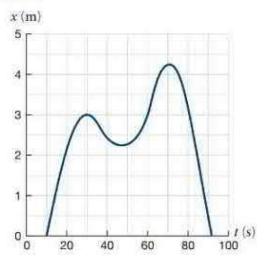
Figure \(\mathrm{P} 2.18\) shows the motion of an object as a function of time. How long did it take the object to get from the position \(x=2.0 \mathrm{~m}\) to the position \(x=3.0 \mathrm{~m}\) ? Is there only one correct answer?Data from Figure P2.18 x (m) 5 4 3 2 0 20 20 40 60 80 1(s) 100
Figure P2.19 is based on a multiple-flash photographic sequence of a ball rolling from left to right on a soft surface. Plot the ball's position as a function of time.Data from Figure P2.19
The position of an object is given by \(x(t)=p+q t+r t^{2}\), with \(p=+0.20 \mathrm{~m}, q=-2.0 \mathrm{~m} / \mathrm{s}\), and \(r=+2.0 \mathrm{~m} / \mathrm{s}^{2}\). (a) Draw a graph of this motion from \(t=0\) to \(t=1.2 \mathrm{~s}\). (b) What is the displacement of the object in the interval
After a rocket is launched at \(t=0\), its position is given by \(x(t)=q t^{3}\), where \(q\) is some positive constant. (a) Sketch a graph of the rocket's position as a function of time. (b) What is the rocket's displacement during the interval from \(t=T\) to \(t=3 T\) ?
Consider the position function \(x(t)=p+q t+r t^{2}\) for a moving object, with \(p=+3.0 \mathrm{~m}, q=+2.0 \mathrm{~m} / \mathrm{s}\), and \(r=-5.0 \mathrm{~m} / \mathrm{s}^{2}\). (a) What is the value of \(x(t)\) at \(t=0\) ? (b) At what value of \(t\) does \(x(t)\) have its maximum value? (c)
The motion of some object is described by the equation \(x(t)=a t-b \sin (c t)\), where \(a=1.0 \mathrm{~m} / \mathrm{s}, b=2.0 \mathrm{~m}\), and \(c=4 \pi \mathrm{s}^{-1}\). This motion is being observed by four students, and measurements of the position of this object begin at time \(t=0\).
In the Midwest, you sometimes see large marks painted on the highway shoulder. How can police patrols flying overhead use these marks to check for speeders?
Calculate the average speed for the runners in the following races: (a) \(100 \mathrm{~m}\) in \(9.84 \mathrm{~s}\), (b) \(200 \mathrm{~m}\) in \(19.32 \mathrm{~s}\), (c) \(400 \mathrm{~m}\) in \(43.29 \mathrm{~s}\), (d) \(1500 \mathrm{~m}\) in \(3 \mathrm{~min}, 27. 37 \mathrm{~s}\), (e) \(10
(a) Can two cars traveling in opposite directions on a highway have the same speed? (b) Can they have the same velocity?
Figure \(\mathrm{P} 2. 27\) is based on a multiple-flash photographic sequence, taken at equal time intervals, of a ball rolling on a smooth surface from right to left. (a) Argue that the ball moves with at least two different speeds during the motion represented in the sequence. (b) During which
Can the average speed of an object moving in one direction ever be larger than the object's maximum speed?
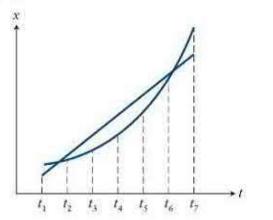
Figure P2.29 shows position as a function of time for two cars traveling along the same highway. (a) At what instant(s) are the cars next to each other? (b) At what instant(s) are they traveling at the same speed?Data from Figure P2.29 49 5 7994 1
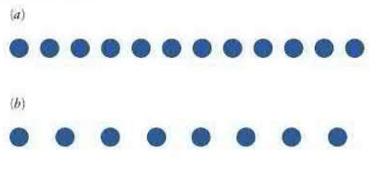
Figure \(\mathrm{P} 2. 30\) is based on two multiple-flash photographic sequences of a hockey puck sliding on ice. Sequence \(a\) was shot at 30 flashes per second, and sequence \(b\) was shot at 20 flashes per second. Compare the speeds of the puck in the two cases.Data from Figure P2.30 (b)
A cyclist takes \(10 \mathrm{~min}\) to ride from point \(A\) to point \(B\) and then another \(10 \mathrm{~min}\) to continue on from point \(B\) to point \(C\), all along a straight line. If you know that the average speed on the ride from \(A\) to \(B\) was faster than the average speed on the
In a road rally race, you are told to drive half the trip at \(25 \mathrm{~m} / \mathrm{s}\) and half the trip at \(35 \mathrm{~m} / \mathrm{s}\). It's not clear from the directions whether this means to drive half the time at each speed or drive half the distance at each speed. Which would yield
A bicycle racer rides from a starting marker to a turnaround marker at \(10.0 \mathrm{~m} / \mathrm{s}\). She then rides back along the same route from the turnaround marker to the starting marker at \(16.0 \mathrm{~m} / \mathrm{s}\).(a) What is her average speed for the whole race?(b) A friend of
You walk \(1.25 \mathrm{~km}\) from home to a restaurant in \(20 \mathrm{~min}\), stay there for \(1.0 \mathrm{~h}\), and then take another \(20 \mathrm{~min}\) to walk back home. (a) What is your average speed for the trip? (b) What is your average velocity?
You are going to visit your grandparents, who live \(500 \mathrm{~km}\) away. As you drive on the freeway, your speed is a constant \(100 \mathrm{~km} / \mathrm{h}\). Half an hour after you leave home, your brother discovers that you forgot your wallet. He jumps into his car and speeds after you.
You and your brother both leave your house at the same instant and drive in separate cars along a straight highway to a nearby lake. After \(10 \mathrm{~min}\), you are both \(3.0 \mathrm{~km}\) from your house. You are now driving at \(100 \mathrm{~km} / \mathrm{h}\), and you continue at this
You are standing on a sidewalk that runs east-west. Consider these instructions I might give you: (1) Walk 15 steps along the sidewalk and stop. (2) Walk 15 steps westward on the sidewalk and stop. Do my instructions unambiguously determine your final location in each case?
What is the \(x\) component of \((a)(+3 \mathrm{~m}) \hat{t},(b)(+3 \mathrm{~m} / \mathrm{s}) \hat{t}\), and \((c)(-3 \mathrm{~m} / \mathrm{s}) \hat{\imath}\) ?
What is the magnitude of \((a)(+3 \mathrm{~m}) \hat{i},(b)(+3 \mathrm{~m} / \mathrm{s}) \hat{t}\), and \((c)(-3 \mathrm{~m} / \mathrm{s}) \hat{n}\) ?
Vectors \(\vec{A}\) and \(\vec{B}\) each have a magnitude of \(5 \mathrm{~m}\) and point to the left. Vector \(\vec{A}\) begins at the origin, while vector \(\vec{B}\) begins at a location \(8 \mathrm{~m}\) to the right of the origin. (a) If the positive \(x\) axis is pointed to the right, what is
Vector \(\vec{A}\) points to the right, as does the positive \(x\) axis. (a) Express this vector in unit vector notation. (b) Now flip \(\vec{A}\) to the opposite direction. Express it in unit vector notation. (c) Keep the vector in its new direction and flip the \(x\) axis so that the positive
Consider two vectors along the \(x\) axis, one with \(x\) component \(A_{x}=+3 \mathrm{~m}\) and the other with \(x\) component \(B_{x}=-5 \mathrm{~m}\). What are \((a) \vec{A}+\vec{B}\) and \((b) \vec{A}-\vec{B}\) ?
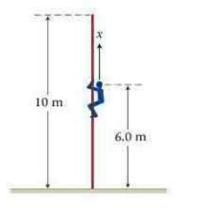
You stop to rest while climbing a vertical \(10-\mathrm{m}\) pole. With the origin at the level of your head and with the positive \(x\) direction upward, as shown in Figure P2.43, what are (a) the \(x\) coordinate of the pole's tip and (b) the tip's position vector?Data from Figure P2.43 10 m x
The height \(x\) above the ground of a vertically launched projectile is given by \(x(t)=p t-q t^{2}\), with \(p=42 \mathrm{~m} / \mathrm{s}\) and \(q=4.9 \mathrm{~m} / \mathrm{s}^{2}\). (a) At what instant is the projectile at a height of \(20 \mathrm{~m}\) ? (b) What is the meaning of the two
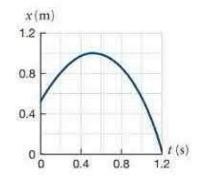
Figure \(\mathrm{P} 2. 45\) shows the \(x\) coordinate as a function of time for a moving object. What is the object's \(x\) coordinate \((a)\) at t=0, (b) t=0.20s, and (c) t=1.2s? What is the object's displacement \((d)\) between \(t=0\) and \(t=0.20 \mathrm{~s}\), (e) between \(t=0.20
Arrange three displacement vectors, of magnitudes \(2 \mathrm{~m}\), \(5 \mathrm{~m}\), and \(7 \mathrm{~m}\), so that their sum is \((a)(+10 \mathrm{~m}) \hat{\imath}\), (b) \((-4 \mathrm{~m}) \hat{i}\), and (c) 0.
The direction of vector \(\vec{A}\) is opposite the direction of the unit vector \(\hat{i}\). Vector \(\vec{B}\) has half the magnitude of \(\vec{A}\), and \(\vec{A}-\vec{B}\) is a vector of magnitude \(\frac{3}{2} A\). Express \(\vec{B}\) in terms of \(\vec{A}\).
You have to deliver some \(5.0 \mathrm{~kg}\) packages from your home to two locations. You drive for \(2.0 \mathrm{~h}\) at \(25 \mathrm{mi} / \mathrm{h}\) due east (call this segment 1 of your trip), then turn around and drive due west for \(30 \mathrm{~min}\) at \(20 \mathrm{mi} / \mathrm{h}\)
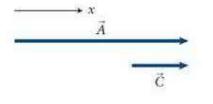
(a) In Figure P2.49, what vector must you add to \(\vec{A}\) to get \(\vec{C}\) ? (b) What vector must you subtract from \(\vec{A}\) to get \(\vec{C}\) ? Sketch your answers on a copy of the figure to confirm your results.Data from Figure P2.49 x A
You drive due east at \(40 \mathrm{~km} / \mathrm{h}\) for \(2.0 \mathrm{~h}\) and then stop. (a) What is your speed during the trip? (b) Is speed a scalar or a vector? (c) How far have you gone? Is distance a scalar or a vector? (d) Write a vector expression for your position after you stop (in
For the motion represented in Figure P2.45, calculate(a) the object's average velocity between \(t=0\) and \(t=1.2 \mathrm{~s}\), (b) its average speed during this same time interval.(c) Why is the answer to part \(a\) different from the answer to part \(b\) ?Data from Figure P2.45
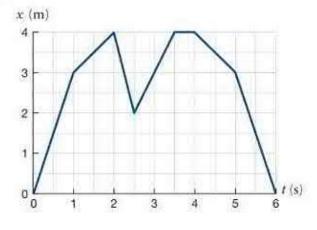
Figure \(\mathrm{P} 2. 52\) is the position-versus-time graph for a moving object. What is the object's average velocity(a) between \(t=0\) and \(t=1.0 \mathrm{~s},(b) between \(t=0\) and \(t=4.0 \mathrm{~s}\), and(c) between \(t=3.0 \mathrm{~s}\) and \(t=6.0 \mathrm{~s}\) ?(d) What is its average
You normally drive a 12 -h trip at an average speed of \(100 \mathrm{~km} / \mathrm{h}\). Today you are in a hurry. During the first two-thirds of the distance, you drive at \(108 \mathrm{~km} / \mathrm{h}\). If the trip still takes \(12 \mathrm{~h}\), what is your average speed in the last third
A cart starts at position \(x=-2.073 \mathrm{~m}\) and travels along the \(x\) axis with a constant \(x\) component of velocity of \(-4.02 \mathrm{~m} / \mathrm{s}\). What is the position of the cart after \(0.103 \mathrm{~s}\) ?
A bug on a windowsill walks at \(10 \mathrm{~mm} / \mathrm{s}\) from left to right for \(120 \mathrm{~mm}\), slows to \(6.0 \mathrm{~mm} / \mathrm{s}\) and conrinues rightward for another \(3.0 \mathrm{~s}\), stops for \(4.0 \mathrm{~s}\), and then walks back to its starting position at \(8.0
You and a friend work in buildings four equal-length blocks apart, and you plan to meet for lunch. Your friend strolls leisurely at \(1.2 \mathrm{~m} / \mathrm{s}\), while you like a brisker pace of \(1.6 \mathrm{~m} / \mathrm{s}\). Knowing this, you pick a restaurant between the two buildings at
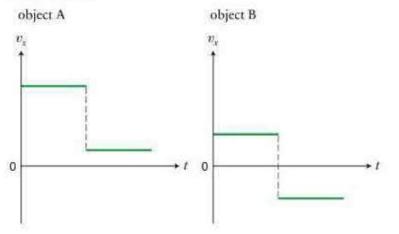
Figure P2.57 shows the velocity-versus-time graphs for objects \(\mathrm{A}\) and \(\mathrm{B}\) moving along an \(x\) axis. Which object has the greater displacement over the time interval shown in the graph?Data from Figure P2.57 object A 0 10 object B
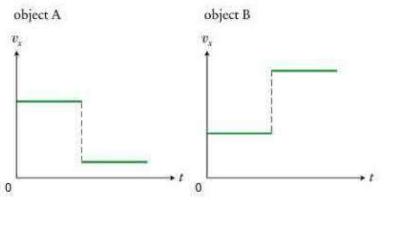
Figure P2.58 shows the \(x\) component of the velocity as a function of time for objects A and B. Which object has the greater displacement over the time interval shown in the graph?Data from Figure P2.58 object A object B 0 0
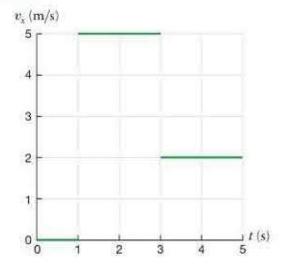
An object moving along an \(x\) axis starts out at \(x=-10 \mathrm{~m}\). Using its velocity-versus-time graph in Figure P2.59, draw a graph of the object's \(x\) coordinate as a function of time.Data from Figure P2.59 v, (m/s) 5 4 3 2 1 2 3 4 5 t(s)
You and a friend ride bicycles to school. Both of you start at the same instant from your house, you riding at \(10 \mathrm{~m} / \mathrm{s}\) and your friend riding at \(15 \mathrm{~m} / \mathrm{s}\). During the trip your friend has a flat tire that takes him \(12 \mathrm{~min}\) to fix. He then
You are going on a bicycle ride with a friend. You start \(3.0 \mathrm{~min}\) ahead of her from her carport, pedal at \(5.0 \mathrm{~m} / \mathrm{s}\) for \(10 \mathrm{~min}\), then stop and chat with a neighbor for \(5.0 \mathrm{~min}\). As you chat, your friend pedals by, oblivious to you. You
You and your roommate are moving to a city \(320 \mathrm{mi}\) away. Your roommate drives a rental truck at a constant \(60 \mathrm{mi} / \mathrm{h}\), and you drive your car at \(70 \mathrm{mi} / \mathrm{h}\). The two of you begin the trip at the same instant. An hour after leaving, you decide to
You are jogging eastward at an average speed of \(2.0 \mathrm{~m} / \mathrm{s}\). Once you are \(2.0 \mathrm{~km}\) from your home, you turn around and begin jogging westward, back to your house. At one point on your return trip, you look to the north and see a friend. You run northward at a
Which of these quantities depend on the choice of origin in a coordinate system: position, displacement, speed, average velocity, instantaneous velocity?
A dragster's position as a function of time is given by \(x(t)=b t^{3 / 2}\), where \(b=30.2 \mathrm{~m} / \mathrm{s}^{3 / 2}\). Calculate the \(x\) component of its velocity at \(1.0 \mathrm{~s}\) and at \(4.0 \mathrm{~s}\).
A mouse runs along a baseboard in your house. The mouse's position as a function of time is given by \(x(t)=p t^{2}+q t\), with \(p=0.40 \mathrm{~m} / \mathrm{s}^{2}\) and \(q=-1.20 \mathrm{~m} / \mathrm{s}\). Determine the mouse's average velocity and average speed \((a)\) between \(t=0\) and
Car A is spotted passing car B just east of Westerville at exactly 2:00 p.m. The same two cars are then spotted next to each other just west of Easterville at exactly 3:00 p.m. If car \(B\) had a constant velocity of \(30 \mathrm{~m} / \mathrm{s}\) eastward for the whole trip, defend the
The motion of an electron is given by \(x(t)=p t^{3}+q t^{2}+r\), with \(p=-2.0 \mathrm{~m} / \mathrm{s}^{3}, q=+1.0 \mathrm{~m} / \mathrm{s}^{2}\), and \(r=+9.0 \mathrm{~m}\). Determine its velocity at (a) \(t=0,\langle bangle t=1.0 \mathrm{~s}\), (c) \(t=2.0 \mathrm{~s}\), and \((d) t=3.0
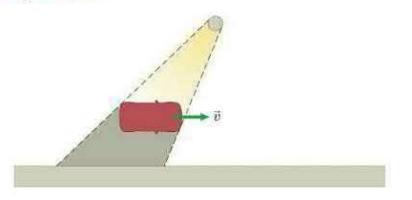
The car in Figure P2.69 passes a bright streetlight at constant speed, casting a shadow on a wall on the other side of the street. For simplicity, assume that car and light are at the same height. (a) Which is greater: the average speed of the car or the average speed of the shadow's leading edge?
The position of a \(6.0-\mathrm{kg}\) shopping cart rolling down a ramp is given by \(x(t)=p+q t^{2}\), with \(p=+1.50 \mathrm{~m}\) and \(q=+2.00 \mathrm{~m} / \mathrm{s}^{2}\). What is the \(x\) component of the cart's average velocity (a) between \(t=2.00 \mathrm{~s}\) and \(t=3.00
You leave Fort Worth, Texas, at 2:38 p.m. and arrive in Dallas at 3:23 p.m., covering a distance of \(58 \mathrm{~km}\). What is your average speed \((a)\) in meters per second and \((b)\) in miles per hour?
In a footrace between two runners, is it possible for the second-place finisher to have a greater speed at the finish line than the winner?
You wish to describe the position of the base of the pole in Figure P2,43 using the indicated coordinate system. What are \((a)\) the position coordinate of the base, \((b)\) the position vector of the base, and \((c)\) the magnitude of that vector?Data from Figure P2.43 10 m x 6.0 m
Runners \(P, Q\), and \(R\) run a \(5-\mathrm{km}\) race in 15,20 , and \(25 \mathrm{~min}\), respectively, each at a constant speed. When runner \(Q\) crosses the \(1-\mathrm{km}\) mark, what is the distance, to the nearest meter, between runners P and R? Assume that times and distances are
Runners \(\mathrm{A}, \mathrm{B}\), and \(\mathrm{C}\) run a \(100-\mathrm{m}\) race, each at a constant speed. Runner A takes first place, beating runner B by \(10 \mathrm{~m}\). Runner \(B\) takes second place, beating runner \(C\) by \(10 \mathrm{~m}\). By what time interval does runner \(A\)
At \(t=0\), car A passes a milepost at constant speed \(v_{A}\), Car B passes the same milepost at constant speed \(v_{\mathrm{B}}>v_{\mathrm{A}}\) after a time interval \(\Delta t\) has elapsed. (a) In terms of \(v_{\mathrm{A}}, v_{\mathrm{B}}\), and \(\Delta t\), at what instant does car B catch
You and your friend are running at a long racetrack. You pass the starting line while running at a constant \(4.0 \mathrm{~m} / \mathrm{s}\). Fifteen seconds later, your friend passes the starting line while running at \(6.0 \mathrm{~m} / \mathrm{s}\) in the same direction, and at the same instant
You drive an old car on a straight, level highway at \(45 \mathrm{mi} / \mathrm{h}\) for \(10 \mathrm{mi}\), and then the car stalls. You leave the car and, continuing in the direction in which you were driving, walk to a friend's house \(2.0 \mathrm{mi}\) away, arriving \(40 \mathrm{~min}\) after
A car's speed during the interval \(t=0.5 \mathrm{~s}\) to \(t=20 \mathrm{~s}\) is given by \(t=c \sqrt{t}\), where \(c\) is a constant. Over the interval \(t=10 \mathrm{~s}\) to \(t=20 \mathrm{~s}\), is the average speed greater than, equal to, or less than the instantaneous speed (a) at \(t=15
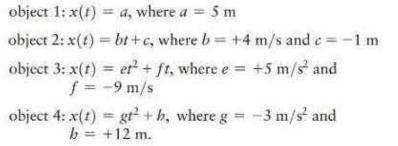
The following equations give the \(x\) component of the position for four objects as functions of time:(a) Which objects have a velocity that changes with time? (b) Which object is at the origin at the earliest instant, and what is that instant? (c) What is that object's velocity \(1 \mathrm{~s}\)
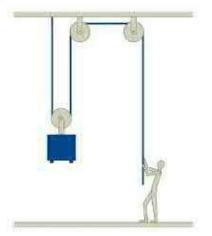
A furniture mover is lifting a small safe by pulling on a rope threaded through the pulley system shown in Figure P2.81. (a) What is the ratio of the vertical distance the safe moves to the length of the rope pulled by the mover? (b) What is the ratio of the speed of the safe to the speed of the
Two steamrollers begin \(100 \mathrm{~m}\) apart and head toward each other, each at a constant speed of \(1.00 \mathrm{~m} / \mathrm{s}\). At the same instant, a fly that travels at a constant speed of \(2.20 \mathrm{~m} / \mathrm{s}\) starts from the front roller of the southbound steamroller and
Consider a \(2.0-\mathrm{kg}\) object that moves along the \(x\) axis according to the expression \(x(t)=c t^{3}\), where \(c=+0.120 \mathrm{~m} / \mathrm{s}^{3}\). (a) Determine the \(x\) component of the object's average velocity during the interval from \(t_{\mathrm{i}}=0.500 \mathrm{~s}\) to
The position of a yo-yo as a function of time is given by \(x(t)=A \cos (p t+q)\), where \(A=0.60 \mathrm{~m}, p=\frac{1}{2} \pi \mathrm{s}^{-1}\), and \(q=\frac{1}{2} \pi\). (a) Plot this function at 17 equally spaced instants from \(t=0\) to \(t=8.0 \mathrm{~s}\). (b) At what instants is the
Zeno, a Greek philosopher and mathematician, was famous for his paradoxes, one of which can be paraphrased as follows: A runner has a race of length \(d\) to run. After an elapsed time interval \(\Delta t\) after the start, he is a distance \(\frac{1}{2} d\) from the finish line. After an
Four traffic lights on a stretch of road are spaced \(300 \mathrm{~m}\) apart. There is a 10-s lag time between successive green lights: The second light turns green \(10 \mathrm{~s}\) after the first light turns green, the third light turns green \(10 \mathrm{~s}\) after the second light does (and
Hare and Tortoise of Aesop's fable fame are having a rematch, a mile-long race. Hare has planned more carefully this time. Five minutes into the race, he figures he can take a \(40-\mathrm{min}\) nap and still win easily because it takes him only \(10 \mathrm{~min}\) to cover \(1 \mathrm{mi}\) and
Two runners are in a \(100-\mathrm{m}\) race. Runner \(\mathrm{A}\) can run this distance in \(12.0 \mathrm{~s}\), but runner B takes \(13.5 \mathrm{~s}\) on a good day. To make the race interesting, runner \(A\) starts behind the starting line. If she wants the race to end in a tie, how far behind
You are on planet Dither, whose inhabitants often change their minds on how to choose a reference axis. At time \(t=0\), while standing \(2.0 \mathrm{~m}\) to the left of the origin of a reference axis for which the positive \(x\) direction points to the left, you launch a toy car that moves with
Your dream job as a 12-ycar-old was to sit at a computer at NASA mission control and guide the motion of the Mars rover across the Martian surface \(2.0 \times 10^{8} \mathrm{~km}\) away. Communication signals to steer the rover travel at the speed of light between Earth and Mars, and the rover's
You are a driver for Ace Mining Company. The boss insists that, every hour on the hour, a loaded truck leaves the mine at \(90.0 \mathrm{~km} / \mathrm{h}\), carrying ore to a mill \(630 \mathrm{~km}\) away. She also insists that an empty truck traveling at \(105 \mathrm{~km} / \mathrm{h}\) leaves
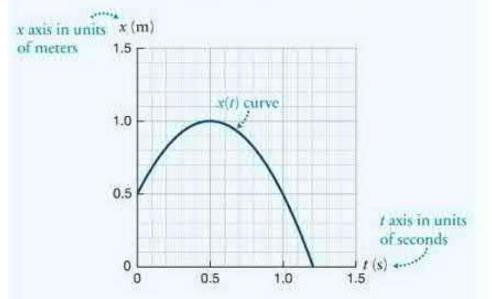
The curve in Figure 2.8 is a graphical representation of the motion of a certain object. (a) What was the \(x\) coordinate of the object at \(t=0.50 \mathrm{~s}\) ? (b) At what instant(s) did the object reach \(x=+0.80 \mathrm{~m}\) ? (c) What distance did the object travel between \(t=0.80
The curve in Figure 2.8 can be mathematically represented by the function \(x(t)=a+b t+c t^{2}\), where \(a=0.50 \mathrm{~m}\), \(b=+2.0 \mathrm{~m} / \mathrm{s}\), and \(c=-2.0 \mathrm{~m} / \mathrm{s}^{2}\). Use this function to answer the four questions in Example 2.1.Data from Figure 2.8Data
With about \(20 \mathrm{~min}\) to spare, you walk leisurely from your dorm to class, which is \(1.0 \mathrm{~km}\) away. Halfway there, you realize you have forgotten your notebook and run back to your dorm. You walked \(6.0 \mathrm{~min}\) before turning around, and you travel three times as far
(a) Is the statement Yesterday the car was parked \(3 \mathrm{~m}\) from the telephone pole sufficient to determine the position of the car? Is position a scalar or a vector? (b) Is the statement New York is 200 miles from Boston sufficient to determine the distance between the two cities? Is
(a) An object moves from an initial position at \(x_{\mathrm{i}}=+3.1 \mathrm{~m}\) to a final position at \(x_{f}=+1.4 \mathrm{~m}\). What is the \(x\) component of the object's displacement? (b) The \(x\) component of an object's displacement is \(+2.3 \mathrm{~m}\). If the object's initial
An object moves from point \(\mathrm{P}\) at \(x=+2.3 \mathrm{~m}\) to point \(\mathrm{Q}\) at \(x=+4.1 \mathrm{~m}\) and then to point \(\mathrm{R}\) at \(x=+1.5 \mathrm{~m}\). (a) What is the \(x\) component of the object's displacement after traveling from \(\mathrm{P}\) to \(\mathrm{R}\) ? (b)
Showing 4500 - 4600
of 4962
First
36
37
38
39
40
41
42
43
44
45
46
47
48
49
50
Step by Step Answers

 Get 50% OFF
Claim Now
Get 50% OFF
Claim Now