New Semester
Started
Get
50% OFF
Study Help!
--h --m --s
Claim Now
Question Answers
Textbooks
Find textbooks, questions and answers
Oops, something went wrong!
Change your search query and then try again
S
Books
FREE
Study Help
Expert Questions
Accounting
General Management
Mathematics
Finance
Organizational Behaviour
Law
Physics
Operating System
Management Leadership
Sociology
Programming
Marketing
Database
Computer Network
Economics
Textbooks Solutions
Accounting
Managerial Accounting
Management Leadership
Cost Accounting
Statistics
Business Law
Corporate Finance
Finance
Economics
Auditing
Tutors
Online Tutors
Find a Tutor
Hire a Tutor
Become a Tutor
AI Tutor
AI Study Planner
NEW
Sell Books
Search
Search
Sign In
Register
study help
physics
particle physics
Principles And Practice Of Physics 2nd Edition Eric Mazur - Solutions
Suppose the \(x\) coordinate of the position of an object moving along the \(x\) axis varies in time according to the expression \(x(t)=c t^{3}\), where \(c\) is a constant. Derive an expression for the \(x\) component of the velocity as a function of time.
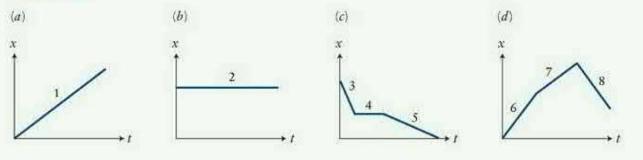
Describe the motion represented by each graph in Figure 2. 14.Data from Figure 2. 14 (a) (b) 2 (c) (d) LELL
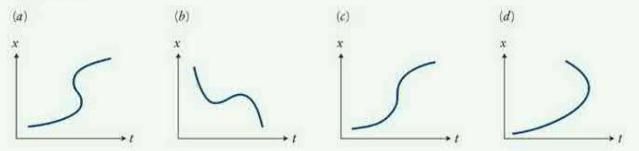
One or more of the graphs in Figure \(\mathbf{2} .15\) represent an impossible motion. Identify which ones and explain why the motion is not possible.Data from Figure 2. 15 (b) (c) (d)
Two cars start from some point P, drive \(10 \mathrm{~km}\) to a point \(Q\), and then return to \(\mathrm{P}\). Car 1 completes the trip in \(10 \mathrm{~min}\); car 2 takes \(11 \mathrm{~min}\). For each car, what are \((a)\) the \(x\) component of the average velocity and \((b)\) the average
Suppose you travel \(10 \mathrm{~km}\) from \(\mathrm{P}\) to \(\mathrm{Q}\) at \(10 \mathrm{~km} / \mathrm{h}\) and another \(10 \mathrm{~km}\) from \(\mathrm{Q}\) to \(\mathrm{R}\) at \(20 \mathrm{~km} / \mathrm{h}\). What is your average speed during the entire trip from \(\mathrm{P}\) to
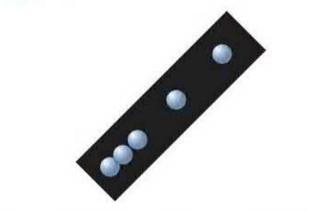
Figure \(P 3. 1\) is based on a multiple-flash photographic sequence of an object moving from left to right on a track, as seen from above. The time intervals between successive flashes are all the same. During which portion(s) of the motion is the object(a) speeding up and(b) slowing down? Explain
A car is traveling north. What are the direction of its acceleration and the direction of its velocity \((a)\) if it is speeding up and \((b)\) if it is slowing down?
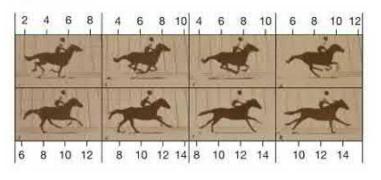
Figure P3.3 shows a series of photographs of a racehorse taken in 1877 by Eadweard Muybridge (1830-1904). Muybridge used multiple, equally spaced cameras triggered sequentially at equal time intervals. Is the horse accelerating? How can you tell?Data from Figure P3.3 2 4 6 8 4 6 8 10 4 6 8 10 6 8
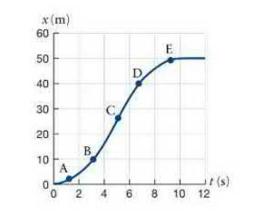
Figure P3.4 shows a graph of position as a function of time for an object moving along a horizontal surface. At which of the labeled points is the object speeding up?Data from Figure P3.4 x (m) 60 50 40 30 20 10 0 T D E B A 0 2 4 6 8 10 12 t(s)
While you are driving on a highway, a friend in another car passes you at a steady speed. You accelerate at a constant rate to catch up. When you do catch up, are your two cars going the same speed? Use a graph to support your answer.
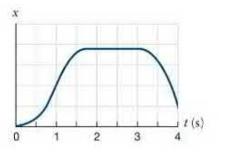
The position of a person pacing in a hall is given by the \(x(t)\) curve in Figure P3.6. During which time interval(s) is the acceleration (a) positive(b) negative?(c) Is the acceleration ever zero during the 4-s interval shown?Data from Figure P3.6 0 1 2 3 2 (5)
You enter an elevator on the ground (first) floor and ride it to the 19 th floor. Describe your acceleration at the different stages of this trip.
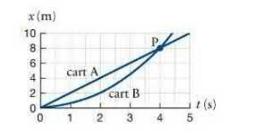
Figure P3.8 shows the position curves for two carts, A and \(\mathrm{B}\), moving on parallel tracks along a horizontal surface. The instant when the two carts are at the same distance from their starting point is indicated by point \(P\). Which cart has the greater acceleration at that
Two cars are headed south on the highway at different speeds. Starting when the faster car pulls alongside the slower car, one of the cars accelerates northward for \(5.0 \mathrm{~s}\) and the other accelerates sourhward for \(5.0 \mathrm{~s}\). At the end of that 5. 0 -s interval, the two cars
Is it true that a pebble released from rest off a bridge falls \(9.8 \mathrm{~m}\) in the first second of its fall?
(a) What is the average speed, over the first \(1.0 \mathrm{~s}\) of its motion, of a pebble released from rest off a bridge? (b) What is the pebble's average speed over the second \(1.0 \mathrm{~s}\) of its motion? (c) What is its average speed during these first \(2.0 \mathrm{~s}\) of its motion?
You toss a (wrapped) sandwich to a friend leaning out of a window \(10 \mathrm{~m}\) above you, throwing just hard enough for it to reach her. At the same instant, she drops a silver dollar to you. Do the dollar and the sandwich pass each other at a position \(5 \mathrm{~m}\) above you, more than
Suppose that the acceleration due to gravity near Earth's surface was cut in half (to about \(5 \mathrm{~m} / \mathrm{s}^{2}\) ). How would this affect the graphs shown in Figure 3. 6, assuming that everything else about the experiment remains the same? Sketch the new curves.Data from Figure 3. 6
A photographer shows you a multiple-flash photographic sequence of a ball traveling vertically (Figure P3.14). (a) If the ball is traveling downward, what is the correct orientation of the picture? (b) If the ball is traveling upward, what is the correct orientation of the picture? (c) According to
A cannonball is shot straight up at an initial speed of \(98 \mathrm{~m} / \mathrm{s}\). What are its velocity and its speed after(a) 5.0 s,(b) 10 s,(c) 15 s, and(d) 20 s?
A coin flipped in the air from elbow height lands on the ground \(1.8 \mathrm{~s}\) later. Did the coin reach its highest position \(0.9 \mathrm{~s}\) after it started moving up, earlier than that, or later than that?
Is it possible for an object to have \((a)\) zero velocity and nonzero acceleration or \((b)\) nonzero velocity and zero acceleration? If you answer yes in either part, give examples to support your answer.
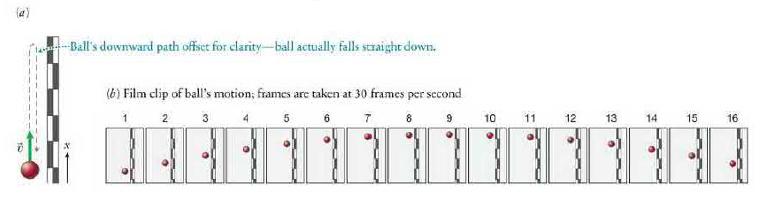
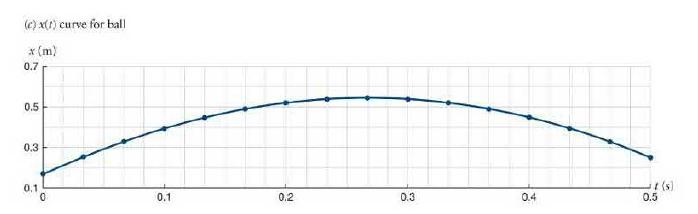
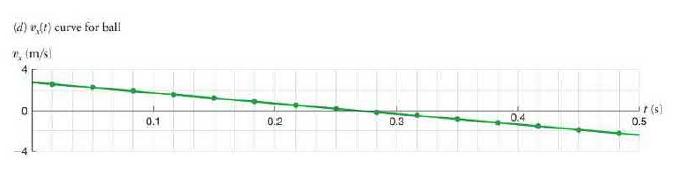
How would graphs \(c\) and \(d\) in Figure 3. 8 be different if the same experiment was conducted on the surface of the Moon, where the acceleration due to gravity is six times less than it is on Earth?Data from Figure 3. 8 Ball's downward path offset for clarity-ball actually falls straight down.
You throw snowballs down to the sidewalk from the roof of a building. Which technique, if either, makes the snowballs land with more speed: throwing them straight down as hard as you can or throwing them straight up just as hard? (Ignore air resistance.)
You are standing by a window and see a ball, thrown from below, moving up past the window. The ball is visible for a time interval \(\Delta t_{\text {up. }}\). On its way back down the ball passes the window again, remaining visible for a time interval \(\Delta t_{\text {down }}\). Neglecting the
For an object in free fall, the curve of its velocity as a function of time is a straight line. How would this curve be different when air resistance (which changes with speed) is not negligible?
When air resistance is ignored, it is straightforward to calculate the travel time interval for a Ping-Pong ball tossed up into the air and caught on its way down because the acceleration can be taken to be a constant \(9.8 \mathrm{~m} / \mathrm{s}^{2}\) downward. However, a more accurate result is
Draw a motion diagram for a car that starts from rest and accelerates at \(4.0 \mathrm{~m} / \mathrm{s}^{2}\) for \(10 \mathrm{~s}\).
A car accelerating from rest at constant acceleration reaches a speed of \(30 \mathrm{~km} / \mathrm{h}\) in \(5.0 \mathrm{~s}\). Draw a motion diagram for the car.
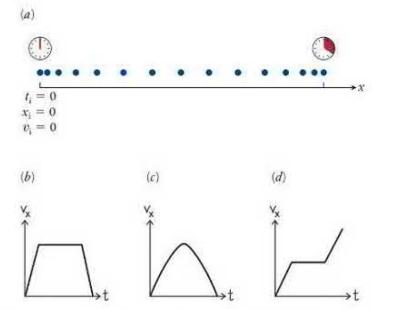
The motion of a cart moving along a horizontal surface is described by the motion diagram shown in Figure P3.25a. The position of the cart is measured every \(0.5 \mathrm{~s}\). Asked to suggest a qualitative graph of velocity versus time that would correspond to this motion, three of your
Draw a motion diagram for a car that starts from rest and accelerates at \(5.0 \mathrm{~m} / \mathrm{s}^{2}\) for \(6.0 \mathrm{~s}\), then travels with constant speed for \(10 \mathrm{~s}\), and then slows to a stop with constant acceleration in \(4.0 \mathrm{~s}\).
A ball you throw straight up has a speed of \(30 \mathrm{~m} / \mathrm{s}\) when it leaves your hand. Draw a motion diagram for the ball up to the instant at which it has a speed of \(30 \mathrm{~m} / \mathrm{s}\) again. Indicate the instant at which the ball reaches its highest position.
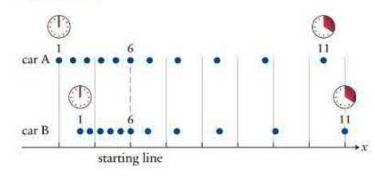
Figure \(\mathrm{P} 3. 28\) shows motion diagrams for two cars, \(\mathrm{A}\) and \(\mathrm{B}\), beginning a race. The diagrams show the position of each car at instants separated by equal time intervals. Both cars drive up to the starting line and then begin to accelerate. (a) Which car has the
You start your car from rest and accelerate at a constant rate along a straight path. Your speed is \(20 \mathrm{~m} / \mathrm{s}\) after \(1.0 \mathrm{~min}\). (a) What is your acceleration? (b) How far do you travel during that \(1.0 \mathrm{~min}\) ?
You and your little brother are rolling toy cars back and forth to each other across the floor. He is sitting at \(x=0\), and you are at \(x=4.0 \mathrm{~m}\). You roll a car toward him, giving it an initial specd of \(2.5 \mathrm{~m} / \mathrm{s}\). It stops just as it reaches him in \(3.0
An electron is accelerated from rest to \(3.0 \times 10^{6} \mathrm{~m} / \mathrm{s}\) in \(5.0 \times 10^{-8} \mathrm{~s}\).(a) What distance does the electron travel in this time interval? (b) What is its average acceleration?
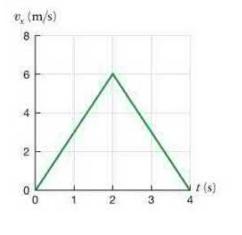
Figure P3.32 shows a graph of velocity as a function of time for a cart moving along a horizontal surface. When asked to describe the motion that resulted in this graph, a student states, "The cart first moved forward with a constant speed, reached a maximum distance at time 2 seconds, then turned
(a) How do you determine an object's displacement from a velocity-versus-time graph? (b) What distance does a car travel as its speed changes from 0 to \(20 \mathrm{~m} / \mathrm{s}\) in \(10 \mathrm{~s}\) at constant acceleration? (c) The \(x\) component of the average velocity of a particle
On a freeway entrance ramp, you accelerate your \(1200-\mathrm{kg}\) car from \(5 \mathrm{~m} / \mathrm{s}\) to \(20 \mathrm{~m} / \mathrm{s}\) over \(500 \mathrm{~m}\). Having an open lane, you continue to accelerate at the same (constant) rate for another \(500 \mathrm{~m}\). Is your final speed
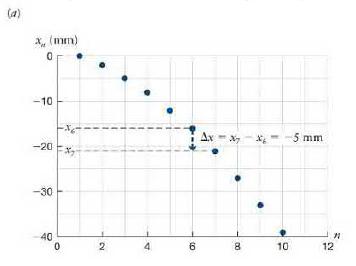
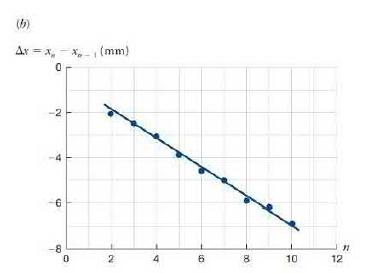
In an introductory physics laboratory, a student drops a steel ball of radius \(15 \mathrm{~mm}\), and a device records its position as a function of time. The clock on the device is set so that \(t=0\) at the instant the ball is dropped. What is the ball's displacement \((a)\) between \(0.15
Which car has the greater acceleration magnitude: one that accelerates from 0 to \(10 \mathrm{~m} / \mathrm{s}\) in \(50 \mathrm{~m}\) or one that accelerates from \(10 \mathrm{~m} / \mathrm{s}\) to \(20 \mathrm{~m} / \mathrm{s}\) in \(50 \mathrm{~m}\) ?
An electron in an old-fashioned television picture tube is accelerated, at a constant rate, from \(2.0 \times 10^{5} \mathrm{~m} / \mathrm{s}\) to \(1.0 \times 10^{7} \mathrm{~m} / \mathrm{s}\) in a 12 -mm-long "electron gun." (a) What is the acceleration of the electron? (b) What time interval is
In a car moving at constant acceleration, you travel \(250 \mathrm{~m}\) between the instants at which the speedometer reads \(40 \mathrm{~km} / \mathrm{h}\) and \(60 \mathrm{~km} / \mathrm{h}\). (a) How many seconds does it take you to travel the \(250 \mathrm{~m}\) ? (b) What is your acceleration?
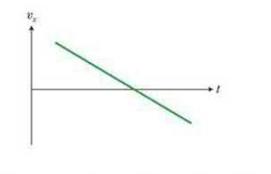
Based on the \(v(t)\) curve in Figure P3.39, explain whether each of these statements is necessarily true for the time interval shown: (a) The acceleration is constant. (b) The object passes through the position \(x=0\). (c) The object has zero velocity at some instant. (d) The object is always
In October 1997, Andy Green broke the sound barrier on land in a jet-powered car traveling at \(763 \mathrm{mi} / \mathrm{h}\) over a \(1.0-\mathrm{mi}\) course. As it arrived at the beginning of this measured mile, Green's car had accelerated from rest to \(763 \mathrm{mi} / \mathrm{h}\) over a
You jump on your bicycle, ride at a constant acceleration of \(0.60 \mathrm{~m} / \mathrm{s}^{2}\) for \(20 \mathrm{~s}\), and then continue riding at a constant velocity for \(200 \mathrm{~m}\). You then slow to a stop with a constant acceleration over \(10 \mathrm{~m}\). (a) What distance do you
In rush-hour traffic, the car in front of you suddenly puts on the brakes. You apply your brakes \(0.50 \mathrm{~s}\) later. The accelerations of the two cars are the same. Does the distance between the two cars remain constant, decrease, or increase?
Two cars are moving at \(97 \mathrm{~km} / \mathrm{h}\), one behind the other, on a rural road. A deer jumps in front of the lead car, and its driver slams on the brakes and stops. What minimum initial distance between the rear of the lead car and the front of the second car is required if the
As a physics instructor hurries to the bus stop, her bus passes her, stops ahead, and begins loading passengers. She runs at \(6.0 \mathrm{~m} / \mathrm{s}\) to catch the bus, but the door closes when she's still \(8.0 \mathrm{~m}\) behind the door, and the bus leaves the stop at a constant
The day after the incident described in Problem 44, the instructor finds herself in the same situation. This time, she tries a harder physics exercise. She keeps running at a constant \(6.0 \mathrm{~m} / \mathrm{s}\) after drawing even with the bus door and pulls ahead for a while, but the
(a) How many seconds does it take a pebble released from rest off a bridge to fall \(9.8 \mathrm{~m}\) ? (b) What is the pebble's speed when it has fallen \(9.8 \mathrm{~m}\) ?
Calculated using the value \(g=9.8 \mathrm{~m} / \mathrm{s}^{2}\), the time interval required for an object released from rest at some arbitrary point \(\mathrm{A}\) above the ground to reach the ground is \(\Delta t\). If \(g\) were \(4.9 \mathrm{~m} / \mathrm{s}^{2}\), by what factor would
A mortar-style fireworks shell is launched upward at \(35 \mathrm{~m} / \mathrm{s}\). Draw a motion diagram showing the position of the shell and its velocity vector at \(t=0,1 \mathrm{~s}, 2 \mathrm{~s}, 3 \mathrm{~s}\), and \(4 \mathrm{~s}\), and draw a graph of x(t) .
The distance a ball thrown upward and released at \(t=0\) travels between \(t=3.0 \mathrm{~s}\) and \(t=4.0 \mathrm{~s}\) is the same as the distance the ball travels between \(t=2.0 \mathrm{~s}\) and \(t=3.0 \mathrm{~s}\). How is this possible?
You toss a ball straight up, and it reaches a maximum height \(b\) above the launch position. If you want to double the length of the time interval during which the ball stays in the air above the launch position, to what maximum height do you have to throw it?
(a) With what minimum speed must a ball be thrown straight up in order to reach a height of \(25 \mathrm{~m}\) above the launch position? (b) How many seconds does the ball take to reach this height?
A snowshoer falls off a ridge into a snow bank \(3.6 \mathrm{~m}\) below and penetrates \(0.80 \mathrm{~m}\) into the snow before stopping. What is her average acceleration in the snow bank?
You are on the second floor of a building under construction, laying bricks of dimensions \(63 \mathrm{~mm} \times 89 \mathrm{~mm} \times 170 \mathrm{~mm}\). At your command, a coworker below tosses bricks up to you, and you catch them when they have risen \(5.0 \mathrm{~m}\) above the launch
A rocket ignited on the ground travels vertically upward with an acceleration of magnitude \(4 \mathrm{~g}\). A spent rocket stage detaches from the payload after the rocket has accelerated for \(5.0 \mathrm{~s}\). With what speed does the spent stage hit the ground?
Show that the distances traveled by a falling rock in successive 1-s intervals after release are in the ratio \(1: 3: 5: 7 \ldots\).
A hot-air balloon takes off from the ground traveling vertically with a constant upward acceleration of magnitude \(g / 4\). After time interval \(\Delta t\), a crew member releases a ballast sandbag from the basket attached to the balloon. How many seconds does it take the sandbag to reach the
A rock dropped from the top of a building takes \(0.50 \mathrm{~s}\) to fall the last \(50 \%\) of the distance from the top to the ground. How tall is the building?
A hot-air balloon of diameter \(10 \mathrm{~m}\) rises vertically at a constant speed of \(12 \mathrm{~m} / \mathrm{s}\). A passenger accidentally drops his camera from the railing of the basket when it is \(18 \mathrm{~m}\) above the ground. If the balloon continues to rise at the same speed, how
A ball tossed vertically upward from the ground next to a building passes the bottom of a window \(1.8 \mathrm{~s}\) after being tossed and passes the top of the window \(0.20 \mathrm{~s}\) later. The window is \(2.0 \mathrm{~m}\) high from top to bottom. (a) What was the ball's initial velocity?
What is the magnitude of the acceleration of a \(65-\mathrm{kg}\) skier moving down a hill that makes a \(45^{\circ}\) angle with the horizontal? Ignore friction.
Starting from rest, a cart takes \(1.25 \mathrm{~s}\) to slide \(1.80 \mathrm{~m}\) down an inclined low-friction track. What is the angle of incline of the track with respect to the horizontal?
Imagine that in his experiment with balls rolling down an inclined plane, Galileo had considered balls that were given an initial speed. Would he have reached different conclusions about the ratio of distance and square of time?
A worker releases boxes at the top of a ramp. From the bottom of the ramp the boxes slide \(10 \mathrm{~m}\) across the floor to a barrier wall. If the ramp is at an elevation angle of \(20^{\circ}\), how long must the ramp be if the boxes are to reach the wall \(2.0 \mathrm{~s}\) after leaving the
A man steps outside one winter day to go to work. His icy driveway is \(8.0 \mathrm{~m}\) long from top to mailbox, and it slopes downward at \(20^{\circ}\) from the horizontal. He sets his briefcase on the ice at the top while opening the garage, and the briefcase slides down the driveway. Ignore
You and a friend ride what are billed as the "world's longest slides" at a county fair. Your slide is \(100 \mathrm{~m}\) long, and your trip takes \(10 \mathrm{~s}\), including any effect of friction. Your friend chooses a taller, \(150-\mathrm{m}\)-long slide made from the same material as yours
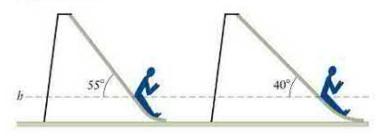
Two children at a playground slide from rest down slides that are of equal height but are inclined at different angles with respect to the horizontal (Figure P3.66). Ignoring friction, at height \(h\) above the ground, which child has (a) the greater acceleration and (b) the higher speed?Data from
You are playing air hockey with a friend. The puck is sitting at rest in his goal when he suddenly lifts his end of the table by \(0.50 \mathrm{~m}\). The puck slides down the tilted surface into your goal, \(2.4 \mathrm{~m}\) away. Ignore friction. (a) How many seconds does it take the puck to
A block has an initial speed of \(6.0 \mathrm{~m} / \mathrm{s}\) up an inclined plane that makes an angle of \(37^{\circ}\) with the horizontal. Ignoring friction, what is the block's speed after it has traveled \(2.0 \mathrm{~m}\) ?
A box is at the lower end of a very slippery ramp of length \(\ell\) that makes a nonzero angle \(\theta\) with the horizontal. A worker wants to give the box a quick shove so that it reaches the top of the ramp.(a) How fast must the box be going after the shove for it to reach its goal? (Ignore
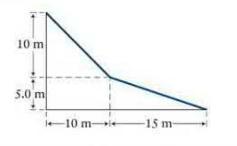
A skier is at the top of a run that consists of two slopes having different inclines (Figure P3.70). The skier lets go, beginning the run with essentially zero speed. Ignoring friction, what are (a) his speed at the end of the lower slope and \((b)\) his average acceleration over the entire
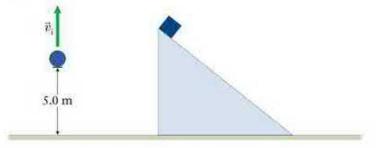
A ball is projected vertically upward from an initial position \(5.0 \mathrm{~m}\) above the ground (Figure P3.71). At the same instant, a cube is released from rest down an ice-covered incline, from a height not necessarily equal to \(5.0 \mathrm{~m}\). The two objects reach the ground at the same
You hold a puck at the top of an ice-covered ramp inclined at \(60^{\circ}\) with respect to the vertical. Your friend stands nearby on level ground and holds a ball at the same height \(h\) above ground as the puck. If the puck and the ball are released from rest at the same instant, what is the
A child on a sled slides down an icy slope, starting at a speed of \(2.5 \mathrm{~m} / \mathrm{s}\). The slope makes a \(15^{\circ}\) angle with the horizontal. After sliding \(10 \mathrm{~m}\) down the slope, the child enters a flat, slushy region, in which she slides for \(2.0 \mathrm{~s}\) with
You throw a ball straight up with an initial speed of \(10 \mathrm{~m} / \mathrm{s}\).(a) What is the ball's instantaneous acceleration at instant \(t_{1}\), just after it leaves your hand; at instant \(t_{2}\), the top of its trajectory; and at instant \(t_{3}\), just before it hits the ground?
A particle is accelerated such that its position as a function of time is given by \(\vec{x}=b t^{3} \hat{t}\), with \(b=1.0 \mathrm{~m} / \mathrm{s}^{3}\). What is the particle's acceleration as a function of time?
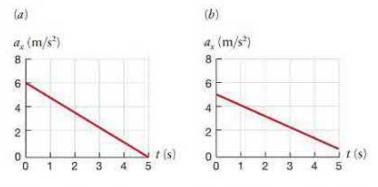
Figure P3.76 shows graphs of the \(x\) component of acceleration as a function of time for two different carts rolling along a flat horizontal table. In which case is the change in the \(x\) component of velocity greater over the time interval shown?Data from Figure P3.76 (a) a (m/s) 8 (b) 4, (m/s)
The position of a cart on a low-friction track can be represented by the equation \(x(t)=b+c t+e t^{2}\), where \(b=4.00 \mathrm{~m}, c=6.00 \mathrm{~m} / \mathrm{s}\), and \(e=0.200 \mathrm{~m} / \mathrm{s}^{2}\). (a) Is the cart accelerating? If so, is the acceleration constant? (b) What is the
A particle moves in the \(x\) direction according to the equation \(x(t)=b t^{3}+c t^{2}+d\), where \(b=4.0 \mathrm{~m} / \mathrm{s}^{3}\), \(c=-10 \mathrm{~m} / \mathrm{s}^{2}\), and \(d=20 \mathrm{~m}\). (a) What are its instantaneous velocity and instantaneous acceleration at \(t=2.0 \mathrm{~s}
A rocket's \(x\) component of acceleration is given by \(a_{x}=b t\), where \(b=1.00 \mathrm{~m} / \mathrm{s}^{3}\). The rocket begins accelerating from rest at \(t=0\).(a) What is its \(x\) component of acceleration at \(t=10.0 \mathrm{~s}\) ?(b) What is its \(x\) component of velocity at \(t=10.0
The acceleration of a particular car during braking has magnitude \(b t\), where \(t\) is the time in seconds from the instant the car begins braking, and \(b=2.0 \mathrm{~m} / \mathrm{s}^{3}\). If the car has an initial speed of \(50 \mathrm{~m} / \mathrm{s}\), how far does it travel before it
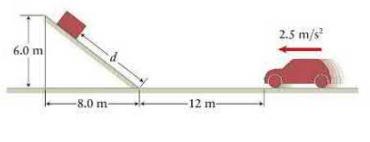
A car is \(12 \mathrm{~m}\) from the bottom of a ramp that is \(8.0 \mathrm{~m}\) long at its base and \(6.0 \mathrm{~m}\) high (Figure P3.81). The car moves from rest toward the ramp with an acceleration ofData from Figure P3.81magnitude \(2.5 \mathrm{~m} / \mathrm{s}^{2}\). At some instant after
In a laboratory experiment, a sphere of diameter \(8.0 \mathrm{~mm}\) is released from rest at \(t=0\) at the surface of honey in a jar, and the sphere's downward speed \(v\) when it travels in the honey is found to be given by \(v=v_{\max }\left(1-e^{-t / \tau}\right)\), where \(v_{\max }=0.040
A video recording of a moving object shows the object moving up and down with a velocity given by \(v_{x}(t)=\) \(v_{\max } \cos (\omega t)\), where \(v_{\max }=1.20 \mathrm{~m} / \mathrm{s}\) and \(\omega=0.15 \mathrm{~s}^{-1}\) and where the positive \(x\) direction is upward. (a) Derive an
The motion of a particle in the \(x\) direction can be described by the equation \(x(t)=b t^{2}+c t+d\), where \(b=0.35 \mathrm{~m} / \mathrm{s}^{2}, c=6.0 \mathrm{~m} / \mathrm{s}\), and \(d=30 \mathrm{~m}\). (a) What is the particle's acceleration at \(t=10 \mathrm{~s}\) ? (b) What is its
It takes you \(7.0 \mathrm{~m}\) to brake to a panic stop from a speed of \(9.0 \mathrm{~m} / \mathrm{s}\). Using the same acceleration, how far do you go as you brake to a panic stop from a speed of \(27 \mathrm{~m} / \mathrm{s}\) ?
A person standing on a building ledge throws a ball vertically from a launch position \(45 \mathrm{~m}\) above the ground. If it takes \(2.0 \mathrm{~s}\) for the ball to hit the ground, \((a)\) with what initial speed was the ball thrown and \((b)\) in which direction was it thrown?
A bullet fired straight through a board \(0.10 \mathrm{~m}\) thick strikes the board with a speed of \(480 \mathrm{~m} / \mathrm{s}\), has constant acceleration through the board, and emerges with a speed of \(320 \mathrm{~m} / \mathrm{s}\). (a) What is the component of the acceleration in the
During a blackout, you are trapped in a tall building. You want to call rescuers on your cell phone, but you can't remember which floor you're on. You pry open the doors to the elevator shaft, drop your keys down the shaft, and hear them hit bottom at ground level \(3.27 \mathrm{~s}\) later. (a)
Starting from rest, a motorcycle moves with constant acceleration along a highway entrance ramp \(0.22 \mathrm{~km}\) long. The motorcycle enters the traffic stream on the highway \(14.0 \mathrm{~s}\) later at \(31.0 \mathrm{~m} / \mathrm{s}\). (a) What is the magnitude of the acceleration along
Hold a dollar bill with its short sides parallel to the floor, and have a friend hold the thumb and forefinger of one hand on either side of the bottom edge, with the thumb and finger about \(20 \mathrm{~mm}\) apart. Offer your friend the following deal: He can keep the dollar if he can catch it
A mortar-style fireworks shell, launched vertically, must be detonated at a height of \(100 \mathrm{~m}\). (a) If the shell is to detonate at the top of its trajectory, what must its launch speed be? (b) For how many seconds must the detonation fuse burn if it is lit at the instant of launch?
A rock dropped from the top of a building travels \(30 \mathrm{~m}\) in the last second before it hits the ground. How high is the building?
A ball launched directly upward from the ground at an initial speed of \(24.5 \mathrm{~m} / \mathrm{s}\) hits the ground \(5.0 \mathrm{~s}\) later. What are(a) the ball's upward position 1. 0, 2. 0, 3. 0, and \(4.0 \mathrm{~s}\) after launch; \((b)\) its upward velocity \(1.0,2.0,3.0\) and \(4.0
After landing on Mars, you drop a marker from the door of your landing module and observe that it takes \(2.1 \mathrm{~s}\) to fall to the ground. When you dropped the marker from the module door on Earth, it took \(1.3 \mathrm{~s}\) to hit the ground. What is the magnitude of the acceleration due
A very elastic rubber ball dropped from a height of \(2.1 \mathrm{~m}\) rebounds to \(88 \%\) of its original height. If the ball is in contact with the floor for \(0.013 \mathrm{~s}\), what is its average acceleration during that interval?
Showing 4600 - 4700
of 4962
First
36
37
38
39
40
41
42
43
44
45
46
47
48
49
50
Step by Step Answers

 Get 50% OFF
Claim Now
Get 50% OFF
Claim Now