New Semester
Started
Get
50% OFF
Study Help!
--h --m --s
Claim Now
Question Answers
Textbooks
Find textbooks, questions and answers
Oops, something went wrong!
Change your search query and then try again
S
Books
FREE
Study Help
Expert Questions
Accounting
General Management
Mathematics
Finance
Organizational Behaviour
Law
Physics
Operating System
Management Leadership
Sociology
Programming
Marketing
Database
Computer Network
Economics
Textbooks Solutions
Accounting
Managerial Accounting
Management Leadership
Cost Accounting
Statistics
Business Law
Corporate Finance
Finance
Economics
Auditing
Tutors
Online Tutors
Find a Tutor
Hire a Tutor
Become a Tutor
AI Tutor
AI Study Planner
NEW
Sell Books
Search
Search
Sign In
Register
study help
physics
physics scientists and engineers
Physics for Scientists and Engineers A Strategic Approach with Modern Physics 4th edition Randall D. Knight - Solutions
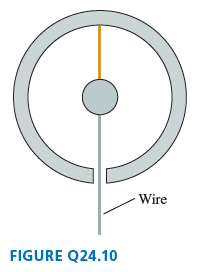
A small, metal sphere hangs by an insulating thread within the larger, hollow conducting sphere of FIGURE Q24.10. A conducting wire extends from the small sphere through, but not touching, a small hole in the hollow sphere. A charged rod is used to transfer positive charge to the protruding wire.
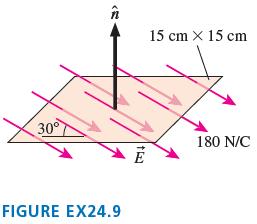
What is the electric flux through the surface shown in FIGURE EX24.9? în 15 cm x 15 cm 30° 180 N/C FIGURE EX24.9
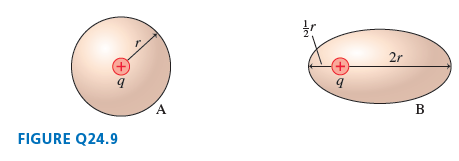
The sphere and ellipsoid in FIGURE Q24.9 surround equal charges. Four students are discussing the situation.Student 1: The fluxes through A and B are equal because the average radius is the same.Student 2: I agree that the fluxes are equal, but that??s because they enclose equal charges.Student 3:
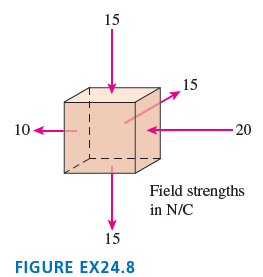
The cube in FIGURE EX24.8 contains no net charge. The electric field is constant over each face of the cube. Does the missing electric field vector on the front face point in or out? What is the field strength? 15 15 10 20 Field strengths in N/C 15 FIGURE EX24.8
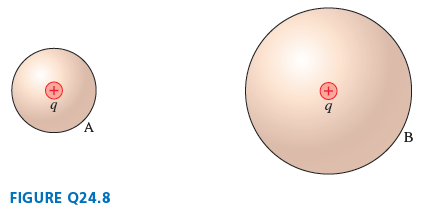
The two spheres in FIGURE Q24.8 on the next page surround equal charges. Three students are discussing the situation. Student 1: The fluxes through spheres A and B are equal because they enclose equal charges.Student 2: But the electric field on sphere B is weaker than the electric field on sphere
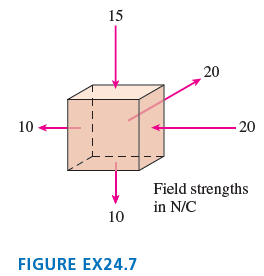
The cube in FIGURE EX24.7 contains negative charge. The electric field is constant over each face of the cube. Does the missing electric field vector on the front face point in or out? What strength must this field exceed? 15 20 10 - 20 Field strengths in N/C 10 FIGURE EX24.7
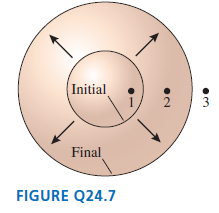
The charged balloon in FIGURE Q24.7 expands as it is blown up, increasing in size from the initial to final diameters shown. Do the electric field strengths at points 1, 2, and 3 increase, decrease, or stay the same? Explain your reasoning for each. Initial 2 3 Final FIGURE Q24.7
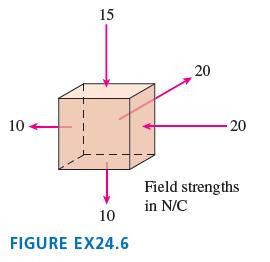
The cube in FIGURE EX24.6 contains negative charge. The electric field is constant over each face of the cube. Does the missing electric field vector on the front face point in or out? What strength must this field exceed? 15 - 20 10 Field strengths in N/C 10 FIGURE EX24.6 20
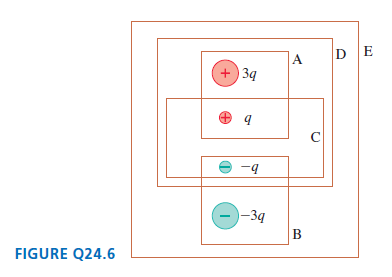
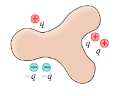
What is the electric flux through each of the surfaces A to E in FIGURE Q24.6? Give each answer as a multiple of q/ε0. D E A + ) 3q C -)-3ª В FIGURE Q24.6
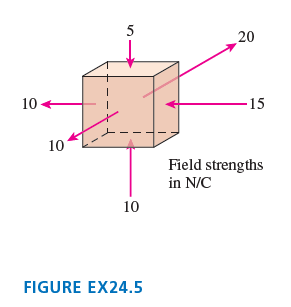
The electric field is constant over each face of the cube shown in FIGURE EX24.5. Does the box contain positive charge, negative charge, or no charge? Explain. 5 20 10 15 10 Field strengths in N/C 10 FIGURE EX24.5
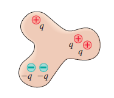
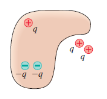
What is the electric flux through each of the surfaces in FIGURE Q24.5? Give each answer as a multiple of q/ε0.a.b.c. b.
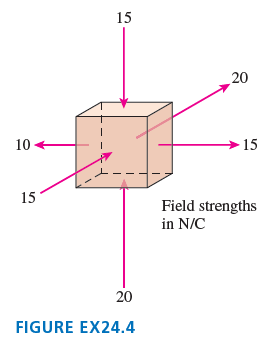
The electric field is constant over each face of the cube shown in FIGURE EX24.4. Does the box contain positive charge, negative charge, or no charge? Explain. 15 20 10 15 15 Field strengths in N/C 20 FIGURE EX24.4
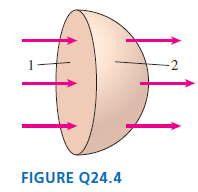
In FIGURE Q24.4, where the field is uniform, is the magnitude of Φ1larger than, smaller than, or equal to the magnitude of Φ2? Explain. FIGURE Q24.4
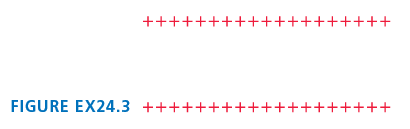
FIGURE EX24.3 shows a cross section of two infinite parallel planes of charge. Draw this figure on your paper, then draw electric field vectors showing the shape of the electric field. +++++++++++++++++++ FIGURE EX24.3 +++++++++++++++++++
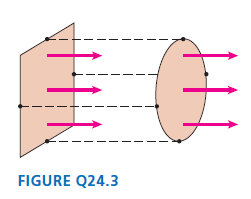
The square and circle in FIGURE Q24.3 are in the same uniform field. The diameter of the circle equals the edge length of the square. Is Φsquarelarger than, smaller than, or equal to Φcircle? Explain. FIGURE Q24.3
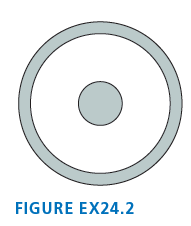
FIGURE EX24.2 shows a cross section of two concentric spheres.The inner sphere has a negative charge. The outer sphere has a positive charge larger in magnitude than the charge on the inner sphere. Draw this figure on your paper, then draw electric field vectors showing the shape of the electric
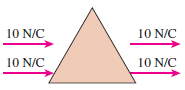
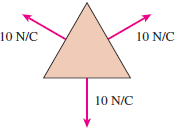
FIGURE Q24.2 shows cross sections of three-dimensional closed surfaces. They have a flat top and bottom surface above and below the plane of the page. However, the electric field is everywhere parallel to the page, so there is no flux through the top or bottom surface. The electric field is uniform
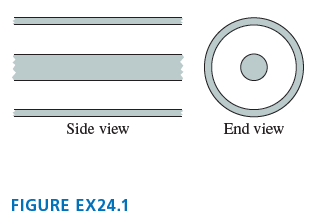
FIGURE EX24.1 shows two cross sections of two infinitely long coaxial cylinders. The inner cylinder has a positive charge, the outer cylinder has an equal negative charge. Draw this figure on your paper, then draw electric field vectors showing the shape of the electric field. Side view End view
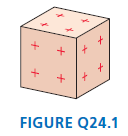
Suppose you have the uniformly charged cube in FIGURE Q24.1. Can you use symmetry alone to deduce the shape of the cube€™s electric field?If so, sketch and describe the field shape. If not, why not? FIGURE Q24.1
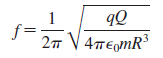
You have a summer intern position with a company that designs and builds nanomachines. An engineer with the company is designing a microscopic oscillator to help keep time, and you€™ve been assigned to help him analyze the design. He wants to place a negative charge at the center of a
A proton orbits a long charged wire, making 1.0 × 10⁶ revolutions per second. The radius of the orbit is 1.0 cm. What is the wire’s linear charge density?
One type of ink-jet printer, called an electrostatic ink-jet printer, forms the letters by using deflecting electrodes to steer charged ink drops up and down vertically as the ink jet sweeps horizontally across the page. The ink jet forms 30@mm@diameter drops of ink, charges them by spraying
A thin cylindrical shell of radius R and length L, like a soda straw, is uniformly charged with surface charge density η. What is the electric field strength at the center of one end of the cylinder?
a. An infinitely long sheet of charge of width L lies in the xy plane between x = -L/2 and x = L/2. The surface charge density is η. Derive an expression for the electric field E along the x-axis for points outside the sheet (x > L/2).b. Verify that your expression has the expected behavior if
a. An infinitely long sheet of charge of width L lies in the xy plane between x = -L/2 and x = L/2. The surface charge density is η. Derive an expression for the electric field E at height z above the centerline of the sheet.b. Verify that your expression has the expected behavior if z V L and if
A rod of length L lies along the y-axis with its center at the origin. The rod has a nonuniform linear charge density λ = a|y| , where a is a constant with the units C/m2.a. Draw a graph of λ versus y over the length of the rod.b. Determine the constant a in terms of L and the rod’s total
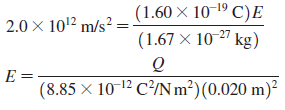
You are given the equation(s) used to solve a problem. For each of thesea. Write a realistic problem for which this is the correct equation(s).b. Finish the solution of the problem. (1.60 × 10⁻¹⁹ C)E (1.67 × 10⁻²⁷ kg) 2.0 × 10¹² m/s² = |E (8.85 × 10⁻¹² C²/Nm²)(0.020 m)²
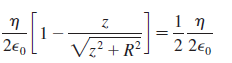
You are given the equation(s) used to solve a problem. For each of thesea. Write a realistic problem for which this is the correct equation(s).b. Finish the solution of the problem. 2² + R². 2 2e0 2€0
You are given the equation(s) used to solve a problem. For each of thesea. Write a realistic problem for which this is the correct equation(s).b. Finish the solution of the problem. 2(2.0 X 10⁻⁷ C/m) |(9.0 × 10° Nm/C²) = 25,000 N/C
You are given the equation(s) used to solve a problem. For each of thesea. Write a realistic problem for which this is the correct equation(s).b. Finish the solution of the problem. (2.0 × 10° C) s (0.025 m)3 (9.0 × 10º Nm²/C²) 1150 N/C %3D
The ozone molecule O3 has a permanent dipole moment of 1.8 × 10⁻³⁰ C m. Although the molecule is very slightly bent—which is why it has a dipole moment—it can be modeled as a uniform rod of length 2.5 × 10⁻¹⁰ m with the dipole moment perpendicular to the axis of the rod. Suppose an ozone
Show that an infinite line of charge with linear charge density λ exerts an attractive force on an electric dipole with magnitude F = 2λp/4πє0r2. Assume that r, the distance from the line, is much larger than the charge separation in the dipole.
An electric field can induce an electric dipole in a neutral atom or molecule by pushing the positive and negative charges in opposite directions. The dipole moment of an induced dipole is directly proportional to the electric field. That is, p = αE, where α is called the polarizability of the
In a classical model of the hydrogen atom, the electron orbits the proton in a circular orbit of radius 0.053 nm. What is the orbital frequency? The proton is so much more massive than the electron that you can assume the proton is at rest.
A 2.0-mm-diameter glass sphere has a charge of +1.0 nC.What speed does an electron need to orbit the sphere 1.0 mm above the surface?
The combustion of fossil fuels produces micron-sized particles of soot, one of the major components of air pollution. The terminal speeds of these particles are extremely small, so they remain suspended in air for very long periods of time. Furthermore, very small particles almost always acquire
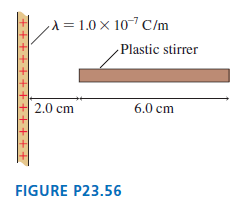
Your physics assignment is to figure out a way to use electricity to launch a small 6.0-cm-long plastic drink stirrer. You decide that you€™ll charge the little plastic rod by rubbing it with fur, then hold it near a long, charged wire, as shown in FIGURE P23.56.When you let go, the
A positron is an elementary particle identical to an electron except that its charge is +e. An electron and a positron can rotate about their center of mass as if they were a dumbbell connected by a massless rod. What is the orbital frequency for an electron and a positron 1.0 nm apart?
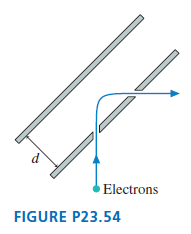
A problem of practical interest is to make a beam of electrons turn a 90? corner. This can be done with the parallel-plate capacitor shown in FIGURE P23.54. An electron with kinetic energy 3.0 × 10⁻¹⁷J enters through a small hole in the bottom plate of the capacitor. a. Should the bottom plate be
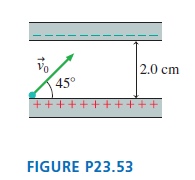
The two parallel plates in FIGURE P23.53 are 2.0 cm apart and the electric field strength between them is 1.0 × 10⁴ N/C. An electron is launched at a 45° angle from the positive plate. What is the maximum initial speed v0the electron can have without hitting the negative
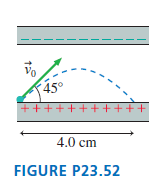
An electron is launched at a 45? angle and a speed of 5.0 × 10⁶m/s from the positive plate of the parallel-plate capacitor shown in FIGURE P23.52. The electron lands 4.0 cm away. a. What is the electric field strength inside the capacitor?b. What is the smallest possible spacing between the
A parallel-plate capacitor has 2.0 cm × 2.0 cm electrodes with surface charge densities ±1.0 × 10⁻⁶ C/m2. A proton traveling parallel to the electrodes at 1.0 × 10⁶ m/s enters the center of the gap between them. By what distance has the proton been deflected sideways when it reaches the far
A sphere of radius R and surface charge density η is positioned with its center distance 2R from an infinite plane with surface charge density η. At what distance from the plane, along a line toward the center of the sphere, is the electric field zero?
An infinite plane of charge with surface charge density 3.2 μC/m2 has a 20-cm-diameter circular hole cut out of it. What is the electric field strength directly over the center of the hole at a distance of 12 cm?
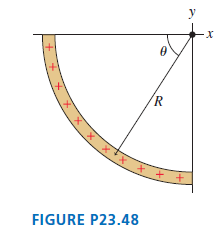
A plastic rod with linear charge density λ is bent into the quarter circle shown in FIGURE P23.48. We want to find the electric field at the origin. a. Write expressions for the x-and y-components of the electric field at the origin due to a small piece of charge at angle θ.b. Write, but do not
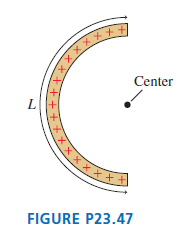
Charge Q is uniformly distributed along a thin, flexible rod of length L. The rod is then bent into the semicircle shown in FIGURE P23.47. a. Find an expression for the electric field E at the center of the semicircle.b. Evaluate the field strength if L = 10 cm and Q = 30 nC. Center L FIGURE P23.47
A ring of radius R has total charge Q.a. At what distance along the z-axis is the electric field strength a maximum?b. What is the electric field strength at this point?
Show that the on-axis electric field of a ring of charge has the expected behavior when z << R and when z >> R.
Two 2.0-cm-diameter disks face each other, 1.0 mm apart. They are charged to ±10 nC.a. What is the electric field strength between the disks?b. A proton is shot from the negative disk toward the positive disk. What launch speed must the proton have to just barely reach the positive disk?
Two parallel plates 1.0 cm apart are equally and oppositely charged. An electron is released from rest at the surface of the negative plate and simultaneously a proton is released from rest at the surface of the positive plate. How far from the negative plate is the point at which the electron and
Air “breaks down” when the electric field strength reaches 3.0 * 106 N/C, causing a spark. A parallel-plate capacitor is made from two 4.0 cm × 4.0 cm electrodes. How many electrons must be transferred from one electrode to other to create a spark between the electrodes?
A parallel-plate capacitor is formed from two 6.0-cm diameter electrodes spaced 2.0 mm apart. The electric field strength inside the capacitor is 1.0 × 10⁶ N/C. What is the charge (in nC) on each electrode?
Two circular disks spaced 0.50 mm apart form a parallel plate capacitor. Transferring 3.0 × 10⁹ electrons from one disk to the other causes the electric field strength to be 2.0 × 10⁵ N/C. What are the diameters of the disks?
A 2.0 m × 4.0 m flat carpet acquires a uniformly distributed charge of -10 μC after you and your friends walk across it several times. A 2.5 μg dust particle is suspended in midair just above the center of the carpet. What is the charge on the dust particle?
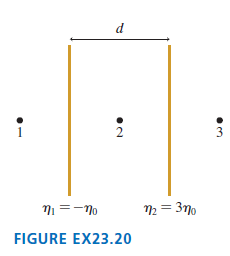
You€™ve hung two very large sheets of plastic facing each other with distance d between them, as shown in FIGURE EX23.20. By rubbing them with wool and silk, you€™ve managed to give one sheet a uniform surface charge density η1= -η0and the other a
Two 2.0-cm-diameter insulating spheres have a 6.0 cm space between them. One sphere is charged to +10 nC, the other to -15 nC. What is the electric field strength at the midpoint between the two spheres?
A 20 cm × 20 cm horizontal metal electrode is uniformly charged to +80 nC. What is the electric field strength 2.0 mm above the center of the electrode?
The electric field strength 2.0 cm from the surface of a 10-cm-diameter metal ball is 50,000 N/C. What is the charge (in nC) on the ball?
Two 10-cm-diameter charged disks face each other, 20 cm apart. The left disk is charged to -50 nC and the right disk is charged to +50 nC.a. What is the electric field E, both magnitude and direction, at the midpoint between the two disks?b. What is the force F on a -1.0 nC charge placed at the
Two 10-cm-diameter charged rings face each other, 20 cm apart. Both rings are charged to +20 nC. What is the electric field strength at(a) The midpoint between the two rings(b) The center of the left ring?
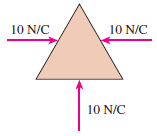
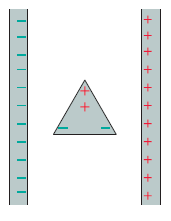
Three charges are placed at the corners of the triangle in FIGURE Q23.15. The + + charge has twice the quantity of charge of the two - charges; the net charge is zero. Is the triangle in equilibrium? If so, explain why. If not, draw the equilibrium orientation. + + + + + + + + + + +
Two 10-cm-diameter charged rings face each other, 20 cm apart. The left ring is charged to -20 nC and the right ring is charged to +20 nC.a. What is the electric field E, both magnitude and direction, at the midpoint between the two rings?b. What is the force on a proton at the midpoint?
A proton and an electron are released from rest in the center of a capacitor.a. Is the force ratio Fp/Fe greater than 1, less than 1, or equal to 1? Explain.b. Is the acceleration ratio ap/ae greater than 1, less than 1, or equal to 1? Explain.
A 12-cm-long thin rod has the nonuniform charge density λ(x) = (2.0 nC/cm)e-|x|/(6.0 cm), where x is measured from the center of the rod. What is the total charge on the rod?
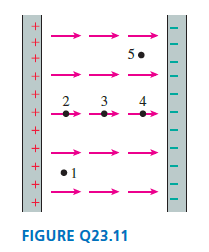
A small object is released at point 3 in the center of the capacitor in FIGURE Q23.11. For each situation, does the object move to the right, to the left, or remain in place? If it moves, does it accelerate or move at constant speed?a. A positive object is released from rest.b. A neutral but
The electric field 5.0 cm from a very long charged wire is (2000 N/C, toward the wire). What is the charge (in nC) on a 1.0-cm-long segment of the wire?
A parallel-plate capacitor consists of two square plates, size L × L, separated by distance d. The plates are given charge ±Q.What is the ratio Ef/Ei of the final to initial electric field strengths if(a) Q is doubled,(b) L is doubled,(c) D is doubled? Each part changes only one quantity; the
A small glass bead charged to + 6.0 nC is in the plane that bisects a thin, uniformly charged, 10-cm-long glass rod and is 4.0 cm from the rod’s center. The bead is repelled from the rod with a force of 840 μN. What is the total charge on the rod?
Rank in order, from largest to smallest, the electric field strengths E1to E5at the five points in FIGURE Q23.11. Explain. 5. 2 3 FIGURE Q23.11 1 1 1 + + + + + + + + + +
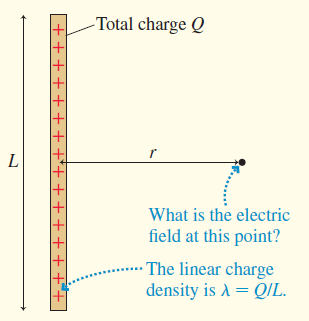
Two 10-cm-long thin glass rods uniformly charged to +10 nC are placed side by side, 4.0 cm apart. What are the electric field strengths E1 to E3 at distances 1.0 cm, 2.0 cm, and 3.0 cm to the right of the rod on the left along the line connecting the midpoints of the two rods?
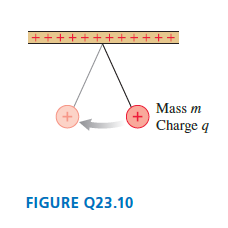
The ball in FIGURE Q23.10 is suspended from a large, uniformly charged positive plate. It swings with period T. If the ball is discharged, will the period increase, decrease, or stay the same? Explain. ++++++++++++ Mass m Charge q FIGURE Q23.10
A 10-cm-long thin glass rod uniformly charged to +10 nC and a 10-cm-long thin plastic rod uniformly charged to -10 nC are placed side by side, 4.0 cm apart. What are the electric field strengths E1 to E3 at distances 1.0 cm, 2.0 cm, and 3.0 cm from the glass rod along the line connecting the
A sphere of radius R has charge Q. The electric field strength at distance r > R is Ei. What is the ratio Ef/Ei of the final to initial electric field strengths if(a) Q is halved,(b) R is halved,(c) R is halved (but is still > R)? Each part changes only one quantity; the other quantities have
The electric field strength 10.0 cm from a very long charged wire is 2000 N/C. What is the electric field strength 5.0 cm from the wire?
A circular disk has surface charge density 8 nC/cm2. What will the surface charge density be if the radius of the disk is doubled?
An electret is similar to a magnet, but rather than being permanently magnetized, it has a permanent electric dipole moment. Suppose a small electret with electric dipole moment 1.0 × 10⁻⁷ C m is 25 cm from a small ball charged to +25 nC, with the ball on the axis of the electric dipole. What is
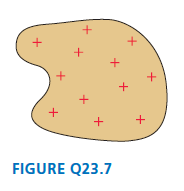
The irregularly shaped area of charge in FIGURE Q23.7 has surface charge density hi. Each dimension (x and y) of the area is reduced by a factor of 3.163. a. What is the ratio ηf/ηi, where ηf is the final surface charge density?b. An electron is very far from the area. What is the ratio Ff/Fi of
An electric dipole is formed from ±1.0 nC charges spaced 2.0 mm apart. The dipole is at the origin, oriented along the x-axis. What is the electric field strength at the points(a) (x, y) = (10 cm, 0 cm)(b) (x, y) = (0 cm, 10 cm)?
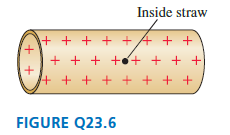
FIGURE Q23.6 shows a hollow soda straw that has been uniformly charged with positive charge. What is the electric field at the center (inside) of the straw? Explain. Inside straw + + + + +A + + +1 + + + ++ + + + + + + + + + + + FIGURE Q23.6
An electric dipole is formed from two charges, ±q, spaced 1.0 cm apart. The dipole is at the origin, oriented along the y-axis. The electric field strength at the point (x, y) = (0 cm, 10 cm) is 360 N/C.a. What is the charge q? Give your answer in nC.b. What is the electric field strength at the
An electron experiences a force of magnitude F when it is 1 cm from a very long, charged wire with linear charge density λ. If the charge density is doubled, at what distance from the wire will a proton experience a force of the same magnitude F?
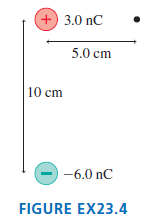
What are the strength and direction of the electric field at the position indicated by the dot in FIGURE EX23.4? Specify the direction as an angle above or below horizontal. +) 3.0 nC 5.0 cm 10 cm -6.0 nC FIGURE EX23.4
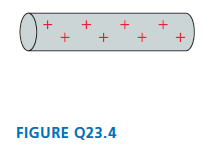
A small segment of wire in FIGURE Q23.4 contains 10 nC of charge. a. The segment is shrunk to one-third of its original length.What is the ratio λf/λi, where λi and λf are the initial and final linear charge densities?b. A proton is very far from the wire. What is the ratio Ff/Fi of the
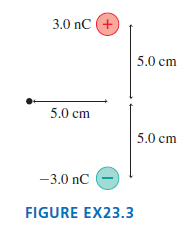
What are the strength and direction of the electric field at the position indicated by the dot in FIGURE EX23.3? Specify the direction as an angle above or below horizontal. 3.0 nC (+ 5.0 cm 5.0 cm 5.0 cm -3.0 nC FIGURE EX23.3
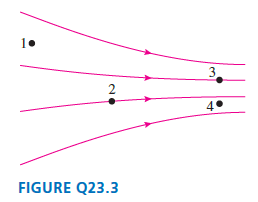
Rank in order, from largest to smallest, the electric field strengths E1to E4at points 1 to 4 in FIGURE Q23.3. Explain. 1. 3. 2 4° FIGURE Q23.3
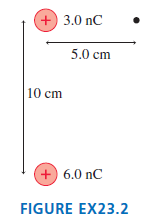
What are the strength and direction of the electric field at the position indicated by the dot in FIGURE EX23.2? Specify the direction as an angle above or below horizontal. (+ 3.0 nC 5.0 cm |10 cm + 6.0 nC FIGURE EX23.2
Reproduce FIGURE Q23.2 on your paper. For each part, draw a dot or dots on the figure to show any position or positions (other than infinity) where E = 0.a.b. +'+
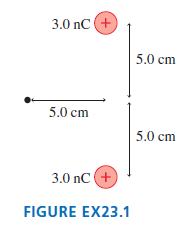
What are the strength and direction of the electric field at the position indicated by the dot in FIGURE EX23.1? Specify the direction as an angle above or below horizontal. 3.0 nC + 5.0 cm 5.0 cm 5.0 cm 3.0 nC + FIGURE EX23.1
You’ve been assigned the task of determining the magnitude and direction of the electric field at a point in space. Give a step-by step procedure of how you will do so. List any objects you will use, any measurements you will make, and any calculations you will need to perform. Make sure that
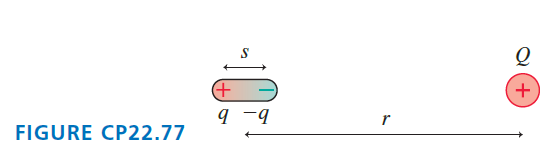
In Section 22.3 we claimed that a charged object exerts a net attractive force on an electric dipole. Let€™s investigate this. FIGURE CP22.77 shows a permanent electric dipole consisting of charges +q and -q separated by the fixed distance s. Charge +Q is distance r from the center of the
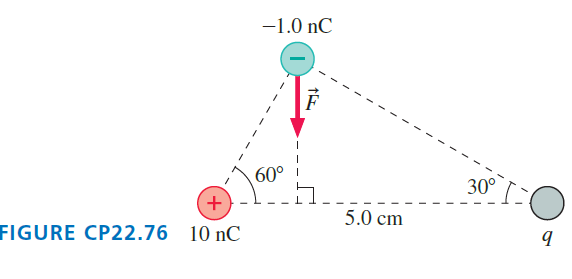
The force on the -1.0 nC charge is as shown in FIGURE CP22.76. What is the magnitude of this force? -1.0 nC 60° 30° +. 5.0 cm FIGURE CP22.76 10 nC
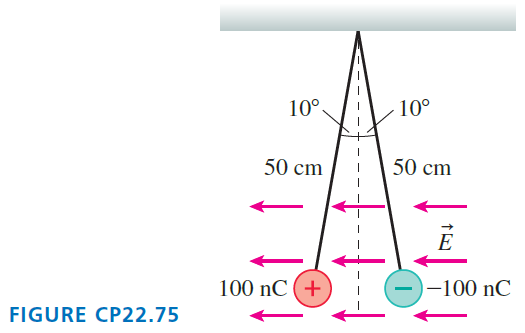
The identical small spheres shown in FIGURE CP22.75 are charged to +100 nC and -100 nC. They hang as shown in a 100,000 N/C electric field. What is the mass of each sphere? 10° 10° 50 cm 50 cm E 100 nC (+ -100 nC FIGURE CP22.75
Three 3.0 g balls are tied to 80-cm-long threads and hung from a single fixed point. Each of the balls is given the same charge q.At equilibrium, the three balls form an equilateral triangle in a horizontal plane with 20 cm sides. What is q?
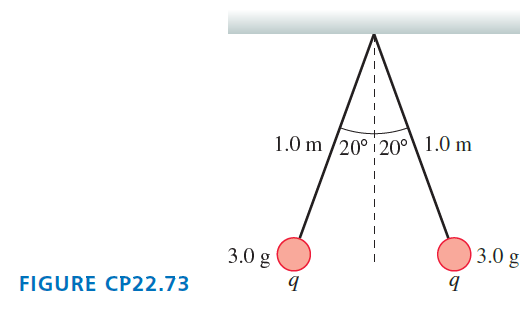
Two 3.0 g point charges on 1.0-m-long threads repel each other after being equally charged, as shown in FIGURE CP22.73.What is the magnitude of the charge q? 1.0 m /20° 20° \1.0 m 3.0 g 3.0 g FIGURE CP22.73
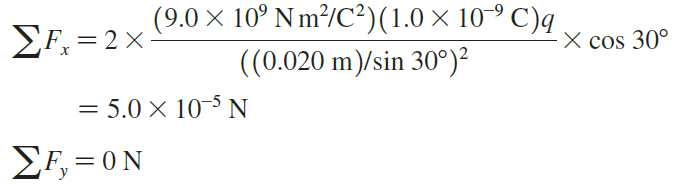
You are given the equation(s) used to solve a problem. For each of these,a. Write a realistic problem for which this is the correct equation(s).b. Finish the solution of the problem. (9.0 × 10° Nm²/C²)(1.0 × 10-° C)q ((0.020 m)/sin 30°)? X cos 30° EF, = 2x = 5.0 × 10⁻⁵ N Σ F,= 0 N
You are given the equation(s) used to solve a problem. For each of these,a. Write a realistic problem for which this is the correct equation(s).b. Finish the solution of the problem. |(9.0 x 10° Nm²/C²)(15 × 10-º C) 54,000 N/C ||
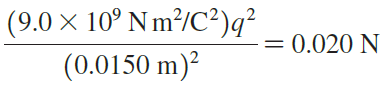
You are given the equation(s) used to solve a problem. For each of these,a. Write a realistic problem for which this is the correct equation(s).b. Finish the solution of the problem. |(9.0 × 10° N m²/C²)q? = 0.020 N (0.0150 m)?
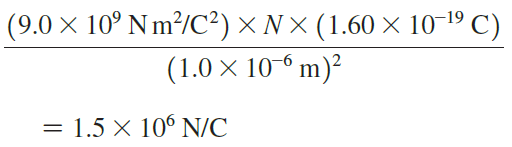
You are given the equation(s) used to solve a problem. For each of these,a. Write a realistic problem for which this is the correct equation(s).b. Finish the solution of the problem. (9.0 × 10° Nm²/C²) × N× (1.60 × 10⁻¹⁹ C) (1.0 × 10-° m)? 1.5 X 10° N/C
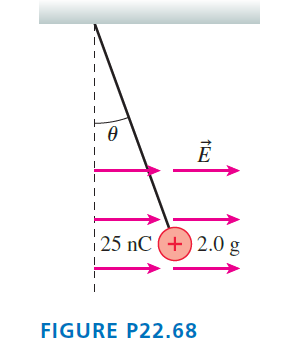
An electric field E = 200,000 in N/C causes the point charge in FIGURE P25.68 to hang at an angle. What is θ? | 25 nC (+) 2.0 g FIGURE P22.68
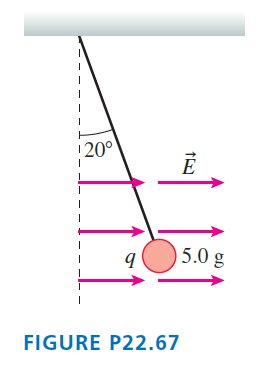
An electric field E = 100,000 in N/C causes the 5.0 g point charge in FIGURE P22.67 to hang at a 20° angle. What is the charge on the ball? 120° 5.0 g FIGURE P22.67
Showing 1900 - 2000
of 3693
First
13
14
15
16
17
18
19
20
21
22
23
24
25
26
27
Last
Step by Step Answers

 Get 50% OFF
Claim Now
Get 50% OFF
Claim Now