New Semester
Started
Get
50% OFF
Study Help!
--h --m --s
Claim Now
Question Answers
Textbooks
Find textbooks, questions and answers
Oops, something went wrong!
Change your search query and then try again
S
Books
FREE
Study Help
Expert Questions
Accounting
General Management
Mathematics
Finance
Organizational Behaviour
Law
Physics
Operating System
Management Leadership
Sociology
Programming
Marketing
Database
Computer Network
Economics
Textbooks Solutions
Accounting
Managerial Accounting
Management Leadership
Cost Accounting
Statistics
Business Law
Corporate Finance
Finance
Economics
Auditing
Tutors
Online Tutors
Find a Tutor
Hire a Tutor
Become a Tutor
AI Tutor
AI Study Planner
NEW
Sell Books
Search
Search
Sign In
Register
study help
physics
physics scientists and engineers
Physics for Scientists and Engineers A Strategic Approach with Modern Physics 4th edition Randall D. Knight - Solutions
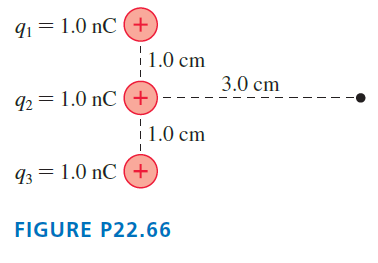
Three 1.0 nC charges are placed as shown in FIGURE P22.66. Each of these charges creates an electric field E at a point 3.0 cm in front of the middle charge. a. What are the three fields E1, E2, and E3 created by the three charges? Write your answer for each as a vector in component form.b. Do you
A 10.0 nC charge is located at position (x, y) = (1.0 cm, 2.0 cm). At what (x, y) position(s) is the electric fielda. -225,000 î N/C?b. (161,000 î + 80,500 ĵ) N/C?c. (21,600 î - 28,800 ĵ) N/C?
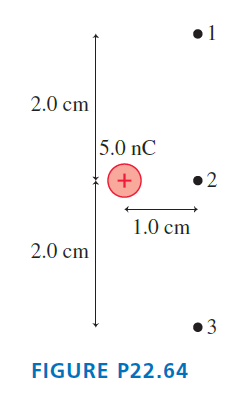
What are the electric fields at points 1, 2, and 3 in FIGURE P22.64?Give your answer in component form. 2.0 cm 5.0 nC +. 1.0 cm 2.0 cm FIGURE P22.64
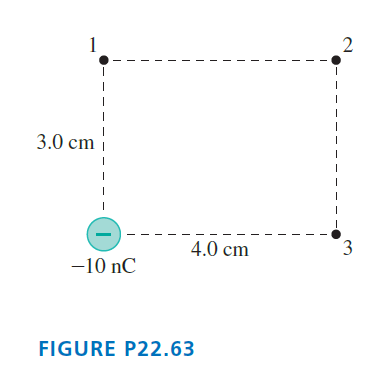
What are the electric fields at points 1, 2, and 3 in FIGURE P22.63?Give your answer in component form. 3.0 cm 4.0 cm 3 -10 nC FIGURE P22.63
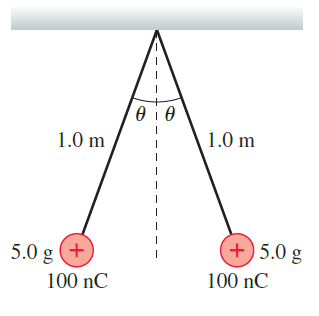
Two 5.0 g point charges on 1.0-m-long threads repel each other after being charged to +100 nC, as shown in FIGURE P22.62. What is the angle θ? You can assume that θ is a small angle. 1.0 m 1.0 m +) 5.0 g 5.0 g (+) 100 nC 100 nC
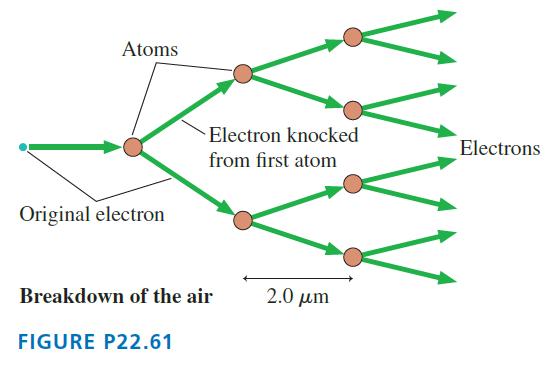
You sometimes create a spark when you touch a doorknob after shuffling your feet on a carpet. Why? The air always has a few free electrons that have been kicked out of atoms by cosmic rays. If an electric field is present, a free electron is accelerated until it collides with an air molecule. Most
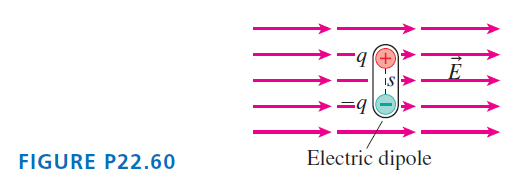
An electric dipole consists of two opposite charges ±q separated by a small distance s. The product p = qs is called the dipole moment. FIGURE P22.60 shows an electric dipole perpendicular to an electric field E. Find an expression in terms of p and E for the magnitude of the torque that the
You have a lightweight spring whose un-stretched length is 4.0 cm. First, you attach one end of the spring to the ceiling and hang a 1.0 g mass from it. This stretches the spring to a length of 5.0 cm. You then attach two small plastic beads to the opposite ends of the spring, lay the spring on a
Two equal point charges 2.5 cm apart, both initially neutral, are being charged at the rate of 5.0 nC/s. At what rate (N/s) is the force between them increasing 1.0 s after charging begins?
Space explorers discover an 8.7 × 10¹⁷ kg asteroid that happens to have a positive charge of 4400 C. They would like to place their 3.3 × 10⁵ kg spaceship in orbit around the asteroid. Interestingly, the solar wind has given their spaceship a charge of –1.2 C. What speed must their spaceship
A 2.0 g metal cube and a 4.0 g metal cube are 6.0 cm apart, measured between their centers, on a horizontal surface. For both, the coefficient of static friction is 0.65. Both cubes, initially neutral, are charged at a rate of 7.0 nC/s. How long after charging begins does one cube begin to slide
You have two small, 2.0 g balls that have been given equal but opposite charges, but you don’t know the magnitude of the charge. To find out, you place the balls distance d apart on a slippery horizontal surface, release them, and use a motion detector to measure the initial acceleration of one
In a simple model of the hydrogen atom, the electron moves in a circular orbit of radius 0.053 nm around a stationary proton.How many revolutions per second does the electron make?
Suppose the magnitude of the proton charge differs from the magnitude of the electron charge by a mere 1 part in 109.a. What would be the force between two 2.0-mm-diameter copper spheres 1.0 cm apart? Assume that each copper atom has an equal number of electrons and protons.b. Would this amount of
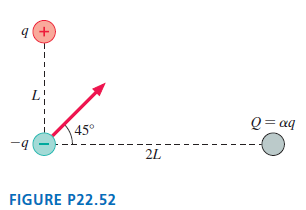
FIGURE P22.52 shows three charges and the net force on charge -q. Charge Q is some multiple a of q. What is a? Q= aq 45° -ą 2L FIGURE P22.52
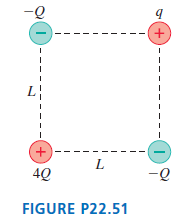
FIGURE P22.51 shows four charges at the corners of a square of side L. What is the magnitude of the net force on q? +, FIGURE P22.51 +. -0°
A positive point charge Q is located at x = a and a negative point charge -Q is at x = -a. A positive charge q can be placed anywhere on the y-axis. Find an expression for (Fnet)x, the x component of the net force on q.
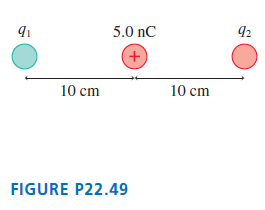
Charge q2in FIGURE P22.49 is in equilibrium. What is q1? 92 5.0 nC 10 cm 10 cm FIGURE P22.49
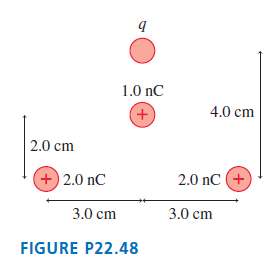
The net force on the 1.0 nC charge in FIGURE P22.48 is zero.What is q? 1.0 nC +. 4.0 cm 2.0 cm + 2.0 nC 2.0 nC (+ 3.0 cm 3.0 cm FIGURE P22.48
A +2.0 nC charge is at the origin and a -4.0 nC charge is at x = 1.0 cm.a. At what x-coordinate could you place a proton so that it would experience no net force?b. Would the net force be zero for an electron placed at the same position? Explain.
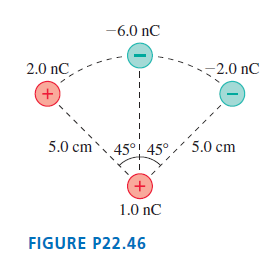
What is the force F on the 1.0 nC charge at the bottom in FIGURE P22.46? Give your answer in component form. -6.0 nC 2.0 nC, 2.0 nC 5.0 cm 45° 45° ,´ 5.0 cm +, 1.0 nC FIGURE P22.46
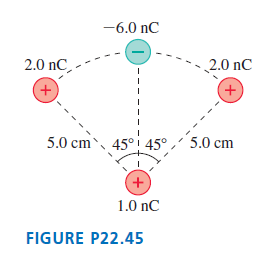
What is the force F on the 1.0 nC charge at the bottom in FIGURE P22.45? Give your answer in component form. -6.0 nC 2.0 nC, 2.0 nC +) +. 5.0 cm, 45° 45° , 5.0 cm +, 1.0 nC FIGURE P22.45
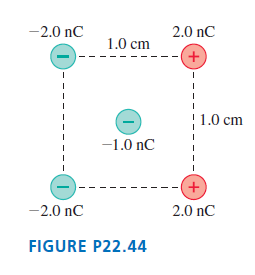
What is the force F on the ˆ’1.0 nC charge in the middle of FIGURE P22.44 due to the four other charges? Give your answer in component form. -2.0 nC 2.0 nC 1.0 cm 1.0 cm -1.0 nC -2.0 nC 2.0 nC FIGURE P22.44
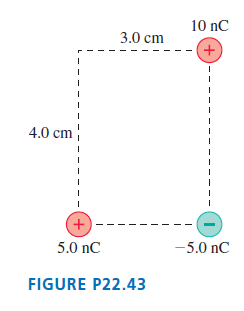
What is the force F on the 5.0 nC charge in FIGURE P22.43?Give your answer as a magnitude and an angle measured cw or ccw (specify which) from the +x@axis. 10 nC 3.0 cm 4.0 cm 5.0 nC -5.0 nC FIGURE P22.43
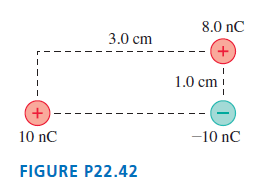
What is the force F on the -10 nC charge in FIGURE P22.42?Give your answer as a magnitude and an angle measured cw or ccw (specify which) from the +x@axis. 8.0 nC 3.0 cm +) 1.0 cm -10 nC 10 nC FIGURE P22.42
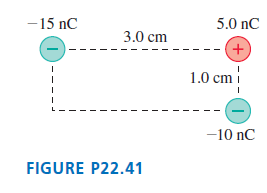
What is the force F on the -10 nC charge in FIGURE P22.41?Give your answer as a magnitude and an angle measured cw or ccw (specify which) from the +x@axis. -15 nC 5.0 nC 3.0 cm (+) 1.0 cm -10 nC FIGURE P22.41
Objects A and B are both positively charged. Both have a mass of 100 g, but A has twice the charge of B. When A and B are placed 10 cm apart, B experiences an electric force of 0.45 N.a. What is the charge on A?b. If the objects are released, what is the initial acceleration of A?
A smart phone charger delivers charge to the phone, in the form of electrons, at a rate of –0.75 C/s. How many electrons are delivered to the phone during 30 min of charging?
A Van de Graaff generator is a device that accumulates electrons on a large metal sphere until the large amount of charge causes sparks. As you’ll learn in Chapter 23, the electric field of a charged sphere is exactly the same as if the charge were a point charge at the center of the sphere.
The nucleus of a 125Xe atom (an isotope of the element xenon with mass 125 u) is 6.0 fm in diameter. It has 54 protons and charge q = +54e.a. What is the electric force on a proton 2.0 fm from the surface of the nucleus?b. What is the proton’s acceleration?
Two 1.0 g spheres are charged equally and placed 2.0 cm apart. When released, they begin to accelerate at 150 m/s2. What is the magnitude of the charge on each sphere?
Pennies today are copper-covered zinc, but older pennies are 3.1 g of solid copper. What are the total positive charge and total negative charge in a solid copper penny that is electrically neutral?
A 0.10 g honeybee acquires a charge of +23 pC while flying.a. The earth’s electric field near the surface is typically (100 N/C, downward). What is the ratio of the electric force on the bee to the bee’s weight?b. What electric field (strength and direction) would allow the bee to hang
A –12 nC charge is located at (x, y) = (1.0 cm, 0 cm). What are the electric fields at the positions (x, y) = (5.0 cm, 0 cm), (-5.0 cm, 0 cm), and (0 cm, 5.0 cm)? Write each electric field vector in component form.
A +12 nC charge is located at the origin.a. What are the electric fields at the positions (x, y) = (5.0 cm, 0 cm), (-5.0 cm, 5.0 cm), and (-5.0 cm, -5.0 cm)?Write each electric field vector in component form.b. Draw a field diagram showing the electric field vectors at these points.
The electric field 2.0 cm from a small object points away from the object with a strength of 270,000 N/C. What is the object’s charge?
What are the strength and direction of an electric field that will balance the weight of a 1.0 g plastic sphere that has been charged to -3.0 nC?
What magnitude charge creates a 1.0 N/C electric field at a point 1.0 m away?
What are the strength and direction of the electric field 4.0 cm from a small plastic bead that has been charged to -8.0 nC?
The electric field at a point in space is E = (400 î + 100 ĵ) N/C.a. What is the electric force on a proton at this point? Give your answer in component form.b. What is the electric force on an electron at this point? Give your answer in component form.c. What is the magnitude of the proton’s
What are the strength and direction of the electric field 1.0 mm from(a) A proton(b) An electron?
A massless spring is attached to a support at one end and has a 2.0 μC charge glued to the other end. A -4.0 μC charge is slowly brought near. The spring has stretched 1.2 cm when the charges are 2.6 cm apart. What is the spring constant of the spring?
Two positive point charges q and 4q are at x = 0 and x = L, respectively, and free to move. A third charge is placed so that the entire three-charge system is in static equilibrium. What are the magnitude, sign, and x-coordinate of the third charge?
A 2.0 g plastic bead charged to -4.0 nC and a 4.0 g glass bead charged to +8.0 nC are 2.0 cm apart and free to move. What are the accelerations of(a) The plastic bead(b) The glass bead?
A small plastic bead has been charged to -15 nC. What are the magnitude and direction of the acceleration of(a) A proton(b) An electron that is 1.0 cm from the center of the bead?
Object A, which has been charged to +4.0 nC, is at the origin. Object B, which has been charged to -8.0 nC, is at (x, y) = (0.0 cm, 2.0 cm). Determine the electric force on each object. Write each force vector in component form.
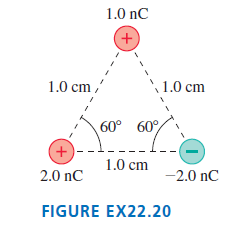
What is the force F on the 1.0 nC charge in FIGURE EX22.20?Give your answer as a magnitude and a direction. 1.0 nC +, 1.0 cm ,' 1.0 cm 60° 60°, 1.0 cm -2.0 nC 2.0 nC FIGURE EX22.20
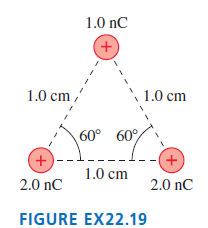
What is the force F on the 1.0 nC charge in Figure EX22.19?Give your answer as a magnitude and a direction. 1.0 nC 1.0 cm ,' 1.0 cm 60° 60°% 1.0 cm 2.0 nC 2.0 nC FIGURE EX22.19
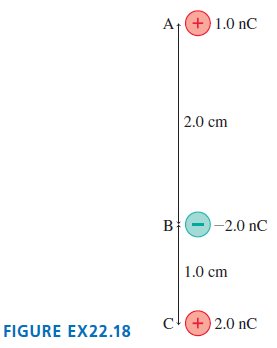
What is the net electric force on charge B in FIGURE EX22.18? A(+1.0 nC | 2.0 cm -2.0 nC 1.0 cm C+) 2.0 nC FIGURE EX22.18
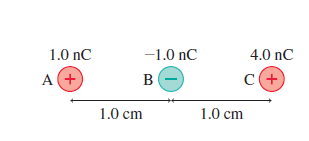
What is the net electric force on charge A in FIGURE EX22.17? 1.0 nC -1.0 nC 4.0 nC B 1.0 cm 1.0 cm
Two protons are 2.0 fm apart.a. What is the magnitude of the electric force on one proton due to the other proton?b. What is the magnitude of the gravitational force on one proton due to the other proton?c. What is the ratio of the electric force to the gravitational force?
A small glass bead has been charged to +20 nC. A small metal ball bearing 1.0 cm above the bead feels a 0.018 N downward electric force. What is the charge on the ball bearing?
The electric force on a charged particle in an electric field is F.What will be the force if the particle’s charge is tripled and the electric field strength is halved?
Two small plastic spheres each have a mass of 2.0 g and a charge of -50.0 nC. They are placed 2.0 cm apart (center to center).a. What is the magnitude of the electric force on each sphere?b. By what factor is the electric force on a sphere larger than its weight?
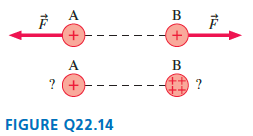
Charges A and B in FIGURE Q22.14 are equal. Each charge exerts a force on the other of magnitude F. Suppose the charge of B is increased by a factor of 4, but everything else is unchanged. In terms of F, (a) What is the magnitude of the force on A, (b) What is the magnitude of the force on B? A B
Two 1.0 kg masses are 1.0 m apart (center to center) on a frictionless table. Each has +10 μC of charge.a. What is the magnitude of the electric force on one of the masses?b. What is the initial acceleration of this mass if it is released and allowed to move?
Reproduce FIGURE Q22.13 on your paper. Then draw a dot (or dots) on the figure to show the position (or positions) where an electron would experience no net force. | | | FIGURE Q22.13
You have two neutral metal spheres on wood stands. Devise a procedure for charging the spheres so that they will have opposite charges of exactly equal magnitude. Use charge diagrams to explain your procedure.
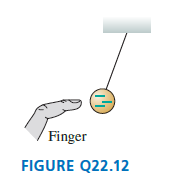
If you bring your finger near a lightweight, negatively charged hanging ball, the ball swings over toward your finger as shown in FIGURE Q22.12. Use charge diagrams and words to explain this observation. Finger FIGURE Q22.12
You have two neutral metal spheres on wood stands. Devise a procedure for charging the spheres so that they will have like charges of exactly equal magnitude. Use charge diagrams to explain your procedure.
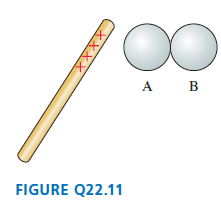
Metal spheres A and B in FIGURE Q22.11 are initially neutral and are touching. A positively charged rod is brought near A, but not touching. Is A now positive, negative, or neutral? Use both charge diagrams and words to explain. A B FIGURE Q22.11
Two neutral metal spheres on wood stands are touching. A negatively charged rod is held directly above the top of the left sphere, not quite touching it. While the rod is there, the right sphere is moved so that the spheres no longer touch. Then the rod is withdrawn. Afterward, what is the charge
A negatively charged electroscope has separated leaves.a. Suppose you bring a negatively charged rod close to the top of the electroscope, but not touching. How will the leaves respond? Use both charge diagrams and words to explain.b. How will the leaves respond if you bring a positively charged
Figure 22.8 showed how an electroscope becomes negatively charged. The leaves will also repel each other if you touch the electroscope with a positively charged glass rod. Use a series of charge diagrams to explain what happens and why the leaves repel each other.
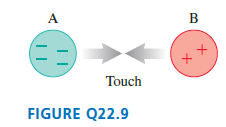
Metal sphere A in FIGURE Q22.9 has 4 units of negative charge and metal sphere B has 2 units of positive charge. The two spheres are brought into contact. What is the final charge state of each sphere? Explain. B A Touch FIGURE Q22.9
A linear accelerator uses alternating electric fields to accelerate electrons to close to the speed of light. A small number of the electrons collide with a target, but a large majority pass through the target and impact a beam dump at the end of the accelerator. In one experiment the beam dump
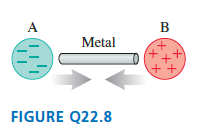
The two oppositely charged metal spheres in FIGURE Q22.8 have equal quantities of charge. They are brought into contact with a neutral metal rod. What is the final charge state of each sphere and of the rod? Use both charge diagrams and words to explain. A B Metal ++ FIGURE Q22.8
A chemical reaction takes place among 3 molecular ions that have each lost 2 electrons, 2 molecular ions that have each gained 3 electrons, and 1 molecular ion that has gained 2 electrons. The products of the reaction are two neutral molecules and multiple molecular ions that each have a charge of
Suppose there exists a third type of charge in addition to the two types we’ve called glass and plastic. Call this third type X charge.What experiment or series of experiments would you use to test whether an object has X charge? State clearly how each possible outcome of the experiments is to be
What mass of aluminum has a total nuclear charge of 1.0 C?Aluminum has atomic number 13.
A plastic balloon that has been rubbed with wool will stick to a wall. Can you conclude that the wall is charged? If so, where does the charge come from? If not, why does the balloon stick?
What is the total charge of all the electrons in 1.0 L of liquid water?
A lightweight metal ball hangs by a thread. When a charged rod is held near, the ball moves toward the rod, touches the rod, then quickly “flies away” from the rod. Explain this behavior.
A glass rod that has been charged to +12 nC touches a metal sphere. Afterward, the rod’s charge is +8.0 nC.a. What kind of charged particle was transferred between the rod and the sphere, and in which direction? That is, did it move from the rod to the sphere or from the sphere to the rod?b. How
Charged plastic and glass rods hang by threads.a. An object repels the plastic rod. Can you predict what it will do to the glass rod? If so, what? If not, why not?b. A different object attracts the plastic rod. Can you predict what it will do to the glass rod? If so, what? If not, why not?
A plastic rod that has been charged to -15 nC touches a metal sphere. Afterward, the rod’s charge is -10 nC.a. What kind of charged particle was transferred between the rod and the sphere, and in which direction? That is, did it move from the rod to the sphere or from the sphere to the rod?b. How
Four lightweight balls A, B, C, and D are suspended by threads.Ball A has been touched by a plastic rod that was rubbed with wool. When the balls are brought close together, without touching, the following observations are made:• Balls B, C, and D are attracted to ball A.• Balls B and D have no
A plastic rod is charged to -12 nC by rubbing.a. Have electrons been added to the rod or protons removed?b. How many electrons have been added or protons removed?
Can a conductor be charged? If so, how would you charge a conductor? If not, why not?
A glass rod is charged to +8.0 nC by rubbing.a. Have electrons been removed from the rod or protons added?b. How many electrons have been removed or protons added?
Can an insulator be charged? If so, how would you charge an insulator? If not, why not?
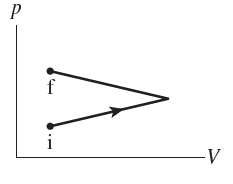
An moles of a diatomic gas with CV = 5/2 R has initial pressure pi and volume Vi. The gas undergoes a process in which the pressure is directly proportional to the volume until the rms speed of the molecules has doubled.a. Show this process on a pV diagram.b. How much heat does this process
A gas of 1.0 × 10²⁰ atoms or molecules has 1.0 J of thermal energy. Its molar specific heat at constant pressure is 20.8 J/mol K.What is the temperature of the gas?
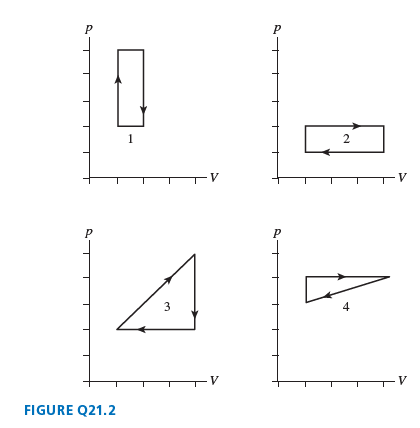
Rank in order, from largest to smallest, the amount of work (Ws)1to (Ws)4done by the gas in each of the cycles shown in FIGURE Q21.2. Explain. FIGURE Q21.2 2. 3.
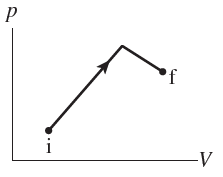
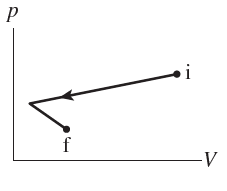
In going from i to f in each of the three processes of FIGURE Q21.1, is work done by the system (W < 0, Ws> 0), is work done on the system (W > 0, Ws< 0), or is no net work done? a. b. c. of i V
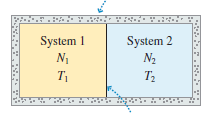
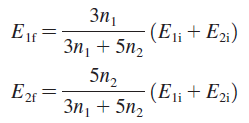
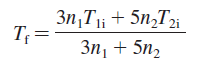
Consider a container like that shown in Figure 20.12, with n1 moles of a monatomic gas on one side and n2moles of a diatomic gas on the other. The monatomic gas has initial temperature T1i.Figure 20.12The diatomic gas has initial temperature T2i.a. Show that the equilibrium thermal energies
A 1.0 kg ball is at rest on the floor in a 2.0 m × 2.0 m × 2.0 m room of air at STP. Air is 80% nitrogen (N2) and 20% oxygen (O2) by volume.a. What is the thermal energy of the air in the room?b. What fraction of the thermal energy would have to be conveyed to the ball for it to be spontaneously
At what temperature does the rms speed of(a) A nitrogen molecule(b) A hydrogen molecule equal the escape speed from the earth’s surface?(c) You’ll find that these temperatures are very high, so you might think that the earth’s gravity could easily contain both gases. But not all molecules
The rms speed of the molecules in 1.0 g of hydrogen gas is 1800 m/s.a. What is the total translational kinetic energy of the gas molecules?b. What is the thermal energy of the gas?c. 500 J of work are done to compress the gas while, in the same process, 1200 J of heat energy are transferred from
2.0 g of helium at an initial temperature of 300 K interacts thermally with 8.0 g of oxygen at an initial temperature of 600 K.a. What is the initial thermal energy of each gas?b. What is the final thermal energy of each gas?c. How much heat energy is transferred, and in which direction?d. What is
A 100 cm3 box contains helium at a pressure of 2.0 atm and a temperature of 100°C. It is placed in thermal contact with a 200 cm3 box containing argon at a pressure of 4.0 atm and a temperature of 400°C.a. What is the initial thermal energy of each gas?b. What is the final thermal energy of each
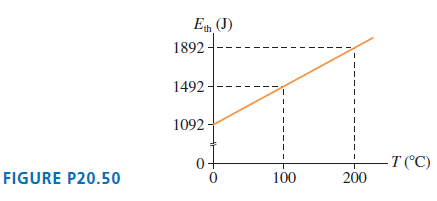
FIGURE P20.50 shows the thermal energy of 0.14 mol of gas as a function of temperature. What is CV for this gas? E (J) 1892--- 1492 - 1092 T (°C) FIGURE P20.50 100 200
A 10 cm × 10 cm × 10 cm box contains 0.010 mol of nitrogen at 20°C. What is the rate of collisions (collisions/s) on one wall of the box?
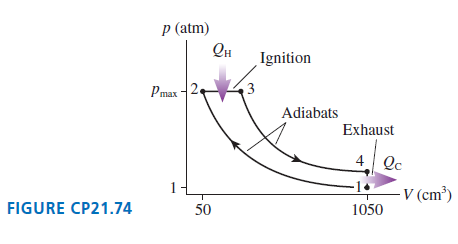
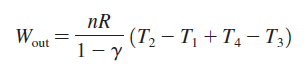
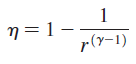
FIGURE CP21.74 shows the Diesel cycle. It is similar to the Otto cycle (see Problem 21.73), but there are two important differences.First, the fuel is not admitted until the air is fully compressed at point 2. Because of the high temperature at the end of an adiabatic compression, the fuel begins
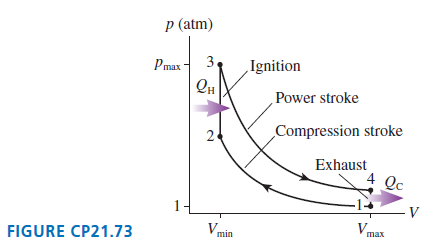
The gasoline engine in your car can be modeled as the Otto cycle shown in FIGURE CP21.73. A fuel-air mixture is sprayed into the cylinder at point 1, where the piston is at its farthest distance from the spark plug. This mixture is compressed as the piston moves toward the spark plug during the
A heat engine using a diatomic ideal gas goes through the following closed cycle:■ Isothermal compression until the volume is halved.■ Isobaric expansion until the volume is restored to its initial value.■ Isochoric cooling until the pressure is restored to its initial value.What are the
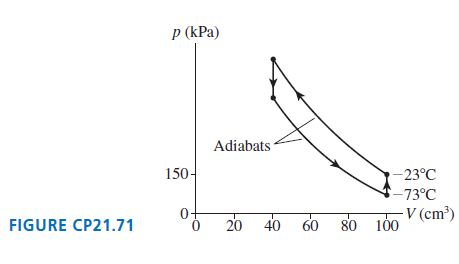
A refrigerator using helium gas operates on the reversed cycle shown in FIGURE CP21.71. What are the refrigerator??s (a) Coefficient of performance (b) Power input if it operates at 60 cycles per second? p (kPa) Adiabats 150- -23°C -73°C 0+ 20 40 60 80 100 V (cm³) FIGURE CP21.71
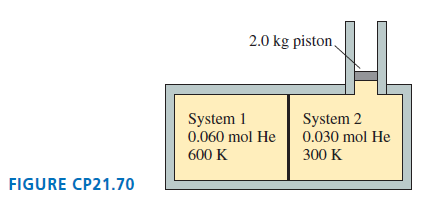
FIGURE CP21.70 shows two insulated compartments separated by a thin wall. The left side contains 0.060 mol of helium at an initial temperature of 600 K and the right side contains 0.030 mol of helium at an initial temperature of 300 K. The compartment on the right is attached to a vertical
100 mL of water at 15°C is placed in the freezer compartment of a refrigerator with a coefficient of performance of 4.0. How much heat energy is exhausted into the room as the water is changed to ice at -15°C?
You are given the equation(s) used to solve a problem. For each of these, you are toa. Write a realistic problem for which this is the correct equation(s).b. Finish the solution of the problem.400 kJ = 1/2(pmax - 100 kPa)(3.0 m3 - 1.0 m3)
Showing 2000 - 2100
of 3693
First
14
15
16
17
18
19
20
21
22
23
24
25
26
27
28
Last
Step by Step Answers

 Get 50% OFF
Claim Now
Get 50% OFF
Claim Now