New Semester
Started
Get
50% OFF
Study Help!
--h --m --s
Claim Now
Question Answers
Textbooks
Find textbooks, questions and answers
Oops, something went wrong!
Change your search query and then try again
S
Books
FREE
Study Help
Expert Questions
Accounting
General Management
Mathematics
Finance
Organizational Behaviour
Law
Physics
Operating System
Management Leadership
Sociology
Programming
Marketing
Database
Computer Network
Economics
Textbooks Solutions
Accounting
Managerial Accounting
Management Leadership
Cost Accounting
Statistics
Business Law
Corporate Finance
Finance
Economics
Auditing
Tutors
Online Tutors
Find a Tutor
Hire a Tutor
Become a Tutor
AI Tutor
AI Study Planner
NEW
Sell Books
Search
Search
Sign In
Register
study help
physics
physics scientists and engineers
Physics for Scientists and Engineers A Strategic Approach with Modern Physics 4th edition Randall D. Knight - Solutions
You are given the equation(s) used to solve a problem. For each of these, you are toa. Write a realistic problem for which this is the correct equation(s).b. Finish the solution of the problem.0.20 = 1 - QC/QHWout = QH - QC = 20 J
You are given the equation(s) used to solve a problem. For each of these, you are toa. Write a realistic problem for which this is the correct equation(s).b. Finish the solution of the problem.4.0 = QC/WinQH = 100 J
You are given the equation(s) used to solve a problem. For each of these, you are toa. Write a realistic problem for which this is the correct equation(s).b. Finish the solution of the problem.0.80 = 1 - (0°C + 273)/(TH + 273)
A heat engine with 0.20 mol of a monatomic ideal gas initially fills a 2000 cm3 cylinder at 600 K. The gas goes through the following closed cycle:■ Isothermal expansion to 4000 cm3.■ Isochoric cooling to 300 K.■ Isothermal compression to 2000 cm3.■ Isochoric heating to 600 K.How much work
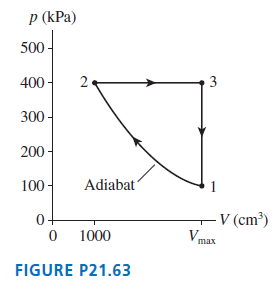
The heat engine shown in FIGURE P21.63 uses 0.020 mol of a diatomic gas as the working substance. a. Determine T1, T2, and T3.b. Make a table that shows ΔEth, Ws, and Q for each of the three processes.c. What is the engine??s thermal efficiency? Р (КРа) 500 - 400 - 2. 3 300 - 200 - 100-
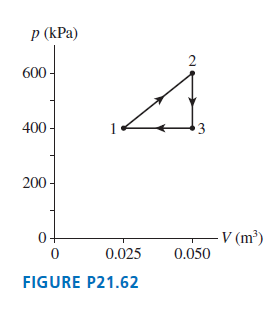
The heat engine shown in FIGURE P21.62 uses 2.0 mol of a monatomic gas as the working substance.a. Determine T1, T2, and T3.b. Make a table that shows ΔEth, Ws, and Q for each of the three processes.c. What is the engine€™s thermal efficiency? p (kPa) 600 - 400 - 200 - – (
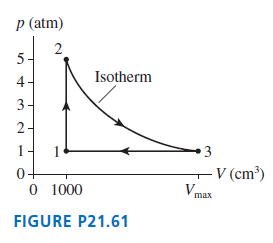
A heat engine using 120 mg of helium as the working substance follows the cycle shown in FIGURE P21.61. a. Determine the pressure, temperature, and volume of the gas at points 1, 2, and 3.b. What is the engine??s thermal efficiency?c. What is the maximum possible efficiency of a heat engine that
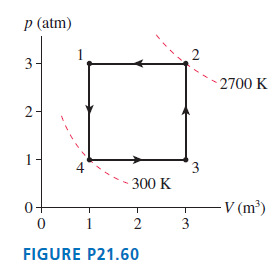
FIGURE P21.60 is the pV diagram of Example 21.2, but now the device is operated in reverse. a. During which processes is heat transferred into the gas?b. Is this QH, heat extracted from a hot reservoir, or QC, heat extracted from a cold reservoir? Explain.c. Determine the values of QH and QC.d. Is
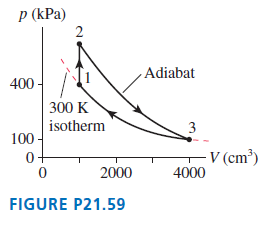
A heat engine uses a diatomic gas that follows the pV cycle in FIGURE P21.59. a. Determine the pressure, volume, and temperature at point 2.b. Determine ΔEth, Ws, and Q for each of the three processes.Put your results in a table for easy reading.c. How much work does this engine do per cycle and
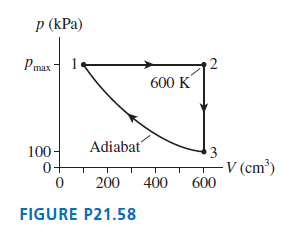
A heat engine using a monatomic gas follows the cycle shown in FIGURE P21.58. a. Find Ws, Q, and ΔEth for each process in the cycle. Display your results in a table.b. What is the thermal efficiency of this heat engine? p (kPa) Pmax 2 600 K 100- Adiabat 3 - V (cm³) 600 0+ 200 400 FIGURE P21.58
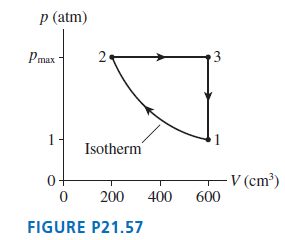
FIGURE P21.57 shows the cycle for a heat engine that uses a gas having Ï’ = 1.25. The initial temperature is T1= 300 K, and this engine operates at 20 cycles per second.a. What is the power output of the engine?b. What is the engine€™s thermal efficiency? p (atm) Pmax - 1
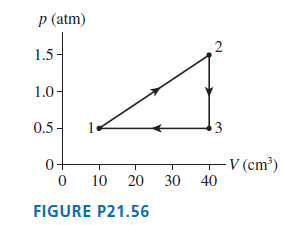
A heat engine using a diatomic gas follows the cycle shown in FIGURE P21.56. Its temperature at point 1 is 20°C.a. Determine Ws, Q, and ΔEthfor each of the three processes in this cycle. Display your results in a table.b. What is the thermal efficiency of this heat engine?c. What is
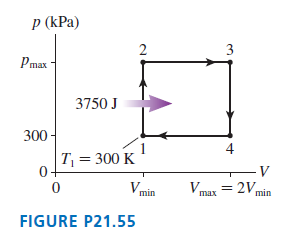
A heat engine using 1.0 mol of a monatomic gas follows the cycle shown in FIGURE P21.55. 3750 J of heat energy is transferred to the gas during process 1 †’ 2.a. Determine Ws, Q, and ΔEthfor each of the four processes in this cycle. Display your results in a table.b. What is
Engineers testing the efficiency of an electric generator gradually vary the temperature of the hot steam used to power it while leaving the temperature of the cooling water at a constant 20°C.They find that the generator’s efficiency increases at a rate of 3.5 × 10⁻⁴ K-1 at steam temperatures
The electric output of a power plant is 750 MW. Cooling water flows through the power plant at the rate 1.0 × 10⁸ L/h. The cooling water enters the plant at 16°C and exits at 27°C. What is the power plant’s thermal efficiency?
A nuclear power plant generates 3000 MW of heat energy from nuclear reactions in the reactor’s core. This energy is used to boil water and produce high-pressure steam at 300°C. The steam spins a turbine, which produces 1000 MW of electric power, then the steam is condensed and the water is
A typical coal-fired power plant burns 300 metric tons of coal every hour to generate 750 MW of electricity. 1 metric ton = 1000 kg. The density of coal is 1500 kg/m3 and its heat of combustion is 28 MJ/kg. Assume that all heat is transferred from the fuel to the boiler and that all the work done
Consider a 1.0 MW power plant (this is the useful output in the form of electric energy) that operates between 30°C and 450°C at 65% of the Carnot efficiency. This is enough electric energy for about 750 homes. One way to use energy more efficiently would be to use the 30°C “waste” energy to
A car’s internal combustion engine can be modeled as a heat engine operating between a combustion temperature of 1500°C and an air temperature of 20°C with 30% of the Carnot efficiency.The heat of combustion of gasoline is 47 kJ/g. What mass of gasoline is burned to accelerate a 1500 kg car
A heat engine running backward is called a refrigerator if its purpose is to extract heat from a cold reservoir. The same engine running backward is called a heat pump if its purpose is to exhaust warm air into the hot reservoir. Heat pumps are widely used for home heating. You can think of a heat
A Carnot heat engine and an ordinary refrigerator with coefficient of performance 2.00 operate between reservoirs at 350 K and 250 K. The work done by the Carnot heat engine drives the refrigerator. If the heat engine extracts 10.0 J of energy from the hot reservoir, how much energy does the
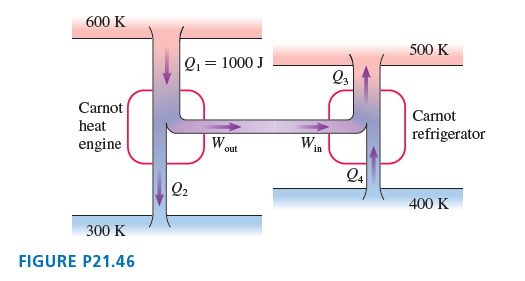
FIGURE P21.46 shows a Carnot heat engine driving a Carnot refrigerator.a. Determine Q2, Q3, and Q4.b. Is Q3greater than, less than, or equal to Q1?c. Do these two devices, when operated together in this way, violate the second law? 600 K 500 K Q1= 1000 J Carnot Carnot heat refrigerator W. out Wn
A Carnot engine operates between temperatures of 5°C and 500°C. The output is used to run a Carnot refrigerator operating between -5°C and 25°C. How many joules of heat energy does the refrigerator exhaust into the room for each joule of heat energy used by the heat engine?
A Carnot heat engine operates between reservoirs at 182°C and 0°C. If the engine extracts 25 J of energy from the hot reservoir per cycle, how many cycles will it take to lift a 10 kg mass a height of 10 m?
There has long been an interest in using the vast quantities of thermal energy in the oceans to run heat engines. A heat engine needs a temperature difference, a hot side and a cold side. Conveniently, the ocean surface waters are warmer than the deep ocean waters. Suppose you build a floating
A freezer with a coefficient of performance 30% that of a Carnot refrigerator keeps the inside temperature at -22°C in a 25°C room. 3.0 L of water at 20°C are placed in the freezer. How long does it take for the water to freeze if the freezer’s compressor does work at the rate of 200 W while
An ideal refrigerator utilizes a Carnot cycle operating between 0°C and 25°C. To turn 10 kg of liquid water at 0°C into 10 kg of ice at 0°C,(a) How much heat is exhausted into the room(b) How much energy must be supplied to the refrigerator?
Prove that the coefficient of performance of a Carnot refrigerator is KCarnot = TC /(TH - TC).
A Carnot refrigerator operates between reservoirs at -20°C and 50°C in a 25°C room. The refrigerator is a 40 cm × 40 cm × 40 cm box. Five of the walls are perfect insulators, but the sixth is a 1.0-cm-thick piece of stainless steel. What electric power does the refrigerator require to maintain
Prove that the work done in an adiabatic process i → f is Ws = (pfVf - piVi)/(1 - ϒ).
A heat engine with 50% of the Carnot efficiency operates between reservoirs at 20°C and 200°C. The engine inputs heat energy at an average rate of 63 W while compressing a spring 22 cm in 0.50 s. What is the spring constant?
The engine that powers a crane burns fuel at a flame temperature of 2000°C. It is cooled by 20°C air. The crane lifts a 2000 kg steel girder 30 m upward. How much heat energy is transferred to the engine by burning fuel if the engine is 40% as efficient as a Carnot engine?
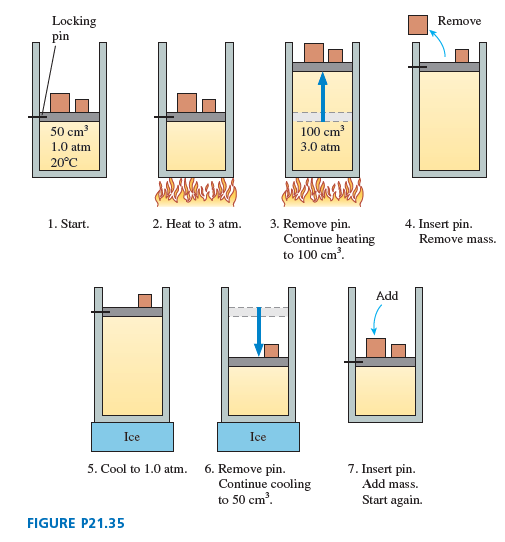
FIGURE P21.35 shows a heat engine going through one cycle.The gas is diatomic. The masses are such that when the pin is removed, in steps 3 and 6, the piston does not move.a. Draw the pV diagram for this heat engine.b. How much work is done per cycle?c. What is this engine€™s thermal
A Carnot heat engine with thermal efficiency 1/3 is run backward as a Carnot refrigerator. What is the refrigerator’s coefficient of performance?
The coefficient of performance of a refrigerator is 5.0. The compressor uses 10 J of energy per cycle.a. How much heat energy is exhausted per cycle?b. If the hot-reservoir temperature is 27°C, what is the lowest possible temperature in °C of the cold reservoir?
A Carnot refrigerator operating between -20°C and +20°C extracts heat from the cold reservoir at the rate 200 J/s. What are(a) The coefficient of performance of this refrigerator,(b) The rate at which work is done on the refrigerator,(c) The rate at which heat is exhausted to the hot side?
A heat engine operating between a hot reservoir at 500°C and a cold reservoir at 0°C is 60% as efficient as a Carnot engine. If this heat engine and the Carnot engine do the same amount of work, what is the ratio QH/(QH)Carnot ?
A heat engine operating between energy reservoirs at 20°C and 600°C has 30% of the maximum possible efficiency. How much energy must this engine extract from the hot reservoir to do 1000 J of work?
The ideal gas in a Carnot engine extracts 1000 J of heat energy during the isothermal expansion at 300°C. How much heat energy is exhausted during the isothermal compression at 50°C?
A Carnot engine whose hot-reservoir temperature is 400°C has a thermal efficiency of 40%. By how many degrees should the temperature of the cold reservoir be decreased to raise the engine’s efficiency to 60%?
A Carnot engine operating between energy reservoirs at temperatures 300 K and 500 K produces a power output of 1000 W.What are(a) The thermal efficiency of this engine,(b) The rate of heat input, in W,(c) The rate of heat output, in W?
a. A heat engine does 200 J of work per cycle while exhausting 600 J of heat to the cold reservoir. What is the engine’s thermal efficiency?b. A Carnot engine with a hot-reservoir temperature of 400°C has the same thermal efficiency. What is the cold-reservoir temperature in °C?
A heat engine does 10 J of work and exhausts 15 J of waste heat during each cycle.a. What is the engine’s thermal efficiency?b. If the cold-reservoir temperature is 20°C, what is the minimum possible temperature in °C of the hot reservoir?
At what cold-reservoir temperature (in °C) would a Carnot engine with a hot-reservoir temperature of 427°C have an efficiency of 60%?
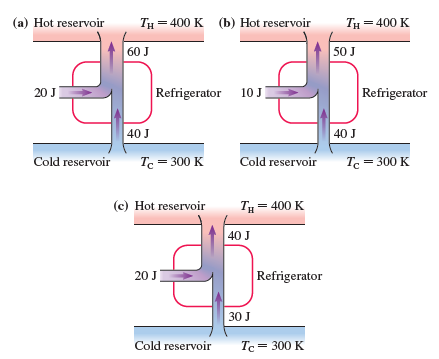
Which, if any, of the refrigerators in FIGURE EX21.23 violate (a) The first law of thermodynamics(b) The second law of thermodynamics? Explain. (a) Hot reservoir (Ь) Hot reservoir TH 3 400 K TH = 400 K 50 J 60 J Refrigerator 20 J Refrigerator 10 J 40 J 40 J Tc = 300 K Cold reservoir Cold
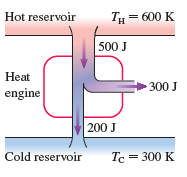
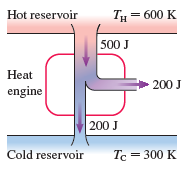
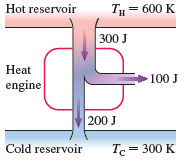
Which, if any, of the heat engines in FIGURE EX21.22 violate (a) The first law of thermodynamics(b) The second law of thermodynamics? Explain.a.b.c. Hot reservoir T = 600 K 500 J Heat 300 J engine 200 J Cold reservoir Tc = 300 K Hot reservoir TH = 600 K 500 J Heat 200 J engine 200 J Cold
An air conditioner removes 5.0 × 10⁵ J/min of heat from a house and exhausts 8.0 × 10⁵ J/min to the hot outdoors.a. How much power does the air conditioner’s compressor require?b. What is the air conditioner’s coefficient of performance?
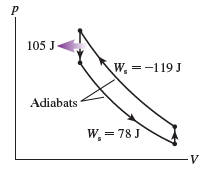
What are(a) The heat extracted from the cold reservoir(b) The coefficient of performance for the refrigerator shown in FIGURE EX21.20? 105 J- W, =-119 J Adiabats W, = 78 J
The coefficient of performance of a refrigerator is 6.0. The refrigerator’s compressor uses 115 W of electric power and is 95% efficient at converting electric power into work. What are (a) The rate at which heat energy is removed from inside the refrigerator(b) The rate at which heat energy
At what pressure ratio does a Brayton cycle using a monatomic gas have an efficiency of 50%?
A heat engine uses a diatomic gas in a Brayton cycle. What is the engine’s thermal efficiency if the gas volume is halved during the adiabatic compression?
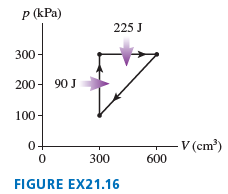
How much heat is exhausted to the cold reservoir by the heat engine shown in FIGURE EX21.16? p (kPa) 225 J 300- 200- 90 J 100- V (cm') 0+ 300 600 FIGURE EX21.16
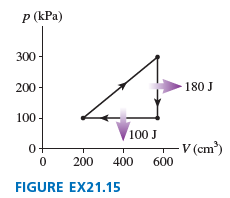
What are(a) The thermal efficiency(b) The heat extracted from the hot reservoir for the heat engine shown in FIGURE EX21.15? p (kPa) 300 180 J 200 100- 100 J V (cm) 600 200 400 FIGURE EX21.15
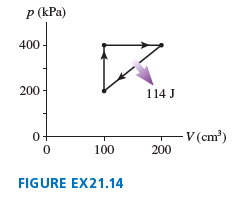
What are(a) Wout and QH(b) The thermal efficiency for the heat engine shown in FIGURE EX21.14? P (kPa) 400 - 200 - 114 J V(cm) 0+ 100 200 FIGURE EX21.14
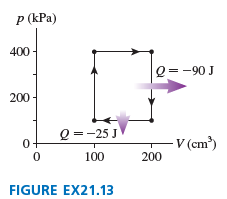
What are(a) Wout and QH(b) The thermal efficiency for the heat engine shown in FIGURE EX21.13? p (kPa) 400 Q = -90 J 200 Q =-25 J V (cm) 0- 100 200 FIGURE EX21.13
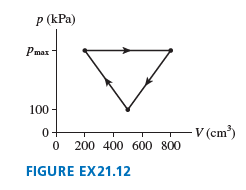
A gas following the pV trajectory of FIGURE EX21.12 does 60 J of work per cycle. What is pmax? P (kPa) Pmax 100 - V (cm) 0+ O 200 400 600 800 FIGURE EX21.12
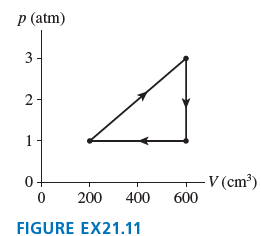
How much work is done per cycle by a gas following the pV trajectory of FIGURE EX21.11? p (atm) 3- 2- 1- V (cm³) 600 0+ 200 400 FIGURE EX21.11
The first and second laws of thermodynamics are sometimes stated as “You can’t win” and “You can’t even break even.” Do these sayings accurately characterize the laws of thermodynamics as applied to heat engines? Why or why not?
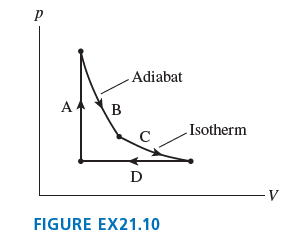
The cycle of FIGURE EX21.10 consists of four processes. Make a table with rows labeled A to D and columns labeled ΔEth, Ws, and Q. Fill each box in the table with +, -, or 0 to indicate whether the quantity increases, decreases, or stays the same during that process. Adiabat A Isotherm
It gets pretty hot in your apartment. In browsing the Internet, you find a company selling small “room air conditioners.” You place the air conditioner on the floor, plug it in, and—the advertisement says—it will lower the room temperature up to 10°F. Should you order one? Explain.
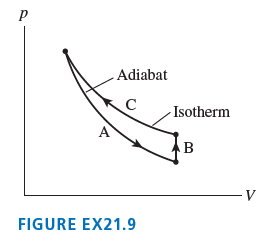
The cycle of FIGURE EX21.9 consists of three processes. Make a table with rows labeled A€“C and columns labeled ΔEth, Ws, and Q. Fill each box in the table with +, -, or 0 to indicate whether the quantity increases, decreases, or stays the same during that process. Adiabat -
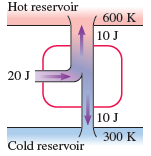
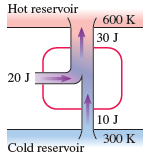
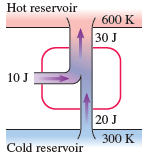
Do the energy-transfer diagrams in FIGURE Q21.9 represent possible refrigerators? If not, what is wrong?a.b.c. Hot reservoir 600 K 10 J 20 J |10 J 300 K Cold reservoir Hot reservoir 600 K 30 J 20 J 10 J 300 K Cold reservoir
1.0 L of 20°C water is placed in a refrigerator. The refrigerator’s motor must supply an extra 8.0 W of power to chill the water to 5°C in 1.0 h. What is the refrigerator’s coefficient of performance?
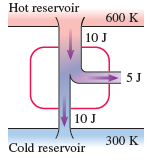
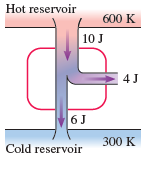
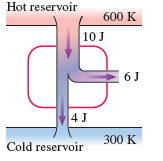
Do the energy-transfer diagrams in FIGURE Q21.8 represent possible heat engines? If not, what is wrong?a.b.c. Hot reservoir 600 K 10 J 10 J 300 K Cold reservoir Hot reservoir 600 K 10 J 6J 300 K Cold reservoir
The power output of a car engine running at 2400 rpm is 500 kW. How much(a) Work is done(b) Heat is exhausted per cycle if the engine’s thermal efficiency is 20%? Give your answers in kJ.
A heat engine satisfies Wout = Qnet. Why is there no ΔEth term in this relationship?
A 32%-efficient electric power plant produces 900 MW of electric power and discharges waste heat into 20°C ocean water.Suppose the waste heat could be used to heat homes during the winter instead of being discharged into the ocean. A typical American house requires an average of 20 kW for heating.
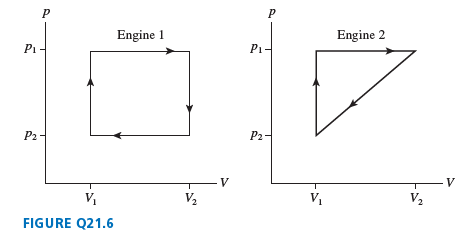
FIGURE Q21.6 shows the thermodynamic cycles of two heat engines. Which heat engine has the larger thermal efficiency? Or are they the same? Explain. Engine 1 Engine 2 Pi P1- P2- P2- - V V2 v, V, V2 FIGURE Q21.6
A refrigerator requires 200 J of work and exhausts 600 J of heat per cycle. What is the refrigerator’s coefficient of performance?
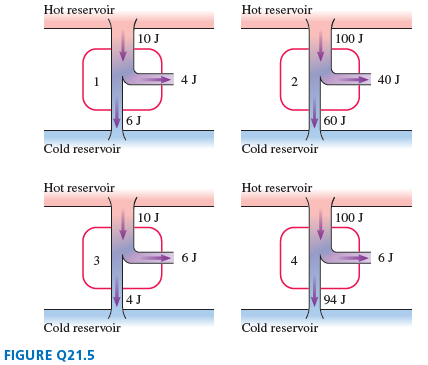
Rank in order, from largest to smallest, the thermal efficiencies η1to η4of the four heat engines in FIGURE Q21.5. Explain. Hot reservoir Hot reservoir 10 J 100 J 4 J 2 40 J 6J 60 J Cold reservoir Cold reservoir Hot reservoir Hot reservoir 10 J 100 J 3 6 J 4 6J V4J 94 J Cold reservoir Cold
50 J of work are done per cycle on a refrigerator with a coefficient of performance of 4.0. How much heat is(a) Extracted from the cold reservoir(b) Exhausted to the hot reservoir per cycle?
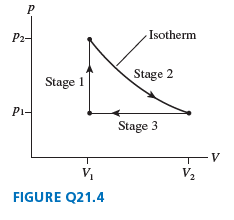
FIGURE Q21.4 shows the pV diagram of a heat engine. During which stage or stages is (a) Heat added to the gas, (b) Heat removed from the gas, (c) Work done on the gas, (d) Work done by the gas? P2- Isotherm Stage 2 Stage 1 P1- Stage 3 V V. V2 FIGURE Q21.4
A heat engine extracts 55 kJ of heat from the hot reservoir each cycle and exhausts 40 kJ of heat. What are(a) The thermal efficiency(b) The work done per cycle?
Could you have a heat engine with η > 1? Explain.
A heat engine with a thermal efficiency of 40% does 100 J of work per cycle. How much heat is(a) Extracted from the hot reservoir(b) Exhausted to the cold reservoir per cycle?
A heat engine does 200 J of work per cycle while exhausting 400 J of waste heat. What is the engine’s thermal efficiency?
An experiment you’re designing needs a gas with ϒ = 1.50.You recall from your physics class that no individual gas has this value, but it occurs to you that you could produce a gas with ϒ = 1.50 by mixing together a monatomic gas and a diatomic gas.What fraction of the molecules need to be
n1 moles of a monatomic gas and n2 moles of a diatomic gas are mixed together in a container.a. Derive an expression for the molar specific heat at constant volume of the mixture.b. Show that your expression has the expected behavior if n1 → 0 or n2 → 0.
The 2010 Nobel Prize in Physics was awarded for the discovery of graphene, a two-dimensional form of carbon in which the atoms form a two-dimensional crystal-lattice sheet only one atom thick. Predict the molar specific heat of graphene.Give your answer as a multiple of R.
A monatomic gas is adiabatically compressed to 1/8 of its initial volume. Does each of the following quantities change? If so, does it increase or decrease, and by what factor? If not, why not?a. The rms speed.b. The mean free path.c. The thermal energy of the gas.d. The molar specific heat at
In the discussion following Equation 20.43 it was said that Q1 = -Q2. Prove that this is so.
A monatomic gas and a diatomic gas have equal numbers of moles and equal temperatures. Both are heated at constant pressure until their volume doubles. What is the ratio Qdiatomic /Qmonatomic?
A water molecule has its three atoms arranged in a “V” shape, so it has rotational kinetic energy around any of three mutually perpendicular axes. However, like diatomic molecules, its vibrational modes are not active at temperatures below 1000 K.What is the thermal energy of 2.0 mol of steam
Scientists studying the behavior of hydrogen at low temperatures need to lower the temperature of 0.50 mol of hydrogen gas from 300 K to 30 K. How much thermal energy must they remove from the gas?
5.0 × 10²³ nitrogen molecules collide with a 10 cm2 wall each second. Assume that the molecules all travel with a speed of 400 m/s and strike the wall head-on. What is the pressure on the wall?
On earth, STP is based on the average atmospheric pressure at the surface and on a phase change of water that occurs at an easily produced temperature, being only slightly cooler than the average air temperature. The atmosphere of Venus is almost entirely carbon dioxide (CO2), the pressure at the
Uranium has two naturally occurring isotopes. 238U has a natural abundance of 99.3% and 235U has an abundance of 0.7%.It is the rarer 235U that is needed for nuclear reactors. The isotopes are separated by forming uranium hexafluoride, UF6, which is a gas, then allowing it to diffuse through a
Equation 20.3 is the mean free path of a particle through a gas of identical particles of equal radius. An electron can be thought of as a point particle with zero radius.a. Find an expression for the mean free path of an electron through a gas.b. Electrons travel 3 km through the Stanford Linear
a. Find an expression for the vrms of gas molecules in terms of p, V, and the total mass of the gas M.b. A gas cylinder has a piston at one end that is moving outward at speed vpiston during an isobaric expansion of the gas. Find an expression for the rate at which vrms is changing in terms of
You are watching a science fiction movie in which the hero shrinks down to the size of an atom and fights villains while jumping from air molecule to air molecule. In one scene, the hero’s molecule is about to crash head-on into the molecule on which a villain is riding. The villain’s molecule
Interstellar space, far from any stars, is filled with a very low density of hydrogen atoms (H, not H2). The number density is about 1 atom/cm3 and the temperature is about 3 K.a. Estimate the pressure in interstellar space. Give your answer in Pa and in atm.b. What is the rms speed of the atoms?c.
Photons of light scatter off molecules, and the distance you can see through a gas is proportional to the mean free path of photons through the gas. Photons are not gas molecules, so the mean free path of a photon is not given by Equation 20.3, but its dependence on the number density of the gas
A mad engineer builds a cube, 2.5 m on a side, in which 6.2 cm-diameter rubber balls are constantly sent flying in random directions by vibrating walls. He will award a prize to anyone who can figure out how many balls are in the cube without entering it or taking out any of the balls. You decide
Dust particles are ≈ 10 mm in diameter. They are pulverized rock, with ρ ≈ 2500 kg/m3. If you treat dust as an ideal gas, what is the rms speed of a dust particle at 20°C?
From what height must an oxygen molecule fall in a vacuum so that its kinetic energy at the bottom equals the average energy of an oxygen molecule at 300 K?
The pressure inside a tank of neon is 150 atm. The temperature is 25°C. On average, how many atomic diameters does a neon atom move between collisions?
Two containers hold several balls. Once a second, one of the balls is chosen at random and switched to the other container.After a long time has passed, you record the number of balls in each container every second. In 10,000 s, you find 80 times when all the balls were in one container (either
4.0 mol of monatomic gas A interacts with 3.0 mol of monatomic gas B. Gas A initially has 9000 J of thermal energy, but in the process of coming to thermal equilibrium it transfers 1000 J of heat energy to gas B. How much thermal energy did gas B have initially?
2.0 mol of monatomic gas A initially has 5000 J of thermal energy.It interacts with 3.0 mol of monatomic gas B, which initially has 8000 J of thermal energy.a. Which gas has the higher initial temperature?b. What is the final thermal energy of each gas?
A rigid container holds 0.20 g of hydrogen gas. How much heat is needed to change the temperature of the gasa. From 50 K to 100 K?b. From 250 K to 300 K?c. From 2250 K to 2300 K?
Showing 2100 - 2200
of 3693
First
15
16
17
18
19
20
21
22
23
24
25
26
27
28
29
Last
Step by Step Answers

 Get 50% OFF
Claim Now
Get 50% OFF
Claim Now