New Semester
Started
Get
50% OFF
Study Help!
--h --m --s
Claim Now
Question Answers
Textbooks
Find textbooks, questions and answers
Oops, something went wrong!
Change your search query and then try again
S
Books
FREE
Study Help
Expert Questions
Accounting
General Management
Mathematics
Finance
Organizational Behaviour
Law
Physics
Operating System
Management Leadership
Sociology
Programming
Marketing
Database
Computer Network
Economics
Textbooks Solutions
Accounting
Managerial Accounting
Management Leadership
Cost Accounting
Statistics
Business Law
Corporate Finance
Finance
Economics
Auditing
Tutors
Online Tutors
Find a Tutor
Hire a Tutor
Become a Tutor
AI Tutor
AI Study Planner
NEW
Sell Books
Search
Search
Sign In
Register
study help
sciences
chemistry a molecular approach
Chemistry A Molecular Approach 5th Edition Nivaldo Tro - Solutions
A 1.20-g sample of dry ice is added to a 755 mL flask containing nitrogen gas at a temperature of 25.0 °C and a pressure of 725 mmHg. The dry ice sublimes (converts from solid to gas), and the mixture returns to 25.0 °C. What is the total pressure in the flask?
A 275-mL flask contains pure helium at a pressure of 752 torr. A second flask with a volume of 475 mL contains pure argon at a pressure of 722 torr. If we connect the two flasks through a stopcock and we open the stopcock, what is the partial pressure of each gas and the total pressure?
A gas mixture contains 1.25 g N2 and 0.85 g O2 in a 1.55 L container at 18 °C. Calculate the mole fraction and partial pressure of each component in the gas mixture.
What is the mole fraction of oxygen gas in air?What volume of air contains 10.0 g of oxygen gas at 273 K and 1.00 atm?
The hydrogen gas formed in a chemical reaction is collected over water at 30.0 °C at a total pressure of 732 mmHg. What is the partial pressure of the hydrogen gas collected in this way? If the total volume of gas collected is 722 mL, what mass of hydrogen gas is collected?
The air in a bicycle tire is bubbled through water and collected at 25 °C. If the total volume of gas collected is 5.45 L at a temperature of 25 °C and a pressure of 745 torr, how many moles of gas were in the bicycle tire?
The zinc in a copper-plated penny will dissolve in hydrochloric acid if the copper coating is filed down in several spots (so that the hydrochloric acid can get to the zinc). The reaction between the acid and the zinc is 2 H+ (aq) + Zn(s) → H2(g) + Zn2+ (aq).When the zinc in a certain penny
Consider the chemical reaction:How many liters of hydrogen gas are formed from the complete reaction of 15.7 g C? Assume that the hydrogen gas is collected at a pressure of 1.0 atm and a temperature of 355 K. (8)³H+ (8)05 (8)0²H + (S))
A heliox deep-sea diving mixture contains 2.0 g of oxygen to every 98.0 g of helium. What is the partial pressure of oxygen when this mixture is delivered at a total pressure of 8.5 atm?
Consider the chemical reaction:What mass of H2O is required to form 1.4 L of O2 at a temperature of 315 K and a pressure of 0.957 atm? 2 H₂O(1) - 2 H₂(g) + O₂(g)
CH3OH can be synthesized by the reaction:What volume of H2 gas (in L), at 748 mmHg and 86 °C, is required to synthesize 25.8 g CH3OH? How many liters of CO gas, measured under the same conditions, are required? CO(g) + 2 H₂(g) CH3OH(g)
Oxygen gas reacts with powdered aluminum according to the reaction:What volume of O2 gas (in L), measured at 782 mmHg and 25 °C, completely reacts with 53.2 g Al? 4 Al(s) + 3 O₂(8) 2 Al₂O3(s)
Automobile air bags inflate following a serious impact. The impact triggers the chemical reaction:If an automobile airbag has a volume of 11.8 L, what mass of NaN3 (in g) is required to fully inflate the airbag upon impact? Assume STP conditions. 2 NaN3(s) 2 Na(s) + 3 N₂(g)
Lithium reacts with nitrogen gas according to the reaction:What mass of lithium (in g) reacts completely with 58.5 mL of N2 gas at STP? 6 Li(s) + N₂(g) 2 LIŽN(s)
Hydrogen gas (a potential future fuel) can be formed by the reaction of methane with water according to the equation:In a particular reaction, 25.5 L of methane gas (measured at a pressure of 732 torr and a temperature of 25 °C) mixes with 22.8 L of water vapor (measured at a pressure of 702 torr
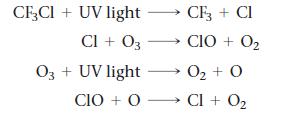
Ozone is depleted in the stratosphere by chlorine from CF3Cl according to this set of equations:What total volume of ozone at a pressure of 25.0 mmHg and a temperature of 225 K is destroyed when all of the chlorine from 15.0 g of CF3Cl goes through 10 cycles of the given reactions? CF3 + Cl CI + 03
Chlorine gas reacts with fluorine gas to form chlorine trifluoride.A 2.00-L reaction vessel, initially at 298 K, contains chlorine gas at a partial pressure of 337 mmHg and fluorine gas at a partial pressure of 729 mmHg. Identify the limiting reactant and determine the theoretical yield of ClF3 in
Carbon monoxide gas reacts with hydrogen gas to form methanol.A 1.50-L reaction vessel, initially at 305 K, contains carbon monoxide gas at a partial pressure of 232 mmHg and hydrogen gas at a partial pressure of 397 mmHg. Identify the limiting reactant and determine the theoretical yield of
Consider a 1.0-L sample of helium gas and a 1.0-L sample of argon gas, both at room temperature and atmospheric pressure.a. Do the atoms in the helium sample have the same average kinetic energy as the atoms in the argon sample?b. Do the atoms in the helium sample have the same average velocity as
A flask at room temperature contains exactly equal amounts (in moles) of nitrogen and xenon.a. Which of the two gases exerts the greater partial pressure?b. The molecules or atoms of which gas have the greater average velocity?c. The molecules or atoms of which gas have the greater average kinetic
Calculate the root mean square velocity and kinetic energy of F2, Cl2, and Br2 at 298 K. Rank these three halogens with respect to their rate of effusion.
Calculate the root mean square velocity and kinetic energy of CO, CO2, and SO3 at 298 K. Which gas has the greatest velocity?The greatest kinetic energy? The greatest effusion rate?
We separate U-235 from U-238 by fluorinating a sample of uranium to form UF6 (which is a gas) and then taking advantage of the different rates of effusion and diffusion for compounds containing the two isotopes. Calculate the ratio of effusion rates for 238UF6 and 235UF6. The atomic mass of U-235
Calculate the ratio of effusion rates for Ar and Kr.
A sample of neon effuses from a container in 76 seconds. The same amount of an unknown noble gas requires 155 seconds.Identify the second gas.
A sample of N2O effuses from a container in 42 seconds. How long will it take the same amount of gaseous I2 to effuse from the same container under identical conditions?
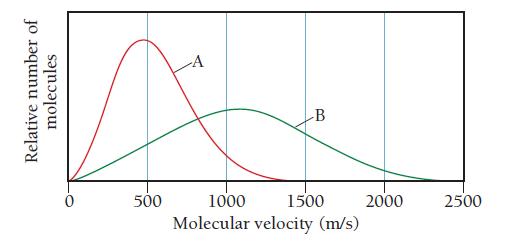
The graph shows the distribution of molecular velocities for two different molecules (A and B) at the same temperature. Which molecule has the higher molar mass? Which molecule has the higher rate of effusion? Relative number of molecules 500 -A -B 1000 1500 Molecular velocity (m/s) 2000 2500
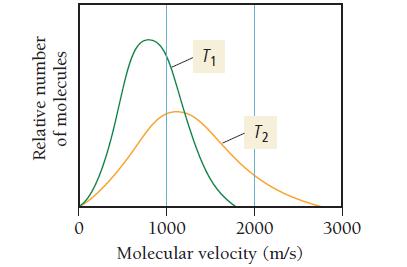
The graph shows the distribution of molecular velocities for the same molecule at two different temperatures (T1 and T2). Which temperature is greater? Explain. Relative number of molecules 0 T₁ T₂ 1000 Molecular velocity (m/s) 2000 3000
Which postulate of the kinetic molecular theory breaks down under conditions of high pressure? Explain.
Which postulate of the kinetic molecular theory breaks down under conditions of low temperature? Explain.
Use the van der Waals equation and the ideal gas equation to calculate the volume of 1.000 mol of neon at a pressure of 500.0 atm and a temperature of 355.0 K. Explain why the two values are different.
Use the van der Waals equation and the ideal gas equation to calculate the pressure exerted by 1.000 mol of Cl2 in a volume of 5.000 L at a temperature of 273.0 K. Explain why the two values are different.
A 2.85-g sample of an unknown chlorofluorocarbon decomposes and produces 564 mL of chlorine gas at a pressure of 752 mmHg and a temperature of 298 K. What is the percent chlorine (by mass) in the unknown chlorofluorocarbon?
Modern pennies are composed of zinc coated with copper. A student determines the mass of a penny to be 2.482 g and then makes several scratches in the copper coating (to expose the underlying zinc). The student puts the scratched penny in hydrochloric acid, where the following reaction occurs
The mass of an evacuated 255 mL flask is 143.187 g. The mass of the flask filled with 267 torr of an unknown gas at 25 °C is 143.289 g. Calculate the molar mass of the unknown gas.
A 118-mL flask is evacuated and found to have a mass of 97.129 g.When the flask is filled with 768 torr of helium gas at 35 °C, it has a mass of 97.171 g. Was the helium gas pure?
A gaseous hydrogen- and carbon-containing compound is decomposed and found to contain 82.66% carbon and 17.34% hydrogen by mass. The mass of 158 mL of the gas, measured at 556 mmHg and 25 °C, was 0.275 g. What is the molecular formula of the compound?
Consider the reaction:If ∪2 is collected over water at 40.0 °C and a total pressure of 745 mmHg, what volume of gas is collected for the complete reaction of 24.78 g of NiO? 2 NiO(s) →→→ 2 Ni(s) + 0₂(8)
A gaseous hydrogen- and carbon-containing compound is decomposed and found to contain 85.63% C and 14.37% H by mass. The mass of 258 mL of the gas, measured at STP, was 0.646 g. What is the molecular formula of the compound?
Consider the reaction:a. If 285.5 mL of SO2 reacts with 158.9 mL of O2 (both measured at 315 K and 50.0 mmHg), what is the limiting reactant and the theoretical yield of SO3?b. If 187.2 mL of SO3 is collected (measured at 315 K and 50.0 mmHg), what is the percent yield for the reaction? 2 SO₂(g)
Consider the reaction:If this reaction produces 15.8 g of Ag(s), what total volume of gas can be collected over water at a temperature of 25 °C and a total pressure of 752 mmHg? 2 Ag₂O(s) - > 4 Ag(s) + O₂(g)
When hydrochloric acid is poured over potassium sulfide, 42.9 mL of hydrogen sulfide gas is produced at a pressure of 752 torr and 25.8 °C. Write an equation for the gas-evolution reaction and determine how much potassium sulfide (in grams) reacted.
Ammonium carbonate decomposes upon heating according to the balanced equation:Calculate the total volume of gas produced at 22 °C and 1.02 atm by the complete decomposition of 11.83 g of ammonium carbonate. (NH4)2CO3(s)→→→→ 2NH3(g) + CO₂(g) + H₂O(g)
Ammonium nitrate decomposes explosively upon heating according to the balanced equation:Calculate the total volume of gas (at 125 °C and 748 mmHg) produced by the complete decomposition of 1.55 kg of ammonium nitrate. 2 NH4NO3(s)→→→→→2 N₂(g) + O₂(g) + 4H₂O(g)
Olympic cyclists fill their tires with helium to make them lighter. Calculate the mass of air in an air-filled tire and the mass of helium in a helium-filled tire. What is the mass difference between the two? Assume that the volume of the tire is 855 mL, that it is filled to a total pressure of 125
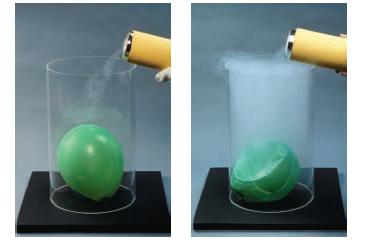
In a common classroom demonstration, a balloon is filled with air and drenched with liquid nitrogen. The balloon contracts as the gases within the balloon cool. Suppose a balloon initially contains 2.95 L of air at a temperature of 25.0 °C and a pressure of 0.998 atm. Calculate the expected volume
Gaseous ammonia is injected into the exhaust stream of a coalburning power plant to reduce the pollutant NO to N2 according to the reaction:Suppose that the exhaust stream of a power plant has a flow rate of 335 L/s at a temperature of 955 K and that the exhaust contains a partial pressure of NO of
The emission of NO2 by fossil fuel combustion can be prevented by injecting gaseous urea into the combustion mixture. The urea reduces NO (which oxidizes in air to form NO2) according to the reaction:Suppose that the exhaust stream of an automobile has a flow rate of 2.55 L/s at 655 K and contains
An ordinary gasoline can measuring 30.0 cm by 20.0 cm by 15.0 cm is evacuated with a vacuum pump. Assuming that virtually all of the air can be removed from inside the can and that atmospheric pressure is 14.7 psi, what is the total force (in pounds) on the surface of the can? Do you think that the
Twenty-five milliliters of liquid nitrogen (density = 0.807 g/mL) is poured into a cylindrical container with a radius of 10.0 cm and a length of 20.0 cm. The container initially contains only air at a pressure of 760.0 mmHg (atmospheric pressure) and a temperature of 298 K. If the liquid nitrogen
An 11.5-mL sample of liquid butane (density = 0.573 g/mL) is evaporated in an otherwise empty container at a temperature of 28.5 °C. The pressure in the container following evaporation is 892 torr. What is the volume of the container?
A 160.0-L helium tank contains pure helium at a pressure of 1855 psi and a temperature of 298 K. How many 3.5-L helium balloons will the helium in the tank fill? (Assume an atmospheric pressure of 1.0 atm and a temperature of 298 K.)
A scuba diver creates a spherical bubble with a radius of 2.5 cm at a depth of 30.0 m where the total pressure (including atmospheric pressure) is 4.00 atm. What is the radius of the bubble when it reaches the surface of the water? (Assume that the atmospheric pressure is 1.00 atm and the
A catalytic converter in an automobile uses a palladium or platinum catalyst (a substance that increases the rate of a reaction without being consumed by the reaction) to convert carbon monoxide gas to carbon dioxide according to the reaction:A chemist researching the effectiveness of a new
A particular balloon can be stretched to a maximum surface area of 1257 cm2. The balloon is filled with 3.0 L of helium gas at a pressure of 755 torr and a temperature of 298 K. The balloon is then allowed to rise in the atmosphere. If the atmospheric temperature is 273 K, at what pressure will the
A mixture of CO(g) and O2( g) in a 1.0-L container at 1.0 * 103 K has a total pressure of 2.2 atm. After some time, the total pressure falls to 1.9 atm as the result of the formation of CO2. Determine the mass (in grams) of CO2 that forms.
The radius of a xenon atom is 1.3 * 10 - 8 cm. A 100-mL flask is filled with Xe at a pressure of 1.0 atm and a temperature of 273 K. Calculate the fraction of the volume that is occupied by Xe atoms.
A quantity of N2 occupies a volume of 1.0 L at 300 K and 1.0 atm.The gas expands to a volume of 3.0 L as the result of a change in both temperature and pressure. Find the density of the gas at these new conditions.
A natural gas storage tank is a cylinder with a moveable top. Its volume can change only as its height changes, and its radius remains fixed. The height of the cylinder is 22.6 m on a day when the temperature is 22 °C. The next day the height of the cylinder increases to 23.8 m when the gas
A mixture of 8.0 g CH4 and 8.0 g Xe is placed in a container, and the total pressure is found to be 0.44 atm. Determine the partial pressure of CH4.
A steel container of volume 0.35 L can withstand pressures up to 88 atm before exploding. What mass of helium can be stored in this container at 299 K?
A sample of N2O3( g) has a pressure of 0.017 atm. The temperature (in K) is doubled, and the N2O3 undergoes complete decomposition to NO2( g) and NO(g). Find the total pressure of the mixture of gases assuming constant volume and no additional temperature change.
Binary compounds of alkali metals and hydrogen react with water to liberate H2(g). The H2 from the reaction of a sample of NaH with an excess of water fills a volume of 0.490 L above the water. The temperature of the gas is 35 °C, and the total pressure is 758 mmHg. Determine the mass of H2
In a given diffusion apparatus, 15.0 mL of HBr gas diffuses in 1.0 min. In the same apparatus and under the same conditions, 20.3 mL of an unknown gas diffuses in 1.0 min. The unknown gas is a hydrocarbon. Find its molecular formula.
When 0.583 g of neon is added to an 800-cm3 bulb containing a sample of argon, the total pressure of the gases is 1.17 atm at a temperature of 295 K. Find the mass of the argon in the bulb.
A gas mixture composed of helium and argon has a density of 0.670 g/L at 755 mmHg and 298 K. What is the composition of the mixture by volume?
A gas mixture contains 75.2% nitrogen and 24.8% krypton by mass. What is the partial pressure of krypton in the mixture if the total pressure is 745 mmHg?
A mixture of NH3(g) and N2H4(g) is placed in a sealed container at 300 K. The total pressure is 0.50 atm. The container is heated to 1200 K, at which time both substances decompose completely according to the equations After decomposition is complete, the total pressure at 1200 K is found to be
A 10-L container is filled with 0.10 mol of H2( g) and heated to 3000 K, causing some of the H2( g) to decompose into H(g). The pressure is found to be 3.0 atm. Find the partial pressure of the H( g) that forms from H2 at this temperature.
A quantity of CO gas occupies a volume of 0.48 L at 1.0 atm and 275 K. The pressure of the gas is lowered, and its temperature is raised until its volume is 1.3 L. Determine the density of the CO under the new conditions.
The world burns approximately 3.7 * 1012 kg of fossil fuel per year. Use the combustion of octane as the representative reaction and determine the mass of carbon dioxide (the most significant greenhouse gas) formed per year. The current concentration of carbon dioxide in the atmosphere is
The atmosphere slowly oxidizes hydrocarbons in a number of steps that eventually convert the hydrocarbon into carbon dioxide and water. Part of the process for methane gas isSuppose that an atmospheric chemist combines 155 mL of methane at STP, 885 mL of oxygen at STP, and 55.5 mL of NO at STP in a
When CO2(g) is put in a sealed container at 701 K and a pressure of 10.0 atm and is heated to 1401 K, the pressure rises to 22.5 atm. Some of the CO2 decomposes to CO and O2. Calculate the mole percent of CO2 that decomposes.
Two identical balloons are filled to the same volume, one with air and one with helium. The next day, the volume of the airfilled balloon has decreased by 5.0%. By what percent has the volume of the helium-filled balloon decreased? (Assume that the air is four-fifths nitrogen and one-fifth oxygen
When the driver of an automobile applies the brakes, the passengers are pushed toward the front of the car, but a helium balloon is pushed toward the back of the car. Upon forward acceleration, the passengers are pushed toward the back of the car, but the helium balloon is pushed toward the front
A mixture of CH4(g) and C2H6(g) has a total pressure of 0.53 atm. Just enough O2(g) is added to the mixture to bring about its complete combustion to CO2(g) and H2O(g). The total pressure of the two product gases is 2.2 atm. Assuming constant volume and temperature, find the mole fraction of CH4 in
A sample of C2H2(g) has a pressure of 7.8 kPa. After some time a portion of it reacts to form C6H6(g). The total pressure of the mixture of gases is then 3.9 kPa. Assume the volume and the temperature do not change. What fraction of C2H2(g) has undergone reaction?
This reaction occurs in a closed container:A reaction mixture initially contains 1.5 L of A and 2.0 L of B.Assuming that the volume and temperature of the reaction mixture remain constant, what is the percent change in pressure if the reaction goes to completion? A(g) + 2 B(g) 2 C(g)
Suppose that a liquid is 10 times denser than water. If you were to sip this liquid at sea level using a straw, what is the maximum length your straw would be?
One mole of nitrogen and one mole of neon are combined in a closed container at STP. How big is the container?
Exactly equal amounts (in moles) of gas A and gas B are combined in a 1-L container at room temperature. Gas B has a molar mass that is twice that of gas A. Which statement is true for the mixture of gases and why?a. The molecules of gas B have greater kinetic energy than those of gas A.b. Gas B
Which gas would you expect to deviate most from ideal behavior under conditions of low temperature: F2, Cl2, or Br2? Explain.
The volume of a sample of a fixed amount of gas is decreased from 2.0 L to 1.0 L. The temperature of the gas in kelvins is then doubled. What is the final pressure of the gas in terms of the initial pressure?
Which gas sample has the greatest volume at STP?a. 10.0 g Kr b. 10.0 g Xe c. 10.0 g He
Draw a depiction of a gas sample, as described by kinetic molecular theory, containing equal molar amounts of helium, neon, and krypton. Use different color dots to represent each element.Give each atom a “tail” to represent its velocity relative to the others in the mixture.
Assign one of the three simple gas laws to each member of your group. For the assigned gas law, have each member write two equations, draw a graph, and describe it in a complete sentence.Have each group member present his or her law to the group.
Without referring back to the text, use algebra to write the ideal gas law and solve for each of the individual variables it contains. Have each group member solve for a different variable and present answers to the group.
Hydrogen peroxide (H2O2) decomposes in the presence of a catalyst to form water and oxygen. The catalyst is added to 5.00 mL of a hydrogen peroxide solution at 25.0 °C, and 49.5 mL of gas is collected over water at a total pressure of 763.8 mmHg.a. Write and balance the chemical reaction
A box contains equal amounts of helium, argon, and krypton (all gases) at 25 °C. Using complete sentences, describe the temperatures, masses, average velocities, and average kinetic energy of the three kinds of gas in the mixture. What do they have in common?What are the differences? How are these
Calculate the pressure exerted by 1 mol of an ideal gas in a box that is 0.500 L and 298 K. Have each group member calculate the pressure of 1 mol of the following gases in the same box at the same temperature: He, Ne, H2, CH4, and CO2. Compare group members’ answers as well as all answers with
Substances A and B, initially at different temperatures, come in contact with each other and reach thermal equilibrium. The mass of substance A is twice the mass of substance B. The specific heat capacity of substance B is twice the specific heat capacity of substance A. Which statement is true
A 12.5-g sample of granite initially at 82.0 °C is immersed into 25.0 g of water initially at 22.0 °C. What is the final temperature of both substances when they reach thermal equilibrium? (For water, Cs = 4.18 J/g # °C and for granite, Cs = 0.790 J/g · °C.)a) 52.0 °C b) 1.55 * 103 °C c)
State the law of conservation of energy. How does it relate to energy exchanges between a thermodynamic system and its surroundings?
A cylinder within a piston expands from a volume of 1.00 L to a volume of 2.00 L against an external pressure of 1.00 atm. How much work (in J) was done by the expansion?(a) 1.00 J (b) -1.00 J (c) 101 J (d) -101 J
To inflate a balloon, you must do pressure–volume work on the surroundings. If you inflate a balloon from a volume of 0.100 L to 1.85 L against an external pressure of 1.00 atm, how much work is done (in joules)?
A cylinder with a moving piston expands from an initial volume of 0.250 L against an external pressure of 2.00 atm.The expansion does 288 J of work on the surroundings. What is the final volume of the cylinder?a) 1.42 L b) 1.17 L c) 144 L d) 1.67 L
What is the SI unit of energy? List some other common units of energy.
Lighters are usually fueled by butane (C4H10). When 1 mol of butane burns at constant pressure, it produces 2658 kJ of heat and does 3 kJ of work. What are the values of ΔH and ΔE for the combustion of one mole of butane?(a) ΔH = -2658 kJ; ΔE = -2655 kJ(b) ΔH = -2658 kJ; ΔE = -3 kJ(c) ΔH =
When a 3.80-g sample of liquid octane (C8H18) is burned in a bomb calorimeter, the temperature of the calorimeter rises by 27.3 °C. The heat capacity of the calorimeter, measured in a separate experiment, is 7.18 kJ/°C. Determine the ΔE for octane combustion in units of kJ/mol octane. a) -5.07 x
State the first law of thermodynamics. What are its implications?
Showing 2300 - 2400
of 4045
First
17
18
19
20
21
22
23
24
25
26
27
28
29
30
31
Last
Step by Step Answers

 Get 50% OFF
Claim Now
Get 50% OFF
Claim Now