New Semester
Started
Get
50% OFF
Study Help!
--h --m --s
Claim Now
Question Answers
Textbooks
Find textbooks, questions and answers
Oops, something went wrong!
Change your search query and then try again
S
Books
FREE
Study Help
Expert Questions
Accounting
General Management
Mathematics
Finance
Organizational Behaviour
Law
Physics
Operating System
Management Leadership
Sociology
Programming
Marketing
Database
Computer Network
Economics
Textbooks Solutions
Accounting
Managerial Accounting
Management Leadership
Cost Accounting
Statistics
Business Law
Corporate Finance
Finance
Economics
Auditing
Tutors
Online Tutors
Find a Tutor
Hire a Tutor
Become a Tutor
AI Tutor
AI Study Planner
NEW
Sell Books
Search
Search
Sign In
Register
study help
sciences
chemistry a molecular approach
Chemistry A Molecular Approach 5th Edition Nivaldo Tro - Solutions
A solution is prepared by mixing 631 mL of methanol with 501 mL of water. The molarity of methanol in the resulting solution is 14.29 M. The density of methanol at this temperature is 0.792 g/mL. Calculate the difference in volume between this solution and the total volume of water and methanol
Two alcohols, isopropyl alcohol and propyl alcohol, have the same molecular formula, C3H8O. A solution of the two that is two-thirds by mass isopropyl alcohol has a vapor pressure of 0.110 atm at 313 K. A solution that is one-third by mass isopropyl alcohol has a vapor pressure of 0.089 atm at 313
A metal, M, of atomic mass 96 amu reacts with fluorine to form a salt that can be represented as MFx. In order to determine x and therefore the formula of the salt, a boiling point elevation experiment is performed. A 9.18-g sample of the salt is dissolved in 100.0 g of water, and the boiling point
Sulfuric acid in water dissociates completely into H+ and HSO4– ions. The HSO4– ion dissociates to a limited extent into H+ and SO4 2– . The freezing point of a 0.1000 m solution of sulfuric acid in water is 272.76 K. Calculate the molality of SO4 2– in the solution, assuming ideal
A solution of 75.0 g of benzene (C6H6) and 75.0 g of toluene (C7H8) has a total vapor pressure of 80.9 mmHg at 303 K.Another solution of 100.0 g benzene and 50.0 g toluene has a total vapor pressure of 93.9 mmHg at this temperature.Find the vapor pressure of pure benzene and pure toluene at 303 K.
A solution is prepared by dissolving 11.60 g of a mixture of sodium carbonate and sodium bicarbonate in 1.00 L of water. A 300.0 cm3 sample of the solution is treated with excess HNO3 and boiled to remove all the dissolved gas. A total of 0.940 L of dry CO2 is collected at 298 K and 0.972 atm. Find
Substance A is a nonpolar liquid and has only dispersion forces among its constituent particles. Substance B is also a nonpolar liquid and has about the same magnitude of dispersion forces among its constituent particles as substance A. When substance A and substance B are combined, they
A power plant built on a river uses river water as a coolant. The water is warmed as it is used in heat exchangers within the plant. Should the warm water be immediately cycled back into the river? Why or why not?
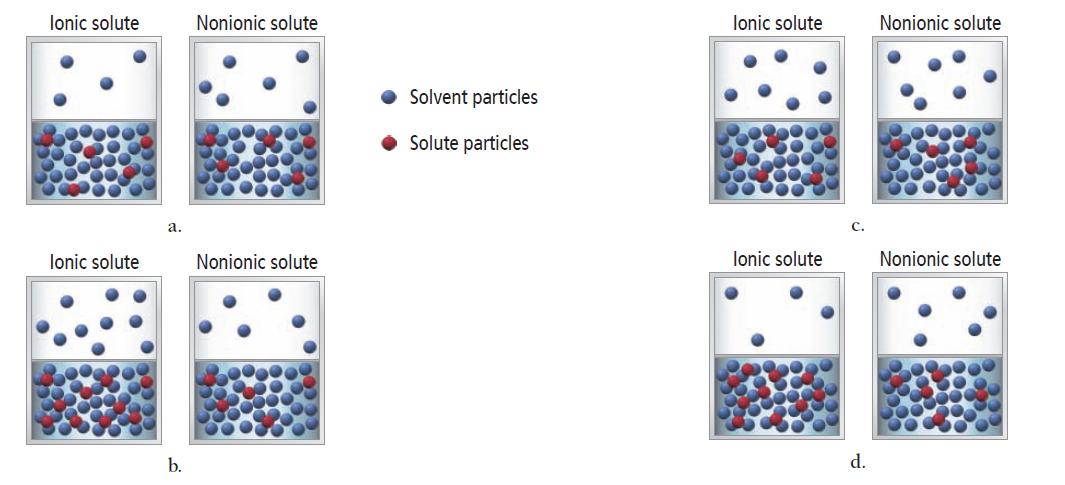
The vapor pressure of a 1 M ionic solution is different from the vapor pressure of a 1 M nonelectrolyte solution. In both cases, the solute is nonvolatile. Which set of diagrams best represents the differences between the two solutions and their vapors? lonic solute lonic solute a. b. Nonionic
If each substance listed here costs the same amount per kilogram, which would be most cost-effective as a way to lower the freezing point of water? (Assume complete dissociation for all ionic compounds.) Explain.a. HOCH2CH2OH b. NaCl c. KCl d. MgCl2 e. SrCl2
A helium balloon inflated on one day will fall to the ground by the next day. The volume of the balloon decreases somewhat overnight but not by enough to explain why it no longer floats.(If you inflate a new balloon with helium to the same size as the balloon that fell to the ground, the newly
Explain why 1-propanol (CH3CH2CH2OH) is miscible in both water (H2O) and hexane (C6H6) when hexane and water are barely soluble in each other.
Have each group member make a flashcard with one of the following on the front: ΔHsoln, ΔHlattice, ΔHsolvent, ΔHmix, and ΔHhydration. On the back of the card, each group member should describe (in words) the ΔH process his or her card lists and how that ΔH relates to other ΔH values
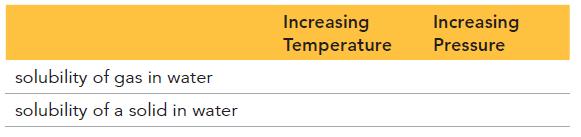
Complete the following table by adding increases, decreases, or no effect: solubility of gas in water solubility of a solid in water Increasing Temperature Increasing Pressure
When 13.62 g (about one tablespoon) of table sugar (sucrose, C12H22O11) is dissolved in 241.5 mL of water (density 0.997 g/mL), the final volume is 250.0 mL (about one cup). Have each group member calculate one of the following for the solution and present his or her answer to the group:a. Mass
Calculate the expected boiling and freezing point for the solution in the previous problem. If you had to bring this syrup to the boiling point for a recipe, would you expect it to take much more time than it takes to boil the same amount of pure water?Why or why not? Would the syrup freeze in a
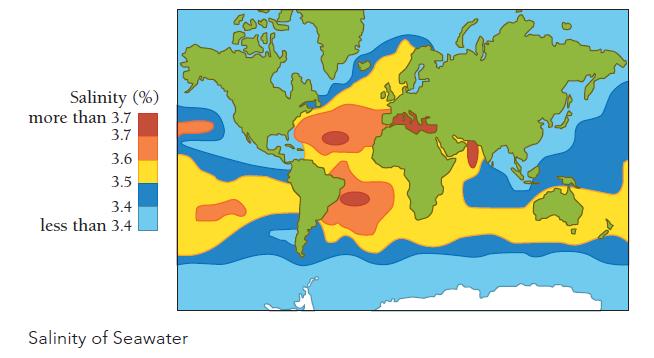
The salinity of seawater can vary in the world’s oceans as shown in the map, which indicates salinity in units of percent by mass NaCl. Examine the image and answer the questions that follow.a. Which regions of the globe generally have higher salinity?Lower salinity? State your answer as a
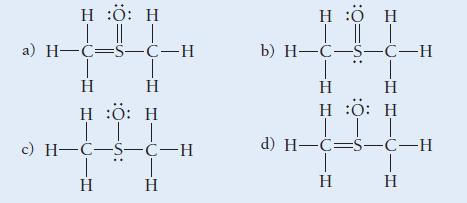
Use formal charge to choose the best Lewis structure for CH3SOCH3. H :O: H | || | a) H=C=5-C-H T Η Η H :O: H III © H-C-5-C-H Η Η H :O H | || | b) H-C-5-C-H Η Η H :O: H ||| d) H-C=s-C-H Η T Η
Write a Lewis structure for the NO3– ion. Include resonance structures.
How does the ionic bonding model explain the relatively high melting points of ionic compounds?
Which elements can have expanded octets? Which elements should never have expanded octets?
What is bond energy? How can you use average bond energies to calculate enthalpies of reaction?
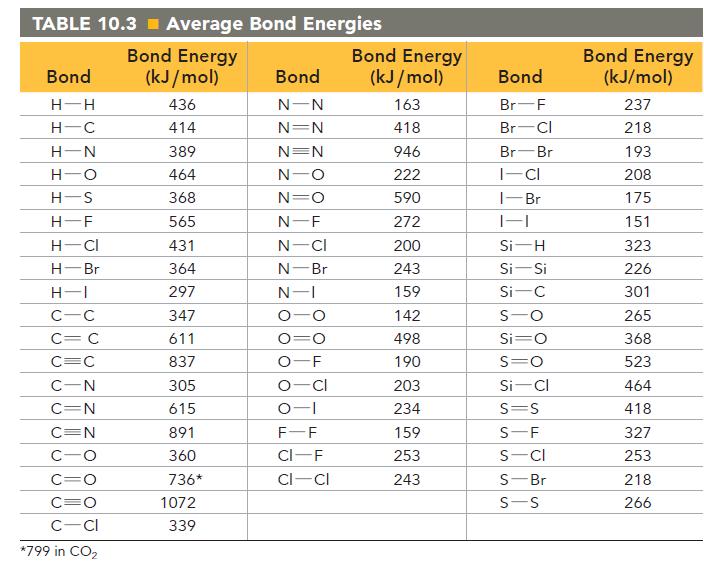
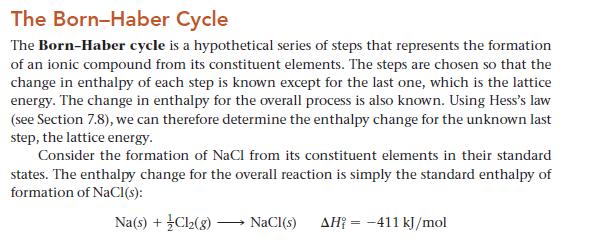
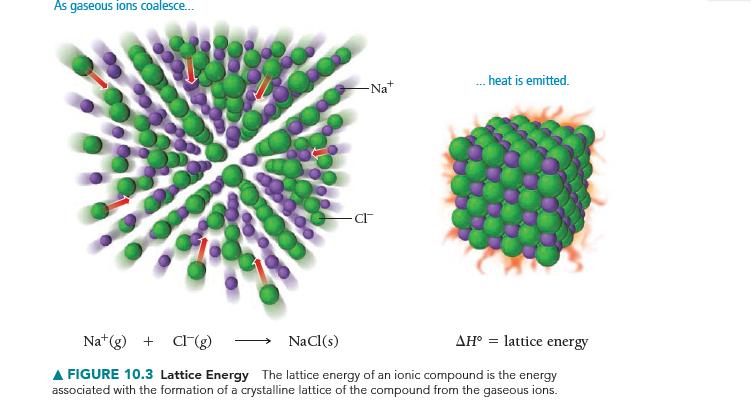
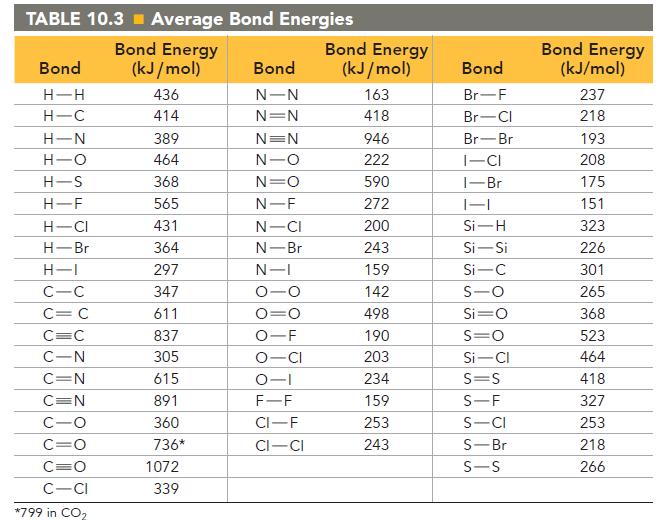
Use the Born–Haber cycle and Table 10.3 to calculate the lattice energy of CaO. (ΔHsub for calcium is 178 kJ/mol; IE1 and IE2 for calcium are 590 kJ/mol and 1145 kJ/mol, respectively; EA1 and EA2 for O are -141 kJ/mol and 744 kJ/mol, respectively.) TABLE 10.3 Average Bond Energies Bond
Explain the difference between endothermic reactions and exothermic reactions with respect to the bond energies of the bonds broken and formed.
What is the electron sea model for bonding in metals?
How does the electron sea model explain the conductivity of metals? The malleability and ductility of metals?
Use the Born–Haber cycle and data from Appendix IIB, Chapter 9, and this chapter to calculate the lattice energy of KCl. (ΔHsub for potassium is 89.0 kJ/mol.)
Write the electron configuration for N. Then write the Lewis symbol for N and show which electrons from the electron configuration are included in the Lewis symbol.
Use covalent Lewis structures to explain why the compound that forms between nitrogen and hydrogen has the formula NH3. Show why NH2 and NH4 are not stable. 10.5 Covalent Bonding: Lewis Structures The Lewis model provides us with a simple and useful model for covalent bonding. In this model, we
Write the electron configuration for Ne. Then write the Lewis symbol for Ne and show which electrons from the electron configuration are included in the Lewis symbol.
Use covalent Lewis structures to explain why each element (or family of elements) occurs as diatomic molecules.a. Hydrogenb. The halogensc. Oxygend. Nitrogen
Write the Lewis structure for each molecule.a. PH3 b. SCl2 c. HI d. CH4
Write the Lewis structure for each molecule.a. NF3 b. HBr c. SBr2 d. CCl4
Write the Lewis structure for each molecule.a. SF2 b. SiH4c. HCOOH (both O bonded to C) d. CH3SH (C and S central)
Write the Lewis structure for each molecule.a. CH2O b. C2Cl4c. CH3NH2 d. CFCl3 (C central)
Determine if a bond between each pair of atoms would be pure covalent, polar covalent, or ionic.a. Br and Br b. C and Cl c. C and S d. Sr and O
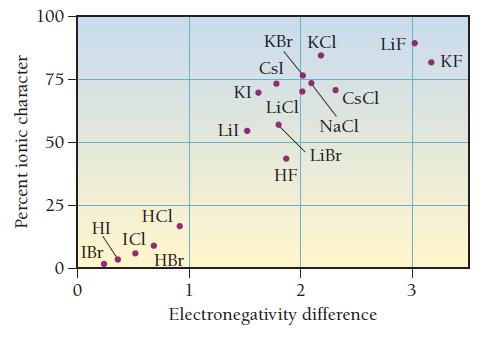
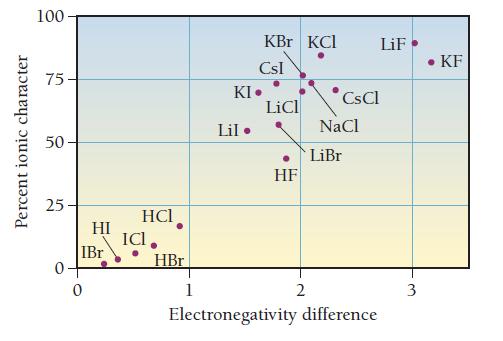
Draw the Lewis structure for CO with an arrow representing the dipole moment. Refer to Figure 10.10 to estimate the percent ionic character of the CO bond. Percent ionic character 100 75 50 25 0. HI IBr 0 HCI ICI. HBr 1 KBr KCI CsI KI. Lil. LiCl HF 2 CsCl NaCl LiBr LiF Electronegativity
Determine if a bond between each pair of atoms would be pure covalent, polar covalent, or ionic.a. C and N b. N and S c. K and F d. N and N
Draw the Lewis structure for BrF with an arrow representing the dipole moment. Refer to Figure 10.10 to estimate the percent ionic character of the BrF bond. Percent ionic character 100 75 50 25 0. HI IBr 0 HCI ICI. HBr 1 KBr KCI CsI KI. Lil. LiCl HF 2 CsCl NaCl LiBr LiF Electronegativity
Write the Lewis structure for each molecule or ion. a. H3COH b. OH- c. Bro- d. 0₂²-
Write the Lewis structure for each molecule or ion.a. CI4 b. N2O c. SiH4 d. Cl2CO
Write the Lewis structure for each molecule or ion.a. N2H2 b. N2H4 c. C2H2 d. C2H4
Write the Lewis structure for each molecule or ion.a. H3COCH3 b. CN– c. NO2–d. ClO–
Write a Lewis structure that obeys the octet rule for each molecule or ion. Include resonance structures if necessary and assign formal charges to each atom. a. SeO₂ b. CO3²- C. CIO- d. NO₂
Write a Lewis structure that obeys the octet rule for each ion.Include resonance structures if necessary and assign formal charges to each atom. a. CIO3 b. ClO4 c. NO3 + d. NH4
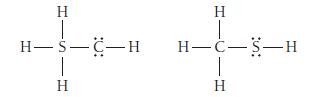
Use formal charges to identify the better Lewis structure. H H-S-C-H 1 H H T H-C-S-H I H
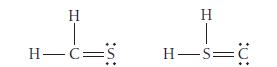
Use formal charge to identify the better Lewis structure. H H-C= H H=C
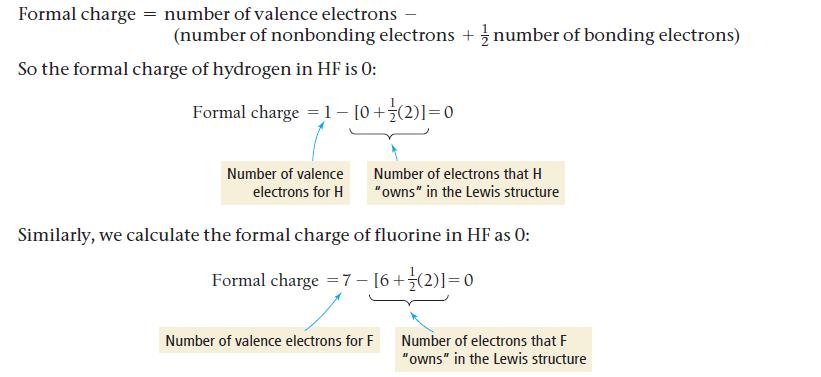
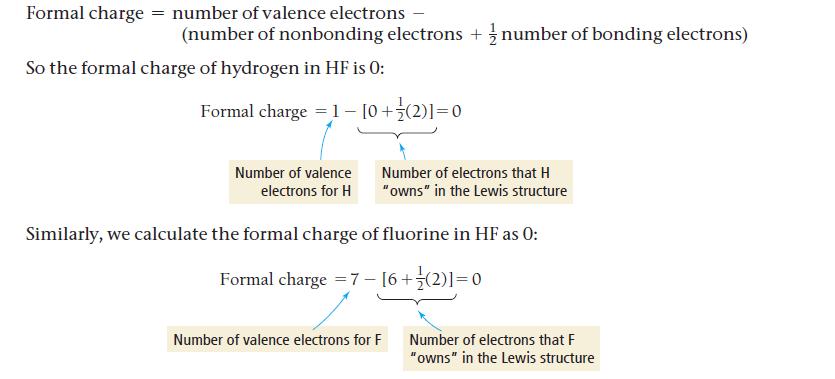
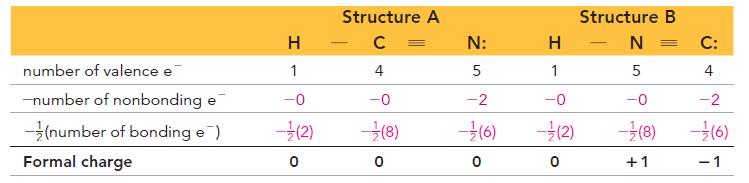
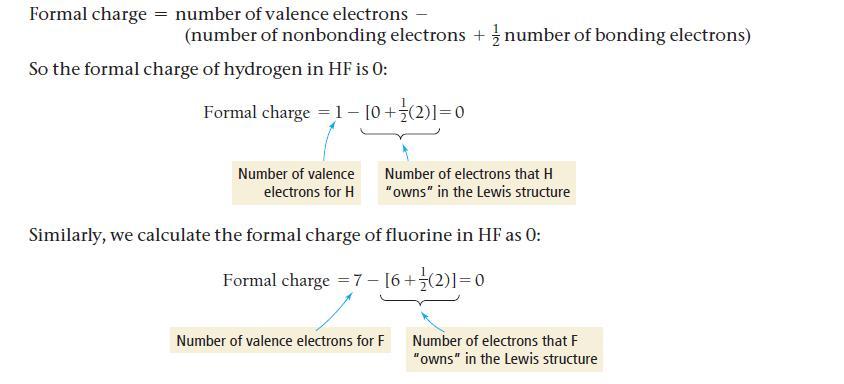
In N2O, nitrogen is the central atom, and the oxygen atom is terminal. In OF2, however, oxygen is the central atom. Use formal charges to explain why. Formal charge = number of valence electrons - (number of nonbonding electrons + number of bonding electrons) So the formal charge of hydrogen in HF
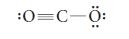
How important is the resonance structure shown here to the overall structure of carbon dioxide? Explain. :0=C—Ô:
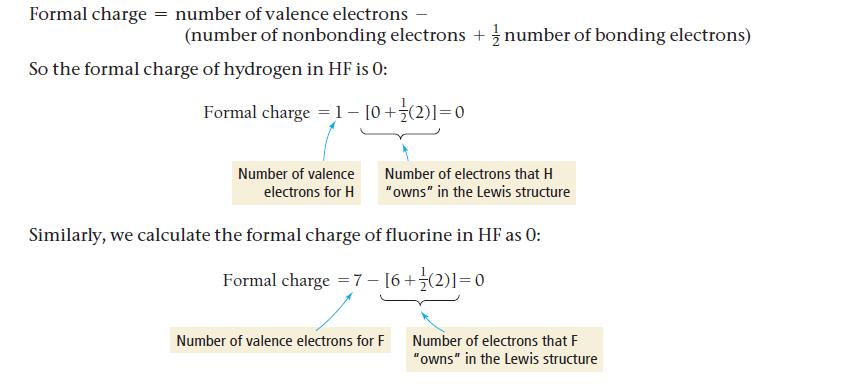
Draw the Lewis structure (including resonance structures) for the acetate ion (CH3COO–). For each resonance structure, assign formal charges to all atoms that have formal charge. Formal charge = number of valence electrons - (number of nonbonding electrons+ number of bonding electrons) So the
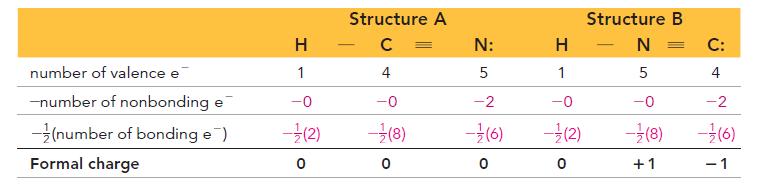
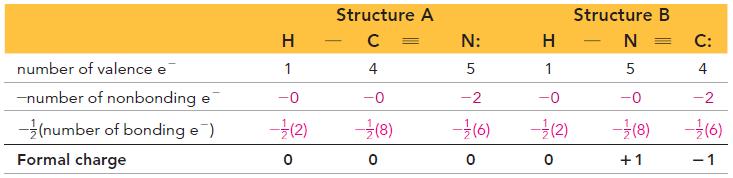
Draw the Lewis structure (including resonance structures) for methyl azide (CH3N3). For each resonance structure, assign formal charges to all atoms that have formal charge. Formal charge number of valence electrons - (number of nonbonding electrons + number of bonding electrons) So the formal
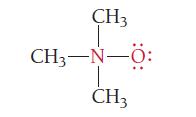
What are the formal charges of the atoms shown in red? CH3 CH3−N–0: -N- CH3
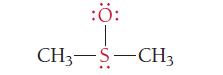
What are the formal charges of the atoms shown in red? :Ö: CH3-S-CH3
Write the Lewis structure for each molecule (octet rule not followed).a. BCl3 b. NO2 c. BH3
Write the Lewis structure for each ion. Include resonance structures if necessary and assign formal charges to all atoms. If necessary, expand the octet on the central atom to lower formal charge. 3- a. PO4³- b. CN- C. SO3²- d. ClO₂
Write the Lewis structure for each molecule (octet rule not followed).a. BBr3b. NOc. ClO2
Write Lewis structures for each molecule or ion. Include resonance structures if necessary and assign formal charges to all atoms. If necessary, expand the octet on the central atom to lower formal charge. 2- a. SO₂²- b. HSO4 C. SO3 d. BrO₂
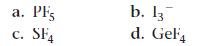
Write Lewis structures for each molecule or ion. Use expanded octets as necessary. a. PF c. SF4 b. 13 d. Gel
Write Lewis structures for each molecule or ion. Use expanded octets as necessary. a. C. CIFS Cl3PO b. AsF6 d. IFs
Which compound shown here has the stronger nitrogen–nitrogen bond? The shorter nitrogen–nitrogen bond? H,NNH,, HNNH
List these compounds in order of increasing carbon–carbon bond strength and in order of decreasing carbon–carbon bond length:HCCH, H2CCH2, H3CCH3.
Hydrogenation reactions are used to add hydrogen across double bonds in hydrocarbons and other organic compounds. Use average bond energies to calculate ΔHrxn for the hydrogenation reaction. H₂C = CH₂(g) + H₂(g) H3C-CH3(g)
Ethanol is a possible fuel. Use average bond energies to calculate ΔHrxn for the combustion of ethanol. CH3CH₂OH(g) + 3 O₂(g) 2 CO₂(g) + 3 H₂O(g)
Ethane burns in air to form carbon dixode and water vapor.Use average bond energies to calculate ΔHrxn for the reaction. 2 H3C CH3(g) + 70₂(g) 4 CO₂(g) + 6H₂O(g)
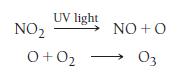
In the Chemistry and the Environment box on free radicals in this chapter, we discussed the importance of the hydroxyl radical in reacting with and eliminating many atmospheric pollutants.However, the hydroxyl radical does not clean up everything. For example, chlorofluorocarbons—which destroy
Write an appropriate Lewis structure for each compound. Make certain to distinguish between ionic and molecular compounds.a. BI3 b. K2S c. HCFO d. PBr3
Write an appropriate Lewis structure for each compound. Make certain to distinguish between ionic and molecular compounds.a. Al2O3 b. ClF5 c. MgI2 d. XeO4
Each compound contains both ionic and covalent bonds. Write ionic Lewis structures for each of them, including the covalent structure for the ion in brackets. Write resonance structures if necessary.a. BaCO3 b. Ca(OH)2c. KNO3 d. LiIO
Each compound contains both ionic and covalent bonds. Write ionic Lewis structures for each of them, including the covalent structure for the ion in brackets. Write resonance structures if necessary.
Carbon ring structures are common in organic chemistry. Draw a Lewis structure for each carbon ring structure, including any necessary resonance structures.a. C4H8 b. C4H4 c. C6H12 d. C6H6
Amino acids are the building blocks of proteins. The simplest amino acid is glycine (H2NCH2COOH). Draw a Lewis structure for glycine.
Formic acid is responsible for the sting of ant bites. By mass, formic acid is 26.10% C, 4.38% H, and 69.52% O. The molar mass of formic acid is 46.02 g/mol. Determine the molecular formula of formic acid and draw its Lewis structure.
Diazomethane is a highly poisonous, explosive compound because it readily evolves N2. Diazomethane has the following composition by mass: 28.57% C; 4.80% H; and 66.64% N. The molar mass of diazomethane is 42.04 g/mol. Find the molecular formula of diazomethane, draw its Lewis structure, and assign
The reaction of Fe2O3(s) with Al(s) to form Al2O3(s) and Fe(s) is called the thermite reaction and is highly exothermic. What role does lattice energy play in the exothermicity of the reaction?
NaCl has a lattice energy of -787 kJ/mol. Consider a hypothetical salt XY. X3+ has the same radius as Na+ and Y3– has the same radius as Cl– . Estimate the lattice energy of XY.
Draw the Lewis structure for nitric acid (the hydrogen atom is attached to one of the oxygen atoms). Include all three resonance structures by alternating the double bond among the three oxygen atoms. Use formal charge to determine which of the resonance structures is most important to the
Phosgene (Cl2CO) is a poisonous gas used as a chemical weapon during World War I. It is a potential agent for chemical terrorism today. Draw the Lewis structure of phosgene. Include all three resonance forms by alternating the double bond among the three terminal atoms. Which resonance structure is
Draw the Lewis structure for each organic compound from its condensed structural formula. a. C3H8 d. CH3COOH b. CH3OCH3 e. CH3CHO C. CH3COCH3
The cyanate ion (OCN–) and the fulminate ion (CNO–) share the same three atoms but have vastly different properties. The cyanate ion is stable, while the fulminate ion is unstable and forms explosive compounds. The resonance structures of the cyanate ion are explored in Example 10.8. Draw Lewis
Draw the Lewis structure for each organic compound from its condensed structural formula. a. C₂H4 d. CH3CH₂OH b. CH3NH₂ e. HCOOH c. HCHO
Use Lewis structures to explain why Br3– and I3– are stable, while F3– is not.
Draw the Lewis structure for HCSNH2. (The carbon and nitrogen atoms are bonded together, and the sulfur atom is bonded to the carbon atom.) Label each bond in the molecule as polar or nonpolar.
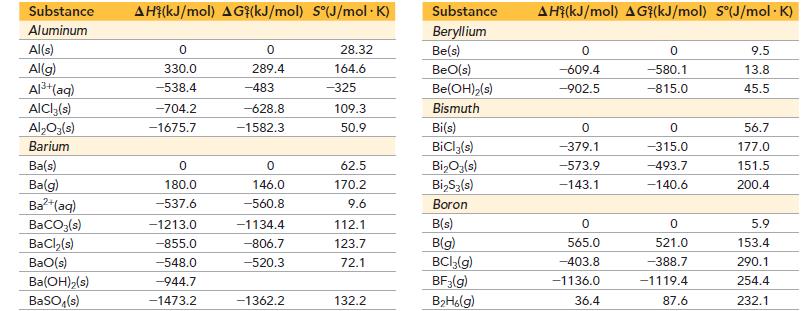
Calculate ΔHrxn for the combustion of octane (C8H18), a component of gasoline, by using average bond energies and then calculate it using enthalpies of formation from Appendix IIB.What is the percent difference between your results? Which result would you expect to be more accurate?Appendix IIB
Draw the Lewis structure for urea, H2NCONH2, one of the compounds responsible for the smell of urine. (The central carbon atom is bonded to both nitrogen atoms and to the oxygen atom.) Does urea contain polar bonds? Which bond in urea is most polar?
Some theories of aging suggest that free radicals cause certain diseases and perhaps aging in general. As you know from the Lewis model, such molecules are not chemically stable and will quickly react with other molecules. According to certain theories, free radicals may attack molecules within the
Free radicals are important in many environmentally significant reactions (see the Chemistry in the Environment box on free radicals in this chapter). For example, photochemical smog—smog that results from the action of sunlight on air pollutants—forms in part by these two steps:The product of
If hydrogen were used as a fuel, it could be burned according to this reaction:Use average bond energies to calculate ΔHrxn for this reaction and also for the combustion of methane (CH4). Which fuel yields more energy per mole? Per gram? (80²H - (8)²0+ (8)²H
Draw the Lewis structure for each compound.a. Cl2O7 (no Cl—Cl bond)b. H3PO3 (two OH bonds)c. H3AsO4
The azide ion, N3–, is a symmetrical ion, all of whose contributing resonance structures have formal charges. Draw three important contributing structures for this ion.
List the following gas-phase ion pairs in order of the quantity of energy released when they form from separated gas-phase ions.List the pair that releases the least energy first. Na+ F–, Mg2+ F–, Na+O2– , Mg2 +O2–, Al3+ O2–.
Calculate ΔH∘ for the reaction H2(g) + Br2(g) → 2 HBr(g) using the bond energy values. The ΔHf° of HBr(g) is not equal to one-half of the value calculated. Account for the difference.
The heat of atomization is the heat required to convert a molecule in the gas phase into its constituent atoms in the gas phase.The heat of atomization is used to calculate average bond energies.Without using any tabulated bond energies, calculate the average C—Cl bond energy from the following
Calculate the heat of atomization of C2H3Cl, using the average bond energies in Table 10.3.Data from Review Question 111The heat of atomization is the heat required to convert a molecule in the gas phase into its constituent atoms in the gas phase.The heat of atomization is used to calculate
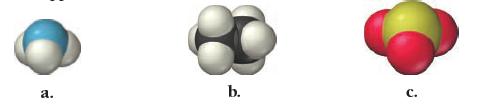
Write a chemical formula for each molecular model. a. b. C.
The presence of one of the ANSWER NOW! following ions within a compound indicates that a compound is soluble with no exceptions. Which ion? (a) OH (b) SO₂²- (c) NO3
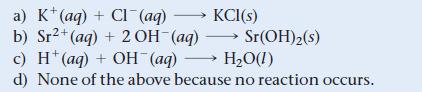
What is the net ionic equation for the reaction that occurs when aqueous solutions of KOH and SrCl2 are mixed? a) K (aq) + CI (aq) →→→→KCI(s) b) Sr²+ (aq) + 2 OH-(aq) Sr(OH)2 (s) c) H* (aq) + OH (aq) →→→ H₂O(1) d) None of the above because no reaction occurs.
What are the solubility rules? How are they useful?
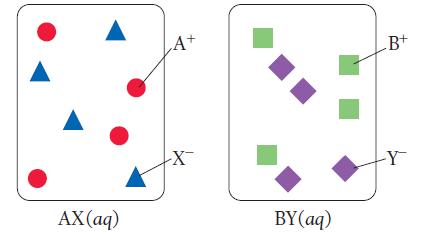
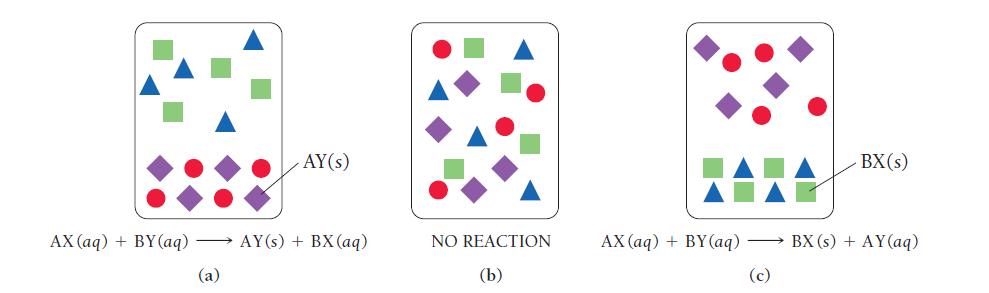
Consider the generic ionic compounds with the formulas AX and BY and the following solubility rules:AX soluble; BY soluble; AY soluble; BX insolubleLet circles represent A+ ions; squares represent B+ ions; triangles represent X- ions; and diamonds represent Y- ions. We represent solutions of the
Write an equation for the precipitation reaction that occurs (if any) when solutions of sodium nitrate and lithium sulfate are mixed.
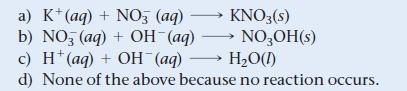
What is the net ionic equation for the reaction that occurs when aqueous solutions of KOH and HNO3 are mixed? a) K+ (aq) + NO3 (aq) b) NO (aq) + OH¯(aq) c) H(aq) + OH(aq) →→→ H₂O(1) d) None of the above because no reaction occurs. KNO3(s) NO3OH(s)
Showing 2000 - 2100
of 4045
First
14
15
16
17
18
19
20
21
22
23
24
25
26
27
28
Last
Step by Step Answers

 Get 50% OFF
Claim Now
Get 50% OFF
Claim Now