New Semester
Started
Get
50% OFF
Study Help!
--h --m --s
Claim Now
Question Answers
Textbooks
Find textbooks, questions and answers
Oops, something went wrong!
Change your search query and then try again
S
Books
FREE
Study Help
Expert Questions
Accounting
General Management
Mathematics
Finance
Organizational Behaviour
Law
Physics
Operating System
Management Leadership
Sociology
Programming
Marketing
Database
Computer Network
Economics
Textbooks Solutions
Accounting
Managerial Accounting
Management Leadership
Cost Accounting
Statistics
Business Law
Corporate Finance
Finance
Economics
Auditing
Tutors
Online Tutors
Find a Tutor
Hire a Tutor
Become a Tutor
AI Tutor
AI Study Planner
NEW
Sell Books
Search
Search
Sign In
Register
study help
sciences
chemistry a molecular approach
Chemistry A Molecular Approach 5th Edition Nivaldo Tro - Solutions
Write complete ionic and net ionic equations for each reaction. (a) 3 SrCl₂ (aq) + 2 Li3PO4(aq) + KOH(aq) (b) HC₂H3O2(aq) Sr3 (PO4)2(s) +6 LiCl(aq) H₂O(1) + KC₂H3O₂(aq)
What are the cations and anions whose compounds are usually soluble? What are the exceptions?
Which of the ions listed below is a spectator ion in the complete ionic equation shown here? Ag (aq) + NO3- (aq) +Na+ (aq) + (aq)→→→→AgI(s) + NO3 (aq) +Na+ (aq) (a) Ag¹(aq) (b) NO3 (aq) (c) I (aq)
The titration of 15.00 mL of HBr solution of unknown concentration requires 18.44 mL of a 0.100 M KOH solution to reach the equivalence point. What is the concentration of the unknown HBr solution in M?a) 0.001844 M b) 0.813 M c) 44 M d) 0.123 M
What is a precipitation reaction? Give an example.
Write a molecular and net ionic equation for the reaction between aqueous HI and aqueous Ba(OH)2.
A 10.0 mL sample of 0.20 M HBr solution is titrated with 0.10 M NaOH. What volume of NaOH is required to reach the equivalence point?(a) 10.0 mL (b) 20.0 mL (c) 40.0 mL
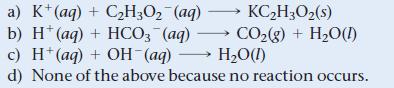
What is the net ionic equation for the reaction that occurs when aqueous solutions of KHCO3 and HBr are mixed? KC₂H3O₂ (s) a) K+ (aq) + C₂H3O₂ (aq) b) H+ (aq) + HCO3 (aq) - c) H+ (aq) + OH-(aq) CO₂(g) + H₂O(1) H₂O(1) d) None of the above because no reaction occurs.
How can you predict whether a precipitation reaction will occur upon mixing two aqueous solutions?
Write a molecular equation, ionic equation, and net ionic equation for the reaction between aqueous acetic acid (HC2H3O2) and aqueous potassium hydroxide (KOH).
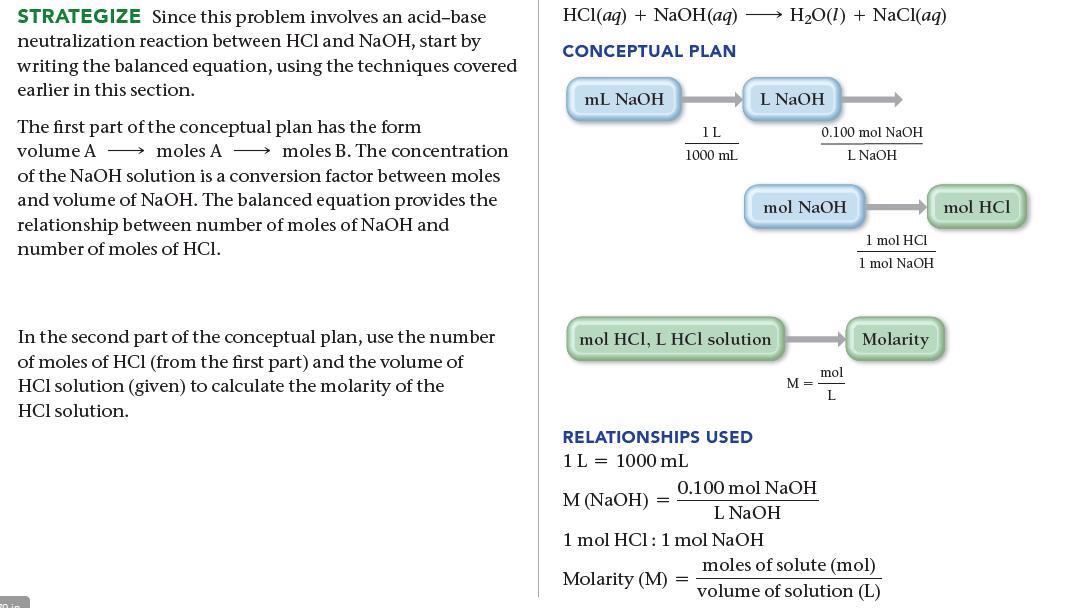
The titration of 10.00 mL of HCl solution of unknown concentration requires 12.54 mL of a 0.100 M NaOH solution to reach the equivalence point. What is the concentration of the unknown HCl solution in M? SORT You are given the volume and concentration of NaOH solution required to titrate a given
Which statement best describes the difference between the charge of a polyatomic ion and the oxidation states of its constituent atoms? (For example, the charge of NO3 - is 1–, and the oxidation states of its atoms are +5 for the nitrogen atom and -2 for each oxygen atom.)(a) The charge of a
Explain how a molecular equation, a complete ionic equation, and a net ionic equation differ.
Sodium reacts with water according to the reaction:Identify the oxidizing agent. 2 Na(s) + 2 H₂O(1) → 2 NaOH(aq) + H₂(g)
Which statement is true?(a) A redox reaction involves either the transfer of an electron or a change in the oxidation state of an element.(b) If any of the reactants or products in a reaction contain oxygen, the reaction is a redox reaction.(c) In a reaction, oxidation can occur independently of
What is the Arrhenius definition of an acid? A base?
Write a molecular equation for the gas-evolution reaction that occurs when you mix aqueous nitric acid and aqueous sodium carbonate.
Which metal is most easily oxidized?(a) Na (b) Cr (c) Au
Which of these ions will spontaneously react with Ni(s) in solution? a) Cu²+ (aq) c) Mg²+ (aq) 2+ b) Zn²+ (aq) d) K + (aq)
What is an acid–base reaction? Give an example.
Assign an oxidation state to each atom in each element, ion, or compound.(a) Cl2 (b) Na+ (c) KF (d) CO2 (e) SO42 - (f) K2O2
Use oxidation states to identify the element that is oxidized and the element that is reduced in the following redox reaction: Mg(s) + 2 H₂O(1) Mg(OH)₂(aq) + H₂(8)
Explain the principles behind an acid–base titration. What is an indicator?
Determine whether each reaction is an oxidation–reduction reaction. For each oxidation–reduction reaction, identify the oxidizing agent and the reducing agent. (a) 2 Mg(s) + O₂(8) 2 MgO(s) (b) 2 HBr(aq) + Ca(OH)₂(aq) → 2 H₂O(I) + CaBr₂(aq) 2+ (c) Zn(s)+Fe²+ (aq) Zn²+ (aq) + Fe(s)
What is a gas-evolution reaction? Give an example.
Determine whether each redox reaction is spontaneous. (a) Fe(s) + Mg2+ (aq) (b) Fe(s) + Pb²+ (aq) Fe2+ (aq) + Mg(s) 2+ Fe²+ (aq) + Pb(s)
What reactant types give rise to gas-evolution reactions?
What is an oxidation–reduction reaction? Give an example.
What are oxidation states?
How can oxidation states be used to identify redox reactions?
What happens to a substance when it becomes oxidized? Reduced?
In a redox reaction, which reactant is the oxidizing agent? The reducing agent?
Calculate the molarity of each solution.a. 3.25 mol of LiCl in 2.78 L solutionb. 28.33 g C6H12∪6 in 1.28 L of solutionc. 32.4 mg NaCl in 122.4 mL of solution
Calculate the molarity of each solution.a. 0.38 mol of LiNO3 in 6.14 L of solutionb. 72.8 g C2H6O in 2.34 L of solutionc. 12.87 mg KI in 112.4 mL of solution
What is the molarity of NO3– in each solution?a. 0.150 M KNO3b. 0.150 M Ca(NO3)2c. 0.150 M Al(NO3)3
What is the molarity of Cl– in each solution?a. 0.200 M NaClb. 0.150 M SrCl2c. 0.100 M AlCl3
How many moles of KCl are contained in each solution?a. 0.556 L of a 2.3 M KCl solutionb. 1.8 L of a 0.85 M KCl solutionc. 114 mL of a 1.85 M KCl solution
What volume of 0.200 M ethanol solution contains each amount in moles of ethanol?a. 0.45 mol ethanolb. 1.22 mol ethanolc. 1.2 * 10 - 2 mol ethanol
A laboratory procedure calls for making 400.0 mL of a 1.1 M NaNO3 solution. What mass of NaNO3 (in g) is needed?
A chemist wants to make 5.5 L of a 0.300 M CaCl2 solution. What mass of CaCl2 (in g) should the chemist use?
If 123 mL of a 1.1 M glucose solution is diluted to 500.0 mL, what is the molarity of the diluted solution?
If 3.5 L of a 4.8 M SrCl2 solution is diluted to 45 L, what is the molarity of the diluted solution?
To what volume should you dilute 50.0 mL of a 12 M stock HNO3 solution to obtain a 0.100 M HNO3 solution?
Consider the precipitation reaction:What volume of 0.175 M Na3PO4 solution is necessary to completely react with 95.4 mL of 0.102 M CuCl2? 2 Na3PO4(aq) + 3 CuCl₂(aq) Cu3(PO4)2 (s) + 6 NaCl(aq)
To what volume should you dilute 25 mL of a 10.0 M H2SO4 solution to obtain a 0.150 M H2SO4 solution?
Consider the reaction:What volume of 0.150 M Li2S solution is required to completely react with 125 mL of 0.150 M Co(NO3)2? Li₂S(aq) + CO(NO3)2(aq) 2 LINO3(aq) + CoS(s)
What is the minimum amount of 6.0 M H2SO4 necessary to produce 25.0 g of H2(g) according to the reaction between aluminum and sulfuric acid? 2 Al(s) + 3 H₂SO4(aq) Al2(SO4)3(aq) + 3 H₂(g)
What is the molarity of ZnCl2 that forms when 25.0 g of zinc completely reacts with CuCl2 according to the following reaction? Assume a final volume of 275 mL. Zn(s) + CuCl2(aq) ZnCl₂(aq) + Cu(s)
For each compound (all water soluble), would you expect the resulting aqueous solution to conduct electrical current? a. CsCl b. CH3OH C. Ca(NO₂)2 d. C6H1206
Classify each compound as a strong electrolyte or nonelectrolyte. a. MgBr₂ b. C12H22011 C. Na₂CO3 d. KOH
Determine whether each compound is soluble or insoluble. If the compound is soluble, list the ions present in solution. a. AgNO3 c. KNO3 b. Pb(C₂H₂O₂)2 d. (NH4)2S
Determine whether each compound is soluble or insoluble. If the compound is soluble, list the ions present in solution. a. Agl c. COCO3 b. Cu3(PO4)2 d. K3PO4
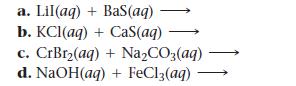
Complete and balance each equation. If no reaction occurs, write “NO REACTION.” a. Lil(aq) + BaS(aq) b. KCl(aq) + CaS(aq) c. CrBr₂(aq) +Na₂CO3(aq) d. NaOH(aq) + FeCl3(aq)
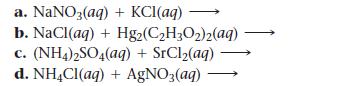
Complete and balance each equation. If no reaction occurs, write “NO REACTION.” a. NaNO3(aq) b. NaCl (aq) + c. (NH4)2SO4(aq) + SrCl₂(aq) d. NH4Cl(aq) + AgNO3(aq) + KC1(aq) Hg2(C₂H3O2)2(aq)
Write a molecular equation for the precipitation reaction that occurs (if any) when each pair of aqueous solutions is mixed. If no reaction occurs, write “NO REACTION.”a. Potassium carbonate and lead(II) nitrateb. Lithium sulfate and lead(II) acetatec. Copper(II) nitrate and magnesium sulfided.
Write balanced complete ionic and net ionic equations for each reaction. a. HCl(aq) + LiOH(aq) H₂O(1)+ LiCI(aq) b. Cas(aq) + CuCl₂(aq) → CuS(s) + CaCl₂(aq) c. NaOH(aq) + HC₂H₂O₂(aq) d. Na3PO4(aq) + NiCl₂(aq) - H₂O() + NaC₂H₂O₂(aq) Ni3(PO4)2(s) + NaCl(aq)
Write a molecular equation for the precipitation reaction that occurs (if any) when each pair of aqueous solutions is mixed. If no reaction occurs, write “NO REACTION.”a. Sodium chloride and lead(II) acetate b. Potassium sulfate and strontium iodide c. Cesium chloride and calcium sulfide d.
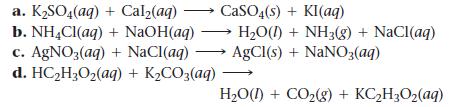
Write balanced complete ionic and net ionic equations for each reaction. a. K₂SO4(aq) b. NH4Cl(aq) c. AgNO3(aq) d. HC₂H₂O₂(aq) + K₂CO3(aq) + Cal₂(aq) + NaOH(aq) + NaCl(aq) CaSO4(s) + KI(aq) H₂O(1) + NH3(g) + NaCl(aq) AgCl(s) + NaNO3(aq) H₂O(1) + CO₂(g) + KC₂H₂O₂(aq)
Mercury(I) ions (Hg22+ ) can be removed from solution by precipitation with Cl– . Suppose that a solution contains aqueous Hg2(NO3)2. Write complete ionic and net ionic equations for the reaction of aqueous Hg2(NO3)2 with aqueous sodium chloride to form solid Hg2Cl2 and aqueous sodium nitrate.
Lead(II) ions can be removed from solution by precipitation with sulfate ions. Suppose that a solution contains lead(II) nitrate. Write complete ionic and net ionic equations for the reaction of aqueous lead(II) nitrate with aqueous potassium sulfate to form solid lead(II) sulfate and aqueous
Write balanced molecular and net ionic equations for the reaction between hydrobromic acid and potassium hydroxide.
Complete and balance each acid–base equation. a. H₂SO4(aq) + Ca(OH)2(aq) b. HClO4(aq) + KOH(aq) c. H₂SO4(aq) + NaOH(aq)
Write balanced molecular and net ionic equations for the reaction between nitric acid and calcium hydroxide.
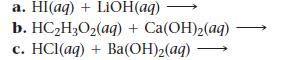
Complete and balance each acid–base equation. a. HI(aq) + LiOH(aq) b. HC₂H₂O₂(aq) + Ca(OH)₂(aq) c. HCl (aq) + Ba(OH)₂(aq)
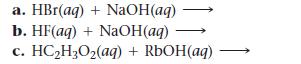
Write balanced complete ionic and net ionic equations for each acid–base reaction. a. HBr(aq) + NaOH(aq) b. HF(aq) + NaOH(aq) C. HC₂H₂O₂(aq) + RbOH(aq)
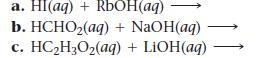
Write balanced complete ionic and net ionic equations for each acid–base reaction. a. HI(aq) + RbOH(aq) b. HCHO₂(aq) + NaOH(aq) c. HC₂H₂O₂(aq) + LiOH(aq)
A 25.00-mL sample of an unknown HClO4 solution requires titration with 22.62 mL of 0.2000 M NaOH to reach the equivalence point. What is the concentration of the unknown HClO4 solution? The neutralization reaction is HCIO4(aq) + NaOH(aq) → H₂O(1) + NaCIO4(aq)
A 30.00-mL sample of an unknown H3PO4 solution is titrated with a 0.100 M NaOH solution. The equivalence point is reached when 26.38 mL of NaOH solution is added. What is the concentration of the unknown H3PO4 solution? The neutralization reaction is H3PO4(aq) + 3 NaOH(aq) → 3 H₂O(1) +
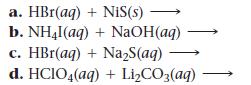
Complete and balance each gas-evolution equation. a. HBr(aq) + NIS(s) b. NH4l (aq) + NaOH(aq) c. HBr(aq) + Na₂S(aq) d. HCIO4(aq) + Li₂CO3(aq)
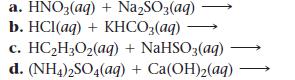
Complete and balance each gas-evolution equation. a. HNO3(aq) + Na₂SO3(aq) b. HCl(aq) + KHCO3(aq) c. HC₂2H₂O₂(aq) + NaHSO3(aq) d. (NH4)2SO4(aq) + Ca(OH)₂(aq)
Assign oxidation states to each atom in each element, ion, or compound. a. Ag d. H₂S b. Ag e. CO3²- c. CaF₂ f. CrO4²- 2-
Assign oxidation states to each atom in each element, ion, or compound. a. Cl₂ d. CH4 b. Fe³+ e. Cr₂0₂²- c. CuCl₂ f. HSO4
What is the oxidation state of Cr in each compound? a. Cro b. CrO3 c. Cr₂O3
What is the oxidation state of Cl in each ion? a. CIO- b. ClO₂ c. ClO3 d. CIO4
Determine whether each reaction is a redox reaction. For each redox reaction, identify the oxidizing agent and the reducing agent. a. 4 Li(s) + O₂(g) → 2 Li₂O(s) b. Mg(s) + Fe²+ (aq)→ Mg2+(aq) + Fe(s) c.Pb(NO3)2(aq) + Na₂SO4(aq) d. HBr(aq) + KOH(aq)→ H₂O(1) + KBr(aq) PbSO4(s) +
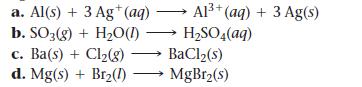
Determine whether each reaction is a redox reaction. For each redox reaction, identify the oxidizing agent and the reducing agent. a. Al(s) + 3 Ag+ (aq) b. SO3(g) + H₂O(1)→ c. Ba(s) + Cl₂(g) d. Mg(s) + Br₂(1) Al³+ (aq) + 3 Ag(s) H₂SO4(aq) → BaCl₂(s) MgBr₂(s)
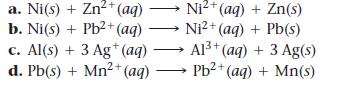
Determine whether each redox reaction occurs spontaneously in the forward direction. a. Ni(s) + Zn²+ (aq) b. Ni(s) + Pb²+ (aq) c. Al(s) + 3 Ag+ (aq) d. Pb(s) + Mn²+ (aq) 2+ Ni²+(aq) + Zn(s) Ni²+(aq) + Pb(s) Al³+ (aq) + 3 Ag(s) Pb²+ (aq) + Mn(s)
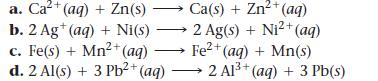
Determine whether each redox reaction occurs spontaneously in the forward direction. a. Ca²+ (aq) + Zn(s) b. 2 Ag+ (aq) + Ni(s) c. Fe(s) + Mn²+ (aq) d. 2 Al(s) + 3 Pb²+ (aq) Ca(s) + Zn²+ (aq) 2 Ag(s) + Ni²+ (aq) Fe²+ (aq) + Mn(s) 2 Al³+ (aq) + 3 Pb(s)
Suppose you wanted to cause Ni2+ ions to come out of solution as solid Ni. Which metal could you use to accomplish this?
Suppose you wanted to cause Pb2 + ions to come out of solution as solid Pb. Which metal could you use to accomplish this?
Which metal in the activity series reduces Al3+ ions but not Na+ ions?
Which metal in the activity series is oxidized with a Ni2 + solution but not with a Cr3 + solution?
The density of a 20.0% by mass ethylene glycol (C2H6O2) solution in water is 1.03 g/mL. Find the molarity of the solution.
Find the percent by mass of sodium chloride in a 1.35 M NaCl solution. The density of the solution is 1.05 g/mL.
People sometimes use sodium bicarbonate as an antacid to neutralize excess hydrochloric acid in an upset stomach. What mass of hydrochloric acid (in grams) can 2.5 g of sodium bicarbonate neutralize?
Predict the products and write a balanced molecular equation for each reaction. If no reaction occurs, write “NO REACTION.” a. HCl(aq) + Hg2(NO3)2(aq) b. KHSO 3(aq) + HNO3(aq) - c. aqueous ammonium chloride and aqueous lead(II) nitrate d. aqueous ammonium chloride and aqueous calcium hydroxide
Toilet bowl cleaners often contain hydrochloric acid, which dissolves the calcium carbonate deposits that accumulate within a toilet bowl. What mass of calcium carbonate (in grams) can 3.8 g of HCl dissolve?
Predict the products and write a balanced molecular equation for each reaction. If no reaction occurs, write “NO REACTION.” a. H₂SO4(aq) + HNO3(aq) b. Cr(NO3)3(aq) + LiOH(aq) - c. aqueous strontium sulfide and aqueous copper(II) sulfate
Hard water often contains dissolved Ca2+ and Mg2 + ions. One way to soften water is to add phosphates. The phosphate ion forms insoluble precipitates with calcium and magnesium ions, removing them from solution. A solution is 0.050 M in calcium chloride and 0.085 M in magnesium nitrate. What mass
An acid solution is 0.100 M in HCl and 0.200 M in H2SO4. What volume of a 0.150 M KOH solution would completely neutralize all the acid in 500.0 mL of this solution?
Find the mass of barium metal (in grams) that must react with O2 to produce enough barium oxide to prepare 1.0 L of a 0.10 M solution of OH–.
A solution contains Cr3 + ions and Mg2+ ions. The addition of 1.00 L of 1.51 M NaF solution causes the complete precipitation of these ions as CrF3(s) and MgF2(s). The total mass of the precipitate is 49.6 g. Find the mass of Cr3 + in the original solution.
Treatment of gold metal with BrF3 and KF produces Br2 and KAuF4, a salt of gold. Identify the oxidizing agent and the reducing agent in this reaction. Find the mass of the gold salt that forms when a 73.5-g mixture of equal masses of all three reactants is prepared.
We prepare a solution by mixing 0.10 L of 0.12 M sodium chloride with 0.23 L of a 0.18 M MgCl2 solution. What volume of a 0.20 M silver nitrate solution do we need to precipitate all the Cl– ion in the solution as AgCl?
A solution contains one or more of the following ions: Ag+, Ca2 +, and Cu2+. When you add sodium chloride to the solution, no precipitate forms. When you add sodium sulfate to the solution, a white precipitate forms. You filter off the precipitate and add sodium carbonate to the remaining solution,
A solution contains one or more of the following ions: Hg22 + , Ba2 +, and Fe2 +. When you add potassium chloride to the solution, a precipitate forms. The precipitate is filtered off, and you add potassium sulfate to the remaining solution, producing no precipitate. When you add potassium
A solution contains Ag+ and Hg2 + ions. The addition of 0.100 L of 1.22 M NaI solution is just enough to precipitate all the ions as AgI and HgI2. The total mass of the precipitate is 28.1 g. Find the mass of AgI in the precipitate.
The water in lakes that have been acidified by acid rain (HNO3 and H2SO4) can be neutralized by a process called liming, in which limestone (CaCO3) is added to the acidified water. What mass of limestone (in kg) would completely neutralize a 15.2 billion-liter lake that is 1.8 * 10 –5 M in H2SO4
Sodium carbonate is often added to laundry detergents to soften hard water and make the detergent more effective. Suppose that a particular detergent mixture is designed to soften hard water that is 3.5 * 10 – 3 M in Ca2+ and 1.1 * 10 – 3 M in Mg2 + and that the average capacity of a washing
Lead poisoning is a serious condition resulting from the ingestion of lead in food, water, or other environmental sources. It affects the central nervous system, leading to a variety of symptoms such as distractibility, lethargy, and loss of motor coordination. Lead poisoning is treated with
Showing 2100 - 2200
of 4045
First
15
16
17
18
19
20
21
22
23
24
25
26
27
28
29
Last
Step by Step Answers

 Get 50% OFF
Claim Now
Get 50% OFF
Claim Now