New Semester
Started
Get
50% OFF
Study Help!
--h --m --s
Claim Now
Question Answers
Textbooks
Find textbooks, questions and answers
Oops, something went wrong!
Change your search query and then try again
S
Books
FREE
Study Help
Expert Questions
Accounting
General Management
Mathematics
Finance
Organizational Behaviour
Law
Physics
Operating System
Management Leadership
Sociology
Programming
Marketing
Database
Computer Network
Economics
Textbooks Solutions
Accounting
Managerial Accounting
Management Leadership
Cost Accounting
Statistics
Business Law
Corporate Finance
Finance
Economics
Auditing
Tutors
Online Tutors
Find a Tutor
Hire a Tutor
Become a Tutor
AI Tutor
AI Study Planner
NEW
Sell Books
Search
Search
Sign In
Register
study help
sciences
chemistry a molecular approach
Chemistry A Molecular Approach 5th Edition Nivaldo Tro - Solutions
Consider the endothermic reaction:If you were trying to maximize the amount of C2H4I2 produced, which tactic might you try? Assume that the reaction mixture reaches equilibrium.a. Decreasing the reaction volume b. Removing I2 from the reaction mixture c. Raising the reaction temperatured. Adding
A system at equilibrium contains I2(g) at a pressure of 0.21 atm and I(g) at a pressure of 0.23 atm. The system is then compressed to half its volume. Find the pressure of each gas when the system returns to equilibrium.
Consider the reaction:A reaction mixture at equilibrium at 175 K contains PH2 = 0.958 atm, PI2 = 0.877 atm, and PHI = 0.020 atm. A second reaction mixture, also at 175 K, contains PH2 = PI2 = 0.621 atm and PHI = 0.101 atm. Is the second reaction at equilibrium? If not, what will be the partial
Consider the reaction:A reaction mixture initially containing 0.500 M H2S and 0.500 M SO2 contains 0.0011 M H2O at equilibrium at a certain temperature. A second reaction mixture at the same temperature initially contains [H2S] = 0.250 M and [SO2] = 0.325 M.Calculate the equilibrium concentration
Ammonia can be synthesized according to the reaction:A 200.0-L reaction container initially contains 1.27 kg of N2 and 0.310 kg of H2 at 725 K. Assuming ideal gas behavior, calculate the mass of NH3 (in g) present in the reaction mixture at equilibrium.What is the percent yield of the reaction
Hydrogen can be extracted from natural gas according to the reaction:An 85.0-L reaction container initially contains 22.3 kg of CH4 and 55.4 kg of CO2 at 825 K. Assuming ideal gas behavior, calculate the mass of H2 (in g) present in the reaction mixture at equilibrium.What is the percent yield of
The system described by the reaction CO(g) + Cl2(g) ⇌ COCl2(g) is at equilibrium at a given temperature when PCO = 0.30 atm, PCl2 = 0.10 atm, and PCOCl2 = 0.60 atm. An additional pressure of Cl2( g) = 0.40 atm is added. Find the pressure of CO when the system returns to equilibrium.
Nitric oxide reacts with chlorine gas according to the reaction:A reaction mixture initially contains equal partial pressures of NO and Cl2. At equilibrium, the partial pressure of NOCl is 115 torr. What were the initial partial pressures of NO and Cl2? 2 NO(g) + Cl₂(8) = 2 NOCI(g) Kp 0.27 at 700
A reaction vessel at 27 °C contains a mixture of SO2 (P = 3.00 atm) and O2 (P = 1.00 atm). When a catalyst is added, this reaction takes place: 2 SO2(g) + O2(g) ⇌ 2 SO3(g).At equilibrium, the total pressure is 3.75 atm. Find the value of Kc.
At 70 K, CCl4 decomposes to carbon and chlorine. The Kp for the decomposition is 0.76. Find the starting pressure of CCl4 at this temperature that will produce a total pressure of 1.0 atm at equilibrium.
The equilibrium constant for the reaction SO2(g) + NO2(g) ⇌ SO3(g) + NO(g) is Kc = 3.0. Find the amount of NO2 that must be added to 2.4 mol of SO2 in order to form 1.2 mol of SO3 at equilibrium.
A sample of CaCO3(s) is introduced into a sealed container of volume 0.654 L and heated to 1000 K until equilibrium is reached. The Kp for the reaction CaCO3(s) ⇌ CaO(s)+ CO2( g) is 3.9 * 10-2 at this temperature. Calculate the mass of CaO(s) that is present at equilibrium.
Carbon monoxide and chlorine gas react to form phosgene:If a reaction mixture initially contains 215 torr of CO and 245 torr of Cl2, what is the mole fraction of COCl2 when equilibrium is reached? CO(g) + Cl₂(8) COC12(8) Kp = 3.10 at 700 K
An equilibrium mixture contains N2O4 (P = 0.28 atm) and NO2 (P = 1.1 atm) at 350 K. The volume of the container is doubled at constant temperature. Write a balanced chemical equation for the reaction and calculate the equilibrium pressures of the two gases when the system reaches a new equilibrium.
Solid carbon can react with gaseous water to form carbon monoxide gas and hydrogen gas. The equilibrium constant for the reaction at 700.0 K is Kp = 1.60 * 10-3. If a 1.55-L reaction vessel initially contains 145 torr of water at 700.0 K in contact with excess solid carbon, find the percent by mass
Consider the reaction:a. A reaction mixture at 175 K initially contains 522 torr of NO and 421 torr of O2. At equilibrium, the total pressure in the reaction mixture is 748 torr. Calculate Kp at this temperature.b. A second reaction mixture at 175 K initially contains 255 torr of NO and 185 torr of
Consider the reaction: A 2.75-L reaction vessel at 950 K initially contains 0.100 mol of SO2 and 0.100 mol of O2. Calculate the total pressure (in atmospheres) in the reaction vessel when equilibrium is reached. 2 SO₂(8) + 0₂(8) = 2 SO 3(8) Kp = 0.355 at 950 K
At a given temperature, a system containing O2(g) and some oxides of nitrogen can be described by these reactions:A pressure of 1 atm of N2O4(g) is placed in a container at this temperature. Predict which, if any, component (other than N2O4) will be present at a pressure greater than 0.2 atm at
When N2O5(g) is heated, it dissociates into N2O3(g) and O2(g) according to the reaction:The N2O3(g) dissociates to give N2O(g) and O2(g) according the reaction:When 4.00 mol of N2O5(g) is heated in a 1.00-L reaction vessel to this temperature, the concentration of O2(g) at equilibrium is 4.50
A sample of pure NO2 is heated to 337 °C, at which temperature it partially dissociates according to the equation:At equilibrium the density of the gas mixture is 0.520 g/L at 0.750 atm. Calculate Kc for the reaction. 2 NO₂(8) 2 NO(g) + O2(8)
A sample of SO3 is introduced into an evacuated sealed container and heated to 600 K. The following equilibrium is established:The total pressure in the system is 3.0 atm, and the mole fraction of O2 is 0.12. Find Kp. 2 SO3(g) = 2 SO₂(g) + O₂(8)
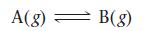
A reaction A(g) ⇌ B(g) has an equilibrium constant of 1.0 * 10-4. For which of the initial reaction mixtures is the x is small approximation most likely to apply?a. [A] = 0.0010 M; [B] = 0.00 Mb. [A] = 0.00 M; [B] = 0.10 Mc. [A] = 0.10 M; [B] = 0.10 Md. [A] = 0.10 M; [B] = 0.00 M
The reaction A(g) ⇌ 2 B(g) has an equilibrium constant of Kc = 1.0 at a given temperature. If a reaction vessel contains equal initial amounts (in moles) of A and B, does the direction in which the reaction proceeds depend on the volume of the reaction vessel? Explain.
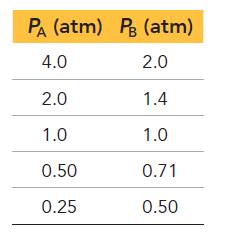
Consider the reaction:Each of the entries in the following table represents equilibrium partial pressures of A and B under different initial conditions.What are the values of a and b in the reaction? aA(g) bB(g)
A particular reaction has an equilibrium constant of Kp = 0.50.A reaction mixture is prepared in which all the reactants and products are in their standard states. In which direction does the reaction proceed?
Consider the simple one-step reaction:Since the reaction occurs in a single step, the forward reaction has a rate of kfor[A] and the reverse reaction has a rate of krev[B].What happens to the rate of the forward reaction when we increase the concentration of A? How does this explain the reason
Consider the reaction: A(g) ⇌ 2 B(g). The graph plots the concentrations of A and B as a function of time at a constant temperature. What is the equilibrium constant for this reaction at this temperature? Concentration 1.0 M- 0.5 M [A] [B] Time-
The reactions shown here can be combined to make the overall reaction C(s) + H2O( g) → CO(g) + H2( g) by reversing some and/or dividing all the coefficients by a number. As a group, determine how the reactions need to be modified to sum to the overall process. Then have each group member
Consider the reaction: a. Write the equilibrium constant expression for this reaction. If some hydrogen is added, before the reaction shifts.b. How will the numerator and denominator of the expression in part a compare to the value at equilibrium?c. Will Q be larger or smaller than K? Why?d. Will
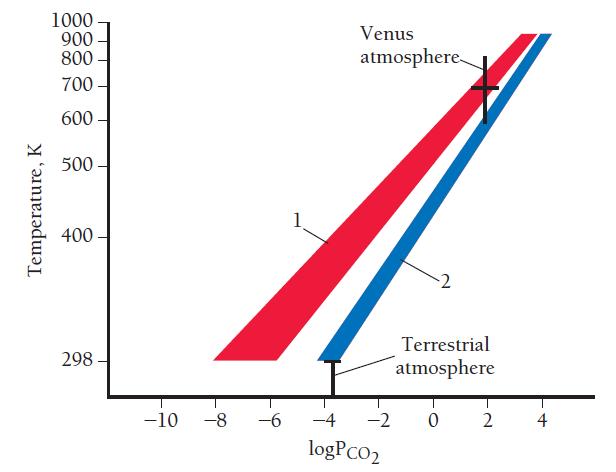
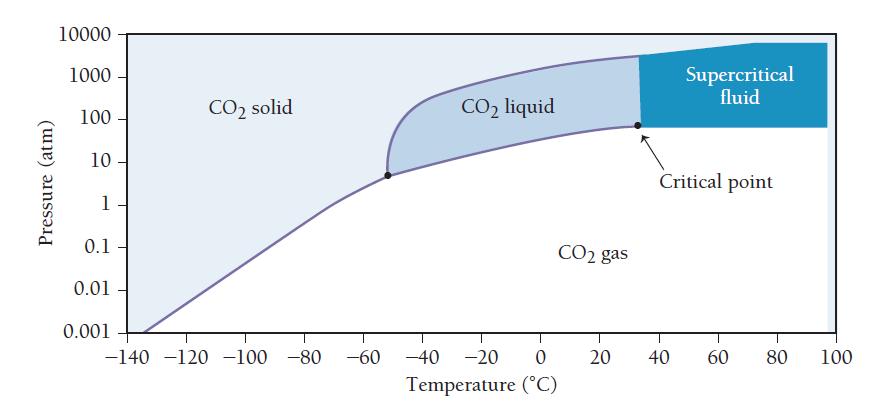
The atmosphere of the planet Venus is almost entirely composed of carbon dioxide (about 96.5 % carbon dioxide). The carbon dioxide on Venus might be in equilibrium with carbonate ions in minerals on the planet’s crust. Two possible equilibrium systems involve CaSiO3 and MgSiO3:The first graph
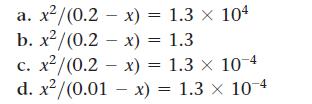
Solve each of the expressions for x using the quadratic formula and the x is small approximation. In which of the following expressions is the x is small approximation valid?In a complete sentence, describe the factor(s) that tend to make the x is small approximation valid in an expression. a.
For the reaction A → B, the ratio of products to reactants at equilibrium is always the same number, no matter how much A or B is initially present. Interestingly, in contrast, the ratio of products to reactants for the reaction C → 2 D does depend on how much of C and D you have initially.
Have each group member explain to the group what happens if a system at equilibrium is subject to one of the following changes and why:a. The concentration of a reactant is increased b. A solid product is added c. The volume is decreased d. The temperature is raised
Express the equilibrium constant for the chemical equation: CH3OH(g) CO(g) + 2 H₂(8)
How does a developing fetus get oxygen in the womb?
What is the correct expression for the equilibrium constant (Kc) for the reaction between carbon and hydrogen gas to form methane shown here? C(s) + 2 H₂(g) = CH₂(g)
Which statement does NOT generally apply to a chemical reaction in dynamic equilibrium?(a) The rates of the forward and reverse reactions are equal.(b) The concentrations of the reactants and products are constant.(c) The concentrations of the reactants and products are equal.
Consider the chemical equation and equilibrium constant for the synthesis of ammonia at 25 °C:Calculate the equilibrium constant for the following reaction at 25 °C: N₂(g) + 3 H₂(g) = 2 NH3(8) K = 5.6 X 10⁵
What is dynamic equilibrium? Why is it called dynamic?
According to the law of mass action, what is the correct expression for the equilibrium constant for the reaction 2A + B 3 C?
The equilibrium constant for the reaction shown here is Kc = 1.0 * 103. A reaction mixture at equilibrium contains [A] = 1.0 * 10-3 M. What is the concentration of B in the mixture? A(g) = B(g)
Give the general expression for the equilibrium constant of the following generic reaction: aA+ bB cC + dD
Nitrogen monoxide, a pollutant in automobile exhaust, is oxidized to nitrogen dioxide in the atmosphere according to the equation:Find Kc for this reaction. 2 NO(g) + 0₂(8) 2 NO₂(8) Kp 2.2 x 10¹2 at 25 °C =
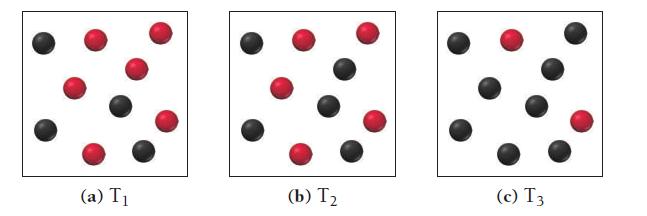
Consider the reaction A(g) ⇌ B(g). The images shown here illustrate equilibrium mixtures of A (red) and B (black) at three different temperatures. At which temperature is the equilibrium constant the largest? (a) T₁ (b) T₂ (c) T3
Use the data shown here to find the equilibrium constant (Kc) for the reaction A(g) ⇌ 2 B(g) + C(g). A(g) = B(g) = 2X(g) + C(g) X(g) Kc = 1.55 Kc = 25.2
Write an expression for the equilibrium constant (Kc) for this chemical equation: CaCO3(s) = CaO(s) + CO2(g)
What is the significance of the equilibrium constant? What does a large equilibrium constant tell us about a reaction? A small one?
The reaction shown here has a Kp = 4.5 * 102 at 825 K. Find Kc for the reaction at this temperature. CH₂(g) + CO₂(g) 2 CO(g) + 2 H₂(g)
The equilibrium constant for the reaction A(g) ⇌ B(g) is 10. A reaction mixture initially contains [A] = 1.1 M and [B] = 0.0 M.Which statement is true at equilibrium?(a) The reaction mixture contains [A] = 1.0 M and [B] = 0.1 M.(b) The reaction mixture contains [A] = 0.1 M and [B] = 1.0 M.(c) The
What happens to the value of the equilibrium constant for a reaction if the reaction equation is reversed? Multiplied by a constant?
The reaction A(g) ⇌ 2 B(g) has an equilibrium constant of K = 0.010. What is the equilibrium constant for the reaction B(g) ⇌ 1/2 A(g)?(a) 1 (b) 10 (c) 100 (d) 0.0010
Consider the reaction between NO and Cl2 to form NOCl:A reaction mixture at a certain temperature initially contains only [NO] = 0.50 M and [Cl2] = 0.50 M. After the reaction comes to equilibrium, the concentration of NOCl is 0.30 M. Find the value of the equilibrium constant (Kc) at this
If two reactions sum to an overall reaction, and the equilibrium constants for the two reactions are K1 and K2, what is the equilibrium constant for the overall reaction?
Under which circumstances are Kp and Kc equal for the reaction shown here?(a) If a + b = c + d.(b) If the reaction is reversible.(c) If the equilibrium constant is small. aA(g) + bB(g) bB(g) cC(g) + dD(g)
Consider the following reaction:2 CH4(g) ⇌ C2H2(g) + 3 H2(g)A reaction mixture at 1700 °C initially contains [CH4] = 0.115 M. At equilibrium, the mixture contains [C2H2] = 0.035 M. What is the value of the equilibrium constant?
For the reaction 2 A(g) ⇌ B(g), the equilibrium constant is Kp = 0.76. A reaction mixture initially contains 2.0 atm of each gas (PA = 2.0 atm and PB = 2.0 atm). Which statement is true of the reaction mixture?a) The reaction mixture is at equilibrium.b) The reaction mixture will proceed toward
Consider the reaction and its equilibrium constant at 25.0 °C:A reaction mixture contains PI2 = 0.114 atm, PCl2 = 0.102 atm, and PICl = 0.355 atm. Is the reaction mixture at equilibrium? If not, in which direction will the reaction proceed? 1₂ (8) + Cl₂(8) 2 IC1 (8) Kp = 81.9
Explain the difference between Kc and Kp. For a given reaction, how are the two constants related?
For which reaction does Kp = Kc ? (a) 2 Na₂O₂(s) + 2 CO₂2(8) (b) Fe₂O3(s) + 3 CO(g) 2 Fe(s) + 3 CO₂(g) (c) NH4NO3(s) = N₂O(g) + 2 H₂O(g) 2 Na₂CO3(s) + 0(g)
Consider the reaction between iodine gas and chlorine gas to form iodine monochloride:A reaction mixture at 298 K initially contains PI2 = 0.25 atm and PCl2 = 0.25 atm. What is the partial pressure of iodine monochloride when the reaction reaches equilibrium?a) 0.18 atm b) 0.64 atm c) 0.41
What units should be used when expressing concentrations or partial pressures in the equilibrium constant? What are the units of Kp and Kc? Explain.
Consider the reaction of A to form B:A reaction mixture at 298 K initially contains [A] = 0.50 M.What is the concentration of B when the reaction reaches equilibrium? 2 A(g) = B(g) Kc = 1.8 x 10⁵ (at 298 K)
For the reaction N2O4(g) ⇌ 2 NO2(g), a reaction mixture at a certain temperature initially contains both N2O4 and NO2 in their standard states, which means that PN2O4 = 1 atm and PNO2 = 1 atm. If Kp = 0.15, which statement is true of the reaction mixture before any reaction occurs?(a) Q = K; the
Consider the reaction:A reaction mixture at 2000 °C initially contains [N2] = 0.200 M and [O2] = 0.200 M. Find the equilibrium concentrations of the reactants and product at this temperature. N₂(8) + O₂(8) 2NO(g) Kc = 0.10 (at 2000 °C)
Why are the concentrations of solids and liquids omitted from equilibrium expressions?
The decomposition of NH4HS is endothermic:Which change to an equilibrium mixture of this reaction results in the formation of more H2S?a) A decrease in the volume of the reaction vessel (at constant temperature)b) An increase in the amount of NH4HS in the reaction vessel c) An increase in
For the reaction, A(g) ⇌ 2 B( g), Kc = 4.0. A reaction mixture at equilibrium contains [A] = 1.0 M. What is the concentration of B in the reaction mixture?(a) 0.50 M (b) 1.0 M (c) 2.0 M (d) 4.0 M
Consider the reaction:A reaction mixture at 100 °C initially contains [NO2] = 0.100 M. Find the equilibrium concentrations of NO2 and N2O4 at this temperature. N₂O4(8) = 2 NO₂(8) Kc 0.36 (at 100 °C)
Does the value of the equilibrium constant depend on the initial concentrations of the reactants and products? Do the equilibrium concentrations of the reactants and products depend on their initial concentrations? Explain.
For the generic reaction, A(g) ⇌ B(g), consider each value of K and initial concentration of A. For which set of values does the x is small approximation most likely apply? (a) K = 1.0 x 10⁵; [A] = 0.250 M (c) K = 1.0 x 10⁻⁵; [A] = 0.00250 M (b) K = 1.0 × 10⁻²; [A] (d) K = 1.0 x 10⁻²; [A] =
The solid XY decomposes into gaseous X and Y:If the reaction is carried out in a 22.4-L container, which initial amounts of X and Y result in the formation of solid XY?a) 5 mol X; 0.5 mol Y b) 2.0 mol X; 2.0 mol Yc) 1 mol X; 1 mol Y d) None of the above XY(s) X(g) + Y(g) Kp = 4.1 (at 0 °C)
Consider the reaction:A reaction mixture at 25 °C initially contains PI2 = 0.100 atm, PCl2 = 0.100 atm, and PICl = 0.100 atm. Find the equilibrium partial pressures of I2, Cl2, and ICl at this temperature. I2(g) + Cl₂(g) 2 ICI(g) Kp = 81.9 (at 25 °C)
Explain how you might deduce the equilibrium constant for a reaction in which you know the initial concentrations of the reactants and products and the equilibrium concentration of only one reactant or product.
What is the effect of adding helium gas (at constant volume) to an equilibrium mixture of the reaction:a) The reaction shifts toward the products.b) The reaction shifts toward the reactants.c) The reaction does not shift in either direction.d) The reaction slows down. CO(g) + Cl₂(g) Cl₂(g)
Consider the exothermic reaction 2 NO(g) + Cl2(g) ⇌ 2 NOCl(g). Which change causes a reaction mixture at equilibrium to shift right?(a) Adding NOCl to the reaction mixture.(b) Increasing the volume of the reaction vessel at constant temperature.(c) Increasing the temperature of the reaction
The reaction X2(g) ⇌ 2 X(g) occurs in a closed reaction vessel at constant volume and temperature. Initially, the vessel contains only X2 at a pressure of 1.55 atm. After the reaction reaches equilibrium, the total pressure is 2.85 atm.What is the value of the equilibrium constant, Kp, for the
Consider the reaction for the decomposition of hydrogen disulfide:A 0.500-L reaction vessel initially contains 0.0125 mol of H2S at 800 °C. Find the equilibrium concentrations of H2 and S2. 2 H₂S(g) → 2 H₂(g) + S₂(8) Kc = 1.67 x 10⁷ at 800 °C
What is the definition of the reaction quotient (Q) for a reaction?What does Q measure?
Consider the reaction for the decomposition of hydrogen disulfide:A 0.500-L reaction vessel initially contains 1.25 * 10-4 mol of H2S at 800 °C.Find the equilibrium concentrations of H2 and S2. 2 H₂S(g) 2 H₂(g) + S₂(8) Kc = 1.67 x 10⁷ at 800 °C
What is the value of Q when each reactant and product is in its standard state?
In what direction will a reaction proceed for each condition:a. Q < K ; b. Q > K ; and c. Q = K ?
Consider the following reaction at chemical equilibrium:What is the effect of decreasing the volume of the reaction mixture? Increasing the volume of the reaction mixture? Adding an inert gas at constant volume? 2 KClO3(s) 2 KCl(s) + 3 O2(8)
Many equilibrium calculations involve finding the equilibrium concentrations of reactants and products given their initial concentrations and the equilibrium constant. Outline the general procedure used in solving these kinds of problems.
The following reaction is endothermic:What is the effect of increasing the temperature of the reaction mixture? Decreasing the temperature? CaCO3(s) = CaO(s) + COz(g)
In equilibrium problems involving equilibrium constants that are small relative to the initial concentrations of reactants, we can often assume that the quantity x (which represents how far the reaction proceeds toward products) is small. When this assumption is made, we can ignore the quantity x
What happens to a chemical system at equilibrium when that equilibrium is disturbed?
What is the effect of a change in concentration of a reactant or product on a chemical reaction initially at equilibrium?
What is the effect of a change in volume on a chemical reaction (that includes gaseous reactants or products) initially at equilibrium?
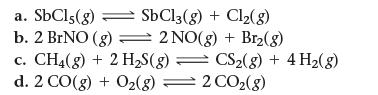
Write an expression for the equilibrium constant of each chemical equation. a. SbCl, (g) SbCl3(g) + Cl₂(g) b. 2 BINO (g) = 2NO(g) + Br₂(g) c. CH₂(g) + 2 H₂S(g) = CS₂(g) + 4 H₂(g) d. 2 CO(g) + O₂(g) = 2 CO₂(g)
What is the effect of a temperature change on a chemical reaction initially at equilibrium? How does the effect differ for an exothermic reaction compared to an endothermic one?
Find and fix each mistake in the equilibrium constant expressions. a. 2 H₂S(g) 2 H₂(8) + S₂(g) K = b. CO(g) + Cl₂(g) = COC12(g) K = [H₂][S₂] [H₂S] [CO][C1₂] [COCl2]
When this reaction comes to equilibrium, will the concentrations of the reactants or products be greater? Does the answer to this question depend on the initial concentrations of the reactants and products? A(g) + B(g) 2 C(g) K = 1.4 x 10⁻⁵
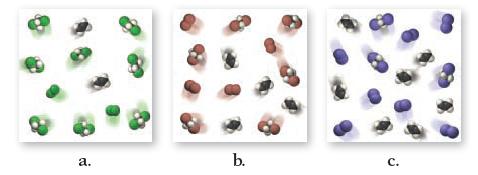
Ethene (C2H4) can be halogenated by this reaction:where X2 can be Cl2 (green), Br2 (brown), or I2 (purple). Examine the three figures representing equilibrium concentrations in this reaction at the same temperature for the three different halogens. Rank the equilibrium constants for the three
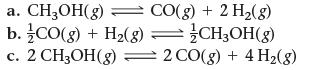
This reaction has an equilibrium constant of Kp = 2.26 * 104 at 298 K.Calculate Kp for each reaction and predict whether reactants or products will be favored at equilibrium. CO(g) + 2 H₂(g) = CH3OH(g)
A chemist trying to synthesize a particular compound attempts two different synthesis reactions. The equilibrium constants for the two reactions are 23.3 and 2.2 * 104 at room temperature.However, upon carrying out both reactions for 15 minutes, the chemist finds that the reaction with the smaller
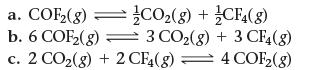
This reaction has an equilibrium constant of Kp = 2.2 * 106 at 298 K.Calculate Kp for each reaction and predict whether reactants or products will be favored at equilibrium. 2 COF2(g) = CO₂(g) + CF4(g)
Consider the reactions and their respective equilibrium constants:Use these reactions and their equilibrium constants to predict the equilibrium constant for the following reaction: NO(g) + Br₂(g) — NOBr(g) 2 NO(g) N₂(g) N₂(g) + O₂(g) Kp = 5.3 Kp = 2.1 × 1030
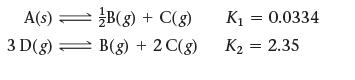
Use the reactions and their equilibrium constants to predict the equilibrium constant for the reaction 2 A(s) ⇌3 D(g). A(s) = 3 D(g) B(g) + C(g) B(g) + 2 C(g) K₁ = 0.0334 K₂ = 2.35
Calculate Kc for each reaction. a. [₂(g) = 21(g) Kp 6.26 x 10⁻²² (at 298 K) b. CH4(g) + H₂O(g) = CO(g) + 3 H₂(g) c. I₂(g) + Cl₂(g) = 2 ICI(g) = Kp = 7.7 x 1024 (at 298 K) Kp = 81.9 (at 298 K) P
Calculate Kp for each reaction. a. N₂O4(8) = 2 NO₂(g) b. N₂(g) + 3 H₂(g) = 2 NH3(g) c. N₂(g) + O₂(g) — 2 NO(g) K = 5.9 x 10-³ (at 298 K) K = 3.7 x 10⁸ (at 298 K) K = 4.10 x 10-³1 (at 298 K)
Showing 1700 - 1800
of 4045
First
11
12
13
14
15
16
17
18
19
20
21
22
23
24
25
Last
Step by Step Answers

 Get 50% OFF
Claim Now
Get 50% OFF
Claim Now

















![Concentration 1.0 M- 0.5 M [A] [B] Time-](https://dsd5zvtm8ll6.cloudfront.net/images/question_images/1700/2/1/8/93765574839d375f1700218936461.jpg)





![a) Ke c) Ke = [CH] [H] [CH] [C][H1 b) K d) Ke = [CH] [C] [H] [CH] [H1](https://dsd5zvtm8ll6.cloudfront.net/images/question_images/1700/2/1/2/07665572d6ce69fe1700212077293.jpg)



![(a) K = [C] [A] [B] (b) K = 3 [C] 2 [A] [B] (c) K = [A] [B] [C] (d) K = [C] [A] [B]](https://dsd5zvtm8ll6.cloudfront.net/images/question_images/1700/2/1/1/35565572a9be07301700211356456.jpg)




















![(a) K = 1.0 x 10⁵; [A] = 0.250 M (c) K = 1.0 10-5; [A] = 0.00250 M (b) K = 1.0 10-2; [A] (d) K = 1.0 x](https://dsd5zvtm8ll6.cloudfront.net/images/question_images/1700/2/1/1/89265572cb4a748f1700211892693.jpg)







![a. 2 HS(g) 2 H(g) + S(g) K = b. CO(g) + Cl(g) = COC12(g) K = [H][S] [HS] [CO][C1] [COCl2]](https://dsd5zvtm8ll6.cloudfront.net/images/question_images/1700/2/1/2/959655730df43cbd1700212958508.jpg)