New Semester
Started
Get
50% OFF
Study Help!
--h --m --s
Claim Now
Question Answers
Textbooks
Find textbooks, questions and answers
Oops, something went wrong!
Change your search query and then try again
S
Books
FREE
Study Help
Expert Questions
Accounting
General Management
Mathematics
Finance
Organizational Behaviour
Law
Physics
Operating System
Management Leadership
Sociology
Programming
Marketing
Database
Computer Network
Economics
Textbooks Solutions
Accounting
Managerial Accounting
Management Leadership
Cost Accounting
Statistics
Business Law
Corporate Finance
Finance
Economics
Auditing
Tutors
Online Tutors
Find a Tutor
Hire a Tutor
Become a Tutor
AI Tutor
AI Study Planner
NEW
Sell Books
Search
Search
Sign In
Register
study help
sciences
chemistry a molecular approach
Chemistry A Molecular Approach 5th Edition Nivaldo Tro - Solutions
Identify each process as endothermic or exothermic and indicate the sign of ΔH.(a) Sweat evaporating from skin(b) Water freezing in a freezer(c) Wood burning in a fire
An endothermic reaction occurs in a flask. What happens to the temperature of the flask?(a) The temperature rises.(b) The temperature falls.(c) The temperature remains unchanged.
Hydrogen gas reacts with oxygen to form water:Determine the minimum mass of hydrogen gas required to produce 226 kJ of heat.a) 8.63 g b) 1.88 g c) 0.942 g d) 0.935 g 2 H₂(g) + O₂(8) 2 H₂O(g) AH = -483.5 kJ
A friend claims to have constructed a machine that creates electricity but requires no energy input. Explain why you should be suspicious of your friend’s claim.
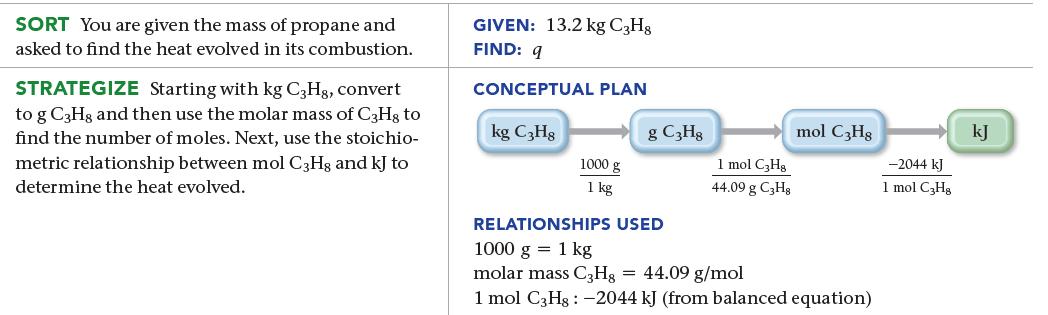
An LP gas tank in a home barbeque contains 13.2 kg of propane, C3H8. Calculate the heat (in kJ) associated with the complete combustion of all of the propane in the tank. C3Hg(g) + 5 O2(g) 3 CO2(g) + 4 H2O(g) ΔΗχη = –2044 kJ
Consider the following thermochemical equation:What is the heat associated with the reaction of 6 moles of A?(a) -51.0 J (b) -306 J (c) -153 J (d) 153 J 2A → AA ΔΗχη → –51.0J
Manganese reacts with hydrochloric acid to produce manganese(II) chloride and hydrogen gas:When 0.625 g Mn is combined with enough hydrochloric acid to make 100.0 mL of solution in a coffee-cup calorimeter, all of the Mn reacts, raising the temperature of the solution from 23.5 °C to 28.8 °C.
What is a state function? List some examples of state functions.
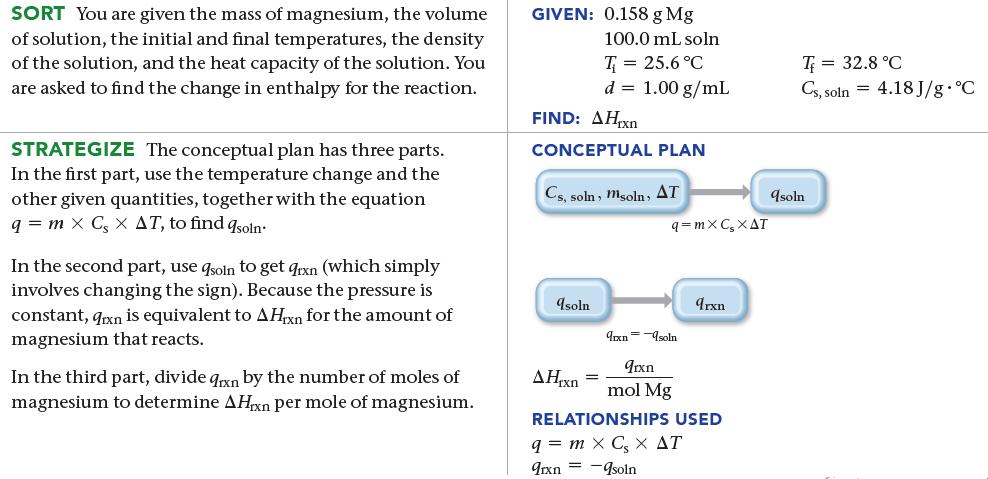
Magnesium metal reacts with hydrochloric acid according to the balanced equation:In an experiment to determine the enthalpy change for this reaction, 0.158 g of Mg metal is combined with enough HCl to make 100.0 mL of solution in a coffee-cup calorimeter. The HCl is sufficiently concentrated so
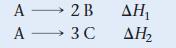
Consider the reactions:What is ΔH for the reaction 2 B→ 3 C? A — 2 B A — 3C ΔΗ ΔΗ,
Find ΔHrxn for the reaction:Use these reactions with known ΔH’s: 3 C(s) + 4 H₂(g) → C3H8(8)
The same reaction, with exactly the same amount of reactant, is conducted in a bomb calorimeter and in a coffee-cup calorimeter. In one of the calorimeters, qrxn = -12.5 kJ and in the other qrxn = -11.8 kJ. Which value was obtained in the bomb calorimeter? (Assume that the reaction has a positive
What is internal energy? Is internal energy a state function?
Consider the following chemical equation:What is ΔHrxn for the reaction 2 C → 4 A + 2 B?(a) 122 J (b) -122 J (c) 244 J (d) -244 J 2 A + B — C ΔΗ,xn 122J
Use standard enthalpies of formation to determine ΔH°rxn for the reaction:a) -541.2 kJ b) -2336 kJ c) 541.2 kJ d) -24.8 kJ Fe₂O3(s) + 3 CO(g) 2 Fe(s) + 3 CO(g)
If energy flows out of a chemical system and into the surroundings, what is the sign of ΔEsystem?
Write equations for the formation of (a) MgCO3(s) and (b) C6H12O6(s) from their respective elements in their standard states. Include the value of ΔH°f for each equation.
Two substances, A and B, of equal mass but at different temperatures come into thermal contact. The specific heat capacity of substance A is twice the specific heat capacity of substance B. Which statement is true of the temperature of the two substances when they reach thermal equilibrium?a) The
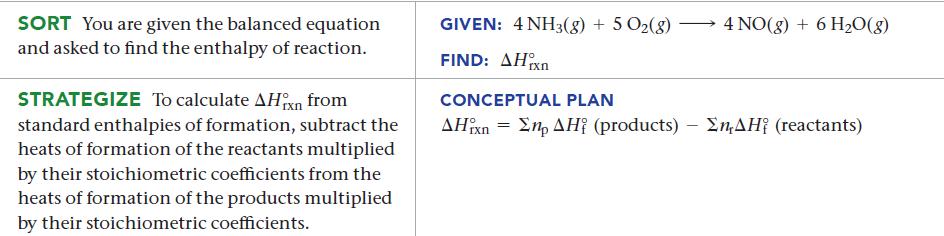
Use the standard enthalpies of formation to determine ΔH°rxn for the reaction: 4 NH3(g) + 5 O₂(8) 4 NO(g) + 6 H₂O(g)
If the internal energy of the products of a reaction is higher than the internal energy of the reactants, what is the sign of ΔE for the reaction? In which direction does energy flow?
Which process is endothermic?a) The evaporation of water from the skinb) The burning of candle waxc) The oxidation of iron in a chemical hand warmerd) The combustion of natural gas in a stove
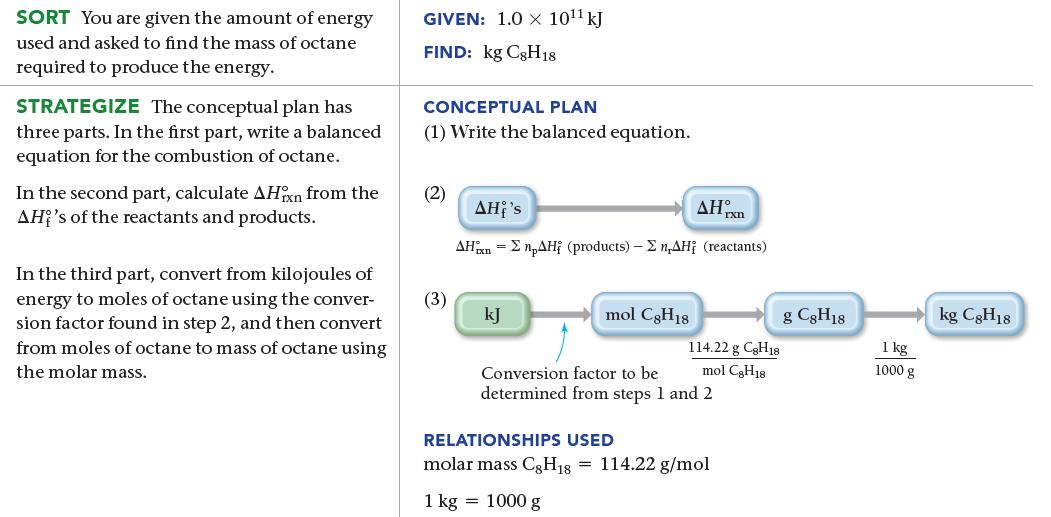
A city of 100,000 people uses approximately 1.0 * 1011 kJ of energy per day. Suppose all of that energy comes from the combustion of liquid octane (C8H18) to form gaseous water and gaseous carbon dioxide. Use standard enthalpies of formation to calculate ΔH°rxn for the combustion of octane and
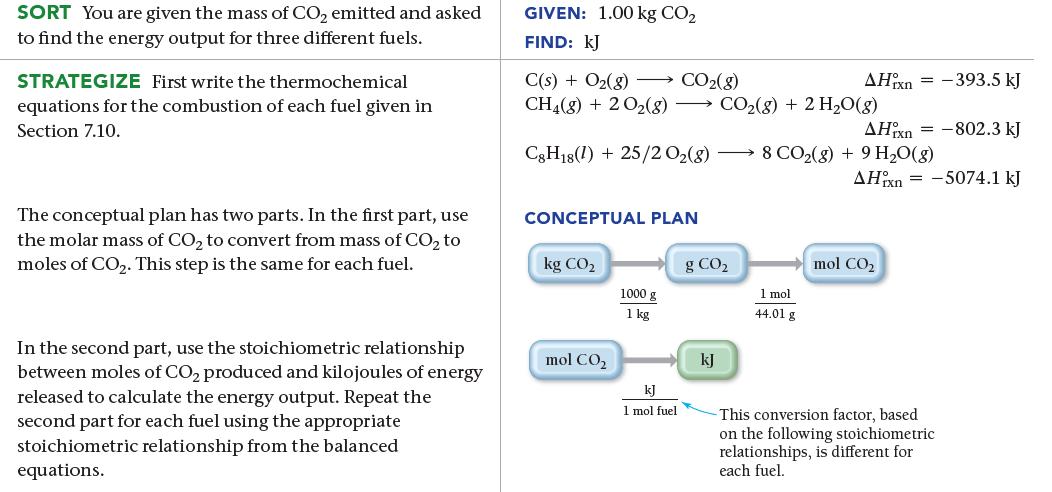
One way to evaluate fuels with respect to global warming is to determine how much heat they release during combustion relative to how much CO2 they produce. The greater the heat relative to the amount of CO2, the better the fuel. Use the combustion reactions of carbon, natural gas, and octane, in
What is heat? Explain the difference between heat and temperature.
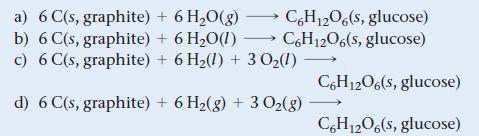
The standard enthalpy of formation for glucose [C6H12O6(s)] is -1273.3 kJ/mol. What is the correct formation equation corresponding to this ΔH°f? a) 6 C(s, graphite) b) 6 C(s, graphite) + 6H₂O(g) →C6H12O6(s, glucose) + 6H₂O(1)→ C6H12O6(s, glucose) c) 6 C(s, graphite) + 6 H₂(1) + 3 0₂
Which fuel is not a fossil fuel?a) Coal b) Hydrogenc) Natural gas d) Petroleum
Natural gas burns in air to form carbon dioxide and water, releasing heat.What minimum mass of CH4 is required to heat 55 g of water by 25 °C?a) 0.115 g b) 2.25 * 103 gc) 115 g d) 8.70 g CH4(g) + O2(g) CO2(g) + H2O(g) ΔΗ IX Π -802.3 kJ
Explain how the sum of heat and work can be a state function, even though heat and work are themselves not state functions.
What is heat capacity? Explain the difference between heat capacity and specific heat capacity.
Explain how the high specific heat capacity of water can affect the weather in coastal regions.
If two objects, A and B, of different temperature come into direct contact, what is the relationship between the heat lost by one object and the heat gained by the other? What is the relationship between the temperature changes of the two objects?
What is pressure–volume work? How is it calculated?
What is calorimetry? Explain the difference between a coffeecup calorimeter and a bomb calorimeter. What is each designed to measure?
What is the change in enthalpy (ΔH) for a chemical reaction?How is ΔH different from ΔE ?
Explain the difference between an exothermic and an endothermic reaction. Give the sign of ΔH for each type of reaction.
From a molecular viewpoint, where does the energy emitted in an exothermic chemical reaction come from? Why does the reaction mixture undergo an increase in temperature even though energy is emitted?
Suppose you are cold-weather camping and decide to heat some objects to bring into your sleeping bag for added warmth. You place a large water jug and a rock of equal mass near the fire. Over time, both the rock and the water jug warm to about 38 °C (100 °F). If you can bring only one into your
How much heat must be absorbed by a 15.0-g sample of water to raise its temperature from 25.0 °C to 55.0 °C? (For water, Cs = 4.18 J/g · °C.)a) 1.57 kJ b) 1.88 kJ c) 3.45 kJ d) 107 J
What is kinetic energy? What is potential energy? List some examples of each.
A 32.5 g cube of aluminum initially at 45.8 °C is submerged into 105.3 g of water at 15.4 °C. What is the final temperature of both substances at thermal equilibrium? (Assume that the aluminum and the water are thermally isolated from everything else.)
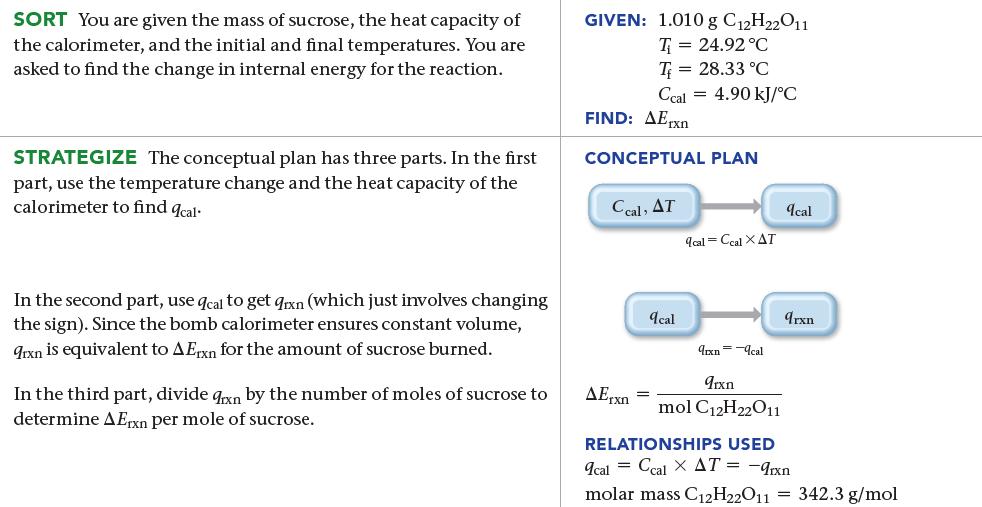
When 1.010 g of sucrose (C12H22O11) undergoes combustion in a bomb calorimeter, the temperature rises from 24.92 °C to 28.33 °C. Find ΔErxn for the combustion of sucrose in kJ/mol sucrose. The heat capacity of the bomb calorimeter, determined in a separate experiment, is 4.90 kJ/°C. SORT You
From a molecular viewpoint, where does the energy absorbed in an endothermic chemical reaction go? Why does the reaction mixture undergo a decrease in temperature even though energy is absorbed?
Is the change in enthalpy for a reaction an extensive property?Explain the relationship between ΔH for a reaction and the amounts of reactants and products that undergo reaction.
Explain how the value of ΔH for a reaction changes upon each operation.a. Multiplying the reaction by a factor b. Reversing the reaction Why do these relationships hold?
What is Hess’s law? Why is it useful?
What is a standard state? What is the standard enthalpy change for a reaction?
What is the standard enthalpy of formation for a compound?For a pure element in its standard state?
How do you calculate ΔH°rxn from tabulated standard enthalpies of formation?
What are the main sources of the energy consumed in the United States?
What are the main environmental problems associated with fossil fuel use?
Explain global climate change. What causes global warming?What is the evidence that global warming is occurring?
Convert between energy units.a. 534 kWh to Jb. 215 kJ to Calc. 567 Cal to Jd. 2.85 * 103 J to cal
Suppose that 25 g of each substance is initially at 27.0 °C. What is the final temperature of each substance upon absorbing 2.35 kJ of heat?a. Gold b. Silver c. Aluminum d. Water
An unknown mass of each substance, initially at 23.0 °C, absorbs 1.95 * 103 J of heat. The final temperature is recorded.Find the mass of each substance.a. Pyrex glass (Tf = 55.4 °C)b. Sand (Tf = 62.1 °C)c. Ethanol (Tf = 44.2 °C)d. Water (Tf = 32.4 °C)
How much work (in J) is required to expand the volume of a pump from 0.0 L to 2.5 L against an external pressure of 1.1 atm?
A 31.1-g wafer of pure gold, initially at 69.3 °C, is submerged into 64.2 g of water at 27.8 °C in an insulated container. What is the final temperature of both substances at thermal equilibrium?
A 2.85-g lead weight, initially at 10.3 °C, is submerged in 7.55 g of water at 52.3 °C in an insulated container. What is the final temperature of both substances at thermal equilibrium?
Two substances, A and B, initially at different temperatures, come into contact and reach thermal equilibrium. The mass of substance A is 6.15 g and its initial temperature is 20.5 °C.The mass of substance B is 25.2 g and its initial temperature is 52.7 °C. The final temperature of both
Hydrazine (N2H4) is a fuel used by some spacecraft. It is normally oxidized by N2O4 according to the equation:Calculate ΔH°rxn for this reaction using standard enthalpies of formation. N₂H4(1) + N₂O4(8) 2 N₂O(g) + 2 H₂O(g)
Pentane (C5H12) is a component of gasoline that burns according to the following balanced equation:Calculate ΔH°rxn for this reaction using standard enthalpies of formation. (The standard enthalpy of formation of liquid pentane is -146.8 kJ/mol.) C5H12(1) + 8 O2(8) 5 CO₂(g) + 6 H₂O(g)
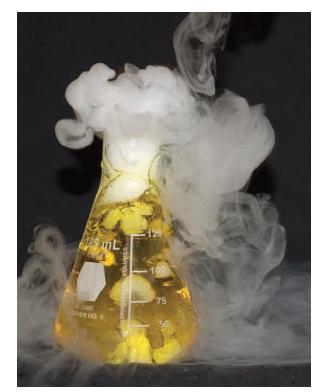
Dry ice is solid carbon dioxide. Instead of melting, solid carbon dioxide sublimes according to the equation:When dry ice is added to warm water, heat from the water causes the dry ice to sublime more quickly. The evaporating carbon dioxide produces a dense fog often used to create
A 25.5-g aluminum block is warmed to 65.4 °C and plunged into an insulated beaker containing 55.2 g water initially at 22.2 °C. The aluminum and the water are allowed to come to thermal equilibrium. Assuming that no heat is lost, what is the final temperature of the water and aluminum?
If 50.0 mL of ethanol (density = 0.789 g/mL) initially at 7.0 °C is mixed with 50.0 mL of water (density = 1.0 g/mL) initially at 28.4 °C in an insulated beaker, and assuming that no heat is lost, what is the final temperature of the mixture?
Palmitic acid (C16H32O2) is a dietary fat found in beef and butter. The caloric content of palmitic acid is typical of fats in general. Write a balanced equation for the complete combustion of palmitic acid and calculate the standard enthalpy of combustion. What is the caloric content of palmitic
Hydrogen and methanol have both been proposed as alternatives to hydrocarbon fuels. Write balanced reactions for the complete combustion of hydrogen and methanol and use standard enthalpies of formation to calculate the amount of heat released per kilogram of the fuel. Which fuel contains the most
When backpacking in the wilderness, hikers often boil water to sterilize it for drinking. Suppose that you are planning a backpacking trip and will need to boil 35 L of water for your group.What volume of fuel should you bring? Assume that the fuel has an average formula of C7H16, 15% of the heat
An ice cube of mass 9.0 g is added to a cup of coffee. The coffee’s initial temperature is 90.0 °C and the cup contains 120.0 g of liquid. Assume the specific heat capacity of the coffee is the same as that of water. The heat of fusion of ice (the heat associated with ice melting) is 6.0 kJ/mol.
Find ΔH, ΔE, q, and w for the freezing of water at -10.0 °C.The specific heat capacity of ice is 2.04 J/g · °C and its heat of fusion (the quantity of heat associated with melting) is -332 J/g.
Starting from the relationship between temperature and kinetic energy for an ideal gas, find the value of the molar heat capacity of an ideal gas when its temperature is changed at constant volume. Find its molar heat capacity when its temperature is changed at constant pressure.
An amount of an ideal gas expands from 12.0 L to 24.0 L at a constant pressure of 1.0 atm. Then the gas is cooled at a constant volume of 24.0 L back to its original temperature. Then it contracts back to its original volume. Find the total heat flow for the entire process.
A propane tank on a home barbeque contains 10.4 * 103 g of propane.a. Write the balanced chemical reaction for the combustion of gaseous propane (C3H8) to form water vapor and gaseous carbon dioxide.b. Use the value for ΔHrxn provided in the text to calculate the total amount of heat produced when
Arrange these three types of electromagnetic radiation—visible light, X-rays, and microwaves—in order of increasing (a) Wavelength. (b) Frequency. (c) Energy per photon.
What values of ml are possible for l = 2?(a) 0, 1, and 2 (b) 0(c) -1, 0, and +1 (d) -2, -1, 0, +1, and +2
Newton’s laws of motion are deterministic. Explain this statement.
Calculate the frequency of each wavelength of electromagnetic radiation.a. 632.8 nm (wavelength of red light from helium–neon laser)b. 503 nm (wavelength of maximum solar radiation)c. 0.052 nm (a wavelength contained in medical X-rays)
An electron traveling at 3.7 * 105 m/s has an uncertainty in its velocity of 1.88 * 105 m/s. What is the minimum uncertainty in its position?
Ultraviolet radiation and radiation of shorter wavelengths can damage biological molecules because these kinds of radiation carry enough energy to break bonds within the molecules.A typical carbon–carbon bond requires 348 kJ/mol to break.What is the longest wavelength of radiation with enough
A laser produces 20.0 mW of red light. In 1.00 hr, the laser emits 2.29 * 1020 photons. What is the wavelength of the laser?
Write the electron configuration for Ge. Identify the valence electrons and the core electrons.
Write the electron configuration and orbital diagram for each ion and determine whether each is diamagnetic or paramagnetic.(a) Al3+ (b) S2- (c) Fe3+
For which element is the gaining of an electron most exothermic?a) Li b) N c) F d) B
Describe the relationship betweena. The radius of a cation and that of the atom from which formsb. The radius of an anion and that of the atom from which it forms
Determine the number of valence electrons in an atom of each element. Which elements do you expect to lose electrons in their chemical reactions? Which do you expect to gain electrons?a. Al b. Sn c. Br d. Se
Write orbital diagrams for each ion and indicate whether the ion is diamagnetic or paramagnetic.a. Cd2+ b. Au+ c. Mo3+ d. Zr2+
Which pair of elements is most likely to form an ionic bond?a) Nitrogen and oxygen b) Carbon and hydrogenc) Sulfur and oxygen d) Calcium and oxygen
Why are bonding theories important? Provide some examples of what bonding theories can predict.
Use Lewis symbols to predict the formula for the compound that forms between calcium and chlorine.
Which compound is most likely to contain ionic bonds?(a) CH4(b) N2O(c) MgF2
Which set of elements is arranged in order of increasing electronegativity?a) O < S < As < Ge b) Ge < As < S < Oc) S < O < As < Ge d) As < O < Ge < S
Why do chemical bonds form? What basic forces are involved in bonding?
Arrange these ionic compounds in order of increasing magnitude of lattice energy: CaO, KBr, KCl, SrO.
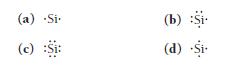
What is the Lewis symbol for silicon? (a) .Si. (c) :Si: (b) :Si (d) .Si.
Which is the correct Lewis structure for magnesium bromide? a) 2 Mg²+ [Br] c) Mg²+2 [Br] b) Mg: Br: d) :Mg: Br:
What are the three basic types of chemical bonds? What happens to electrons in the bonding atoms in each type?
Classify the bond formed between each pair of atoms as covalent, polar covalent, or ionic.(a) Sr and F (b) N and Cl (c) N and O
Use the ionic bonding model to determine which has the higher melting point: NaCl or MgO. Explain the relative ordering.(a) MgO has a higher melting point because the ions have larger charges.(b) MgO has a higher melting point because the ions have smaller charges.(c) NaCl has a higher melting
What is wrong with the following statement? Atoms form bonds in order to satisfy the octet rule.(a) Nothing. The statement is correct.(b) Atoms form bonds for complex reasons that include the lowering of potential energy. The octet rule helps us predict in which cases bonds form.(c) Atoms form
Which compound is likely to have an incomplete octet?a) NH3 b) SO3 c) N2O d) BH3
How do you determine how many dots to put around the Lewis symbol of an element?
Write the Lewis structure for CO2.
Showing 2400 - 2500
of 4045
First
18
19
20
21
22
23
24
25
26
27
28
29
30
31
32
Last
Step by Step Answers

 Get 50% OFF
Claim Now
Get 50% OFF
Claim Now


















![a) 2 Mg+ [Br] c) Mg+2 [Br] b) Mg: Br: d) :Mg: Br:](https://dsd5zvtm8ll6.cloudfront.net/images/question_images/1700/0/3/3/62365547457aa2fb1700033622210.jpg)


