New Semester
Started
Get
50% OFF
Study Help!
--h --m --s
Claim Now
Question Answers
Textbooks
Find textbooks, questions and answers
Oops, something went wrong!
Change your search query and then try again
S
Books
FREE
Study Help
Expert Questions
Accounting
General Management
Mathematics
Finance
Organizational Behaviour
Law
Physics
Operating System
Management Leadership
Sociology
Programming
Marketing
Database
Computer Network
Economics
Textbooks Solutions
Accounting
Managerial Accounting
Management Leadership
Cost Accounting
Statistics
Business Law
Corporate Finance
Finance
Economics
Auditing
Tutors
Online Tutors
Find a Tutor
Hire a Tutor
Become a Tutor
AI Tutor
AI Study Planner
NEW
Sell Books
Search
Search
Sign In
Register
study help
sciences
chemistry a molecular approach
Chemistry A Molecular Approach 5th Edition Nivaldo Tro - Solutions
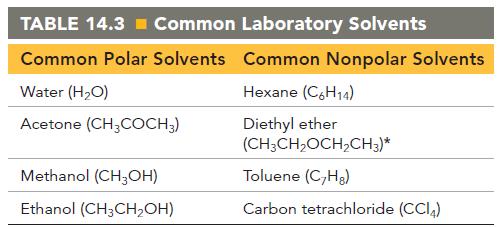
Pick an appropriate solvent from Table 14.3 to dissolve each substance. State the kind of intermolecular forces that would occur between the solute and solvent in each case.a. Motor oil (nonpolar)b. Ethanol (polar, contains an OH group)c. Lard (nonpolar)d. Potassium chloride (ionic) TABLE 14.3=
What keeps the particles in a colloidal dispersion from coalescing?
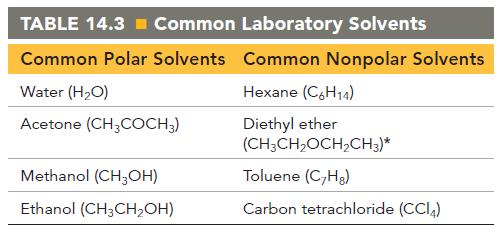
Pick an appropriate solvent from Table 14.3 to dissolve each substance. State the kind of intermolecular forces that would occur between the solute and solvent in each case.a. Isopropyl alcohol (polar, contains an OH group)b. Sodium chloride (ionic)c. Vegetable oil (nonpolar)d. Sodium nitrate
Which molecule would you expect to be more soluble in water:CH3CH2CH2OH or HOCH2CH2CH2OH?
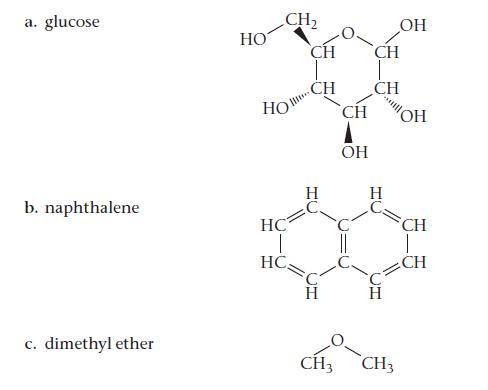
For each compound, would you expect greater solubility in water or in hexane? Indicate the kinds of intermolecular forces that occur between the solute and the solvent in which the molecule is most soluble. a. glucose b. naphthalene c. dimethyl
Which molecule would you expect to be more soluble in water:CCl4 or CH2Cl2?
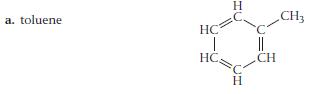
For each compound, would you expect greater solubility in water or in hexane? Indicate the kinds of intermolecular forces that would occur between the solute and the solvent in which the molecule is most soluble. a. toluene. HC | HC Н Н || CH CH3
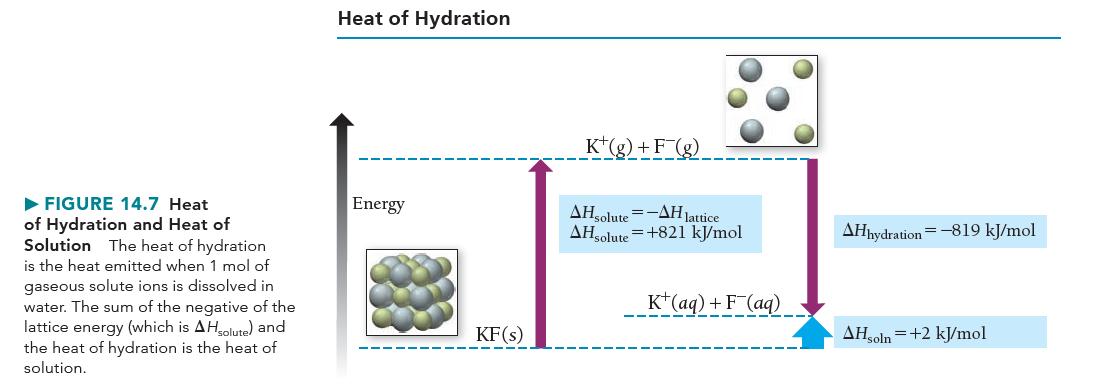
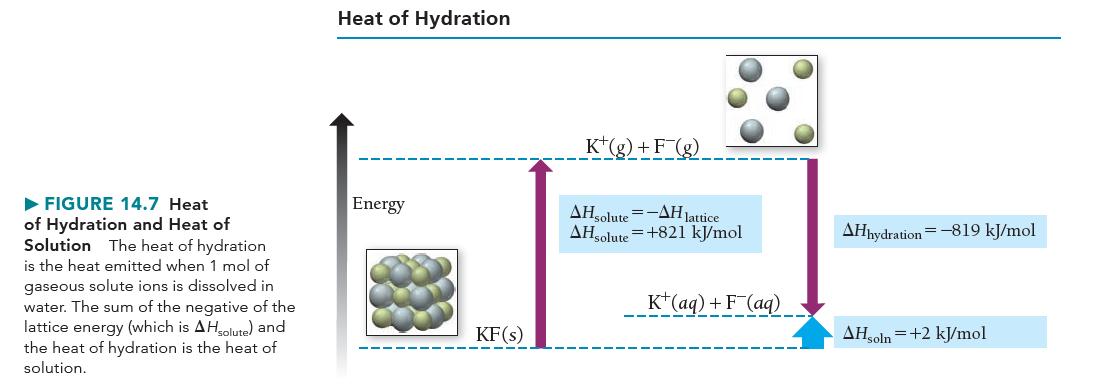
When ammonium chloride (NH4Cl) is dissolved in water, the solution becomes colder.a. Is the dissolution of ammonium chloride endothermic or exothermic?b. What can you conclude about the relative magnitudes of the lattice energy of ammonium chloride and its heat of hydration?c. Sketch a qualitative
When lithium iodide (LiI) is dissolved in water, the solution becomes hotter.a. Is the dissolution of lithium iodide endothermic or exothermic?b. What can you conclude about the relative magnitudes of the lattice energy of lithium iodide and its heat of hydration?c. Sketch a qualitative energy
Use the data to calculate the heats of hydration of lithium chloride and sodium chloride. Which of the two cations, lithium or sodium, has stronger ion–dipole interactions with water? Why? Compound LICI NaCl Lattice Energy (kJ/mol) AHSoln (kJ/mol) -834 -37.0 -769 +3.88
Silver nitrate has a lattice energy of -820 kJ/mol and a heat of solution of 22.6 kJ/mol. Calculate the heat of hydration for silver nitrate.
Lithium iodide has a lattice energy of -7.3 * 102 kJ/mol and a heat of hydration of -793 kJ/mol. Find the heat of solution for lithium iodide and determine how much heat is evolved or absorbed when 15.0 g of lithium iodide completely dissolves in water.
Potassium nitrate has a lattice energy of -163.8 kcal/mol and a heat of hydration of -155.5 kcal/mol. How much potassium nitrate has to dissolve in water to absorb 1.00 * 102 kJ of heat?
A solution contains 25 g of NaCl per 100.0 g of water at 25 °C. Is the solution unsaturated, saturated, or supersaturated?
A solution contains 32 g of KNO3 per 100.0 g of water at 25 °C. Is the solution unsaturated, saturated, or supersaturated?
A KNO3 solution containing 45 g of KNO3 per 100.0 g of water is cooled from 40 °C to 0 °C. What happens during cooling?
A KCl solution containing 42 g of KCl per 100.0 g of water is cooled from 60 °C to 0 °C. What happens during cooling?
Some laboratory procedures involving oxygen-sensitive reactants or products call for using water that has been boiled (and then cooled). Explain.
A person preparing a fish tank fills the tank with water that has been boiled (and then cooled). When the person puts fish into the tank, they die. Explain.
Scuba divers breathing air at increased pressure can suffer from nitrogen narcosis—a condition resembling drunkenness—when the partial pressure of nitrogen exceeds about 4 atm. What property of gas/water solutions causes this to happen? How can a diver reverse this effect?
Scuba divers breathing air at increased pressure can suffer from oxygen toxicity—too much oxygen in their bloodstream—when the partial pressure of oxygen exceeds about 1.4 atm.What happens to the amount of oxygen in a diver’s bloodstream when he or she breathes oxygen at elevated
Calculate the mass of nitrogen dissolved at room temperature in an 80.0-L home aquarium. Assume a total pressure of 1.0 atm and a mole fraction for nitrogen of 0.78.
Use Henry’s law to determine the molar solubility of helium at a pressure of 1.0 atm and 25 °C.
An aqueous NaCl solution is made using 112 g of NaCl diluted to a total solution volume of 1.00 L. Calculate the molarity, molality, and mass percent of the solution.
An aqueous KNO3 solution is made using 72.5 g of KNO3 diluted to a total solution volume of 2.00 L. Calculate the molarity, molality, and mass percent of the solution.
To what volume should you dilute 50.0 mL of a 5.00 M KI solution so that 25.0 mL of the diluted solution contains 3.05 g of KI?
To what volume should you dilute 125 mL of an 8.00 M CuCl2 solution so that 50.0 mL of the diluted solution contains 4.67 g CuCl2?
Silver nitrate solutions are often used to plate silver onto other metals. What is the maximum amount of silver (in grams) that can be plated out of 4.8 L of an AgNO3 solution containing 3.4%Ag by mass? Assume that the density of the solution is 1.01 g/mL.
A dioxin-contaminated water source contains 0.085% dioxin by mass. How much dioxin is present in 2.5 L of this water?Assume a density of 1.00 g/mL.
A hard water sample contains 0.0085% Ca by mass (in the form of Ca2 + ions). How much water (in grams) contains 1.2 g of Ca?(1.2 g of Ca is the recommended daily allowance of calcium for adults between 19 and 24 years old.)
Lead is a toxic metal that affects the central nervous system.A Pb-contaminated water sample contains 0.0011% Pb by mass.How much of the water (in mL) contains 150 mg of Pb? (Assume a density of 1.0 g/mL.)
You can purchase nitric acid in a concentrated form that is 70.3% HNO3 by mass and has a density of 1.41 g/mL. Describe exactly how you would prepare 1.15 L of 0.100 M HNO3 from the concentrated solution.
You can purchase hydrochloric acid in a concentrated form that is 37.0% HCl by mass and that has a density of 1.20 g/mL.Describe exactly how to prepare 2.85 L of 0.500 M HCl from the concentrated solution.
Describe how to prepare each solution from the dry solute and the solvent.a. 1.00 * 102 mL of 0.500 M KClb. 1.00 * 102 g of 0.500 m KClc. 1.00 * 102 g of 5.0% KCl solution by mass
Describe how to prepare each solution from the dry solute and the solvent.a. 125 mL of 0.100 M NaNO3b. 125 g of 0.100 m NaNO3c. 125 g of 1.0% NaNO3 solution by mass
A solution is prepared by dissolving 28.4 g of glucose (C6H12O6) in 355 g of water. The final volume of the solution is 378 mL. For this solution, calculate the concentration in each unit.a. Molarity b. Molalityc. Percent by mass d. Mole fractione. Mole percent
A solution is prepared by dissolving 20.2 mL of methanol (CH3OH) in 100.0 mL of water at 25 °C. The final volume of the solution is 118 mL. The densities of methanol and water at this temperature are 0.782 g/mL and 1.00 g/mL, respectively. For this solution, calculate the concentration in each
Household hydrogen peroxide is an aqueous solution containing 3.0% hydrogen peroxide by mass. What is the molarity of this solution?
One brand of laundry bleach is an aqueous solution containing 4.55% sodium hypochlorite (NaOCl) by mass. What is the molarity of this solution?
An aqueous solution contains 36% HCl by mass. Calculate the molality and mole fraction of the solution.
An aqueous solution contains 5.0% NaCl by mass. Calculate the molality and mole fraction of the solution.
A beaker contains 100.0 mL of pure water. A second beaker contains 100.0 mL of seawater. The two beakers are left side by side on a lab bench for 1 week. At the end of the week, the liquid level in both beakers has decreased. However, the level has decreased more in one of the beakers than in the
Which solution has the highest vapor pressure?a. 20.0 g of glucose (C6H12O6) in 100.0 mL of waterb. 20.0 g of sucrose (C12H22O11) in 100.0 mL of waterc. 10.0 g of potassium acetate KC2H3O2 in 100.0 mL of water
Calculate the vapor pressure of a solution containing 24.5 g of glycerin (C3H8O3) in 135 mL of water at 30.0 °C. The vapor pressure of pure water at this temperature is 31.8 torr. Assume that glycerin is not volatile and dissolves molecularly (i.e., it is not ionic), and use a density of 1.00 g/mL
A solution contains naphthalene (C10H8) dissolved in hexane (C6H14) at a concentration of 12.35% naphthalene by mass.Calculate the vapor pressure at 25 °C of hexane above the solution.The vapor pressure of pure hexane at 25 °C is 151 torr.
A solution contains 50.0 g of heptane (C7H16) and 50.0 g of octane (C8H18) at 25 °C. The vapor pressures of pure heptane and pure octane at 25 °C are 45.8 torr and 10.9 torr, respectively.Assuming ideal behavior, answer the following:a. What is the vapor pressure of each of the solution
A solution contains a mixture of pentane and hexane at room temperature. The solution has a vapor pressure of 258 torr. Pure pentane and hexane have vapor pressures of 425 torr and 151 torr, respectively, at room temperature. What is the mole fraction composition of the mixture?
A solution contains 4.08 g of chloroform (CHCl3) and 9.29 g of acetone (CH3COCH3). The vapor pressures at 35 °C of pure chloroform and pure acetone are 295 torr and 332 torr, respectively.Assuming ideal behavior, calculate the vapor pressures of each of the components and the total vapor pressure
A solution of methanol and water has a mole fraction of water of 0.312 and a total vapor pressure of 211 torr at 39.9 °C. The vapor pressures of pure methanol and pure water at this temperature are 256 torr and 55.3 torr, respectively. Is the solution ideal? If not, what can you say about the
A glucose solution contains 55.8 g of glucose (C6H12O6) in 455 g of water. Determine the freezing point and boiling point of the solution.
An ethylene glycol solution contains 21.2 g of ethylene glycol (C2H6O2) in 85.4 mL of water. Determine the freezing point and boiling point of the solution.
Calculate the freezing point and boiling point of a solution containing 10.0 g of naphthalene (C10H8) in 100.0 mL of benzene.Benzene has a density of 0.877 g/cm3.
Calculate the freezing point and boiling point of a solution containing 7.55 g of ethylene glycol (C2H6O2) in 85.7 mL of ethanol. Ethanol has a density of 0.789 g/cm3.
An aqueous solution containing 17.5 g of an unknown molecular (nonelectrolyte) compound in 100.0 g of water has a freezing point of -1.8 °C. Calculate the molar mass of the unknown compound.
An aqueous solution containing 35.9 g of an unknown molecular (nonelectrolyte) compound in 150.0 g of water has a freezing point of -1.3 °C. Calculate the molar mass of the unknown compound.
Calculate the osmotic pressure of a solution containing 24.6 g of glycerin (C3H8O3) in 250.0 mL of solution at 298 K.
What mass of sucrose (C12H22O11) would you combine with 5.00 * 102 g of water to make a solution with an osmotic pressure of 8.55 atm at 298 K?
A solution containing 27.55 mg of an unknown protein per 25.0 mL solution was found to have an osmotic pressure of 3.22 torr at 25 °C. What is the molar mass of the protein?
Calculate the osmotic pressure of a solution containing 18.75 mg of hemoglobin in 15.0 mL of solution at 25 °C. The molar mass of hemoglobin is 6.5 * 104 g/mol.
Calculate the freezing point and boiling point of each aqueous solution, assuming complete dissociation of the solute.a. 0.100 m K2Sb. 21.5 g of CuCl2 in 4.50 * 102 g waterc. 5.5% NaNO3 by mass (in water)
Calculate the freezing point and boiling point in each solution, assuming complete dissociation of the solute.a. 10.5 g FeCl3 in 1.50 * 102 g waterb. 3.5% KCl by mass (in water)c. 0.150 m MgF2
What mass of salt (NaCl) should you add to 1.00 L of water in an ice-cream maker to make a solution that freezes at -10.0 °C?Assume complete dissociation of the NaCl and density of 1.00 g/mL for water.
Determine the required concentration (in percent by mass) for an aqueous ethylene glycol (C2H6O2) solution to have a boiling point of 104.0 °C.
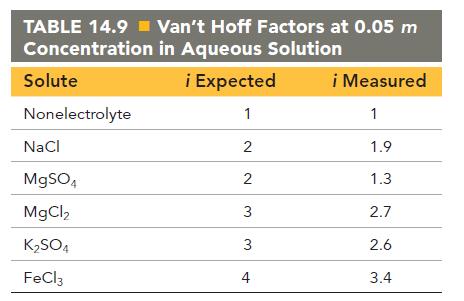
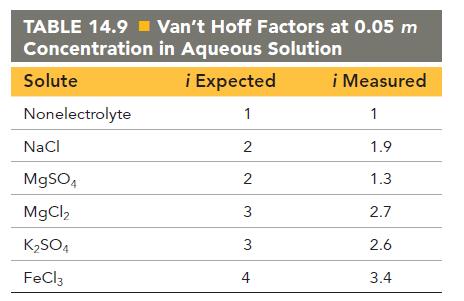
Use the van’t Hoff factors in Table 14.9 to calculate each colligative property:a. The melting point of a 0.100 m iron(III) chloride solution b. The osmotic pressure of a 0.085 M potassium sulfate solution at 298 K c. The boiling point of a 1.22% by mass magnesium chloride solution TABLE 14.9
Using the van’t Hoff factors in Table 14.9, calculate the mass of solute required to make each aqueous solution:a. A sodium chloride solution containing 1.50 * 102 g of water that has a melting point of -1.0 °C b. 2.50 * 102 mL of a magnesium sulfate solution that has an osmotic pressure of
A 1.2 m aqueous solution of an ionic compound with the formula MX2 has a boiling point of 101.4 °C. Calculate the van’t Hoff factor (i) for MX2 at this concentration.
A 0.95 m aqueous solution of an ionic compound with the formula MX has a freezing point of -3.0 °C. Calculate the van’t Hoff factor (i) for MX at this concentration.
A 0.100 M ionic solution has an osmotic pressure of 8.3 atm at 25 °C. Calculate the van’t Hoff factor (i) for this solution.
A solution contains 8.92 g of KBr in 500.0 mL of solution and has an osmotic pressure of 6.97 atm at 25 °C. Calculate the van’t Hoff factor (i) for KBr at this concentration.
Calculate the vapor pressure at 25 °C of an aqueous solution that is 5.50% NaCl by mass.
An aqueous CaCl2 solution has a vapor pressure of 81.6 mmHg at 50 °C. The vapor pressure of pure water at this temperature is 92.6 mmHg. What is the concentration of CaCl2 in mass percent?
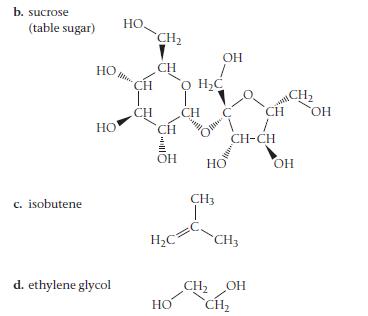
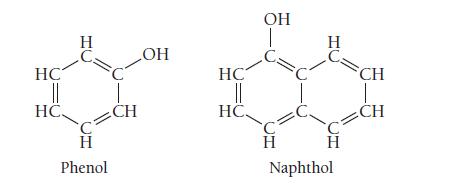
The solubility of phenol in water at 25 °C is 87 g/L. The solubility of naphthol at the same temperature is only 0.74 g/L. Examine the structures of phenol and naphthol shown here and explain why phenol is so much more soluble than naphthol.
The solubility of carbon tetrachloride (CCl4) in water at 25 °C is 1.2 g/L. The solubility of chloroform (CHCl3) at the same temperature is 10.1 g/L. Why is chloroform almost ten times more soluble in water than carbon tetrachloride?
Potassium perchlorate (KClO4) has a lattice energy of -599 kJ/mol and a heat of hydration of -548 kJ/mol. Find the heat of solution for potassium perchlorate and determine the temperature change that occurs when 10.0 g of potassium perchlorate is dissolved with enough water to make 100.0 mL of
Sodium hydroxide (NaOH) has a lattice energy of −887 kJ/mol and a heat of hydration of −932 kJ/mol. How much solution could be heated to boiling by the heat evolved by the dissolution of 25.0 g of NaOH?
A saturated solution forms when 0.0537 L of argon, at a pressure of 1.0 atm and a temperature of 25 °C, is dissolved in 1.0 L of water. Calculate the Henry’s law constant for argon.
A gas has a Henry’s law constant of 0.112 M/atm. What total volume of solution is needed to completely dissolve 1.65 L of the gas at a pressure of 725 torr and a temperature of 25 °C?
The Safe Drinking Water Act (SDWA) sets a limit for mercury—a toxin to the central nervous system—at 0.0020 ppm by mass.Water suppliers must periodically test their water to ensure that mercury levels do not exceed this limit. Suppose water becomes contaminated with mercury at twice the legal
Water softeners often replace calcium ions in hard water with sodium ions. Since sodium compounds are soluble, the presence of sodium ions in water does not cause the white, scaly residues caused by calcium ions. However, calcium is more beneficial to human health than sodium because calcium is a
An aqueous solution contains 12.5% NaCl by mass. What mass of water (in grams) is contained in 2.5 L of the vapor above this solution at 55 °C? The vapor pressure of pure water at 55 °C is 118 torr.
The vapor above an aqueous solution contains 19.5 mg water per liter at 25 °C. Assuming ideal behavior, what is the concentration of the solute within the solution in mole percent?
What is the freezing point of an aqueous solution that boils at 106.5 °C?
What is the boiling point of an aqueous solution that has a vapor pressure of 20.5 torr at 25 °C?
An isotonic solution contains 0.90% NaCl mass to volume. Calculate the percent mass to volume for isotonic solutions containing each solute at 25 °C. Assume a van’t Hoff factor of 1.9 for all ionic solutes.a. KCl b. NaBr c. Glucose (C6H12O6)
A solution is prepared from 4.5701 g of magnesium chloride and 43.238 g of water. The vapor pressure of water above this solution is 0.3624 atm at 348.0 K. The vapor pressure of pure water at this temperature is 0.3804 atm. Find the value of the van’t Hoff factor (i) for magnesium chloride in
Magnesium citrate, Mg3(C6H5O7)2, belongs to a class of laxatives called hyperosmotics, which cause rapid emptying of the bowel.When a concentrated solution of magnesium citrate is consumed, it passes through the intestines, drawing water and promoting diarrhea, usually within 6 hours. Calculate the
When HNO2 is dissolved in water, it partially dissociates according to the equation HNO2 ⇌ H+ + NO2–. A solution is prepared that contains 7.050 g of HNO2 in 1.000 kg of water. Its freezing point is -0.2929 °C. Calculate the fraction of HNO2 that has dissociated.
A solution of a nonvolatile solute in water has a boiling point of 375.3 K. Calculate the vapor pressure of water above this solution at 338 K. The vapor pressure of pure water at this temperature is 0.2467 atm.
The density of a 0.438 M solution of potassium chromate (K2CrO4) at 298 K is 1.063 g/mL. Calculate the vapor pressure of water above the solution. The vapor pressure of pure water at this temperature is 0.0313 atm.
The vapor pressure of carbon tetrachloride, CCl4, is 0.354 atm, and the vapor pressure of chloroform, CHCl3, is 0.526 atm at 316 K. A solution is prepared from equal masses of these two compounds at this temperature. Calculate the mole fraction of the chloroform in the vapor above the solution. If
Distillation is a method of purification based on successive separations and recondensations of vapor above a solution. Use the result of the previous problem to calculate the mole fraction of chloroform in the vapor above a solution obtained by three successive separations and condensations of the
A solution of 49.0% H2SO4 by mass has a density of 1.39 g/cm3 at 293 K. A 25.0-cm3 sample of this solution is mixed with enough water to increase the volume of the solution to 99.8 cm3. Find the molarity of sulfuric acid in this solution.
Find the mass of urea (CH4N2O) needed to prepare 50.0 g of a solution in water in which the mole fraction of urea is 0.0770.
A solution contains 10.05 g of unknown compound dissolved in 50.0 mL of water. (Assume a density of 1.00 g/mL for water.)The freezing point of the solution is -3.16 °C. The mass percent composition of the compound is 60.97% C, 11.94% H, and the rest is O. What is the molecular formula of the
The osmotic pressure of a solution containing 2.10 g of an unknown compound dissolved in 175.0 mL of solution at 25 °C is 1.93 atm. The combustion of 24.02 g of the unknown compound produced 28.16 g CO2 and 8.64 g H2O. What is the molecular formula of the compound (which contains only carbon,
A 100.0-mL aqueous sodium chloride solution is 13.5% NaCl by mass and has a density of 1.12 g/mL. What would you add (solute or solvent), and what mass of it, to make the boiling point of the solution 104.4 °C?
A 50.0-mL solution is initially 1.55% MgCl2 by mass and has a density of 1.05 g/mL. What is the freezing point of the solution after you add an additional 1.35 g MgCl2?
The small bubbles that form on the bottom of a water pot that is being heated (before boiling) are due to dissolved air coming out of solution. Use Henry’s law and the solubilities given to calculate the total volume of nitrogen and oxygen gas that should bubble out of 1.5 L of water upon warming
The vapor above a mixture of pentane and hexane at room temperature contains 35.5% pentane by mass. What is the mass percent composition of the solution? Pure pentane and hexane have vapor pressures of 425 torr and 151 torr, respectively, at room temperature.
A 1.10-g sample contains only glucose (C6H12O6) and sucrose (C12H22O11). When the sample is dissolved in water to a total solution volume of 25.0 mL, the osmotic pressure of the solution is 3.78 atm at 298 K. What is the mass percent composition of glucose and sucrose in the sample?
Showing 1900 - 2000
of 4045
First
13
14
15
16
17
18
19
20
21
22
23
24
25
26
27
Last
Step by Step Answers

 Get 50% OFF
Claim Now
Get 50% OFF
Claim Now