New Semester
Started
Get
50% OFF
Study Help!
--h --m --s
Claim Now
Question Answers
Textbooks
Find textbooks, questions and answers
Oops, something went wrong!
Change your search query and then try again
S
Books
FREE
Study Help
Expert Questions
Accounting
General Management
Mathematics
Finance
Organizational Behaviour
Law
Physics
Operating System
Management Leadership
Sociology
Programming
Marketing
Database
Computer Network
Economics
Textbooks Solutions
Accounting
Managerial Accounting
Management Leadership
Cost Accounting
Statistics
Business Law
Corporate Finance
Finance
Economics
Auditing
Tutors
Online Tutors
Find a Tutor
Hire a Tutor
Become a Tutor
AI Tutor
AI Study Planner
NEW
Sell Books
Search
Search
Sign In
Register
study help
sciences
college physics reasoning
College Physics Reasoning and Relationships 2nd edition Nicholas Giordano - Solutions
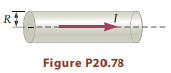
According to Ampere’s law, the magnetic field produced by a long, straight wire depends only on the current enclosed by the Ampere’s law path (Eq. 20.16). Use this fact to compute the magnetic field inside a wire (Fig. P20.78). Assume the wire has a radius R = 1.0 mm and carries a current I =
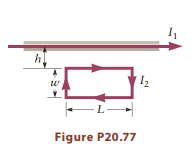
A long, straight wire (Fig. P20.77) carries current I1 = 3.5 A and is a distance h = 15 cm from a rectangular current loop that carries a current I2 = 1.5 A. (a) If the loop has length L = 45 cm and width w = 20 cm, what are the magnitude and direction of the force exerted by the wire on
A high-voltage power line carries a current of 5000 A. If the power line is a height 20 m above the ground, what is the magnetic field strength at ground level? How does it compare with the Earth’s magnetic field?
The magnetic field near a particular permanent magnet is 2.0 T. Consider a long wire carrying a current I. If the field produced by the current at a location 1.0 cm from the wire is equal to the field of this permanent magnet, what is I?
A magnetic field B = 1 T is considered to be a strong field. If you want to produce this field using a single loop of wire wound around a pencil, what must the current be?
Consider a single circular loop of wire that carries current I = 1.5 A. If the field due to the current in the loop at the loop’s center is equal to the Earth’s field, what is the radius of the loop?
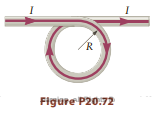
A wire is formed so as to make a circular loop connecting two long, straight sections as shown in Figure P20.72. If the radius of the loop is R = 20 cm and the wire carries current I = 2.4 A, what are the magnitude and direction of the magnetic field at the center of the loop? Figure P20:72
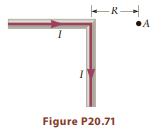
Consider a long wire that makes a right angle (90°) bend as shown in Figure P20.71. If the wire carries a current I, what is the magnetic field at point A? Use the result for the field from an infinitely long wire (Eq. 20.19) to find the field produced by a “semi”-infinite wire (i.e., half of
Two long, straight, parallel wires of length 4.0 m carry parallel currents of 3.5 A and 1.2 A.(a) If the wires are separated by a distance of 3.5 cm, what is the magnitude of the force between the two wires?(b) Is this force attractive or repulsive?(c) If the currents are in opposite directions
The Earth’s magnetic field is approximately 5x10⁻⁵ T. If the field produced by the current in a long straight wire 1.0 mm from the wire is equal to the Earth’s field, what is the current in the wire?
A long, straight wire carries a current of 5.4 A. What is the magnitude of the magnetic field at a distance of 10 cm from the wire?
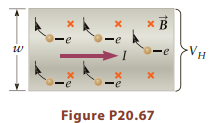
Consider the Hall effect experiment in Figure P20.67 and suppose the current is carried by electrons. In Section 20.6, we saw that the magnetic field exerts a force on the moving electrons directed from the bottom edge of the wire toward the top. This force causes a net negative charge to
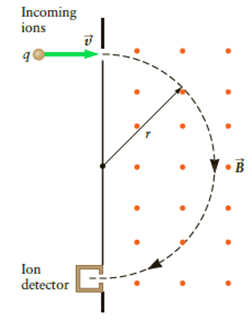
Some mass spectrometers use an electric field to give the incoming ions a certain known kinetic energy as they enter the magnetic field region.(a) If the ions have charge q and kinetic energy KE, what is the value of r in Figure 20.27 in terms of m, q, B, and KE?(b) How does the final kinetic
Consider a mass spectrometer used to separate the two isotopes of uranium, 238U3+ and 235U3+. Assume the ions enter the magnetic field region with a speed of 6.0 = 105 m/s. What value of B is required to give a separation of 1.0 mm when the ions leave the spectrometer?
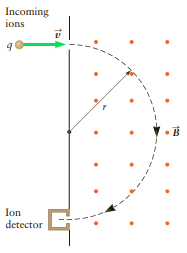
A mass spectrometer can separate ions according to their charges and masses. One simple design for such a device is shown in Figure 20.27. Ions of mass m, charge q, and speed v enter a region in which the magnetic field B is constant and perpendicular to the plane. The ions then travel in a
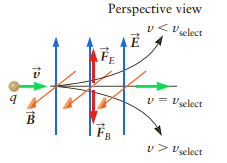
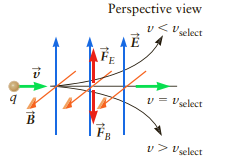
You wish to design a velocity selector (see Problem 62 and Fig. P20.62) that will allow protons to pass through only if they have a speed of 500 m/s.(a) If the magnetic field is B = 0.050 T, what electric field do you need?(b) You decide to produce this electric field using a parallel-plate
. Velocity selector. Consider a charged particle moving through a region in which the electric field is perpendicular to the magnetic field, with both fields perpendicular to the initial velocity of the particle (Fig. P20.62). Such a device is called a velocity selector because for one particular
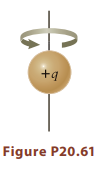
A ball of positive charge rotates about a vertical axis (Fig. P20.61).(a) If the rotation is clockwise as viewed from above, what is the direction of the ball’s magnetic moment?(b) If the charge on the ball is negative, what is the direction of the magnetic moment? +q Figure P20.61
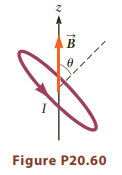
The plane of a circular current loop is oriented at a nonzero angle u relative to a magnetic field parallel to z (Fig. P20.60). If the current loop is free to rotate about an axis perpendicular to z, which of the following is true?(a) The loop will rotate so that the axis of the loop (indicated by
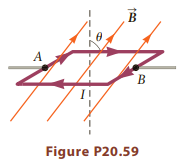
Consider a square current loop (L = 25 cm) that carries a current I = 5.6 A (Fig. P20.59). A constant magnetic field B = 0.25 T makes an angle u 30° with the direction normal to the plane of the loop and perpendicular to the line connecting points A and B.(a) Find the total magnetic force on
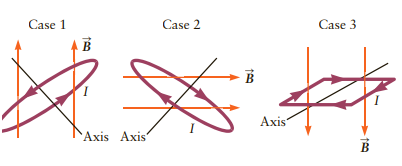
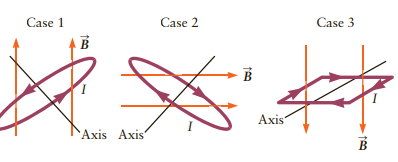
Consider the square current loop, case 3 in Figure P20.57. It has an edge length L = 0.33 m and carries a current I = 7.5 A. The magnetic field B = 0.22 T is perpendicular to the plane of the loop. What is the magnitude of the torque on the loop?Figure 20.57 Case 1 Case 2 Case 3 Axis Axis Axis
Figure P20.57 shows several different current loops in a magnetic field.In case 1, the black line is drawn along the axis of the loop and the current is clockwise when viewed from the upper left.In case 2, the black line is drawn along the axis of the loop and the current is clockwise when viewed
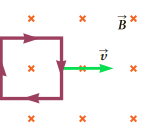
A square current loop of edge length L 0.25 m with I 4.5 A is pulled from a region where the magnetic field is zero into a region where the magnetic field is perpendicular to the loop with a magnitude B 2.5 T (Fig. P20.56).(a) What is the direction of the magnetic force on the loop?(b) What
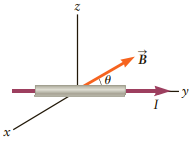
A long current-carrying wire lies on the y axis and carries current I 4.5 A along the +y direction. A magnetic field of magnitude B = 1.2 T lies in the y–z plane, directed 30° away from the y axis as shown in Figure P20.55.(a) What is the direction of the magnetic force on the wire?(b) What is
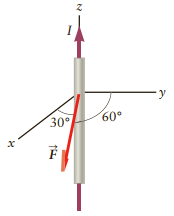
A wire carries a current along the +z direction and experiences a force that lies in the x–y plane as shown in Figure P20.54. What might be the direction of B(vector) ? 60° 30°
A wire carries a current along the +z direction and experiences a force along -y. If the magnetic field is perpendicular to the wire, what is the direction of B(vecotor)?
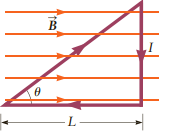
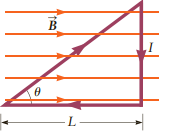
Consider again the force on the triangular current loop in Figure P20.51, but now work out the force as a function of L, u, and B. Explain your answer. -L
A right-triangular current loop carries a current I, and a constant magnetic field B is directed perpendicular to one edge of the loop (Fig. P20.51). If u 37°, L 30 cm, and B = 2.3 T, what is the total force on the loop? -L
Consider a straight piece of copper wire of length 2 m and diameter 1 mm that carries current I 3.5 A. A magnetic field of magnitude B is directed perpendicular to the wire, and the magnetic force on the wire is just strong enough to “levitate” the wire (i.e., the magnetic force on the wire is
The electric current carried in a typical household circuit is about 1 A, and the Earth’s magnetic field is about 5x10⁻⁵ T. What is the approximate magnitude of the magnetic force on such a wire if its length is 1 m? Could you detect this force if you were holding the wire? Compare this force to
Repeat Problem 47, but assume the force is 5.6 N. Is this possible?Data from Problem 47A long, straight wire of length 0.75 m carries current I = 1.5 A in a region where B = 2.3 T. If the force on the wire is 1.4 N, what is the angle between the field and the wire?
A long, straight wire of length 0.75 m carries current I = 1.5 A in a region where B = 2.3 T. If the force on the wire is 1.4 N, what is the angle between the field and the wire?
A long, straight wire carries current I = 100 A in a region where the magnetic field has a magnitude B = 10 T, but it is found that the force on the wire is zero. Explain how that can be.
A long, straight wire of length 1.4 m carries current I = 3.5A. If a magnetic field of magnitude B = 1.5 T is directed perpendicular to the wire, what is the magnitude of the force on the wire?
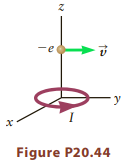
Figure P20.44 shows an electron moving near a current loop which lies in the x–y plane with its center at the origin. If the electron’s velocity is parallel to the y axis, what is the direction of the magnetic force on the electron when it passes over the center of the loop? -e Figure P20.44
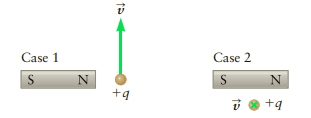
Figure P20.43 shows two cases in which a positively charged particle is moving near a bar magnet. What is the direction of the magnetic force in each case? Case 2 Case 1 +9 +4
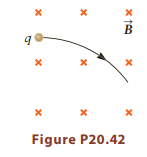
A charged particle moves as shown in Figure P20.42. Is the particle positively charged or negatively charged? Figure P20.42
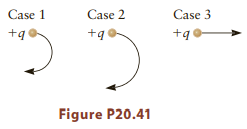
Figure P20.41 shows three identical particles, each with a positive charge and all moving at the same speed. In which case is B(vector) largest? Smallest? Assume B(vector) is perpendicular to the plane of the drawing. Case 1 Case 2 Case 3 +q Figure P20.41
A positively charged particle moves as shown in Figure P20.40. Which statement best describes the direction of B(vector)?(a) It is into the plane of the figure.(b) It is out of the plane of the figure.(c) It is along the +x direction.(d) It is along the +y direction.(e) The direction of B(vector) y
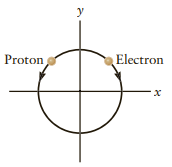
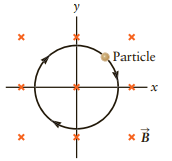
An electron and a proton are both moving in a circle in the x–y plane due to the force produced by a magnetic field perpendicular to the plane (Fig. P20.39).(a) If the electron moves clockwise and the proton moves counterclockwise, is the magnetic field directed into the plane or out of the plane
A charged particle moves in the x–y plane, and a magnetic field B is directed into the plane as shown in Figure P20.38. The magnetic force on the particle causes the particle to move clockwise along a circle of radius R.(a) Is the particle positively charged or negatively charged?(b) The charge
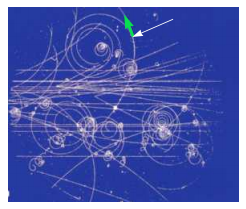
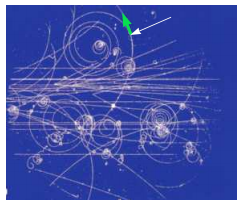
How would the trajectory in Figure P20.36 change if the charge on the particle were increased by a factor of 3? How would it change if the mass were decreased by a factor of 10?Figure 36
A bubble chamber is a device used to study the trajectories of elementary particles such as electrons and protons. Figure P20.36 shows the trajectories of some typical particles, one of which is indicated by a white arrow. Suppose this particle is moving in the direction indicated by the green
Cosmic rays undergo a helical (i.e., spiral) trajectory as they travel to the Earth. Consider a cosmic ray that is an iron ion Fe+ traveling at 1x10⁷ m/s. What is the approximate minimum radius of the helix when the ion is near the Earth’s surface?
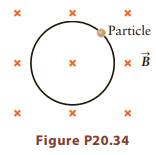
A positively charged particle undergoes circular motion in the plane of the drawing in Figure P20.34 as a result of the magnetic force produced by a field that is perpendicular to this plane. Does this particle move clockwise or counterclockwise? Particle Figure P20.34
A nitrogen ion N+ is traveling through the atmosphere at a speed of 500 m/s. What is the approximate force on this ion from the Earth’s magnetic field if the ion is moving perpendicular to the Earth’s field?
A cosmic ray of charge +5e approaches the Earth’s equator with a speed of 2.2x10⁷ m/s. If the acceleration of this particle is 8.0x10¹⁰ m/s2, what is the approximate mass of the cosmic-ray particle?
If the particle in Problem 30 is an electron instead of a proton, what is the radius of the trajectory? Data From Problem 30A proton has an initial velocity v S B when it enters a region in which BA(vector) proton has an initial velocity is parallel to the z direction (Fig. P20.28). (a)
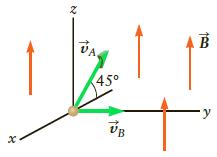
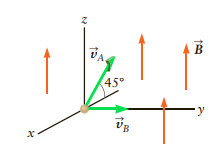
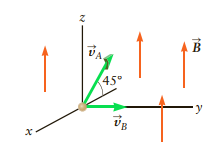
A proton has an initial velocity v S B when it enters a region in which BA(vector) proton has an initial velocity is parallel to the z direction (Fig. P20.28).(a) Show that the proton will move in a circle that lies in the x–y plane.(b) If vB = 500 m/s and B = 0.80 T, what is the radius of
Repeat Problem 28, but now assume the particle is an electron.Data From Problem 28A proton with velocity vA(vector) (which lies in the x–z plane) enters a region in which the magnetic field is along z as shown in Figure P20.28. Describe qualitatively the trajectory of the proton. 45° х
A proton with velocity vA(vector) (which lies in the x–z plane) enters a region in which the magnetic field is along z as shown in Figure P20.28. Describe qualitatively the trajectory of the proton. 45° х Ов
Repeat part (c) of Problem 26, but now assume the particle’s velocity is along the -x direction at t 0.Part (C)from problem 26(c) If the particle is moving parallel to +y at t = 0, is the circular motion clockwise or is it counterclockwise as viewed from along the +z axis?
A particle of charge 23 mC and mass 1.3 10-16 kg moves at a speed of 2000 m/s, and its velocity vector lies in the x–y plane. There is a magnetic field of magnitude 0.88 T along the +z direction. The magnetic force on the particle causes the particle to move in a circle that lies in the
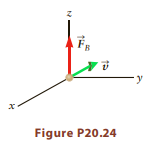
Figure P20.24 shows an alpha particle (a helium atom, but without the two electrons) moving with a velocity in the-x direction. If this particle experiences a force along the +z direction, what can you conclude about the direction of B(vector) ? Figure P20.24
An alpha particle is a helium nucleus that consists of two protons bound with two neutrons. An alpha particle moving through a perpendicular magnetic field of 1.5 T experiences an acceleration of 2000 m/s2. What is the alpha particle’s speed?
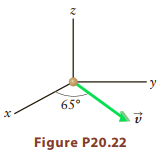
A particle of charge q = -8.3 mC has a velocity of 600 m/s that lies in the x–y plane and makes an angle of 65° with respect to the x axis as shown in Figure P20.22. If there is a constant magnetic field of magnitude 1.5 T parallel to +y, what are the magnitude and direction of the magnetic
A particle of charge q 7.2 mC is moving at an angle of 25° with respect to the x axis with a speed of 250 m/s. A constant magnetic field of magnitude 0.55 T is parallel to the x direction. Find the magnitude of the magnetic force on the particle.
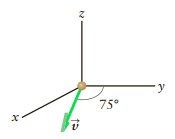
The particle in Figure P20.20 has a negative charge, and its velocity vector lies in the x–y plane and makes an angle of 75° with the y axis. If the magnetic field is along the+x direction, what is the direction of the magnetic force on the particle? 75°
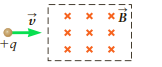
The particle in Figure P20.19 has a positive charge, and its initial velocity is to the right when it enters a region where B(vector) is directed into the plane of the drawing. Will the particle be deflected toward the top of the figure or toward the bottom? х х х х х х х +q
A particle of unknown charge has a velocity along the +y direction. There is a constant magnetic field along the +z axis, and it is found that the magnetic force on the particle is along +x. Is the particle positively or negatively charged?
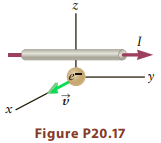
An electron is traveling near a current-carrying wire as shown in Figure P20.17. The electron is moving along the x axis with its velocity along the +x direction, and the wire lies in the y–z plane and is parallel to the y axis. What is the direction of the force on the electron from the wire’s
A proton is at the origin and is moving in the +z direction. What is the direction of the magnetic field due to the moving proton at a location on the x axis at x +1 m?
An electron is moving in the x–y plane with its velocity along the -y direction. If the magnetic force on the electron is in the +z direction when B(vector) direction. If the magnetic force on the electron is in the lies along one of the coordinate axes, what is the direction of the magnetic
Consider a proton that approaches the Earth from outer space. If the proton is moving perpendicular to the Earth’s surface near the equator, what is the direction of the magnetic force on the proton? The direction of the Earth’s magnetic field is shown in Figure 20.42A.
A proton with v = 300 m/s is moving through a region in which the magnetic field is B = 2.5 T. If the magnitude of the force on the proton is 6.4x10⁻¹⁷ N, what angle does the proton’s velocity make with B(vector) the proton is 6.4 ?
If the particle in Problem 11 is an electron, how will the magnitude and direction of the force change?Data From Problem 11A proton moves at a speed of 1000 m/s in a direction perpendicular to a magnetic field with a magnitude of 0.75 T. What is the magnitude of the magnetic force on the proton?
A proton moves at a speed of 1000 m/s in a direction perpendicular to a magnetic field with a magnitude of 0.75 T. What is the magnitude of the magnetic force on the proton?
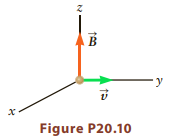
The charged particle in Figure P20.10 has a velocity along +y and experiences a force along the +x direction. Does this particle have a positive charge or a negative charge? х Figure P20.10
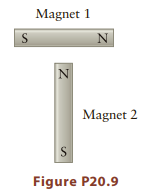
In Figure P20.9, bar magnet 1 is fixed in place and bar magnet 2 is free to move.(a) What is the direction of the total force on bar magnet 2?(b) What is the direction of the torque (clockwise or counterclockwise) on bar magnet 2 about an axis perpendicular to the plane of the drawing and through
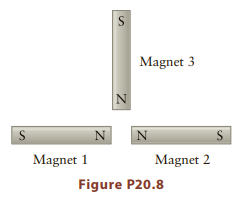
In Figure P20.8, what is the direction of the force on bar magnet 3? Magnet 3 N Magnet 2 Magnet 1 Figure P20.8
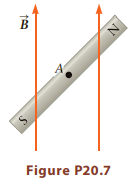
A bar magnet is placed in a uniform magnetic field (Fig. P20.7).(a) What is the direction of the total force on the bar magnet?(b) What is the direction (clockwise or counterclockwise) of the torque on the bar magnet about an axis perpendicular to the plane and passing through point A? Figure P20.7
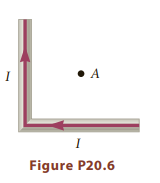
Use right-hand rule number 1 to find the direction of the magnetic field at point A near a wire that makes a right-angle bend as sketched in Figure P20.6. A Figure P20.6
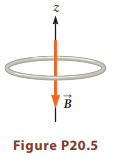
The magnetic field produced by the current loop in Figure P20.5 is along the -z direction. Is the direction of the current in the loop clockwise or counterclockwise as viewed from above? Figure P20.5
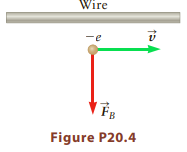
An electron is traveling near a current- carrying wire as shown in Figure P20.4. If the magnetic force F B(vector) is directed as shown, what is the direction of the current in the wire? counterclockwise) on bar magnet 2 about an axis perpendicular to the plane of the drawing and through
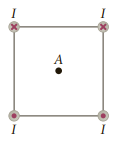
Four long, straight wires each carrying a current I are oriented perpendicular to the plane of Figure P20.3, forming a square as shown. What is the direction of B(vector) at the center of the square (point A)? I I A
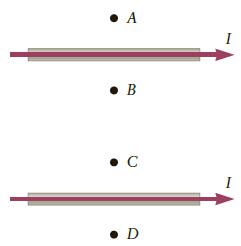
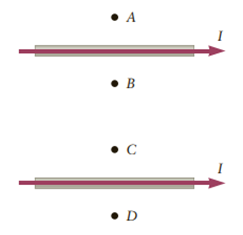
Suppose the currents in Figure P20.1 are in opposite directions: the current in the top wire is from left to right and the current in the bottom wire is from right to left. Find the direction of the magnetic field at points A, B, C, and D. • A • B • C I • D
The two long wires in Figure P20.1 carry parallel currents of equal magnitude I. Give the direction of the total magnetic field at points A, B, C, and D. • A • B • D
A wire carries a current in the -z direction. If there is a magnetic force in the +x direction, what might be the direction of the magnetic fi eld, (a) +x, (b) -x,(c) +y,(d) -y,(e) -z,(f) -z?
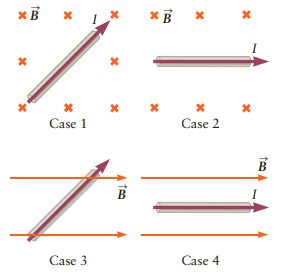
Figure Q20.21 shows a straight wire of length L carrying a current I in a magnetic field of magnitude B. In all cases, the direction and magnitude of the field are the same everywhere. In which case is the magnetic force on the wire largest? In which case is it smallest? Order the situations from
A square loop with constant current I is placed in a uniform magnetic field. Explain why the total force on the loop is zero, no matter how the loop is oriented relative to the field direction.
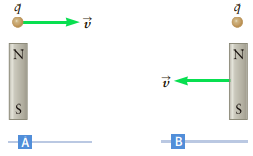
Figure Q20.19 shows in part A an electric charge q moving past a stationary bar magnet and in part B a bar magnet moving past a stationary electric charge. In which case will there be a magnetic force on the charge? Will there be a force on the charge in the other case? Explain. N A B
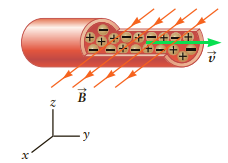
Blood plasma has a high content of Na+ and Cl- ions, and as blood follows through a vessel, the ions travel along at the same speed. A magnetic field is applied such that the field is perpendicular to the vessel as shown in Figure Q20.18.(a) What effect will the magnetic field have on the
Does a current-carrying wire placed in a magnetic field always experience a magnetic force? Explain
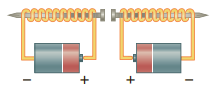
Two 20-penny nails are wrapped with insulated wire in the shape of a solenoid. They are then laid down end to end with the heads almost touching as shown in Figure Q20.16. If a battery is connected to the solenoid of each nail as shown, will the nails be attracted or will they repel each
The Earth’s magnetic field is produced by the fl ow of electrons within its molten interior. If the fl ow is in the form of a ring of current in the plane of the equator, in which direction must the electrons fl ow to produce the observed polarity of the Earth’s field?
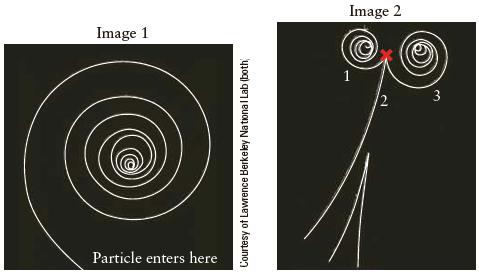
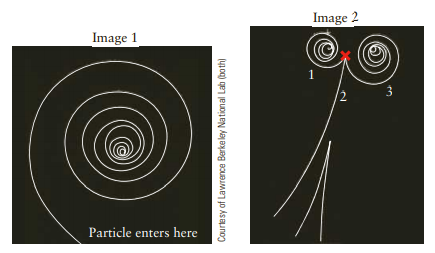
The bubble chamber image on the right in Figure Q20.13 (image 2) shows three particles emanating from a point marked with a red near the top of the image. The bubble chamber is in a magnetic field oriented so that the field lines point out of the page.(a) Identify the sign of the charge on
A bubble chamber is a device that makes the path of a charged particle visible. When a charged particle with sufficient kinetic energy passes through a liquid, it will knock electrons off the atoms in its path. If the liquid is at a temperature above its boiling point, these ionized atoms become
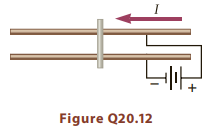
The rail gun. The simple configuration in Figure Q20.12 provides a means for launching projectiles, as long as the projectile can conduct electricity. Two copper rails are connected to a battery such that the current flows as indicated in the figure when a conducting rod is laid across the rails.
The medical technique called magnetic resonance imaging (MRI) uses the magnetic field produced by a large solenoid to obtain images from inside living tissue. These solenoids are large enough that a person can fit inside. Assuming the inside field is 1 T, design an MRI solenoid. Estimate the
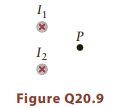
Repeat all parts of Question 9, but this time assume the current I2 is directed out of the page and opposite to current I1.Data from question 9Two parallel wires are oriented perpendicular to the page as shown in Figure Q20.9. The wires carry equal currents, and the direction of the current is into
Two parallel wires are oriented perpendicular to the page as shown in Figure Q20.9. The wires carry equal currents, and the direction of the current is into the page for each. The vertices of an equilateral triangle are marked by the two wires and a point P as shown.(a) What is the direction of the
In our discussion of the solenoid in Figure 20.33B, we claimed that the field outside the solenoid is much smaller than the field inside and that it is a good approximation to assume the field outside a very long solenoid is zero. Explain how this approximation can be consistent with the property
Figure Q20.7 shows the direction of B(vector) in a particular region of space. The density (i.e., spacing) of the crosses and dots indicate qualitatively the magnitude of B(vector). What is the possible source of this field? х* х х х** х ххх х |в] large Figure Q20.7
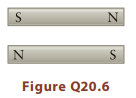
Make a qualitative sketch of the magnetic field near two bar magnets that are placed side by side as shown in Figure Q20.6. Figure Q20.6
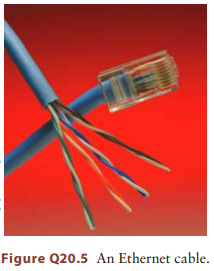
Pairs of wires that allow current to fl ow into and out of a circuit are often twisted together. Figure Q20.5 shows a common type of cable with such twisted pairs. What is the advantage of pairing the wires that carry input currents with wires carrying output currents? Figure Q20.5 An Ethernet
A positively charged particle moves with velocity v(vector) in a region where there is a magnetic field B(vector) and a nonzero magnetic force F (vector) n the particle. Consider how these three vectors are oriented with respect to one another.(a) Which pairs of these vectors are always
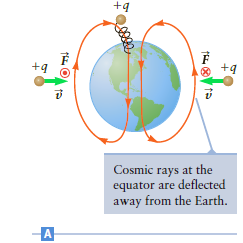
Consider the moving cosmic-ray particle on the right in Figure 20.45A and suppose it has a negative charge. What is the direction of the magnetic force on this particle? +9 +4 +9 Cosmic rays at the equator are deflected away from the Earth.
A long straight current-carrying wire is placed in a region where there is a magnetic field B(vector) that has a constant direction. If there is no magnetic force on the wire, what can you say about the direction of B (vector) relative to the wire.
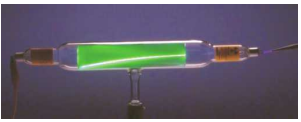
The photo in Figure Q20.1 shows a beam of electrons moving from right to left in a glass tube in which a vacuum has been established. This beam is deflected downward by a magnetic field. What is the direction of this magnetic field at the center of the tube?
Making your own immersion heater. Tired of having his morning cup of coffee go cold, an enterprising young physics major decides to build an immersion heater (see Problem 112) out of batteries and a 1.0-m length of 32-gauge (0.20-mm diameter) copper wire. By coiling up the copper wire so that it
Showing 3100 - 3200
of 4913
First
25
26
27
28
29
30
31
32
33
34
35
36
37
38
39
Last
Step by Step Answers

 Get 50% OFF
Claim Now
Get 50% OFF
Claim Now




![х* х х х** х ххх х |в] large Figure Q20.7](https://dsd5zvtm8ll6.cloudfront.net/si.question.images/images/question_images/1549/2/9/1/9465c5851aab4cc51549321543874.jpg)