New Semester
Started
Get
50% OFF
Study Help!
--h --m --s
Claim Now
Question Answers
Textbooks
Find textbooks, questions and answers
Oops, something went wrong!
Change your search query and then try again
S
Books
FREE
Study Help
Expert Questions
Accounting
General Management
Mathematics
Finance
Organizational Behaviour
Law
Physics
Operating System
Management Leadership
Sociology
Programming
Marketing
Database
Computer Network
Economics
Textbooks Solutions
Accounting
Managerial Accounting
Management Leadership
Cost Accounting
Statistics
Business Law
Corporate Finance
Finance
Economics
Auditing
Tutors
Online Tutors
Find a Tutor
Hire a Tutor
Become a Tutor
AI Tutor
AI Study Planner
NEW
Sell Books
Search
Search
Sign In
Register
study help
sciences
college physics reasoning
College Physics Reasoning and Relationships 2nd edition Nicholas Giordano - Solutions
A wire has a diameter of 1.0 mm and a length of 30 m, and is found to have a resistance of 1.2 Ω. What is the resistivity of the wire?
If the diameter of a piece of wire is reduced by a factor of 2.5, by what factor does the resistance change?
If the length of a wire is increased by a factor of 4, by what factor does the resistance change?
Calculate the resistance of a piece of copper wire that is 1.0 m long and has a diameter of 1.0 mm.
A 14.4-V battery for a cordless drill can supply 2.0 A of current.(a) If the drill is continuously operated for 5 min, what is the total charge passing through the battery?(b) What total amount of work does the battery do on the charge during these 5 min?
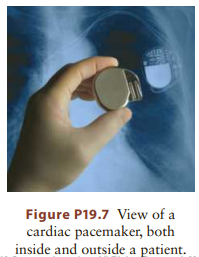
Lithium-iodine batteries are particularly useful in situations in which small amounts of current are required over a long period of time. One such application is in a cardiac pacemaker (Fig. P19.7), where changing a battery requires a patient to undergo an operation. Typical pacemakers require 0.50
Car batteries are typically rated in ampere-hours, or A · h.(a) Show that ampere-hours are actually a unit of charge and determine the conversion from ampere-hours to coulombs.(b) If a 100 A · h battery can deliver a steady current of 5.0 A until it is completely depleted, what is the total time
During a thunderstorm, a lightning “bolt” carries current between a cloud and the ground below. If a particular bolt carries a total charge of 20 C in 1.0 ms, what is the magnitude of the current? How many electrons are involved in this process?
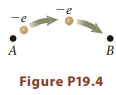
Electrons move between points A and B in Figure P19.4 at a rate of 15 electrons per second. What is the current? Give the magnitude and direction of I. -e re Figure P19.4
A current of 0.75 A fl ows through a lightbulb for 1 h. How many electrons pass through the lightbulb in this time?
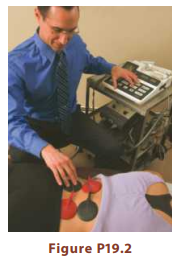
As a treatment for chronic back pain, a medical patient may be fitted with a device that passes a small electrical current (10 mA) through the muscles in the lower back as shown in Figure P19.2. If the current is supplied in short pulses 0.50 s in length, how many electrons pass through the muscles
A current of 3.5 A flows through a wire. How many electrons pass a particular point on the wire in 12 s?
When the author built his current house, he ran wires in the walls to be used for stereo speakers. He ran wires from several different rooms to a central location, but he forgot to mark the wires so he could tell which wires emerge in which room. Explain how he was able to solve this problem and
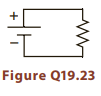
The circuit in Figure Q19.23 has a nonzero current that will carry electrons from one end of the resistor through the wire at the top to the positive terminal of the battery. We know that electrons always move from a region of low electric potential to a region of higher potential. We also know
If one terminal of a battery is connected to an object, does any charge fl ow from the battery to the object? If there is charge fl ow, explain why it is very brief.
In Example 19.1, we stated an estimate for the number of tungsten atoms in the fi lament of a lightbulb. Carry out a calculation of this number and compare your result with our estimate.
In Example 19.2, we discussed how a capacitor can be used to store electrical energy. Investigate how capacitors are used in real camera fl ash circuits and discuss why they are better for this application than batteries.
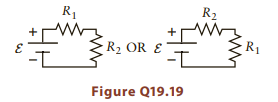
Figure Q19.19 shows two circuits which contain the same circuit elements, but the positions of the resistors are interchanged. Will that affects the current? Justify your answer using Kirchhoff?s rules.? R1 R2 R1 R2 OR E -L Figure Q19.19
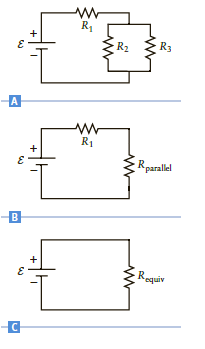
In Example 19.5, we used the rules for combining resistors in series and in parallel to analyze the circuit in Figure 19.22. Take a different approach and use Kirchhoff?s rules to derive equations for the currents through the different circuit branches. Show that these equations lead to the same
You are given four capacitors, each with capacitance C. Devise two ways to connect these capacitors to get a total capacitance less than C.
You are given four capacitors, each with capacitance C. Devise two ways to connect these capacitors to get a total equivalent capacitance greater than C.
A piece of wire with a constant cross-sectional area has a total resistance R0. The wire is cut into three pieces of equal length, which are then reconnected to form an equivalent resistor with resistance R0 /2. Draw a circuit diagram showing how the three pieces of wire can be connected to give
You are given four resistors, all with resistance R. Devise a way to connect these resistors to get an equivalent resistance of 2.5R.
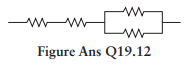
You are given four resistors, each with resistance R. Devise two ways to connect these resistors to get a total equivalent resistance less than R. Figure Ans Q19.12
You are given four resistors, each with resistance R. Devise two ways to connect these resistors to get a total equivalent resistance greater than R.
If three circuit elements are connected in parallel, which of the following statements is true? (a) The voltage across the circuit elements is always the same.(b) The current through the circuit elements is always the same.(c) The power is always the same in all three circuit elements
If two circuit elements are connected in series, which of the following staements is true? (a) The voltage across the circuit elements is always the same.(b) The current through the circuit elements is always the same.(c) The current is always largest through the fi rst circuit element.
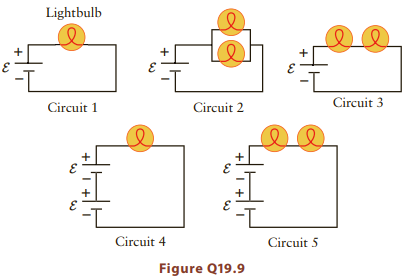
An incandescent lightbulb contains a fi lament that has a certain electrical resistance R. The brightness of the bulb depends on the current and increases as the current through the fi lament is increased. Consider the following situations in Figure Q19.9. (a) Two identical lightbulbs are connected
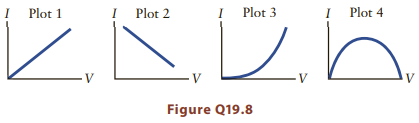
Which of the plots in Figure Q19.8 shows how the current depends on voltage for an ordinary resistor?? I Plot 1 I Plot 2 I Plot 3 I Plot 4 Kレ V V V Figure Q19.8
In Chapter 17, we argued that the electric field inside a metal in equilibrium is always zero. In this chapter, we found that there is a nonzero electric field inside a current-carrying wire. How can both of these statements be correct?
Is the product of the voltage across a conductor and the current through the conductor called the (a) power,(b) capacitance,(c) resistance?
Is the ratio of the voltage across a conductor to the current through the conductor called the(a) power,(b) capacitance,c) resistance
In a solution of salt water (NaCl dissolved in water), is an electric current carried mainly by(a) electrons,(b) protons,(c) Na+,(d) Cl-,(e) Na+ and Cl-, or(f) electrons and protons?
In a metal, is an electric current carried by(a) protons,(b) electrons,(c) both protons and electrons?
Explain why a complete circuit is necessary for a nonzero current to exist.
Discuss how Kirchhoff’s rules for circuit analysis are related to conservation principles.
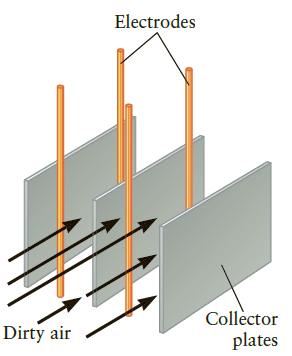
Some electrostatic air cleaners consist of parallel metal plates with wire electrodes running between them as sketched in Figure P18.88. These air cleaners act by first ionizing a dust particle and then attracting it to one of the plates. If the plates are 10 cm apart and the electric potential
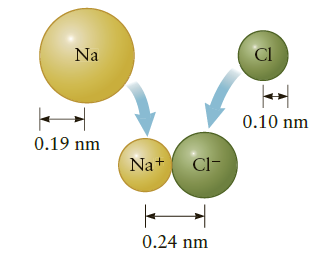
An atom of Na can combine with an atom of Cl to form the molecule NaCl. It is a good approximation to view this process as two steps (Fig. P18.87) in which the Na atom gives up an electron to the Cl atom, forming a positive ion (Na+) and a negative ion (Cl-). These ions are then attracted by the
A useful model of a water molecule is sketched in Figure P18.86, with point charges of 5.2 × 10⁻²⁰ C at the H sites and a point charge -10.4 × 10⁻²⁰ C at the O site. The H–O bond length is 9.6 × 10⁻¹¹ m, and the bond angle is θ = 104°. (a) What is the total electric potential energy of
(a) A capacitor with C = 15 F is used to store energy. If this capacitor stores an amount of energy equal to the kinetic energy of a baseball (m = 0.22 kg) moving at 45 m/s (about 100 mi/h), what is the voltage across the capacitor? (b) If this structure is a parallel-plate capacitor with a
Big shock. One of the world’s most advanced capacitor banks (Fig. P18.84), located at the Rossendorf Research Center in Dresden, Germany, can store 50 MJ of energy and release it in less than 5 ms. This high-energy pulse of electricity is used to produce the world’s most powerful magnetic
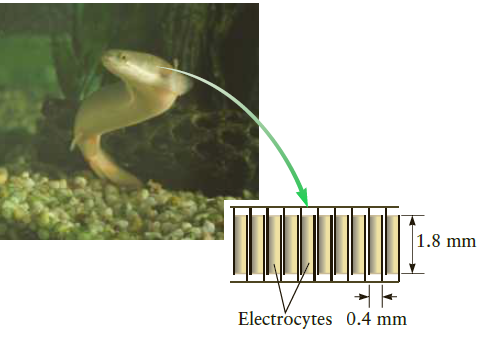
The electric eel. The knife fish species Electrophorus electricus shown in Figure P18.83 is not really an eel, but it can grow up to 2 m long and generate a potential difference of 600 V between a region just behind its head and its tail. The fish can stun or kill by sending large quantities of
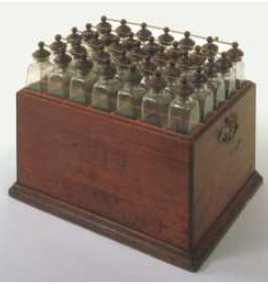
Benjamin Franklin made use of a “bank” of Leiden jars (Fig. P18.82) for some of his experiments. (a) Are these 35 Leiden jar capacitors arranged in series or in parallel? Close inspection of the photo shows that the central rods of the jars are all connected together. (b) Calculate
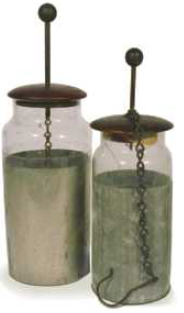
Some of the first capacitors constructed were called Leiden jars. These capacitors were actual jars with a layer of foil on the inside and outside of the glass as shown in Figure P18.81. A conducting sphere topped a metal rod that in turn connected to a dangling chain that made contact with the
A homemade capacitor is made from a sandwich of a piece of standard printer paper (8.5 in. by 11 in., 20-lb bond, 0.0038 in. thick) between two equal area sheets of aluminum foil. (a) Calculate the capacitance of this device. (b) What maximum potential can be put across it? (c) How
Big cap. The unit of capacitance is the farad. A capacitor with C = 1 F is a large one; although such capacitors do exist, most applications use capacitors with capacitances in the range of mF, µF, nF, or even pF (picofarads, known affectionately as “puffs”). (a) To get a sense of how big
Two metal spheres, each of mass 10 g and initially at rest, are dropped from a height of 5.0 m in an evacuated chamber. One sphere has a charge of +100 µC, and the other has a charge –100 µC. Find the difference in final speeds of the two spheres (the speeds just before each one hits the
A proton is directed such that it comes within 1.8 × 10⁻¹⁵ m of a carbon nucleus. (a) How much kinetic energy must the proton have initially to get this close to (i.e., “collide” with) the carbon nucleus? (b) What is the corresponding speed of the proton? (c) What potential
Consider two isolated, charged conducting spheres. One is a large sphere, and the second is smaller with a radius four times smaller than that of the large sphere but with four times as much charge. We denote the potential of the large sphere by VL and the electric field at its surface by EL. The
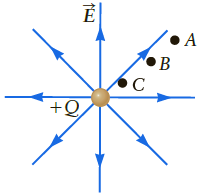
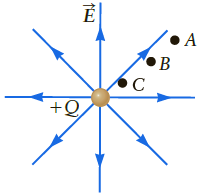
If the charge Q in Figure P18.74 is doubled, by what factor does the energy density change at point A? Figure P18.74 ? A ●B C +Q
Figure P18.74 shows a point charge. At which point (A, B, or C) is the energy density (the energy per unit volume) largest? Figure P18.74 ? A ●B C +Q
A parallel-plate capacitor with C = 10 µF is charged so as to contain 1.2 J of energy. If the capacitor has a vacuum between plates that are spaced by 0.30 mm, what is the energy density (the energy per unit volume)?
Suppose the energy stored in the electric field in a particular region of space is 50 J in a region of volume 10 mm3. What is the average electric field strength in this region?
A defibrillator containing a 20-µF capacitor is used to shock the heart of a patient in serious condition by attaching it to the patient’s chest. Just prior to discharging, the capacitor has a potential difference of 10,000 V across its plates. (a) What is the energy released into the
Using the data from Problems 67 and 68, find the approximate separation between two equipotential surfaces with ΔV = 100 V near the Earth’s surface. Compare this distance to your height.Data From Problem 67Experiments have shown that in good weather the Earth has, on average, a negative charge
Using the data from Problems 67 and 68, find the approximate electric potential 1.5 m above the Earth’s surface (about eye level). Take the ground to be at V = 0.Data From Problem 67Experiments have shown that in good weather the Earth has, on average, a negative charge of approximately 10-13 C
Use the data from Problem 67 to estimate the approximate electric field near the Earth’s surface.Data From Problem 67Experiments have shown that in good weather the Earth has, on average, a negative charge of approximately 10-13 C on every square centimeter of surface area.
Experiments have shown that in good weather the Earth has, on average, a negative charge of approximately 10-13 C on every square centimeter of surface area. What is the approximate total excess charge on the entire Earth? How many electrons does that correspond to? For simplicity, assume that
A parallel-plate capacitor initially has Mylar between its plates and carries charge ±Q. A different dielectric is then inserted between the plates without changing the charge. If the energy stored in the capacitor decreases to 30% of its initial value, what is the value of k for the new
The dielectric in a capacitor is changed to a material with a dielectric constant that is larger by a factor of five. If the charge on the capacitor is held fixed, by what factor does the energy stored in the capacitor change? Explain why the energy is different in the two cases.
When you walk across a carpeted floor while wearing socks on a dry day, your socks (and hence you) become charged by rubbing with the carpet. When your finger approaches a metal doorknob, you notice that a spark jumps across the air gap between your finger and the doorknob when that gap is less
Consider a parallel-plate capacitor with an area of 1.0 cm2, with a plate spacing of 0.20 mm, and filled with mica. At what voltage will this capacitor exhibit dielectric breakdown?
A cell membrane is composed of lipid molecules and is approximately 10 nm thick. If the dielectric constant of a lipid is k ≈ 5, what is the approximate capacitance of a spherical cell that has a diameter of 10 mm?
In Example 18.8, we analyzed a parallel-plate capacitor (plate area L × L with L - 0.10 µm and a plate separation of 10 nm) as might be found in an integrated circuit (RAM chip), but we omitted the dielectric that would usually be found between the plates. This dielectric is composed of SiO2 and
The space between the plates of a capacitor is filled with paper. By what factor does the paper change the capacitance relative to that found when the plates are filled with air?
Consider a capacitor with the same dimensions as the capacitor in Example 18.10, but now suppose there is air between the plates. What is the maximum safe operating voltage of this capacitor? That is, what is the voltage at which there will be dielectric breakdown?
A parallel-plate capacitor has square plates of edge length 1.0 cm and a plate spacing of 0.10 mm. If the gap between the plates is filled with mica, what is the capacitance?
A charge ±Q is placed on the plates of a parallel-plate capacitor. The plate spacing is then increased from L to 2L. (a) By what factor does the electric potential energy stored in this capacitor change? (b) Energy must be conserved, so where did this extra energy come from (or go to)?
Some charge is placed on a capacitor with C1 = 35 µF so that ΔV = 12 V. The capacitor is then attached in parallel to a second capacitor with C2 = 55 µF. What is the final voltage across the two capacitors?
An amount of charge ±Q is placed on the plates of a parallel-plate capacitor so that the potential across the plates is ΔVinit. The capacitor is then disconnected, and the separation between its plates is increased by a factor of three. If the charge on the plates is ±35 µC while the final
Two capacitors with C1 = 1.5 µF and C2 = 2.5 µF are connected in parallel. If the combined charge on both capacitors is 25 µC, what is the voltage across the capacitors?
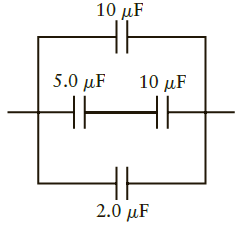
Four capacitors are connected as shown in Figure P18.53. What is the equivalent capacitance? Figure P18.53 ? 10 μF 5.0 μF 10 μF 2.0 μF
Design a combination of identical capacitors, each with capacitance C, for which the equivalent capacitance is 3C/4.
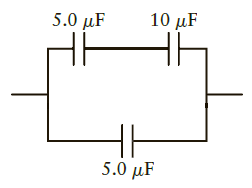
Three capacitors are connected as shown in Figure P18.51. What is the equivalent capacitance?Figure P18.51 10 μF 5.0 μF 5.0 μF
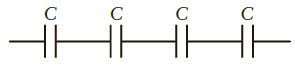
Four capacitors, all with capacitance C, are connected in series as shown in Figure P18.50. What is the equivalent capacitance of this combination? Figure P18.50 ? C C C C
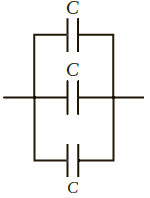
Three capacitors, all with capacitance C, are connected in parallel as shown in Figure P18.49. What is the equivalent capacitance of this combination?Figure P18.49 C
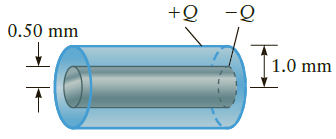
Consider a hollow metal cylinder of radius 1.0 mm that has a thin wire of radius 0.50 mm running down the center as sketched in Figure P18.48. This structure is a capacitor, with the wire acting as one ?plate? and the cylinder acting as the other plate. Calculate the capacitance using the following
A charge ±Q is placed on the plates of a capacitor, which is then disconnected from the outside world. The separation between the plates is changed, and it is found that the voltage across the plates decreases. (a) Have the plates been moved closer together or farther apart? (b) If the
Design a parallel-plate capacitor with C = 5.0 F. That is, find values of the plate area and the plate spacing that will give this capacitance. Assume there is a vacuum between the plates. Be sure to choose a practical value for the separation between the plates. Do you think that you could lift
A voltage of 12 V is placed on a capacitor with C = 100 pF (picofarads). (a) What is the charge on the capacitor? (b) How much energy is stored in the capacitor?
A typical capacitor in an MP3 player has C = 0.10 µF. If a charge ±5.0 µC is placed on the plates, what is the voltage across the capacitor?
A parallel-plate capacitor has square plates of edge length 1.0 cm and a plate spacing of 0.010 mm. If the gap between the plates is a vacuum, what is the capacitance?
Make a sketch of the equipotential surfaces between the plates of a parallel-plate capacitor.
The dimensions of a parallel-plate capacitor are all increased by a factor of three. By what factor does the capacitance change?
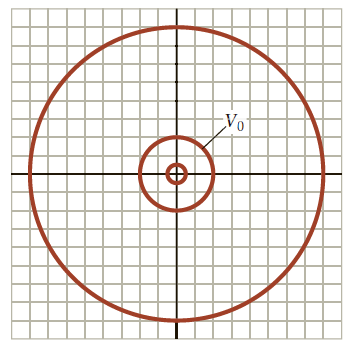
Figure P18.40 shows several equipotential surfaces that result from a point charge at the origin. (a) If V0 = +20 V, is this point charge positive or negative? (b) An external force moves an electron from the outermost equipotential surface drawn in Figure P18.40 to the innermost equipotential
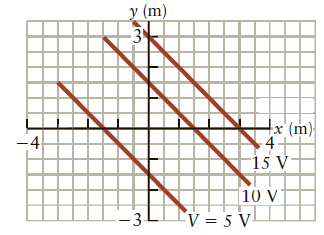
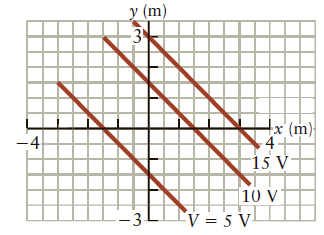
A proton is initially at the point (x, y) - (0, -1.5 m) in Figure P18.37. An external force then moves the proton to (x, y) = (3.0 m, 0). If the proton begins from rest and has a final speed of zero, what is the work done by the external force on the proton?Figure P18.37 y (m) -3 x (m) -4 15
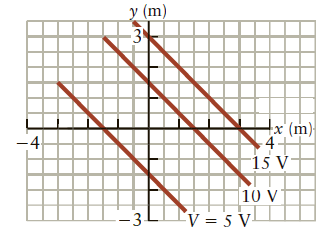
If an electron placed at the point (x, y) = (1.0 m, -1.0 m) in Figure P18.37 is released from rest, in what direction will it move? Figure P18.37 ? y (m) tx (m) -4 15 V 10 V --3 V = 5 V
The equipotential planes in a particular region of space are shown in Figure P18.37.? (a) What is the approximate magnitude and direction of the electric field at the origin? Consider only the components of the field along x and y.? (b) Is the magnitude of the field larger at the origin or at the
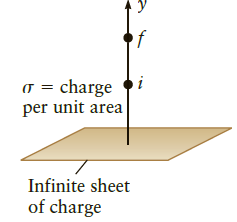
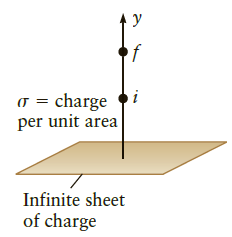
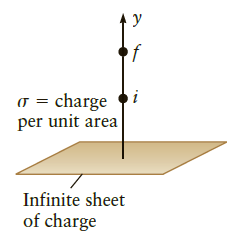
Make a sketch of the equipotential surfaces near the plane of charge in Figure P18.27. How is the direction of E(vector) related to the orientation of an equipotential surface? Figure P18.27 ? of 7 = charge per unit area Infinite sheet of charge
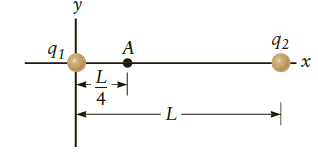
Two point particles with charges q1 and q2 are separated by a distance L as shown in Figure P18.35. The electric potential is zero at point A, which is a distance L/4 from q1. What is the ratio q1/q2? Figure P18.35 ? y A 92 91 4 ·L-
Consider a solid sphere of radius R = 0.55 m that is uniformly charged with ρ = -2.5 µC/m3. What is the electric potential a distance 2.5 m from the center of the sphere?
A thin circular ring of charge has radius R and charge per unit length l. What is the electric potential at the center of the ring? Take V = 0 at infinity.
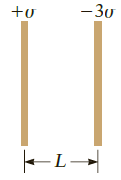
Two infinite, parallel, uniformly charged plates with charge densities +??and -3??are separated by a distance L (Fig. P18.32). If the plate on the right is at V = 0, what is the potential of the plate on the left? Express your answer in terms of s and L. Figure P18.32 ? +u - 30
A point charge Q is located at the center of a spherical metal shell that has an inner radius r1 and an outer radius r2. The net excess charge of the shell is zero. (a) What is the excess charge on the inner surface of the shell (at r = r1)? (b) What is the electric potential at r = r1?
A point charge Q is located at the center of a very thin, spherical metal shell. The net excess charge of the shell is zero. If the radius of the shell is rshell, what is the electric potential of the shell?
Ten electrons are placed on a metal sphere. If the potential of the sphere is -35 V, what is the radius of the sphere?
Consider again the plane of charge in Figure P18.27 with???= 2.0 ?C/m2. Calculate the change in potential experienced by an electron that starts a distance 2.5 m from the plane and moves a distance 5.5 m in a direction perpendicular to the y axis. Give an intuitive explanation of your
An infinite plane of charge (Fig. P18.27) has a charge per unit area of???= 2.0 ?C/m2. What is the change in the electric potential between points that are 2.5 m (initial) and 4.5 m (final) from the plane? Figure P18.27 ? y (T = charge per unit area Infinite sheet of charge
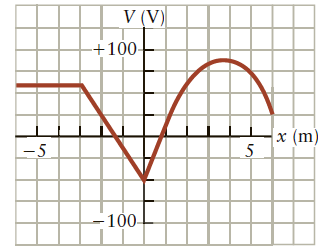
The electric potential varies with x as sketched in Figure P18.26. Make a qualitative plot of the component of the electric field along the x direction as a function of x. Figure P18.26 ? V (V) +100 x (m) -5 -10-
Four point charges, each with Q = 4.5 μC, are arranged at the corners of a square of edge length 1.5 m. What is the electric potential at the center of the square?
Showing 3300 - 3400
of 4913
First
27
28
29
30
31
32
33
34
35
36
37
38
39
40
41
Last
Step by Step Answers

 Get 50% OFF
Claim Now
Get 50% OFF
Claim Now