New Semester
Started
Get
50% OFF
Study Help!
--h --m --s
Claim Now
Question Answers
Textbooks
Find textbooks, questions and answers
Oops, something went wrong!
Change your search query and then try again
S
Books
FREE
Study Help
Expert Questions
Accounting
General Management
Mathematics
Finance
Organizational Behaviour
Law
Physics
Operating System
Management Leadership
Sociology
Programming
Marketing
Database
Computer Network
Economics
Textbooks Solutions
Accounting
Managerial Accounting
Management Leadership
Cost Accounting
Statistics
Business Law
Corporate Finance
Finance
Economics
Auditing
Tutors
Online Tutors
Find a Tutor
Hire a Tutor
Become a Tutor
AI Tutor
AI Study Planner
NEW
Sell Books
Search
Search
Sign In
Register
study help
sciences
college physics with an integrated approach
College Physics With An Integrated Approach To Forces And Kinematics 5th Edition Alan Giambattista - Solutions
In an action movie, the hero dangles his archenemy over the edge of a cliff. The archenemy's mass is 68 kg and his center of mass is 44 cm horizontally past the edge of the cliff. The hero's center of mass is 15 cm horizontally from the edge of the cliff. What is the smallest value of the hero's
The positions of three objects, written as (x, y) coordinates, are: (1.0 m, 1.0 m), (2.0 m, 3.0 m), and (3.0 m, 1.0 m). The objects have equal masses. If one of the objects is moved 12 cm in the positive xdirection, by how much does the CM move?
Consider two falling objects. Their masses are 3.0 kg and 4.0 kg. At time t = 0, the two are released from rest. What is the velocity of their CM at t = 10.0 s? Ignore air resistance.
An object of 1.0 kg mass approaches a stationary object of 5.0 kg at 10.0 m/s and, after colliding, rebounds in the reverse direction along the same line with a speed of 5.0 m/s. What is the speed of the 5.0 kg object after the collision?
A 2.0 kg object is at rest on a frictionless surface when it is hit by a 3.0 kg object moving at 8.0 m/s. If the two objects are stuck together after the collision, what is the speed of the combination?
(a) In Practice Problem 7.11, find the momentum change of the ball of mass m1 during the collision. Give your answer in x- and y-component form; express the components in terms of m1 and vi. (b) Repeat for the ball of mass m2. How are the momentum changes related?In Problem 7.11 A ball of
A 6.0 kg object is at rest on a frictionless surface when it is struck head-on by a 2.0 kg object moving at 10 m/s. If the collision is elastic, what is the speed of the 6.0 kg object after the collision?
A 2.0 kg object (the “projectile”) approaches a stationary object (the “target”) at 5.0 m/s. The projectile is deflected through an angle of 60.0° and its speed after the collision is 3.0 m/s. What is the magnitude of the momentum of the target after the collision?
In a nuclear reactor, a neutron moving at speed vi in the positive x-direction strikes a deuteron, which is at rest. The neutron is deflected by 90.0° and moves off with speed 0.577vi in the positive y-direction. Find the x- and y-components of the deuteron's velocity after the collision.
Two identical pucks are on an air table. Puck A has an initial velocity of 2.0 m/s in the +x-direction. Puck B is at rest. Puck A collides with puck B, and A moves off at 1.0 m/s at an angle of 60° above the x-axis. (a) What are the speed and direction of puck B after the collision? (b)
A block of mass 2.00 kg slides eastward along a frictionless surface with a speed of 2.70 m/s. A chunk of clay with a mass of 1.50 kg slides southward on the same surface with a speed of 3.20 m/s. The two objects collide and move off together. What is their velocity after the collision?
In a circus trapeze act, two acrobats fly through the air and grab on to each other, then together grab a swinging bar. One acrobat, with a mass of 60 kg, is moving at 3.0 m/s at an angle of 10° above the horizontal, and the other, with a mass of 80 kg, is approaching her with a speed of 2.0 m/s
In a game of pool, suppose that the cue ball initially moves in the −x-direction. After a collision with the 4-ball of equal mass, the cue ball moves at 52.0° above the −x-axis and the 4-ball moves at 38.0° below the −x-axis. Find the ratio of the balls' speeds vc/v4 after the collision.
To contain a violent mob, the riot squad approaches with fire hoses. Suppose that the rate of flow of water through a fire hose is 24 kg/s, and the stream of water from the hose moves at 17 m/s. What force is exerted by such a stream on a person in the crowd? Assume that the water comes to a dead
An object of mass 2.0 kg (the “projectile”) approaches a stationary object (the “target”) at 8.0 m/s. The projectile is deflected through an angle of 90.0° and its speed after the collision is 6.0 m/s. What is the speed of the target after the collision if the collision is elastic?
Gerald wants to know how fast he can throw a ball, so he hangs a 2.30 kg target on a rope from a tree. He picks up a 0.50 kg ball of putty and throws it horizontally against the target. The putty sticks to the target and the putty and target swing up a vertical distance of 1.50 m from its original
It is the bottom of the ninth inning at a baseball game. The score is tied and there is a runner on second base when the batter gets a hit. The 85 kg base runner rounds third base and is heading for home with a speed of 8.0 m/s. Just before he reaches home plate, he crashes into the opposing team's
Pendulum bob A has half the mass of pendulum bob B. Each bob is tied to a string that is 5.1 m long. When bob A is held with its string horizontal and then released, it swings down and, once bob A's string is vertical, it collides elastically with bob B. How high does each bob rise after the
At the beginning of a scene in an action movie, the 78.0 kg star, Indianapolis Jones, stands on a ledge 3.70 m above the ground and the 55.0 kg heroine, Georgia Smith, stands on the ground. Jones swings down on a rope, grabs Smith around the waist, and continues swinging until they come to rest on
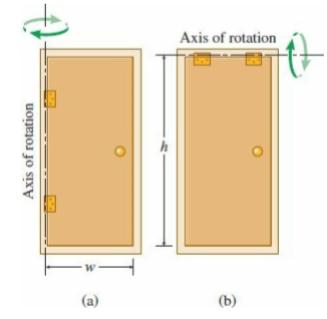
In Fig. 8.2b, where should the doorknob be located to make the door easier to open? Axis of rotation (a) (b) Axis of rotation
A Vulcan spaceship has a mass of 65 000 kg and a Romulan spaceship is twice as massive. Both have engines that generate the same total force of 9.5 × 10⁶ N. (a) If each spaceship fires its engine for the same amount of time, starting from rest, which will have the greater kinetic energy?
A boy of mass 60 kg is sledding down a 70 m slope starting from rest. The slope is angled at 15° below the horizontal. After going 20 m along the slope, he passes his friend, who hops onto the sled. The friend has a mass of 50 kg, and the coefficient of kinetic friction between the sled and the
A 0.122 kg dart is fired from a gun with a speed of 132 m/s horizontally into a 5.00 kg wooden block. The block is attached to a spring with a spring constant of 8.56 N/m. The coefficient of kinetic friction between the block and the horizontal surface it is resting on is 0.630. After the dart
Verify that has dimensions of energy. lo
When both are expressed in terms of SI base units, torque has the same units as(a) Angular acceleration (b) Angular momentum (c) Force (d) Energy (e) Rotational inertia (f) Angular velocity
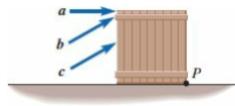
A heavy box is resting on the floor. You would like to push the box to tip it over on its side, using the minimum force possible. Which of the arrows in the diagram shows the correct location and direction of the force? Assume enough friction so that the box does not slide; instead it rotates about
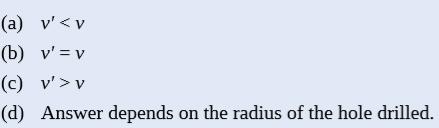
How does the speed of the cylinder compare with its original value?A uniform solid cylinder rolls without slipping down an incline. At the bottom of the incline, the speed v of the cylinder is measured and the translational and rotational kinetic energies (Ktr, Krot) are calculated. A hole is
How does the ratio of rotational to translational kinetic energy of the cylinder compare with its original value?A uniform solid cylinder rolls without slipping down an incline. At the bottom of the incline, the speed v of the cylinder is measured and the translational and rotational kinetic
Explain why it is easier to drive a wood screw using a screwdriver with a large-diameter handle rather than one with a thin handle. An object in equilibrium has only two forces acting on it. The forces must be equal in magnitude and opposite in direction in order to give a translational net
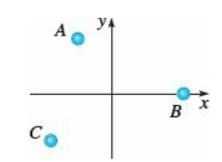
Find the rotational inertia of the system of point particles shown in the figure assuming the system rotates about the (a) x-axis, (b) y-axis, (c) z-axis. The z-axis is perpendicular to the xy-plane and points out of the page. Point particle A has a mass of 200 g and is located at
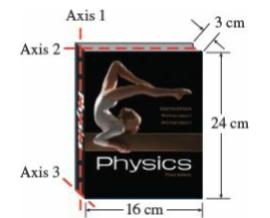
An object in equilibrium has only two forces acting on it. The forces must be equal in magnitude and opposite in direction in order to give a translational net force of zero. What else must be true of the two forces for the object to be in equilibrium? Axis 1 3 cm Axis 2- 24 cm Physics Axis 3 -16 cm
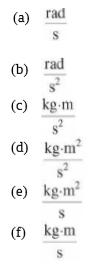
The SI units of angular momentum are (a) rad (b) rad (c) kg-m (d) kg-m? (e) kg-m? (f) kg-m
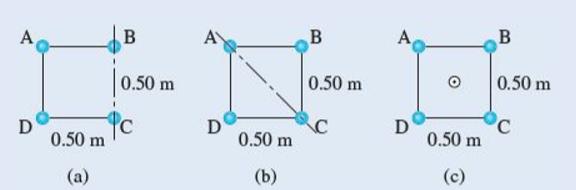
Calculate the rotational inertia for each of the three arrangements.Four point masses of 3.0 kg each are arranged in a square on massless rods. The length of a side of the square is 0.50 m. Consider rotation of this square about three different axes: (a) An axis passing through masses B
Rank the three arrangements in increasing order of the rotational inertia.Four point masses of 3.0 kg each are arranged in a square on massless rods. The length of a side of the square is 0.50 m. Consider rotation of this square about three different axes: (a) An axis passing through
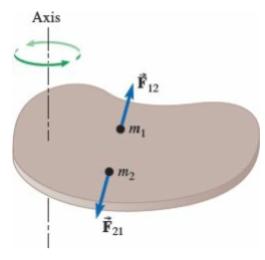
In Section 8.6, it was asserted that the sum of all the internal torques (i.e., the torques due to internal forces) acting on a rigid object is zero. The figure shows two particles in a rigid object. The particles exert forces and on each other. These forces are directed along a line that
Which of the forces in the figure produces the largest magnitude torque about the rotation axis indicated?(a) 1 (b) 2 (c) 3 (d) 4
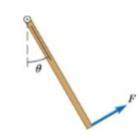
A uniform bar of mass m is supported by a pivot at its top, about which the bar can swing like a pendulum. If a force F is applied perpendicularly to the lower end of the bar as in the diagram, how big must F be in order to hold the bar in equilibrium at an angle θ from the vertical?(a)
Which of the forces in the figure produces a CW torque about the rotation axis indicated?(a) 3 only (b) 4 only (c) 1 and 2 (d) 1, 2, and 3(e) 1, 2, and 4
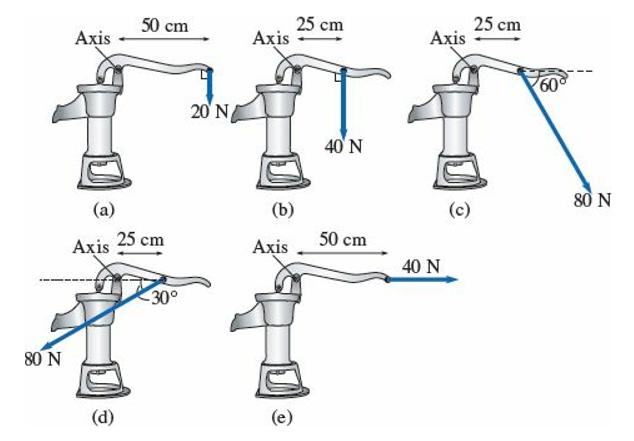
In each of the five situations shown, a force is applied to a point on the handle of an old pump. Rank the situations in order of the magnitude of the torque applied to the handle, smallest to largest 25 cm Axis 25 cm Axis 50 cm Axis 60 20 N 40 N 80 N (a) (b) (c) 25 cm Ахis Axis 50 cm 40
Which pair of forces in the figure might produce equal magnitude torques with opposite signs?(a) 2 and 3 (b) 2 and 4 (c) 1 and 2 (d) 1 and 3 (e) 1 and 4 (f) 3 and 4
A high diver in midair pulls her legs inward toward her chest in order to rotate faster. Doing so changes which of these quantities: her angular momentum L, her rotational inertia I, and her rotational kinetic energy Krot?(a) L only(b) I only (c) Krot only (d) L and I only (e) I
As shown in the top-view diagram, a 46.4 N force is applied to the outer edge of a door of width 1.26 m in such a way that it acts (a) Perpendicular to the door, (b) At an angle of 43.0° with respect to the door surface, (c) So that the line of action of the force passes through the
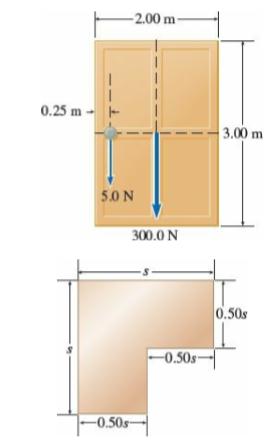
A plate of uniform thickness is shaped as shown. Where is the center of gravity? Assume the origin (0, 0) is located at the lower left corner of the plate; the upper left corner is at (0, s); and the upperright corner is at (s, s). -2.00 m- 0.25 m 3.00 m 5.0 N 300.0 N 0.50s -0.50s -0.50s
A mechanic turns a wrench using a force of 25 N at a distance of 16 cm from the rotation axis. The force is perpendicular to the wrench handle. What magnitude torque does she apply to the wrench?
Your friend balances a package with mass m = 10 kg on top of his head while standing. The mass of his upper body is M = 55 kg (about 65% of his total mass). Because the spine is vertical rather than horizontal, the force exerted by the sacrum on the spine ( in Fig 8.33) is directed approximately
The pull cord of a lawnmower engine is wound around a drum of radius 6.00 cm. While the cord is pulled with a force of 75 N to start the engine, what magnitude torque does the cord apply to the drum?
The human mandible (lower jaw) is attached to the temporomandibular joint (TMJ). The masseter muscle is largely responsible for pulling the mandible upward when you are talking or eating. It is attached at a horizontal distance of about 2.5 cm from the TMJ. If this muscle exerts a force of 220 N
(a) Assuming that the cord does not slip as it passes around the pulley, what is the relationship between the angular acceleration of the pulley (α) and the magnitude of the linear acceleration of the blocks (a)? (b) What is the net torque on the pulley about its axis of rotation in terms of
The radius of a wheel is 0.500 m. A rope is wound around the outer rim of the wheel. The rope is pulled with a force of magnitude 5.00 N, unwinding the rope and making the wheel spin CCW about its central axis. Ignore the mass of the rope. (a) How much rope unwinds while the wheel makes 1.00
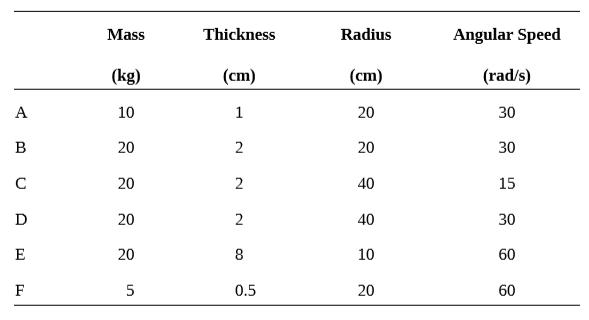
Six flywheels have masses, thicknesses, radii, and angular speeds as given in the table. Each flywheel is a solid disk. Rank the flywheels in order of their angular momentum, smallest to largest. Mass Thickness Radius Angular
A Ferris wheel rotates because a motor exerts a torque on the wheel. The radius of the London Eye, a huge observation wheel on the banks of the Thames, is 67.5 m and its mass is 1.90 × 10⁶ kg. The cruising angular speed of the wheel is 3.50 × 10⁻³ rad/s. (a) How much work does the motor
A discus thrower moves the discus in 1.5 complete revolutions in 1.4 s (starting from rest). The radius of the circular path of the discus is 0.90 m, and the mass of the discus is 2.0 kg. Assume a constant torque is applied to the discus by the athlete. (a) What is the angular speed of the
A solid cylinder (mass 160 g, radius 2.0 cm) rolls without slipping at a speed of 5.0 cm/s. What is its total kinetic energy?
A uniform disk of mass 5.00 kg has a radius of 0.100 m and spins with a frequency of 0.550 rev/s. What is its angular momentum?
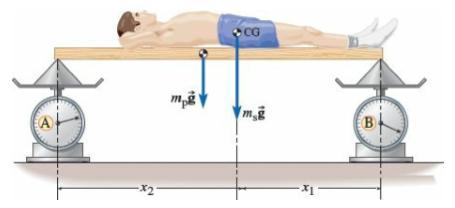
One way to determine the location of your center of gravity is shown in the diagram. A 2.2 m long uniform plank is supported by two bathroom scales, one at either end. Initially the scales each read 100.0 N. A 1.60 m tall student then lies on top of the plank, with the soles of his feet directly
A figure skater is spinning at 10.0 rad/s with her arms extended. Her rotational inertia is 2.50 kg·m2. After pulling her arms in, her rotational inertia is 1.60 kg·m2. How much work does she do to pull her arms in while spinning?
If the cylinder rotates at 300.0 rev/min, what is the magnitude of the average torque required to tilt its axis by 60.0° in a time of 3.00 s?A solid cylindrical disk is to be used as a stabilizer in a ship. By using a massive disk rotating in the hold of the ship, the captain knows that a large
(a) Assume Earth is a uniform solid sphere. Find the kinetic energy of Earth due to its rotation about its axis. (b) Suppose we could somehow extract 1.0% of Earth's rotational kinetic energy to use for other purposes. By how much would that change the length of the day? (c) For how many
A collection of objects is set to rolling, without slipping, down a slope inclined at 30°. The objects are a solid sphere, a hollow sphere, a solid cylinder, and a hollow cylinder. A frictionless cube is also allowed to slide down the same incline. Rank the order in which they arrive at the finish
A grinding wheel, with a mass of 20.0 kg and a radius of 22.4 cm, is a uniform cylindrical disk. (a) Find the rotational inertia of the wheel about its central axis. (b) When the grinding wheel's motor is turned off, friction causes the wheel to slow from 1200 rev/min to rest in 60.0s.
A rotating star collapses under the influence of gravitational forces to form a pulsar. The radius of the pulsar is 1.0 × 10⁻⁴ times the radius of the star before collapse. There is no change in mass. In both cases, the mass of the star is uniformly distributed in a spherical shape. Find the
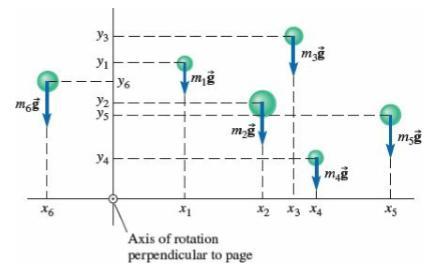
A flat object in the xy-plane is free to rotate about the z-axis. The gravitational field is uniform in the −y-direction. Think of the object as a large number of particles with masses mn located at coordinates (xn, yn), as in the figure. (a) Show that the torques on the particles about the
A 5.60 kg uniform door is 0.760 m wide by 2.030 m high, and is hung by two hinges, one at 0.280 m from the top and one at 0.280 m from the bottom of the door. If the vertical components of the forces on each of the two hinges are identical, find the vertical and horizontal force components acting
In a motor, a flywheel (solid disk of radius R and mass M) is rotating with angular velocity ωi. When the clutch is released, a second disk (radius r and mass m) initially not rotating is brought into frictional contact with the flywheel. The two disks spin around the same axle with frictionless
A uniform solid cylinder rolls without slipping or sliding down an incline. The angle of inclination is 60.0°. Use energy considerations to find the cylinder's speed after it has traveled a distance of 30.0 cm along the incline.
A person on a bicycle (combined total mass 80.0 kg) starts from rest and coasts down a hill to the bottom 20.0 m below. Each wheel can be treated as a hoop with mass 1.5 kg and radius 40 cm. Ignore friction and air resistance. (a) Find the speed of the bike at the bottom. (b) Would the
An experimental flywheel, used to store energy and replace an automobile engine, is a solid disk of mass 200.0 kg and radius 0.40 m. (a) What is its rotational inertia? (b) When driving at 22.4 m/s (50 mi/h), the fully energized flywheel is rotating at an angular speed of 3160 rad/s. What
Nina wants to lean a ladder of mass 15 kg and length 8.0 m against a wall. She lifts one end over her head. Then she “walks” her hands from rung to rung toward the other end, which rests on the ground. (a) When she is holding the ladder 2.0 m from the end where she started, what vertical
A hoop of 2.00 m circumference is rolling down an inclined plane of length 10.0 m in a time of 10.0 s. It started out from rest. (a) What is its angular velocity when it arrives at the bottom? (b) If the mass of the hoop, concentrated at the rim, is 1.50 kg, what is the angular momentum
A hollow cylinder rolls without slipping or sliding along a horizontal surface toward an incline. (a) If the cylinder's speed is 3.00 m/s at the base of the incline and the angle of inclination is 37.0°, how far up the incline does the cylinder travel before coming to a stop? (b) What is
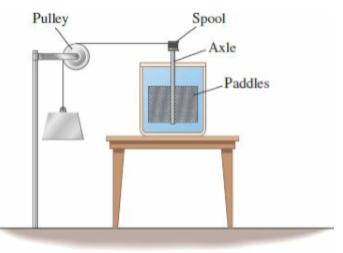
Consider the apparatus shown in the figure (not to scale). The pulley, which can be treated as a uniform disk, has a mass of 60.0 g and a radius of 3.00 cm. The spool also has a radius of 3.00 cm. The rotational inertia of the spool, axle, and paddles about their axis of rotation is 0.00140 kg·m2.
A bicycle and its rider have a total mass of 74.0 kg. Each of its wheels can be modeled as a thin hoop with mass 1.30 kg and diameter of 70.0 cm. When the brakes are applied, two brake pads squeeze the rims of each wheel. Assume that the four brake pads exert normal forces on the wheels that are
A uniform disk is rotated about its symmetry axis. The disk goes from rest to an angular speed of 11 rad/s in a time of 0.20 s with constant angular acceleration. The rotational inertia and radius of the disk are 1.5 kg · m2 and 11.5 cm, respectively. (a) What is the angular acceleration
You are mowing the lawn on a hill near your house when the lawnmower blade strikes a stone of mass 100 g and sends it flying horizontally toward a window. The lawnmower blade can be modeled as a thin rod with a mass of 2.0 kg and a length of 50 cm rotating about its center. The stone impacts the
A child's toy is made of a 12.0 cm radius rotating wheel that picks up 1.00 g pieces of candy in a pocket at its lowest point, brings the candy to the top, then releases it. The frequency of rotation is 1.60 Hz. (a) How far from its starting point does the candy land? (b) What is the
Carlos and Shannon are sledding down a snow-covered slope that is angled at 12° below the horizontal. When sliding on snow, Carlos's sled has a coefficient of friction μk = 0.10; Shannon has a “supersled” with μk = 0.010. Carlos takes off down the slope starting from rest. When Carlos
A rocket engine can accelerate a rocket launched from rest vertically up with an acceleration of 20.0 m/s2. However, after 50.0 s of flight the engine fails. Ignore air resistance. (a) What is the rocket's altitude when the engine fails? (b) When does it reach its maximum height? (c)
A person stands on a bathroom scale in an elevator. Rank the scale readings from highest to lowest based on the given information about the speed v or the magnitude of the acceleration a. (a) Ascending with increasing speed (a = 1.0 m/s2); (b) Descending at constant speed (v = 2.0
The orange jewelweed (Impatiens capensis) has seed pods that explode when lightly touched, launching the seeds as projectiles to disperse them. Suppose a seed is launched at 1.2 m/s from a height of 1.1 m. Assume air resistance is negligible and that the seed follows a clear path to the
An archer fish spies a meal of a grasshopper sitting on a long stalk of grass at the edge of the pond in which he is swimming. If the fish is to successfully spit at and strike the grasshopper, which is 0.200 m away horizontally and 0.525 m above his mouth, what is the minimum speed at which the
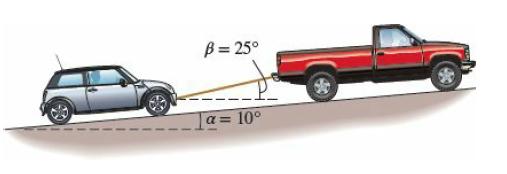
A 3000 kg truck is about to tow a 1250 kg car up a hill that makes an angle of α = 10° with respect to the horizontal. The rope attached from the truck to the car makes an angle of β = 25° with respect to the horizontal. The coefficient of static friction between the truck tires and the road is
The snow leopard (Uncia uncia) is an endangered species that lives in the mountains of central Asia. It is thought to be the longest jumper in the animal kingdom. If a snow leopard jumps at 35° above the horizontal and lands 15.0 m away on flat ground, what was its initial speed?
A clay roof tile of mass 2.7 kg slides down a roof inclined at 48° with respect to the horizontal. If the tile starts from rest 3.2 m from the edge of the roof and friction is negligible, how fast is it moving when it reaches the edge?
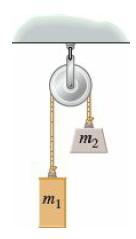
Two blocks are connected by an ideal cord that passes over a frictionless pulley. If m1 = 3.6 kg and m2 = 9.2 kg, and block 2 is initially at rest 140 cm above the floor, how long does it take block 2 to reach the floor?
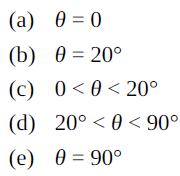
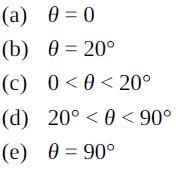
A stone is thrown at an angle of 20° below the horizontal from the top of a cliff. Assume no air resistance. One second after being thrown, the stone's velocity is at angle θ below the horizontal. Which is true? (а) 0 %3D 0 (b) 0 = 20° (с) 0
An airplane starts from rest on the runway. The engines exert a constant force of 78 kN on the body of the plane (mass 9.2 × 10⁴ kg) during takeoff. How far down the runway does the plane reach its takeoff speed of 68 m/s? m2 m1
A stone is thrown at an angle of 20° below the horizontal from the top of a cliff. Assume no air resistance. One second after being thrown, the stone's acceleration makes an angle θ below the horizontal. Which is true? (а) 0 %3D 0 (b) 0 = 20° (с) 0
In a cathode ray tube, electrons are accelerated from rest by a constant electric force of mag nitude 6.4 × 10⁻¹⁷ N during the first 2.0 cm of the tube's length; then they move at essentially constant velocity another 45 cm before hitting the screen. (a) Find the speed of the electrons when
On the way down, the magnitude of the ball's acceleration is_____.A ball is tossed straight up. Air resistance is not negligible; the force of air resistance is opposite in direction to the ball's velocity. Assume its magnitude is less than the ball's weight. Answer choices:(a) Less than g(b) Equal
A train of mass 55 200 kg is traveling along a straight, level track at 26.8 m/s. Suddenly the engineer sees a truck stalled on the tracks 184 m ahead. If the maximum possible braking force has magnitude 84.0 kN, can the train be stopped in time?
At the top the magnitude of the ball's acceleration is _____.A ball is tossed straight up. Air resistance is not negligible; the force of air resistance is opposite in direction to the ball's velocity. Assume its magnitude is less than the ball's weight. Answer choices:(a) Less than g(b) Equal to
The forces on a small airplane (mass 1160 kg) in horizontal flight heading eastward are as follows: weight = 11.4 kN downward, lift = 11.4 kN upward, thrust = 1.800 kN eastward, and drag = 1.400 kN westward. At t = 0, the plane's speed is 60.0 m/s. If the forces remain constant, how far does the
On the way up, the magnitude of the ball's acceleration is _____.A ball is tossed straight up. Air resistance is not negligible; the force of air resistance is opposite in direction to the ball's velocity. Assume its magnitude is less than the ball's weight. Answer choices:(a) Less than g(b) Equal
When a coin is tossed directly upward, what can you say about its velocity and acceleration at the high point of the toss?
In a game of shuffleboard, a disk with an initial speed of 3.2 m/s travels 6.0 m before coming to rest. (a) What was the acceleration of the disk? (b) What was the coefficient of kinetic friction between the floor and the disk?
You throw a ball up with initial speed vi, and when it reaches its high point at height h, you throw another ball into the air with the same initial speed vi. Will the two balls cross at half the height h, more than half, or less than half? Explain.
Why might an elevator cable break during acceleration when lifting a lighter load than it normally supports at rest or at constant velocity?
A 70.0 kg man stands on a bathroom scale in an elevator. What does the scale read if the elevator is slowing down at a rate of 3.00 m/s2 while descending?(a) 210 N(b) 476 N(c) 686 N(d) 700 N(e) 896 N
If air resistance is ignored, what force(s) act on an object in free fall?
Two blocks are connected by a light string passing over a pulley. The block with mass m1 slides on the frictionless horizontal surface, while the block with mass m2 hangs vertically (m1 > m2). The tension in the string is (a) Zero; (b) Less than m2g;(c) Equal to m2g; (d) Greater
Showing 1200 - 1300
of 1578
First
2
3
4
5
6
7
8
9
10
11
12
13
14
15
16
Step by Step Answers

 Get 50% OFF
Claim Now
Get 50% OFF
Claim Now