New Semester
Started
Get
50% OFF
Study Help!
--h --m --s
Claim Now
Question Answers
Textbooks
Find textbooks, questions and answers
Oops, something went wrong!
Change your search query and then try again
S
Books
FREE
Study Help
Expert Questions
Accounting
General Management
Mathematics
Finance
Organizational Behaviour
Law
Physics
Operating System
Management Leadership
Sociology
Programming
Marketing
Database
Computer Network
Economics
Textbooks Solutions
Accounting
Managerial Accounting
Management Leadership
Cost Accounting
Statistics
Business Law
Corporate Finance
Finance
Economics
Auditing
Tutors
Online Tutors
Find a Tutor
Hire a Tutor
Become a Tutor
AI Tutor
AI Study Planner
NEW
Sell Books
Search
Search
Sign In
Register
study help
sciences
college physics with an integrated approach
College Physics With An Integrated Approach To Forces And Kinematics 5th Edition Alan Giambattista - Solutions
A 1.5 V flashlight battery can maintain a current of 0.30 A for 4.0 h before it is exhausted. How much chemical energy is converted to electrical energy in this process?
Consider a 60.0 W incandescent lightbulb and a 100.0 W incandescent lightbulb designed for use in a household lamp socket at 120 V. (a) What are the resistances of these two bulbs? (b) If they are wired together in a series circuit, which bulb shines brighter (dissipates more power)?
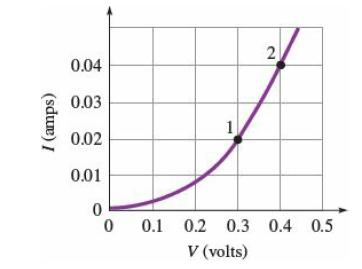
A certain electric device has the current-voltage (I-V) graph shown with Problem 30. What is the power dissipated at points 1 and 2? ww 90 90
A 1.5 hp motor operates on 120 V. Ignoring I2R losses, how much current does it draw?
The filament of an incandescent lightbulb is made of tungsten. At room temperature of 20.0°C the filament has a resistance of 10.0 Ω.(a) What is the power dissipated in the lightbulb immediately after it is connected to a 120 V emf (when the filament is still at 20.0°C)? (b) After a brief
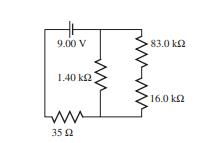
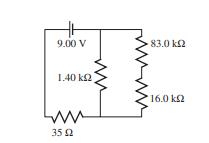
A voltmeter with a resistance of 670 kΩ is used to measure the voltage across the 83.0 kΩ resistor in the figure with Problems 79 and 80. What is the voltmeter reading?(a) Redraw the following circuit to show how an ammeter would be connected to measure the current through the 1.40kΩ
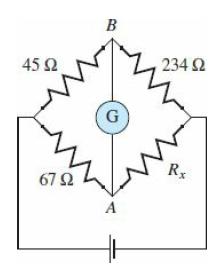
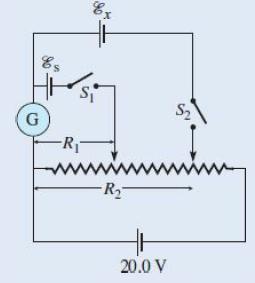
A potentiometer is a resistor with a sliding contact. It can be used to measure emfs accurately (Problem 131) or to supply a variable voltage to a circuit (Problem 132). In the diagram with switch S1 closed and S2 open, there is no current through the galvanometer G (a sensitive detector of current
(a) What is the resistance of the heater element in a 1500 W hair dryer that plugs into a 120 V outlet? (b) What is the current through the hair dryer when it is turned on? (c) At a cost of $0.10 per kW· h, how much does it cost to run the hair dryer for 5.00 min? (d) If you were to
Poiseuille's law [Eq. (9-41)] gives the volume flow rate of a viscous fluid through a pipe. (a) Show that Poiseuille's law can be written in the form ΔP = IR, where I = ΔV/Δt represents the volume flow rate and R is a constant of proportionality called the fluid flow resistance. (b)
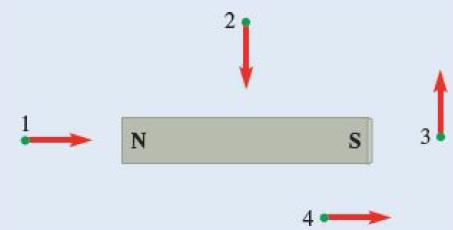
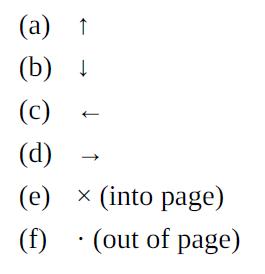
What is the direction of the magnetic force on charge 2 if q2 > 0?In the figure, four point charges move in the directions indicated in the vicinity of a bar magnet. The magnet, charge positions, and velocity vectors all lie in the plane of this page. Answer choices: (а) 1 (b) ! (c) (d) (e) x
A parallel plate capacitor is constructed from two square conducting plates of length L = 0.10 m on a side. There is air between the plates, which are separated by a distance d = 89 μm. The capacitor is connected to a 10.0 V battery. (a) After the capacitor is fully charged, what is the
Two immersion heaters, A and B, are both connected to a 120 V supply. Heater A can raise the temperature of 1.0 L of water from 20.0°C to 90.0°C in 2.0 min, whereas heater B can raise the temperature of 5.0 L of water from 20.0°C to 90.0°C in 5.0 min. What is the ratio of the resistance of
The field between the plates of a parallel plate capacitor, E = Q/(ϵ0A), is due to the superposition of equal contributions from the charges on the two plates. Therefore, each plate exerts an electric force on the other. (a) Find the magnitude of this force in terms of Q, ϵ0, and A. (b)
The electric field is defined as the electric force per unit charge. Explain why the magnetic field cannot be defined as the magnetic force per unit charge.
What is the direction of the magnetic force on charge 4 if q4 < 0?In the figure, four point charges move in the directions indicated in the vicinity of a bar magnet. The magnet, charge positions, and velocity vectors all lie in the plane of this page. Answer choices: (а) 1 (b) ! (c) (d) (e) x
What is the direction of the magnetic force on charge 3 if q3 < 0?In the figure, four point charges move in the directions indicated in the vicinity of a bar magnet. The magnet, charge positions, and velocity vectors all lie in the plane of this page. Answer choices: (а) 1 (b) ! (c) (d) (e) x
The magnetic force on a point charge in a magnetic field is largest, for a given speed, when (a) It moves in the direction of the magnetic field. (b) Moves in the direction opposite to the magnetic field. (c) Moves perpendicular to the magnetic field. (d) Has velocity
A uniform magnetic field directed upward exists in some region of space. In what direction(s) could an electron be moving if its trajectory is (a) A straight line? (b) A circle? Assume that the electron is subject only to magnetic forces.
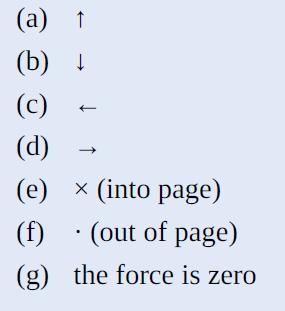
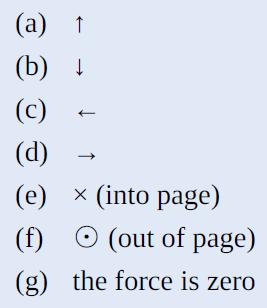
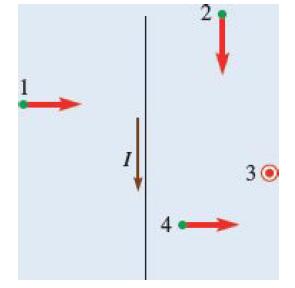
What is the direction of the magnetic force on charge 1 if q1 < 0?A wire carries current as shown in the figure. Charged particles 1, 2, 3, and 4 move in the directions indicated. Answer choices for Questions 6–8: (а) 1 (b) ! (c) (d) (e) x (into page) (f) O (out of page) (g) the force is zero
What is the direction of the magnetic force on charge 3 if q3 < 0?A wire carries current as shown in the figure. Charged particles 1, 2, 3, and 4 move in the directions indicated. Answer choices for Questions 6–8: (а) 1 (b) ! (c) (d) (e) x (into page) (f) O (out of page) (g) the force is zero
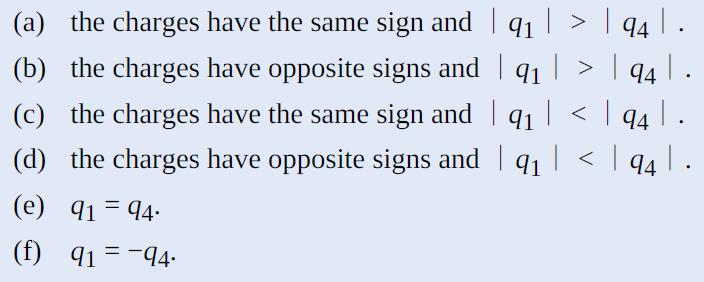
If the magnetic forces on charges 1 and 4 are equal and their velocities are equal,A wire carries current as shown in the figure. Charged particles 1, 2, 3, and 4 move in the directions indicated. Answer choices for Questions 6–8: (a) the charges have the same sign and | q1| > | q4 | . (b) the
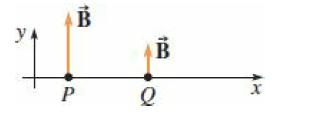
The magnetic field due to a long straight wire carrying steady current is measured at two points, P and Q. Where is the wire and in what direction does the current flow? y 4
The magnetic field lines inside a bar magnet run in what direction?(a) From north pole to south pole(b) From south pole to north pole(c) From side to side(d) None of the above—there are no magnetic field lines inside a bar magnet.
The magnetic forces that two parallel wires with unequal currents flowing in opposite directions exert on each other are (a) Attractive and unequal in magnitude.(b) Repulsive and unequal in magnitude.(c) Attractive and equal in magnitude.(d) Repulsive and equal in magnitude. (e) Both
Rank the electrons in order of the magnitude of the magnetic force on them, from greatest to least.Several electrons move at speed 8.0 × 10⁵ m/s in a uniform magnetic field with magnitude B = 0.40 T directed downward.
What is the direction of the magnetic field at point P in the figure? (P is on the axis of the coil.) 30 4- 2.
Which of these statements are implied by the second law of thermodynamics?(a) The entropy of an engine (including its fuel and/or heat reservoirs) operating in a cycle never decreases.(b) The increase in internal energy of a system in any process is the sum of heat absorbed plus work done on the
An ideal gas is heated at a constant pressure of 2.0 × 10⁵ Pa from a temperature of −73°C to a temperature of +27°C. The initial volume of the gas is 0.10 m3. The heat energy supplied to the gas in this process is 25 kJ. What is the increase in internal energy of the gas?
If the pressure on a fish increases from 1.1 atm to 1.2 atm, its swim bladder decreases in volume from 8.16 mL to 7.48 mL while the temperature of the air inside remains constant. How much work is done on the air in the bladder?
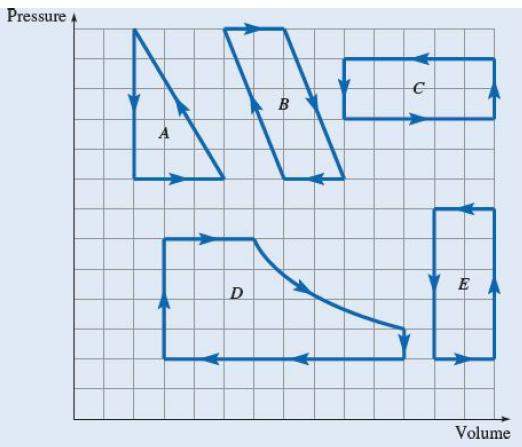
(a) Which might describe a heat engine? (b) Which might describe a heat pump? (c) Which might describe a refrigerator? Explain.The figure shows PV diagrams for five cyclical processes. (Cycle D is a simplified model of a steam engine cycle.) Pressure . E Volume
Suppose 1.00 mol of oxygen is heated at constant pressure of 1.00 atm from 10.0°C to 25.0°C. (a) How much heat is absorbed by the gas? (b) Using the ideal gas law, calculate the change of volume of the gas in this process. (c) What is the work done by the gas during this
Rank the processes in order of the net work done by the system per cycle, from greatest to least. Rank positive work done by the system (as in an engine) higher than negative work done by the system (as in a heat pump).The figure shows PV diagrams for five cyclical processes. (Cycle D is a
An ideal engine has an efficiency of 0.725 and uses gas from a hot reservoir at a temperature of 622 K. What is the temperature of the cold reservoir to which it exhausts heat?
A heat engine takes in 125 kJ of heat from a reservoir at 815 K and exhausts 82 kJ to a reservoir at 293 K. (a) What is the efficiency of the engine? (b) What is the efficiency of an ideal engine operating between the same two reservoirs?
The motor that drives a refrigerator produces 148 W of useful power. The hot and cold temperatures of the heat reservoirs are 20.0°C and −5.0°C. What is the maximum possible amount of ice it can produce in 2.0 h from water that is initially at 8.0°C?
A new organic semiconductor device is able to generate electricity (which can be used to charge a battery or light an LED) using the warmth of human skin. If your skin temperature is maintained by your body at 35°C and the temperature of the surroundings is 20°C, what is the maximum possible
The human body could potentially serve as a very good thermal reservoir, as its internal temperature remains quite constant at around 37°C and is stabilized by continual intake of food. Suppose an inventor designed microscopic engines that could be implanted under the skin in order to charge
Two engines operate between the same two temperatures of 750 K and 350 K, and have the same rate of heat input. One of the engines is a reversible engine with a power output of 23 kW. The second engine has an efficiency of 42%. What is the power output of the second engine?
An oil-burning electric power plant uses steam at 773 K to drive a turbine, after which the steam is expelled at 373 K. The engine has an efficiency of 0.40. What is the theoretical maximum efficiency possible at those temperatures?
(a) For a reversible engine, will you obtain a better efficiency by increasing the high-temperature reservoir by an amount ΔT or decreasing the low-temperature reservoir by the same amount ΔT? Explain. (b) To illustrate your answer to this question, calculate the efficiencies of a reversible
Rank these in order of increasing entropy: (a) 0.5 kg of ice and 0.5 kg of (liquid) water at 0°C; (b) 1 kg of ice at 0°C; (c) 1 kg of (liquid) water at 0°C; (d) 1 kg of water at 20°C.
Rank these in order of increasing entropy: (a) 1 mol of water at 20°C and 1 mol of ethanol at 20°C in separate containers; (b) A mixture of 1 mol of water at 20°C and 1 mol of ethanol at 20°C; (c) 0.5 mol of water at 20°C and 0.5 mol of ethanol at 20°C in separate
What is the change in entropy of 10 g of steam at 100°C as it condenses to liquid water at 100°C?
Humans cool off by perspiring; the evaporating sweat removes heat from the body. If the skin temperature is 35.0°C and the air temperature is 28.0°C, what is the entropy change of the universe due to the evaporation of 150 mL of sweat? Take the latent heat of vaporization of sweat to be the same
A 0.500 kg block of iron at 60.0°C is placed in contact with a 0.500 kg block of iron at 20.0°C. (a) The blocks soon come to a common temperature of 40.0°C. Estimate the entropy change of the universe when this occurs.(b) Estimate the entropy change of the universe if, instead, the
On a day when the temperature is 19°C, a 0.15 kg baseball is dropped from the top of a 24 m tower. After the ball hits the ground, bounces a few times, and comes to rest, approximately how much has the entropy of the universe increased?
Suppose you mix 4.0 mol of a monatomic ideal gas at 20.0°C and 3.0 mol of another monatomic ideal gas at 30.0°C. If the mixture is allowed to reach equilibrium, what is the final temperature of the mixture?
Suppose you inhale 0.50 L of air initially at 20°C and 100 kPa pressure. While holding your breath, this air is warmed at constant pressure to 37°C. Treating the air as an ideal diatomic gas, how much heat flows from the body into the air?
On a hot day, you are in a sealed, insulated room. The room contains a refrigerator, operated by an electric motor. The motor does work at the rate of 250 W when it is running. The refrigerator removes heat from the food storage space at a rate of 450 W when the motor is running. In an effort to
A container holding 1.20 kg of water at 20.0°C is placed in a freezer that is kept at −20.0°C. The water freezes and comes to thermal equilibrium with the interior of the freezer. What is the minimum amount of electrical energy required by the freezer to do this if it operates between
A fish at a pressure of 1.1 atm has its swim bladder inflated to an initial volume of 8.16 mL. If the fish starts swimming horizontally, its temperature increases from 20.0°C to 22.0°C as a result of the exertion. (a) Since the fish is still at the same pressure, how much work is done by the
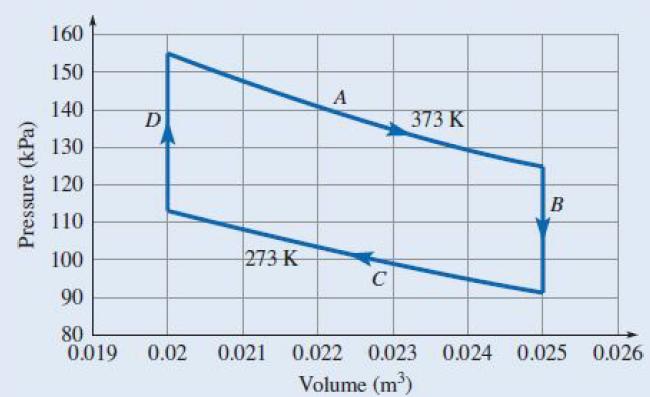
(a) Find the work done by the engine during each of the four steps and the net work done for the cycle. (b) If the heat input per cycle is 2770 J, what is the efficiency of the engine? (c) Compare the efficiency to that of an ideal engine using the same reservoirs.The PV diagram shown is
(a) Find the heat flow into or out of the gas during each of the four steps. (b) What is the net heat flow into the gas per cycle? (c) Calculate the change in entropy of the cold reservoir (not of the gas) in steps B and C and the change in entropy of the hot reservoir in steps A and
Find the change in internal energy of the gas during each of the four steps.The PV diagram shown is for a heat engine that uses 1.000 mol of a diatomic ideal gas as its working substance. In the constant-temperature processes A and C, the gas is in contact with reservoirs at temperatures 373 K and
Draw a PV diagram to illustrate the cycle for this engine. Label the axes with numerical values.In a heat engine, 3.00 mol of a monatomic ideal gas, initially at 4.00 atm of pressure, undergoes an isothermal expansion, increasing its volume by a factor of 9.50 at a constant temperature of 650.0 K.
In a heat engine, 3.00 mol of a monatomic ideal gas, initially at 4.00 atm of pressure, undergoes an isothermal expansion, increasing its volume by a factor of 9.50 at a constant temperature of 650.0 K. The gas is then compressed at a constant pressure to its original volume. Finally, the pressure
(a) Find the heat flow into or out of the gas during each step, (b) Find the entropy change of the gas during the isothermal step.(c) What is the entropy change of the gas for a complete cycle? Is it equal in magnitude to the entropy change of the environment per cycle? Explain.In a heat
A model steam engine of 1.00 kg mass pulls eight cars of 1.00 kg mass each. The cars start at rest and reach a velocity of 3.00 m/s in a time of 3.00 s while moving a distance of 4.50 m. During that time, the net heat input is 135 J. What is the change in the internal energy of the engine?
An engine has a 30.0% efficiency. The engine raises a 5.00 kg crate from rest to a vertical height of 10.0 m, at which point the crate has a speed of 4.00 m/s. How much heat input is required for this engine?
A 0.50 kg block of iron [c = 0.44 kJ/(kg·K)] at 20.0°C is in contact with a 0.50 kg block of aluminum [c = 0.900 kJ/(kg·K)] at a temperature of 20.0°C. The system is completely isolated from the rest of the universe. Suppose heat flows from the iron into the aluminum until the temperature of
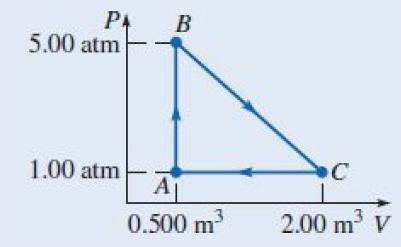
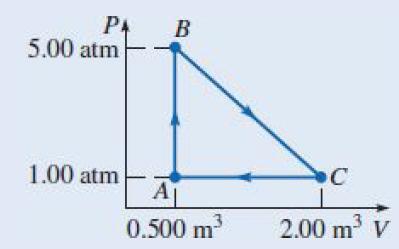
(a) How much net work does this engine do per cycle? (b) Assuming that the efficiency of the engine is 0.444, what is the heat input into the gas per cycle? (c) How much heat is exhausted per cycle? (d) It takes 3.0 s for the engine to go through each cycle. The engine is used to
(a) What is the maximum temperature of the gas? (b) What would be the efficiency of an ideal engine with reservoirs at the maximum and minimum temperatures of this engine? Compare this to the actual efficiency, 0.444. PA 5.00 atm В 1.00 atm A 0.500 m 2.00 m V
A power plant burns coal to produce pressurized steam at 535 K. The steam then condenses back into water at a temperature of 323 K. (a) What is the maximum possible efficiency of this plant? (b) If the plant operates at 50.0% of its maximum efficiency and its power output is 1.23 × 10⁸
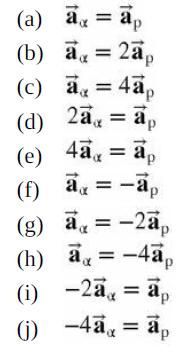
An alpha particle (charge +2e and mass 4mp) is on a collision course with a proton (charge +e and mass mp). Assume that no forces act other than the electrical repulsion. Which one of these statements about the accelerations of the two particles is true? (a) a = ap = ap %3D (b) a = 2ap (c) a =
(a) How many moles of gas are used in this engine? (b) Calculate the heat flow into or out of the gas in steps AB and CA. (c) Calculate the work done by the gas during each step.
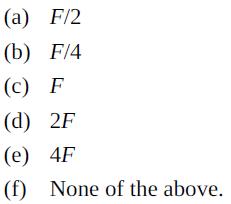
Two charged particles attract each other with a force of magnitude F acting on each. If the charge of one is doubled and the distance separating the particles is also doubled, the force acting on each of the two particles has magnitude (а) F/2 (b) F/4 (с) F (d) 2F (e) (е) 4F (f) None of the
In electrostatic equilibrium, the excess electric charge on an irregularly shaped conductor is(a) Uniformly distributed throughout the volume.(b) Confined to the surfaces and is uniformly distributed.(c) Entirely on the surfaces, but is not uniformly distributed.(d) Dispersed throughout the volume
The electric field at a point in space is a measure of(a) The total charge on an object at that point.(b) The electric force on any charged object at that point.(c) The charge-to-mass ratio of an object at that point.(d) The electric force per unit mass on a point charge at that point.(e) The
A charged insulator and an uncharged metal object near each other (a) Exert no electric force on each other.(b) Repel each other electrically.(c) Attract each other electrically.(d) Attract or repel, depending on whether the charge is positive or negative.
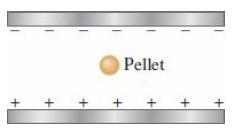
A tiny charged pellet of mass m is suspended at rest by the electric field between two horizontal, charged metallic plates. The lower plate has a positive charge and the upper plate has a negative charge.Which statement in the answers here is not true?(a) The electric field between the plates
A hollow metal sphere carries a charge of 6.0 μC. An identical sphere carries a charge of 18.0 μC. The two spheres are brought into contact with each other, then separated. How much charge is on each?
Which of these statements comparing electric and gravitational forces is correct?(a) The direction of the electric force exerted by one point particle on another is always the same as the direction of the gravitational force exerted by that particle on the other.(b) The electric and
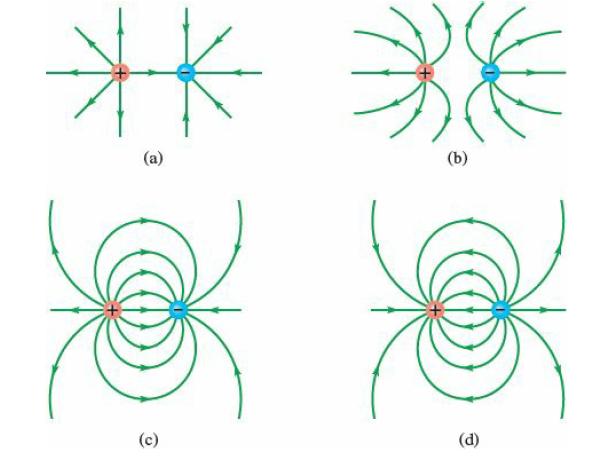
In the figure, which best represents the field lines due to two point charges with opposite charges? 斗米然 (a) (b) (d)
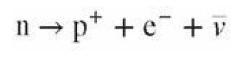
The following hypothetical reaction shows a neutron (n) decaying into a proton (p+), an electron (e−), and an uncharged particle called an antineutrino :At first there is no charge, but then charge seems to be “created.” Does this reaction violate the law of charge conservation? Explain. (v)
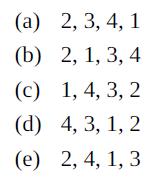
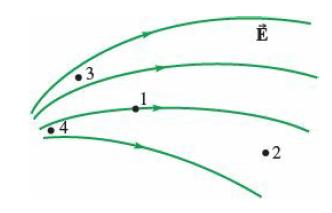
In the figure, rank points 1–4 in order of increasing field strength. (а) 2, 3, 4, 1 (b) 2, 1, 3, 4 (с) 1, 4, 3, 2 (d) 4, 3, 1, 2 (е) 2, 4, 1, 3
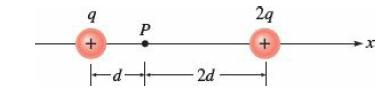
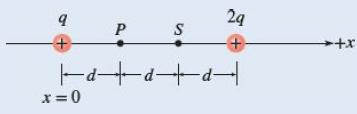
Two point charges q and 2q lie on the x-axis. Which region(s) on the x-axis include a point where the electric field due to the two point charges is zero?(a) To the right of 2q(b) Between 2q and point P(c) Between point P and q(d) To the left of q(e) Both (a) and (c)(f) Both (b) and (d)
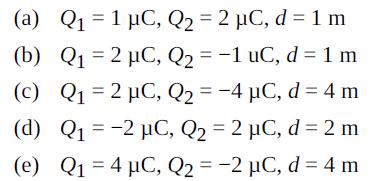
In each of five situations, two point charges (Q1, Q2) are separated by a distance d. Rank them in order of the magnitude of the electric force on Q1, from largest to smallest. (a) Q1 = 1 µC, Q2 = 2 µC, d = 1 m (b) Q1 = 2 µC, Q2 = -1 uC, d =1 m (c) Q1 = 2 µC, Q2 = -4 µC, d = 4 m (d) Q1 = -2
A rod is negatively charged by rubbing it with fur. It is brought near another rod of unknown composition and charge. There is a repulsive force on each. (a) Is the first rod an insulator or a conductor? Explain. (b) What can you tell about the charge of the second rod?
A +2.0 nC point charge is 3.0 cm away from a −3.0 nC point charge.(a) What are the magnitude and direction of the 6electric force acting on the +2.0 nC charge? (b) What are the magnitude and direction of the electric force acting on the −3.0 nC charge?
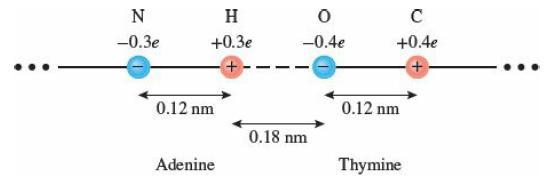
In a DNA molecule, the base pair adenine and thymine is held together by two hydrogen bonds (see Fig. 16.5). Let’s model one of these hydrogen bonds as four point charges arranged along a straight line. Using the information in the figure, calculate the magnitude of the net electric force exerted
Two point charges are separated by a distance r and repel each other with forces of magnitude F. If their separation is reduced to 0.25 times the original value, what is the magnitude of the forces of repulsion?
A K+ ion and a Cl− ion are directly across from each other on opposite sides of a cell membrane 9.0 nm thick. What is the electric force on the K+ ion due to the Cl− ion? Ignore the presence of other charges.
What are the magnitude and direction of the electric field midway between two point charges, −15 μC and +12 μC, that are 8.0 cm apart?
An electron traveling horizontally from west to east enters a region where a uniform electric field is directed upward. What is the direction of the electric force exerted on the electron once it has entered the field?
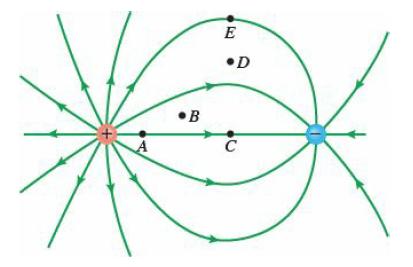
Rank points A-E in order of the magnitude of the electric field, from largest to smallest. E •D •B A C
Are there any points not on the x-axis where ? Explain.Positive point charges q and 2q are located at x = 0 and x = 3d, respectively.
On the x-axis, in which of the three regions x < 0, 0 < x < 3d, and x > 3d is there a point where = 0 ? Explain.Positive point charges q and 2q are located at x = 0 and x = 3d, respectively.
(a) Find the x-coordinates of the point(s) on the x-axis where = 0 . (b) Sketch a graph of Ex vs. x for points on the x-axis.Positive point charges q and 2q are located at x = 0 and x = 3d, respectively.
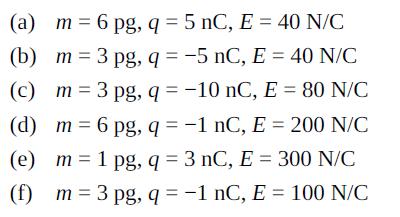
In each of six situations, a particle (mass m, charge q) is located at a point where the electric field has magnitude E. No other forces act on the particles. Rank them in order of the magnitude of the particle’s acceleration, from largest to smallest. (a) m = 6 pg, q = 5 nC, E = 40 N/C (b) m = 3
Three point charges are placed on the x-axis. A charge of 3.00 μC is at the origin. A charge of −5.00 μC is at 20.0 cm, and a charge of 8.00 μC is at 35.0 cm. What is the force on the charge at the origin?
Some forms of cancer can be treated using proton therapy in which proton beams are accelerated to high energies, then directed to collide into a tumor, killing the malignant cells. Suppose a proton accelerator is 4.0 m long and must accelerate protons from rest to a speed of 1.0 × 10⁷ m/s. Ignore
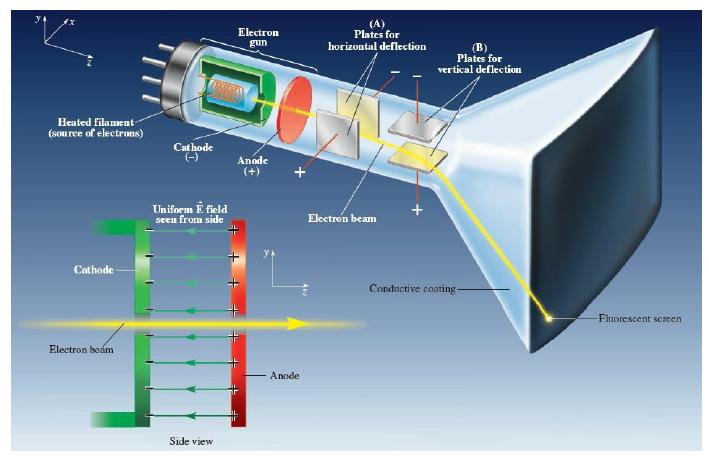
If the electric field between plates (A) is 1.0 × 10³ N/C in the + xdirection, what is the horizontal deflection (Δx) of the beam as it exits the region between plates (A)?After the electrons in Example 16.9 pass through the anode, they are moving in the z-direction at a speed of 8.4 × 10⁶ m/s.
The electric field between plates (A) is zero. As the beam exits the space between plates (B), it has been deflected 2.0 mm downward (Δy = −2.0 mm). What is the electric field between plates (B)?After the electrons in Example 16.9 pass through the anode, they are moving in the z-direction at a
The electric field between plates (A) is zero. As the beam exits the space between plates (B), it has been deflected 2.0 mm downward (Δy = −2.0 mm). In what direction is the beam moving now?After the electrons in Example 16.9 pass through the anode, they are moving in the z-direction at a speed
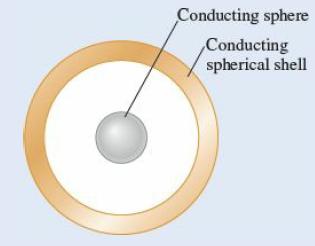
The inner sphere has a net charge of −6 μC and the shell has a net charge of +2 μC.A conducting sphere (radius a) is placed at the center of a conducting spherical shell (inner radius b and outer radius c). The conductors are in electrostatic equilibrium. For the given charges: (a) Sketch
The inner sphere has a net charge of +6 μC and the shell has a net charge of +6 μC.A conducting sphere (radius a) is placed at the center of a conducting spherical shell (inner radius b and outer radius c). The conductors are in electrostatic equilibrium. For the given charges: (a) Sketch a
The inner sphere has a net charge of +6 μC and the shell has a net charge of −6 μC.A conducting sphere (radius a) is placed at the center of a conducting spherical shell (inner radius b and outer radius c). The conductors are in electrostatic equilibrium. For the given charges: (a) Sketch
A negative point charge −Q is situated near a large metal plate that has a total charge of +Q. Sketch the electric field lines.
Two oppositely charged parallel plates produce a uniform electric field between them. An uncharged metal sphere is placed between the plates. Assume that the sphere is small enough that it does not affect the charge distribution on the plates. Sketch the electric field lines between the plates once
Two metal spheres of the same radius R are given charges of equal magnitude and opposite sign. No other charges are nearby. Sketch the electric field lines when the center-to-center distance between the spheres is approximately 3R.
Showing 700 - 800
of 1578
1
2
3
4
5
6
7
8
9
10
11
12
13
14
15
Last
Step by Step Answers

 Get 50% OFF
Claim Now
Get 50% OFF
Claim Now