New Semester
Started
Get
50% OFF
Study Help!
--h --m --s
Claim Now
Question Answers
Textbooks
Find textbooks, questions and answers
Oops, something went wrong!
Change your search query and then try again
S
Books
FREE
Study Help
Expert Questions
Accounting
General Management
Mathematics
Finance
Organizational Behaviour
Law
Physics
Operating System
Management Leadership
Sociology
Programming
Marketing
Database
Computer Network
Economics
Textbooks Solutions
Accounting
Managerial Accounting
Management Leadership
Cost Accounting
Statistics
Business Law
Corporate Finance
Finance
Economics
Auditing
Tutors
Online Tutors
Find a Tutor
Hire a Tutor
Become a Tutor
AI Tutor
AI Study Planner
NEW
Sell Books
Search
Search
Sign In
Register
study help
sciences
college physics with an integrated approach
College Physics With An Integrated Approach To Forces And Kinematics 5th Edition Alan Giambattista - Solutions
In fair weather, over flat ground, there is a downward electric field of about 150 NlC. Assume that Earth is a conducting sphere with charge on its surface. If the electric field just outside is 150 N/C pointing radially inward, calculate the total charge on Earth and the charge per unit area.
A parallel-plate capacitor consists of two flat metal plates of area A separated by a small distance d. The plates are given equal and opposite net charges ±q. (a) Sketch the field lines and use your sketch to explain why almost all of the charge is on the inner surfaces of the
In Problem 86, the +2.0 μC charge is at x = 0 and the −4.0 μC charge is at x = d. Find the x-coordinates of the point(s) where the electric field is zero.Data From Problem 86A parallel plate capacitor has a charge of 0.020 μC on each plate with a potential difference of 240 V. The parallel
(a) What would the net charges on the Sun and Earth have to be if the electric force instead of the gravitational force were responsible for keeping Earth in its orbit? There are many possible answers, so restrict yourself to the case where the magnitude of the charges is proportional to the
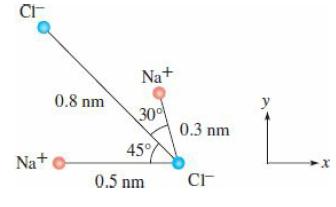
What is the electric force on the chloride ion in the lower righthand corner in the diagram? Since the ions are in water, the “effective charge” on the chloride ions (Cl−) is −2 × 10⁻²¹ C and that of the sodium ions (Na+) is +2 × 10⁻²¹ C. (The effective charge is a way to account for
In lab tests it was found that rats can detect electric fields of about 5.0 kN/C or more. If a point charge of 1.0 μC is sitting in a maze, how close must the rat come to the charge in order to detect it?
A point charge q1 = +5.0 μC is fixed in place at x = 0, and a point charge q2 = −3.0 μC is fixed at x = −20.0 cm. Where can we place a point charge q3 = −8.0 μC so that the net electric force on q1 due to q2 and q3 is zero?
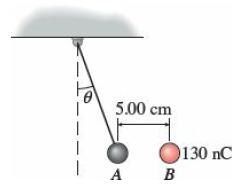
Object A has mass 90.0 g and hangs from an insulated thread. When object B, which has a charge of +130 nC, is held nearby, A is attracted to it. In equilibrium, A hangs at an angle θ = 7.20° with respect to the vertical and is 5.00 cm to the left of B. (a) What is the charge on A?(b) What is
An electron with a velocity of 10.0 m/s in the positive y-direction enters a region where there is a uniform electric field of 200 N/C in the positive x-direction. What are the x- and y-components of the electron’s displacement 2.40 μs after entering the electric-field region if no other forces
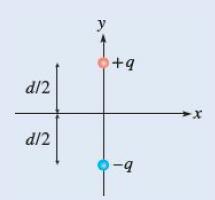
(a) Write an expression for the magnitude of the electric field at a point (x, 0) on a line perpendicular to the dipole axis. State the direction of the field for x > 0 and for x < 0. (b) Show that when x ≫ d, E ≈ kqd/x3. (c) The field is inversely proportional to the distance
A thin wire with positive charge Q evenly spread along its length is shaped into a semicircle of radius R. (a). What is the direction of the electric field at the center of curvature of the semicircle? Explain. (b) Is the magnitude of the field at the center less than, equal to, or
(a) Write an expression for the electric field at a point (0, y) on the dipole axis for y > d/2. What is the direction of the field?(b) Show that when y ≫ d, E ≈ 2kqd/y3. (c) The field is inversely proportional to the distance cubed. Does this conflict with Coulomb’s law? Explain.
In gel electrophoresis, the mobility μ of a molecule in a particular gel matrix is defined as μ = v1/E, where v1 is the terminal speed of the molecule and E is the applied electric field strength. In one case, a molecule has mobility 3.0 × 10⁻⁸ C·m/(N·s) and charge −12e. (a) Estimate
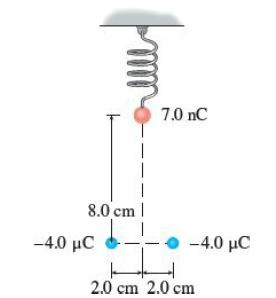
In an experiment to measure the Coulomb constant, a tiny sphere with charge +7.0 nC is suspended from a spring. When two other tiny charged spheres, each with a charge of −4.0 μC, are placed in the positions shown in the figure, the spring stretches 0.50 mm from its previous equilibrium
A spherical rain drop of radius 1.0 mm has a charge of +2.0 nC. The electric field in the vicinity is 2.0 kN/C downward. The terminal speed of an identical but uncharged drop is 6.5 m/s. The drag force is related to the drop’s speed by Fd = bv2 (turbulent drag rather than viscous drag). Calculate
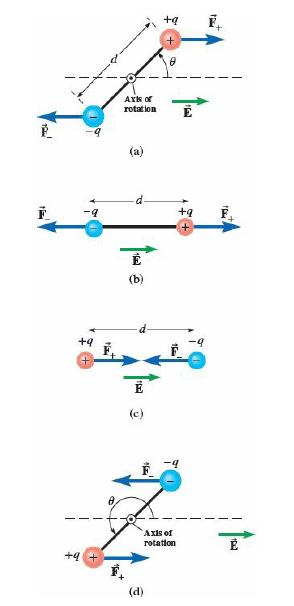
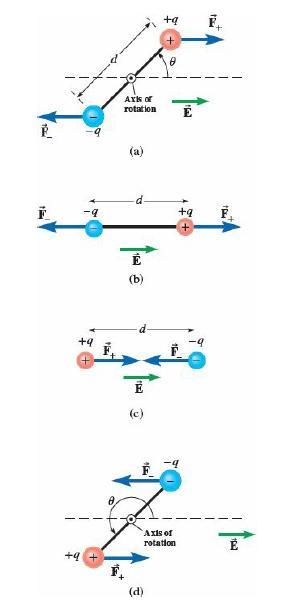
(a) Calculate the net electric force acting on the dipole. (b) Show that the magnitude of the torque on the dipole is τ = qEd sin θ. (c) Calculate the torque acting on the dipole for θ = 0, 36.9°, and 90.0°.The axis of a dipole (charges ±q = ±3.0 μC at the ends of a uniform rod of
What is the angular acceleration of the dipole at θ = 135°?The axis of a dipole (charges ±q = ±3.0 μC at the ends of a uniform rod of length d = 7.0 cm) makes an angle θ with a uniform electric field E = 2.0 × 10⁴ N/C, as shown in Fig. 16.43. The charges each have mass 5.0 g and the rod has
The dipole is released from rest at θ = 90.0°. What is its angular speed when it reaches θ = 0?The axis of a dipole (charges ±q = ±3.0 μC at the ends of a uniform rod of length d = 7.0 cm) makes an angle θ with a uniform electric field E = 2.0 × 10⁴ N/C, as shown in Fig. 16.43. The charges
What is the maximum possible torque on the molecule due to the electric field?An isolated water molecule is modeled as two point charges ±0.80e separated by 0.048 nm. Its rotational inertia is 2.93 × 10−47 kg·m2 about the axis shown in Fig.16.43a. The molecule is in a uniform electric field of
If the molecule is initially at rest at θ = 90.0°, what is its angular speed when it reaches θ = 0, assuming no other forces or torques?An isolated water molecule is modeled as two point charges ±0.80e separated by 0.048 nm. Its rotational inertia is 2.93 × 10−47 kg·m2 about the axis shown
Among these choices, which is/are correct units for electric field?(a) N/kg only(b) N/C only(c) N only(d) N·m/C only(e) V/m only(f) both N/C and V/m
In each of five situations, two point charges (Q1, Q2) are separated by a distance d. Rank them in order of the electric potential energy, from highest to lowest. Q1 = 1 µC, Q2 = 2 µC, d = 1 m (b) Q1 = 2 µC, Q2 = -1 µC, d = 1 m (c) Q1 = 2 µC, Q2 = -4 µC, d = 2 m (a) Q1 = -2 µC, Q2 = -2 µC,
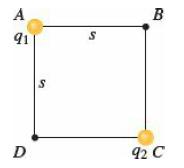
Two charges are located at opposite corners (A and C) of a square. We do not know the magnitude or sign of these charges. What can be said about the potential at corner B relative to the potential at corner D?(a) It is the same as that at D.(b) It is different from that at D.(c) It is the same as
A bird is perched on a high-voltage power line whose potential varies between −100 kV and +100 kV. Why is the bird not electrocuted?
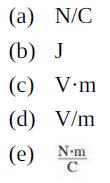
Which of these units can be used to measure electric potential? (a) N/C (b) J (c) V•m (d) V/m (e) N•m
A positive charge is initially at rest in an electric field and is free to move. Does the charge start to move toward a position of higher or lower potential? What happens to a negative charge in the same situation?
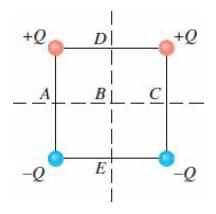
In the diagram, the potential is zero at which of the points A–E?(a) B, D, and E(b) B only(c) A, B, and C(d) All five points(e) All except B +Q D| A BL_C E
A parallel plate capacitor is attached to a battery that supplies a constant potential difference. While the battery is still attached, the parallel plates are separated a little more. Which statement describes what happens?(a) The electric field increases and the charge on the plates decreases.(b)
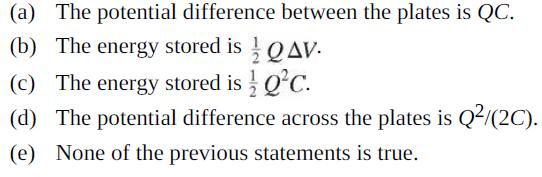
A capacitor has been charged with +Q on one plate and −Q on the other plate. Which of these statements is true? (a) The potential difference between the plates is QC. (b) The energy stored is QAV- (c) The energy stored is Q C. (d) The potential difference across the plates is Q²/(2C). (e) None
A point charge moves to a region of higher potential and yet the electric potential energy decreases. How is this possible?
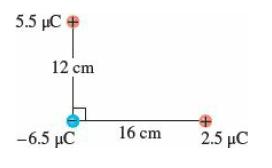
Three point charges are located at the corners of a right triangle as shown in the figure. How much work does it take for an external force to move the charges apart until they are very far away from one another? 5.5 µC 12 cm -6.5 µC 16 cm 2.5 με
Two solid metal spheres of different radii are far apart. The spheres are connected by a fine metal wire. Some charge is placed on one of the spheres. After electrostatic equilibrium is reached, the wire is removed. Which of these quantities will be the same for the two spheres?(a) The charge on
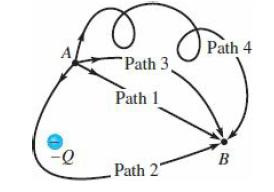
A large negative charge −Q is located in the vicinity of points A and B. Suppose a positive charge +q is moved at constant speed from A to B by an external agent. Along which of the paths shown in the figure will the work done by the field be the greatest?(a) Path 1(b) Path 2(c) Path 3(d)
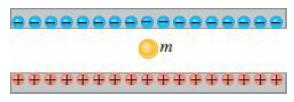
A tiny charged pellet of mass m is suspended at rest between two horizontal, charged metallic plates. The lower plate has a positive charge and the upper plate has a negative charge. Which statement in the answers here is not true?(a) The electric field between the plates points vertically
If E = 0 everywhere throughout a region of space, what do we know is true about the potential at points in that region?
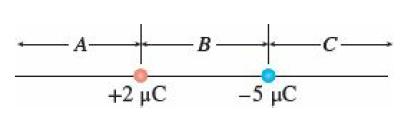
A positive charge +2 μC and a negative charge −5 μC lie on a line. In which region or regions (A, B, C) is there a point on the line a finite distance away where the potential is zero? Explain your reasoning. Are there any points where both the electric field and the potential are zero? + -
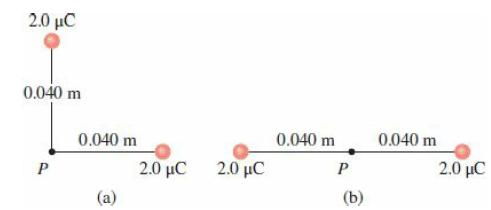
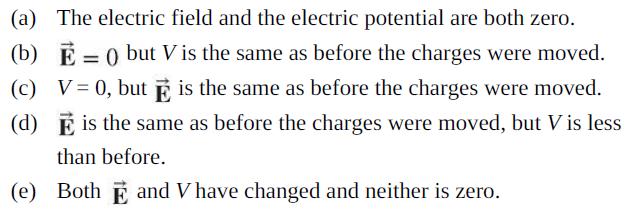
Two positive 2.0 μC point charges are placed as shown in part (a) of the figure. The distance from each charge to the point P is 0.040 m. Then the charges are rearranged as shown in part (b) of the figure. Which statement is now true concerning and V at point P?
If the potential is the same at every point throughout a region of space, is the electric field the same at every point in that region? What can you say about the magnitude of in the region? Explain.
In the diagram, which two points are closest to being at the same potential?(a) A and D(b) B and C(c) B and D(d) A and C
If a uniform electric field exists in a region of space, is the potential the same at all points in the region? Explain.
In the diagram, which point is at the lowest potential?(a) A(b) B(c) C(d) D
When we talk about the potential difference between the plates of a capacitor, shouldn't we really specify two points, one on each plate, and talk about the potential difference between those points? Or doesn't it matter which points we choose? Explain.
During a thunderstorm, some cows gather under a large tree. One cow stands facing directly toward the tree. Another cow stands at about the same distance from the tree, but it faces sideways (tangent to a circle centered on the tree). Which cow do you think is more likely to be killed if lightning
The charge on a capacitor doubles. What happens to its capacitance?
A point charge q = +3.0 nC moves through a potential difference ΔV = Vf − Vi = +25 V. What is the change in the electric potential energy?
If we know the potential at a single point, what (if anything) can we say about the magnitude of the electric field at that same point?
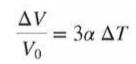
The volume of a solid cube with side s0 at temperature T0 isShow that if Δs ≪ s0, the change in volume ΔV due to a change in temperature ΔT is given byand therefore that β = 3α. (Although we derive this relation for a cube, it applies to a solid of any shape.) Vo = So-
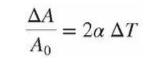
A flat square of side s0 at temperature T0 expands by Δs in both length and width when the temperature increases by ΔT. The original area is s20 and the final area is (s0 + Δs)2 = A. Show that if Δs ≪ s0,(Although we derive this relation for a square plate, it applies to a flat area of
A steel rule is calibrated for measuring lengths at 20.00°C. The rule is used to measure the length of a Vycor glass brick; when both are at 20.00°C, the brick is found to be 25.00 cm long. If the rule and the brick are both at 80.00°C, what would be the length of the brick as measured by the
A steel sphere with radius 1.0010 cm at 22.0°C must slip through a brass ring that has an internal radius of 1.0000 cm at the same temperature. To what temperature must the brass ring be heated so that the sphere, still at 22.0°C, can just slip through?
A copper washer is to be fit in place over a steel bolt. Both pieces of metal are at 20.0°C. If the diameter of the bolt is 1.0000 cm and the inner diameter of the washer is 0.9980 cm, to what temperature must the washer be raised so it will fit over the bolt? Only the copper washer is heated.
Consider the situation described in Problem 18. (a) Take into account the expansion of the glass and calculate how much water will spill out of the glass. Compare your answer with the case where the expansion of the glass was not considered. (b) By what percentage has the answer changed
An ordinary drinking glass is filled to the brim with water (268.4 mL) at 2.0°C and placed on the sunny pool deck for a swimmer to enjoy. If the temperature of the water rises to 32.0°C before the swimmer reaches for the glass, how much water will have spilled over the top of the glass? Assume
A cylindrical brass container with a base of 75.0 cm2 and height of 20.0 cm is filled to the brim with water when the system is at 25.0°C. How much water overflows when the temperature of the water and the container is raised to 95.0°C?
Suppose you have a filling in one of your teeth, and, while eating some ice cream, you suddenly realize that the filling came out. One of the reasons the filling may have become detached from your tooth is the differential contraction of the filling relative to the rest of the tooth due to the
Explain how it is possible that more than half of the molecules in an ideal gas have kinetic energies less than the average kinetic energy. Shouldn't half have less and half have more?
Aluminum rivets used in airplane construction are made slightly too large for the rivet holes to be sure of a tight fit. The rivets are cooled with dry ice (−78.5°C) before they are driven into the holes. If the holes have a diameter of 0.6350 cm at 20.5°C, what should be the diameter of the
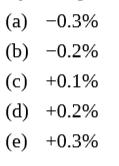
A metal box is heated until each of its sides has expanded by 0.1%. By what percent has the volume of the box changed? (а) -0.3% (b) -0.2% (с) +0.1% (d) +0.2% (е) +0.3%
Why does a helium weather balloon expand as it rises into the air? Assume the temperature remains constant.
A Ping-Pong ball that has been dented during hard play can often be restored by placing it in hot water. Explain why this works.
The mass of an aluminum atom is 27.0 u. What is the mass of one mole of aluminum atoms?
The average kinetic energy of a gas molecule can be found from which of these quantities? (a) Pressure only (b) Number of molecules only (c) Temperature only (d) Pressure and temperature are both required
What are the most favorable conditions for real gases to approach ideal behavior? (a) High temperature and high pressure (b) Low temperature and high pressure (c) Low temperature and low pressure (d) High temperature and low pressure
If the temperature of an ideal gas is doubled and the pressure is held constant, the rms speed of the molecules (a) Remains unchanged. (b) Is 2 times the original speed. (c) Is √2 times the original speed. (d) Is 4 times the original speed.
Why must we use absolute temperature (temperature in kelvins) in the ideal gas law (PV = NkBT)? Explain how using the Celsius scale would give nonsensical results.
Five slabs with temperature coefficients of expansion α have lengths L at Ti = 20°C. Their temperatures then rise to Tf. Rank them in order of how much their lengths increase, greatest to smallest.
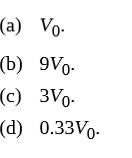
An ideal gas has the volume V0. If the temperature and the pressure are each tripled during a process, the new volume is (а) Vo- (b) 9Vo- (c) 3Vo- (d) 0.33Vo.
The rms speed is the (a) Speed at which all the gas molecules move. (b) Speed of a molecule with the average kinetic energy. (c) Average speed of the gas molecules. (d) Maximum speed of the gas molecules
Which of these increases the average kinetic energy of the molecules in an ideal gas? (a) Reducing the volume, keeping P and N constant (b) Increasing the volume, keeping P and N constant (c) Reducing the volume, keeping T and N constant (d) Increasing the pressure, keeping T
(a) Imagine drawing a circle on the surface of a metal plate. When the temperature increases, what happens to the size of the circle? (b) Instead of drawing a circle, suppose you cut out the circle and then put it back inside the hole in the plate. What would happen to the two pieces when the
The absolute temperature of an ideal gas is directly proportional to (a) The number of molecules in the sample. (b) The average momentum of a molecule of the gas.(c) The average translational kinetic energy of the gas. (d) The diffusion constant of the gas.
Under what special circumstances can kelvins or Celsius degrees be used interchangeably?
The average kinetic energy of the molecules in a sample of an ideal gas increases with the volume remaining constant. Which of these statements must be true? (a) The pressure increases and the temperature stays the same. (b) The number density decreases. (c) The temperature increases
In a mixed gas such as air, the rms speeds of different molecules are (a) Independent of molecular mass. (b) Proportional to molecular mass.(c) Inversely proportional to molecular mass. (d) Proportional to √molecular mass. (e) Inversely proportional to √molecular mass.
(a) Show that since the bulk modulus has SI units N/m2 and mass density has SI units kg/m3, Eq. (12-1) gives the speed of sound in m/s. Thus, the equation is dimensionally consistent. (b) Show that no other combination of B and ρ can give dimensions of speed. Thus, Eq. (12-1) must be correct
A piano “string” is steel wire with radius 0.50 mm and length 1.2 m. It is under 800 N of tension. (a) What is the speed of transverse waves on the string?(b) What is the fundamental frequency for transverse waves?(c) What is the speed of longitudinal waves (i.e., sound) in the wire?
The A string on a guitar has length 64.0 cm and fundamental frequency 110.0 Hz. The string's tension is 133 N. It is vibrating in its fundamental standing wave mode with a maximum displacement from equilibrium of 2.30 mm. The air temperature is 20.0°C. (a) What is the wavelength of the
A 30.0 cm long string has a mass of 0.230 g and is vibrating at its third-lowest natural frequency f3. The tension in the string is 7.00 N. (a) What is f3? (b) What are the frequency and wavelength of the sound in the surrounding air if the speed of sound is 350 m/s?
Bats of the Vespertilionidae family detect the distance to an object by timing how long it takes for an emitted signal to reflect off the object and return. Typically they emit sound pulses 3 ms long and 70 ms apart while cruising. (a) If an echo is heard 60 ms later (vsound = 331 m/s), how
At what frequency/does a sound wave in air have a wavelength of 15 cm, about half the diameter of the human head? Some methods of localization work well only for frequencies below f, whereas others work well only above f.
Kyle is climbing a sailboat mast and is 5.00 m above the surface of the ocean, while his friend Rob is scuba diving below the boat. Kyle shouts to someone on another boat and Rob hears him shout 0.0210 s later. The ocean temperature is 25°C and the air is at 20°C. How deep is Rob below the boat?
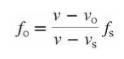
Akiko rides her bike toward a brick wall with a speed of 7.00 m/s while blowing a whistle that is emitting sound with a frequency of 512.0 Hz. (a) What is the frequency of the sound that is reflected from the wall as heard by Haruki, who is standing still? (b) Junichi is walking away from
An aluminum rod, 1.0 m long, is held lightly in the middle. One end is struck head-on with a rubber mallet so that a longitudinal pulse —a sound wave—travels down the rod. The fundamental frequency of the longitudinal vibration is 2.55 kHz. (a) Describe the locations of the displacement
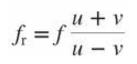
Blood flow rates can be found by measuring the Doppler shift in frequency of ultrasound reflected by red blood cells (known as angiodynography). If the speed of the red blood cells is v, the speed of sound in blood is u, the ultrasound source emits waves of frequency f, and we assume that the blood
(a) In Problem 49, find the beat frequency between the outgoing and reflected sound waves. (b) Show that the beat frequency is proportional to the speed of the blood cell if v ≪ u. [Hint: Use the binomial approximation from Appendix A.9.]Data From Problem 49Blood flow rates can be found by
The bat of Problem 55 emits a chirp that lasts for 2.0 ms and then is silent while it listens for the echo. If the beginning of the echo returns just after the outgoing chirp is finished, how close to the moth is the bat?Data From Problem 55A bat emits chirping sounds of frequency 82.0 kHz while
A bat emits chirping sounds of frequency 82.0 kHz while hunting for moths to eat. If the bat is flying toward the moth at a speed of 4.40 m/s and the moth is flying away from the bat at 1.20 m/s, what is the frequency of the sound wave reflected from the moth as observed by the bat? Assume it is a
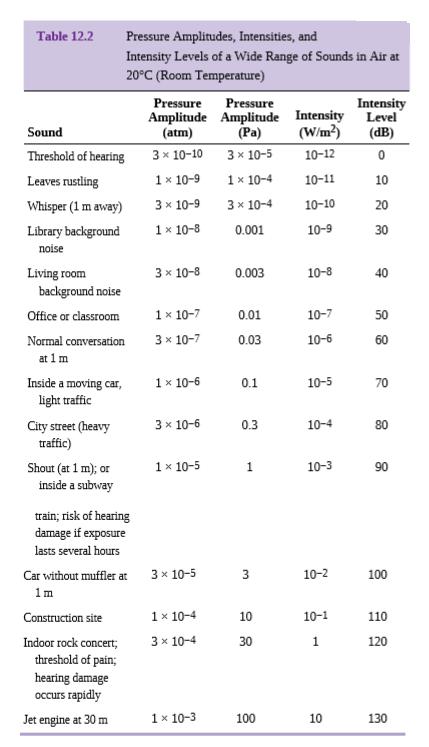
Table 12.2 lists 120 dB as the intensity level at the threshold of pain for humans. (a) Show that the corresponding pressure amplitude is 29 Pa. (b) What is this pressure amplitude as a fraction of atmospheric pressure? Table 12.2 Pressure Amplitudes, Intensities, and Intensity Levels of
A speedboat is traveling at 20.1 m/s toward another boat moving in the opposite direction with a speed of 15.6 m/s. The speedboat pilot sounds his horn, which has a frequency of 312 Hz. What is the frequency heard by a passenger in the oncoming boat?
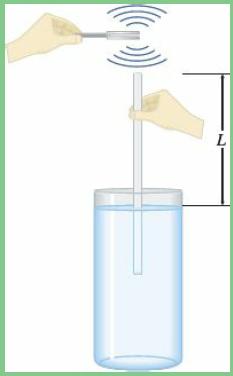
When a tuning fork is held over the open end of a very thin tube, as in Fig. 12.7, the smallest value of L that produces resonance is found to be 30.0 cm. (a) What is the wavelength of the sound? (b) What is the next larger value of L that will produce resonance with the same tuning
At a factory, a noon whistle is sounding with a frequency of 500 Hz. As a car traveling at 85 km/h approaches the factory, the driver hears the whistle at frequency fi. After driving past the factory, the driver hears frequency ff. What is the change in frequency ff − fi heard by the driver?
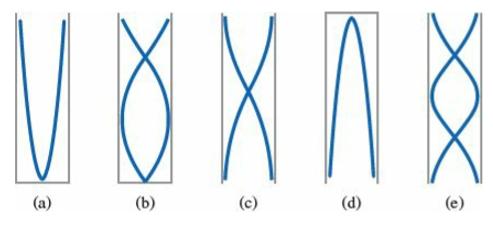
The figure shows standing wave patterns in five pipes of equal length. Pipes (c) and (e) are open at both ends; the others are closed at one end. Rank the standing waves in order of the frequency, largest to smallest. (а) (b) (с) (а) (e)
A musician plays a string on a guitar that has a fundamental frequency of 330.0 Hz. The string is 65.5 cm long and has a mass of 0.300 g. (a) At what speed do the waves travel on the string? (b) What is the tension in the string? (c) While the guitar string is still being plucked,
Six sound waves have pressure amplitudes p0 and frequencies f as given. Rank them in order of the displacement amplitude, largest to smallest. (a) Po = 0.05 Pa, f = 400 Hz (b) Po = 0.01 Pa, f = 400 Hz (c) Po = 0.01 Pa, f= 2000 Hz (d) Po = 0.05 Pa, f = 80 Hz (e) po = 0.05 Pa, f = 16 Hz (f) Po = 0.25
A glass tube is closed at one end and has a diaphragm covering the other end. The tube is filled with gas and some very fine sawdust has been scattered along inside the tube. When the diaphragm is driven at a frequency of 1457 Hz, the sawdust forms small piles 20 cm apart.(a) What is the speed of
A sound wave in room-temperature air has an intensity level of 65.0 dB and a frequency of 131 Hz. (a) What is the pressure amplitude?(b) What is the displacement amplitude?
A moving source emits a sound wave that is heard by a moving observer. Imagine a thin wall at rest between the source and observer. The wall completely absorbs the sound and instantaneously emits an identical sound wave. Use this scenario to explain why we can combine the Doppler shifts due to
Chronic exposure to loud noises can be damaging to one's hearing. This can be a problem in occupations in which heavy machinery is used. If a machine produces sound with an intensity level of 100.0 dB, what would its intensity level have to be to reduce the intensity by a factor of 2.0?
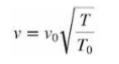
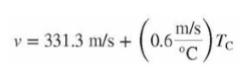
Derive Eq. (12-5): (a) Starting with Eq. (12-4), substitute T = TC + 273.15. (b) Apply the binomial approximation to the square root (see Appendix A.9) and simplify. T v = vo1 To
A 40 Hz sound wave is barely audible at a sound intensity level of 60 dB. What is the displacement amplitude of this sound wave? Compare it with the average distance between molecules in air at room temperature, about 3 nm.
Showing 800 - 900
of 1578
First
2
3
4
5
6
7
8
9
10
11
12
13
14
15
16
Step by Step Answers

 Get 50% OFF
Claim Now
Get 50% OFF
Claim Now