New Semester
Started
Get
50% OFF
Study Help!
--h --m --s
Claim Now
Question Answers
Textbooks
Find textbooks, questions and answers
Oops, something went wrong!
Change your search query and then try again
S
Books
FREE
Study Help
Expert Questions
Accounting
General Management
Mathematics
Finance
Organizational Behaviour
Law
Physics
Operating System
Management Leadership
Sociology
Programming
Marketing
Database
Computer Network
Economics
Textbooks Solutions
Accounting
Managerial Accounting
Management Leadership
Cost Accounting
Statistics
Business Law
Corporate Finance
Finance
Economics
Auditing
Tutors
Online Tutors
Find a Tutor
Hire a Tutor
Become a Tutor
AI Tutor
AI Study Planner
NEW
Sell Books
Search
Search
Sign In
Register
study help
sciences
college physics with an integrated approach
College Physics With An Integrated Approach To Forces And Kinematics 5th Edition Alan Giambattista - Solutions
If the trajectory is parabolic in one reference frame, is it always, never, or sometimes parabolic in another reference frame that moves at constant velocity with respect to the first reference frame? If the trajectory can be other than parabolic, what else can it be?
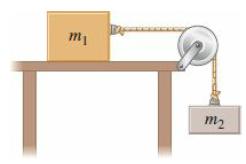
A woman stands on a bathroom scale in an elevator that is not moving. The scale reads 500 N. The elevator then moves downward at a constant velocity of 4.5 m/s. What does the scale read while the elevator descends with constant velocity?(a) 100 N(b) 250 N(c) n450 N(d) 500 N(e) 750 N m1 m2
A typical sneeze expels material at a maximum speed of 44 m/s. Suppose the material begins inside the nose at rest, 2.0 cm from the nostrils. It has a constant acceleration for the first 0.25 cm and then moves at constant velocity for the remainder of the distance. (a) What is the acceleration
A car is speeding up and has an instantaneous velocity of 1.0 m/s in the +x-direction when a stopwatch reads 10.0 s. It has a constant acceleration of 2.0 m/s2 in the +x-direction. (a) What is the speed when the stopwatch reads 12.0 s? (b) How far does the car move between t = 10.0 s and
A small plane climbs with a constant velocity of 250 m/s at an angle of 28° with respect to the horizontal. Which statement is true concerning the magnitude of the net force on the plane?(a) It is equal to zero.(b) It is equal to the weight of the plane.(c) It is equal to the magnitude of the
A thin string that can withstand a tension of 35.0 N, but breaks under any larger tension, is attached to the ceiling of an elevator. How large a mass can be attached to the string if the initial acceleration as the elevator starts to ascend is 3.20 m/s2?(a) 3.57 kg(b) 2.69 kg(c) 4.26 kg(d) 2.96
What force(s) act on a parachutist descending to Earth with a constant velocity? What is the acceleration of the parachutist?
A person stands on the roof garden of a tall building with one ball in each hand. If the red ball is thrown horizontally off the roof and the blue ball is simultaneously dropped over the edge, which statement is true?(a) Both balls hit the ground at the same time, but the red ball has a higher
What does it mean when we refer to a cord as an “ideal cord” and a pulley as an “ideal pulley”?
A pilot without special training or equipment can tolerate a horizontal acceleration of up to about 9g for a short period of time (about a minute) without losing consciousness. (a) How long would it take a supersonic jet in horizontal flight to accelerate from 200 m/s to 700 m/s at an
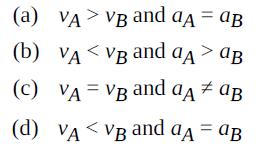
A ball is thrown into the air and follows a parabolic trajectory. Point A is the highest point in the trajectory and B is a point as the ball is falling back to the ground. Choose the correct relationship between the speeds and the magnitudes of the acceleration at the two points. VA = VB and aa ±
An object is placed on a scale. Under what conditions does the scale read something other than the object's weight, even though the scale is functioning properly and is calibrated correctly? Explain.
A ball is thrown into the air and follows a parabolic trajectory. At the highest point in the trajectory,(a) The velocity is zero, but the acceleration is not zero.(b) Both the velocity and the acceleration are zero.(c) The acceleration is zero, but the velocity is not zero.(d) Neither the
Why does a 1 kg sandbag fall with the same acceleration as a 5 kg sandbag? Explain in terms of Newton's second law and his law of gravitation.
Two balls, identical except for color, are projected horizontally from the roof of a tall building at the same instant. The initial speed of the red ball is twice the initial speed of the blue ball. Ignoring air resistance,(a) The red ball reaches the ground first.(b) The blue ball reaches the
A kicker kicks a football from the 5 yard line to the 45 yard line (both on the same half of the field). Ignoring air resistance, where along the trajectory is the speed of the football a minimum?(a) At the 5 yard line, just after the football leaves the kicker's foot(b) At the 45 yard line, just
Four objects move to the right with constant acceleration. Rank the motion diagrams in order of the magnitude of the acceleration, from greatest to least. The time interval between dots is the same in each diagram. (а) (b) (с) (d)
A ball is thrown straight up into the air. Ignore air resistance. While the ball is in the air, its acceleration (a) Increases.is zero.(b) Remains constant.(c) Decreases on the way up and increases on the way down.(d) Changes direction.
A leopard starts from rest at t = 0 and runs in a straight line with a constant acceleration until t = 3.0 s. The distance covered by the leopard between t = 1.0 s and t = 2.0 s is the (a) Same as the distance covered during the first second.(b) Twice the distance covered during the
Anthony is going to drive a flat-bed truck up a hill that makes an angle of 10° with respect to the horizontal direction. A 36.0 kg package sits in the back of the truck. The coefficient of static friction between the package and the truck bed is 0.380. What is the maximum acceleration the truck
Paula swims across a river that is 10.2 m wide. She can swim at 0.833 m/s in still water, but the river flows with a speed of 1.43 m/s. If Paula swims in such a way that she crosses the river in as short a time as possible, how far downstream is she when she gets to the opposite shore?
Harrison traveled 2.00 km west, then 5.00 km in a direction 53.0° south of west, then 1.00 km in a direction 60.0° north of west. (a) In what direction, and for how far, should Harrison travel to return to his starting point? (b) If Harrison returns directly to his starting point with a
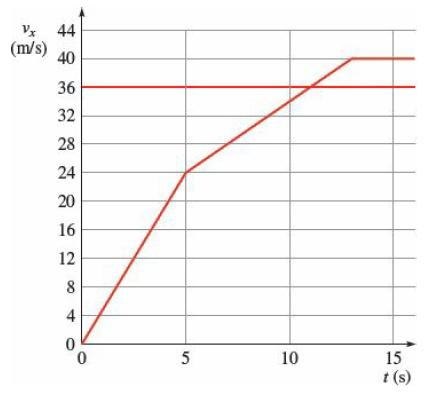
A motorcycle is speeding on a straight, level highway at constant speed. At t = 0, the motorcycle passes a police car that is initially at rest. The officer gives chase, but the motorcyclist doesn’t notice and keeps moving at constant speed. The graph below shows vx(t) for both. (a) When are
A sample in a centrifuge moves in a circle of radius 8.0 cm at a constant speed of 500 m/s. (a) How much time does it take for the velocity’s direction to change by 45° (1/8 of a revolution)? (b) What is the magnitude of the average acceleration during that time?
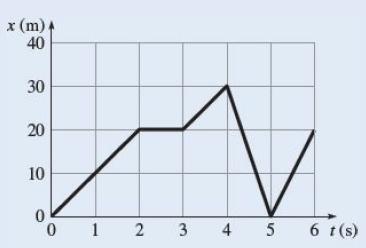
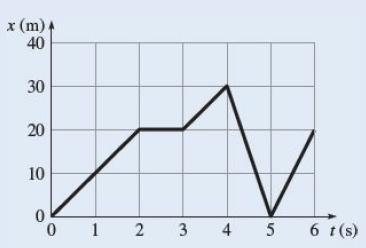
How far does the object move from t = 0 to t = 3 s?A bicycle is moving along a straight line. The graph shows its position from the starting point as a function of time. Consider the 1 s time intervals 0–1 s, 1–2 s, and so on. x (m). 40 30 20 10 1 2 3 4 5 6 t(s)
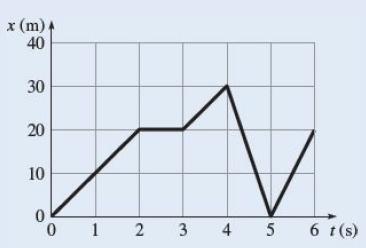
Rank the time intervals in order of decreasing velocity vx, from largest positive to largest negative.A bicycle is moving along a straight line. The graph shows its position from the starting point as a function of time. Consider the 1 s time intervals 0–1 s, 1–2 s, and so on. x
To pass a physical fitness test, Marcella must run 1.00 km at an average speed of 3.33 m/s. She runs the first 0.500 km at an average of 4.20 m/s. What should be her average speed over the remaining 0.500 km in order to finish with an overall average speed of 4.00 m/s?
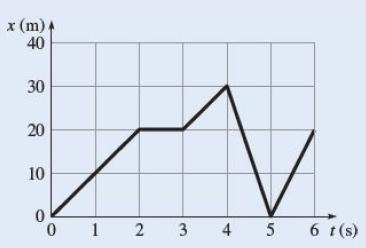
Rank the time intervals in order of increasing speed.A bicycle is moving along a straight line. The graph shows its position from the starting point as a function of time. Consider the 1 s time intervals 0–1 s, 1–2 s, and so on. x (m). 40 30 20 10 1 2 3 4 5 6 t(s)
Rank the time intervals in order of increasing displacement, from largest negative to largest positive.A bicycle is moving along a straight line. The graph shows its position from the starting point as a function of time. Consider the 1 s time intervals 0–1 s, 1–2 s, and so on. x
Fish don’t move as fast as you might think. A small trout has a top swimming speed of only about 2 m/s, which is about the speed of a brisk walk (for a human, not a fish!). It may seem to move faster because it is capable of large accelerations—it can dart about, changing its speed or direction
(a) If a freestyle swimmer travels 1.50 km in a time of 14 min 53 s, how fast is his average speed? (b) If the pool is rectangular and 50 m in length, how does the speed you found compare with his sustained swimming speed of 1.54 m/s during one length of the pool after he has been swimming for
Samantha goes kayaking on a straight river. After she has paddled upstream for a while, she realizes she dropped a lifejacket overboard when she launched so she turns around and paddles downstream to retrieve it. The lifejacket has been drifting along with the current the whole time, but eventually
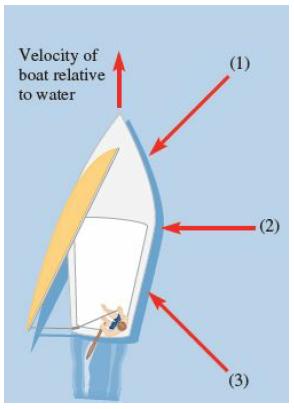
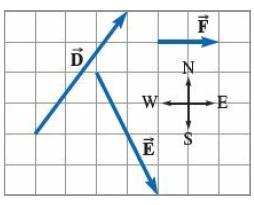
One of the tricky things about learning to sail is distinguishing the “true wind” from the “apparent wind.” The true wind is the velocity of the air relative to the water, whereas the apparent wind is the velocity of the air relative to the sailboat. The figure shows three different
A spotter plane sees a school of tuna swimming at a steady 5.00 km/h northwest. The pilot informs a fishing trawler, which is just then 100.0 km due south of the fish. The trawler sails along a straight-line course and intercepts the tuna after 4.0 h. How fast did the trawler move?
Beatrice needs to drag her suitcase again. This time she pulls with a force of 105 N at 38.0° with the horizontal. The coefficients of static and kinetic friction between the suitcase and the floor are 0.273 and 0.117, respectively. (a) Draw an FBD of the suitcase. (b) What is the
In a plate glass factory, sheets of glass move along a conveyor belt at a speed of 15.0 cm/s. An automatic cutting tool descends at preset intervals to cut the glass to size. Since the assembly belt must keep moving at constant speed, the cutter is set to cut at an angle to compensate for the
A small plane is flying directly west with an airspeed of 30.0 m/s. The plane flies into a region where the wind is blowing at 10.0 m/s at an angle of 30° to the south of west. (a) If the pilot does not change the heading of the plane, what will be the ground speed of the airplane? (b)
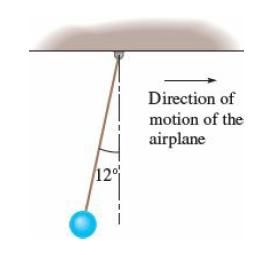
An accelerometer—a device to measure acceleration—can be as simple as a small pendulum hanging in an airplane cockpit. An essentially similar accelerometer is found in the inner ear of vertebrates. Suppose you are flying a small plane in a straight, horizontal line and your accelerometer hangs
An airplane has a velocity relative to the ground of 210 m/s toward the east. The pilot measures his airspeed (the speed of the plane relative to the air) to be 160 m/s. What is the minimum wind velocity possible?
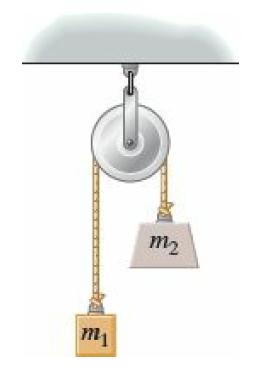
In Fig. 3.39, two blocks are connected by a lightweight cord that does not stretch and that passes over an ideal pulley. (a) If m1 = 3.0 kg and m2 = 5.0 kg, what are the accelerations of each block? (b) What is the tension in the cord? m2
While an elevator of mass 2530 kg moves upward, the tension in the cable is 33.6 kN. (a) What is the acceleration of the elevator?(b) If at some point in the motion the velocity of the elevator is 1.20 m/s upward, what is the elevator’s velocity 4.00 s later?
A 2010 kg elevator moves with a downward acceleration of 1.50 m/s2. What is the tension in the cable that supports the elevator?Assume the elevator is supported by a single cable. Forces exerted by the guide rails and air resistance are negligible.
A 2010 kg elevator moves with an upward acceleration of 1.50 m/s2. What is the tension in the cable that supports the elevator?Assume the elevator is supported by a single cable. Forces exerted by the guide rails and air resistance are negligible.
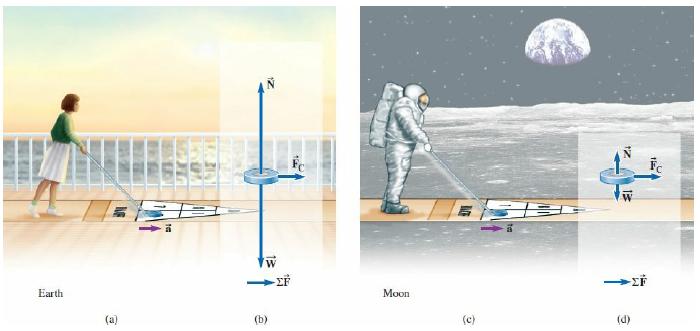
In Fig. 3.30 an astronaut is playing shuffleboard on Earth. The puck has a mass of 2.0 kg. Between the board and puck the coefficient of static friction is 0.35 and that of kinetic friction is 0.25.(a) If she pushes the puck with a force of 5.0 N in the forward direction, does the puck
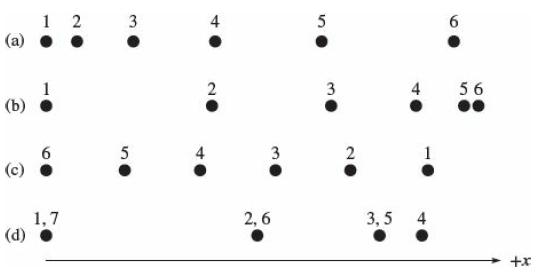
In each motion diagram, the dots are labeled with the “frame” number (frame 1 is the first position of the object). Choose the x-axis pointing to the right. For each diagram, sketch graphs of x(t), vx(t), and ax(t) and describe the motion in words. What is the direction of the net force in each
Five objects all start from rest at t = 0. Each is pushed to the right by a constant net force. Rank the objects according to their speeds at the instants of time indicated, from largest to smallest. (a) Mass m, net force F; speed at time t1; (b) Mass 2m, net force 2F; speed at time
In a binary star system, two stars orbit their common center of mass.In one such system, star A has 4.0 times the mass of star B. (a) Draw and label vector arrows for the gravitational forces that each star exerts on the other, showing how their directions and magnitudes are related. (b)
Draw a motion diagram and sketch graphs of x(t), vx(t), and ax(t) for a sprinter running a short race on a straight track, from just before the start of the race until the sprinter has stopped after finishing the race. Sketch FBDs for the runner while speeding up, while running at constant speed,
An automobile is traveling along a straight road to the southeast at 24 m/s when the driver sees a deer begin to cross the road ahead of her. She steps on the brake and brings the car to a complete stop in an elapsed time of 8.0 s. A data recording device, triggered by the sudden braking action,
A tennis ball (mass 57.0 g) moves toward the player’s racquet at 47.5 m/s. It is in contact with the racquet for 3.60 ms, after which it moves in the opposite direction at 50.2 m/s. What is the average force on the ball due to the racquet?
A 1200 kg airplane starts from rest and, with a constant acceleration of magnitude 5.0 m/s2, reaches its takeoff speed in 9.00 s. (a) What is the magnitude of the net force on the airplane during this time interval? (b) Assume that when the plane is just reaching its takeoff speed the
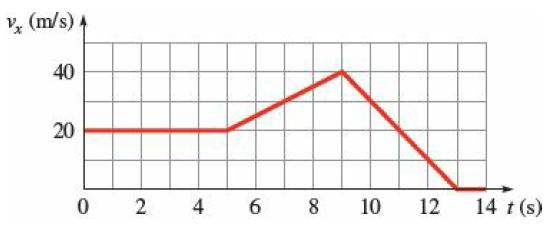
The graph shows vx versus t for an object moving along the x-axis. (a) What is ax at t = 11 s? (b) What is ax at t = 3 s? (c) Sketch a graph of ax(t). (d) How far does the object travel from t = 12 s to t = 14 s? V, (m/s) 40 20 0 2 4 6 8 10 12 14 t (s)
An 1100 kg airplane starts from rest and accelerates horizontally forward for 8.0 s until it reaches its takeoff speed of 35 m/s. What is the average net force on the airplane during this time?
The graph with Problem 24 shows vx(t) for a skateboard moving along the x-axis. Rank the times t = 0.5 s, 1.5 s, 2.5 s, 3.5 s, 4.5 s, and 5.5 s, in order of the magnitude of the acceleration, from largest to smallest.
If a car (mass 1200 kg) traveling at 28 m/s is brought to a full stop in 4.0 s after the brakes are applied, find the average frictional force exerted on the car.
(a) One of the fastest land animals of North America is the pronghorn antelope. (a) If a pronghorn antelope accelerates from rest in a straight line with a constant acceleration of 1.7 m/s2, how much time does it take for the antelope to reach a speed of 22 m/s? (b) The total frictional force
A sailor climbs the mast in a bosun’s chair to make an emergency repair while the boat is moving forward at a steady 3.0 m/s (5.8 knots). At the top of the mast, he drops his wrench. If air resistance is negligible, the wrench lands on the deck(a) Significantly in front of the mast.(b)
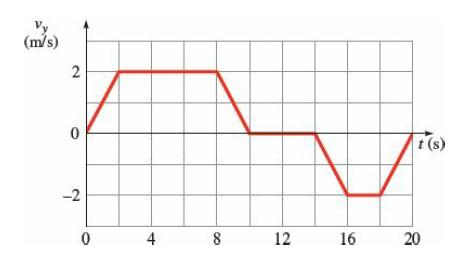
A graph is plotted of the vertical velocity component vy of an elevator versus time. The y-axis points up. (a) How high is the elevator above the starting point (t = 0) after 20 s have elapsed? (b) When is the elevator at its highest location above the starting point?(c) Describe the
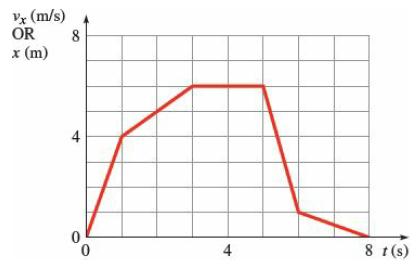
The graph shows vx in meters per second versus t in seconds for a skateboard moving along the x-axis. How far does the board move between t = 3.00 s and t = 8.00 s? Sketch a motion diagram and a graph of x(t) for the same time interval. Vx (m/s) OR 8 x (m) 4 4 8 t(s)
The graph shows x(t) for an object traveling along the x-axis. Plot vx as a function of time for this object from t = 0 to t = 8 s.
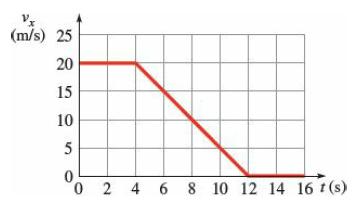
Speedometer readings are obtained and graphed as a car skids to a stop along a straight-line path. How far does the car move between t = 0 and t = 16 s? Sketch a motion diagram showing the position of the car at 2 s intervals and sketch a graph of x(t). (m/s) 25 20 15 10 5 0 2 4 6 8 10 12 14 16 t
A boy plans to cross a river in a rubber raft. The current flows from north to south at 1 m/s. In what direction should he head to get across the river to the east bank in the least amount of time if he is able to paddle the raft at 1.5 m/s in still water?(a) Directly to the east(b) South of
A boy plans to paddle a rubber raft across a river to the east bank while the current flows down river from north to south at 1 m/s. He is able to paddle the raft at 1.5 m/s in still water. In what direction should he head the raft to go straight east across the river to the opposite bank?(a)
Give a real example of the motion of some object for which: (a) The velocity and net force are in the same direction; (b) The velocity and net force are in opposite directions; (c) The velocity is nonzero and the net force is zero; (d) The velocity and net force are not along
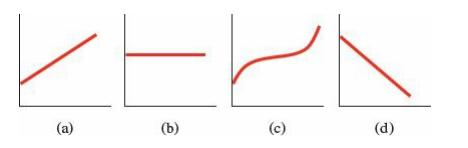
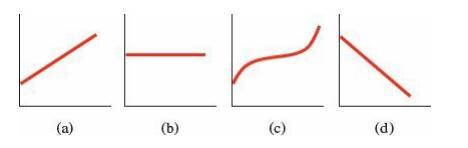
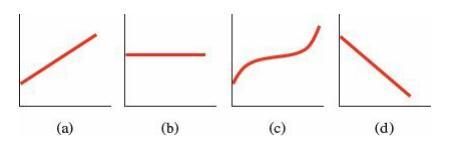
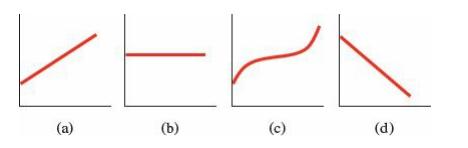
The four graphs show vx versus time. Which graph shows a changing ax that is always positive?
While you are supervising playground activity during recess, the children are playing a game of tag. As Marlene and Shelly run past each other in opposite directions, Marlene reaches out and touches the shiny logo on Shelly’s jacket. Shelly starts to cry and says that Marlene poked her really
Two cars, a Porsche Boxster convertible and a Toyota Scion xB, are traveling at constant speeds in the same direction, although the Boxster is 186 m behind the Scion. The speed of the Boxster is 24.4 m/s and the speed of the Scion is 18.6 m/s. Sketch graphs of x(t) for the two cars on the same
The four graphs show vx versus time. Which graph shows ax constant and negative? (a) (b) (d)
You are given the task of designing a mechanism to trip a switch in an automobile seat belt, causing it to tighten in case of an accident. You decide that if the velocity of the car is high and constant the passenger is in no danger; it is only high acceleration that matters. Explain.
Jason drives due west with a speed of 35.0 mi/h for 30.0 min, continues in the same direction with a speed of 60.0 mi/h for 2.00 h, and then drives farther west at 25.0 mi/h for 10.0 min. What is Jason’s average velocity? Sketch a motion diagram at 10 min intervals.
The four graphs show vx versus time. Which graph shows ax constant and positive? (a) (b) (d)
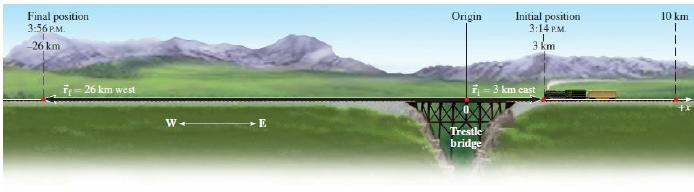
For the train in Fig. 3.2 and Example 3.3, find the average velocity between 3:14 P.M. when the train is at 3 km east of the origin and 3:28 P.M. when it is 10 km east of the origin.In Figure 3.2 Final position 3:56 P.M. 26 km Origin Initial position 3:14 P.M. 10 km 3 km T=26 km west = 3 km
An object is subjected to two constant forces that are perpendicular to each other. Can a set of x- and y-axes be chosen so that the acceleration of the object has only one nonzero component? If so, how? Explain.
The four graphs show vx versus time. Which graph shows a constant velocity? (a) (b) (P)
Refer to Conceptual Question 17 in Chapter 2. A heavy lead ball hangs from a string attached to a sturdy wooden frame. A second string is attached to a hook on the bottom of the lead ball. In Chapter 2, you imagined pulling slowly and steadily on the lower string and found that the upper string
Repeat Problem 8 using the component (algebraic) method.A scout troop is practicing its orienteering skills with map and compass. First they walk due east for 1.2 km. Next, they walk 45° west of north for 2.7 km. In what direction must they walk to go directly back to their starting point? How far
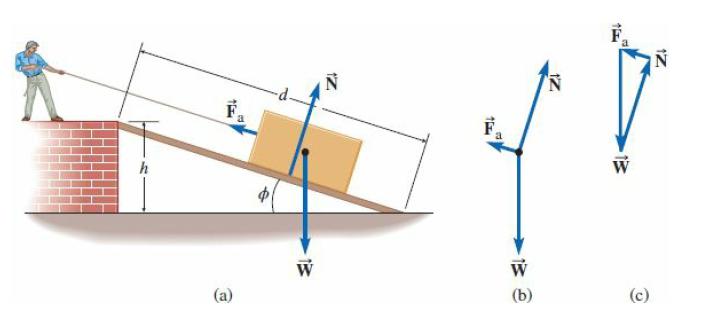
Mechanical advantage is the ratio of the force required without the use of a simple machine to that needed when using the simple machine. Compare the force to lift an object with that needed to slide the same object up a frictionless incline and show that the mechanical advantage of the inclined
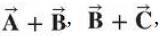
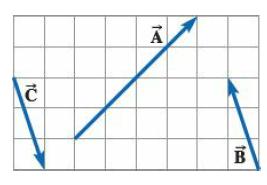
Rank, in order of increasing x-component, and in Problem 4. The x-axis points to the right. Explain your reasoning. A + B B + C.
Crate of potatoes of mass 18.0 kg is on a ramp with angle of incline 30° to the horizontal. The coefficients of friction are μs = 0.75 and μk = 0.40. Find the normal force (magnitude) and the frictional force (magnitude and direction) on the crate if The crate is sliding up the
With the y-axis pointing north, rank vectors and F(vector) in Problem 8 in order of increasing y-component. Explain your reasoning. D, E-
A study was done observing the ability of the eye to rapidly rotate in order to follow a moving object by placing contact lenses that contain accelerometers on a subject’s eye. The eyeball has radius 1.25 cm. Suppose that, while the subject watches a moving object, the eyeball rotates through
A “blink of an eye” is a time interval of about 150 ms for an average adult. The “closure” portion of the blink takes only about 55 ms. Let us model the closure of the upper eyelid as uniform angularacceleration through an angular displacement of 15°. (a) What is the value of the
A clothes washer reaches an angular speed of 1400 rev/min in 2.0 s, starting from rest, during the spin cycle. (a) Assuming the angular acceleration is constant, what is its magnitude? (b) How many revolutions does the washer make during this time interval?
A hamster of mass 0.100 kg gets into its exercise wheel and starts to run at t = 0. After t = 0.800 s, the wheel turns with a constant rotational frequency of 1.00 Hz. What is the tangential acceleration of the inner surface of the wheel between t = 0 and t = 0.800 s, assuming it is constant? The
A pendulum is 0.80 m long, and the bob has a mass of 1.0 kg. At the bottom of its swing, the bob’s speed is 1.6 m/s. (a) What is the tension in the string at the bottom of the swing? (b) Explain why the tension is greater than the weight of the bob.
The orbital speed of Earth about the Sun is 3.0 × 10⁴ m/s and its distance from the Sun is 1.5 × 10¹¹ m. The mass of Earth is approximately 6.0 × 1024 kg and that of the Sun is 2.0 × 1030 kg. What is the magnitude of the force exerted by the Sun on Earth?
A curve in a stretch of highway has radius 610 m. The road is banked at angle 5.8° to the horizontal. The coefficient of static friction between the tires and road is 0.50. What is the fastest speed that a car can travel through the curve without skidding?
A road with a radius of 75.0 m is banked so that a car can navigate the curve at a speed of 15.0 m/s without any friction. On a cold day when the street is icy, the coefficient of static friction between the tires and the road is 0.120. What is the slowest speed the car can go around this curve
A roller coaster car of mass 320 kg (including passengers) travels around a horizontal curve of radius 35 m. Its speed is 16 m/s. (a) What are the magnitude and direction of the total force exerted on the car by the track? (b) What is the banking angle of the track if the frictional force
Medical testing has established that the maximum acceleration a pilot can be subjected to without losing consciousness is approximately 5.0g if the axis of acceleration is aligned with the spine. A pilot can avoid “blackout” at accelerations up to approximately 9.0g by wearing special
Rank the flywheels of Problems 11 and 12 in order of the radial acceleration of a point on the rim, largest to smallest.Five flywheels are spinning as follows: (a) Radius 8.0 cm, period 4.0 ms; (b) Radius 2.0 cm, period 4.0 ms; (c) Radius 8.0 cm, period 1.0 ms; (d) Radius 2.0
Rank the flywheels in order of the linear speed at the rim, largest to smallest. Explain.Five flywheels are spinning as follows: (a) Radius 8.0 cm, period 4.0 ms; (b) Radius 2.0 cm, period 4.0 ms; (c) Radius 8.0 cm, period 1.0 ms; (d) Radius 2.0 cm, period 1.0 ms; (e)
An astronaut is out in space far from any large bodies. He uses his jets to start spinning, then releases a baseball he has been holding in his hand. Ignoring the gravitational force between the astronaut and the baseball, how would you describe the path of the baseball after it leaves the
Rank the flywheels in order of angular speed, largest to smallest. Explain.Five flywheels are spinning as follows: (a) Radius 8.0 cm, period 4.0 ms; (b) Radius 2.0 cm, period 4.0 ms; (c) Radius 8.0 cm, period 1.0 ms; (d) Radius 2.0 cm, period 1.0 ms; (e) Radius 1.0 cm,
An object is in nonuniform circular motion with constant angular acceleration. Identify the correct statement(s).(1) Its acceleration is constant.(2) Its radial acceleration component is constant in magnitude.(3) Its tangential acceleration component is constant in magnitude.
An object is in uniform circular motion. Identify the correct statement(s).(a) 1 only(b) 2 only(c) 3 only(d) 1, 2, and 3(e) 2 and 3(f) 1 and 2(g) 1 and 3(h) None of them.(1) Its acceleration is constant.(2) Its radial acceleration component is constant in magnitude.(3) Its tangential acceleration
In aviation, a standard rate turn proceeds at an angular speed of 180° per minute. What is the radius of a standard rate turn for a plane moving at 240 m/s?
When is the tension in the rope the greatest?A boy swings in a tire swing. Answer choices:(a) At the highest point of the motion(b) At the lowest point of the motion(c) At a point neither highest nor lowest(d) It is constant.
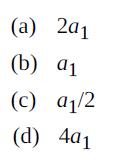
Two satellites are in orbit around Mars with the same orbital radius. Satellite 2 has twice the mass of satellite 1. The radial acceleration of satellite 1 has magnitude a1. The radial acceleration of satellite 2 has magnitude (а) 2а1 (b) a1 a1/2 (d) 4а1
Dung beetles are renowned for building large (relative to their body size) balls of dung and rolling them on the ground.(a) If a dung beetle can roll (without slipping) a ball of dung whose radius is 2.5 cm at a linear speed of 3.5 cm/s, through what angle does the ball roll as the ball moves a
Showing 1300 - 1400
of 1578
First
2
3
4
5
6
7
8
9
10
11
12
13
14
15
16
Step by Step Answers

 Get 50% OFF
Claim Now
Get 50% OFF
Claim Now