New Semester
Started
Get
50% OFF
Study Help!
--h --m --s
Claim Now
Question Answers
Textbooks
Find textbooks, questions and answers
Oops, something went wrong!
Change your search query and then try again
S
Books
FREE
Study Help
Expert Questions
Accounting
General Management
Mathematics
Finance
Organizational Behaviour
Law
Physics
Operating System
Management Leadership
Sociology
Programming
Marketing
Database
Computer Network
Economics
Textbooks Solutions
Accounting
Managerial Accounting
Management Leadership
Cost Accounting
Statistics
Business Law
Corporate Finance
Finance
Economics
Auditing
Tutors
Online Tutors
Find a Tutor
Hire a Tutor
Become a Tutor
AI Tutor
AI Study Planner
NEW
Sell Books
Search
Search
Sign In
Register
study help
sciences
college physics with an integrated approach
College Physics With An Integrated Approach To Forces And Kinematics 5th Edition Alan Giambattista - Solutions
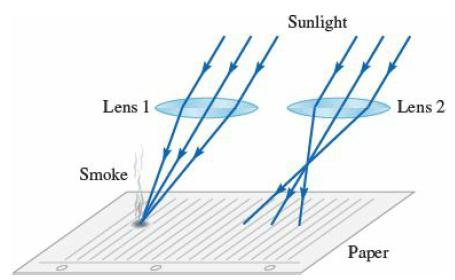
Two converging lenses, of the same size and shape, are held in sunlight, the same distance above a sheet of paper. The figure shows the paths of some rays through the two lenses. Which lens is made of material with a higher index of refraction? How do you know?(a) Lens 1, because its focal length
A spherical wave (from a point source) reflects from a planar surface. Draw a ray diagram and sketch some wavefronts for the reflected wave.
A man runs toward a plane mirror at 5 m/s and the mirror, on rollers, simultaneously approaches him at 2 m/s. What is the speed at which his image moves relative to the ground?(a) 14 m/s(b) 7 m/s(c) 3 m/s(d) 9 m/s(e) 12 m/s
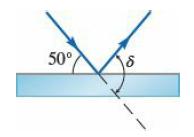
A light ray reflects from a plane mirror as shown in the figure. What is the angle of deviation δ? 50° ဝ်
A ray of light passes from air into water, striking the surface of the water with an angle of incidence of 45°. Which of these quantities change as the light enters the water: wavelength, frequency, speed of propagation, direction of propagation?
Which of these statements correctly describe the images formed by an object placed before a single thin lens?1. Real images are always enlarged.2. Real images are always inverted.3. Virtual images are always upright.4. Converging lenses never produce virtual images.(a) 1 and 3(b) 2 and 3(c) 2 and
A point source of light is placed at the focal point of a converging lens; the rays of light coming out of the lens are parallel to the principal axis. Now suppose the source is moved closer to the lens but still on the axis. Which statement is true about the light rays coming out of the lens?(a)
A concave mirror has focal length f.(a) If you look into the mirror from a distance less than f, is the image you see upright or inverted? (b) If you stand at a distance greater than 2f, is the image upright or inverted? (c) If you stand at a distance between f and 2f, an image is formed
Light reflected from horizontal surfaces of lakes, roads, and automobile hoods is(a) Partially polarized in the horizontal direction.(b) Partially polarized in the vertical direction.(c) Partially polarized only if the Sun is directly overhead.(d) Randomly polarized.
The focal length of a concave mirror is 4.00 m and an object is placed 3.00 m in front of the mirror. Describe the image in terms of real, virtual, upright, and inverted.
A light ray inside a glass prism is incident at Brewster's angle on a surface of the prism with air outside. Which of these is true?(a) There is no transmitted ray; the reflected ray is plane polarized.(b) The transmitted ray is plane polarized; the reflected ray is partially polarized.(c) There is
Why is the passenger's side mirror in many cars convex rather than plane or concave?
When a virtual image is formed by a mirror, is it in front of the mirror or behind it? What about a real image?
In Figure 23.11, a coin is right up against the far edge of the mug. In picture (a) The coin is just hidden from view and in picture (b) We can almost see the whole coin. If the mug is 6.5 cm in diameter and 8.9 cm tall, what is the diameter of the coin? (a) (Ь)
Light rays travel from left to right through a lens. If a virtual image is formed, on which side of the lens is it? On which side would a real image be found?
A glass lens has a scratch-resistant plastic coating on it. The speed of light in the glass is 0.67c, and the speed of light in the coating is 0.80c. A ray of light in the coating is incident on the plastic-glass boundary at an angle of 12.0° with respect to the normal. At what angle with respect
Why must projectors and cameras form real images? Does the lens in the eye form real or virtual images on the retina?
A 6.20 mH inductor is one of the elements in an RLC series circuit. When this circuit is connected to a 1.60 kHz sinusoidal source with an rms voltage of 960.0 V, an rms current of 2.50 A lags behind the voltage by 52.0°. (a) What is the impedance of this circuit? (b) What is the
An ac circuit has a single resistor, capacitor, and inductor in series. The circuit uses 100 W of power and draws a maximum rms current of 2.0 A when operating at 60 Hz and 120 V rms. The capacitive reactance is 0.50 times the inductive reactance. (a) Find the phase angle. (b) Find the
An RLC circuit has a resistance of 10.0 Ω, an inductance of 15.0 mH, and a capacitance of 350 μF. By what factor does the impedance of this circuit change when the frequency at which it is driven changes from 60 Hz to 120 Hz? Does the impedance increase or decrease?
Repeat Problem 37 for an operating frequency of 98.7 Hz. (a) What is the phase angle for this circuit? (b) Draw the phasor diagram. (c) What is the resonant frequency for this circuit?Data From Problem 37 A series RLC circuit has a 0.20 mF capacitor, a 13 mH inductor, and a 10.0
A variable inductor can be placed in series with a lightbulb to act as a dimmer. (a) What inductance would reduce the current through a 100 W lightbulb to 75% of its maximum value? Assume a 120 V rms,60 Hz source. (b) Could a variable resistor be used in place of the variable inductor to
For a particular RLC series circuit, the capacitive reactance is 12.0 Ω, the inductive reactance is 23.0 Ω, and the maximum voltage across the 25.0 Ω resistor is 8.00 V. (a) What is the impedance of the circuit?(b) What is the maximum voltage across this circuit? (c) What is the
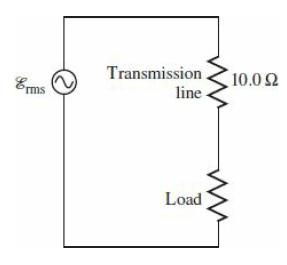
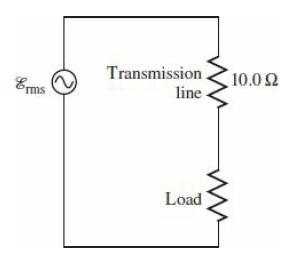
A generator supplies an average power of 12 MW through a transmission line that has a resistance of 10.0 Ω. What is the power loss in the transmission line if the rms line voltage is (a) 15 kV and (b) 110 kV? What percentage of the total power supplied by the generator is lost in
(a) Calculate the rms current drawn by the load in the figure with Problem 88 if kV and the average power supplied by the generator is 12 MW. (b) Suppose that the average power supplied by the generator is still 12 MW, but the load is not purely resistive; rather, the load has a power
Make a figure analogous to Fig. 21.5 for an ideal inductor in an ac circuit. Start by assuming that the voltage across an ideal inductor is vL(t) = VL sin ωt. Make a graph showing one cycle of vL(t) and i(t) on the same axes. Then, at each of the times , indicate the direction of the current (or
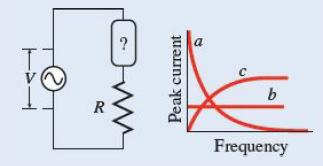
Which graph is correct if the circuit element is a capacitor?The graphs show the peak current as a function of frequency for various circuit elements placed in the diagrammed circuit. The amplitude of the generator emf is constant, independent of the frequency. T v (~ R ? Peak current b Frequency
A series RLC circuit has R = 500.0 Ω, L = 35.0 mH, and C = 87.0 pF. What is the impedance of the circuit at resonance? Explain.
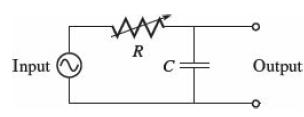
An RC filter is shown. The filter resistance R is variable between 180 Ω and 2200 Ω and the filter capacitance is C = 0.086 μF. At what frequency is the output amplitude equal to times the input amplitude if R = (a) 180 Ω? (b) 2200 Ω? (c) Is this a low-pass or high-pass filter? Explain.
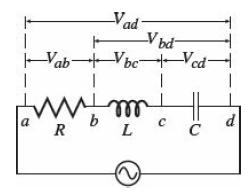
The circuit shown has a source voltage of 440 V rms, resistance R = 250 Ω, inductance L = 0.800 H, and capacitance C = 2.22 μF. (a) Find the angular frequency ω0 for resonance in this circuit. (b) Draw a phasor diagram for the circuit at resonance. (c) Find these rms voltages
Electrical impedance tomography (EIT) is a medical imaging technique in which a low ac current is passed through part of the body. The impedance between the electrodes provides a measure of body composition. Consider a simplified model in which the body acts as the resistor and capacitor of an RLC
To test hearing at various frequencies, a resonant RLC circuit is connected to a speaker. The resonant frequency is selected by changing a variable capacitor. (a) For an RLC circuit with L = 300 mH, what is the necessary capacitance to achieve a resonance frequency of 20 Hz (about the lowest
Finola has a circuit with a 4.00 kΩ resistor, a 0.750 H inductor, and a capacitor of unknown value connected in series to a 440.0 Hz ac source. With an oscilloscope, she measures the phase angle to be25.0°. (a) What is the value of the unknown capacitor? (b) Finola has several
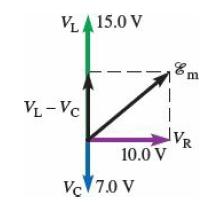
The phasor diagram for a particular RLC series circuit is shown in the figure. If the circuit has a resistance of 100 Ω and is driven at a frequency of 60 Hz, find (a) The current amplitude, (b) The capacitance, and (c) The inductance. VLA 15.0 V VL-VC 10.0 V Vc 7.0 V m
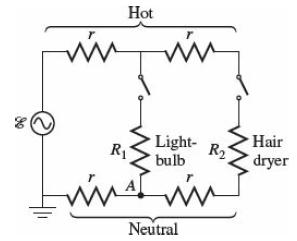
The diagram shows a simplified household circuit. Resistor r1 = 240.0 Ω represents a lightbulb; resistor r2 = 12.0 Ω represents a hair dryer. The resistors r = 0.50 Ω (each) represent the resistance of the wiring in the walls. Assume that the generator supplies a constant 120.0 V rms. (a) The
The field coils used in an ac motor are designed to have a resistance of 0.45 Ω and an impedance of 35.0 Ω. What inductance is required if the frequency of the ac source is (a) 60.0 Hz? (b) 0.20 kHz?
A 40.0 mH inductor, with internal resistance of 30.0 Ω, is connected to an ac source(a) What is the impedance of the inductor in the circuit? (b) What are the peak and rms voltages across the inductor (including the internal resistance)? (c) What is the peak current in the
An alternator supplies a peak current of 4.68 A to a coil. The voltage of the alternator is 420 V peak at 60.0 Hz. When a capacitor of 38.0 μF is placed in series with the coil, the power factor is found to be 1.00. Find (a) The inductive reactance of the coil and (b) The inductance of
A large coil used as an electromagnet has a resistance of R = 450 Ω and an inductance of L = 2.47 H. The coil is connected to an ac source with a voltage amplitude of 2.0 kV and a frequency of 9.55 Hz. (a) What is the power factor? (b) What is the impedance of the circuit? (c) What
An RLC circuit has a resistance of 255 Ω, an inductance of 146 mH, and a capacitance of 877 nF. (a) What is the resonant frequency of this circuit? (b) If this circuit is connected to a sinusoidal generator with a frequency 0.50 times the resonant frequency and a maximum voltage of 480
Transformers are often rated in terms of kilovoltamps. A pole on a residential street has a transformer rated at 35 kVA to serve four homes on the street. (a) If each home has a fuse that limits the incoming current to 60 A rms at 220 V rms, find the maximum load in kV·A on the
In an RLC circuit, these three elements are connected in series: a resistor of 20.0 Ω, a 35.0 mH inductor, and a 50.0 μF capacitor. The ac source of the circuit has an rms voltage of 100.0 V and an angular frequency of 1.0 × 10³ rad/s. (a) Find the rms current and the rms voltage
(a) What is the reactance of a 5.00 μF capacitor at the frequencies f = 12.0 Hz and 1.50 kHz? (b) What is the impedance of a series combination of the 5.00 μF capacitor and a 2.00 kΩ resistor at the same two frequencies? (c) What is the maximum current through the circuit of part (b)
An RLC series circuit is connected to a 240 V rms power supply at a frequency of 2.50 kHz. The elements in the circuit have the following values: R = 12.0 Ω, C = 0.26 μF, and L = 15.2 mH. (a) What is the impedance of the circuit? (b) What is the rms current? (c) What is the phase
A parallel plate capacitor has two plates, each of area 3.0 × 10⁻⁴ m2, separated by 3.5 × 10⁻⁴ m. The space between the plates is filled with a dielectric. When the capacitor is connected to a source of 120 V rms at 8.0 kHz, an rms current of 1.5 × 10⁻⁴ A is measured. (a) What is
Suppose a power plant produces 800 kW of power and is to send that power for many miles over a copper wire with a total resistance of 12 Ω. (a) If the power is sent across the copper wires at 48 kV rms, how much current flows through the wires? (b) What is the power dissipated due to the
Consider an induction stove utilizing a primary heating coil located just beneath the stove top. The circuit elements in the stove supply the coil with a peak ac voltage of 340 V at a frequency of 50 kHz. The coil has 18 turns; its inductance is 80 μH and its resistance is 1.0 Ω. (a) What
A hydroelectric power plant is situated at the base of a dam. Water exits the power plant 120 m below the top of the reservoir at a speed of about 4 m/s (at atmospheric pressure). The volume flow rate of water through the power plant is 1000 m3/s. The plant operates with an energy efficiency of 80%
A parallel plate capacitor is used in a series RLC circuit along with a 0.650 H inductor. When the space between the plates is filled with a dielectric with k = 5.50, the resonant frequency is 220 Hz. Now the dielectric is removed, leaving air between the capacitor plates. What is the new resonant
The speed of an electromagnetic wave in vacuum depends on the amplitude of the electric field but not on the amplitude of the magnetic field.(a) The amplitude of the magnetic field but not on the amplitude of(b) The electric field.(c) The amplitude of both fields.(d) The angle between the electric
An electromagnetic wave is created by(a) All electric charges.(b) An accelerating electric charge.(c) An electric charge moving at constant velocity.(d) A stationary electric charge.(e) A stationary bar magnet.(f) A moving electric charge, whether accelerating or not.
The radio station that broadcasts your favorite music is located due north of your home; it uses a horizontal electric dipole antenna directed north-south. In order to receive this broadcast, you need to(a) Orient the receiving antenna horizontally, north-south.(b) Orient the receiving
The Sun is directly overhead, and you are facing toward the north. Light coming to your eyes from the sky just above the horizon is(a) Partially polarized north-south.(b) Partially polarized east-west.(c) Partially polarized up-down.(d) Randomly polarized.(e) Linearly polarized up-down.
Why are days longer in summer than in winter?
A dipole radio transmitter has its rod-shaped antenna oriented vertically. At a point due south of the transmitter, the radio waves have their magnetic field(a) Oriented north-south.(b) Oriented east-west.(c) Oriented vertically.(d) Oriented in any horizontal direction.
A beam of light is linearly polarized. You wish to rotate its direction of polarization by 90° using one or more ideal polarizing sheets. To get maximum transmitted intensity, you should use how many sheets?(a) 1(b) 2(c) 3(d) As many as possible(e) There is no way to rotate the direction of
A vertical electric dipole antenna (a) Radiates uniformly in all directions.(b) Radiates uniformly in all horizontal directions, but more strongly in the vertical direction.(c) Radiates most strongly and uniformly in the horizontal directions.(d) Does not radiate in the horizontal directions.
Which is the only one of these properties of a wave that could be changed without changing any of the others?(a) Amplitude(b) Wavelength (c) Speed(d) Frequency
(a) Write an equation for a harmonic wave with amplitude 0.750 mm, frequency 36.0 Hz, and wave speed 144 m/s traveling in the +xdirection. At t = 0, the point x = 0 is at its maximum displacement in the +y-direction. (b) What is the maximum acceleration of a point on the string?
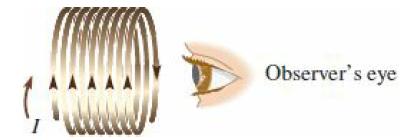
Sketch the magnetic field as it would appear inside the coil of wire to an observer, looking into the coil from the position shown. I Observer's eye
A positron (q = +e) moves at 5.0 × 10⁷ m/s in a magnetic field of magnitude 0.47 T. The magnetic force on the positron has magnitude 2.3 × 10⁻¹² N. (a) What is the component of the positron's velocity perpendicular to the magnetic field? (b) What is the component of the positron's
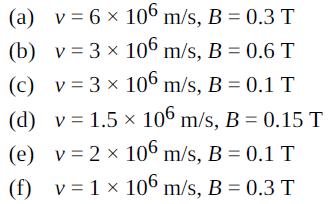
Six protons move (at speed v) in magnetic fields (magnitude B) along circular paths. Rank them in order of the radius of their paths, greatest to smallest. (a) v = 6 x 10⁶ m/s, B = 0.3 T (b) v = 3 × 10⁶ m/s, B = 0.6 T (c) v = 3 × 10⁶ m/s, B = 0.1 T (d) v = 1.5 × 10⁶ m/s, B = 0.15 T v = 2 x 10⁶
In one type of mass spectrometer, ions having the same velocity move through a uniform magnetic field. The spectrometer is being used to distinguish 12C+ and 14C+ ions. The 12C+ ions move in a circle of diameter 25 cm. (a) What is the diameter of the orbit of 14C+ ions? (b) What is the
Naturally occurring carbon consists of two different isotopes (excluding 14C, which is present in only trace amounts). The most abundant isotope is 12C. When carbon is placed in a mass spectrometer, 12C+ ions moved in a circle of radius 15.0 cm, whereas ions of the other isotope moved in a circle
A sample containing 12C, 16O, and an unknown isotope is analyzed in a mass spectrometer. As in Fig. 19.17(a), the ions move around a semicircle before striking a photographic plate. The 12C+ and 16O+ ions are separated by 2.250 cm on the plate, and the unknown isotope strikes the plate 1.160
After being accelerated through a potential difference of 5.0 kV, a singly charged 12C+ ion moves in a circle of radius 21 cm in the magnetic field of a mass spectrometer. What is the magnitude of the field?In each of these problems, the ions entering the mass spectrometer have the same charges.
Show that the time for one revolution of a charged particle moving perpendicular to a uniform magnetic field is independent of its speed. (This is the principle on which the cyclotron operates.) In doing so, write an expression that gives the period T (the time for one revolution) in terms of the
The strip in the diagram is used as a Hall probe to measure magnetic fields, (a) What happens if the strip is not perpendicular to the field? Does the Hall probe still read the correct field magnitude? Explain. (b) What happens if the field is in the plane of the strip?
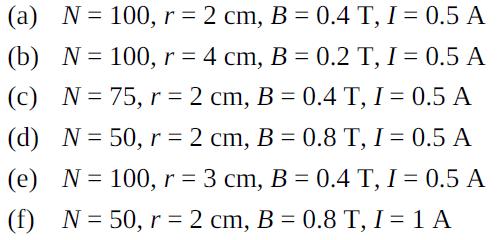
In each of six electric motors, a cylindrical coil with N turns and radius r is immersed in a magnetic field of magnitude B. The current in the coil is I. Rank the motors in order of the maximum torque on the coil, greatest to smallest. (a) (b) (c) (d) (e) (f) N = 100, r = 2 cm, B = 0.4 T, I = 0.5
An electromagnetic flowmeter is used to measure blood flow rates during surgery. Blood containing ions (primarily Na+) flows through an artery with a diameter of 0.50 cm. The artery is in a magnetic field of 0.35 T and develops a Hall voltage of 0.60 mV across its diameter.(a) What is the blood
The intrinsic magnetic dipole moment of the electron has a magnitude 9.3 × 10⁻²⁴ A·m2. What is the maximum torque on an electron due to its intrinsic dipole moment in a 1.0 T magnetic` field?
Imagine a long straight wire perpendicular to the page and carrying a current I into the page. Sketch some field lines with arrowheads to indicate directions.
Estimate the magnetic field at distances of 1 μm and 1 mm produced by a current of 3 μA along the medial nerve of the human arm. Model the nerve as a straight current-carrying wire. Compare with the magnitude of Earth's magnetic field near the surface, about 0.05 mT.
Some animals are capable of detecting magnetic fields and use this sense to help them navigate. Suppose a high-voltage directcurrent power line carries a current of 5.0 kA. (a) How far from the wire would a homing pigeon have to be so the field due to the wire has magnitude 45 μT, which is
Two parallel wires in a horizontal plane carry currents I1 and I2 to the right. The wires each have length L and are separated by a distance d. Find the magnitudes and directions of the (a) The magnetic field due to wire 1 at the location of wire 2, (b) The magnetic force on wire
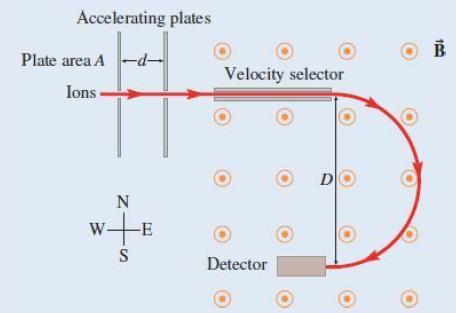
Find the mass of the 238U+ ions in terms of v, B, D, and universal constants. Accelerating plates Plate area A -d- Ions N w+ -E S Velocity selector D Detector
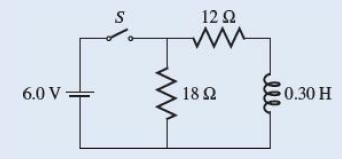
(a) How much energy is stored in the inductor at t = 0? (b) What is the instantaneous rate of change of the inductor’s energy at t = 0? (c) What is the average rate of change of the inductor’s energy between t = 0.0 and t = 1.0 s?In the circuit, switch S is opened at t = 0 after
A dc motor has coils with a resistance of 16 Ω and is connected to an emf of 120.0 V. When the motor operates at full speed, the back emf is 72 V. (a) What is the current in the motor when it first starts up? (b) What is the current when the motor is at full speed? (c) If the
A circular conducting coil with radius 2.6 cm is placed in a vertical magnetic field of 0.33 T. The coil is made of copper wire with a diameter of 0.90 mm. The coil starts in a horizontal plane and is flipped over (rotated 180° about a horizontal axis) in 0.57 s. What is the average current that
A solid metal cylinder of mass m rolls down parallel metal rails spaced a distance L apart with a constant acceleration of magnitude a0 [part (a) of figure]. The rails are inclined at an angle θ to the horizontal. Now the rails are connected electrically at the top and immersed in a magnetic field
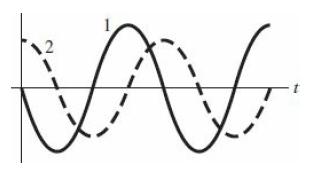
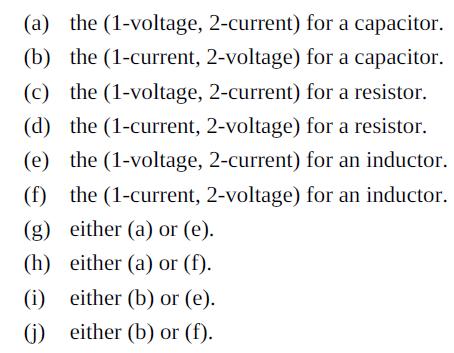
For an ac circuit, graphs (1, 2) could represent: 1 NAV
For an ideal inductor in an ac circuit, the current through the inductor (a) Is in phase with the induced emf.(b) Leads the induced emf by 90°.(c) Leads the induced emf by an angle less than 90°.(d) Lags the induced emf by 90°.(e) Lags the induced emf by an angle less than 90°.
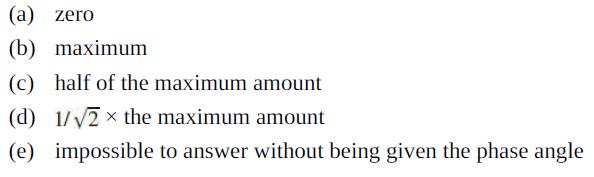
For a capacitor in an ac circuit, how much energy is stored in the capacitor at the instant when current is zero? (a) zero (b) maximum (c) half of the maximum amount (d) 1/√2x the maximum amount (e) impossible to answer without being given the phase angle
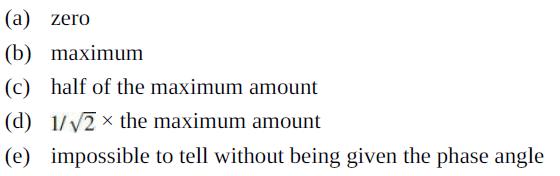
For an ideal inductor in an ac circuit, how much energy is stored in the inductor at the instant when current is zero? (a) zero (b) maximum (c) half of the maximum amount (d) 1/√2x the maximum amount (e) impossible to tell without being given the phase angle
A capacitor is connected to the terminals of a variable frequency oscillator. The peak voltage of the source is kept fixed while the frequency is increased. Which statement is true?(a) The rms current through the capacitor increases.(b) The rms current through the capacitor decreases.(c) The phase
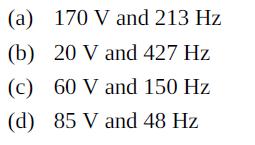
A voltage v(t) = (120 V) sin [(302 rad/s)t] is produced by an ac generator. What is the rms voltage and the frequency of the source? (a) 170 V and 213 Hz (b) 20 V and 427 Hz (c) 60 V and 150 Hz (d) 85 V and 48 Hz
An ac source is connected to a series combination of a resistor, capacitor, and an inductor. Which statement is correct?(a) The current in the capacitor leads the current in the inductor by 180°.(b) The current in the inductor leads the current in the capacitor by 180°.(c) The current in the
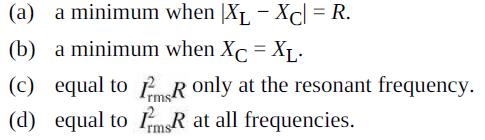
A series RLC circuit is connected to an ac generator. When the generator frequency varies (but the peak emf is constant), the average power is: a minimum (b) a minimum (c) equal to (d) equal to when |XL - XC| = R. when XC = XL. R only at the resonant frequency. R at all frequencies.
The instantaneous sinusoidal emf from an ac generator with an rms emf of 4.0 V oscillates between what values?
What happens if a 40 W incandescent lightbulb, designed to be connected to an ac voltage with amplitude 170 V and frequency 60 Hz, is instead connected to a 170 V dc power supply? Explain. What dc voltage would make the lightbulb burn with the same brightness as the 170 V peak 60 Hz ac?
Which graph is correct if the circuit element is a resistor?The graphs show the peak current as a function of frequency for various circuit elements placed in the diagrammed circuit. The amplitude of the generator emf is constant, independent of the frequency. T v (~ R ? Peak current b Frequency
A circuit has a resistor and an unknown component in series with a 12 V (rms) sinusoidal ac source. The current in the circuit decreases by 20% when the frequency decreases from 240 Hz to 160 Hz. What is the second component in the circuit? Explain your reasoning.
Show that over one complete cycle, the average value of a sin2 ωt is 1/2. Use the trigonometric identity sin2 ωt = (1 − cos 2ωt)/2.
A circuit has a resistor and an unknown component in series with a 12 V (rms) sinusoidal ac source. The current in the circuit decreases by 25% when the frequency increases from 150 Hz to 250 Hz. What is the second component in the circuit? Explain your reasoning.
Explain what is meant by a phase difference. Sketch graphs of i(t) and vC(t), given that the current leads the voltage by π/2 radians.
Show, from XC = 1/(ωC), that the units of capacitive reactance are ohms.
Three capacitors (2.0 μF, 3.0 μF, 6.0 μF) are connected in series to an ac voltage source with amplitude 12.0 V and frequency 6.3 kHz. (a) What are the peak voltages across each capacitor? (b) What is the peak current that flows in the circuit?
A capacitor (capacitance = C) is connected to an ac power supply with peak voltage V and angular frequency ω. (a) During a quarter cycle when the capacitor goes from being uncharged to fully charged, what is the average current (in terms of C, V, and ω)? (b) What is the rms
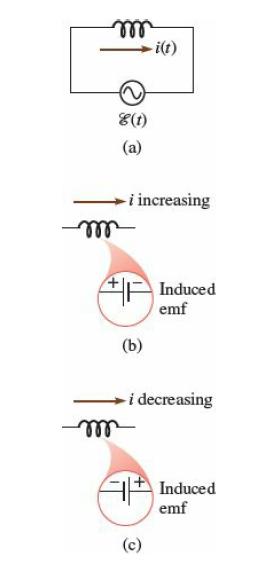
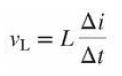
Suppose that current flows to the left through the inductor in Fig. 21.7a so that i is negative. (a) If the current is increasing in magnitude, what is the sign of Δi/Δt? (b) In what direction is the induced emf that opposes the increase in current? (c) Show that Eq. (21-22) gives
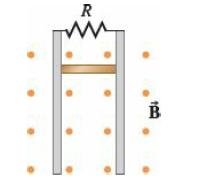
A 15.0 g conducting rod of length 1.30 m is free to slide downward between two vertical rails without friction. The ends of the rod maintain electrical contact with the rails. The rails are connected to an 8.00 Ω resistor, and the entire apparatus is placed in a 0.450 T uniform magnetic field.
Showing 300 - 400
of 1578
1
2
3
4
5
6
7
8
9
10
11
12
13
14
15
Last
Step by Step Answers

 Get 50% OFF
Claim Now
Get 50% OFF
Claim Now