New Semester
Started
Get
50% OFF
Study Help!
--h --m --s
Claim Now
Question Answers
Textbooks
Find textbooks, questions and answers
Oops, something went wrong!
Change your search query and then try again
S
Books
FREE
Study Help
Expert Questions
Accounting
General Management
Mathematics
Finance
Organizational Behaviour
Law
Physics
Operating System
Management Leadership
Sociology
Programming
Marketing
Database
Computer Network
Economics
Textbooks Solutions
Accounting
Managerial Accounting
Management Leadership
Cost Accounting
Statistics
Business Law
Corporate Finance
Finance
Economics
Auditing
Tutors
Online Tutors
Find a Tutor
Hire a Tutor
Become a Tutor
AI Tutor
AI Study Planner
NEW
Sell Books
Search
Search
Sign In
Register
study help
sciences
college physics with an integrated approach
College Physics With An Integrated Approach To Forces And Kinematics 5th Edition Alan Giambattista - Solutions
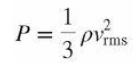
Show that, for an ideal gas, where P is the pressure, ρ is the mass density, and vrms is the rms speed of the gas molecules. P = 1 3 pvrms
What determines the direction of heat flow when two objects at different temperatures are placed in thermal contact?
A long, narrow steel rod of length 2.5000 m at 25°C is oscillating as a pendulum about a horizontal axis through one end. If the temperature changes to 0°C, what will be the fractional change in its period?
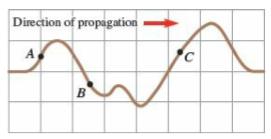
The drawing shows a complex wave moving to the right along a cord. At the instant shown, which points on the cord are moving downward? (a) A (b) B (c) C (d) A and C (e) A, B, and C Direction of propagation A B с
Doppler ultrasound is used to measure the speed of blood flow (see Problem 49). The reflected sound interferes with the emitted sound, producing beats. If the speed of red blood cells is 0.10 m/s, the ultrasound frequency used is 5.0 MHz, and the speed of sound in blood is 1570 m/s, what is the
Two children are playing with a tin-can telephone. The children are 12 m apart, the string connecting their tin cans has a linear mass density of 1.3 g/m, and it is stretched with a tension of 8.0 N. One child decides to pluck the string. How long does it take for the wave pulse to travel from one
(a) What is the position of the peak of the pulse shown in the figure at t = 3.00 s? (b) When does the peak of the pulse arrive at x = 4.00 m? y(cm) 10 5 y(cm) 10 5 0 0 1 1 1=0 t=0.20 s 2 2 3 x (m) 3 x (m)
Two successive transverse pulses, one caused by a brief displacement to the right and the other by a brief displacement to the left, are sent down a Slinky that is fastened at the far end. At the point where the first reflected pulse meets the second advancing pulse, the deflection (compared with
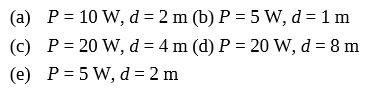
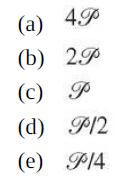
Six sources emit sound equally in all directions with average power P. A microphone is placed at a distance d from each source. Rank the situations in order of the intensity at the location of the microphone, smallest to largest. (a) P = 10 W, d = 2 m (b) P = 5W, d = 1 m (c) P = 20 W, d = 4 m (d) P
Transverse waves travel on five stretched strings with the following properties. Rank the strings according to the time it takes a transverse wave pulse to travel from one end to the (e)other, from largest to smallest(a) Length L, total mass m, tension F (b) Length 2L, total mass m, tension
Why is a transverse wave sometimes called a shear wave?
In a transverse wave, the motion of individual particles of the medium is(a) Circular. (b) Elliptical. (c) Parallel to the direction of the wave's travel. (d) Perpendicular to the direction of the wave's travel.
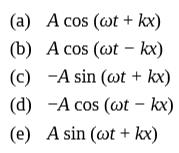
A transverse wave on a string is described by y(x, t) = A cos (ωt + kx). It arrives at the point x = 0 where the string is fixed in place. Which function describes the reflected wave? (a) A cos (wt + kx) (b) A cos (wt - kx) (c) A sin (@ot + kx) (d) -A cos (wt - kx) (e) A sin (oot + kx)
When a wave passes from one medium into another, which of these quantities must stay the same?(a) Wavelength (b) Wave speed(c) Frequency (d) Direction of propagation
Michelle is enjoying a picnic across the valley from a cliff. She claps her hands and the echo takes 1.5 s to return. Given that the speed of sound in air is 343 m/s on that day, how far away is the cliff?
Standing waves on a string are produced by the superposition of two waves with(a) The same amplitude, frequency, and direction of propagation. (b) The same amplitude and frequency, and opposite propagation directions. (c) The same amplitude and direction of propagation, but different
The spectators at a sports stadium are “doing the wave”: they stand and raise their arms simultaneously with those in front of them and slightly after their neighbors on one side. This gives the appearance of a wave pulse propagation around the stadium. Is “the wave” analogous to a
At a grocery store, a spring scale (spring constant = 450 N/m) hangs near the produce section. The spring hangs vertically with a 0.250 kg pan suspended from its lower end. Jenna drops a 2.20 kg bag of oranges from a height of 30.0 cm above the pan. The pan and oranges start oscillating vertically
Two strings, each 15.0 m long, are stretched side by side. One string has a mass of 78.0 g and a tension of 180.0 N. The second string has a mass of 58.0 g and a tension of 160.0 N. A pulse is generated at one end of each string simultaneously. (a) On which string will the pulse move
(a) Write an equation for a harmonic wave with amplitude 1.20 mm, wavelength 30.0 cm, and wave speed 6.40 m/s traveling in the −x-direction. At t = 0, the point x = 0 is moving in the +y-direction at its maximum transverse speed. (b) What is the value of the maximum transverse speed?
Write the equation for a harmonic wave with amplitude 2.50 cm and angular frequency 2.90 rad/s that is moving in the +x-direction with a wave speed that is 5.00 times as fast as the maximum transverse speed of a point on the string. At t = 0, the point x = 0 is at y = 0 and is moving in the
The mass density of diamond (a crystalline form of carbon) is 3500 kg/m3. How many carbon atoms per cubic centimeter are there?
At 0.0°C and 1.00 atm, 1.00 mol of a gas occupies a volume of 0.0224 m3. (a) What is the number density? (b) Estimate the average distance between the molecules. (c) If the gas is nitrogen (N2), the principal component of air, what is the total mass and mass density?
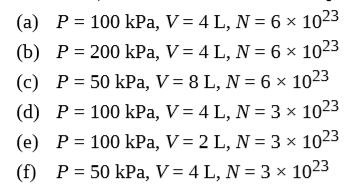
Six cylinders contain ideal gases (not necessarily the same gas) with the properties given (P = pressure, V = volume, N = number of molecules). Rank them in order of temperature, highest to lowest. (a) P = 100 kPa, V = 4 L, N = 6 x 10²³ (b) P = 200 kPa, V= 4 L, N = 6 × 10²³ (c) P = 50 kPa, V = 8
A flight attendant wants to change the temperature of the air in the cabin from 18.0°C to 21.0°C without changing the pressure. What fractional change in the number of moles of air in the cabin would be required?
A cylinder in a car engine takes Vi = 4.50 × 10⁻² m3 of air into the chamber at 30°C and at atmospheric pressure. The piston then compresses the air to one-ninth of the original volume (0.111 Vi) and to 20.0 times the original pressure (20.0 Pi). What is the new temperature of the air?
What fraction of the air molecules in a house must be pushed outside while the furnace raises the inside temperature from 16.0°C to 20.0°C? The pressure does not change since the house is not airtight.
A patient with emphysema is breathing pure O2 through a face mask. The cylinder of O2 contains 0.0170 m3 of O2 gas at a pressure of 15.2 MPa. (a) What volume would the oxygen occupy at atmospheric pressure (and the same temperature)? (b) If the patient takes in 8.0 L/min of O2 at
What is the mass density of air at P = 1.0 atm and T = (a) −10°C and (b) 30°C? The average molecular mass of air is approximately 29 u.
In intergalactic space, there is an average of about one hydrogen atom per cubic centimeter and the temperature is 3 K. What is the absolute pressure?
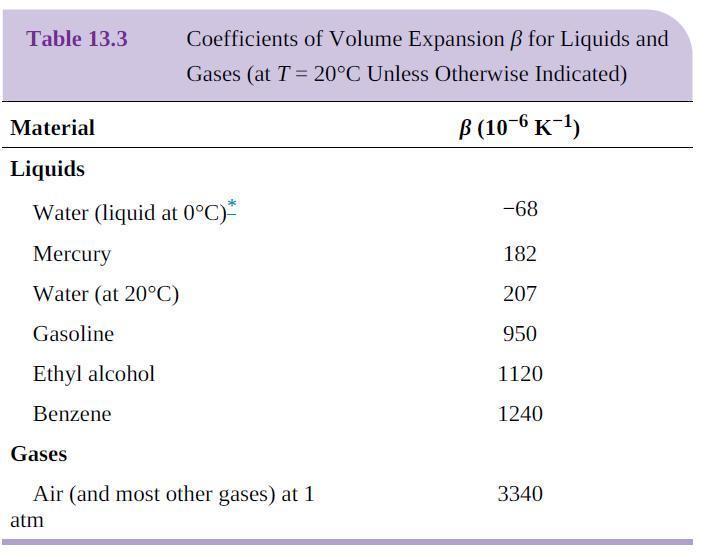
Consider the expansion of an ideal gas at constant pressure. The initial temperature is T0 and the initial volume is V0. (a) Show that ΔV/V0 = β ΔT, where β = 1/T0. (b) Compare the coefficient of volume expansion β for an ideal gas at 20°C to the values for liquids and gases listed
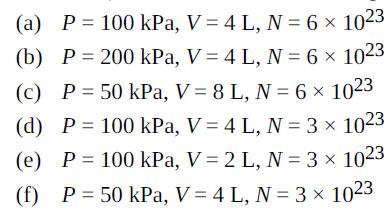
Rank the six gases of Problem 43 in order of the total translational kinetic energy, greatest to least.Data From Problem 43 Six cylinders contain ideal gases (not necessarily the same gas) with the properties given (P = pressure, V = volume, N = number of molecules). Rank them in order of
What is the total translational kinetic energy of the gas molecules of air at atmospheric pressure that occupies a volume of 1.00 L?
What is the total internal kinetic energy of 1.0 mol of an ideal gas at 0.0°C and 1.00 atm?
Find the rms speed in air at 0.0°C and 1.00 atm of (a) The N2 molecules, (b) The O2 molecules, and (c) The CO2 molecules.
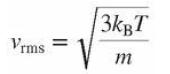
Show that the rms speed of a molecule in an ideal gas at absolute temperature T is given by where m is the mass of a molecule. 3kgT Vrms m
On a cold day, you take a breath, inhaling 0.50 L of air whose initial temperature is −10°C. In your lungs, its temperature is raised to 37°C. Assume that the pressure is 101 kPa and that the air may be treated as an ideal gas. What is the total change in translational kinetic energy of the air
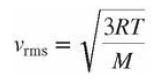
Show that the rms speed of a molecule in an ideal gas at absolute temperature T is given by where M is the molar mass—the mass of the gas per mole. 3RT Vrms %3D M
Platelet cells in blood play an essential role in the formation of clots and exist in normal human blood at the level of about 200 000 per cubic millimeter. In order to illustrate that diffusion alone is not responsible for transporting platelets, consider the following situation. The diffusion
Consider the sphere and ring of Problem 20. What must the final temperature be if both the ring and the sphere are heated to the same final temperature?Data From Problem 20A steel sphere with radius 1.0010 cm at 22.0°C must slip through a brass ring that has an internal radius of 1.0000 cm at the
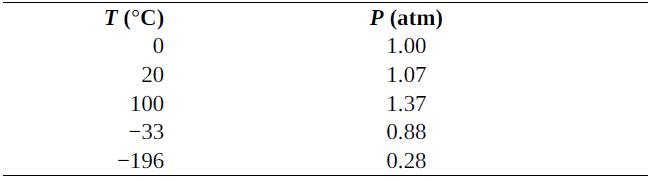
The data in the following table are from a constant-volume gas thermometer experiment. The volume of the gas was kept constant, while the temperature was changed. The resulting pressure was measured. Plot the data on a pressure versus temperature diagram. Based on these data, estimate the value of
Suppose due to a bad break of your femur, you require the insertion of a titanium rod to help the fracture heal. The coefficient of linear expansion for titanium is α = 8.6 × 10⁻⁶ K−1, and the length of the rod when it is in equilibrium with the leg bone and muscle at 37°C is 5.00 cm. How
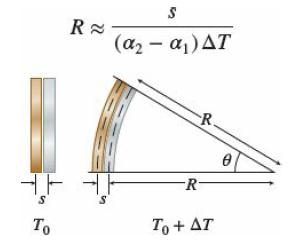
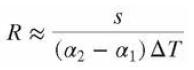
A bimetallic strip is made from metals with expansion coefficients α1 and α2 (with α2 > α1). The thickness of each layer is s. At some temperature T0, the bimetallic strip is relaxed and straight. (a) Show that, at temperature T0 + ΔT, the radius of curvature of the strip is(b) If the
At a normal body temperature of 37.0°C, (a) what is the average kinetic energy of the gas molecules in the lungs? (b) If a fever increases the temperature to 37.8°C, by what percentage does the average kinetic energy of the molecules increase?
A 10.0 L vessel contains 12 g of N2 gas at 20°C. (a) Estimate the nearest-neighbor distance. (b) Can the gas be considered to be dilute?
A temperature change ΔT causes a volume change ΔV but has no effect on the mass of an object. (a) Show that the change in density Δρ is given by Δρ = −βρ ΔT. (b) Find the fractional change in density (Δρ/ρ) of a brass sphere when the temperature changes from 32°C to
The diameter of an oxygen (O2) molecule is approximately 0.3 nm. For an oxygen molecule in air at atmospheric pressure and 20°C, estimate the average magnitudes of these quantities during a 1.0 s time interval: (a) The distance traveled between collisions with other molecules; (b) The
A mass of 1.4 kg of water at 22°C is poured from a height of 2.5 m into a vessel containing 5.0 kg of water at 22°C. (a) How much does the internal energy of the 6.4 kg of water increase? (b) Is it likely that the water temperature increases? Explain.
The main loss of heat from Earth is by(a) Radiation.(b) Convection.(c) Conduction.(d) All three processes are significant modes of heat loss from Earth.
The average temperature of Earth's atmosphere is 253 K. What would be the eventual average temperature of Earth's atmosphere if the power radiated by the Sun were to decrease by 10%?(a) 253 K(b) (0.90)1/4 × 253 K = 246 K(c) 0.90 × 253 K = 228 K(d) (0.90)4 × 253 K = 166 K
Which term best represents the relation between a blackbody and radiant energy? A blackbody is an ideal ____ of radiant energy.(a) Emitter(b) Absorber(c) Reflector(d) Emitter and absorber
If Mars orbits the Sun with an orbital radius that is 1.5 times the orbital radius of Earth about the Sun, what is the approximate atmospheric temperature of Mars? The atmospheric temperature of Earth is 253 K.(a) (253 K)/1.5 = 170 K(b) (253 K)/1.52 = 112 K(c) (253 K)/1.54 = 50 K(d) (253
A window conducts power from a house to the cold outdoors. What power is conducted through a window of half the area and half the thickness?
Why are several layers of clothing warmer than one coat of equal weight?
Iron has a specific heat that is about 3.4 times that of gold. A cube of gold and a cube of iron, both of equal mass and at 20°C, are placed in two different Styrofoam cups, each filled with 100 g of water at 40°C. The Styrofoam cups have negligible heat capacities. After equilibrium has been
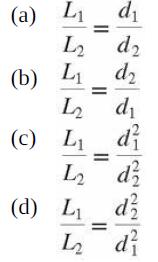
Two thin rods are made from the same material and are of lengths L1 and L2. The two ends of the rods have the same temperature difference. What should the relation be between their diameters and lengths so that they conduct equal amounts of heat energy in a given time? (a) L1 (b) L1 %3D (c)
If you place your hand underneath, but not touching, a kettle of hot water, you mainly feel the presence of heat from(a) Conduction.(b) Convection.(c) Radiation.
A metal plant stand on a wooden deck feels colder than the wood around it. Is it necessarily colder? Explain.
Near a large lake, in what direction does a breeze passing over the land tend to blow at night?
Sublimation is involved in which of these phase changes?(a) Liquid to gas(b) Solid to liquid(c) Solid to gas(d) Gas to liquid
What is the purpose of having fins on an automobile or motorcycle radiator?
When a gas condenses to a liquid,Its internal energy increases.Its temperature rises.Its temperature falls.It gives off internal energy.
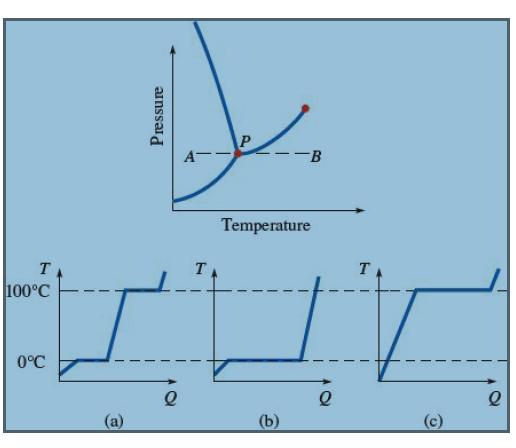
The phase diagram for water is shown in the figure. If the temperature of a certain amount of ice is increased by following the path represented by the horizontal dashed line from A to B through point P, which of the graphs of temperature as a function of heat added is correct?
Why do roadside signs warn that bridges ice before roadways? Explain.
When a substance is at its triple point, it(a) Is in its solid phase.(b) Is in its liquid phase.(c) Is in its gas phase.(d) May be in any or all of these phases.
Why do cooking directions on packages advise different timing to be followed for some locations?
Rank these six situations in order of the temperature increase, largest to smallest.(a) 1 kJ of heat into 400 g of steel with c = 0.45 kJ/(kg·K)(b) 2 kJ of heat into 400 g of steel(c) 2 kJ of heat into 800 g of steel(d) 1 kJ of heat into 400 g of aluminum with c = 0.90 kJ/(kg·K)(e) 2 kJ of heat
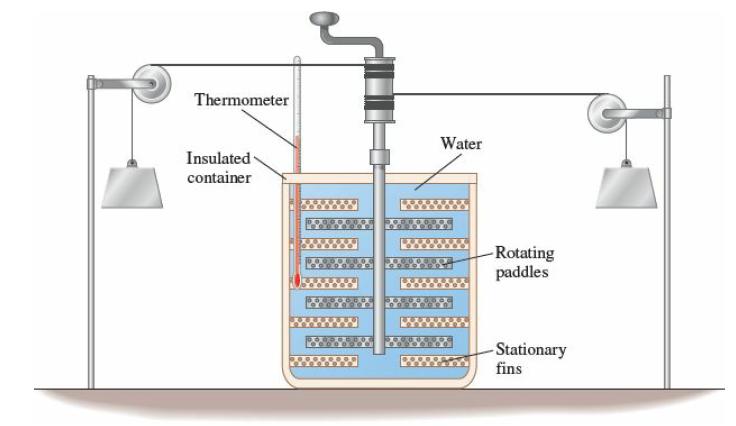
An experiment is conducted with a Joule apparatus (see Fig. 14.2). The hanging objects descend through a distance of 1.25 m each time. After 30 descents, a total of 1.00 kJ has been delivered to the water. What is the total mass of the hanging objects?
When the temperature as measured in °C of a radiating object is doubled (such as a change from 20°C to 40°C), is the radiation rate necessarily increased by a factor of 16?
Would heat loss be reduced or increased by increasing the air gap, usually about 1 cm, between commercially made double-paned windows? Explain your reasoning.
Two objects with the same surface area are inside an evacuated container. The walls of the container are kept at a constant temperature. Suppose one object absorbs a larger fraction of incident radiation than the other. Explain why that object must emit a correspondingly greater amount of radiation
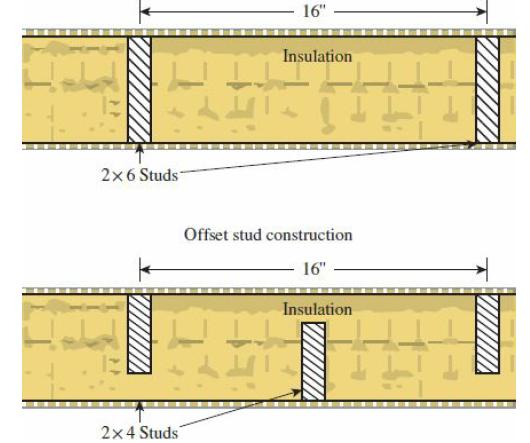
In a conventional exterior wall, a 2 × 6 wooden stud is placed every 16 in. (A stud is an upright support.) The stud runs all the way from the exterior siding to the interior wall and the spaces between studs are filled with insulation. In offset stud wall construction, 2 × 4 studs are staggered
A 7.30 kg steel ball at 15.2°C is dropped from a height of 10.0 m into an insulated container with 4.50 L of water at 10.1°C. If no water splashes, what is the final temperature of the water and steel?
Jill takes in 0.021 mol of air in a single breath. The air is taken in at 20°C and exhaled at 35°C. (a) How much heat leaves her body in a single breath due to the temperature increase of the air? Ignore the humidification of the air in the lungs and treat air as an ideal diatomic
A chamber with a fixed volume of 1.0 m3 contains a monatomic gas at 3.00 × 10² K. The chamber is heated to a temperature of 4.00 × 10² K. This operation requires 10.0 J of heat. (Assume all the energy is transferred to the gas.) How many gas molecules are in the chamber?
In an emergency, it is sometimes the practice of medical professionals to immerse a patient who suffers from heat stroke in an ice bath, a mixture of ice and water in equilibrium at 0°C, in order to reduce her body temperature. (a) If a 75 kg patient whose body temperature is 40.8°C must
Repeat Problem 41 without ignoring the temperature change of the glass. The glass has a mass of 350 g and the specific heat of the glass is 0.837 kJ/(kg·K). By what percentage does the answer change from the answer for Problem 41?Data in Problem 41?Tina is going to make iced tea by first brewing
If a leaf is to maintain a temperature of 40°C (reasonable for a leaf), it must lose 250 W/m2 by transpiration (evaporative heat loss). Note that the leaf also loses heat by radiation, but we will ignore this. How much water is lost after 1 h through transpiration only? The area of the leaf is
A dog loses a lot of heat through panting. The air rushing over the upper respiratory tract causes evaporation and thus heat loss. A dog typically pants at a rate of around 300 pants per minute. As a rough calculation, assume that one pant causes 0.010 g of water to be evaporated from the
You are given 250 g of coffee (same specific heat as water) at 80.0°C (too hot to drink). In order to cool this to 60.0°C, how much ice (at 0.0°C) must be added? Ignore the heat capacity of the cup and heat exchanges with the surroundings.
A hiker is wearing wool clothing of 0.50 cm thickness to keep warm. Her skin temperature is 35°C and the outside temperature is 4.0°C. Her body surface area is 1.2 m2. (a) If the thermal conductivity of wool is 0.040 W/(m·K), what is the rate of heat conduction through her
Find the temperature drop across the epidermis (the outer layer of skin) under these conditions: the rate of heat flow via conduction through a 10.0 cm2 area of the epidermis is 50 mW; the epidermis is 2.00 mm thick and has thermal conductivity 0.45 W/(m·K).
Five walls of a house have different surface areas, insulation materials, and insulation thicknesses. Rank them in order of the rate of heat flow through the wall, greatest to smallest. Assume the same indoor and outdoor temperatures for each wall.(a) Area = 120 m2; 10 cm thickness of insulation
A brick wall with thermal conductivity κ = 1.3 W/(m·K) is covered completely with a sheet of foam of the same thickness as the brick, but with κ = 0.025 W/(m·K). How is the rate at which heat is conducted through the wall changed by the addition of the foam?
Six wood stoves have total surface areas A and surface temperatures T as given. Rank them in order of the power radiated, from greatest to least. Assume they all have the same emissivity.(a) A = 1.00 m2, T = 227°C(b) A = 1.01 m2, T = 227°C(c) A = 1.05 m2, T = 227°C(d) A = 1.00 m2, T = 232°C(e)
A sphere with a diameter of 80 cm is initially at a temperature of 250°C. If the intensity of the radiation detected at a distance of 2.0 m from the sphere's center is 102 W/m2, what is the emissivity of the sphere?
A student in a lecture hall has 0.25 m2 of skin (arms, hands, and head) exposed. The skin is at 34°C and has an emissivity of 0.97. The temperature of the room is 20°C (air, walls, ceiling, and floor all at the same temperature). (a) At what rate does the skin emit thermal
It is often argued that the head is the most important part of the body to cover when out in cold weather. Estimate the total energy loss by radiation if a person's head is uncovered for 15 min on a very cold, −15°C day, assuming he is bald, his skin temperature is 35°C, and that skin has an
Consider the net rate of heat loss by radiation from exposed skin on a cold day. By what factor does the rate for an outdoor temperature of 0°C exceed the rate at 5°C? Assume an initial skin temperature of 35°C.
A copper bar of thermal conductivity 401 W/(m·K) has one end at 104°C and the other end at 24°C. The length of the bar is 0.10 m, and the cross-sectional area is 1.0 × 10⁻⁶ m2. (a) What is the rate of heat conduction along the bar? (b) What is the temperature gradient in the
If the maximum intensity of radiation for a blackbody is found at 2.65 um, what is the temperature of the blackbody?
Many species cool themselves by sweating, because as the sweat evaporates, heat is transferred to the surroundings. A human exercising strenuously has an evaporative heat loss rate of about 650 W. If a person exercises strenuously for 30.0 min, how much water must he drink to replenish his fluid
A wall consists of a layer of wood outside and a layer of insulation inside. The temperatures inside and outside the wall are +22°C and −18°C; the temperature at the wood/insulation boundary is −8.0°C.By what factor would the heat loss through the wall increase if the insulation were not
The student from Problem 79 realizes that standing naked in a cold room will not give him the desired weight loss results since it is much less efficient than simply exercising. So he decides to “burn” calories through conduction. He fills the bathtub with 16°C water and gets in. The water
On a hot summer day, Daphne is off to the park for a picnic. She puts 0.10 kg of ice at 0°C in a thermos and then adds tea initially at 25°C. How much tea will just melt all the ice?
It requires 17.10 kJ to melt 1.00 × 10² g of urethane [CO2(NH2)C2H5] at 48.7°C. What is the latent heat of fusion of urethane in kJ/mol?
A 20.0 g lead bullet leaves a rifle at a temperature of 47.0°C and travels at a speed of 5.00 × 10² m/s until it hits a 6.0 kg block of ice at 0°C that is initially at rest on a frictionless surface. The bullet becomes embedded in the ice. (a) How fast is the the block of ice moving after
A 3.0 L container of nitrogen gas (N2) and a 5.0 L container of oxygen gas (O2) are both at 20°C and 1.0 atm. (a) Which gas has the larger rms speed? Explain. (b) At what temperature will oxygen gas have the same rms speed as nitrogen when the nitrogen is at 20°C? (c) How much heat
A 60.0 g piece of ice slides 5.00 m down an icy roof inclined at 27.0° to the horizontal. The magnitude of its acceleration is 4.10 m/s2. All the ice is at 0°C. How much ice melts?
A heat engine runs between reservoirs at temperatures of 300°C and 30°C. What is its maximum possible efficiency?(a) 10%(b) 47%(c) 53%(d) 90%(e) 100%
Showing 500 - 600
of 1578
1
2
3
4
5
6
7
8
9
10
11
12
13
14
15
Last
Step by Step Answers

 Get 50% OFF
Claim Now
Get 50% OFF
Claim Now