New Semester
Started
Get
50% OFF
Study Help!
--h --m --s
Claim Now
Question Answers
Textbooks
Find textbooks, questions and answers
Oops, something went wrong!
Change your search query and then try again
S
Books
FREE
Study Help
Expert Questions
Accounting
General Management
Mathematics
Finance
Organizational Behaviour
Law
Physics
Operating System
Management Leadership
Sociology
Programming
Marketing
Database
Computer Network
Economics
Textbooks Solutions
Accounting
Managerial Accounting
Management Leadership
Cost Accounting
Statistics
Business Law
Corporate Finance
Finance
Economics
Auditing
Tutors
Online Tutors
Find a Tutor
Hire a Tutor
Become a Tutor
AI Tutor
AI Study Planner
NEW
Sell Books
Search
Search
Sign In
Register
study help
sciences
organic chemistry 6th
Organic Chemistry 6th Edition Marc Loudon, Jim Parise - Solutions
Give the products expected when each of the following alkenes is subjected to oxymercuration–reduction.(a) Cyclohexene (b) 2-methyl-2-pentene (c) Trans-4-methyl-2-pentene
Give the product(s) expected from the hydroboration–oxidation of each of the following alkenes.(a) Cyclohexene (b) 2-methyl-2-pentene (c) Trans-4-methyl-2-pentene (d) Cis-3-hexene
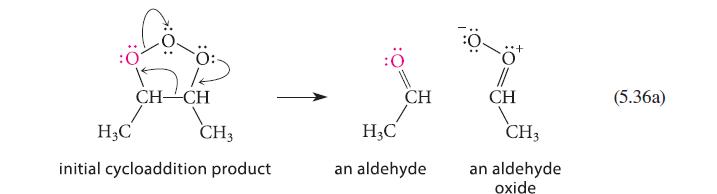
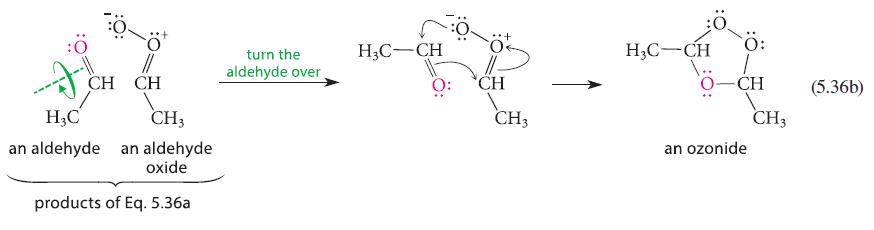
Ozonolysis of 2-pentene gives a mixture of the following three ozonides. Using the mechanism in Eqs. 5.36a and 5.36b, explain the origin of all three ozonides. H₂C-HC A CH-CH3 H₂C-HC B CH-CH₂CH3 CH3CH₂-HC CH-CH₂CH3 b-ó C
From what alkene and by which methods could you prepare each of the following alcohols essentially free of constitutional isomers? (a) OH (b) LOH (c) Et3C-OH (Hint: Draw out the structure!)
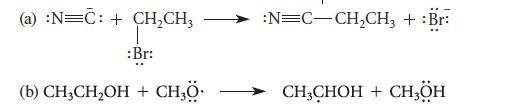
Indicate whether each of the following reactions is homolytic or heterolytic, and tell how you know. Write the appropriate fishhook or curved-arrow notation for each. (a) :N=C:+ CH,CH, CH₂CH3 I :Br: (b) CH₂CH₂OH + CH3Ö. :N=C-CH₂CH3 + : Br: CH3CHOH + CH3OH
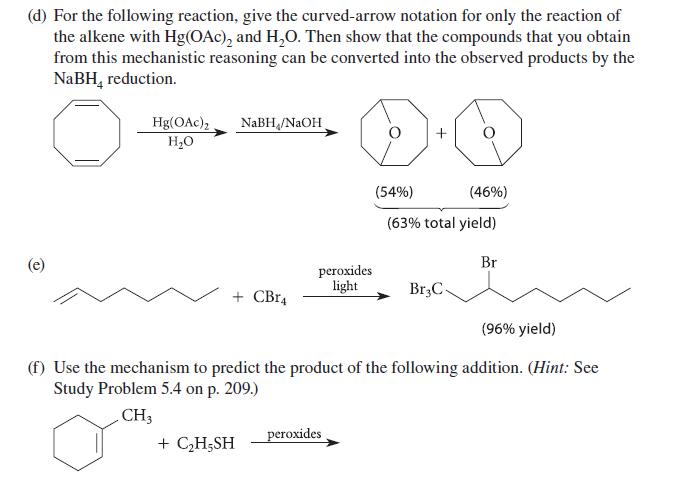
In the presence of light, the addition of Br2 to alkenes can occur by a free-radical mechanism rather than a bromonium-ion mechanism. Write a free-radical chain mechanism that shows the propagation steps for the following addition:Assume that the initiation step for the reaction is the
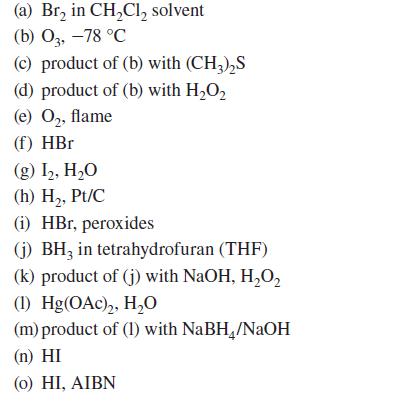
Give the principal organic products expected when 1-butene reacts with each of the following reagents. (a) Br₂ in CH₂Cl₂ solvent (b) 03, -78 °C (c) product of (b) with (CH3)2S (d) product of (b) with H₂O₂ (e) O₂, flame (f) HBr (g) 1₂, H₂O (h) H₂, Pt/C (i) HBr, peroxides (j) BH,
Give the structure the organic product(s) formed when HBr reacts with each of the following alkenes in the presence of peroxides, and explain your reasoning. If more than one product is formed, predict which one should predominate and why.(a) 1-pentene (b) (E)-4,4-dimethyl-2-pentene
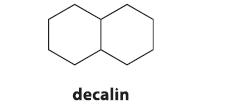
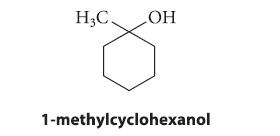
Draw the structure of (a) A six-carbon alkene that would give the same product from reaction with HBr whether peroxides are present or not.(b) Four compounds of formula C10H16 that would undergo catalytic hydrogenation to give decalin:(c) Two alkenes that would yield 1-methylcyclohexanol when
Repeat Problem 5.27 for 1-ethylcyclopentene.Problem 5.27Give the principal organic products expected when 1-butene reacts with each of the following reagents. (a) Br₂ in CH₂Cl₂ solvent (b) 03, -78 °C (c) product of (b) with (CH3)2S (d) product of (b) with H₂O₂ (e) O₂, flame (f) HBr (g)
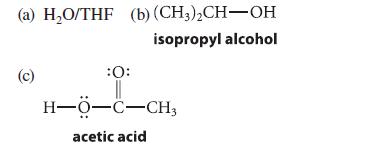
Using the mechanism of the oxymercuration reaction to guide you, predict the product(s) obtained when 1-hexene is treated with mercuric acetate in each of the following solvents and the resulting products are treated with NaBH4/NaOH. Explain your answers and tell what functional groups are present
Using the mechanism of halogen addition to alkenes to guide you, predict the product(s) obtained when 2-methyl-1-butene is subjected to each of the following conditions.Explain your answers.(a) Br2 in CH2Cl2 (an inert solvent)(b) Br2 in H2O(c) Br2 in CH3OH solvent(d) Br2 in CH3OH solvent containing
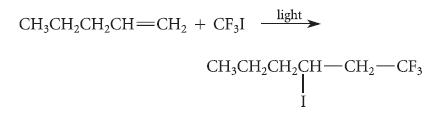
Trifluoroiodomethane undergoes an addition to alkenes in the presence of light by a free-radical chain mechanism.The initiation step of this reaction is the light-induced homolysis of the C—I bond:Using the fishhook notation, write the propagation steps of a free-radical chain mechanism for this
In thermal cracking (Sec. 5.8), bonds generally break homolytically.(a) In the thermal cracking of 2,2,3,3-tetra me thylbutane, which bond would be most likely to break? Explain.(b) Which compound, 2,2,3,3-tetramethylbutane or ethane, undergoes thermal cracking more rapidly at a given temperature?
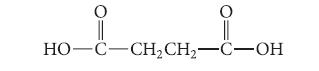
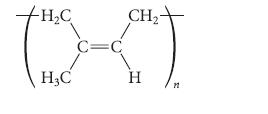
(a) What product would be obtained from the ozonolysis of natural rubber, followed by reaction with H2O2?(b) Gutta-percha is a natural polymer that gives the same ozonolysis product as natural rubber. Suggest a structure for gutta-percha. +H₂C H₂C CH₂ (?) H C=C E
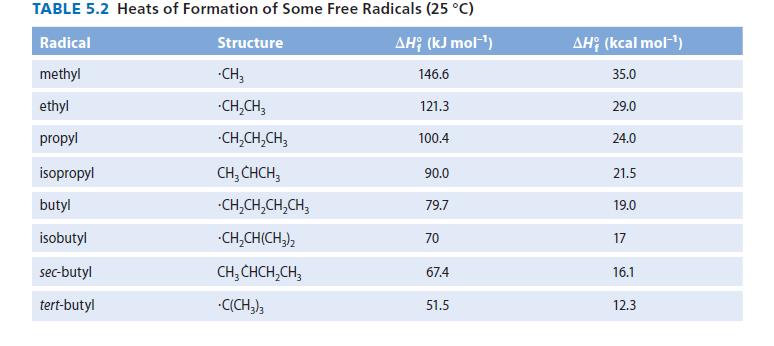
Free-radical addition of thiols (molecules with the general structure RSH) to alkenes is a well-known reaction, and it is initiated by peroxides.(a) Use information found in tables in this chapter plus the following information to calculate the C—S bond dissociation energy for ethanethiol
The halogenation of methane in the gas phase is an industrial method for the preparation of certain alkyl halides and takes place by the following equation (X = halogen):(a) This reaction takes place readily when X = Br or X = Cl, but not when X =i. Show that these observations are expected from
The mechanism for the free-radical polymerization of ethylene shown in Eqs. 5.72a–c (pp. 217–218) is somewhat simplified because it does not account for the observation that low-density polyethylene (LDPE) contains a significant number of branched chains. (The branching accounts for the low
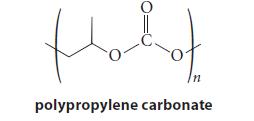
Polypropylene carbonate is considered to be a “green” polymer because it is made from CO2 and is biodegradable.Draw out the structure of polypropylene carbonate for n = 3. (Leave the “dangling bonds” at the ends.) In polypropylene carbonate
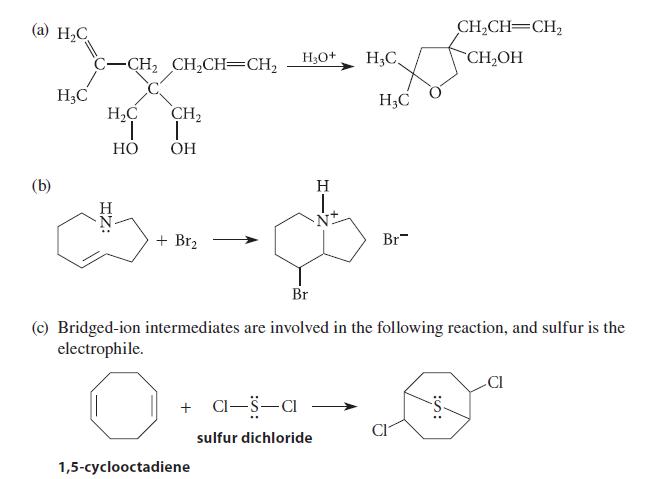
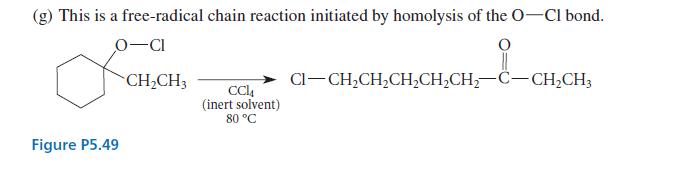
Using the curved-arrow or fishhook notation, as appropriate, suggest mechanisms for each of the reactions given in Fig. P5.49. (a) H₂C (b) H3C C-CH₂ CH₂CH=CH₂ H₂C CH₂ T T HO OH C#yan + Br₂ H3O+ H₂C + CI-S-CI 1,5-cyclooctadiene H .. H₂C Br (c) Bridged-ion intermediates are involved
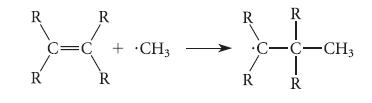
Consider the reaction of a methyl radical (·CH3) with the p bond of an alkene:The relative rates of the reaction shown in Fig. P5.50 were determined for various alkenes.(a) Draw the free-radical product of the reaction in each case and explain.(b) Explain the order of the relative rates. R
Equations 5.25a–c on p. 193 show the formation of trialkylboranes from alkenes and BH3. In the reaction of 2,3-dimethyl-2-butene with BH3, only two equivalents of the alkene react, even with a large excess of alkene, to give a dialkylborane called disiamylborane.Give the structure of
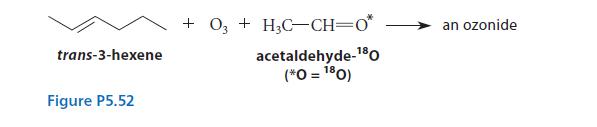
When trans-3-hexene is subjected to ozonolysis in the presence of an excess of acetaldehyde containing the isotope 18O, an ozonide is isolated that contains the isotope at one of the oxygens. Use the mechanism of ozonolysis to postulate a structure for the ozonide, including the position of the
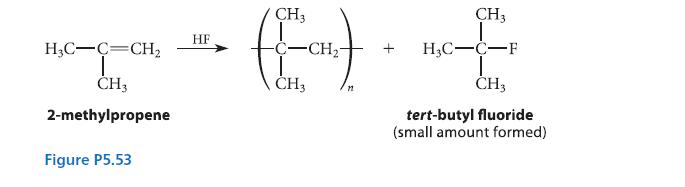
Isobutylene (2-methylpropene) can be polymerized by treating it with liquid HF as shown in Fig. P5.53. A small amount of tert-butyl fluoride is formed in the reaction. Suggest a curved-arrow mechanism for this process, which is an example of cationic polymerization. (Hint: Carbocations are
Showing 1300 - 1400
of 1324
1
2
3
4
5
6
7
8
9
10
11
12
13
14
Step by Step Answers

 Get 50% OFF
Claim Now
Get 50% OFF
Claim Now