New Semester
Started
Get
50% OFF
Study Help!
--h --m --s
Claim Now
Question Answers
Textbooks
Find textbooks, questions and answers
Oops, something went wrong!
Change your search query and then try again
S
Books
FREE
Study Help
Expert Questions
Accounting
General Management
Mathematics
Finance
Organizational Behaviour
Law
Physics
Operating System
Management Leadership
Sociology
Programming
Marketing
Database
Computer Network
Economics
Textbooks Solutions
Accounting
Managerial Accounting
Management Leadership
Cost Accounting
Statistics
Business Law
Corporate Finance
Finance
Economics
Auditing
Tutors
Online Tutors
Find a Tutor
Hire a Tutor
Become a Tutor
AI Tutor
AI Study Planner
NEW
Sell Books
Search
Search
Sign In
Register
study help
sciences
organic chemistry 6th
Organic Chemistry 6th Edition Marc Loudon, Jim Parise - Solutions
A compound contains carbon, hydrogen, oxygen, and one nitrogen. Classify each of the following fragment ions derived from this compound as an odd-electron or an even-electron ion. Explain.(a) The molecular ion(b) A fragment ion of even mass containing one nitrogen(c) A fragment ion of odd mass
In each of the following cases, the labeled protons are constitutionally equivalent. Determine whether the labeled protons in each case are expected to have identical or different chemical shifts. (a) Ha Hb Cl CH3 (b) Ha 1 H3C-C-OH Hb O Ha Cl | | H3C-C-CH-CH3 Hb (d) Ha 1 CH3O-C-OCH3 Hb
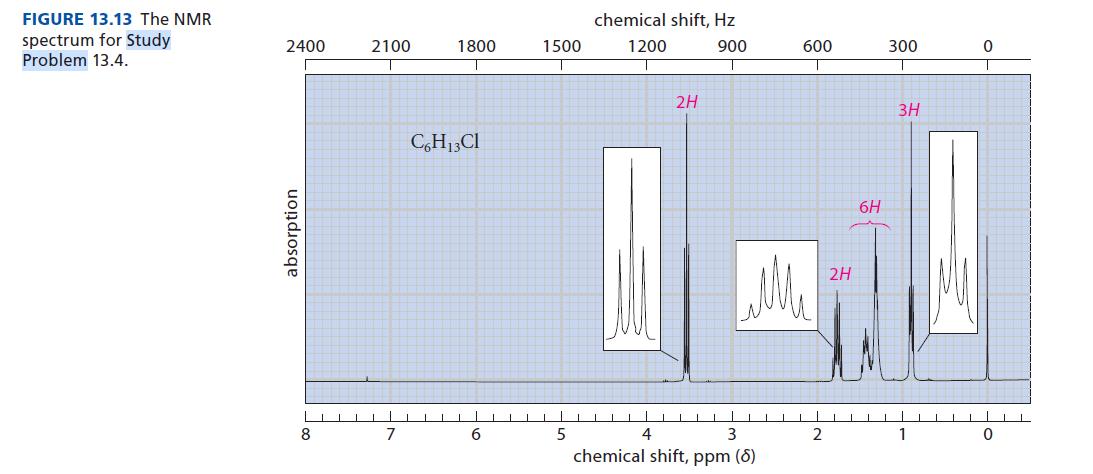
Determine the structure of the compound with the formula C6H13Cl that has the NMR spectrum shown in Fig. 13.13. FIGURE 13.13 The NMR spectrum for Study Problem 13.4. 2400 absorption 8 2100 7 1800 C6H13Cl 6 1500 chemical shift, Hz 1200 900 TIL 5 2H 600 Me 4 3 chemical shift, ppm
A compound C8H18O2 with a strong, broad infrared absorption at 3293 cm–1 has the following proton NMR spectrum:(The resonance at d 1.96 disappears when the sample is shaken with D2O.) The proton-decoupled 13C NMR spectrum of this compound consists of three lines, with the following chemical
An unknown compound with the molecular formula C5H11Br has an NMR spectrum consisting of two resonances, one at δ 1.02 (relative integral 8378 units), and the other at δ 3.15 (relative integral 1807 units). Propose a structure for this compound.
A compound C7H16O3 has the following 13C NMR-DEPT spectrum (the numbers in parentheses indicate the number of attached hydrogens):Propose a structure for this compound. 8 15.2 (3), 8 59.5 (2), 8 112.9 (1)
How would you use 13C NMR spectroscopy to differentiate the two isomers 1-chloropentane and 3-chloropentane?
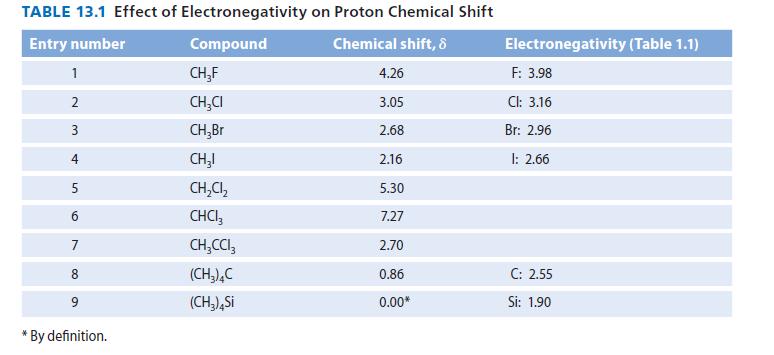
(a) Consider entries 1 through 4 of Table 13.1. How does the chemical shift of a proton vary with the electronegativity of the neighboring halogen?(b) Compare entries 2, 5, and 6 of Table 13.1. How does chemical shift vary with the number of neighboring halogens?(c) Compare entries 6 and 7. How is
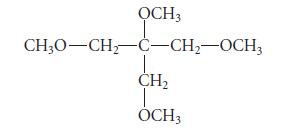
Predict the NMR spectrum, including approximate chemical shifts, of the following compound. Explain your reasoning. OCH3 CH3O-CH₂-C-CH₂-OCH3 CH₂ OCH3
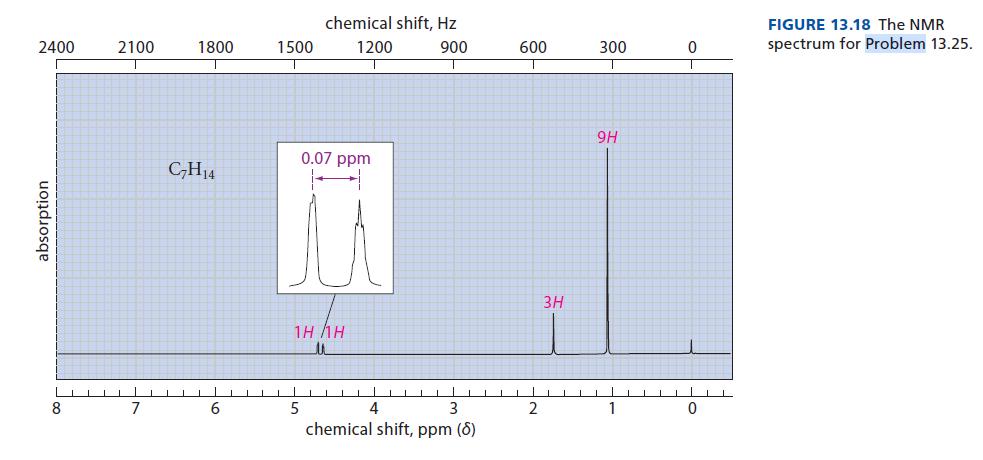
Propose a structure for a compound with the formula C7H14 with the NMR spectrum shown in Fig. 13.18. Explain in detail how you arrived at your structure. 2400 absorption Lii 8 2100 7 1800 C₂H14 6 1500 chemical shift, Hz 1200 900 5 0.07 ppm 1H /1H u 4 3 chemical shift, ppm
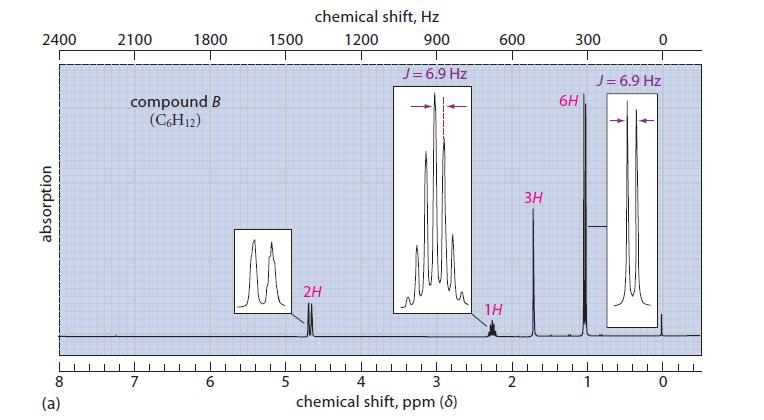
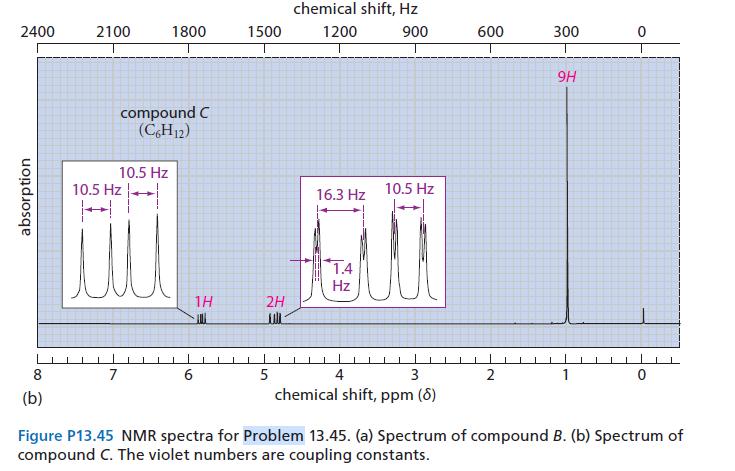
Each of four bottles, A, B, C, and D, is labeled only “C6H12” and contains a colorless liquid. You have been called in as an expert to identify these compounds from their spectra:Compound A:NMR: one line only at δ 1.66 (s); IR: no absorption in the range 1620–1700 cm–1; reacts with Br2 in
Suggest structures for each of the following compounds. (a) C4H₁0O; 8 1.27 (9H, s); 8 1.92 (1H, broad s; disappears after D₂O shake) (b) C5H₁O: 8 1.78 (3H, s); 8 1.83 (3H, s); 8 2.18 (1H, broad s; disappears after D₂O shake); 8 4.10 (2H, d, J = 7 Hz); 8 5.40 (1H, t, J = 7 Hz)
Explain how the NMR spectra of (a) 3-methyl-2-buten-1-ol and (b) 1,2,2-trimethyl-1-propanol would change following a D2O shake.
Suggest structures for compounds with the following proton NMR spectra. (a) C₂H₁0O: 8 1.13 (3H, t, J = 7 Hz); 8 3.38 (2H, q, J = 7 Hz) 10 (b) C₂H5F₂Cl: 8 1.75 (3H, t, J = 17.5 Hz); 8 3.63 (2H, t, J = 13 Hz)
Suppose you were able to cool a sample of 1-bromo-1,1,2-trichloroethane enough that rotation about the carbon–carbon bond becomes slow on the NMR time scale. What changes in the NMR spectrum would you anticipate? Be explicit.
Indicate two things you would look for in their 13C NMR spectra to distinguish between 1,1-dichlorocyclohexane and cis-1,2-dichlorocyclohexane.
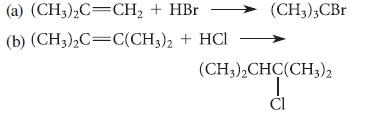
Suppose you wish to carry out the following reactions and you have the NMR spectrum of each starting material. In each case, explain what evidence you would look for in the NMR spectra to verify that the reactions have proceeded as shown. (a) (CH3)₂C=CH₂ + HBr (b) (CH3)₂C=C(CH3)2 +
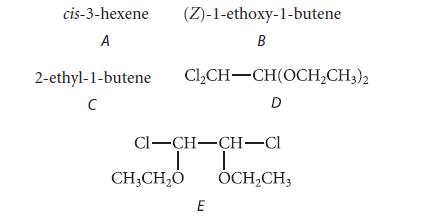
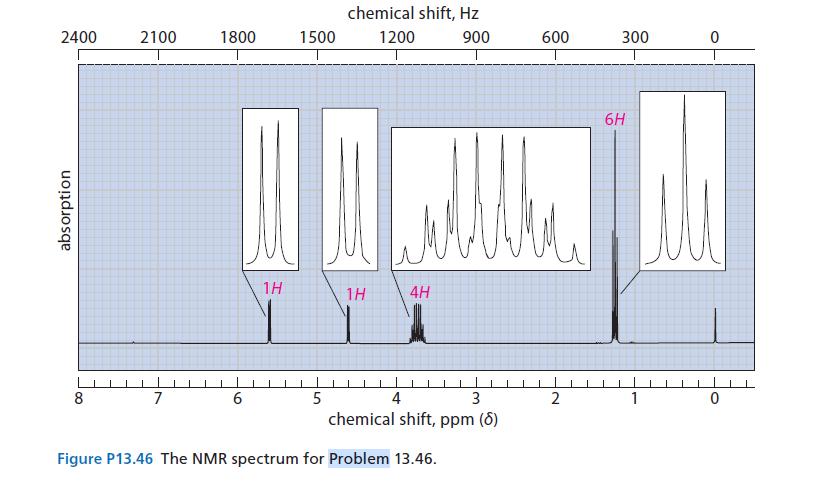
To which of the following compounds does the NMR spectrum shown in Fig. P13.46 belong? Explain your choice carefully. Once you have made your choice, explain why the resonance at δ 3.7 is so complex. cis-3-hexene (Z)-1-ethoxy-1-butene A B 2-ethyl-1-butene
What four primary types of information are available from an NMR spectrum? How is each used?
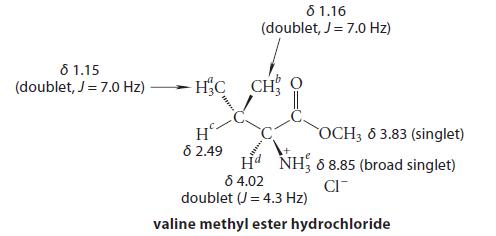
The proton NMR spectrum of valine methyl ester hydrochloride is summarized at the top of the next column.Note that protons He are not split by Hd (and vice versa) because protons He are rapidly exchanging. Also, the chemical shifts of protons Ha and Hb could be reversed; the important point is that
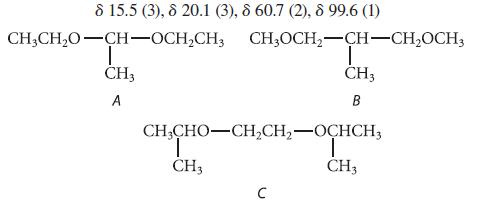
To which of the following compounds does the following 13C NMR-DEPT spectrum belong (attached protons in parentheses): 8 15.5 (3), 8 20.1 (3), 8 60.7 (2), 8 99.6 (1) CH3CH₂0-CH-OCH₂CH3 CH3OCH₂-CH-CH₂OCH3 ī CH3 I CH3 B A TH CHO CH3 CH3CHO-CH₂CH₂-OCHCH3 C T CH3
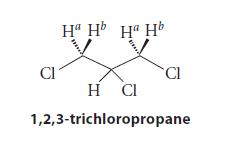
The two protons Ha and Hb in 1,2,3-trichloropropane have slightly different chemical shifts, and the splitting pattern of each is a doublet of doublets. For one proton, J 5 9.0 Hz and 4.9 Hz; for the other, J 5 9.0 Hz and 6.0 Hz.(a) Explain why Ha and Hb have different chemical shifts.(b) Explain
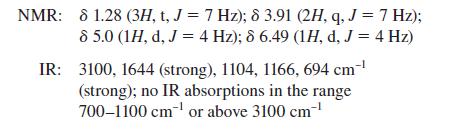
Propose a structure for the compound that has the following spectra:Mass spectrum: m/z = 152, 150 (equal intensity; double molecular ion) NMR: 81.28 (3H, t, J = 7 Hz); 8 3.91 (2H, q, J = 7 Hz); 8 5.0 (1H, d, J = 4 Hz); 8 6.49 (1H, d, J = 4 Hz) IR: 3100, 1644 (strong), 1104, 1166, 694
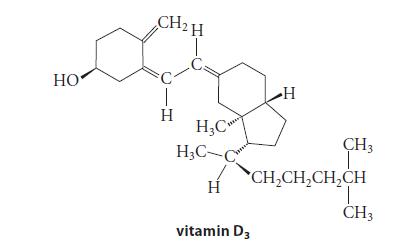
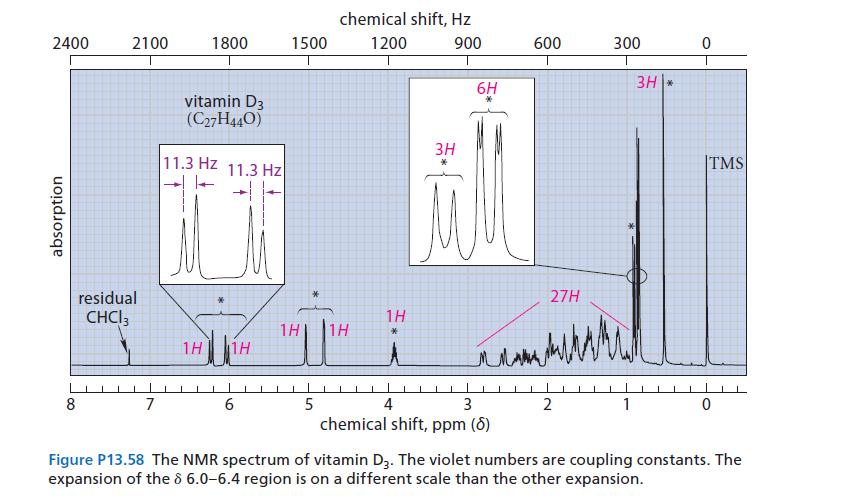
The NMR spectrum of vitamin D3 is given in Fig. P13.58.Interpret the resonances marked with asterisks (*) by indicating the part of the structure to which they correspond.(Do not try to assign the individual resonances within the groups.) Explain your choices. HO CH₂H H H₂C H₂C- H H vitamin
You work for a reputable chemical supply house. An angry customer, Fly Ofterhandle, has called, alleging that a sample of 2,5-hexanediol he purchased cannot be the correct compound. As evidence, he cites its 13C NMR spectrum:(Notice that the spectrum contains three sets of two closely spaced
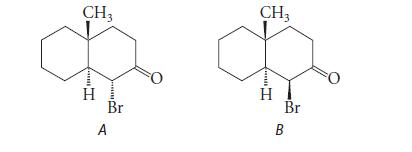
A reaction has yielded a mixture of the following two stereoisomers. Explain how you would use proton NMR to determine which is which. CH3 HH. T Br A CH3 H Br B
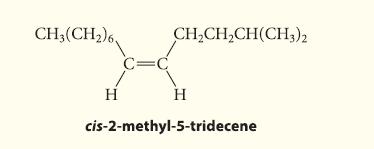
Outline a synthesis of the following compound from acetylene and any other compounds containing no more than five carbons: CH3(CH₂)6, CH,CH,CH(CH3)2 C=C H H cis-2-methyl-5-tridecene
17O is a rare isotope that has a nuclear spin. The 17O NMR of a small amount of water dissolved in CCl4 is a triplet (intensity ratio 1 : 2 : 1). When water is dissolved in the strongly acidic HF-SbF5 solvent, its 17O NMR becomes a 1 : 3 : 3 : 1 quartet. Suggest a reason for these observations.
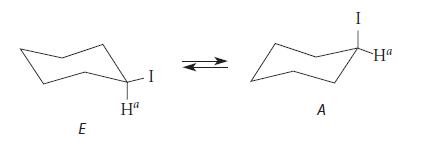
The NMR spectrum of iodocyclohexane was taken at 280 °C. At that temperature, the chair interconversion is slow and each chair conformation can be observed separately.The resonance of proton Ha is well resolved from the rest of the spectrum because of its unique chemical shift. The resonance of
Carbon–carbon splitting is not apparent in naturalabundance 13C NMR spectra because of the rarity of the 13C isotope. However, it can be observed in compounds that are enriched in 13C. A chemist, Buster Magnet, has just completed a synthesis of CH3CH2Br that contains 50% 13C at each position.
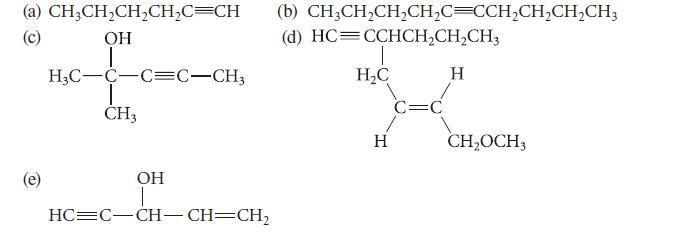
Provide the substitutive name for each of the following compounds. Also provide common names for (a) and (b). (a) CH3CH₂CH₂CH₂C=CH (c) (e) OH T H3C-C-C=C-CH3 T CH3 OH HC=C–CH–CH=CH, (b) CH3CH₂CH₂CH₂C=CCH₂CH₂CH₂CH3 (d) HC CCHCH₂CH₂CH3 H₂C H C=C H CH₂OCH3
A student consulted a well-known compilation of reference spectra for the proton NMR spectrum of propyne and was surprised to find that this spectrum consists of a single unsplit resonance at d 1.8. Believing this to be an error, he comes to you for an explanation. Explain to him why it is
Give the product that results from the addition of one equivalent of Br2 to 3-hexyne. What are the possible stereoisomers that could be formed?
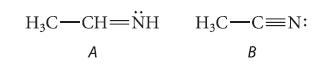
Each of the following compounds protonates on nitrogen. Draw the conjugate acid of each. Which compound is more basic? Explain. HỌC–CH=NH H₂C-C=N: A B
(a) Ion A is more acidic than ion B in the gas phase. Is this the acidity order predicted by hybridization arguments? Explain.(b) Ion B is less acidic because it is stabilized by resonance, whereas ion A is not. Show the resonance structure for ion B, and, with the aid of an energy diagram, show
Explain why graduate student Choke Fumely, in attempting to synthesize 4,4-dimethyl-2-pentyne using the reaction ofwith tert-butyl bromide, obtained none of the desired product. What product did he obtain? H₂C-C=C: Nat
In the course of the synthesis of the sex attractant of the grape berry moth, both the cis and trans isomers of the following alkene were needed.(a) Outline a synthesis of the cis isomer of this alkene from the following alkyl halide and any other organic compounds.(b) Outline a synthesis of the
Propose a synthesis of 4,4-dimethyl-2-pentyne from an alkyl halide and an alkyne.
Outline two different preparations of 2-pentyne that involve an alkyne and an alkyl halide.
The following compound is an intermediate in one synthesis of the mating pheromone of the female Indian meal moth. Show how this compound can be converted into the pheromone in a single reaction. H H₂C C=C CH₂-C=C-CH₂CH₂CH₂CH₂CH₂CH₂CH₂CH₂0-C-CH3 H
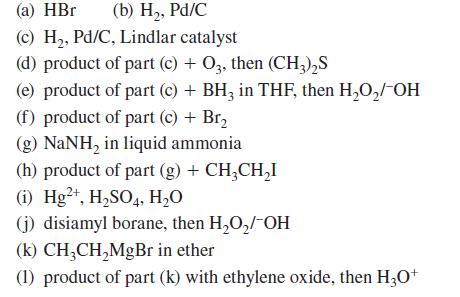
Give the principal product(s) expected when 1-hexyne or the other compounds indicated are treated with each of the following reagents: (a) HBr (b) H₂, Pd/C (c) H₂, Pd/C, Lindlar catalyst (d) product of part (c) + O3, then (CH3)₂S (e) product of part (c) + BH3 in THF, then H₂O₂/-OH (f)
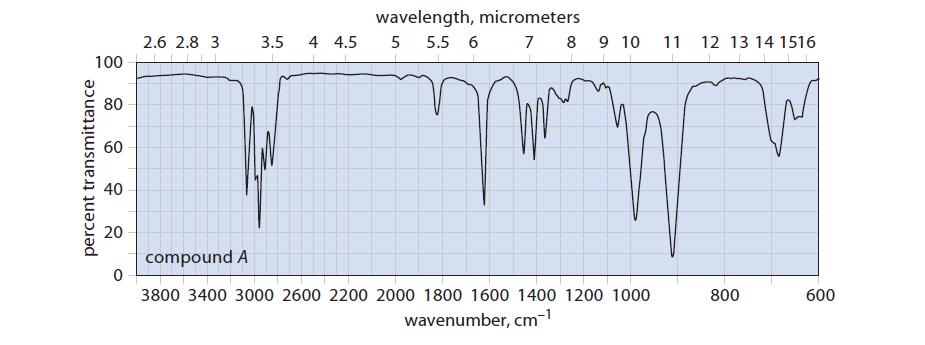
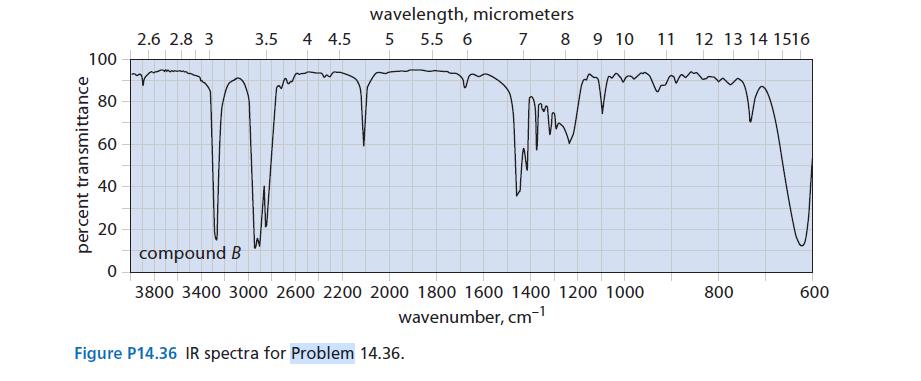
A box labeled “C6H10 isomers” contains samples of three compounds: A, B, and C. Along with the compounds are the IR spectra of A and B, shown in Fig. P14.36. Fragmentary data in a laboratory notebook suggest that the compounds are 1-hexyne, 2-hexyne, and 3-methyl-1,4-pentadiene. Identify the
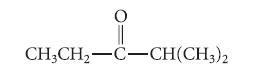
(a) Draw the structures of all enols that would spontaneously form the following ketone, including stereoisomers.(b) Would alkyne hydration be a good preparative method for this compound? If so, give the reaction. If not, explain why. CH3CH₂-C-CH(CH3)2
In each case, draw a structure containing only carbon and hydrogen that satisfies the indicated criterion.(a) A stable alkyne of five carbons containing a ring(b) A chiral alkyne of six carbon atoms(c) An alkyne of six carbon atoms that gives the same single product in its reaction either with BH3
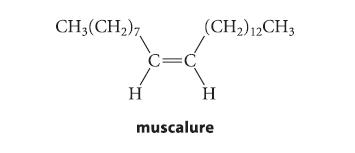
You have just been hired by Triple Bond, Inc., a company that specializes in the manufacture of alkynes containing five or fewer carbons. The President, Mr. Al Kyne, needs an outlet for the company’s products. You have been asked to develop a synthesis of the housefly sex pheromone, muscalure,
(a) When the reduction of alkynes to alkenes by Na in liquid ammonia is attempted with a 1-alkyne, every three moles of 1-alkyne give only one mole of alkene and two moles of the acetylenic anion:Explain this result using the mechanism of this reduction and what you know about the acidity of
Arrange the following three carboxylic acids in order of increasing acidity (decreasing pKa). Explain your reasoning. H,C=CHCH,CO,H HC=CCH,CO,HCH,CH,CH,CO,H A B C
An optically active alkyne A (C10H14) can be catalytically hydrogenated to butylcyclohexane. Treatment of A with EtMgBr liberates no gas. Catalytic hydrogenation of A over Pd/C in the presence of quinoline poison and treatment of the product with O3 and then H2O2 gives an optically active
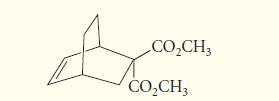
Give the structure of the diene and dienophile that would react in a Diels–Alder reaction to give the following product: CO₂CH3 CO₂CH3
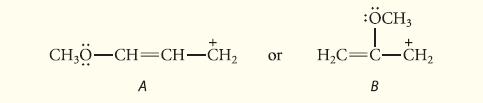
Which of the following carbocations is more stable? + CH₂0-CH=CH-CH₂ or A :ÖCH, 1 H₂C=C-CH₂ B +
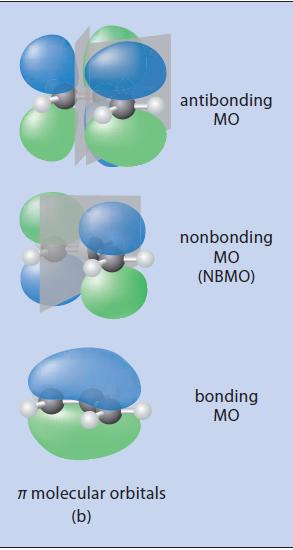
The conjugated triene (E)-1,3,5-hexatriene has six π molecular orbitals with relative energies ±1.80β, ±1.25β, and ±0.44β.(a) Sketch these MOs. Indicate which are bonding and which are antibonding. (b) Tell how many nodes each has. (c) Show the position of the nodes in π1, π2, and π6*.
Predict the relative reactivity of the following two compounds in an SN1 solvolysis reaction. CH₂OCH₂CH₂Cl CH₂CH₂OCH₂Cl 1-chloro-2-methoxyethane (chloromethoxy)ethane A B
Calculate the delocalization energy for (E)-1,3,5-hexatriene.
Draw the s-cis and s-trans conformations of (2E,4E)-2,4-hexadiene and (2E,4Z)-2,4-hexadiene. Which diene contains the greater proportion of the gauche conformation? Why? (Use the s-cis conformation as an approximation of the gauche conformation.)
Use the Frost circle to determine the energy levels and electron occupancies for the π MOs of benzene.
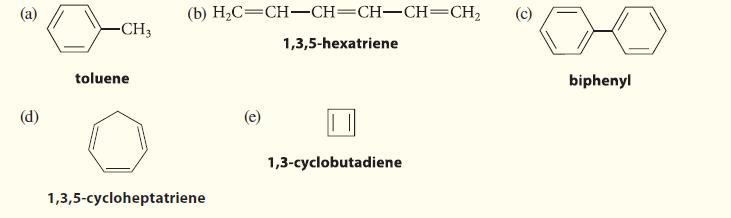
Decide whether each of the following compounds is aromatic. Explain your reasoning. (a) (d) -CH3 toluene (b) H₂C=CH-CH=CH-CH=CH₂ 1,3,5-hexatriene 1,3,5-cycloheptatriene (e) 1,3-cyclobutadiene (c) biphenyl
Explain why there is a larger difference between the heats of formation of (E)-1,3 - pentadiene and 1,4-pentadiene (29.3 kJ mol–1 or 7.1 kcal mol–1) than between (E)-1,3- hexadiene and (E)-1,4-hexadiene (19.7 kJ mol–1 or 4.7 kcal mol–1).
What is the energy of light (in kJ mol–1 or kcal mol–1) with a wavelength of(a) 450 nm? (b) 250 nm?
(a) What percent of the incident radiation is transmitted by a sample when its absorbance is 1.0? When its absorbance is 0?(b) What is the absorbance of a sample that transmits one-half of the incident radiation intensity?
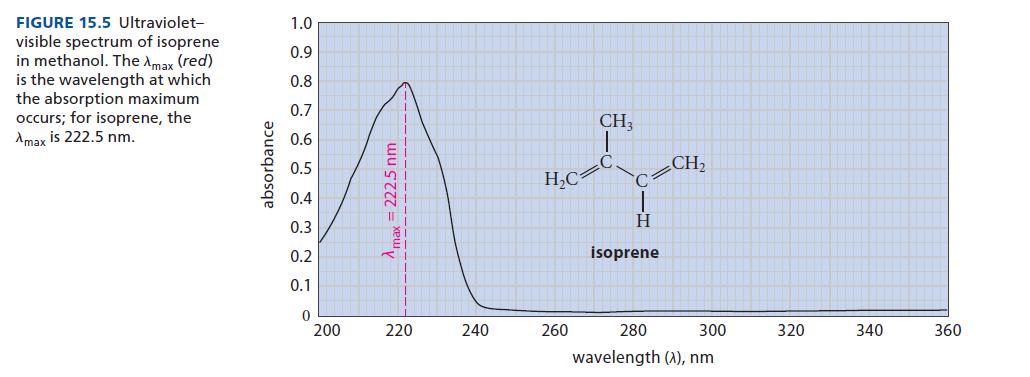
(a) From the extinction coefficient of isoprene (10,750 M–1 cm–1) and its observed absorbance at 222.5 nm (Fig. 15.5), calculate the concentration of isoprene in mol L–1 (assume a 1 cm light path).(b) From the results of part (a) and Fig. 15.5, calculate the extinction coefficient of isoprene
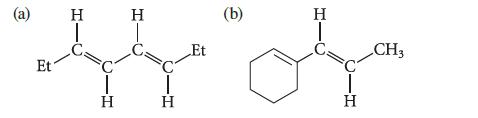
Predict λmax for the UV absorption of each of the following compounds. (a) Et H T H H T H Et (b) H T H CH3
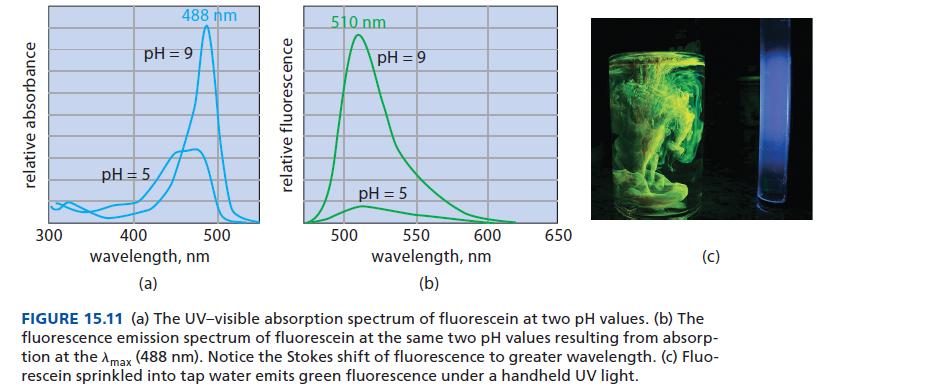
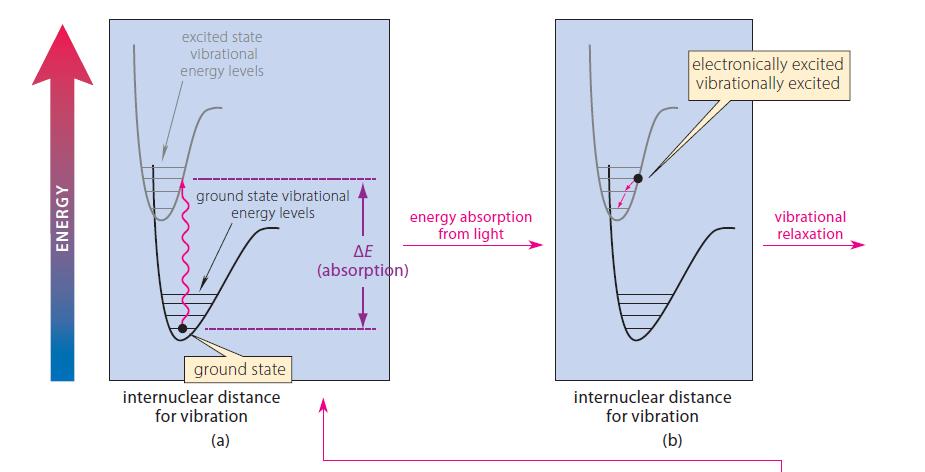
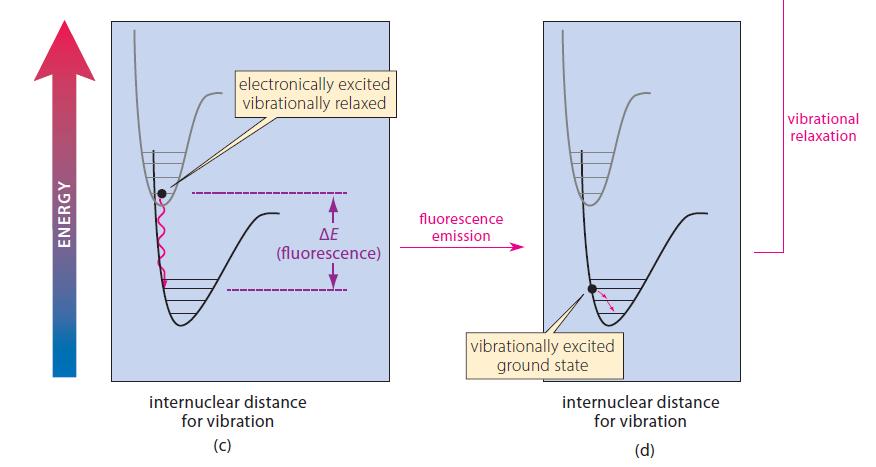
Refer to Fig. 15.11. At what pH does the fluorescence of fluorescein have the greater quantum yield, pH = 9 or pH = 5? How do you know? relative absorbance 300 488 nm pH=9 pH = 5 400 wavelength, nm (a) 500 relative fluorescence 510 nm pH=9 pH = 5 500 600 550 wavelength, nm (b) 650 (C) FIGURE 15.11
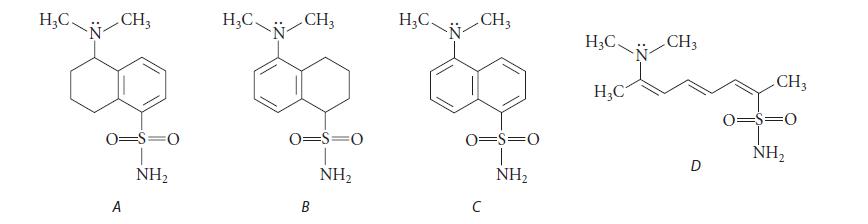
One of the following compounds has an intense yellow fluorescence when irradiated with UV light. Which one do you think it is, and why? H₂C. CH3 0=S=O A NH₂ H₂C. N CH₂ 0=S=0 NH₂ B H₂C. CH3 0=S=0 NH₂ C H3C. H₂C CH3 D CH3 0=$=0 NH₂
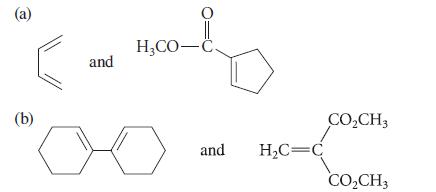
What products are formed in the Diels–Alder reactions of the following dienes and dienophiles? (a) (b) and H₂CO-C. and H₂C=C CO₂CH3 CO₂CH3
Give the diene and dienophile that would react in a Diels–Alder reaction to give each of the following products. (a) CN (b) CO₂CH3
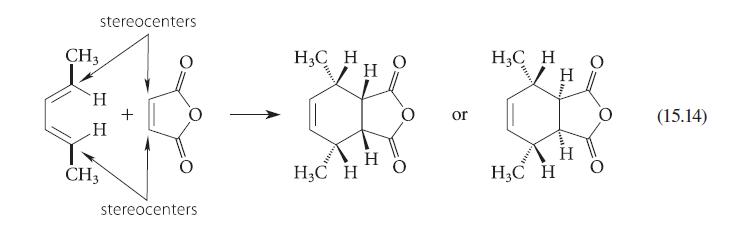
(a) In the products of Eq. 15.14, the observed stereochemistry at the ring fusion is not specified. Show this stereo chemistry, assuming that the Diels–Alder reaction gives the endo product.(b) Sketch diagrams like the one in Fig. 15.10 (without the orbitals) that shows the approach of the diene
(a) What product would be expected from the Diels–Alder reaction of 1,3-butadiene as the diene and ethylene as the dienophile?(b) This product is actually not observed under ordinary conditions because 1,3-butadiene reacts with itself faster than it does with ethylene. In this reaction, one
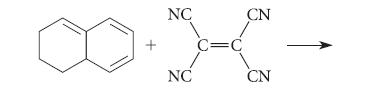
Complete the following Diels–Alder reaction. NC NC =C CN CN
A mixture of 0.1 mole of (2E,4E)-2,4-hexadiene and 0.1 mole of (2E,4Z)-2,4-hexadiene was allowed to react with 0.1 mole of TCNE. After the reaction, the unreacted diene was found to consist of only one of the starting 2,4-hexadiene isomers. Which isomer did not react? Explain.
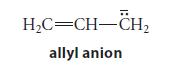
(a) The allyl anion has an unshared electron pair on the allylic carbon:This anion has two more π electrons than the allyl cation. Use the molecular orbital diagram in Fig. 15.14b to decide which molecular orbital these “extra electrons” occupy.(b) According to the molecular orbital
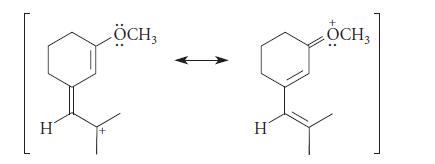
In each of the following sets, show by the curved-arrow notation how each resonance structure is derived from the other one, and indicate which structure is more important and why. @ [:c=ö< :c=] [H_c–c=NH carbon monoxide (CH,),Č–CH=CH, (c)[(CH₂)₂C=CH-CH₂ H3)2 N: CH3 + CH3 H₂C-C=NH]
(a) Break down the following resonance interaction into four separate resonance structures (counting the two below), each connected to the next by one curved arrow.(b) Draw a hybrid structure corresponding to the ion in part (a) containing dashed lines and partial charges. H ÖCH3 H OCH3
Suggest structures for the two constitutional isomers formed when 1,3-butadiene reacts with one equivalent of Br2. (Ignore any stereochemical issues.) Which of these products would predominate if the two were brought to equilibrium?
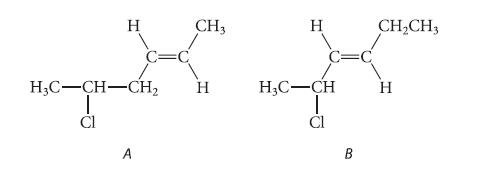
The following isomers do not differ greatly in stability. Predict which one should react more rapidly in an SN1 solvolysis reaction in aqueous acetone. Explain. H C=C A CH3 H3C-CH-CH₂ H Cl H H₂C-CH Cl B CH₂CH3 H
(a) The following resonance-stabilized ion can protonate to give two different constitutional isomers. Give their structures and give the curved-arrow notation for their formation.(b) One of the compounds in Problem 15.32 gives two different constitutional isomers as a product of its SN1 reaction
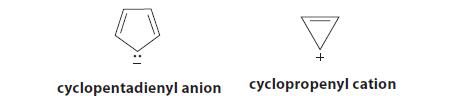
Use a Frost circle to determine the π-electron structure of (a) The cyclopentadienyl anion, which has a planar structure and six π electrons; and (b) The cyclopropenyl cation, which has two π electrons. cyclopentadienyl anion cyclopropenyl cation
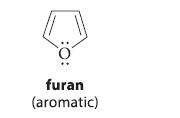
Furan is an aromatic compound. Discuss the hybridization of its oxygen and the geometry of its two electron pairs. furan (aromatic)
How many bonding MOs are there in a planar, cyclic, conjugated hydrocarbon that contains a ring of 10 carbon atoms? How many π electrons does it have? How many of the π electrons can be accommodated in the bonding MOs?
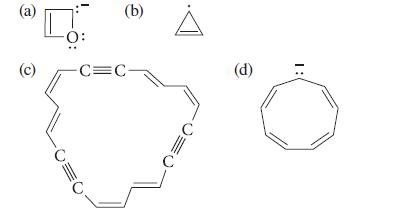
Which of the following species should be aromatic by the Hückel 4n + 2 rule? (a) thiophene G O H H (d) N: isoxazole :0: B Et
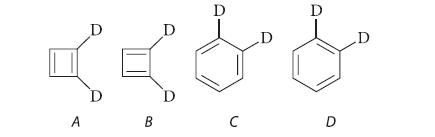
Using the theory of aromaticity, explain the finding that A and B are different compounds, but C and D are identical. (That A and B are different molecules was established by Prof. Barry Carpenter and his students at Cornell University in 1980.) A D D B D D C D D D D
Which of the compounds or ions in Problem 15.38 are likely to be antiaromatic? Explain.Problem 15.38Which of the following species should be aromatic by the Hückel 4n + 2 rule? (a) thiophene G O H H (d) N: isoxazole :0: B Et
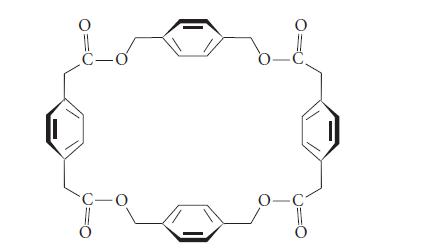
The following molecule has a barrel shape (in which the benzene rings are the “walls” of the barrel). It forms a noncovalent complex with the iodide salt of acetylcholine in chloroform solvent.Describe the orientation of the acetylcholine molecule within the complex. O C-o C-O 8 O -C₂ 0-C
Using the Hückel 4n + 2 rule, determine whether each of the following compounds is likely to be aromatic. Explain how you arrived at the π-electron count in each case. (a) (c) CO (b) -C=C- (d) :1
Give the principal product(s) expected, if any, when trans-1,3-pentadiene reacts under the following conditions. Assume one equivalent of each reagent reacts unless noted otherwise.(a) Br2 (dark) in CH2Cl2 (b) HBr(c) H2 (two molar equivalents), Pd/C(d) H2O, H3O+ (e) Na+ EtO– in EtOH(f) Maleic
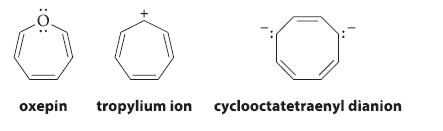
Which of the following molecules is likely to be planar and which nonplanar? Explain. :O: oxepin tropylium ion cyclooctatetraenyl dianion
A colleague, Ima Hack, has subjected isoprene to catalytic hydrogenation to give isopentane. Hack has inadvertently stopped the hydrogenation prematurely and wants to know how much unreacted isoprene remains in the sample. The mixture of isoprene and 2-methylbutane (75 mg total) is diluted to one
How would the color of b-carotene be affected by treatment of the compound with a large excess of H2 over a Pt/C catalyst? Explain.
Fluorescein was once used to color the Chicago River green on St. Patrick’s Day until it was subsequently replaced with a vegetable dye. One problem with fluorescein was that the green color required bright sunshine for maximum effect—definitely a problem for Chicago in March! Explain this
If a solution of fluorescein at pH = 9 is subjected to visible light at 488 nm, it has maximum fluorescence at 510 nm. Calculate the energy difference between the absorbed and fluorescing radiation in kJ mol–1.
Draw as many resonance structures as you can for (a) The form of fluorescein present at pH = 9, and (b) The fluorescent group of the green fluorescent protein.Use the curved-arrow notation to derive your structures.Be sure in both cases that an unshared electron pair on the anionic oxygen is
A chemist, I. M. Shoddy, has just purchased some compounds in a going-out-of-business sale from Pybond, Inc., a cut-rate chemical supply house. The company, whose motto is “You get what you pay for,” has sent Shoddy a compound A at a bargain price in a bottle labeled only “C6H10.”
Account for the fact that the antibiotic mycomycin is optically active.
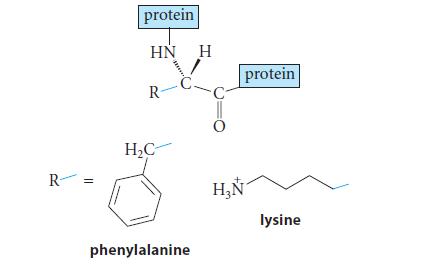
If a lysine residue and a phenylalanine residue are located close to each other in a protein structure, describe how you would expect them to be oriented for the most favorable interaction. R || protein HN H R- H₂C phenylalanine -C 0 protein H₂Ń lysine
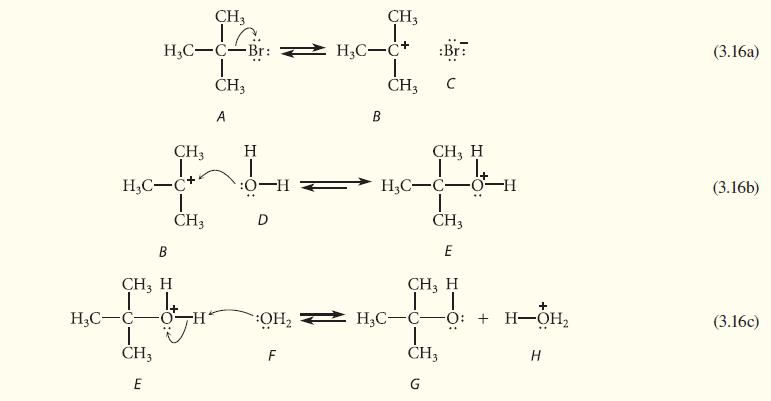
Following is a series of acid–base reactions that represent the individual steps in a known organic transformation, the replacement of —Br by —OH at a carbon bearing three alkyl groups. Considering only the forward direction, classify each reaction as a Brønsted acid–base reaction or a
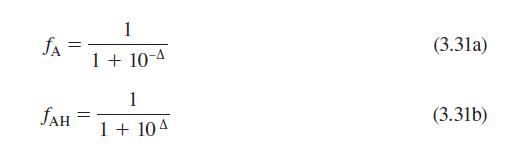
Let pH - pKa = Δ. Starting with Eqs. 3.30c and 3.30d, derive Eqs. 3.31a and 3.31b. fA= = 10-PK₁ 10 PK + 10-PH (3.30c)
(a) Which acid is the strongest in Problem 3.13?(b) Which acid is the strongest in Problem 3.14?Problem 3.13What is the pKa of an acid that has each of the following dissociation constants?Problem 3.14What is the dissociation constant of an acid that has each of the following pKa values?(a) 4 (b)
Acetic acid, CH3CO2H, is a carboxylic acid with pKa = 4.76. What is the fraction of acetic acid dissociated (fA) if 0.1 mole of acetic acid is dissolved in pure water?
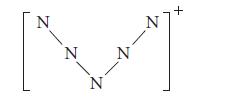
A scientist at an Air Force Research Laboratory in California has studied “highly energetic materials” (explosive materials) and, more significantly, has lived to tell about it. In 2000, he and his equally adventurous collaborators determined the X-ray crystal structure of the N5+ cation; most
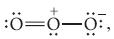
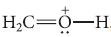
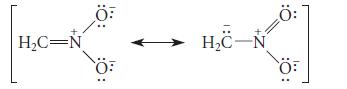
Use the curved-arrow notation to derive resonance structures that convey the following ideas. In each case, draw a single hybrid structure using dashed lines and partial charges that conveys the same meaning as the resonance sructures.(a) The outer oxygens of ozone,have an equal amount of negative
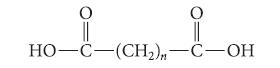
Malonic acid has two carboxylic acid groups and consequently undergoes two ionization reactions. The pKa for the first ionization of malonic acid is 2.86; the pKa for the second is 5.70. The pKa of acetic acid is 4.76.(a) Write out the equations for the first and second ionizations of malonic
Showing 800 - 900
of 1324
1
2
3
4
5
6
7
8
9
10
11
12
13
14
Step by Step Answers

 Get 50% OFF
Claim Now
Get 50% OFF
Claim Now


















![@ [:c= < :c=] [H_cc=NH carbon monoxide (CH,),CH=CH, (c)[(CH)C=CH-CH H3)2 N: CH3 + CH3 HC-C=NH]](https://dsd5zvtm8ll6.cloudfront.net/images/question_images/1701/4/2/9/3986569c0968fb0b1701429394807.jpg)


![JAH = [AH] [A] + [AH] [AH] (K[AH]/[H3O+]) + [AH] = [H3O+] K + [H3O+] a 10-PH 10-PK + 10-PH (3.30d)](https://dsd5zvtm8ll6.cloudfront.net/images/question_images/1701/3/1/8/17165680e1b9bff21701318171525.jpg)