New Semester
Started
Get
50% OFF
Study Help!
--h --m --s
Claim Now
Question Answers
Textbooks
Find textbooks, questions and answers
Oops, something went wrong!
Change your search query and then try again
S
Books
FREE
Study Help
Expert Questions
Accounting
General Management
Mathematics
Finance
Organizational Behaviour
Law
Physics
Operating System
Management Leadership
Sociology
Programming
Marketing
Database
Computer Network
Economics
Textbooks Solutions
Accounting
Managerial Accounting
Management Leadership
Cost Accounting
Statistics
Business Law
Corporate Finance
Finance
Economics
Auditing
Tutors
Online Tutors
Find a Tutor
Hire a Tutor
Become a Tutor
AI Tutor
AI Study Planner
NEW
Sell Books
Search
Search
Sign In
Register
study help
sciences
organic chemistry 6th
Organic Chemistry 6th Edition Marc Loudon, Jim Parise - Solutions
What is the stereochemistry of the 2,3-butanediol formed when meso-2,3-dimethyloxirane reacts with aqueous sodium hydroxide?
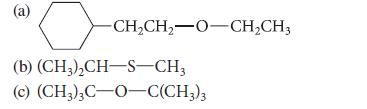
Suggest a Williamson ether synthesis, if one is possible, for each of the following compounds. If no Williamson ether synthesis is possible, explain why. (a) CH,CH,−O−CH,CH, (b) (CH3)₂CH-S-CH3 (c) (CH3)3C-0-C(CH3)3
(a) Write the mechanism of Eq. 11.8a and account for the regioselectivity of the reaction.(b) Explain what would happen in an attempt to synthesize the ether product of Eq. 11.8b by a Williamson ether synthesis. 1-hexene + Hg(OAc)₂ +
Calculate the proximity effect for the intramolecular reaction in Eq. 11.61b given that its rate is 3200 times greater than its intermolecular counterpart. EtSCH₂CH₂Cl + H₂O ß-chloroethyl ethyl sulfide 20 M water dioxane 100 °C EtSCH₂CH₂-OH + HCl 2-(ethylthio)ethanol 3200 (11.61b)
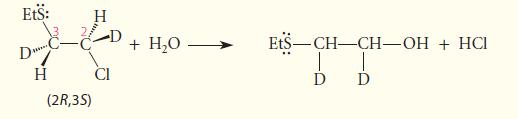
Indicate the stereochemical outcome of the following substitution reaction (a) If neighboring-group participation does not occur, and (b) If neighboring-group participation takes place. EtS: D Η H 20+140 + H₂O CI (2R,3S) EtS-CH-CH-OH + HCI --- D D
Outline a synthesis of 1-hexanol from 1-butanol and any other reagents.
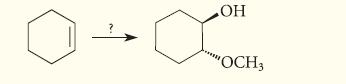
Outline a synthesis of (±)-trans-2-methoxycyclohexanol from cyclohexene. P. ОН с "OCH3
Outline a synthesis of each of the following ethers using alkoxymercuration–reduction:(a) Dicyclohexyl ether (b) Tert-butyl isobutyl ether
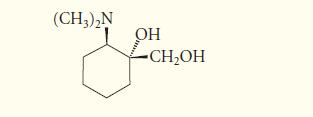
Outline a synthesis of the following compound as a single enantiomer. (CH₂)₂N OH -CH₂OH
Explain why the dehydration of primary alcohols can only be used for preparing symmetrical ethers. What would happen if a mixture of two different alcohols were used as the starting material in this reaction?
Give the structure of the alkene that would react with mCPBA to give each of the following epoxides. (b) Me₂C-CH₂ O Ph" H **** CH3 H Ph **** H C-C-H CH3
Outline a synthesis of each ether using either alcohol dehydration or alkene addition, as appropriate.(a) ClCH2CH2OCH2CH2Cl (b) 2-methoxy-2-methylbutane (c) Tert-butyl isopropyl ether (d) Dibutyl ether
Give the product expected when each of the following alkenes is treated with MMPP. (a) trans-3-hexene (b) =CH₂
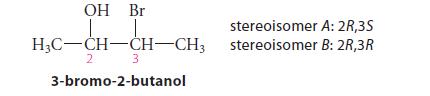
From models of the transition states for their reactions, predict which of the following two diastereomers of 3-bromo-2-butanol should form an epoxide at the greater rate when treated with base, and explain your reasoning. OH Br H₂C-CH-CH-CH3 3 3-bromo-2-butanol 2 stereoisomer stereoisomer A:
The chlorohydrin trans-2-chlorocyclohexanol reacts rapidly in base to form an epoxide. The cis stereoisomer, however, is relatively unreactive and does not give an epoxide. Explain why the two stereoisomers behave so differently.
From what epoxide and what nucleophile could each of the following compounds be prepared? (Assume each is racemic.) (a) ОН SCH3 (b) OH CH3(CH₂)4CHCH₂CN
Explain each of the following facts with a mechanistic argument.(a) When butyl methyl ether (1-methoxybutane) is treated with HI and heat, the initially formed products are mainly methyl iodide and 1-butanol; little or no methanol and 1-iodobutane are formed.(b) When the reaction mixture in part
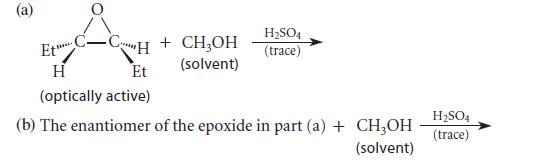
Predict the major product(s) of each of the following transformations. (a) Et C-CH + CH₂OH (solvent) ***** H Et (optically active) H₂SO4 (trace) H₂SO4 (b) The enantiomer of the epoxide in part (a) + CH3OH (trace) (solvent)
From what alkene could each of the following glycols be prepared by the OsO4 or KMnO4 method? OH I CH3CH₂OCH₂CH₂CHCH₂OH (b) OH -CH₂OH (c) meso-4,5-octanediol (d) (±)-4,5-octanediol
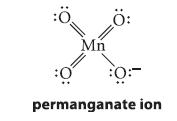
Show a curved-arrow mechanism for the first step, and the structure of the cyclic intermediate formed, when an alkene is treated with KMnO4. A Lewis structure for the permanganate ion is as follows: :Ö Mn Ö: :0: permanganate ion
Give the product(s) expected when each of the following compounds is treated with periodic acid. З OH OH | -CH-CH3 (b) ОН | PhCH₂CHCH₂OH ОН OH
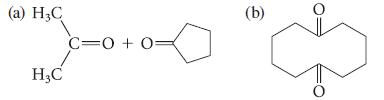
What glycol undergoes oxidation to give each of the following sets of products? (a) H₂C H₂C C=0+0= (b) O
Using the abbreviations for lysine and SAM shown in Eq. 11.60a, write a curved-arrow mechanism for the formation of N,Ndimethyllysine. Assume that acids (+BH) and bases (:B) are available as necessary. R-NH₂ +
The nucleophilic substitution reaction of sodium 2-bromopropanoate with water and/or –OH can occur by both an SN2 (intermolecular) mechanism and a mechanism that involves neighboring-group participation.(a) Give the curved-arrow notation for the SN2 mechanism with –OH as the nucleophile.(b)
Two reactions, A and B, have the same DH°⧧, but the DS°⧧ of reaction A is 230 J deg–1 mol–1, and the DS°⧧ of reaction B is 2180 J deg–1 mol–1. At 25 °C (298 K), which reaction is faster and by what factor?
The nucleophilic substitution reaction of sodium 2-bromopropanoate with water shown in Problem 11.35 occurs with retention of configuration at very low NaOH concentrations, but occurs with inversion of configuration at 1 M NaOH. Relate this finding to your answers for Problem 11.35.Problem 11.35The
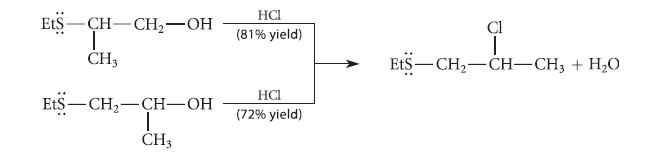
Explain why the following two alcohols each react with HCl to give the same alkyl chloride. EtS -CH-CH₂-OH | CH3 EtS-CH₂-CH-OH T CH3 HCI (81% yield) HC1 (72% yield) Cl ₁+1 EtS—CH,—CH–CH3 + H,O
Give the product and its stereochemistry when each of the following alcohols is subjected to asymmetric epoxidation with tert-butyl hydroperoxide, Ti(OiPr)4, and the stereoisomer of diethyl tartrate (DET) indicated. Ph OH, (-)-DET (b) H H₂C =C CH₂OH CH3 3 (+)-DET O OH 3 (-)-DET
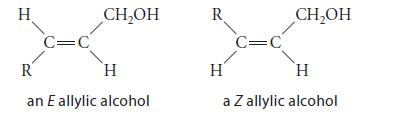
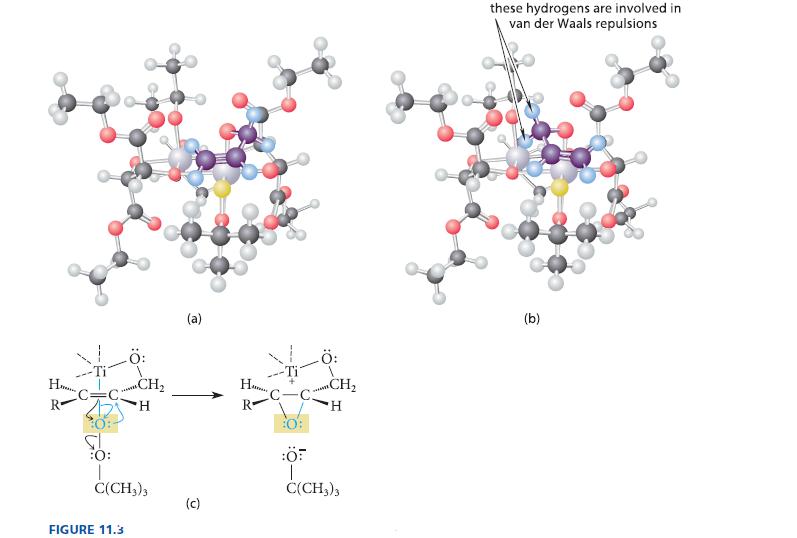
(a) Use the picture of the catalyst complex in Fig. 11.3a to explain why most E allylic alcohols undergo asymmetric epoxidation more rapidly than their Z isomers.(b) Would the same phenomenon be observed with (2)-DET, the enantiomer of the DET used in Fig. 11.3? Explain. H C=C CH₂OH R H an E
Propose a synthesis for each of the following compounds in enantiomerically pure form. Use an asymmetric epoxidation in each synthesis. (a) H ...CH₂OH (b) H CH3CH₂ CH3CH₂CH₂S C OH CH₂OH CH3
Give the major organic product of each of the following reactions. Include stereochemistry where relevant.(a) Dibutyl sulfide with 1 equivalent of H2O2 at 25°C(b) Dibutyl sulfide with 2 or more equivalents of H2O2 and heat(c) Cis-3-hexene with magnesium monoperoxyphthalate (MMPP)(d) The product of
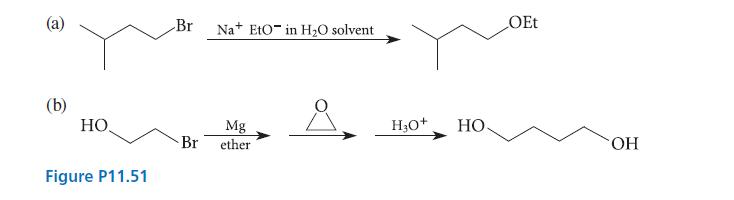
A student has run the reactions shown in Fig. P11.51 and is disappointed to find that each has given none of the desired product. Explain why each reaction failed. (b) HO, Figure P11.51 Br Na EtO in H₂O solvent Mg Br ether H3O+ HO OEt OH
When HCl is formed as a by-product in reactions, it is usually removed from reaction mixtures by neutralization with aqueous base. At times, however, the use of base is not compatible with the products or conditions of a reaction. It has been found that propylene oxide (2-methyloxirane) can be used
For each of the following alkenes, state whether a reaction with OsO4 followed by aqueous NaHSO3 will give a racemic mixture of products that can (in principle) be resolved into enantiomers under ordinary conditions.(a) Ethylene (b) Cis-2-butene (c) Trans-2-butene (d) Cis-2-pentene
Keeping in mind that many intramolecular reactions that form six-membered rings are faster than competing intermolecular reactions (Sec. 11.8), predict the product of the reaction given in Fig. P11.56. CH3 I HOCH₂CH₂CCH₂CH=CH₂ CH3 Figure P11.56 Hg(OAc)2 THF/water NaBH4 compound with the
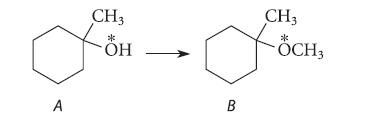
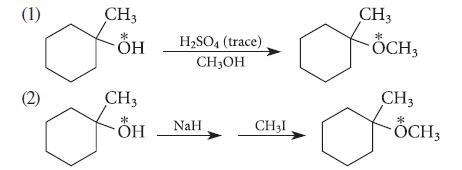
You are a manager for a company, Weighty Matters, that specializes in the manufacture of organic compounds containing 18O, a heavy isotope of oxygen. You have assigned the task of preparing ether B to a team of two staff experts, and you have stipulated that alcohol A must be used as a starting
The (+)-stereoisomer of 2-methyloxirane reacts with aqueous NaOH to give the (R)-(-)- stereo isomer of 1,2-propanediol. Use this observation to propose the absolute stereochemical configuration of (+)-2-methyloxirane.
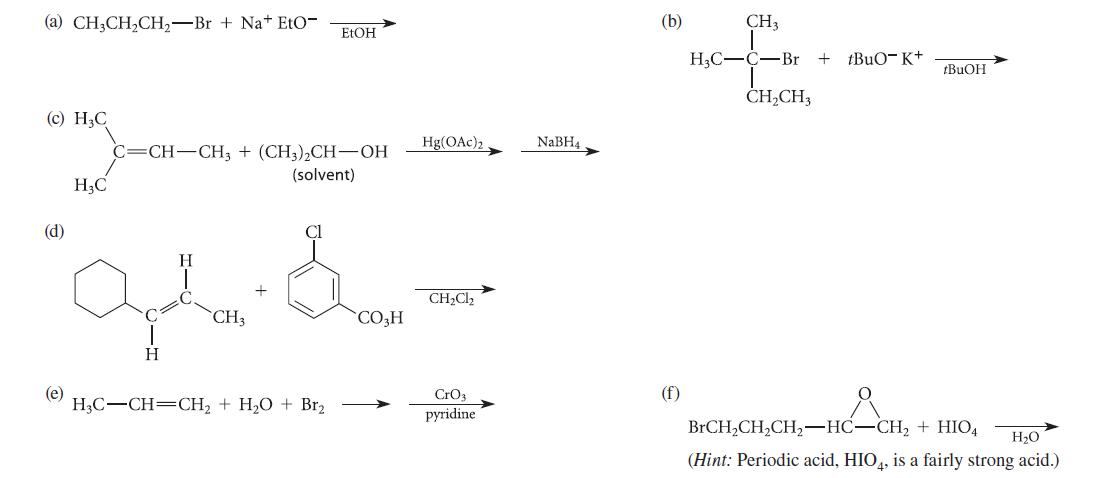
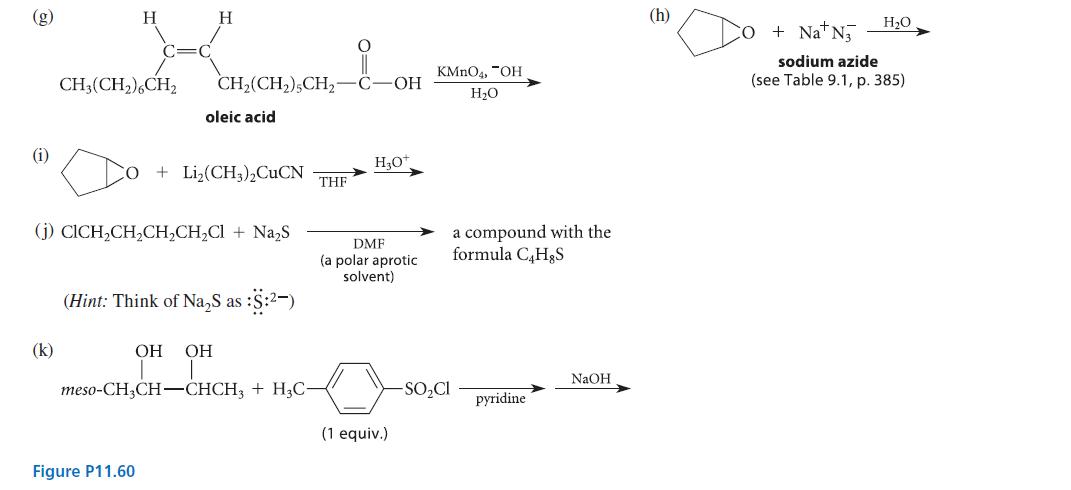
Complete the reactions given in Fig. P11.60 by giving the principal organic products. Indicate the stereochemistry of the products in parts (d), (g), (h), (i), and (k). (a) CH3CH₂CH₂-Br+Na+ Eto- (c) H₂C (d) (e) H₂C quidem CH3 CO3H C=CH-CH3 + (CH3)₂CH-OH (solvent) C EtOH H H3C-CH=CH₂ +
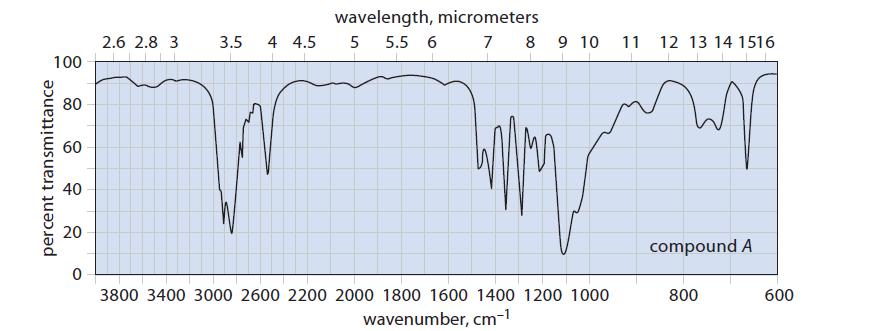
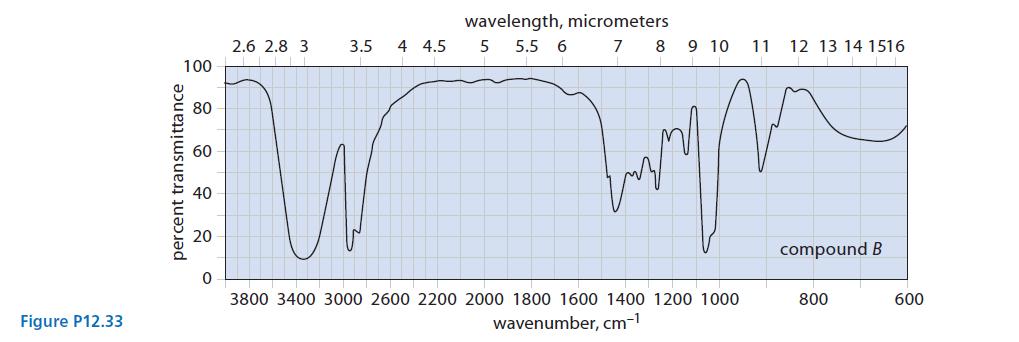
Match each of the following four compounds with one of the compounds A–D on the basis of the following experimental facts. Compounds A, B, and C are optically active, but compound D is not. Compound C gives the same products as compound D on treatment with periodic acid, but compound B gives a
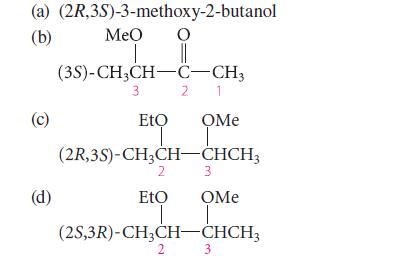
Outline a synthesis for each of the following compounds in enantiomerically pure form from enantiomerically pure (2R,3R)-2,3-dimethyloxirane: (a) (b) (c) (d) (2R,3S)-3-methoxy-2-butanol O T || (3S)-CH3CH-C-CH3 3 MeO 2 1 EtỌ OMe (2R,3S)-CH3CH-CHCH3 2 EtO 3 OMe L T (2S,3R)-CH3CH-CHCH3 2 3
Compound A, C8H16, undergoes catalytic hydrogenation to give octane. When treated with meta- chloroperoxybenzoic acid, A gives an epoxide B, which, when treated with aqueous acid, gives a compound C, C8H18O2, which can be resolved into enantiomers. When A is treated with OsO4 followed by aqueous
(a) What is the wavenumber (in cm–1) of infrared radiation with a wavelength of 6.0 μm?(b) What is the wavelength of light with a wavenumber of 1720 cm–1?
The base peak in the mass spectrum of 2,2,5,5-tetramethylhexane (molecular mass = 142) is at m/z = 57, which corresponds to a composition C4H9. (a) Suggest a structure for the fragment that accounts for this peak. (b) Offer a reason that this fragment is so abundant. (c) Give a mechanism that
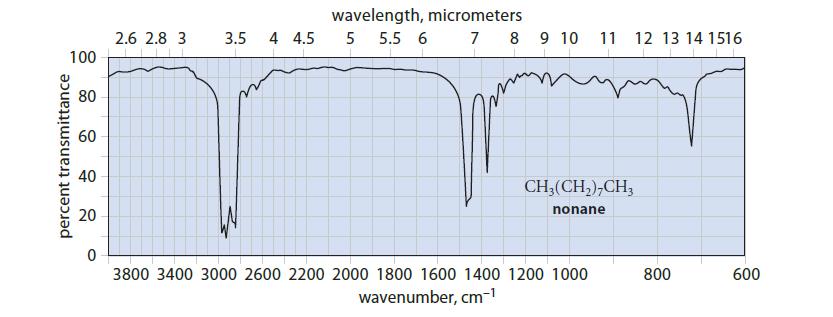
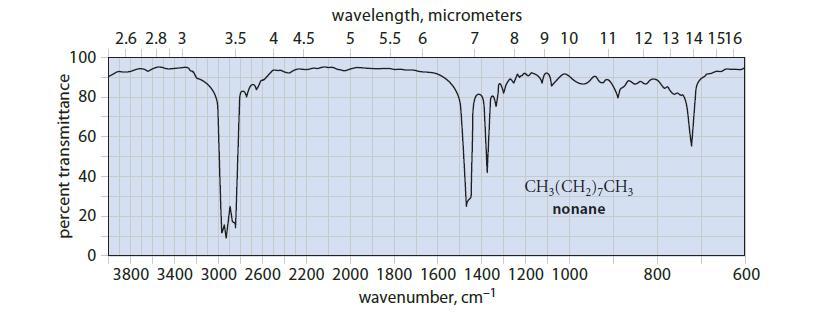
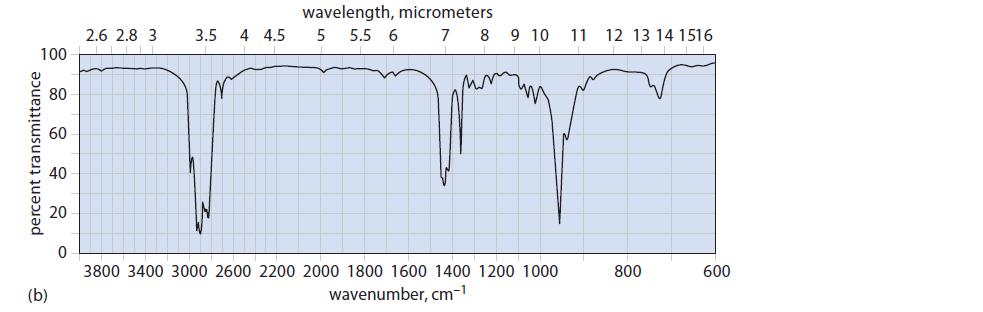
Given that the stretching vibration of a typical C—H bond has a frequency of about 9 * 1013 s–1, which peak(s) in the IR spectrum of nonane (Fig. 12.4) would you assign to the C—H stretching vibrations? percent transmittance 100 80 60 40 20 0 2.6 2.8 3 3.5 4 4.5 wavelength, micrometers 5 5.5
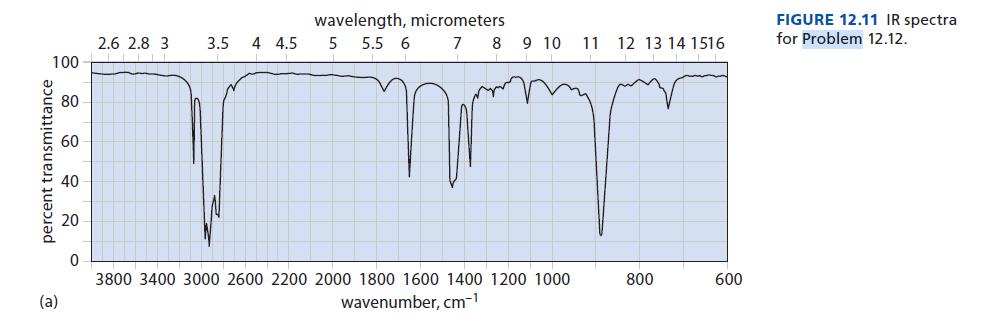
One of the spectra in Fig. 12.11 is that of trans-2-heptene and the other is that of 2-methyl-1-hexene. Which is which? Explain. 100 percent transmittance (a) 80 60 40 0 2.6 2.8 3 3.5 4 4.5 wavelength, micrometers 5 5.5 6 7 8 9 10 11 12 13 14 1516 mm 3800 3400 3000 2600 2200 2000 1800 1600 1400
The following bonds all have IR stretching absorptions in the 4000–2900 cm–1 region of the spectrum. Rank the following bonds in order of decreasing stretching frequencies, greatest first, and explain your reasoning. C-H, O-H, N-H, F-H
Explain why the IR spectra of some ethers have two C—O stretching absorptions.
Explain why the frequency of the O—H stretching absorption of an alcohol in solution changes as the alcohol solution is diluted.
A thin piece of red glass held up to white light appears brighter to the eye than a piece of the same glass that is twice as thick. Which piece has the greater absorbance?
(a) Match each of the following 13C NMR spectra to either 2-hexyne or 3-hexyne. Explain.Spectrum A: δ 3.3, 13.6, 21.1, 22.9, 75.4, 79.1 Spectrum B: δ 12.7, 14.6, 81.0 (b) Assign each of the resonances in the two spectra to the appropriate carbon atoms.
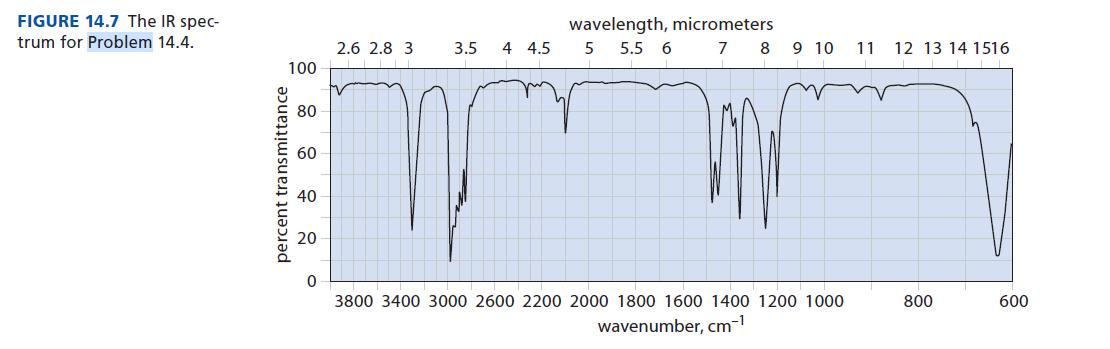
Identify the compound with a molecular mass of 82 that has the IR spectrum shown in Fig. 14.7 and the following NMR spectrum: δ 1.90 (1H, s); δ 1.21 (9H, s). FIGURE 14.7 The IR spec- trum for Problem 14.4. 100 percent transmittance 80 60 40 20 2.6 2.8 3. 3.5 4 4.5 wavelength, micrometers 5 5.5
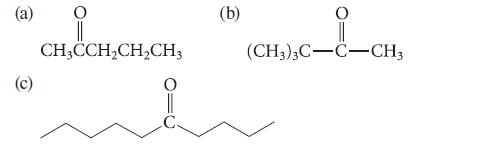
From which alkyne could each of the following compounds be prepared by acid- catalyzed hydration? (a) (c) CH3CCH₂CH₂CH3 (b) O (CH3)3C-C-CH3
Which of the following compounds are enols? For those that are enols, show the ketone into which they would be converted. OH A OH B OH CH3CHCH₂CH₂ C HO Me- D OH
Compare the results of hydroboration–oxidation and mercuric-ion-catalyzed hydration for (a) Cyclohexylacetylene and (b) 2-butyne.
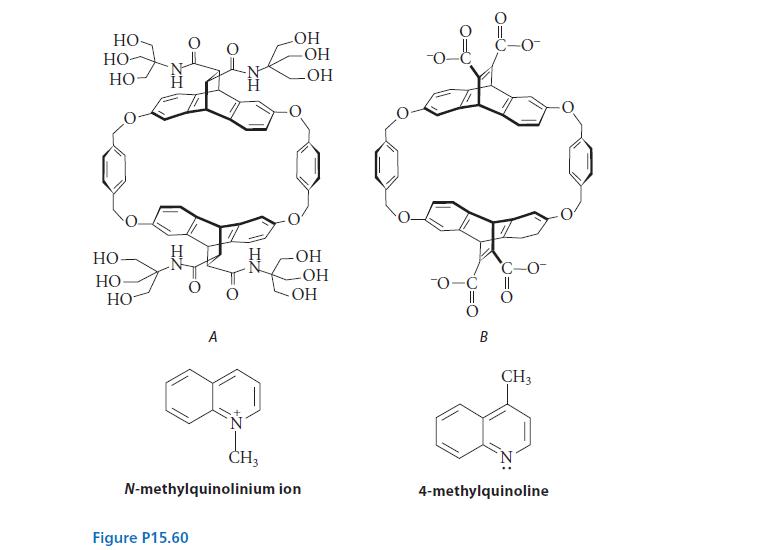
The N-methylquinolinium ion forms a noncovalent complex with molecule A in water that has a standard free energy of dissociation ΔG°d 5 28.9 kJ mol–1 (6.9 kcal mol–1). The neutral molecule 4-methylquinoline forms a noncovalent complex with molecule A in water with ΔG°d 5 22.2 kJ mol–1
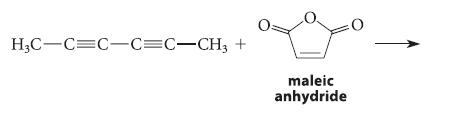
Knowing that conjugated dienes react in the Diels–Alder reaction, a student, M. T. Brainpan, has come to you with an original research idea: to use conjugated alkynes as the diene component in the Diels–Alder reaction (such as the following). Would Brainpan’s idea work? Explain.
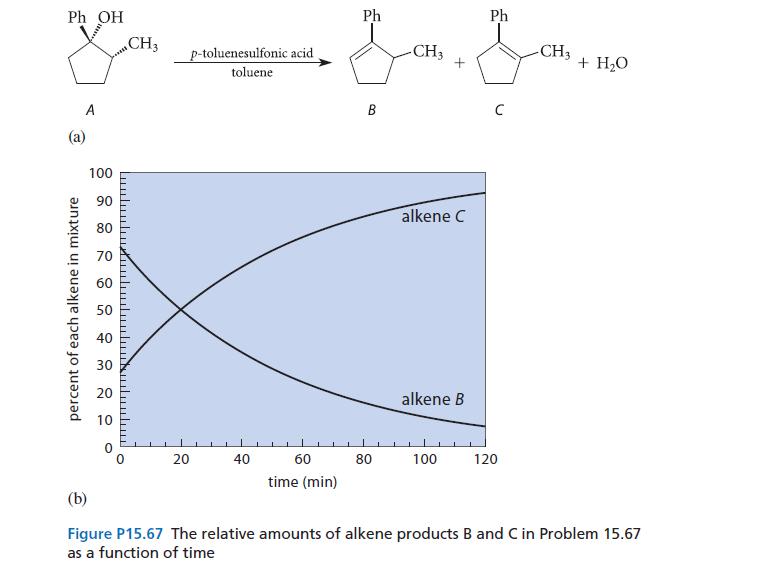
When the alcohol A undergoes acid-catalyzed dehydration, two isomeric alkenes are formed: B and C (see Fig. P15.67a). The relative percentage of each alkene formed is shown as a function of time in Fig. P15.67b. The composition of the alkene mixture at very long times is the equilibrium
Explain the fact that 2,3-dimethyl-1,3-butadiene and maleic anhydride readily react to give a Diels–Alder adduct, but 2,3- di-tert-butyl-1,3-butadiene and maleic anhydride do not.
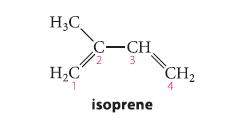
(a) Which carbocation is more stable: the carbocation formed by protonation of isoprene at carbon-1 or the carbocation formed by protonation of isoprene at carbon-4? Explain.(b) Predict the products expected from the addition of one equivalent of HBr to isoprene; explain your reasoning.(c) Predict
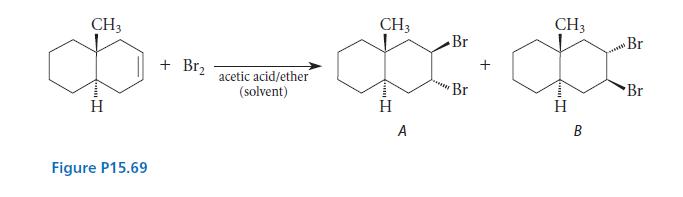
Consider the bromine addition shown in Figure P15.69. Product A is the predominant product formed at low temperature. If the products are allowed to stand under the reaction conditions or are brought to equilib-rium at higher temperature, product B is the only product formed.(a) Which is the
The 1,2-addition of one equivalent of HCl to the triple bond of vinylacetylene, HC≡C—CH=CH2, gives a chlorine- containing conjugated diene called chloroprene.Chloroprene can be polymerized to give neoprene, valued for its resistance to oils, oxidative breakdown, and other deterioration. Give
When 1,3-cyclopentadiene containing carbon-13 (13C) only at carbon-5 (as indicated by the asterisk in Fig. P15.72) is treated with potassium hydride (KH), a species X is formed and a gas is evolved. When the resulting mixture is added to water, a mixture of 13C-labeled 1,3-cyclopentadienes is
When an excess of 1,3-butadiene reacts with Cl2 in chloroform solvent, two compounds, A and B, both with the formula C4H6Cl2, are formed. Compound B reacts with more Cl2 to form compound C, C4H6Cl4, which proves to be a meso compound. Compound A reacts with more Cl2 to form both C and a
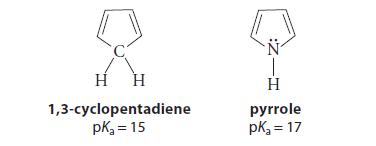
An amine R2NH is typically more than 20 pKa units more acidic than the hydrogens of the carbon analog, R2CH2 (the element effect; Sec. 3.6A). However, the acidities of 1,3-cyclopentadiene and pyrrole are an exception.Use the theory of aromaticity to explain this exception. H
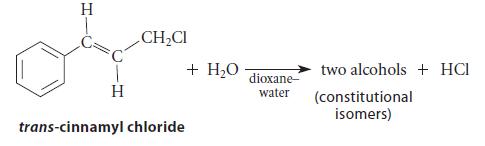
The SN1 solvolysis of cinnamyl chloride in water gives two structurally isomeric alcohols (neglect stereoisomers).(a) Show five resonance structures of the carbocation intermediate. In each of your structures, the positive charge should be on a different carbon.(b) Even though the positive charge
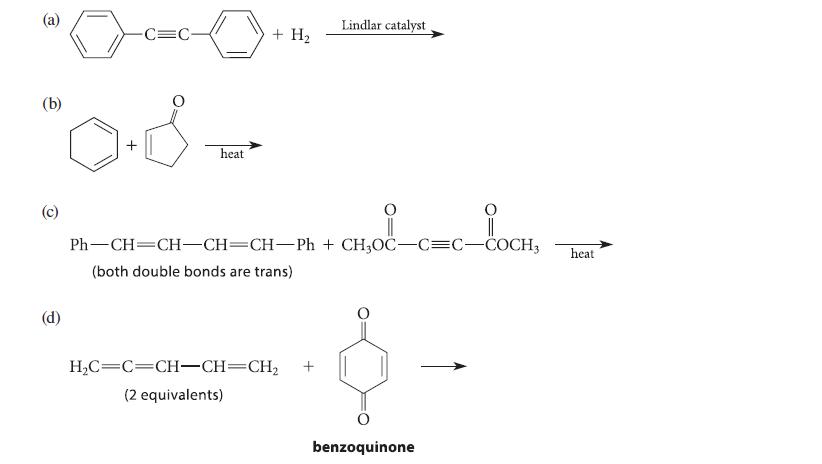
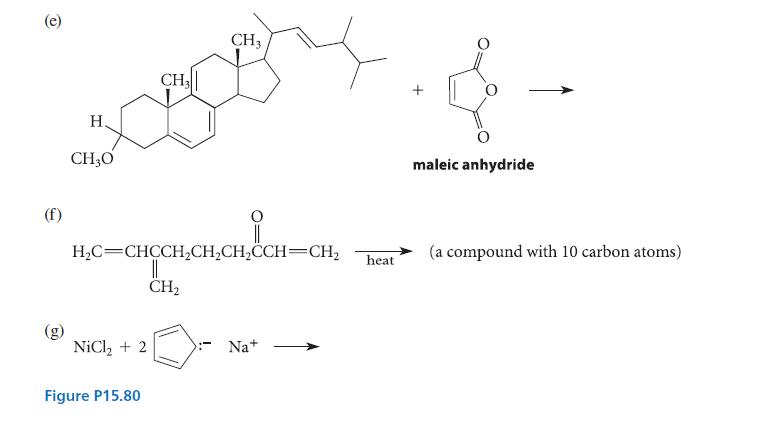
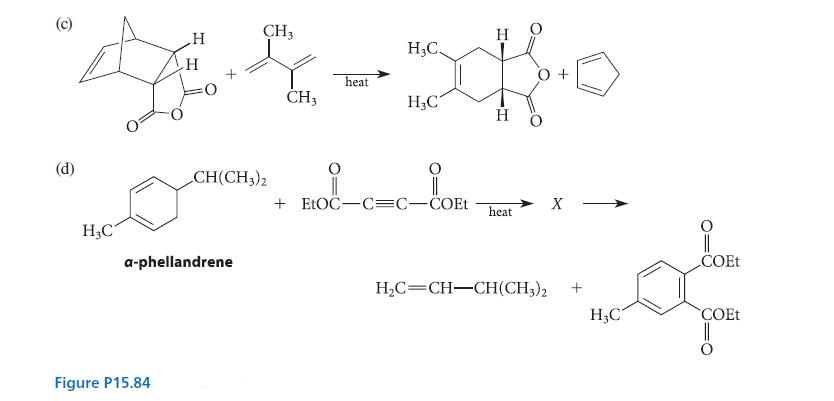
Complete the reactions given in Fig. P15.80 on, giving the structures of all reasonable products and the reasoning used to obtain them. e (b) "a-d- 0.6 + O -C=C- (d) heat + H₂ +CH₂OL_C=C-LOCH, Ph-CH=CH-CH=CH-Ph + CH₂OC-C=C-COCH3 (both double bonds are trans) H₂C=C=CH-CH=CH₂ (2
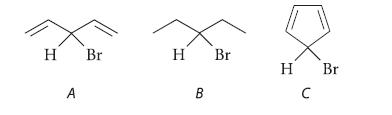
Invoking Hammond’s postulate and the properties of the carbocation intermediates, explain why the doubly allylic alkyl halide A undergoes much more rapid solvolysis in aqueous acetone than compound B. Then explain why compound C, which is also a doubly allylic alkyl halide, is solvolytically
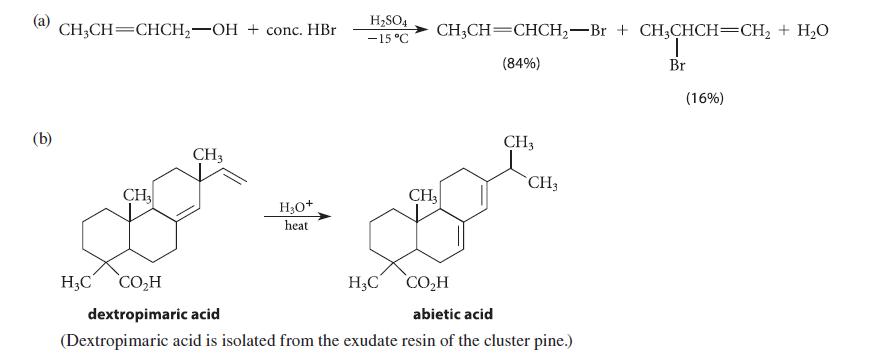
Account for each of the transformations shown in Fig. P15.84 with a curved-arrow mechanism. (Don’t try to explain any percentages.) In part (d), identify X; give the mechanisms for both the formation and the subsequent reaction of X; and explain why the equilibrium for the reaction of X strongly
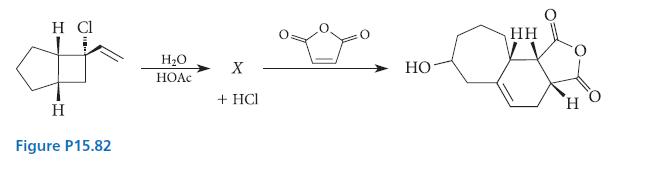
Use the structure of the Diels–Alder adduct to deduce the structure of the product X in the reaction given in Fig. P15.82. Then give a curved-arrow mechanism for the formation of X. H Cl да Н Figure P15.82 H2O НОАс X + HCI НО- HH
Account for the fact that the central “benzene ring” of [4]phenylene (Fig. P15.86) undergoes catalytic hydrogenation readily under conditions usually used for ordinary alkenes, but the other benzene rings do not. [4]phenylene Figure P15.86 + 3H₂ 5% Pd/C THF H H₂ HH H H
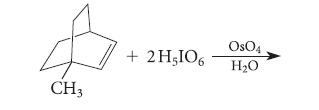
An alternative to the ozonolysis of alkenes is to treat an alkene with two molar equivalents of periodic acid and a catalytic amount of OsO4.(a) Explain the role of each reagent in the reaction shown in Fig. P11.64. Your explanation should account for the fact that two molar equivalents of periodic
When reacts with two equivalents of CH3I, the following double sulfonium salt precipitates:(a) Give a curved-arrow mechanism for the formation of this salt.(b) Upon closer examination, this compound is found to be a mixture of two isomers with melting points of 123–124 °C and 154 °C,
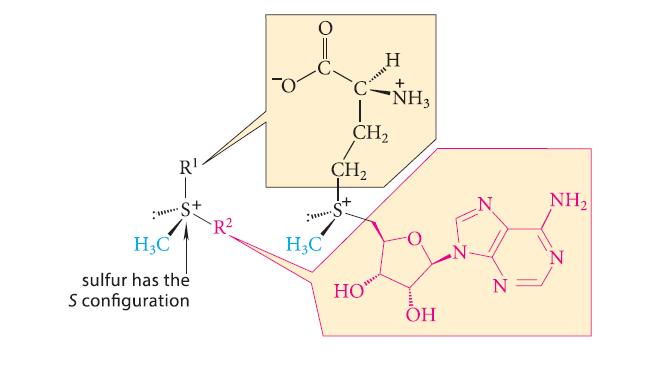
When S-adenosylmethionine (Fig. 11.1), isolated from natural sources, is allowed to stand in aqueous solution for several weeks at room temperature, a stereoisomeric contaminant appears in solution that can be separated by ordinary methods. Suggest a structure for this contaminant and a reason that
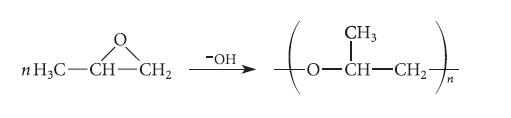
One of the side reactions that occur when epoxides react with –OH is the formation of polymers. Propose a mechanism for the following polymerization reaction, using the curved-arrow notation. n H3C CH-CH₂ -OH for CH3 O–CH–CH,
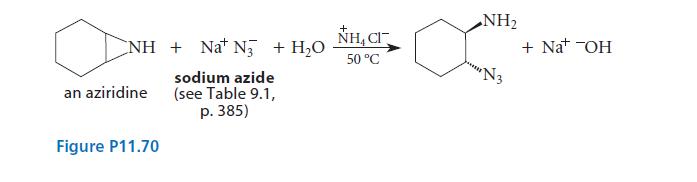
(a) Give a curved-arrow mechanism for the reaction shown in Fig. P11.70. Be sure your mechanism indicates the role of the weak acid ammonium chloride.(b) Why does the reaction of an aziridine require this weak acid?(c) The pKa of ammonium ion is 9.25; the conjugate-acid pKa of an aziridine is about
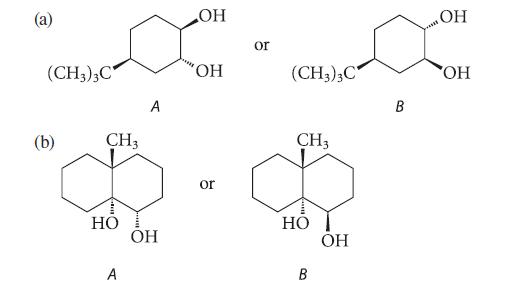
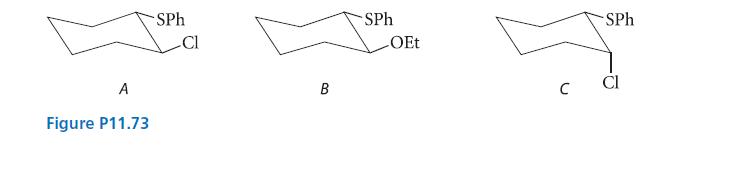
In each of the following pairs, one of the glycols is virtually inert to periodate oxidation. Which glycol is inert? Explain why. В (с (CH3)3C (b) CH3 HO A A OH OH OH or or (CH3)3C CH3 HO B OH B OH OH
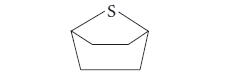
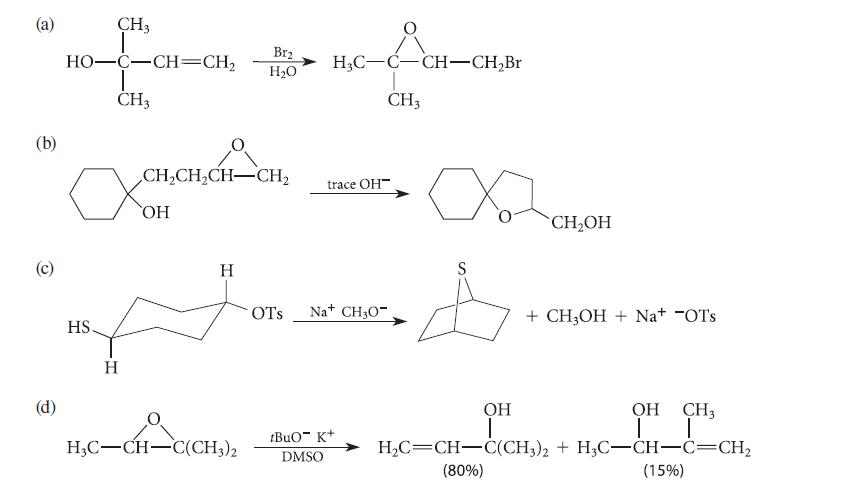
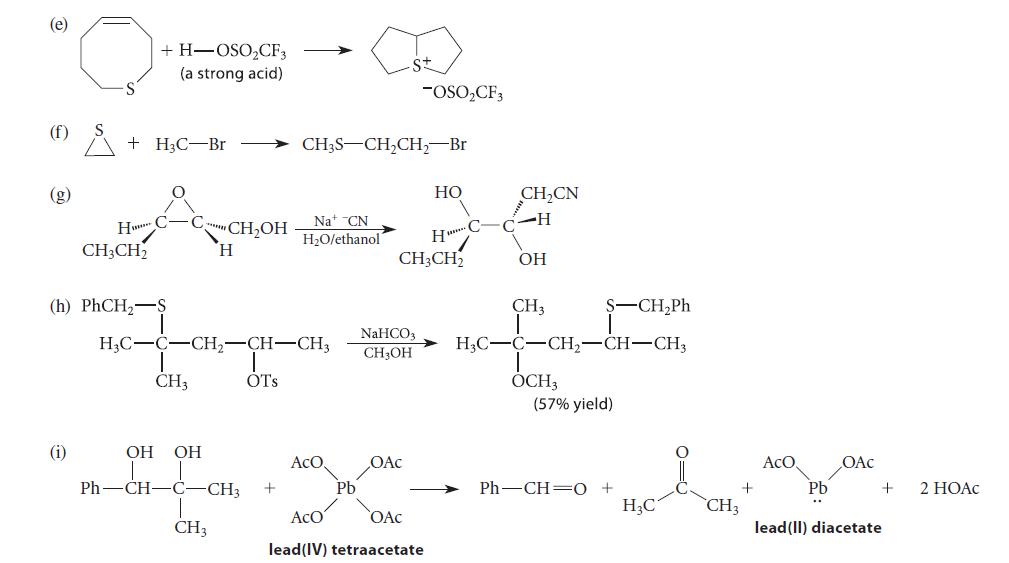
Draw a curved-arrow mechanism for each of the conversions shown in Fig. P11.77.Figure P11.77 S
Account for the following observations with a mechanism.(1) In 80% aqueous ethanol, compound A reacts to give compound B. Notice that trans-B is the only stereoisomer of this compound that is formed.(2) Optically active A gives completely racemic B.(3) The reaction of A is about 105 times faster
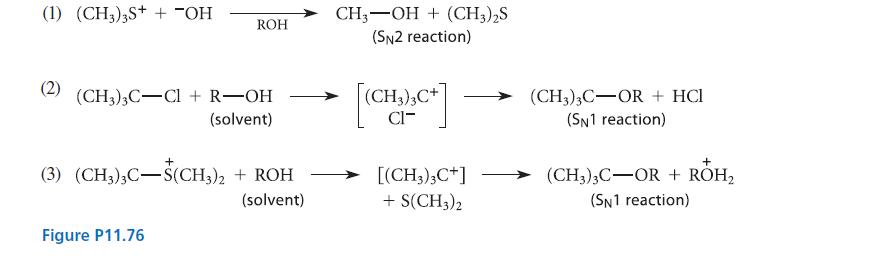
One of the reactions given in Fig. P11.76 is about 2000 times faster in pure water than it is in pure ethanol.Another is about 20,000 times faster in pure ethanol than it is in pure water. The rate of the third changes very little when the solvent composition is changed from ethanol to water. Which
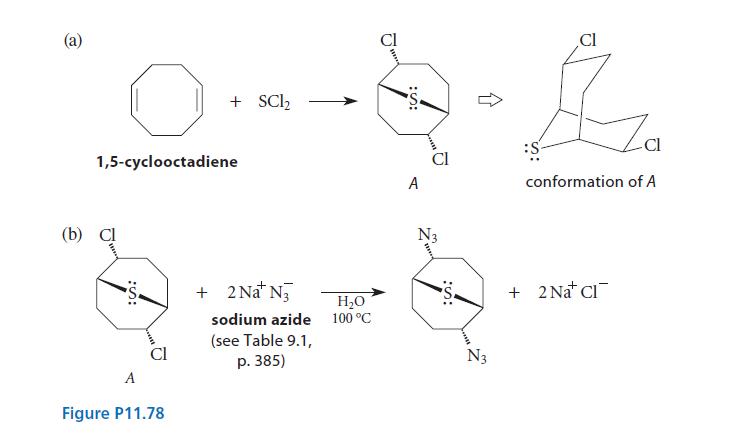
(a) As shown in Fig. P11.78(a), 1,5-cyclooctadiene undergoes an electrophilic addition with SCl2 to give compound A. (Notice the conformation of A, also shown.) Provide a curved-arrow mechanism for this transformation that accounts for the stereochemistry.(b) Suggest a mechanism that accounts for
Calculate the frequency of(a) Infrared light with λ = 9 * 10–6 m (b) Blue light with λ = 4800 Å
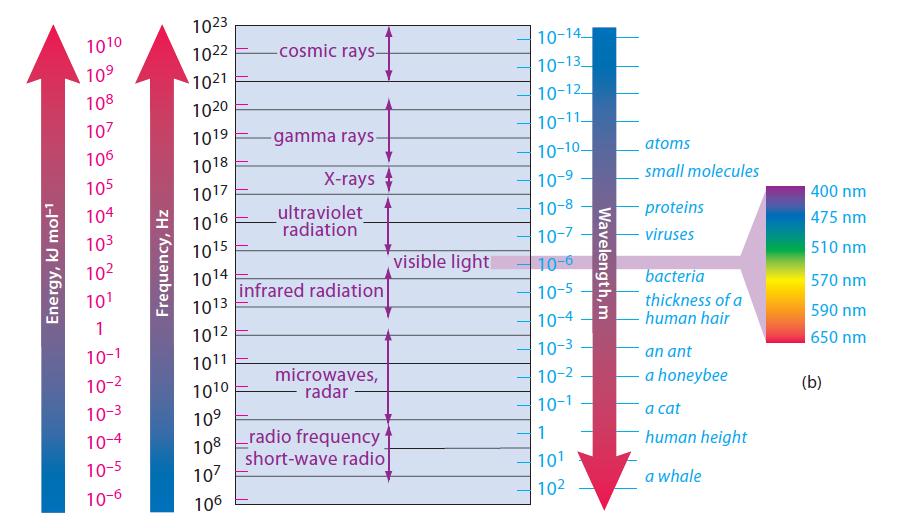
Use Figure 12.2 to answer the following questions.(a) How does the energy of X-rays compare with that of blue light (greater or smaller)?(b) How does the energy of radar waves compare with that of red light (greater or smaller)? Energy, kJ
The typical stretching frequency for a carbon–carbon double bond is 1650 cm-1. Estimate the stretching frequency of a carbon–carbon triple bond.
Calculate the energy in kJ mol–1 of the light described in(a) Problem 12.1(a) (b) Problem 12.1(b)Problem 12.1Calculate the frequency of(a) Infrared light with λ = 9 * 10–6 m (b) Blue light with λ = 4800 Å
Each of three alkenes, A, B, and C, has the molecular formula C5H10, and each undergoes catalytic hydrogenation to yield pentane. Alkene A has IR absorptions at 1642, 990, and 911 cm–1; alkene B has an IR absorption at 964 cm–1 and no absorption in the 1600–1700 cm–1 region; and alkene C
In the infrared spectrum of nonane in Fig. 12.4, what is the absorbance of the sharp peak at 1380 cm–1? percent transmittance 100 80 60 40 20 0 2.6 2.8 3 wavelength, micrometers 3.5 4 4.5 5 5.5 6 7 8 9 10 11 CH3(CH₂)7CH3 nonane 3800 3400 3000 2600 2200 2000 1800 1600 1400 1200 1000 wavenumber,
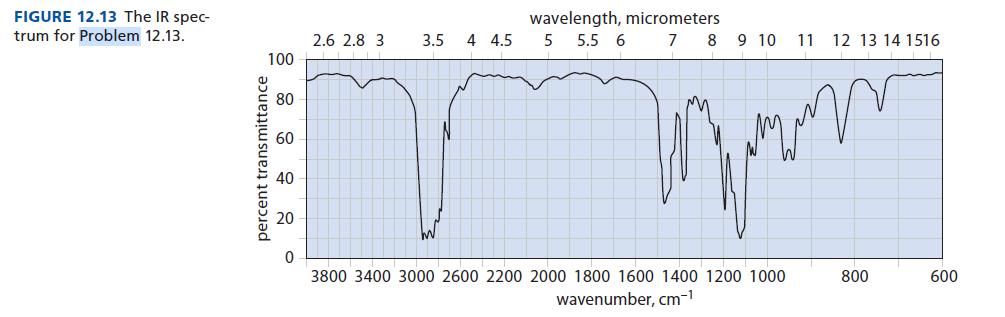
Match the IR spectrum in Fig. 12.13 to one of the following three compounds: 2-methyl-1-octene, butyl methyl ether, or 1-pentanol. FIGURE 12.13 The IR spec- trum for Problem 12.13. percent transmittance 100 80 60 40 20 2.6 2.8 3 3.5 4 4.5 wavelength, micrometers 5 5.5 6 7 8 9 10 11 12 13 14
The mass spectrum of tetramethylsilane, (CH3)4Si, has a base peak at m/z = 73. Calculate the relative abundances of the isotopic peaks at m/z = 74 and 75.
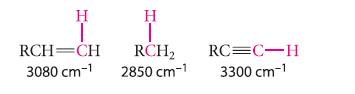
(a) Given the stretching frequencies for the C—H bonds shown in color, arrange the corresponding bonds in order of increasing strength. Explain your reasoning.(b) If the bond dissociation energy of the = C—H bond is 558 kJ mol–1 (133 kcal mol–1), use the stretching frequencies in part (a)
The peak of highest mass in the EI mass spectrum of 2,2,5,5-tetramethylhexane occurs at m/z = 71 and has about 33% relative abundance.(a) In a structure of the molecule, indicate the bond at which fragmentation occurs to give this ion.(b) Give a mechanism for this fragmentation.(c) What is the
The mass spectrum of 2-chloropentane shows large and almost equally intense peaks at m/z = 71 and m/z = 70.(a) Classify each peak as an even-electron or odd-electron ion.(b) What stable neutral molecule can be lost to give the odd-electron ion?(c) Write a mechanism for the origin of each fragment
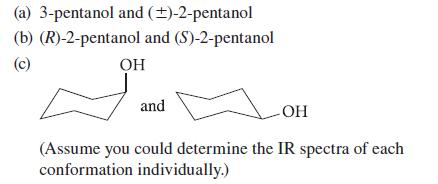
Which of the molecules in each of the following pairs should have identical IR spectra, and which should have different IR spectra (if only slightly different)? Explain your reasoning carefully. (a) 3-pentanol and (±)-2-pentanol (b) (R)-2-pentanol and (S)-2-pentanol (c) OH and -OH (Assume you
List the factors that determine the wavenumber of an infrared absorption.
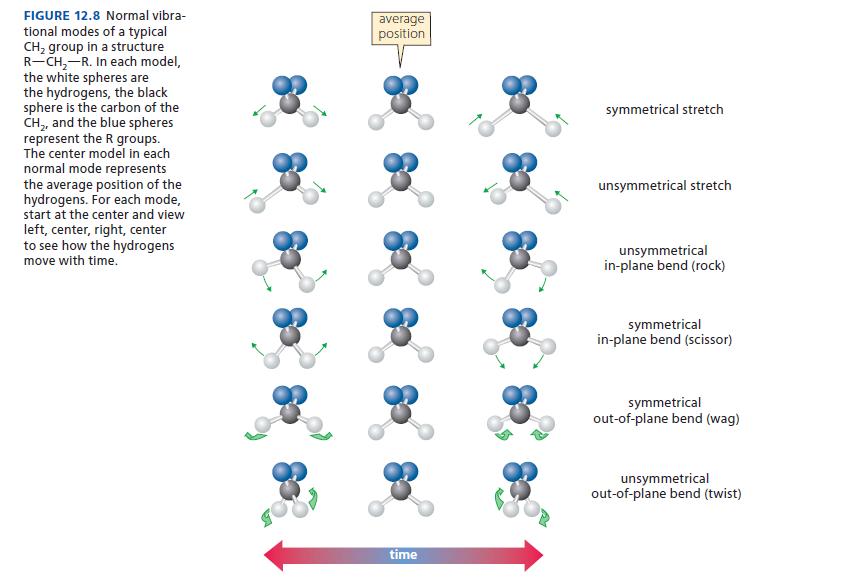
(a) The water molecule has three distinguishable molecular vibrations. Construct a diagram like Fig. 12.8 for the three vibrational modes of water.(b) Classify each vibration as a stretching or bending vibration.(c) The IR spectrum of water vapor has three absorptions: 1595, 3652, and 3756 cm–1.
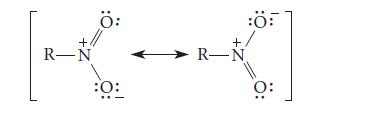
Explain why a nitro compound has two N—O stretching vibrations. (These typically occur at about 1370 and 1550 cm–1.) R-N Ö: :0: R-N :Ö
(a) Explain why the S—H stretching absorption in the IR spectrum of a thiol is less intense and occurs at lower frequency (2550 cm–1) than the O—H stretching absorption of an alcohol.(b) Is the wavenumber difference between O—H and S—H absorptions caused primarily by the greater mass of
Suggest structures for the following neutral molecules commonly lost in mass spectral fragmentation.(a) Mass = 28 from a compound containing only C and H(b) Mass = 18 from a compound containing C, H, and O(c) Mass = 36 from a compound with an M + 2 peak about one-third the size of the molecular ion.
An alcohol A, when treated with NaH followed by CH3I, gives a compound B with a strong M + 1 peak in its CI mass spectrum at m/z = 117. Compound A, known from other evidence to be a tertiary alcohol, has prominent fragments in its EI mass spectrum at m/z = 87 and m/z = 73 (base peak). Propose
Explain why the mass spectrum of dibromomethane has three peaks at m/z = 172, 174, and 176 in the approximate relative abundances 1 : 2 : 1.
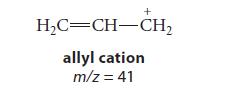
(a) Explain why ionization of a π electron requires less energy than ionization of a σ electron.(b) Draw the structure of the molecular ion of 1-heptene formed by ionization of a π electron.(c) The base peak in the EI mass spectrum of 1-heptene occurs at m/z = 41, which is believed to correspond
Showing 700 - 800
of 1324
1
2
3
4
5
6
7
8
9
10
11
12
13
14
Step by Step Answers

 Get 50% OFF
Claim Now
Get 50% OFF
Claim Now

















![* + K-H Figure P15.72 [X] + a gas HO * 20% +* 40% 40%](https://dsd5zvtm8ll6.cloudfront.net/images/question_images/1701/4/3/2/8526569ce14857d61701432851459.jpg)
![[4]phenylene Figure P15.86 + 3H 5% Pd/C THF H H HH H H](https://dsd5zvtm8ll6.cloudfront.net/images/question_images/1701/4/3/3/3666569d016105371701433361598.jpg)