New Semester
Started
Get
50% OFF
Study Help!
--h --m --s
Claim Now
Question Answers
Textbooks
Find textbooks, questions and answers
Oops, something went wrong!
Change your search query and then try again
S
Books
FREE
Study Help
Expert Questions
Accounting
General Management
Mathematics
Finance
Organizational Behaviour
Law
Physics
Operating System
Management Leadership
Sociology
Programming
Marketing
Database
Computer Network
Economics
Textbooks Solutions
Accounting
Managerial Accounting
Management Leadership
Cost Accounting
Statistics
Business Law
Corporate Finance
Finance
Economics
Auditing
Tutors
Online Tutors
Find a Tutor
Hire a Tutor
Become a Tutor
AI Tutor
AI Study Planner
NEW
Sell Books
Search
Search
Sign In
Register
study help
social science
introduction to logic
Introduction To Logic 15th Edition Irving M. Copi, Carl Cohen, Victor Rodych - Solutions
For each of the following arguments, inferring just two statements from the premises will produce a formal proof of its validity. Construct a formal proof for each of these arguments.In these formal proofs, and in all the proofs to follow in later sections, note to the right of each inferred
Use Conditional Proof (C.P.) to prove that the following statements are tautologies.(R ⊃ Q) ⊃ [~ (Q ⋅ S) ⊃ ~ (S ⋅ R)]
If any truth-functional argument is valid, we have the tools to prove it valid; and if it is invalid, we have the tools to prove it invalid. For each of the following arguments determine whether it is valid or invalid using the STTT. If it is valid, prove it valid using the nineteen rules of
Translate each of the following into the logical notation of propositional functions and quantifiers, in each case making the formula begin with a quantifier, not with a negation symbol.Everybody doesn’t like something, but nobody doesn’t like Willie Nelson.—Steve Dollar, Cox News Service
For each of the following arguments, use the STTT to determine whether the argument is valid or invalid. For some of these arguments, Steps 2 C , 3 C , and 4 (i.e., the C-Sequence) will be most efficient; for some of these arguments Steps 2 P , 3 P , and 4 (i.e., the P-Sequence) will be most
Each of the following arguments in English may be similarly translated, and for each, a formal proof of validity (using only the nine elementary valid argument forms as rules of inference) may be constructed. These proofs vary in length, some requiring a sequence of thirteen statements (including
For each of the following arguments, inferring just two statements from the premises will produce a formal proof of its validity. Construct a formal proof for each of these arguments.In these formal proofs, and in all the proofs to follow in later sections, note to the right of each inferred
If any truth-functional argument is valid, we have the tools to prove it valid; and if it is invalid, we have the tools to prove it invalid. For each of the following arguments determine whether it is valid or invalid using the STTT. If it is valid, prove it valid using the nineteen rules of
Translate each of the following into the logical notation of propositional functions and quantifiers, in each case making the formula begin with a quantifier, not with a negation symbol.No man but a blockhead ever wrote except for money.—Samuel Johnson
For each of the following arguments, use the STTT to determine whether the argument is valid or invalid. For some of these arguments, Steps 2 C , 3 C , and 4 (i.e., the C-Sequence) will be most efficient; for some of these arguments Steps 2 P , 3 P , and 4 (i.e., the P-Sequence) will be most
Each of the following arguments in English may be similarly translated, and for each, a formal proof of validity (using only the nine elementary valid argument forms as rules of inference) may be constructed. These proofs vary in length, some requiring a sequence of thirteen statements (including
For each of the following arguments, inferring just two statements from the premises will produce a formal proof of its validity. Construct a formal proof for each of these arguments.In these formal proofs, and in all the proofs to follow in later sections, note to the right of each inferred
If any truth-functional argument is valid, we have the tools to prove it valid; and if it is invalid, we have the tools to prove it invalid. For each of the following arguments determine whether it is valid or invalid using the STTT. If it is valid, prove it valid using the nineteen rules of
For each of the following, find a normal-form formula that is logically equivalent to the given one:∼ (x) (Ax ⊃ Bx)
For each of the following arguments, use the STTT to determine whether the argument is valid or invalid. For some of these arguments, Steps 2 C , 3 C , and 4 (i.e., the C-Sequence) will be most efficient; for some of these arguments Steps 2 P , 3 P , and 4 (i.e., the P-Sequence) will be most
Each of the following arguments in English may be similarly translated, and for each, a formal proof of validity (using only the nine elementary valid argument forms as rules of inference) may be constructed. These proofs vary in length, some requiring a sequence of thirteen statements (including
For each of the following arguments, inferring just two statements from the premises will produce a formal proof of its validity. Construct a formal proof for each of these arguments.In these formal proofs, and in all the proofs to follow in later sections, note to the right of each inferred
For each of the following, find a normal-form formula that is logically equivalent to the given one:∼ (x) (Cx ⊃ ∼ Dx)
For each of the following arguments, use the STTT to determine whether the argument is valid or invalid. For some of these arguments, Steps 2 C , 3 C , and 4 (i.e., the C-Sequence) will be most efficient; for some of these arguments Steps 2 P , 3 P , and 4 (i.e., the P-Sequence) will be most
For each of the following arguments, inferring just two statements from the premises will produce a formal proof of its validity. Construct a formal proof for each of these arguments.In these formal proofs, and in all the proofs to follow in later sections, note to the right of each inferred
Each of the following arguments in English may be similarly translated, and for each, a formal proof of validity (using only the nine elementary valid argument forms as rules of inference) may be constructed. These proofs vary in length, some requiring a sequence of thirteen statements (including
Each of the following arguments in English may be similarly translated, and for each, a formal proof of validity (using only the nine elementary valid argument forms as rules of inference) may be constructed. These proofs vary in length, some requiring a sequence of thirteen statements (including
For each of the following, find a normal-form formula that is logically equivalent to the given one:∼ (∃x) (Ex ⋅ Fx)
For each of the following arguments, use the STTT to determine whether the argument is valid or invalid. For some of these arguments, Steps 2 C , 3 C , and 4 (i.e., the C-Sequence) will be most efficient; for some of these arguments Steps 2 P , 3 P , and 4 (i.e., the P-Sequence) will be most
For each of the following arguments, inferring just two statements from the premises will produce a formal proof of its validity. Construct a formal proof for each of these arguments.In these formal proofs, and in all the proofs to follow in later sections, note to the right of each inferred
For each of the following, find a normal-form formula that is logically equivalent to the given one:∼ (∃x) (Gx ⋅ ∼ Hx)
Each of the following arguments in English may be similarly translated, and for each, a formal proof of validity (using only the nine elementary valid argument forms as rules of inference) may be constructed. These proofs vary in length, some requiring a sequence of thirteen statements (including
For each of the following arguments, use the STTT to determine whether the argument is valid or invalid. For some of these arguments, Steps 2 C , 3 C , and 4 (i.e., the C-Sequence) will be most efficient; for some of these arguments Steps 2 P , 3 P , and 4 (i.e., the P-Sequence) will be most
For each of the following arguments, inferring just two statements from the premises will produce a formal proof of its validity. Construct a formal proof for each of these arguments.In these formal proofs, and in all the proofs to follow in later sections, note to the right of each inferred
For each of the following, find a normal-form formula that is logically equivalent to the given one:∼ (∃x) (Gx ⋅ ∼ Hx)
For each of the following arguments, use the STTT to determine whether the argument is valid or invalid. For some of these arguments, Steps 2 C , 3 C , and 4 (i.e., the C-Sequence) will be most efficient; for some of these arguments Steps 2 P , 3 P , and 4 (i.e., the P-Sequence) will be most
Each of the following arguments in English may be similarly translated, and for each, a formal proof of validity (using only the nine elementary valid argument forms as rules of inference) may be constructed. These proofs vary in length, some requiring a sequence of thirteen statements (including
For each of the following arguments, inferring just two statements from the premises will produce a formal proof of its validity. Construct a formal proof for each of these arguments.In these formal proofs, and in all the proofs to follow in later sections, note to the right of each inferred
For each of the following, find a normal-form formula that is logically equivalent to the given one:∼ (x) (∼ Kx ꓦ ∼ Lx)
For each of the following arguments, use the STTT to determine whether the argument is valid or invalid. For some of these arguments, Steps 2 C , 3 C , and 4 (i.e., the C-Sequence) will be most efficient; for some of these arguments Steps 2 P , 3 P , and 4 (i.e., the P-Sequence) will be most
For each of the following arguments, inferring just two statements from the premises will produce a formal proof of its validity. Construct a formal proof for each of these arguments.In these formal proofs, and in all the proofs to follow in later sections, note to the right of each inferred
For each of the following, find a normal-form formula that is logically equivalent to the given one:(∃x) [∼ (Mx ꓦ Nx)]
For each of the following arguments, use the STTT to determine whether the argument is valid or invalid. For some of these arguments, Steps 2 C , 3 C , and 4 (i.e., the C-Sequence) will be most efficient; for some of these arguments Steps 2 P , 3 P , and 4 (i.e., the P-Sequence) will be most
For each of the following arguments, inferring just two statements from the premises will produce a formal proof of its validity. Construct a formal proof for each of these arguments.In these formal proofs, and in all the proofs to follow in later sections, note to the right of each inferred
For each of the following, find a normal-form formula that is logically equivalent to the given one:∼ (∃x) [∼ (Ox ꓦ ∼ Px)]
For each of the following arguments, use the STTT to determine whether the argument is valid or invalid. For some of these arguments, Steps 2 C , 3 C , and 4 (i.e., the C-Sequence) will be most efficient; for some of these arguments Steps 2 P , 3 P , and 4 (i.e., the P-Sequence) will be most
For each of the following arguments, inferring just two statements from the premises will produce a formal proof of its validity. Construct a formal proof for each of these arguments.In these formal proofs, and in all the proofs to follow in later sections, note to the right of each inferred
For each of the following, find a normal-form formula that is logically equivalent to the given one:∼ (∃x) [∼ (∼ Qx ꓦ Rx)]
For each of the following arguments, use the STTT to determine whether the argument is valid or invalid. For some of these arguments, Steps 2 C , 3 C , and 4 (i.e., the C-Sequence) will be most efficient; for some of these arguments Steps 2 P , 3 P , and 4 (i.e., the P-Sequence) will be most
For each of the following arguments, inferring just two statements from the premises will produce a formal proof of its validity. Construct a formal proof for each of these arguments.In these formal proofs, and in all the proofs to follow in later sections, note to the right of each inferred
For each of the following, find a normal-form formula that is logically equivalent to the given one:∼ (x) [∼ Sx ⋅ ∼ Tx)
For each of the following arguments, use the STTT to determine whether the argument is valid or invalid. For some of these arguments, Steps 2 C , 3 C , and 4 (i.e., the C-Sequence) will be most efficient; for some of these arguments Steps 2 P , 3 P , and 4 (i.e., the P-Sequence) will be most
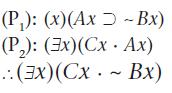
Construct a formal proof of validity for each of the following arguments: (P₁): (x)(Ax-Bx) (P₂): (3x)(Cx. Ax) .: (3x) (Cx - Bx)
For each of the following arguments, inferring just two statements from the premises will produce a formal proof of its validity. Construct a formal proof for each of these arguments.In these formal proofs, and in all the proofs to follow in later sections, note to the right of each inferred
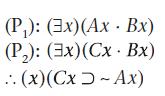
Prove the invalidity of the following: (P₁): (Ex) (Ax. Bx) (P₂): (3x) (Cx. Bx) :: (x) (Cx - Ax)
For each of the following, find a normal-form formula that is logically equivalent to the given one:∼ (x) [∼ (∼ Ux ⋅ ∼ Vx)
For each of the following arguments, use the STTT to determine whether the argument is valid or invalid. For some of these arguments, Steps 2 C , 3 C , and 4 (i.e., the C-Sequence) will be most efficient; for some of these arguments Steps 2 P , 3 P , and 4 (i.e., the P-Sequence) will be most
For each of the following arguments, a formal proof may be constructed by making just three inferences. Construct a formal proof of validity for each of them.(P1): ~ A ⊃ A∴ A
For each of the following, find a normal-form formula that is logically equivalent to the given one:∼ (∃x) [∼ (∼ Wx ꓦ Xx)]
For each of the following arguments, use the STTT to determine whether the argument is valid or invalid. For some of these arguments, Steps 2 C , 3 C , and 4 (i.e., the C-Sequence) will be most efficient; for some of these arguments Steps 2 P , 3 P , and 4 (i.e., the P-Sequence) will be most
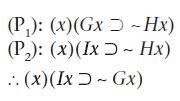
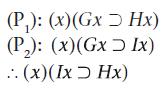
Construct a formal proof of validity for each of the following arguments: (P₁): (x)(Gx-Hx) (P₂): (x) (Ix - Hx) .. (x)(Ix-Gx)
For each of the following arguments, a formal proof may be constructed by making just three inferences. Construct a formal proof of validity for each of them.(P1): ~ B ꓦ (C ⋅ D)∴ B ⊃ C
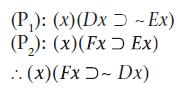
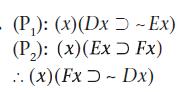
Construct a formal proof of validity for each of the following arguments: - Ex) Ex) (P₁): (x)(Dx (P₂): (x)(Fx ..(x) (Fx - Dx)
For each of the following arguments, a formal proof may be constructed by making just three inferences. Construct a formal proof of validity for each of them.(P1): E ꓦ (F ⋅ G)∴ E ꓦ G
Prove the invalidity of the following: - (P₁): (x)(Dx-Ex) (P₂): (x)(Ex Fx) :. (x) (Fx - Dx)
For each of the following arguments, a formal proof may be constructed by making just three inferences. Construct a formal proof of validity for each of them.(P1): H ⋅ (I ⋅ J)∴ J ⋅ (I ⋅ H)
For each of the following arguments, a formal proof may be constructed by making just three inferences. Construct a formal proof of validity for each of them.(P1): [(K ꓦ L) ꓦ M] ꓦ N∴ (N ꓦ K) ꓦ (L ꓦ M)
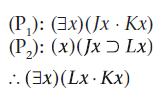
Construct a formal proof of validity for each of the following arguments: (P₁): (3x) (Jx Kx) (P₂): (x)(JxLx) .. (3x)(Lx.Kx)
Prove the invalidity of the following: (P₁): (x)(GxHx) (P₂): (x)(GxIx) :. (x)(IxƆ Hx)
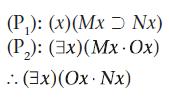
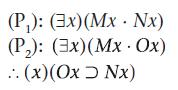
Construct a formal proof of validity for each of the following arguments: (P₁): (x)(MxNx) (P₂): (3x)(Mx Ox) .. (3x)(Ox. Nx)
Translate the following statements into logical symbolism, in each case using the abbreviations suggested:Apples and oranges are delicious and nutritious. (Ax, Ox, Dx, Nx)
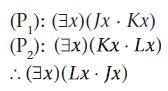
Prove the invalidity of the following: (P₁): (3x)(Jx. Kx) (P₂): (3x)(KxLx) :. (3x)(Lx. Jx)
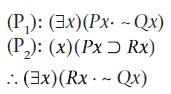
Construct a formal proof of validity for each of the following arguments: (P₁): (3x) (Px - Qx) (P₂): (x) (Px Rx) .. (3x) (Rx. ~ Qx)
Translate the following statements into logical symbolism, in each case using the abbreviations suggested:Some foods are edible only if they are cooked. (Fx, Ex, Cx)
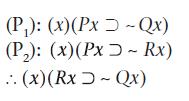
Prove the invalidity of the following: (P₁): (x)(Px-Qx) (P₂): (x)(Px - Rx) .. (x) (Rx - Qx)
Prove the invalidity of the following: (P₁): (3x)(Mx Nx) (P₂): (Ex) (Mx Ox) :: (x) (OxƆ Nx)
Translate the following statements into logical symbolism, in each case using the abbreviations suggested:No car is safe unless it has good brakes. (Cx, Sx, Bx)
Translate the following statements into logical symbolism, in each case using the abbreviations suggested:Any tall man is attractive if he is dark and handsome. (Tx, Mx, Ax, Dx, Hx)
Translate the following statements into logical symbolism, in each case using the abbreviations suggested:A gladiator wins if and only if he is lucky. (Gx, Wx, Lx)
Translate the following statements into logical symbolism, in each case using the abbreviations suggested:A boxer who wins if and only if he is lucky is not skillful. (Bx, Wx, Lx, Sx)
Prove the invalidity of the following, in each case using the suggested notation:All anarchists are bearded. All communists are bearded. Therefore all anarchists are communists. (Ax, Bx, Cx)
For each of the following, either construct a formal proof of its validity or prove it invalid, in each case using the suggested notation:A book is interesting only if it is well written. A book is well written only if it is interesting. Therefore any book is both interesting and well written if it
Do the same (as in Set C) for each of the following:All citizens who are not traitors are present. All officials are citizens. Some officials are not present. Therefore there are traitors. (Cx, Tx, Px, Ox)
Do the same (as in Set C) for each of the following:Doctors and lawyers are professional people. Professional people and executives are respected. Therefore doctors are respected. (Dx, Lx, Px, Ex, Rx)
Do the same (as in Set C) for each of the following:Only lawyers and politicians are members. Some members are not college graduates. Therefore some lawyers are not college graduates. (Lx, Px, Mx, Cx)
Do the same (as in Set C) for each of the following:All cut-rate items are either shopworn or out of date. Nothing shopworn is worth buying. Some cut-rate items are worth buying. Therefore some cut-rate items are out of date. (Cx, Sx, Ox, Wx)
Do the same (as in Set C) for each of the following:Some diamonds are used for adornment. Only things worn as jewels or applied as cosmetics are used for adornment. Diamonds are never applied as cosmetics. Nothing worn as a jewel is properly used if it has an industrial application. Some diamonds
Do the same (as in Set C) for each of the following:No candidate who is either endorsed by labor or opposed by the Tribune can carry the farm vote. No one can be elected who does not carry the farm vote. Therefore no candidate endorsed by labor can be elected. (Cx, Lx, Ox, Fx, Ex)
Do the same (as in Set C) for each of the following:No metal is friable that has been properly tempered. No brass is properly tempered unless it is given an oil immersion. Some of the ashtrays on the shelf are brass. Everything on the shelf is friable. Brass is a metal. Therefore some of the
Do the same (as in Set C) for each of the following:Anyone on the committee who knew the nominee would vote for the nominee if free to do so. Everyone on the committee was free to vote for the nominee except those who were either instructed not to by the party caucus or had pledged support to
Do the same (as in Set C) for each of the following:Some criminal robbed the Russell mansion. Whoever robbed the Russell mansion either had an accomplice among the servants or had to break in. To break in, one would either have to smash the door or pick the lock. Only an expert locksmith could have
In each of the following passages,a. What data are to be explained?b. What hypotheses are proposed to explain them?c. Evaluate the hypotheses in terms of the criteria presented in Section 13.3, pp. 564–566.In an unusual logjam of contradictory claims, a revolutionary new model of the universe, as
In each of the following passages,a. What data are to be explained?b. What hypotheses are proposed to explain them?c. Evaluate the hypotheses in terms of the criteria presented in Section 13.3, pp. 564–566.Population clusters—groups of persons who are found to buy the same things, get their
In each of the following passages,a. What data are to be explained?b. What hypotheses are proposed to explain them?c. Evaluate the hypotheses in terms of the criteria presented in Section 13.3, pp. 564–566.Monkeypox, a viral disease related to smallpox but less infectious and less deadly, was
In each of the following passages,a. What data are to be explained?b. What hypotheses are proposed to explain them?c. Evaluate the hypotheses in terms of the criteria presented in Section 13.3, pp. 564–566.A small study of heart-disease patients testing a hypothesis so improbable that its
In each of the following passages,a. What data are to be explained?b. What hypotheses are proposed to explain them?c. Evaluate the hypotheses in terms of the criteria presented in Section 13.3, pp. 564–566.Boy babies tend to be about 100 grams heavier on average than girl babies, but it has never
In each of the following passages,a. What data are to be explained?b. What hypotheses are proposed to explain them?c. Evaluate the hypotheses in terms of the criteria presented in Section 13.3, pp. 564–566.Humans, apes, and dolphins are highly social animals with large brains; they have been
In each of the following passages,a. What data are to be explained?b. What hypotheses are proposed to explain them?c. Evaluate the hypotheses in terms of the criteria presented in Section 13.3, pp. 564–566.The Nobel Prize for chemistry for 2003 was shared by Dr. Peter Agre, who encountered a new
In each of the following passages,a. What data are to be explained?b. What hypotheses are proposed to explain them?c. Evaluate the hypotheses in terms of the criteria presented in Section 13.3, pp. 564–566.Early in the eighteenth century Edmund Halley asked: “Why is the sky dark at night?”
The data to be explained here are the reports of the mapping of radiation in the entire cosmos. Two conflicting theories about the size and shape of the universe are offered to account for the resultant maps: one of these involves the hypothesis that the cosmos has ascertainable limits and a finite
In each of the following passages,a. What data are to be explained?b. What hypotheses are proposed to explain them?c. Evaluate the hypotheses in terms of the criteria presented in Section 13.3, pp. 564–566.Swedish researchers, collaborating with colleagues in South Africa, found that dung beetles
Some of the following passages contain explanations, some contain arguments, and some may be interpreted as either an argumaent or an explanation. What is your judgment about the chief function of each passage? What would have to be the case for the passage in question to be an argument? To be an
Hundreds of thousands of recent college graduates today cannot express themselves with the written word. Why? Because universities have shortchanged them, offering strange literary theories, Marxism, feminism, deconstruction, and other oddities in the guise of writing courses.—Stanley Ridgeley,
What is the probability of getting tails every time in three tosses of a coin?
Diagram each of the following passages, which may contain more than one argument.At any cost we must have filters on our Ypsilanti Township library computers. Pornography is a scourge on society at every level. Our public library must not be used to channel this filth to the people of the
Showing 2700 - 2800
of 3685
First
21
22
23
24
25
26
27
28
29
30
31
32
33
34
35
Last
Step by Step Answers

 Get 50% OFF
Claim Now
Get 50% OFF
Claim Now