New Semester
Started
Get
50% OFF
Study Help!
--h --m --s
Claim Now
Question Answers
Textbooks
Find textbooks, questions and answers
Oops, something went wrong!
Change your search query and then try again
S
Books
FREE
Study Help
Expert Questions
Accounting
General Management
Mathematics
Finance
Organizational Behaviour
Law
Physics
Operating System
Management Leadership
Sociology
Programming
Marketing
Database
Computer Network
Economics
Textbooks Solutions
Accounting
Managerial Accounting
Management Leadership
Cost Accounting
Statistics
Business Law
Corporate Finance
Finance
Economics
Auditing
Tutors
Online Tutors
Find a Tutor
Hire a Tutor
Become a Tutor
AI Tutor
AI Study Planner
NEW
Sell Books
Search
Search
Sign In
Register
study help
social science
introduction to logic
Introduction To Logic 15th Edition Irving M. Copi, Carl Cohen, Victor Rodych - Solutions
A. Identify three disagreements in current political or social controversy that are of the three types described in this section: one that is genuine, one that is merely verbal, and one that is apparently verbal but really genuine. Explain the disagreements in each case.B. Discuss each of the
Identify and explain any fallacies of defective induction or of presumption in the following passages:A national mailing soliciting funds, by People for the Ethical Treatment of Animals (PETA), included a survey in which questions were to be answered “yes” or “no.” Two of the questions
Identify the premises and conclusions in the following passages. Some premises do support the conclusion, others do not. Note that premises may support conclusions directly or indirectly and that even simple passages may contain more than one argument.Thomas Aquinas argued that human intelligence
If the odds in craps are 8-to-1 against rolling an 8 the “hard way” (that is, with two 4’s), what is the expectation purchased by a $1 bet on a “hard-way” 8?
Each of the following famous passages, taken from classical literature and philosophy, comprises a set of arguments whose complicated interrelations are critical for the force of the whole. Construct for each the diagram that you would find most helpful in analyzing the flow of argument in that
Identify and explain the fallacies of relevance in the following passages:Like an armed warrior, like a plumed knight, James G. Blaine marched down the halls of the American Congress and threw his shining lances full and fair against the brazen foreheads of every defamer of his country and maligner
Some of the following passages contain explanations, some contain arguments, and some may be interpreted as either an argumaent or an explanation. What is your judgment about the chief function of each passage? What would have to be the case for the passage in question to be an argument? To be an
Which of the various functions of language are exemplified by each of the following passages?What traveler among the ruins of Carthage, of Palmyra, Persepolis, or Rome, has not been stimulated to reflections on the transiency of kingdoms and men, and to sadness at the thought of a vigorous and rich
Racially diverse nations tend to have lower levels of social support than homogenous ones. People don’t feel as bound together when they are divided on ethnic lines and are less likely to embrace mutual support programs. You can have diversity or a big welfare state. It’s hard to have
An urn contains 27 white balls and 40 black balls. What is the probability of getting four black balls in four successive drawings:A. If each ball drawn is replaced before making the next drawing?B. If the balls are not replaced?
Diagram each of the following passages, which may contain more than one argument.At his best, Lyndon Johnson was one of the greatest of all American presidents. He did more for racial justice than any president since Abraham Lincoln. He built more social protections than anyone since Franklin
A. Identify three disagreements in current political or social controversy that are of the three types described in this section: one that is genuine, one that is merely verbal, and one that is apparently verbal but really genuine. Explain the disagreements in each case.B. Discuss each of the
Identify and explain any fallacies of defective induction or of presumption in the following passages:If you want a life full of sexual pleasures, don’t graduate from college. A study to be published next month in American Demographics magazine shows that people with the most education have the
Identify the premises and conclusions in the following passages. Some premises do support the conclusion, others do not. Note that premises may support conclusions directly or indirectly and that even simple passages may contain more than one argument.Sir Edmund Hillary is a hero, not because he
Identify the kinds of agreement or disagreement most probably exhibited by the following pairs:a. A stitch in time saves nine.b. Better late than never.
Identify and explain the fallacies of relevance in the following passages:However, it matters very little now what the king of England either says or does; he hath wickedly broken through every moral and human obligation, trampled nature and conscience beneath his feet, and by a steady and
What expectation does a person with $15 have who bets on heads, beginning with a $1 bet, and uses the doubling technique, if the bettor resolves to play just four times and quit?
Each of the following famous passages, taken from classical literature and philosophy, comprises a set of arguments whose complicated interrelations are critical for the force of the whole. Construct for each the diagram that you would find most helpful in analyzing the flow of argument in that
Some of the following passages contain explanations, some contain arguments, and some may be interpreted as either an argumaent or an explanation. What is your judgment about the chief function of each passage? What would have to be the case for the passage in question to be an argument? To be an
Identify the kinds of agreement or disagreement most probably exhibited by the following pairs:a. Absence makes the heart grow fonder.b. Out of sight, out of mind.
Orlando Patterson claims that “freedom is a natural part of the human condition.” Nothing could be further from the truth. If it were true, we could expect to find free societies spread throughout human history. We do not. Instead what we fi nd are every sort of tyrannical government from time
Which of the various functions of language are exemplified by each of the following passages?Moving due south from the center of Detroit, the fi rst foreign country one encounters is not Cuba, nor is it Honduras or Nicaragua or any other Latin American nation; it is Canada.
An urn contains 27 white balls and 40 black balls. What is the probability of getting four black balls in four successive drawings:A. If each ball drawn is replaced before making the next drawing?B. If the balls are not replaced?
Diagram each of the following passages, which may contain more than one argument.Married people are healthier and more economically stable than single people, and children of married people do better on a variety of indicators. Marriage is thus a socially responsible act. There ought to be some way
A. Identify three disagreements in current political or social controversy that are of the three types described in this section: one that is genuine, one that is merely verbal, and one that is apparently verbal but really genuine. Explain the disagreements in each case.B. Discuss each of the
Identify and explain any fallacies of defective induction or of presumption in the following passages:There is no surprise in discovering that acupuncture can relieve pain and nausea. It will probably also be found to work on anxiety, insomnia, and itching, because these are all conditions in which
Identify the premises and conclusions in the following passages. Some premises do support the conclusion, others do not. Note that premises may support conclusions directly or indirectly and that even simple passages may contain more than one argument.Standardized tests have a disparate racial and
The probability of the shooter winning in craps is .493, slightly less than even, as we proved in the preceding section. In casinos, a bet that the shooter will win is a bet on what is called the “Pass” line. We could all become rich, it would seem, if only we bet consistently against the
Translate each of the following into the logical notation of propositional functions and quantifiers, in each case using the abbreviations suggested and making each formula begin with a quantifier, not with a negation symbol.Nurses are always considerate. (Nx: x is a nurse; Cx: x is considerate.)
For each of the following arguments, it is possible to provide a formal proof of validity by validly inferring just three statements. Writing these out, carefully and accurately, will strengthen your command of the rules of inference, a needed preparation for the construction of proofs that are
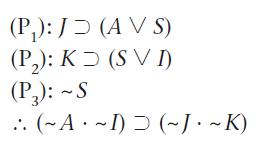
Use Conditional Proof to prove the validity of the following arguments. (P₂): JD (AVS) (P₂): KD (SVI) (P₂): ~S .. (~A~I) (~J. ~K)
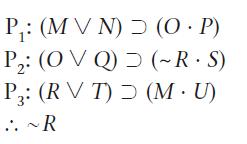
For each of the following arguments, construct an indirect proof of validity. P₁: (MVN) P₂: (OVQ) P₂: (RVT) 3 :. R (O·P) (~R.S) (M.U)
For each of the following, either construct a formal proof of validity or prove invalidity by means of the STTT.(P1): M ⊃ (N ⋅ O)(P2): (N ꓦ O) ⊃ P∴ M ⊃ P
Here follows a set of twenty elementary valid arguments. They are valid because each of them is exactly in the form of one of the nine elementary valid argument forms. For each of them, state the rule of inference by which its conclusion follows from its premise or premises.(P1): ~ (J ⋅ K) ⋅ (L
For each numbered statement that is not a premise in each of the formal proofs that follow, state the rule of inference that justifies it.1. (M ꓦ N) ⊃ (O ⋅ P)2. ~ O∴ ~ M3. ~ O ꓦ ~ P4. ~ (O ⋅ P)5. ~ (M ꓦ N)6. ~ M ⋅ ~ N7. ~ M
The following set of arguments involves, in each case, one inference only, in which one of the ten logical equivalences set forth in this section has been employed. Here are two examples, the first two in the exercise set immediately following.(P1): [L ⊃ (M ꓦ N)] ꓦ [L ⊃ (M ꓦ N)]∴ L ⊃
Each of the following exercises presents a flawless formal proof of validity for the indicated argument. For each proof, state the justification for each inferred statement (i.e., each statement that is not a premise).1. I ⊃ J2. J ⊃ K3. L ⊃ M4. I ꓦ L∴ K ꓦ M5. I ⊃ K6. (I ⊃ K) ⋅ (L
For the following statements, if there are forced truth-value assignments, make them. If there are no forced truth-value assignments, determine, using Maxim V, the requisite truth-value combinations on which, and the number of ways that, the statement can be true (or false), as the case requires.M
Translate each of the following into the logical notation of propositional functions and quantifiers, in each case using the abbreviations suggested and making each formula begin with a quantifier, not with a negation symbol.Reporters are present. (Rx: x is a reporter; Px: x is present.)
For each of the following arguments, it is possible to provide a formal proof of validity by validly inferring just three statements. Writing these out, carefully and accurately, will strengthen your command of the rules of inference, a needed preparation for the construction of proofs that are
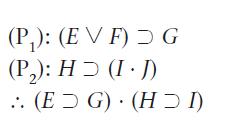
Use Conditional Proof to prove the validity of the following arguments. (P₁): (EVF) G (P₂): HD (I.J) :. (EG) (HDI)
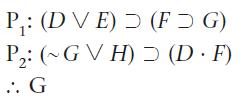
For each of the following arguments, construct an indirect proof of validity. P₁: (DVE) (FG) P₂: (~GVH) (D.F) .. G
For each of the following, either construct a formal proof of validity or prove invalidity by means of the STTT.(P1): I ⊃ (J ꓦ K)(P2): (J ⋅ K) ⊃ L∴ I ⊃ L
Here follows a set of twenty elementary valid arguments. They are valid because each of them is exactly in the form of one of the nine elementary valid argument forms. For each of them, state the rule of inference by which its conclusion follows from its premise or premises.(P1): H ⊃ I∴ (H ⊃
For each numbered statement that is not a premise in each of the formal proofs that follow, state the rule of inference that justifies it.1. (H ꓦ I) ⊃ [J ⋅ (K ⋅ L)]2. I∴ J ⋅ K3. I ꓦ H4. H ꓦ I5. J ⋅ (K ⋅ L)6. (J ⋅ K) ⋅ L7. J ⋅ K
The following set of arguments involves, in each case, one inference only, in which one of the ten logical equivalences set forth in this section has been employed. Here are two examples, the first two in the exercise set immediately following.(P1): [I ⊃ (J ⊃ K)] ⋅ (J ⊃ ~ I)∴ [(I ⋅ J)
The following set of arguments involves, in each case, one inference only, in which one of the ten logical equivalences set forth in this section has been employed. Here are two examples, the first two in the exercise set immediately following.(P1): (E ⊃ F) ⋅ (G ⊃ ~ H)∴ (~ E ꓦ F) ⋅ (G
Each of the following exercises presents a flawless formal proof of validity for the indicated argument. For each proof, state the justification for each inferred statement (i.e., each statement that is not a premise).1. (E ꓦ F) ⋅ (G ꓦ H)2. (E ⊃ G) ⋅ (F ⊃ H)3. ~ G∴ H4. E ꓦ F5. G ꓦ
For the following statements, if there are forced truth-value assignments, make them. If there are no forced truth-value assignments, determine, using Maxim V, the requisite truth-value combinations on which, and the number of ways that, the statement can be true (or false), as the case requires.D
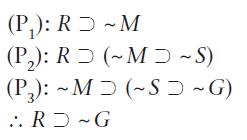
Use Conditional Proof to prove the validity of the following arguments. (P₂): RD-M (P₂): RD (~M~S) (P₂): ~MD (~S~G) :. RD-G
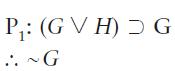
For each of the following arguments, construct an indirect proof of validity. P₁: (GVH) G ~G
For each of the following, either construct a formal proof of validity or prove invalidity by means of the STTT.(P1): (E ⊃ F) ⋅ (G ⊃ H)∴ (E ꓦ G) ⊃ (F ⋅ H)
Here follows a set of twenty elementary valid arguments. They are valid because each of them is exactly in the form of one of the nine elementary valid argument forms. For each of them, state the rule of inference by which its conclusion follows from its premise or premises.(P1): (D ꓦ E) ⋅ (F
For each numbered statement that is not a premise in each of the formal proofs that follow, state the rule of inference that justifies it.1. (D ⋅ E) ⊃ F2. (D ⊃ F) ⊃ G∴ E ⊃ G3. (E ⋅ D) ⊃ F4. E ⊃ (D ⊃ F)5. E ⊃ G
The following set of arguments involves, in each case, one inference only, in which one of the ten logical equivalences set forth in this section has been employed. Here are two examples, the first two in the exercise set immediately following.(P1): (A ⊃ B) ⋅ (C ⊃ D)∴ (A ⊃ B) ⋅ (~ D ⊃
For the following statements, if there are forced truth-value assignments, make them. If there are no forced truth-value assignments, determine, using Maxim V, the requisite truth-value combinations on which, and the number of ways that, the statement can be true (or false), as the case requires.Z
Translate each of the following into the logical notation of propositional functions and quantifiers, in each case using the abbreviations suggested and making each formula begin with a quantifier, not with a negation symbol.No beast is without some touch of pity. (Bx: x is a beast; Px: x has some
For each of the following arguments, it is possible to provide a formal proof of validity by validly inferring just three statements. Writing these out, carefully and accurately, will strengthen your command of the rules of inference, a needed preparation for the construction of proofs that are
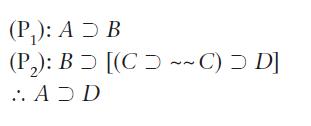
Use Conditional Proof to prove the validity of the following arguments. (P₁): ADB (P₂): B [(C~~C) D] :. ADD
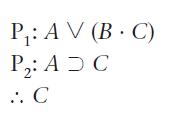
For each of the following arguments, construct an indirect proof of validity. Pr: A V (B · C) P₂: ADC :.c C
For each of the following, either construct a formal proof of validity or prove invalidity by means of the STTT.(P1): (A ⊃ B) ⋅ (C ⊃ D)∴ (A ⋅ C) ⊃ (B ꓦ D)
For each numbered statement that is not a premise in each of the formal proofs that follow, state the rule of inference that justifies it.1. A ⊃ B2. C ⊃ ~ B∴ A ⊃ ~ C3. ~~ B ⊃ ~ C4. B ⊃ ~ C5. A ⊃ ~ C
Using the letters E , I , J , L , and S to abbreviate the simple statements, “Egypt’s food shortage worsens,” “Iran raises the price of oil,” “Jordan requests more U.S. aid,” “Libya raises the price of oil,” and “Saudi Arabia buys five hundred more warplanes,” symbolize these
Using the letters E , I , J , L , and S to abbreviate the simple statements, “Egypt’s food shortage worsens,” “Iran raises the price of oil,” “Jordan requests more U.S. aid,” “Libya raises the price of oil,” and “Saudi Arabia buys five hundred more warplanes,” symbolize these
Using the letters E , I , J , L , and S to abbreviate the simple statements, “Egypt’s food shortage worsens,” “Iran raises the price of oil,” “Jordan requests more U.S. aid,” “Libya raises the price of oil,” and “Saudi Arabia buys fi ve hundred more warplanes,” symbolize these
Using the letters E , I , J , L , and S to abbreviate the simple statements, “Egypt’s food shortage worsens,” “Iran raises the price of oil,” “Jordan requests more U.S. aid,” “Libya raises the price of oil,” and “Saudi Arabia buys fi ve hundred more warplanes,” symbolize these
Using the letters E , I , J , L , and S to abbreviate the simple statements, “Egypt’s food shortage worsens,” “Iran raises the price of oil,” “Jordan requests more U.S. aid,” “Libya raises the price of oil,” and “Saudi Arabia buys five hundred more warplanes,” symbolize these
Symbolize the following, using capital letters to abbreviate the simple statements involved.If Argentina does not mobilize, then either Brazil will not protest to the UN or Chile will not call for a meeting of all the Latin American states.
Use truth tables to decide which of the following biconditionals are tautologies.p = [p ⋅ (q ꓦ ~ q)]
If A , B , and C are true statements and X , Y , and Z are false statements, which of the following are true?~(A · B) ꓦ (X · Y)
Symbolize the following, using capital letters to abbreviate the simple statements involved.Either Argentina will mobilize or if Brazil protests to the UN, then Chile will call for a meeting of all the Latin American states.
Use truth tables to decide which of the following biconditionals are tautologies.p = p ⋅ (q ⋅ ~ q)
If A , B , and C are true statements and X , Y , and Z are false statements, which of the following are true?~(C · Y) ꓦ (A · Z)
Symbolize the following, using capital letters to abbreviate the simple statements involved.If either Argentina mobilizes or Brazil protests to the UN, then Chile will call for a meeting of all the Latin American states.
Use truth tables to decide which of the following biconditionals are tautologies.p = [p ꓦ (q · ~ q)]
If A , B , and C are true statements and X , Y , and Z are false statements, which of the following are true?(B · C ) ꓦ (Y · Z)
Symbolize the following, using capital letters to abbreviate the simple statements involved.If Argentina mobilizes and Brazil protests to the UN, then Chile will call for a meeting of all the Latin American states.
Use truth tables to decide which of the following biconditionals are tautologies.(p ⊃ q) ≡ [(p ꓦ q) = q]
If A , B , and C are true statements and X , Y , and Z are false statements, which of the following are true?(A · X ) ꓦ (B · Y)
Use truth tables to determine the validity or invalidity of the following arguments:If oil consumption continues to grow, then oil imports will increase and domestic oil reserves will be depleted. If either oil imports increase or domestic oil reserves are depleted, then the nation will soon be
Symbolize the following, using capital letters to abbreviate the simple statements involved.If Argentina mobilizes, then Brazil will protest to the UN, and Chile will call for a meeting of all the Latin American states.
Use truth tables to decide which of the following biconditionals are tautologies.p = [p ꓦ (p ⊃ q)]
If A , B , and C are true statements and X , Y , and Z are false statements, which of the following are true?~ Z ꓦ X
Use truth tables to determine the validity or invalidity of the following arguments:If oil consumption continues to grow, then either oil imports will increase or domestic oil reserves will be depleted. If oil imports increase and domestic oil reserves are depleted, then the nation eventually will
Symbolize the following, using capital letters to abbreviate the simple statements involved.If Argentina mobilizes, then Brazil will protest to the UN and Chile will call for a meeting of all the Latin American states.
Use truth tables to decide which of the following biconditionals are tautologies.p = [p ⋅ (q ⊃ p)
If A , B , and C are true statements and X , Y , and Z are false statements, which of the following are true?~ Y ꓦ C
Use truth tables to determine the validity or invalidity of the following arguments:If people are entirely rational, then either all of a person’s actions can be predicted in advance or the universe is essentially deterministic. Not all of a person’s actions can be predicted in advance. Thus,
Symbolize the following, using capital letters to abbreviate the simple statements involved.If Argentina mobilizes, then either Brazil will protest to the UN or Chile will call for a meeting of all the Latin American states.
Use truth tables to decide which of the following biconditionals are tautologies.p = [p ⋅ (p ⊃ q)]
If A , B , and C are true statements and X , Y , and Z are false statements, which of the following are true?~ B ꓦ X
Use truth tables to determine the validity or invalidity of the following arguments:If terrorists’ demands are met, then lawlessness will be rewarded. If terrorists’ demands are not met, then innocent hostages will be murdered. So either lawlessness will be rewarded or innocent hostages will be
Symbolize the following, using capital letters to abbreviate the simple statements involved.If Argentina mobilizes, then if Brazil protests to the UN, then Chile will call for a meeting of all the Latin American states.
Use truth tables to decide which of the following biconditionals are tautologies.p = [p ꓦ (p · q)]
If A , B , and C are true statements and X , Y , and Z are false statements, which of the following are true?~ A ꓦ B
Use truth tables to determine the validity or invalidity of the following arguments:If equality of opportunity is to be achieved, then those people previously disadvantaged should now be given special opportunities. If those people previously disadvantaged should now be given special opportunities,
Use truth tables to decide which of the following biconditionals are tautologies.p = [p ⋅ (p ꓦ q)]
Using the truth-table definitions of the dot, the wedge, and the tilde (curl), determine which of the following statements are true:~ [(~ London is the capital of England ⋅ Paris is the capital of France) ꓦ ~(~ Paris is the capital of France · Rome is the capital of Spain)].
Use truth tables to determine the validity or invalidity of the following arguments:If Montana suffers a severe drought, then, if Nevada has its normal light rainfall, Oregon’s water supply will be greatly reduced. Nevada does have its normal light rainfall. So if Oregon’s water supply is
Use truth tables to decide which of the following biconditionals are tautologies.[p ⊃ (q ⊃ r)] = [q ⊃ (p ⊃ r)]
Showing 2800 - 2900
of 3685
First
22
23
24
25
26
27
28
29
30
31
32
33
34
35
36
Last
Step by Step Answers

 Get 50% OFF
Claim Now
Get 50% OFF
Claim Now