New Semester
Started
Get
50% OFF
Study Help!
--h --m --s
Claim Now
Question Answers
Textbooks
Find textbooks, questions and answers
Oops, something went wrong!
Change your search query and then try again
S
Books
FREE
Study Help
Expert Questions
Accounting
General Management
Mathematics
Finance
Organizational Behaviour
Law
Physics
Operating System
Management Leadership
Sociology
Programming
Marketing
Database
Computer Network
Economics
Textbooks Solutions
Accounting
Managerial Accounting
Management Leadership
Cost Accounting
Statistics
Business Law
Corporate Finance
Finance
Economics
Auditing
Tutors
Online Tutors
Find a Tutor
Hire a Tutor
Become a Tutor
AI Tutor
AI Study Planner
NEW
Sell Books
Search
Search
Sign In
Register
study help
social science
introduction to logic
A Concise Introduction to Logic 13th edition Patrick J. Hurley, Lori Watson - Solutions
There are at most two cities in Malta. (Cx: x is a city; Mx: x is in Malta)Translate the following statements.Numerical statements
There is at most one national holiday in July. (Nx: x is a national holiday; Jx: x is in July)Translate the following statements.Numerical statements
There are at most two national parks in South Dakota. (Nx: x is a national park; Sx: x is in South Dakota)Translate the following statements.Numerical statements
There are at most two national parks in South Dakota. (Nx: x is a national park; Sx: x is in South Dakota)Translate the following statements.Numerical statements
There is at most one city in Belize. (Cx: x is a city; Bx: x is in Belize)Translate the following statements.Numerical statements
Every pitcher except Cy Young has won fewer than 500 games. (Px: x is a pitcher; Wx: x has won fewer than 500 games; c: Cy Young)Translate the following statements.Statements involving “all except”
All metals except mercury are solids at room temperature. (Mx: x is a metal; Sx: x is a solid at room temperature; m: mercury)Translate the following statements.Statements involving “all except”
Every U.S. president except Ford won a national election. (Ux: x is a U.S. president; Wx: x won a national election; f : Ford)Translate the following statements.Statements involving “all except”
Every city except Istanbul is situated on a single continent. (Cx: x is a city; Sx: x is situated on a single continent; i: Istanbul)Translate the following statements.Statements involving “all except”
Death Valley is the lowest region in North America. (Rx: x is a region; Nx: x is in North America; Lyx: x is lower than y; d: Death Valley)Translate the following statements.Superlative statements
Harvard is the oldest American university. (Ax: x is American; Ux: x is a university; Oxy: x is older than y; h: Harvard)Translate the following statements.Superlative statements
The smallest planet in our solar system is Mercury. (Px: x is a planet in our solar system; Sxy: x is smaller than y; m: Mercury)Translate the following statements.Superlative statements
Hydrogen is the lightest element. (Ex: x is an element; Lxy: x is lighter than y; h: hydrogen)Translate the following statements.Superlative statements
No sport except hockey uses a puck. (Sx: x is a sport; Px: x uses a puck; h: hockey)Translate the following statements.Statements involving “only,” “the only,” and “no . . . except”
No state except Hawaii is surrounded by water. (Sx: x is a state; Wx: x is surrounded by water; h: Hawaii)Translate the following statements.Statements involving “only,” “the only,” and “no . . . except”
The only U.S. presidents who were Federalists were Washington and Adams. (Ux: x is a U.S. president; Fx: x is a Federalist; w: Washington; a: Adams)Translate the following statements.Statements involving “only,” “the only,” and “no . . . except”
The only nation having a maple-leaf flag is Canada. (Nx: x is a nation; Mx: x has a maple-leaf flag; c: Canada)Translate the following statements.Statements involving “only,” “the only,” and “no . . . except”
The only national park in Maine is Acadia. (Nx: x is a national park; Mx: x is in Maine; a: Acadia)Translate the following statements.Statements involving “only,” “the only,” and “no . . . except”
The only national park in Maine is Acadia. (Nx: x is a national park; Mx: x is in Maine; a: Acadia)Translate the following statements.Statements involving “only,” “the only,” and “no . . . except”
Only Don Larsen has pitched a perfect World Series game. (Px: x has pitched a perfect World Series game; l: Don Larsen)Translate the following statements.Statements involving “only,” “the only,” and “no . . . except”
Only Linus Pauling has won two unshared Nobel prizes. (Wx: x has won two Nobel prizes; p: Linus Pauling)Translate the following statements.Statements involving “only,” “the only,” and “no . . . except”
Hermann Hesse is not André Gide. (h, g)Translate the following statements.Simple identity statements
Marilyn Monroe is Norma Jean Baker. (m, b)Translate the following statements.Simple identity statements
Auguste Renoir is not Claude Monet. (r, m)Translate the following statements.Simple identity statements
Dr. Seuss is Theodore Geisel. (s, g)Translate the following statements.Simple identity statements
Create five statements involving the relational predicate “friend of.” Then translate each statement into the language of predicate logic.
If there are any instructors, then if at least one classroom is available they will be effective. If there are either any textbooks or workbooks, there will be instructors and classrooms. Furthermore, if there are any classrooms, they will be available. Therefore, if there are any textbooks, then
If anything is missing, then some person stole it. If anything is damaged, then some person broke it. Something is either missing or damaged. Therefore, some person either stole something or broke something. (Mx: x is missing; Px: x is a person; Sxy: x stole y; Dx: x is damaged; Bxy: x broke
If there are any policemen, then if there are any robbers, then they will arrest them. If any robbers are arrested by policemen, they will go to jail. There are some policemen and Macky is a robber. Therefore, Macky will go to jail. (Px: x is a policeman; Rx: x is a robber; Axy: x arrests y; Jx: x
Some people are friends of every person they know. Every person knows someone (or other). Therefore, at least one person is a friend of someone. (Px: x is a person; Fxy: x is a friend of y; Kxy: x knows y)Translate the following arguments into symbolic form. Then derive the conclusion of each,
Some people are friends of every person they know. Every person knows someone (or other). Therefore, at least one person is a friend of someone. (Px: x is a person; Fxy: x is a friend of y; Kxy: x knows y)Translate the following arguments into symbolic form. Then derive the conclusion of each,
Dr. Rogers can cure any person who cannot cure himself. Dr. Rogers is a person. Therefore, Dr. Rogers can cure himself. (Px: x is a person; Cxy: x can cure y)Translate the following arguments into symbolic form. Then derive the conclusion of each, using conditional proof or indirect proof when
If there are any honest politicians, then if all the ballots are counted they will be reelected. Some honest politicians will not be reelected. Therefore, some ballots will not be counted. (Hx: x is honest; Px: x is a politician; Bx: x is a ballot; Cx: x is counted; Rx: x will be
O’Brien is a person. Furthermore, O’Brien is smarter than any person in the class. Since no person is smarter than himself, it follows that O’Brien is not in the class. (Px: x is a person; Sxy: x is smarter than y; Cx: x is in the class)Translate the following arguments into symbolic form.
A horse is an animal. Therefore, whoever owns a horse owns an animal. (Hx: x is a horse; Ax: x is an animal; Oxy: x owns y)Translate the following arguments into symbolic form. Then derive the conclusion of each, using conditional proof or indirect proof when needed.
Whoever is a friend of either Michael or Paul will receive a gift. If Michael has any friends, then Eileen is one of them. Therefore, if Ann is a friend of Michael, then Eileen will receive a gift. (Fxy: x is a friend of y; Rx: x will receive a gift)Translate the following arguments into symbolic
Any professional can outplay any amateur. Jones is a professional but he cannot outplay Meyers. Therefore, Meyers is not an amateur. (Px: x is a professional; Ax: x is an amateur; Oxy: x can outplay y)Translate the following arguments into symbolic form. Then derive the conclusion of each, using
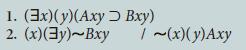
Derive the conclusion of the following symbolized arguments. Use conditional proof or indirect proof as needed.
Derive the conclusion of the following symbolized arguments. Use conditional proof or indirect proof as needed.
Derive the conclusion of the following symbolized arguments. Use conditional proof or indirect proof as needed.
Derive the conclusion of the following symbolized arguments. Use conditional proof or indirect proof as needed.
Derive the conclusion of the following symbolized arguments. Use conditional proof or indirect proof as needed.
Derive the conclusion of the following symbolized arguments. Use conditional proof or indirect proof as needed.
Derive the conclusion of the following symbolized arguments. Use conditional proof or indirect proof as needed.
Derive the conclusion of the following symbolized arguments. Use conditional proof or indirect proof as needed.
Derive the conclusion of the following symbolized arguments. Use conditional proof or indirect proof as needed.
Derive the conclusion of the following symbolized arguments. Use conditional proof or indirect proof as needed.
Derive the conclusion of the following symbolized arguments. Use conditional proof or indirect proof as needed.
Derive the conclusion of the following symbolized arguments. Use conditional proof or indirect proof as needed.
Derive the conclusion of the following symbolized arguments. Use conditional proof or indirect proof as needed.
Derive the conclusion of the following symbolized arguments. Use conditional proof or indirect proof as needed.
Derive the conclusion of the following symbolized arguments. Use conditional proof or indirect proof as needed.
Derive the conclusion of the following symbolized arguments. Use conditional proof or indirect proof as needed.
Derive the conclusion of the following symbolized arguments. Use conditional proof or indirect proof as needed.
Derive the conclusion of the following symbolized arguments. Use conditional proof or indirect proof as needed.
Derive the conclusion of the following symbolized arguments. Use conditional proof or indirect proof as needed.
Derive the conclusion of the following symbolized arguments. Use conditional proof or indirect proof as needed.
Derive the conclusion of the following symbolized arguments. Use conditional proof or indirect proof as needed.
Derive the conclusion of the following symbolized arguments. Use conditional proof or indirect proof as needed.
Derive the conclusion of the following symbolized arguments. Use conditional proof or indirect proof as needed.
Derive the conclusion of the following symbolized arguments. Use conditional proof or indirect proof as needed.
If there are any safe drivers, then some safe drivers will be hired.Translate the following statements into symbolic form.
If there are any safe drivers, then if none of the trucks break down they will be hired. (Sx: x is safe; Dx: x is a driver; Tx: x is a truck; Bx: x breaks down; Hx: x will be hired)Translate the following statements into symbolic form.
All children in the fourth grade can read any of the books in the library.Translate the following statements into symbolic form.
Some children in the third grade can read any of the books in the library. (Cx: x is a child; Tx: x is in the third grade; Rxy: x can read y; Bx: x is a book; Lx: x is in the library)Translate the following statements into symbolic form.
Some lawyers will represent any person who will not represent himself. (Lx: x is a lawyer; Px: x is a person; Rxy: x represents y)Translate the following statements into symbolic form.
Every lawyer will represent a wealthy client. (Lx: x is a lawyer; Rxy: x will represent y; Wx: x is wealthy; Cx: x is a client)Translate the following statements into symbolic form.
If there are any cheaters, then if all the referees are vigilant they will be punished. (Cx: x is a cheater; Rx: x is a referee; Vx: x is vigilant; Px: x will be punished)Translate the following statements into symbolic form.
If there are cheaters, then some cheaters will be punished. (Cx: x is a cheater; Px: x will be punished)Translate the following statements into symbolic form.
Some policemen arrest every traffic violator they see. (Px: x is a policeman; Axy: x arrests y; Tx: x is a traffic violator; Sxy: x sees y)Translate the following statements into symbolic form.
Some policemen arrest only traffic violators. (Px: x is a policeman; Axy: x arrests y; Tx: x is a traffic violator)Translate the following statements into symbolic form.
Some people admire every person they meet.Translate the following statements into symbolic form.
Every person admires some people he or she meets. (Px: x is a person; Axy: x admires y; Mxy: x meets y)Translate the following statements into symbolic form.
Some people speak to whoever speaks to them. (Px: x is a person; Sxy: x speaks to y)Translate the following statements into symbolic form.
Some people break everything they touch. (Px: x is a person; Bxy: x breaks y; Txy: x touches y)Translate the following statements into symbolic form.
Christopher invited some of his friends.Translate the following statements into symbolic form.
Sylvia invited only her friends. (Ixy: x invited y; Fxy: x is a friend of y)Translate the following statements into symbolic form.
Sylvia invited only her friends. (Ixy: x invited y; Fxy: x is a friend of y)Translate the following statements into symbolic form.
Jones can drive any car in the lot.Translate the following statements into symbolic form.
Peterson can drive some of the cars in the lot. (Dxy: x can drive y; Cx: x is a car; Lx: x is in the lot)Translate the following statements into symbolic form.
The Clark Corporation advertises everything it produces. (Axy: x advertises y; Pxy: x produces y)Translate the following statements into symbolic form.
The Clark Corporation advertises everything it produces. (Axy: x advertises y; Pxy: x produces y)Translate the following statements into symbolic form.
The Royal Hotel serves only good drinks. (Sxy: x serves y; Gx: x is good; Dx: x is a drink)Translate the following statements into symbolic form.
Some people can sell anything.Translate the following statements into symbolic form.
No person can sell everything.Translate the following statements into symbolic form.
No person can sell everything.Translate the following statements into symbolic form.
Some people cannot sell anything.Translate the following statements into symbolic form.
Every person can sell something or other. (Px: x is a person; Sxy: x can sell y)Translate the following statements into symbolic form.
Dr. Nelson teaches a few morons. (Txy: x teaches y; Mx: x is a moron)Translate the following statements into symbolic form.
Dr. Nelson teaches a few morons. (Txy: x teaches y; Mx: x is a moron)Translate the following statements into symbolic form.
Dr. Jordan teaches only geniuses. (Txy: x teaches y; Gx: x is a genius)Translate the following statements into symbolic form.
If James has any friends, then Marlene is one of them. (Fxy: x is a friend of y)Translate the following statements into symbolic form.
James is a friend of either Ellen or Connie. (Fxy: x is a friend of y)Translate the following statements into symbolic form.
Whoever reads Paradise Lost is educated. (Rxy: x reads y; Ex: x is educated)Translate the following statements into symbolic form.
Charmaine read Paradise Lost. (Rxy: x read y)Translate the following statements into symbolic form.
Create an invalid argument relating to parties—the fun kind, not the political sort. Then translate the argument into the symbolism of predicate logic and use both the counterexample method and the finite universe method to prove the argument invalid.
All cellists and violinists are members of the string section. Some violinists are not cellists. Also, some cellists are not violinists. Therefore, everyone is a member of the string section. (C, V, M )Translate the following arguments into symbolic form. Then use either the counterexample method
All timpanists are haughty. If some timpanists are haughty, then some percussionists are overbearing. Therefore, all timpanists are overbearing. (T, H, P, O)Translate the following arguments into symbolic form. Then use either the counterexample method or the finite universe method to prove that
If there are any oboists, there are some bassoonists. If there are any clarinetists, there are some flutists. Amelia is both an oboist and a clarinetist. Therefore, some bassoonists are flutists. (O, B, C, F )Translate the following arguments into symbolic form. Then use either the counterexample
Pianists and harpsichordists are meticulous. Alfred Brendel is a pianist. Therefore, everyone is meticulous. (P, H, M )Translate the following arguments into symbolic form. Then use either the counterexample method or the finite universe method to prove that each is invalid.
Showing 400 - 500
of 3685
1
2
3
4
5
6
7
8
9
10
11
12
13
14
15
Last
Step by Step Answers

 Get 50% OFF
Claim Now
Get 50% OFF
Claim Now


![1. (x)(y) [Axy (Bx Cy)] 2. (x) (y)[(Bxv Dy) ~Axy] /~(3x) (y)Axy](https://dsd5zvtm8ll6.cloudfront.net/si.question.images/images/question_images/1696/4/0/3/144651d0ec8b80e11696403144171.jpg)

![1. (x)[Ax (3y) (By Cxy)] 2. (x)[Ax (y) (By Dxy)] (3x)(y)(Cxy Dxy)](https://dsd5zvtm8ll6.cloudfront.net/si.question.images/images/question_images/1696/4/0/2/680651d0cf84e2fd1696402679433.jpg)



![1. (x)[Ax 2. (x) (BxD Cx) [(y)(By Cy) Dx]} / (x)[Ax (BxDx)]](https://dsd5zvtm8ll6.cloudfront.net/si.question.images/images/question_images/1696/4/0/2/330651d0b9a9549d1696402330043.jpg)
![1. (3x){Ax. (y)[(By v Cy) Dxy]} 2. (3x) Ax (3y)By / (3x)(y)Dxy](https://dsd5zvtm8ll6.cloudfront.net/si.question.images/images/question_images/1696/4/0/2/298651d0b7a47e921696402297173.jpg)
![1. (3x)(y) [(Ay By) > Cxy] 2. (y)(Ay By) / (y) [Ay (3x)Cxy]](https://dsd5zvtm8ll6.cloudfront.net/si.question.images/images/question_images/1696/4/0/2/078651d0a9e2e9fb1696402077515.jpg)
![1. (3x){Ax [(y)By 2. (x)(Ax > Bx) Cx]} / (3x)Cx](https://dsd5zvtm8ll6.cloudfront.net/si.question.images/images/question_images/1696/4/0/2/029651d0a6d393dd1696402028453.jpg)

![1. (3x)[Ax. (y)(By Cxy)] 2. (x) (3y)(Ax By) 7 (3x) (y)Cxy](https://dsd5zvtm8ll6.cloudfront.net/si.question.images/images/question_images/1696/4/0/1/733651d09450293b1696401732012.jpg)
![1. (3x)[Ax. (y) (Ay Bxy)] / (3x)Bxx](https://dsd5zvtm8ll6.cloudfront.net/si.question.images/images/question_images/1696/4/0/1/644651d08ec790b21696401643430.jpg)
![1. (x) (y)(Ax 2. (3x) (y) (Ay By) Cx) / (x) (y)[Ax (By Cy)]](https://dsd5zvtm8ll6.cloudfront.net/si.question.images/images/question_images/1696/4/0/1/548651d088cb1ac81696401548097.jpg)


![1. (3x)[Ax 2. (3x)Ax (y) (By Cxy)] Bj / (3x)Cxj](https://dsd5zvtm8ll6.cloudfront.net/si.question.images/images/question_images/1696/4/0/1/430651d0816821f61696401429399.jpg)
![1. (x)[Ax 2. Am Bn (y)(By Cxy)] / Cmn](https://dsd5zvtm8ll6.cloudfront.net/si.question.images/images/question_images/1696/4/0/1/351651d07c77c7481696401350898.jpg)
![1. (x)[Ax (y)Bxy] / (y) Bmy 2. Am](https://dsd5zvtm8ll6.cloudfront.net/si.question.images/images/question_images/1696/4/0/1/332651d07b411be11696401331361.jpg)


