New Semester
Started
Get
50% OFF
Study Help!
--h --m --s
Claim Now
Question Answers
Textbooks
Find textbooks, questions and answers
Oops, something went wrong!
Change your search query and then try again
S
Books
FREE
Study Help
Expert Questions
Accounting
General Management
Mathematics
Finance
Organizational Behaviour
Law
Physics
Operating System
Management Leadership
Sociology
Programming
Marketing
Database
Computer Network
Economics
Textbooks Solutions
Accounting
Managerial Accounting
Management Leadership
Cost Accounting
Statistics
Business Law
Corporate Finance
Finance
Economics
Auditing
Tutors
Online Tutors
Find a Tutor
Hire a Tutor
Become a Tutor
AI Tutor
AI Study Planner
NEW
Sell Books
Search
Search
Sign In
Register
study help
social science
introduction to logic
A Concise Introduction to Logic 13th edition Patrick J. Hurley, Lori Watson - Solutions
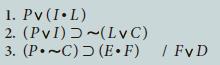
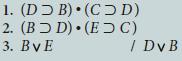
Use the first thirteen rules of inference to derive the conclusions of the following symbolized arguments: 1. Pv (I.L) 2. (PVI) ~(LvC) 3. (P.~C) (E.F) / FvD
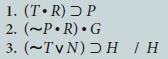
Use the first thirteen rules of inference to derive the conclusions of the following symbolized arguments: 1. (T.R) DP 2. (~P.R) G 3. (~TvN) DH IH
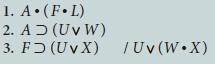
Use the first thirteen rules of inference to derive the conclusions of the following symbolized arguments: 1. A. (F.L) 2. A (UvW) 3. F (UvX) /Uv (W.X)
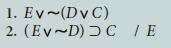
Use the first thirteen rules of inference to derive the conclusions of the following symbolized arguments: 1. Ev (DvC) 2. (Ev D) DC /E
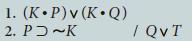
Use the first thirteen rules of inference to derive the conclusions of the following symbolized arguments: 1. (K.P) v (KQ) 2. PO K / QvT
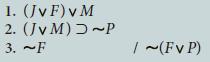
Use the first thirteen rules of inference to derive the conclusions of the following symbolized arguments: 1. (Jv F) v M 2. (JvM) 3. ~F ~P /~(Fv P)
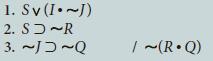
Use the first thirteen rules of inference to derive the conclusions of the following symbolized arguments: 1. Sv (I.~J) 2. SO R 3.~1~Q /~(RQ)
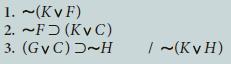
Use the first thirteen rules of inference to derive the conclusions of the following symbolized arguments: 1. ~(KvF) 2. ~FD (Kv C) 3. (Gv C) ~H /~(Kv H)
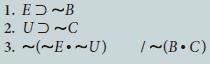
Use the first thirteen rules of inference to derive the conclusions of the following symbolized arguments: 1. ED 2. UD 3. ~(~E~U) B C /~(B.C)
Use the first thirteen rules of inference to derive the conclusions of the following symbolized arguments: 1. [(IvM) v G] ~G 2. MVG IM
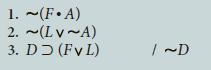
Use the first thirteen rules of inference to derive the conclusions of the following symbolized arguments: 1. ~(F.A) 2. ~(LV~A) 3. DD (FvL) /~D
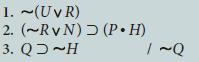
Use the first thirteen rules of inference to derive the conclusions of the following symbolized arguments: 1. ~(UVR) 2. (~RvN) 3. Q~H (P.H) 1~Q
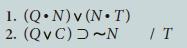
Use the first thirteen rules of inference to derive the conclusions of the following symbolized arguments: 1. (Q.N) v (NT) 2. (QVC) ~N IT
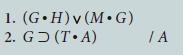
Use the first thirteen rules of inference to derive the conclusions of the following symbolized arguments: 1. (G.H) v (MG) 2. GO (T.A) /A
Use the first thirteen rules of inference to derive the conclusions of the following symbolized arguments: 1. ~(JvK) 2. BOK 3. SOB 1~S~]
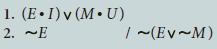
Use the first thirteen rules of inference to derive the conclusions of the following symbolized arguments: 1. (E.I) v (MU) 2. ~E /~(Ev~M)
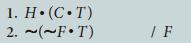
Use the first thirteen rules of inference to derive the conclusions of the following symbolized arguments: 1. H.(C.T) 2. ~(~F.T) IF
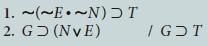
Use the first thirteen rules of inference to derive the conclusions of the following symbolized arguments: 1. ~(~E~N) 2. GO (NVE) OT I GOT
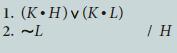
Use the first thirteen rules of inference to derive the conclusions of the following symbolized arguments: 1. (KH)v(KL) 2. ~L
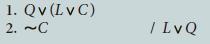
Use the first thirteen rules of inference to derive the conclusions of the following symbolized arguments: I. Qv (LvC) 2. ~C / LvQ
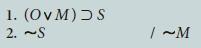
Use the first thirteen rules of inference to derive the conclusions of the following symbolized arguments: W~/ 2. ~S SC (W^O) 'I
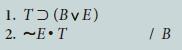
Use the first thirteen rules of inference to derive the conclusions of the following symbolized arguments: 1. T 2. E T (BVE) I B
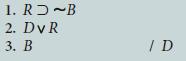
Use the first thirteen rules of inference to derive the conclusions of the following symbolized arguments: 1. RD B 2. DVR 3. B ID
Use the first thirteen rules of inference to derive the conclusions of the following symbolized arguments: 1. HD A 2. A /~(Hv~A)
Use the first thirteen rules of inference to derive the conclusions of the following symbolized arguments: 1. HD A 2. A /~(Hv~A)
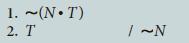
Use the first thirteen rules of inference to derive the conclusions of the following symbolized arguments: 1. ~(N.T) 2. T 1~N
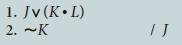
Use the first thirteen rules of inference to derive the conclusions of the following symbolized arguments: 1. Jv (K.L) 2. ~K IJ
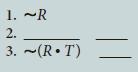
Use the first thirteen rules of inference to derive the conclusions of the following symbolized arguments: 1. ~S /~(F.S)
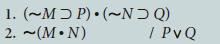
Use the first thirteen rules of inference to derive the conclusions of the following symbolized arguments: 1. (~MDP). 2. ~ (M.N) (~NDQ) / PvQ
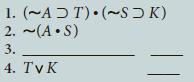
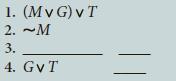
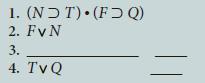
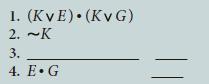
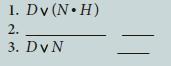
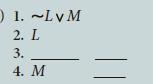
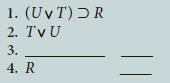
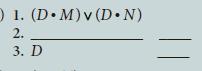
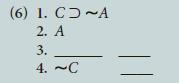
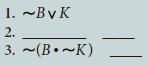
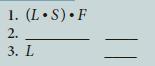
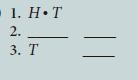
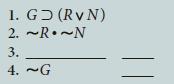
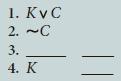
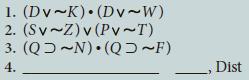
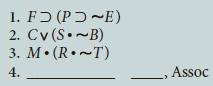
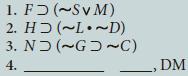
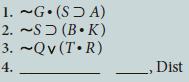
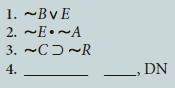
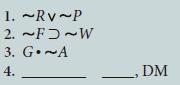
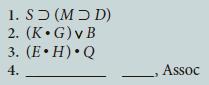
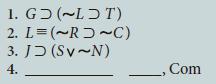
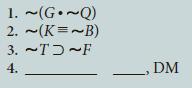
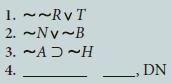
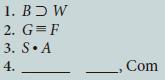
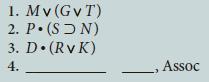
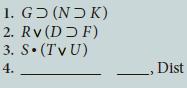
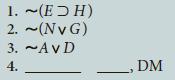
In the following symbolized arguments, derive the line needed to obtain the conclusion (last line ), and supply the justification for both lines.
In the following symbolized arguments, derive the line needed to obtain the conclusion (last line ), and supply the justification for both lines.
In the following symbolized arguments, derive the line needed to obtain the conclusion (last line ), and supply the justification for both lines.
In the following symbolized arguments, derive the line needed to obtain the conclusion (last line ), and supply the justification for both lines.
In the following symbolized arguments, derive the line needed to obtain the conclusion (last line ), and supply the justification for both lines.
In the following symbolized arguments, derive the line needed to obtain the conclusion (last line ), and supply the justification for both lines.
In the following symbolized arguments, derive the line needed to obtain the conclusion (last line ), and supply the justification for both lines.
In the following symbolized arguments, derive the line needed to obtain the conclusion (last line ), and supply the justification for both lines.
In the following symbolized arguments, derive the line needed to obtain the conclusion (last line ), and supply the justification for both lines.
In the following symbolized arguments, derive the line needed to obtain the conclusion (last line ), and supply the justification for both lines.
In the following symbolized arguments, derive the line needed to obtain the conclusion (last line ), and supply the justification for both lines.
In the following symbolized arguments, derive the line needed to obtain the conclusion (last line ), and supply the justification for both lines.
In the following symbolized arguments, derive the line needed to obtain the conclusion (last line ), and supply the justification for both lines.
In the following symbolized arguments, derive the line needed to obtain the conclusion (last line ), and supply the justification for both lines.
In the following symbolized arguments, derive the line needed to obtain the conclusion (last line ), and supply the justification for both lines.
In the following symbolized arguments, derive the line needed to obtain the conclusion (last line ), and supply the justification for both lines.
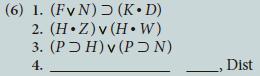
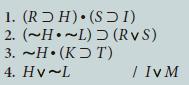
For each of the following lists of premises, derive the indicated conclusion and complete the justification. For double negation, avoid the occurrence of triple tildes.
For each of the following lists of premises, derive the indicated conclusion and complete the justification. For double negation, avoid the occurrence of triple tildes.
For each of the following lists of premises, derive the indicated conclusion and complete the justification. For double negation, avoid the occurrence of triple tildes.
For each of the following lists of premises, derive the indicated conclusion and complete the justification. For double negation, avoid the occurrence of triple tildes.
For each of the following lists of premises, derive the indicated conclusion and complete the justification. For double negation, avoid the occurrence of triple tildes.
For each of the following lists of premises, derive the indicated conclusion and complete the justification. For double negation, avoid the occurrence of triple tildes.
For each of the following lists of premises, derive the indicated conclusion and complete the justification. For double negation, avoid the occurrence of triple tildes.
For each of the following lists of premises, derive the indicated conclusion and complete the justification. For double negation, avoid the occurrence of triple tildes.
For each of the following lists of premises, derive the indicated conclusion and complete the justification. For double negation, avoid the occurrence of triple tildes.
For each of the following lists of premises, derive the indicated conclusion and complete the justification. For double negation, avoid the occurrence of triple tildes. Exercise 6 has two possible answers.
For each of the following lists of premises, derive the indicated conclusion and complete the justification. For double negation, avoid the occurrence of triple tildes. Exercise 6 has two possible answers.
For each of the following lists of premises, derive the indicated conclusion and complete the justification. For double negation, avoid the occurrence of triple tildes.
For each of the following lists of premises, derive the indicated conclusion and complete the justification. For double negation, avoid the occurrence of triple tildes.
For each of the following lists of premises, derive the indicated conclusion and complete the justification. For double negation, avoid the occurrence of triple tildes.
For each of the following lists of premises, derive the indicated conclusion and complete the justification. For double negation, avoid the occurrence of triple tildes.
For each of the following lists of premises, derive the indicated conclusion and complete the justification. For double negation, avoid the occurrence of triple tildes.
For each of the following lists of premises, derive the indicated conclusion and complete the justification. For double negation, avoid the occurrence of triple tildes.
For each of the following lists of premises, derive the indicated conclusion and complete the justification. For double negation, avoid the occurrence of triple tildes.
For each of the following lists of premises, derive the indicated conclusion and complete the justification. For double negation, avoid the occurrence of triple tildes.
For each of the following lists of premises, derive the indicated conclusion and complete the justification. For double negation, avoid the occurrence of triple tildes.
Create four symbolized arguments consisting of at least three premises each, and whose proof requires at least two of the rules introduced in this section. The arguments should look like those in Part III of this section. Then derive the conclusion of each.
If the assassination of terrorist leaders violates civilized values and also is not effective in the long run, then if it prevents terrorist atrocities, then it is effective in the long run. If the assassination of terrorist leaders violates civilized values, then it is not effective in the long
If the assassination of terrorist leaders violates civilized values and also is not effective in the long run, then if it prevents terrorist atrocities, then it is effective in the long run. If the assassination of terrorist leaders violates civilized values, then it is not effective in the long
If we are less than certain the human fetus is a person, then we must give it the benefit of the doubt. If we are certain the human fetus is a person, then we must accord it the right to live. If either we must give the fetus the benefit of the doubt or accord it the right to live, then we are not
If either medical fees or malpractice awards escape restrictions, then health-care costs will soar and millions of poor will go uninsured. If the lawyers get their way, then malpractice awards will escape restrictions. If the doctors get their way, then medical fees will escape restrictions. Either
If either medical fees or malpractice awards escape restrictions, then health-care costs will soar and millions of poor will go uninsured. If the lawyers get their way, then malpractice awards will escape restrictions. If the doctors get their way, then medical fees will escape restrictions. Either
If either manufacturers will not concentrate on producing a superior product or they will not market their product abroad, then if they will not concentrate on producing a superior product, then the trade deficit will worsen. Either manufacturers will concentrate on producing a superior product or
If either manufacturers will not concentrate on producing a superior product or they will not market their product abroad, then if they will not concentrate on producing a superior product, then the trade deficit will worsen. Either manufacturers will concentrate on producing a superior product or
If either parents get involved in their children’s education or the school year is lengthened, then if the children learn phonics, their reading will improve and if they are introduced to abstract concepts earlier, their math will improve. If either parents get involved in their children’s
If either parents get involved in their children’s education or the school year is lengthened, then if the children learn phonics, their reading will improve and if they are introduced to abstract concepts earlier, their math will improve. If either parents get involved in their children’s
If either parents get involved in their children’s education or the school year is lengthened, then if the children learn phonics, their reading will improve and if they are introduced to abstract concepts earlier, their math will improve. If either parents get involved in their children’s
If either parents get involved in their children’s education or the school year is lengthened, then if the children learn phonics, their reading will improve and if they are introduced to abstract concepts earlier, their math will improve. If either parents get involved in their children’s
If either parents get involved in their children’s education or the school year is lengthened, then if the children learn phonics, their reading will improve and if they are introduced to abstract concepts earlier, their math will improve. If either parents get involved in their children’s
If half the nation suffers from depression, then if either the insurance companies have their way or the psychiatrists have their way, then everyone will be taking antidepressant drugs. If either half the nation suffers from depression or sufferers want a real cure, then it is not the case that
Either animals are mere mechanisms or they feel pain. If either animals feel pain or they have souls, then they have a right not to be subjected to needless pain and humans have a duty not to inflict needless pain on them. It is not the case that animals are mere mechanisms. Therefore, animals have
If either executive salaries are out of control or exorbitant bonuses are paid, then either shareholders will be cheated or ordinary workers will be paid less. Executive salaries are out of control and the rich are getting richer. If shareholders are cheated, then future investors will stay away;
If clear-cutting continues in primary forests and the Endangered Species Act is not repealed, then either the Endangered Species Act will be repealed or thousands of animal species will become extinct. Clear-cutting continues in primary forests. The Endangered Species Act will not be repealed.
If topaz is harder than quartz, then it will scratch quartz and also feldspar. Topaz is harder than quartz and it is also harder than calcite. Therefore, either topaz will scratch quartz or it will scratch corundum. (T, Q, F, C, O)Translate the following arguments into symbolic form and use the
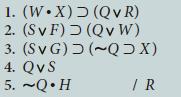
Use the first eight rules of inference to derive the conclusions of the following symbolized arguments:
Use the first eight rules of inference to derive the conclusions of the following symbolized arguments:
Use the first eight rules of inference to derive the conclusions of the following symbolized arguments:
Use the first eight rules of inference to derive the conclusions of the following symbolized arguments:
Use the first eight rules of inference to derive the conclusions of the following symbolized arguments:
Use the first eight rules of inference to derive the conclusions of the following symbolized arguments:
Use the first eight rules of inference to derive the conclusions of the following symbolized arguments:
Use the first eight rules of inference to derive the conclusions of the following symbolized arguments:
Use the first eight rules of inference to derive the conclusions of the following symbolized arguments:
Use the first eight rules of inference to derive the conclusions of the following symbolized arguments:
Use the first eight rules of inference to derive the conclusions of the following symbolized arguments:
Use the first eight rules of inference to derive the conclusions of the following symbolized arguments:
Use the first eight rules of inference to derive the conclusions of the following symbolized arguments:
Use the first eight rules of inference to derive the conclusions of the following symbolized arguments:
Use the first eight rules of inference to derive the conclusions of the following symbolized arguments:
Use the first eight rules of inference to derive the conclusions of the following symbolized arguments:
Use the first eight rules of inference to derive the conclusions of the following symbolized arguments:
Showing 900 - 1000
of 3685
First
3
4
5
6
7
8
9
10
11
12
13
14
15
16
17
Last
Step by Step Answers

 Get 50% OFF
Claim Now
Get 50% OFF
Claim Now


![1. [(IvM) v G] ~G 2. MVG IM](https://dsd5zvtm8ll6.cloudfront.net/si.question.images/images/question_images/1695/8/9/0/70865153d1425ed11695890707847.jpg)
![1. ~(JvK) 2. BOK 3. SOB 1~S~]](https://dsd5zvtm8ll6.cloudfront.net/si.question.images/images/question_images/1695/8/9/0/56665153c865b7421695890565959.jpg)


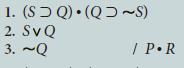
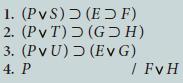
![1. (~M~N) [(~MvH) (KL)] 2. ~M.(COD) 3. ~N (F= G) / K.~N](https://dsd5zvtm8ll6.cloudfront.net/si.question.images/images/question_images/1695/8/1/2/13065140a2217b741695812127715.jpg)
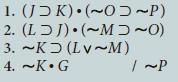
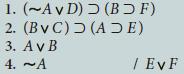
![I. (~K~N) [(~PK) (~RDG)] 2. KON 3. ~N. B 4. ~PV~R / G that](https://dsd5zvtm8ll6.cloudfront.net/si.question.images/images/question_images/1695/8/1/2/001651409a1699611695811999498.jpg)
![1. [Av (KJ)]] (~E~F) 2. MD [A. (PVR)] 3. M. U /~E.A](https://dsd5zvtm8ll6.cloudfront.net/si.question.images/images/question_images/1695/8/1/1/533651407cdc28801695811533285.jpg)