New Semester
Started
Get
50% OFF
Study Help!
--h --m --s
Claim Now
Question Answers
Textbooks
Find textbooks, questions and answers
Oops, something went wrong!
Change your search query and then try again
S
Books
FREE
Study Help
Expert Questions
Accounting
General Management
Mathematics
Finance
Organizational Behaviour
Law
Physics
Operating System
Management Leadership
Sociology
Programming
Marketing
Database
Computer Network
Economics
Textbooks Solutions
Accounting
Managerial Accounting
Management Leadership
Cost Accounting
Statistics
Business Law
Corporate Finance
Finance
Economics
Auditing
Tutors
Online Tutors
Find a Tutor
Hire a Tutor
Become a Tutor
AI Tutor
AI Study Planner
NEW
Sell Books
Search
Search
Sign In
Register
study help
social science
introduction to logic
A Concise Introduction to Logic 13th edition Patrick J. Hurley, Lori Watson - Solutions
Violinists who play well are accomplished musicians. There are some violinists in the orchestra. Therefore, some musicians are accomplished. (V, P, A, M, O)Translate the following arguments into symbolic form. Then use either the counterexample method or the finite universe method to prove that
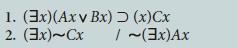
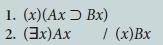
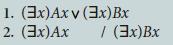
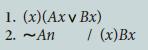
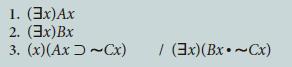
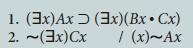
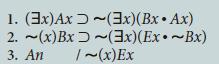
Use the finite universe method to prove that the following symbolized arguments are invalid.
Use the finite universe method to prove that the following symbolized arguments are invalid.
Use the finite universe method to prove that the following symbolized arguments are invalid.
Use the finite universe method to prove that the following symbolized arguments are invalid.
Use the finite universe method to prove that the following symbolized arguments are invalid.
Use the finite universe method to prove that the following symbolized arguments are invalid.
Use the finite universe method to prove that the following symbolized arguments are invalid.
Use the finite universe method to prove that the following symbolized arguments are invalid.
Use the finite universe method to prove that the following symbolized arguments are invalid.
Use the finite universe method to prove that the following symbolized arguments are invalid.
Use the finite universe method to prove that the following symbolized arguments are invalid.
Use the finite universe method to prove that the following symbolized arguments are invalid.
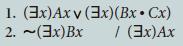
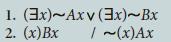
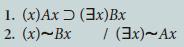
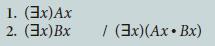
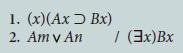
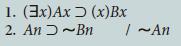
Use the counterexample method to prove that the following symbolized arguments are invalid.
Use the counterexample method to prove that the following symbolized arguments are invalid.
Use the counterexample method to prove that the following symbolized arguments are invalid.
Use the counterexample method to prove that the following symbolized arguments are invalid.
Use the counterexample method to prove that the following symbolized arguments are invalid.
Use the counterexample method to prove that the following symbolized arguments are invalid.
Use the counterexample method to prove that the following symbolized arguments are invalid.
Use the counterexample method to prove that the following symbolized arguments are invalid.
Use the counterexample method to prove that the following symbolized arguments are invalid.
Use the counterexample method to prove that the following symbolized arguments are invalid.
Use the counterexample method to prove that the following symbolized arguments are invalid.
Create two valid arguments relating to hobbies. Then translate the arguments into the symbolism of predicate logic; use conditional proof to derive the conclusion of one and indirect proof to derive the conclusion of the other.Translate the following arguments into symbolic form. Then use
Either some governors are present or some ambassadors are present. If anyone is present, then some ambassadors are clever diplomats. Therefore, some diplomats are clever. (G, P, A, C, D)Translate the following arguments into symbolic form. Then use conditional or indirect proof to derive the
Either no senators are present or no representatives are present. Furthermore, either some senators are present or no women are present. Therefore, none of the representatives who are present are women. (S, P, R, W )Translate the following arguments into symbolic form. Then use conditional or
If there are any voters, then all politicians are astute. If there are any politicians, then whoever is astute is clever. Therefore, if there are any voters, then all politicians are clever. (V, P, A, C )Translate the following arguments into symbolic form. Then use conditional or indirect proof to
If there are any consuls, then all ambassadors are satisfied diplomats. If no consuls are ambassadors, then some diplomats are satisfied. Therefore, some diplomats are satisfied. (C, A, S, D)Translate the following arguments into symbolic form. Then use conditional or indirect proof to derive the
If there are any senators, then some employees are well paid. If there is anyone who is either an employee or a volunteer, then there are some legislative assistants. Either there are some volunteers or there are some senators. Therefore, there are some legislative assistants. (S, E, W, V, L
All ambassadors are diplomats. Furthermore, all experienced ambassadors are cautious, and all cautious diplomats have foresight. Therefore, all experienced ambassadors have foresight. (A, D, E, C, F )Translate the following arguments into symbolic form. Then use conditional or indirect proof to
All secretaries and undersecretaries are intelligent and cautious. All those who are cautious or vigilant are restrained and austere. Therefore, all secretaries are austere. (S, U, I, C, V, R, A)Translate the following arguments into symbolic form. Then use conditional or indirect proof to derive
All secretaries and undersecretaries are intelligent and cautious. All those who are cautious or vigilant are restrained and austere. Therefore, all secretaries are austere. (S, U, I, C, V, R, A)Translate the following arguments into symbolic form. Then use conditional or indirect proof to derive
If all judges are wise, then some attorneys are rewarded. Furthermore, if there are any judges who are not wise, then some attorneys are rewarded. Therefore, some attorneys are rewarded. ( J, W, A, R)Translate the following arguments into symbolic form. Then use conditional or indirect proof to
All senators are well liked. Also, if there are any well-liked senators, then O’Brien is a voter. Therefore, if there are any senators, then O’Brien is a voter. (S, W, V )Translate the following arguments into symbolic form. Then use conditional or indirect proof to derive the conclusion of
All ambassadors are wealthy. Furthermore, all Republicans are clever. Therefore, all Republican ambassadors are clever and wealthy. (A, W, R, C )Translate the following arguments into symbolic form. Then use conditional or indirect proof to derive the conclusion of each.
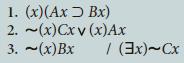
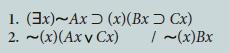
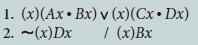
Use either indirect proof or conditional proof to derive the conclusions of the following symbolized arguments.
Use either indirect proof or conditional proof to derive the conclusions of the following symbolized arguments.
Use either indirect proof or conditional proof to derive the conclusions of the following symbolized arguments.
Use either indirect proof or conditional proof to derive the conclusions of the following symbolized arguments.
Use either indirect proof or conditional proof to derive the conclusions of the following symbolized arguments.
What Is Accounting?
Use either indirect proof or conditional proof to derive the conclusions of the following symbolized arguments.
Use either indirect proof or conditional proof to derive the conclusions of the following symbolized arguments.
Use either indirect proof or conditional proof to derive the conclusions of the following symbolized arguments.
Use either indirect proof or conditional proof to derive the conclusions of the following symbolized arguments.
Use either indirect proof or conditional proof to derive the conclusions of the following symbolized arguments.
Use either indirect proof or conditional proof to derive the conclusions of the following symbolized arguments.
Use either indirect proof or conditional proof to derive the conclusions of the following symbolized arguments.
Use either indirect proof or conditional proof to derive the conclusions of the following symbolized arguments.
Use either indirect proof or conditional proof to derive the conclusions of the following symbolized arguments.
Use either indirect proof or conditional proof to derive the conclusions of the following symbolized arguments.
Use either indirect proof or conditional proof to derive the conclusions of the following symbolized arguments.
Use either indirect proof or conditional proof to derive the conclusions of the following symbolized arguments.
Use either indirect proof or conditional proof to derive the conclusions of the following symbolized arguments.
Use either indirect proof or conditional proof to derive the conclusions of the following symbolized arguments.
Use either indirect proof or conditional proof to derive the conclusions of the following symbolized arguments.
Use either indirect proof or conditional proof to derive the conclusions of the following symbolized arguments.
Use either indirect proof or conditional proof to derive the conclusions of the following symbolized arguments.
Use either indirect proof or conditional proof to derive the conclusions of the following symbolized arguments.
Use either indirect proof or conditional proof to derive the conclusions of the following symbolized arguments.
Use either indirect proof or conditional proof to derive the conclusions of the following symbolized arguments.
Create two valid arguments relating to vacations. At least one of the premises of each argument must begin with the words “It is not the case that..." Then translate the arguments into the language of predicate logic and derive the conclusion of each.
It is not the case that some physicians are either on the golf course or in the hospital. All of the neurologists are physicians in the hospital. Either some physicians are cardiologists or some physicians are neurologists. Therefore, some cardiologists are not on the golf course. (P, G, H, N, C
All poorly trained allergists and dermatologists are untrustworthy specialists. It is not the case, however, that some specialists are untrustworthy. Therefore, it is not the case that some dermatologists are poorly trained. (P, A, D, U, S)Translate the following arguments into symbolic form. Then
If some obstetricians are not gynecologists, then some hematologists are radiologists. But it is not the case that there are any hematologists or gynecologists. Therefore, it is not the case that there are any obstetricians. (O, G, H, R)Translate the following arguments into symbolic form. Then use
All pathologists are specialists and all internists are generalists. Therefore, since it is not the case that some specialists are generalists, it is not the case that some pathologists are internists. (P, S, I, G )Translate the following arguments into symbolic form. Then use the quantifier
It is not the case that some internists are not physicians. Furthermore, it is not the case that some physicians are not doctors of medicine. Therefore, all internists are doctors of medicine. (I, P, D)Translate the following arguments into symbolic form. Then use the quantifier negation rule and
All physicians who did not attend medical school are incompetent. It is not the case, however, that some physicians are incompetent. Therefore, all physicians have attended medical school. (P, A, I )Translate the following arguments into symbolic form. Then use the quantifier negation rule and the
Either some general practitioners are pediatricians or some surgeons are endocrinologists. But it is not the case that there are any endocrinologists. Therefore, there are some pediatricians. (G, P, S, E )Translate the following arguments into symbolic form. Then use the quantifier negation rule
If some surgeons are allergists, then some psychiatrists are radiologists. But no psychiatrists are radiologists. Therefore, no surgeons are allergists. (S, A, P, R)Translate the following arguments into symbolic form. Then use the quantifier negation rule and the eighteen rules of inference to
Either Dr. Adams is an internist or all the pathologists are internists. But it is not the case that there are any internists. Therefore, Dr. Adams is not a pathologist. (I, P )Translate the following arguments into symbolic form. Then use the quantifier negation rule and the eighteen rules of
If all the physicians are either hematologists or neurologists, then there are no cardiologists. But Dr. Frank is a cardiologist. Therefore, some physicians are not neurologists. (P, H, N, C )Translate the following arguments into symbolic form. Then use the quantifier negation rule and the
Use the quantifier negation rule together with the eighteen rules of inference to derive the conclusions of the following symbolized arguments. Do not use either conditional proof or indirect proof.
Use the quantifier negation rule together with the eighteen rules of inference to derive the conclusions of the following symbolized arguments. Do not use either conditional proof or indirect proof.
Use the quantifier negation rule together with the eighteen rules of inference to derive the conclusions of the following symbolized arguments. Do not use either conditional proof or indirect proof.
Use the quantifier negation rule together with the eighteen rules of inference to derive the conclusions of the following symbolized arguments. Do not use either conditional proof or indirect proof.
Use the quantifier negation rule together with the eighteen rules of inference to derive the conclusions of the following symbolized arguments. Do not use either conditional proof or indirect proof.
Use the quantifier negation rule together with the eighteen rules of inference to derive the conclusions of the following symbolized arguments. Do not use either conditional proof or indirect proof.
Use the quantifier negation rule together with the eighteen rules of inference to derive the conclusions of the following symbolized arguments. Do not use either conditional proof or indirect proof.
Use the quantifier negation rule together with the eighteen rules of inference to derive the conclusions of the following symbolized arguments. Do not use either conditional proof or indirect proof.
Use the quantifier negation rule together with the eighteen rules of inference to derive the conclusions of the following symbolized arguments. Do not use either conditional proof or indirect proof.
Use the quantifier negation rule together with the eighteen rules of inference to derive the conclusions of the following symbolized arguments. Do not use either conditional proof or indirect proof.
Use the quantifier negation rule together with the eighteen rules of inference to derive the conclusions of the following symbolized arguments. Do not use either conditional proof or indirect proof.
Use the quantifier negation rule together with the eighteen rules of inference to derive the conclusions of the following symbolized arguments. Do not use either conditional proof or indirect proof.
Use the quantifier negation rule together with the eighteen rules of inference to derive the conclusions of the following symbolized arguments. Do not use either conditional proof or indirect proof.
Use the quantifier negation rule together with the eighteen rules of inference to derive the conclusions of the following symbolized arguments. Do not use either conditional proof or indirect proof.
Use the quantifier negation rule together with the eighteen rules of inference to derive the conclusions of the following symbolized arguments. Do not use either conditional proof or indirect proof.
Use the quantifier negation rule together with the eighteen rules of inference to derive the conclusions of the following symbolized arguments. Do not use either conditional proof or indirect proof.
Use the quantifier negation rule together with the eighteen rules of inference to derive the conclusions of the following symbolized arguments. Do not use either conditional proof or indirect proof.
Use the quantifier negation rule together with the eighteen rules of inference to derive the conclusions of the following symbolized arguments. Do not use either conditional proof or indirect proof.
Use the quantifier negation rule together with the eighteen rules of inference to derive the conclusions of the following symbolized arguments. Do not use either conditional proof or indirect proof.
Use the quantifier negation rule together with the eighteen rules of inference to derive the conclusions of the following symbolized arguments. Do not use either conditional proof or indirect proof.
Use the quantifier negation rule together with the eighteen rules of inference to derive the conclusions of the following symbolized arguments. Do not use either conditional proof or indirect proof.
Use the quantifier negation rule together with the eighteen rules of inference to derive the conclusions of the following symbolized arguments. Do not use either conditional proof or indirect proof.
Create two valid arguments relating to national parks. Then translate them into the symbolism of predicate logic and use the rules of inference to derive the conclusion of each.
Create two valid arguments relating to national parks. Then translate them into the symbolism of predicate logic and use the rules of inference to derive the conclusion of each.
The following dialogue contains nine arguments. Translate each into symbolic form and then use the eighteen rules of inference to derive the conclusion of each. Some of them are quite challenging.Where’s the Beef?“Have you decided what to order?” Paul says to Mindy, as he folds his menu and
If the artichokes in the kitchen are ripe, then the guests will be surprised. Furthermore, if the artichokes in the kitchen are flavorful, then the guests will be pleased. The artichokes in the kitchen are ripe and flavorful. Therefore, the guests will be surprised and pleased. (A, K, R, G, S, F, P
If there are any ripe watermelons, then the caretakers performed well. Furthermore, if there are any large watermelons, then whoever performed well will get a bonus. There are some large, ripe watermelons. Therefore, the caretakers will get a bonus. (R, W, C, P, L, B )Translate the following
Showing 500 - 600
of 3685
1
2
3
4
5
6
7
8
9
10
11
12
13
14
15
Last
Step by Step Answers

 Get 50% OFF
Claim Now
Get 50% OFF
Claim Now







![1. (x)[Ax 2. (3x) Ax (Bx v Cx)] / (3x) Bx](https://dsd5zvtm8ll6.cloudfront.net/si.question.images/images/question_images/1696/3/2/8/169651be9e989ce91696328165641.jpg)

![1. (3x)(Ax Bx) 2. (3x)(CxBx) 3. (x)(Ax Cx) / (3x) [(CxBx)~Ax]](https://dsd5zvtm8ll6.cloudfront.net/si.question.images/images/question_images/1696/3/2/7/970651be9220737f1696327966219.jpg)
![Bx) 1. (x)[(Ax. 2. (x) [(Ax Cx) Cx] Dx] / (x)[(Ax. Dx) Cx]](https://dsd5zvtm8ll6.cloudfront.net/si.question.images/images/question_images/1696/3/2/7/582651be79e5f8861696327578574.jpg)
![1. (x)[(Axv Bx) > Cx] 2. (x)[(CxDx) Ex] / (x)(Ax Ex)](https://dsd5zvtm8ll6.cloudfront.net/si.question.images/images/question_images/1696/3/2/7/555651be7839dcdc1696327551741.jpg)
![1. (x)[Ax (Bx v Cx)] 2. (x)[(BxCx) Dx] / (x)(AxDx)](https://dsd5zvtm8ll6.cloudfront.net/si.question.images/images/question_images/1696/3/2/7/395651be6e381ae61696327389991.jpg)
![1. (x)[Axv (Bx v Cx)] / (x)Axv [(x)Bxv (x)Cx]](https://dsd5zvtm8ll6.cloudfront.net/si.question.images/images/question_images/1696/3/2/7/188651be61436c801696327184363.jpg)
![1. (3x)(Ax Bx) 2. (3x)(Ax Cx) / (3x)[Ax. (BxCx)]](https://dsd5zvtm8ll6.cloudfront.net/si.question.images/images/question_images/1696/3/2/7/160651be5f8113801696327156398.jpg)
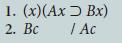



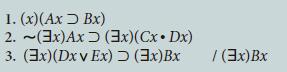
![1. (3x)(Axv Ex) 2. (3x) (Bxv Fx) (x)(Bx~Cx) (x)(Cx v Dx) /(x)(Ax] Dx)](https://dsd5zvtm8ll6.cloudfront.net/si.question.images/images/question_images/1696/3/2/6/564651be3a492be41696326561004.jpg)

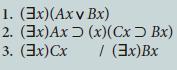
![1. (x)[Ax 2. (x) [Dx (Bx Cx)] (Ex. Fx)] / (x)(Cx Dx) (x)(AxFx)](https://dsd5zvtm8ll6.cloudfront.net/si.question.images/images/question_images/1696/3/2/6/315651be2ab38c011696326313622.jpg)
![1. (x) [Bx (CxDx)] / (x) (Ax Bx) (x) (Ax Dx)](https://dsd5zvtm8ll6.cloudfront.net/si.question.images/images/question_images/1696/3/2/6/104651be1d81d31a1696326100163.jpg)
![1. (x) (Ax=Bx) 2. (x)[Ax 3. (3x)Axv (Bx > Cx)] (3x)Bx / (3x)Cx](https://dsd5zvtm8ll6.cloudfront.net/si.question.images/images/question_images/1696/3/2/6/072651be1b8824f31696326067626.jpg)

![1. (x)[(Axv Bx) > Cx] 2. (3x)(~Axv Dx) (x)Ex / (x)Cxv (x)Ex](https://dsd5zvtm8ll6.cloudfront.net/si.question.images/images/question_images/1696/3/2/5/929651be12938e4a1696325925041.jpg)

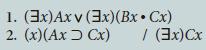

![1. (3x)Ax (x)(Bx > Cx) 2. (3x)Dx(x)~Cx /(x)[(Ax. Dx)~Bx]](https://dsd5zvtm8ll6.cloudfront.net/si.question.images/images/question_images/1696/3/2/1/711651bd0af3599c1696321710364.jpg)
![1. (x) [(Ax v Bx) > Cx] 2. (x)[(Cx v Dx) > ~Ax] / (x)~Ax](https://dsd5zvtm8ll6.cloudfront.net/si.question.images/images/question_images/1696/3/2/1/687651bd0972cc531696321685749.jpg)


![1. (x)[(Axv Bx) 2. (x)[(Cxv Dx) Cx] Ex] / (x) (Ax > Ex)](https://dsd5zvtm8ll6.cloudfront.net/si.question.images/images/question_images/1696/3/2/1/517651bcfedbeff11696321516526.jpg)
![1. (x)(Ax > Bx) 2. (x) [(AxBx) Cx] / (x)(Ax Cx)](https://dsd5zvtm8ll6.cloudfront.net/si.question.images/images/question_images/1696/3/2/0/542651bcc1e15f5e1696320541025.jpg)


![1. (x) (Ax 2. (x)(Ax Bx) Cx) / (x)[Ax (Bx Cx)]](https://dsd5zvtm8ll6.cloudfront.net/si.question.images/images/question_images/1696/3/2/0/440651bcbb8162ea1696320437335.jpg)
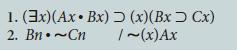
![1. (3x) Ax [(3x)Bxv (x)Cx] 2. (3x)(Ax~Cx) 3. ~(x)Cx [(x)Fx (x)~Bx] /(3x)~Fx](https://dsd5zvtm8ll6.cloudfront.net/si.question.images/images/question_images/1696/3/1/9/522651bc8227c1ee1696319521655.jpg)
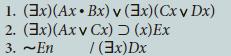
![1. (3x)(AxBx) 2. (x)[(Axv Ex) (Bxv Fx)] 3. ~(x)Dx /(x)(Ex v Ex) (x)(Cx Dx)](https://dsd5zvtm8ll6.cloudfront.net/si.question.images/images/question_images/1696/3/1/9/469651bc7ed305521696319468316.jpg)
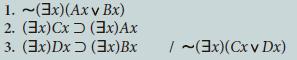
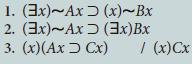

![1. (x)[(Ax Bx) > Cx] 2. ~(x)(Ax Cx) / ~ (x)Bx](https://dsd5zvtm8ll6.cloudfront.net/si.question.images/images/question_images/1696/3/1/9/337651bc769672dd1696319336621.jpg)
![1. ~(3x) (Ax~Bx) (3x)(Ax~Cx) 2. ~ / (x)[Ax (Bx Cx)]](https://dsd5zvtm8ll6.cloudfront.net/si.question.images/images/question_images/1696/3/1/9/306651bc74a8d2121696319304893.jpg)