New Semester
Started
Get
50% OFF
Study Help!
--h --m --s
Claim Now
Question Answers
Textbooks
Find textbooks, questions and answers
Oops, something went wrong!
Change your search query and then try again
S
Books
FREE
Study Help
Expert Questions
Accounting
General Management
Mathematics
Finance
Organizational Behaviour
Law
Physics
Operating System
Management Leadership
Sociology
Programming
Marketing
Database
Computer Network
Economics
Textbooks Solutions
Accounting
Managerial Accounting
Management Leadership
Cost Accounting
Statistics
Business Law
Corporate Finance
Finance
Economics
Auditing
Tutors
Online Tutors
Find a Tutor
Hire a Tutor
Become a Tutor
AI Tutor
AI Study Planner
NEW
Sell Books
Search
Search
Sign In
Register
study help
social science
introduction to logic
A Concise Introduction to Logic 13th edition Patrick J. Hurley, Lori Watson - Solutions
If there are any ripe watermelons, then the caretakers performed well. Furthermore, if there are any large watermelons, then whoever performed well will get a bonus. There are some large, ripe watermelons. Therefore, the caretakers will get a bonus. (R, W, C, P, L, B )Translate the following
Some huckleberries are ripe. Furthermore, some boysenberries are sweet. If there are any huckleberries, then the boysenberries are edible if they are sweet. Therefore, some boysenberries are edible. (H, R, B, S, E )Translate the following arguments into symbolic form. Then use the eighteen rules of
All gardeners are industrious people. Furthermore, any person who is industrious is respected. Therefore, since Arthur and Catherine are gardeners, it follows that they are respected. (G, I, P, R )Translate the following arguments into symbolic form. Then use the eighteen rules of inference to
There are some cucumbers in the garden. If there are any cucumbers, there are some pumpkins in the garden. All pumpkins are vegetables. Therefore, there are some vegetables in the garden. (C, G, P, V )Translate the following arguments into symbolic form. Then use the eighteen rules of inference to
Beans and peas are legumes. There are no legumes in the garden. Therefore, there are no beans in the garden. (B, P, L, G )Translate the following arguments into symbolic form. Then use the eighteen rules of inference to derive the conclusion of each. Do not use conditional or indirect proof.
Carrots are vegetables and peaches are fruit. Furthermore, there are carrots and peaches in the garden. Therefore, there are vegetables and fruit in the garden. (C, V, P, F, G )Translate the following arguments into symbolic form. Then use the eighteen rules of inference to derive the conclusion of
Apples and pears grow on trees. Therefore, apples grow on trees. (A, P, G )Translate the following arguments into symbolic form. Then use the eighteen rules of inference to derive the conclusion of each. Do not use conditional or indirect proof.
Tomatoes are vegetables. Therefore, the tomatoes in the garden are vegetables. (T, V, G )Translate the following arguments into symbolic form. Then use the eighteen rules of inference to derive the conclusion of each. Do not use conditional or indirect proof.
Oranges are sweet. Also, oranges are fragrant. Therefore, oranges are sweet and fragrant. (O, S, F )Translate the following arguments into symbolic form. Then use the eighteen rules of inference to derive the conclusion of each. Do not use conditional or indirect proof.
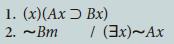
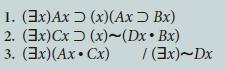
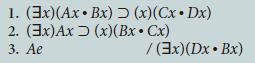
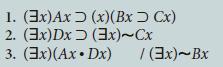
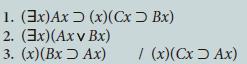
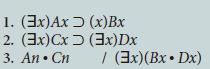
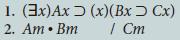
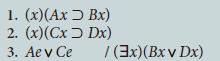
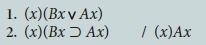
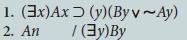
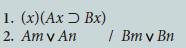
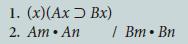
Use the eighteen rules of inference to derive the conclusions of the following symbolized arguments. Do not use either conditional proof or indirect proof.
Use the eighteen rules of inference to derive the conclusions of the following symbolized arguments. Do not use either conditional proof or indirect proof.
Use the eighteen rules of inference to derive the conclusions of the following symbolized arguments. Do not use either conditional proof or indirect proof.
Use the eighteen rules of inference to derive the conclusions of the following symbolized arguments. Do not use either conditional proof or indirect proof.
Use the eighteen rules of inference to derive the conclusions of the following symbolized arguments. Do not use either conditional proof or indirect proof.
Use the eighteen rules of inference to derive the conclusions of the following symbolized arguments. Do not use either conditional proof or indirect proof.
Use the eighteen rules of inference to derive the conclusions of the following symbolized arguments. Do not use either conditional proof or indirect proof.
Use the eighteen rules of inference to derive the conclusions of the following symbolized arguments. Do not use either conditional proof or indirect proof.
Use the eighteen rules of inference to derive the conclusions of the following symbolized arguments. Do not use either conditional proof or indirect proof.
Use the eighteen rules of inference to derive the conclusions of the following symbolized arguments. Do not use either conditional proof or indirect proof.
Use the eighteen rules of inference to derive the conclusions of the following symbolized arguments. Do not use either conditional proof or indirect proof.
Use the eighteen rules of inference to derive the conclusions of the following symbolized arguments. Do not use either conditional proof or indirect proof.
Use the eighteen rules of inference to derive the conclusions of the following symbolized arguments. Do not use either conditional proof or indirect proof.
Use the eighteen rules of inference to derive the conclusions of the following symbolized arguments. Do not use either conditional proof or indirect proof.
Use the eighteen rules of inference to derive the conclusions of the following symbolized arguments. Do not use either conditional proof or indirect proof.
Use the eighteen rules of inference to derive the conclusions of the following symbolized arguments. Do not use either conditional proof or indirect proof.
Use the eighteen rules of inference to derive the conclusions of the following symbolized arguments. Do not use either conditional proof or indirect proof.
Use the eighteen rules of inference to derive the conclusions of the following symbolized arguments. Do not use either conditional proof or indirect proof.
Use the eighteen rules of inference to derive the conclusions of the following symbolized arguments. Do not use either conditional proof or indirect proof.
Use the eighteen rules of inference to derive the conclusions of the following symbolized arguments. Do not use either conditional proof or indirect proof.
Use the eighteen rules of inference to derive the conclusions of the following symbolized arguments. Do not use either conditional proof or indirect proof.
Use the eighteen rules of inference to derive the conclusions of the following symbolized arguments. Do not use either conditional proof or indirect proof.
Use the eighteen rules of inference to derive the conclusions of the following symbolized arguments. Do not use either conditional proof or indirect proof.
Use the eighteen rules of inference to derive the conclusions of the following symbolized arguments. Do not use either conditional proof or indirect proof.
Use the eighteen rules of inference to derive the conclusions of the following symbolized arguments. Do not use either conditional proof or indirect proof.
Use the eighteen rules of inference to derive the conclusions of the following symbolized arguments. Do not use either conditional proof or indirect proof.
Use the eighteen rules of inference to derive the conclusions of the following symbolized arguments. Do not use either conditional proof or indirect proof.
Create five statements relating to social media. Then translate them into the symbolism of predicate logic.Translate the following statements into symbolic form. Avoid negation signs preceding quantifiers. The predicate letters are given in parentheses.
If the scientists and technicians are conscientious and exacting, then some of the mission directors will be either pleased or delighted. (S, T, C, E, M, P, D)Translate the following statements into symbolic form. Avoid negation signs preceding quantifiers. The predicate letters are given in
The physicists and astronomers at the symposium are listed in the program if they either chair a meeting or read a paper. (P, A, S, L, C, R)Translate the following statements into symbolic form. Avoid negation signs preceding quantifiers. The predicate letters are given in parentheses.
Some employees will get raises if and only if some managers are overly generous. (E, R, M, O)Translate the following statements into symbolic form. Avoid negation signs preceding quantifiers. The predicate letters are given in parentheses.
Balcony seats are never chosen unless all the orchestra seats are taken. (B, S, C, O, T )Translate the following statements into symbolic form. Avoid negation signs preceding quantifiers. The predicate letters are given in parentheses.
Experienced mechanics are well paid only if all the inexperienced ones are lazy. (E, M, W, L)Translate the following statements into symbolic form. Avoid negation signs preceding quantifiers. The predicate letters are given in parentheses.
Experienced mechanics are well paid only if all the inexperienced ones are lazy. (E, M, W, L)Translate the following statements into symbolic form. Avoid negation signs preceding quantifiers. The predicate letters are given in parentheses.
If all the buildings in Manhattan are skyscrapers, then the Chrysler building is a skyscraper. (B, M, S)Translate the following statements into symbolic form. Avoid negation signs preceding quantifiers. The predicate letters are given in parentheses.
Swiss watches are not expensive unless they are made of gold. (S, W, E, M )Translate the following statements into symbolic form. Avoid negation signs preceding quantifiers. The predicate letters are given in parentheses.
Skaters and dancers are energetic individuals. (S, D, E, I )Translate the following statements into symbolic form. Avoid negation signs preceding quantifiers. The predicate letters are given in parentheses.
If there are any interesting mysteries, then Rebecca is interesting. (M, I )Translate the following statements into symbolic form. Avoid negation signs preceding quantifiers. The predicate letters are given in parentheses.
If all mysteries are interesting, then Rebecca is interesting. (M, I )Translate the following statements into symbolic form. Avoid negation signs preceding quantifiers. The predicate letters are given in parentheses.
If any witnesses told the truth, then either Parsons or Harris is guilty. (W, T, G )Translate the following statements into symbolic form. Avoid negation signs preceding quantifiers. The predicate letters are given in parentheses.
Taylor is guilty if and only if all the witnesses committed perjury. (G, W, C )Translate the following statements into symbolic form. Avoid negation signs preceding quantifiers. The predicate letters are given in parentheses.
Hurricanes and earthquakes are violent and destructive. (H, E, V, D)Translate the following statements into symbolic form. Avoid negation signs preceding quantifiers. The predicate letters are given in parentheses.
Hurricanes and earthquakes are violent and destructive. (H, E, V, D)Translate the following statements into symbolic form. Avoid negation signs preceding quantifiers. The predicate letters are given in parentheses.
Some French cafés are not recommended. (F, C, R)Translate the following statements into symbolic form. Avoid negation signs preceding quantifiers. The predicate letters are given in parentheses.
Some French restaurants are exclusive. (F, R, E )Translate the following statements into symbolic form. Avoid negation signs preceding quantifiers. The predicate letters are given in parentheses.
A room with a view is expensive. (R, V, E )Translate the following statements into symbolic form. Avoid negation signs preceding quantifiers. The predicate letters are given in parentheses.
A room with a view is available. (R, V, A)Translate the following statements into symbolic form. Avoid negation signs preceding quantifiers. The predicate letters are given in parentheses.
Violins and cellos are stringed instruments. (V, C, S, I )Translate the following statements into symbolic form. Avoid negation signs preceding quantifiers. The predicate letters are given in parentheses.
Violins and cellos are stringed instruments. (V, C, S, I )Translate the following statements into symbolic form. Avoid negation signs preceding quantifiers. The predicate letters are given in parentheses.
Violins and cellos are stringed instruments. (V, C, S, I )Translate the following statements into symbolic form. Avoid negation signs preceding quantifiers. The predicate letters are given in parentheses.
A good violin is rare and expensive. (G, V, R, E )Translate the following statements into symbolic form. Avoid negation signs preceding quantifiers. The predicate letters are given in parentheses.
Not every foreign car runs smoothly. (F, C, R)Translate the following statements into symbolic form. Avoid negation signs preceding quantifiers. The predicate letters are given in parentheses.
Any well-made car runs smoothly. (W, C, R)Translate the following statements into symbolic form. Avoid negation signs preceding quantifiers. The predicate letters are given in parentheses.
Only talented musicians perform in the symphony. (T, M, P)Translate the following statements into symbolic form. Avoid negation signs preceding quantifiers. The predicate letters are given in parentheses.
The only musicians that are available are trombonists. (M, A, T)Translate the following statements into symbolic form. Avoid negation signs preceding quantifiers. The predicate letters are given in parentheses.
The only musicians that are available are trombonists. (M, A, T)Translate the following statements into symbolic form. Avoid negation signs preceding quantifiers. The predicate letters are given in parentheses.
Some children act up only if they are tired. (C, A, T)Translate the following statements into symbolic form. Avoid negation signs preceding quantifiers. The predicate letters are given in parentheses.
Some companies go bankrupt if sales decline. (C, B, S)Translate the following statements into symbolic form. Avoid negation signs preceding quantifiers. The predicate letters are given in parentheses.
An airliner is safe if and only if it is properly maintained. (A, S, P )Translate the following statements into symbolic form. Avoid negation signs preceding quantifiers. The predicate letters are given in parentheses.
Some dogs bite if and only if they are teased. (D, B, T)Translate the following statements into symbolic form. Avoid negation signs preceding quantifiers. The predicate letters are given in parentheses.
Snakes are harmless unless they have fangs. (S, H, F)Translate the following statements into symbolic form. Avoid negation signs preceding quantifiers. The predicate letters are given in parentheses.
There are no circular triangles. (C, T)Translate the following statements into symbolic form. Avoid negation signs preceding quantifiers. The predicate letters are given in parentheses.
A few cities are neither safe nor beautiful. (C, S, B)Translate the following statements into symbolic form. Avoid negation signs preceding quantifiers. The predicate letters are given in parentheses.
None but gentlemen prefer blondes. (G, P)Translate the following statements into symbolic form. Avoid negation signs preceding quantifiers. The predicate letters are given in parentheses.
A few guests arrived late. (G, A)Translate the following statements into symbolic form. Avoid negation signs preceding quantifiers. The predicate letters are given in parentheses.
Not any horse chestnuts are edible. (H, E)Translate the following statements into symbolic form. Avoid negation signs preceding quantifiers. The predicate letters are given in parentheses.
Not all mushrooms are edible. (M, E)Translate the following statements into symbolic form. Avoid negation signs preceding quantifiers. The predicate letters are given in parentheses.
A thoroughbred won the race. (T, W )Translate the following statements into symbolic form. Avoid negation signs preceding quantifiers. The predicate letters are given in parentheses.
A thoroughbred is a horse. (T, H )Translate the following statements into symbolic form. Avoid negation signs preceding quantifiers. The predicate letters are given in parentheses.
Ghosts do not exist. (G )Translate the following statements into symbolic form. Avoid negation signs preceding quantifiers. The predicate letters are given in parentheses.
Everything is imaginable. (I )Translate the following statements into symbolic form. Avoid negation signs preceding quantifiers. The predicate letters are given in parentheses.
Nobody consumed by jealousy is happy. (C, H )Translate the following statements into symbolic form. Avoid negation signs preceding quantifiers. The predicate letters are given in parentheses.
Terrorists are neither rational nor empathic. (T, R, E )Translate the following statements into symbolic form. Avoid negation signs preceding quantifiers. The predicate letters are given in parentheses.
Any caring mother is vigilant and nurturing. (C, M, V, N )Translate the following statements into symbolic form. Avoid negation signs preceding quantifiers. The predicate letters are given in parentheses.
Whoever is a socialite is vain. (S, V )Translate the following statements into symbolic form. Avoid negation signs preceding quantifiers. The predicate letters are given in parentheses.
There is trouble in River City. (T, R)Translate the following statements into symbolic form. Avoid negation signs preceding quantifiers. The predicate letters are given in parentheses.
Every penguin loves ice. (P, L)Translate the following statements into symbolic form. Avoid negation signs preceding quantifiers. The predicate letters are given in parentheses.
Not every smile is genuine. (S, G )Translate the following statements into symbolic form. Avoid negation signs preceding quantifiers. The predicate letters are given in parentheses.
There are pornographic art works. (A, P )Translate the following statements into symbolic form. Avoid negation signs preceding quantifiers. The predicate letters are given in parentheses.
Anything that leads to violence is wrong. (L, W )Translate the following statements into symbolic form. Avoid negation signs preceding quantifiers. The predicate letters are given in parentheses.
Tigers exist. (T )Translate the following statements into symbolic form. Avoid negation signs preceding quantifiers. The predicate letters are given in parentheses.
Gertrude is not correct only if the Taj Mahal is made of granite. (C, G )Translate the following statements into symbolic form. Avoid negation signs preceding quantifiers. The predicate letters are given in parentheses.
If Gertrude is correct, then the Taj Mahal is made of marble. (C, M )Translate the following statements into symbolic form. Avoid negation signs preceding quantifiers. The predicate letters are given in parentheses.
Some holidays are not relaxing. (H, R)Translate the following statements into symbolic form. Avoid negation signs preceding quantifiers. The predicate letters are given in parentheses.
Some holidays are not relaxing. (H, R)Translate the following statements into symbolic form. Avoid negation signs preceding quantifiers. The predicate letters are given in parentheses.
Some holidays are not relaxing. (H, R)Translate the following statements into symbolic form. Avoid negation signs preceding quantifiers. The predicate letters are given in parentheses.
No novels are biographies. (N, B)Translate the following statements into symbolic form. Avoid negation signs preceding quantifiers. The predicate letters are given in parentheses.
Some grapes are sour. (G, S )Translate the following statements into symbolic form. Avoid negation signs preceding quantifiers. The predicate letters are given in parentheses.
All maples are trees. (M, T )Translate the following statements into symbolic form. Avoid negation signs preceding quantifiers. The predicate letters are given in parentheses.
Belgium and France subsidize the arts only if Austria or Germany expand museum holdings. (S, E )Translate the following statements into symbolic form. Avoid negation signs preceding quantifiers. The predicate letters are given in parentheses.
Intel designs a faster chip only if Micron does. (D)Translate the following statements into symbolic form. Avoid negation signs preceding quantifiers. The predicate letters are given in parentheses.
Showing 600 - 700
of 3685
1
2
3
4
5
6
7
8
9
10
11
12
13
14
15
Last
Step by Step Answers

 Get 50% OFF
Claim Now
Get 50% OFF
Claim Now


![1. (3x)Ax 2. (3x)Dx 3. An. Bn (x)[(Axv Ex) > Dx] (x) [Dx (Cxv~Bx)] / (3x)Cx](https://dsd5zvtm8ll6.cloudfront.net/si.question.images/images/question_images/1696/3/1/7/548651bc06c881051696317547779.jpg)
![1. (x)(Ax Bx) 2. (x)Ax 3. (x)Bx (Cev~Be) [(3x) Cx (Dnv~An)] / (3x)Dx](https://dsd5zvtm8ll6.cloudfront.net/si.question.images/images/question_images/1696/3/1/7/530651bc05a4d3051696317529485.jpg)
![1. (x)(Ax. ~Bx) 2. An 3. Am [~(3x) x Bc] (x)(Cx Dx) / (3x)Dx](https://dsd5zvtm8ll6.cloudfront.net/si.question.images/images/question_images/1696/3/1/7/512651bc048f15771696317512223.jpg)
![1. (x)[Ax (Bx=Cx)] 2. An Am 3. Cn. Cm / Bn. ~Bm](https://dsd5zvtm8ll6.cloudfront.net/si.question.images/images/question_images/1696/3/1/7/431651bbff7a3c381696317430892.jpg)

![1. (x)[(Ax. Bx) > Cx] 2. (3x) (Bx~Cx) / (3x)~Ax](https://dsd5zvtm8ll6.cloudfront.net/si.question.images/images/question_images/1696/3/1/6/744651bbd48170ba1696316743276.jpg)
![1. (x)[Ax (Bx v Cx)] 2. (3x)(Ax~Cx) / (3x)Bx](https://dsd5zvtm8ll6.cloudfront.net/si.question.images/images/question_images/1696/3/1/6/539651bbc7b4bd951696316538152.jpg)
![1. (x)[Jx (KxLx)] 2. (y)~Ky / (32)~Jz](https://dsd5zvtm8ll6.cloudfront.net/si.question.images/images/question_images/1696/3/1/6/140651bbaec079bc1696316139276.jpg)
![1. (x)[(Axv Bx) 2. (y) (Ay.Dy) Cx] / (y) Cy](https://dsd5zvtm8ll6.cloudfront.net/si.question.images/images/question_images/1696/3/1/6/121651bbad9e02391696316121096.jpg)
![1. (x)[Ax (Bx v Cx)] 2. Ag~Bg I Cg](https://dsd5zvtm8ll6.cloudfront.net/si.question.images/images/question_images/1696/3/1/6/089651bbab9b886f1696316088986.jpg)