New Semester
Started
Get
50% OFF
Study Help!
--h --m --s
Claim Now
Question Answers
Textbooks
Find textbooks, questions and answers
Oops, something went wrong!
Change your search query and then try again
S
Books
FREE
Study Help
Expert Questions
Accounting
General Management
Mathematics
Finance
Organizational Behaviour
Law
Physics
Operating System
Management Leadership
Sociology
Programming
Marketing
Database
Computer Network
Economics
Textbooks Solutions
Accounting
Managerial Accounting
Management Leadership
Cost Accounting
Statistics
Business Law
Corporate Finance
Finance
Economics
Auditing
Tutors
Online Tutors
Find a Tutor
Hire a Tutor
Become a Tutor
AI Tutor
AI Study Planner
NEW
Sell Books
Search
Search
Sign In
Register
study help
physics
modern classical physics
Modern Classical Physics Optics Fluids Plasmas Elasticity Relativity And Statistical Physics 1st Edition Kip S. Thorne, Roger D. Blandford - Solutions
(a) Show that the coordinate transformation (24.60a) brings the metric ds2 = ηαβdxαdxβ into the form of Eq. (24.60b), accurate to linear order in separation xĵ from the origin of coordinates.(b) Compute the connection coefficients for the coordinate basis of Eq. (24.60b) at an arbitrary
Inside a laboratory on Earth’s surface the effects of spacetime curvature are so small that current technology cannot measure them. Therefore, experiments performed in the laboratory can be analyzed using special relativity. (a) Explain why the space time metric in the proper reference frame of
By introducing a specific but arbitrary coordinate system, show that among all timelike world lines that a particle could take to get from event P0 to event P1, the one or ones whose proper time lapse is stationary under small variations of path are the freefall geodesics. In other words, an action
Show that in an arbitrary coordinate system xα(P) the geodesic equation (25.11c) takes the form of Eq. (25.14). V₂ P=0 (25.11c)
By inserting the coordinate transformation (25.8b) into the Robertson-Walker metric (25.8a), derive the metric (25.8c), (25.8d) for a local Lorentz frame.Equations 25.8. ds²=a² (n) [-dn²+dx² + x²(do²+ sin² 0dp²)]. (25.8a)
Consider a thin disk with radius R at z = 0 in a Lorentz reference frame. The disk rotates rigidly with angular velocity Ω. In the early years of special relativity there was much confusion over the geometry of the disk: In the inertial frame it has physical radius (proper distance from center to
With the help of the Newtonian limit (25.35) of the Riemann curvature tensor, show that near Earth’s surface the radius of curvature of spacetime has a magnitude R ∼ (1 astronomical unit)≡(distance from the Sun to Earth).What is the radius of curvature of spacetime near the Sun’s surface?
(a) Place a local Lorentz frame at the center of Earth, and let εjk be the tidal field there, produced by the Newtonian gravitational fields of the Sun and the Moon. For simplicity, treat Earth as precisely spherical. Show that the gravitational acceleration (relative to Earth’s center) at some
(a) Let a and b be scalar fields with arbitrary but smooth dependence on location in curved spacetime, and let A(vector) and B(vector) be vector fields. Show that(b) Use Eq. (25.32) to show that (i) The commutator of the double gradient is independent of how the differentiated vector field varies
Since Maxwell’s equations, written in terms of the classically measurable electromagnetic field tensor F [Eqs. (2.48)] involve only single gradients, it is reasonable to expect them to be lifted into curved spacetime without curvature-coupling additions. Assume this is true. It can be shown
On the surface of a sphere, such as Earth, introduce spherical polar coordinates in which the metric, written as a line element, takes the formwhere a is the sphere’s radius.(a) Show (first by hand and then by computer) that the connection coefficients for the coordinate basis {∂/∂θ ,
Consider two neighboring geodesics (great circles) on a sphere of radius a, one the equator and the other a geodesic slightly displaced from the equator (by △θ = b) and parallel to it at ∅ = 0. Let ξ(vector) be the separation vector between the two geodesics, and note that at ∅ = 0,
By evaluating expression (25.30) in an arbitrary basis (which might not even be a coordinate basis), derive Eq. (25.50) for the components of the Riemann tensor. In your derivation keep in mind that commas denote partial derivations only in a coordinate basis; in an arbitrary basis they denote the
(a) In the Newtonian theory of gravity, consider an axisymmetric, spinning body (e.g., Earth) with spin angular momentum Sj and time-independent mass distribution ρ(x), interacting with an externally produced tidal gravitational field εjk (e.g., that of the Sun and the Moon). Show that the torque
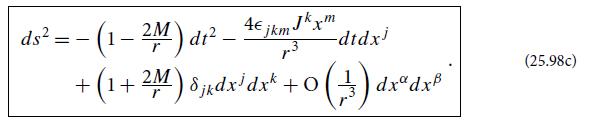
Derive Eqs. (25.98a) for the trace-reversed metric perturbation outside a stationary (time-independent), linearized source of gravity. More specifically, do the following.(a) First derive h̅00. In your derivation identify a dipolar term of the form 4Djxj/r3, and show that by placing the origin
In this exercise we illustrate linearized theory by computing the gravitational field of a moving particle with finite rest mass and then that of a zero-rest-mass particle that moves with the speed of light.(a) From Eq. (25.91), deduce that, for a particle with mass M at rest at the origin, the
Consider a system that can be covered by nearly globally Lorentz coordinates in which the Newtonian-limit constraints (25.75) are satisfied. For such a system, flesh out the details of the text’s derivation of the Newtonian limit. More specifically, do the following.(a) Derive Eq. (25.76) for the
(a) Derive the Bianchi identity (25.70) in 4-dimensional spacetime.(b) By contracting the Bianchi identity (25.70) on ∈αβμν∈νγδ∈, derive the contracted Bianchi identity (25.69).Equations. V.G=0, (25.69)
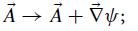
(a) Show that the “infinitesimal” coordinate transformation (25.87) produces the change (25.88) of the linearized metric perturbation and that it leaves the Riemann tensor (25.80) unchanged.(b) Exhibit a differential equation for the ξα that brings the metric perturbation into gravitational
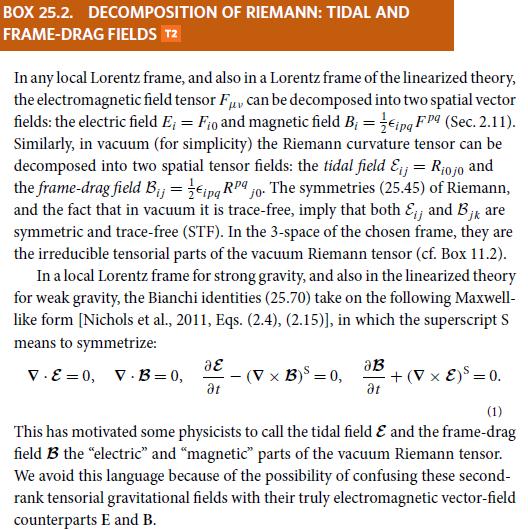
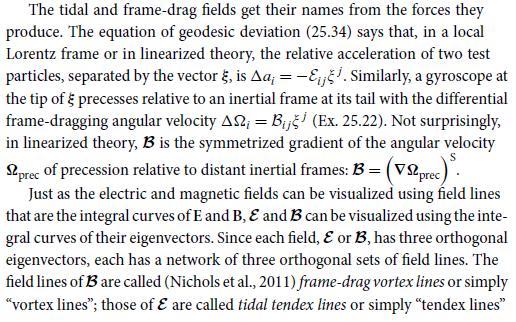
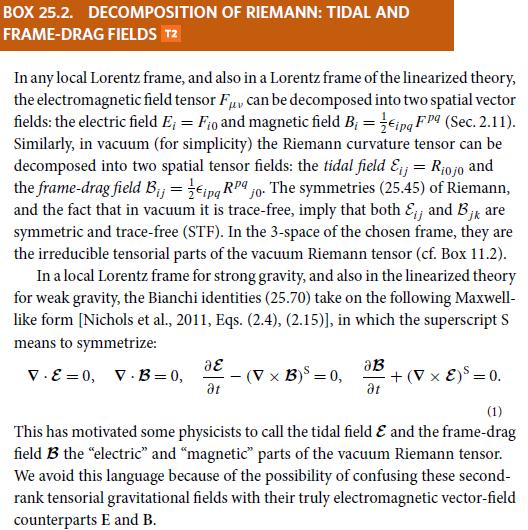
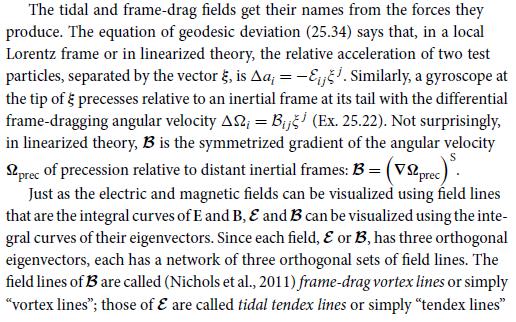
(a) Derive the equation △Ωi = Bijξj for the precession angular velocity of a gyroscope at the tip of ξ as measured in an inertial frame at its tail. Here Bij is the frame-drag field introduced in Box 25.2.(b) Show that in linearized theory, B is the symmetrized gradient of the angular velocity
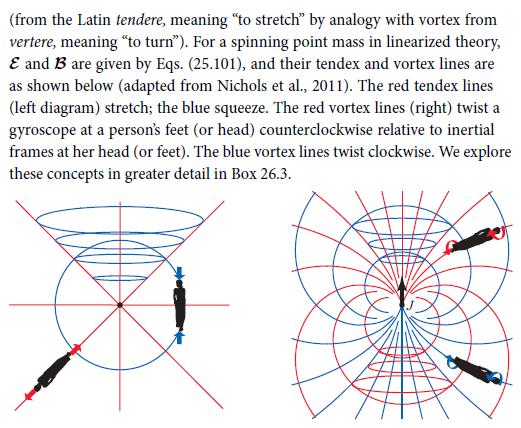
Show that in linearized theory, for a spinning particle at the origin with mass M and with its spin J along the polar axis, the orthonormal-frame components of ε and B areWhat are the eigenvectors of these fields? Convince yourself that these eigenvectors’ integral curves (the tidal tendex lines
(a) It turns out that the following line element is a solution of the vacuum Einstein field equation G = 0:Since this solution is spherically symmetric, Birkhoff’s theorem guarantees it must represent the standard Schwarzschild spacetime geometry in a coordinate system that differs from
Bruno Bertotti (1959) and Ivor Robinson (1959) independently solved the Einstein field equation to obtain the following metric for a universe endowed with a uniform magnetic field:HereIf one computes the Einstein tensor from the metric coefficients of the line element (26.13) and equates it to 8π
Consider a photon emitted by an atom at rest on the surface of a static star with mass M and radius R. Analyze the photon’s motion in the Schwarzschild coordinate system of the star’s exterior, r ≥ R > 2M. In particular, compute the “gravitational redshift” of the photon by the
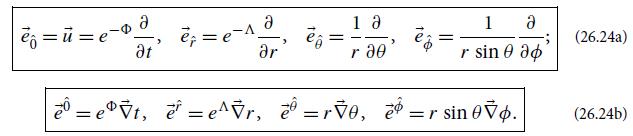
Show that in the coordinate system {x0̂, x1̂, x2̂, x3̂} of Eqs. (26.25b), the coordinate basis vectors at xĵ = 0 are Eqs. (26.24), and, accurate through first order in distance from xĵ = 0, the spacetime line element is Eq. (26.26); that is, errors are no larger than second order.Equations.
(a) Use index manipulations to show that in general (not just inside a static star), for a perfect fluid with Tαβ = (ρ + P)uαuβ + Pgαβ, the law of energy conservation uα Tαβ;β = 0 reduces to the first law of thermodynamics (26.30).(b) Similarly, show that PμαTαβ;β = 0 reduces to the
The equation of state of a neutron star is very hard to calculate at the supra-nuclear densities required, because the calculation is a complex, many-body problem and the particle interactions are poorly understood and poorly measured. Observations of neutron stars’ masses and radii can therefore
(a) Show that the embedding surface of Eq. (26.48) is a paraboloid of revolution everywhere outside the star.(b) Show that in the interior of a uniform-density star, the embedding surface is a segment of a sphere.(c) Show that the match of the interior to the exterior is done in such a way that, in
The fluid treatment of the neutrino component would only be adequate if the neutrinos were self-collisional, which they are not. The phenomenon of Landau damping alerts us to the need for a kinetic approach. We develop this in stages.Following the discussion, we introduce the neutrino distribution
(a) Using an order-of-magnitude analysis based on Eq. (27.60), show that the strongest gravitational waves that are likely to occur each year in LIGO’s HF band have h+ ∼ h× ∼ 10−21—which is the actual amplitude of LIGO’s first observed wave burst, GW150914.(b) As a concrete example,
Burke’s radiation-reaction potential (27.64) produces a force per unit volume −ρ∇Φreact on its nearly Newtonian source. If we multiply this force per unit volume by the velocity v = dx/dt of the source’s material, we obtain thereby a rate of change of energy per unit volume.
(a) Compute the net rate at which the quadrupolar waves (27.57) carry energy away from their source, by carrying out the surface integral (25.102) with T0j being Isaacson’s gravitational-wave energy flux (27.40). Your answer should be Eq. (27.61).(b) The computation of the waves’ angular
Show that the Euler-Lagrange equation for the action principle (27.8) is equivalent to the geodesic equation for a photon in the static spacetime metric g00(xk), gij(xk). Specifically, do the following.(a) The action (27.8) is the same as that for a geodesic in a 3-dimensional space with metric
The isotropic-coordinate line element (26.16) describing the spacetime geometry of a Schwarzschild wormhole is independent of the time coordinate t . However, because gtt = 0 at the wormhole’s throat, r̅ = M/2, the proper timemeasured by an observer at rest appears to vanish, which cannot be
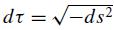
(a) Near the event {r = 2M, θ = θo, ∅ = ∅o, t finite}, on the horizon of a black hole, introduce locally Cartesian spatial coordinatesaccurate to first order in distance from that event. Show that the metric in these coordinates has the form(accurate to leading order in distance from the
Derive Eq. (11.56) for the free energy of a beam that is compressed with a force F and has a critical compression Fcrit = π2D/ℓ2, where D is its flexural rigidity. V
(a) Verify that −∇ · TM = j × B, where TM is the magnetic stress tensor (19.11).(b) Take the scalar product of the fluid velocity v with the equation of motion (19.10) and combine with mass conservation to obtain the energy conservation equation (19.16).(c) Combine energy conservation (19.16)
Consider a normal shock wave (v perpendicular to the shock front), in which the magnetic field is parallel to the shock front, analyzed in the shock front’s rest frame.(a) Show that the junction conditions across the shock are the vanishing of all the following quantities:(b) Specialize to a
Consider an infinitely long cylinder of plasma with constant electric conductivity, surrounded by vacuum. Assume that the cylinder initially is magnetized uniformly parallel to its length, and assume that the field decays quickly enough that the plasma’s inertia keeps it from moving much during
Consider a stably stratified fluid at rest with a small (negative) vertical density gradient dρ/dz.(a) By modifying the analysis in this section, ignoring the effects of viscosity, heat conduction, and concentration gradients, show that small-amplitude linear waves, which propagate in a direction
Make an order-of-magnitude estimate of the size of the fingers and the time it takes for them to grow in a small transparent jar. You might like to try an experiment.
Consider a small bubble of air rising slowly in a large expanse of water. If the bubble is large enough for surface tension to be ignored, then it will form an irregular cap of radius r. Show that the speed with which the bubble rises is roughly (gr)1/2. (A more refined estimate gives a numerical
The density and temperature in the deep interior of the Sun are roughly 0.1 kgm−3 and 1.5 × 10⁷ K.(a) Estimate the central gas pressure and radiation pressure and their ratio.(b) The mean free path of the radiation is determined almost equally by Thomson scattering, bound-free absorption, and
Consider a knife on its back, so its sharp edge points in the upward, z direction. The edge (idealized as extending infinitely far in the y direction) is hot, and by heating adjacent fluid, it creates a rising thermal plume. Introduce a temperature deficit △T (z) that measures the typical
Use the Rayleigh criterion to estimate the temperature difference that would have to be maintained for 2mm of corn/canola oil, or water, or mercury in a skillet to start convecting. Look up the relevant physical properties and comment on your answers. Do not perform this experiment with mercury.
In Sec. 14.4, we introduced the notion of a laminar boundary layer by analyzing flow past a thin plate. Now suppose that this same plate is maintained at a different temperature from the free flow. A thermal boundary layer will form, in addition to the viscous boundary layer, which we presume to be
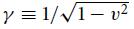
In astrophysics (e.g., in supernova explosions and in jets emerging from the vicinities of black holes), one sometimes encounters shock fronts for which the flow speeds relative to the shock approach the speed of light, and the internal energy density is comparable to the fluid’s rest-mass
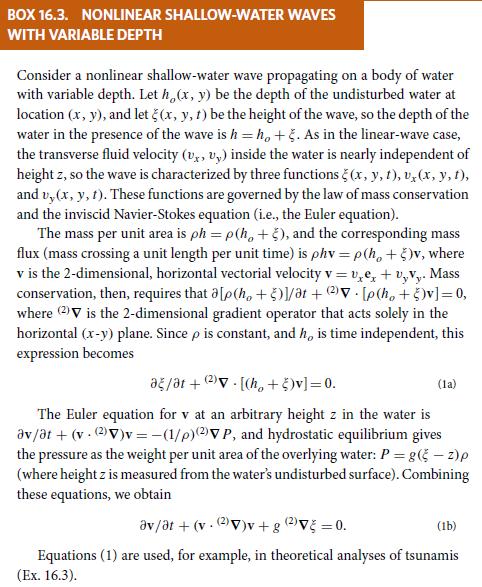
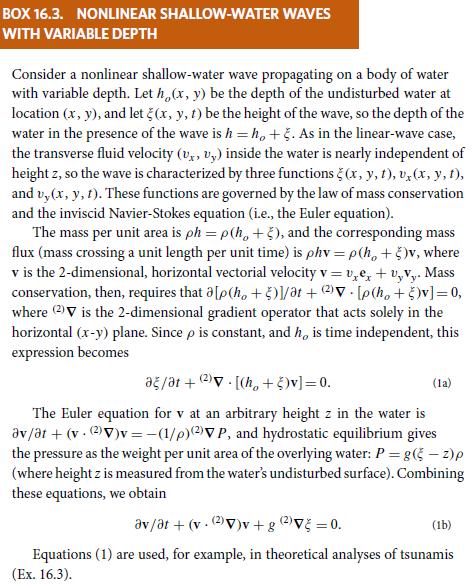
Consider the 1-dimensional flow of shallow water in a straight, narrow channel, neglecting dispersion and boundary layers. The equations governing the flow, a derived and discussed in Box 16.3 and Eqs. (16.23), areHere h(x, t) is the height of the water, and v(x, t) is its depth-independent
Consider a black hole or neutron star with mass M at rest in interstellar gas that has constant ratio of specific heats γ. In this exercise you will derive some features of the adiabatic, spherical accretion of the gas onto the hole or star, a problem first solved by Bondi (1952b). This exercise
Use the development of relativistic gas dynamics in Sec. 13.8.2 to show that the cross sectional area of a relativistic 1-dimensional flow tube is also minimized when the flow is transonic. Assume that the equation of state is P = 1/3ρc2. For details see Blandford and Rees (1974).
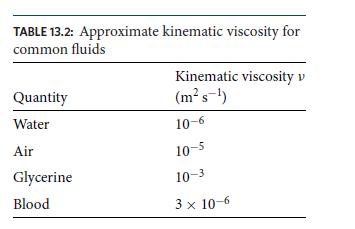
(a) Show that viscosity damps a monochromatic deep-water wave with an amplitude e-folding time τ∗ = (2νk2)−1, where k is the wave number, and ν is the kinematic viscosity.(b) As an example, consider the ocean waves that one sees at an ocean beach when the surf is “up” (large-amplitude
Consider small-amplitude (linear) shallow-water waves in which the height of the bottom boundary varies, so the unperturbed water’s depth is variable: ho = ho(x, y).(a) Using the theory of nonlinear shallow-water waves with variable depth (Box 16.3), show that the wave equation for the
A toy boat moves with uniform velocity u across a deep pond (Fig. 16.2). Consider the wave pattern (time-independent in the boat’s frame) produced on the water’s surface at distances large compared to the boat’s size. Both gravity waves and surface-tension (capillary) waves are excited. Show
Verify that expression (16.33) does indeed satisfy the dimensionless KdV equation (16.32). az az +5 + ат an a3s an3 = 0. (16.32)
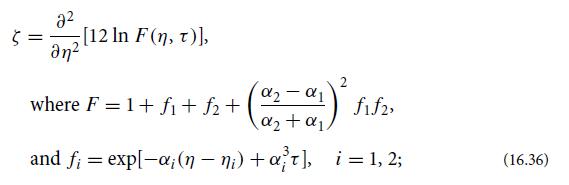
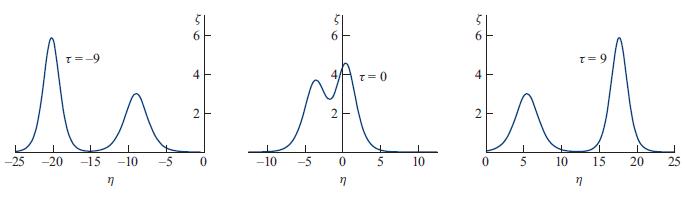
(a) Verify, using symbolic-manipulation computer software (e.g., Maple, Matlab, or Mathematica) that the two-soliton expression (16.36) satisfies the dimensionless KdV equation.(b) Verify analytically that the two-soliton solution (16.36) has the properties claimed in the text. First consider the
For the radially oscillating ball as analyzed in Sec. 16.5.3, verify that the radiation reaction acceleration removes energy from the ball, plus the fluid loaded onto it, at the same rate as the sound waves carry energy away. See Ex. 27.12 for the analogous gravitational-wave result.Data from
In Sec. 7.5, we explored five elementary (generic) caustics that can occur in geometric optics. Each is described by its phase φ(ã , b̃; x̃, ỹ, z̃) for light arriving at an observation point with Cartesian coordinates {x̃, ỹ, z̃} along paths labeled by (ã , b̃).(a) Suppose the
Telescopes can also look down through the same atmospheric irregularities as those mentioned in Sec. 8.3.2. In what important respects will the optics differ from those for ground-based telescopes looking upward?
In Ex. 3.17, we studied the diffusion of particles through an infinite 3-dimensional medium. By solving the diffusion equation, we found that, if the particles’ number density at time t = 0 was no(x), then at time t it has becomewhere D is the diffusion coefficient [Eq. (3.73)].(a) For any one of
(a) Enthalpy H is a macroscopic thermodynamic variable defined byShow that this definition can be regarded as a Legendre transformation that converts from the energy representation of thermodynamics with ε(V , S, N) as the fundamental potential, to an enthalpy representation with H(P , S, N) as
Polarization observations of the CMB provide an extremely important probe of fluctuations in the early universe.(a) By invoking the electromagnetic features of Thomson scattering by free electrons, give a heuristic demonstration of why a net linear polarization signal is expected.(b) Using the
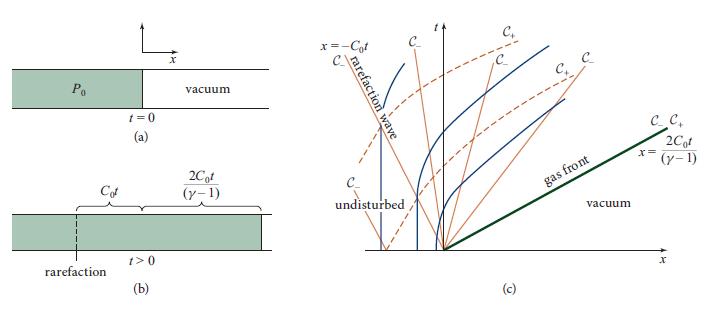
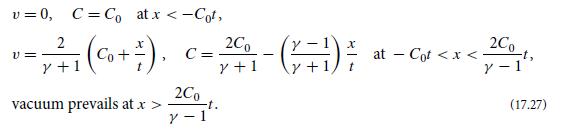
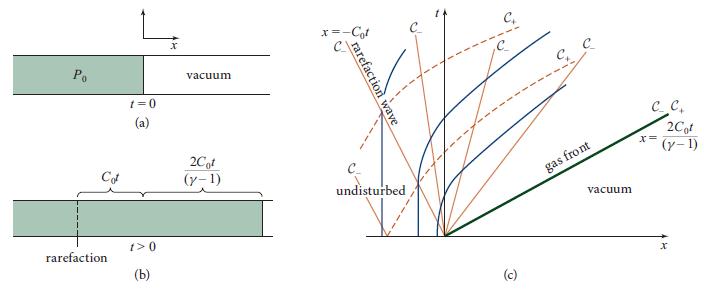
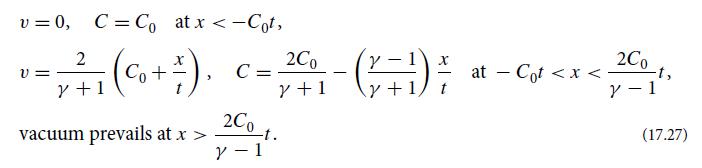
Use a similarity analysis to derive the solution (17.27) for the shock-tube flow depicted in Fig. 17.9.Figure 17.9.Equation 17.27. Po Co rarefaction t=0 (a) 1>0 (b) vacuum 2Cot (x-1) X = -Cot rarefaction wave undisturbed (c) C gas front vacuum C__c. X = 2Co (x-1)
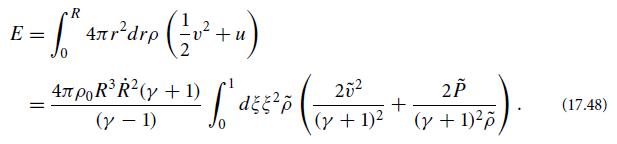
Many stars possess powerful stellar winds that drive strong spherical shockwaves into the surrounding interstellar medium. If the strength of the wind remains constant, the kinetic and internal energy of the swept-up interstellar medium will increase linearly with time.(a) Modify the text’s
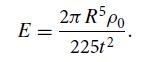
A simple analytical solution to the Sedov-Taylor similarity equations can be found for the particular case γ = 7. This is a fair approximation to the behavior of water under explosive conditions, as it will be almost incompressible.(a) Make the ansatz (whose self-consistency we will check later)
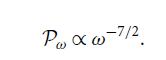
Use the quoted scaling of N-wave amplitude with cylindrical radius ω̅ to make an order-of-magnitude estimate of the flux of acoustic energy produced by the Space Shuttle flying at Mach 2 at an altitude of 20km. Give your answer in decibels [Eq. (16.61)].Equation 16.61. FdB = 120 + 10 log10
Consider a shock tube as discussed in Sec. 17.4.2 and Fig. 17.9. High density “driver” gas with sound speed C0 and specific heat ratio γ is held in place by a membrane that separates it from target gas with very low density, sound speed C1, and the same specific-heat ratio γ .When the
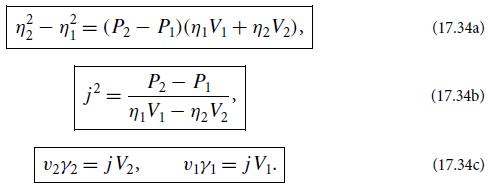
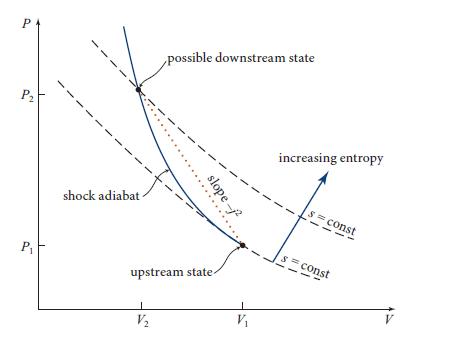
(a) Almost all equations of state satisfy the condition (∂2V/∂P2)s > 0. Show that, when this condition is satisfied, the Rankine-Hugoniot relations and the law of entropy increase imply that the pressure and density must increase across a shock and the fluid must decelerate: P2 > P1, V2
We have computed the velocity field for a freely expanding gas in 1 dimension, Eqs. (17.27).Use this result to show that the path of an individual fluid element, which begins at x = x0Equation 17.27. 2Cot -Cot X = - 200²₁ + (x + 1) xo (=C₂¹) F хо Y-1 - Хо at 0 < хо Co
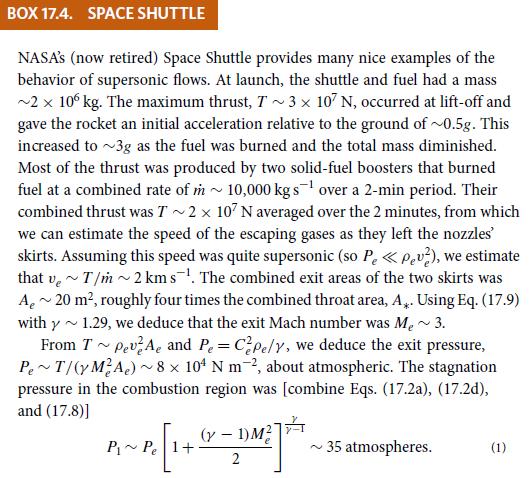
Use the rough figures in Box 17.4 to estimate the energy released per unit mass in burning the fuel. Does your answer seem reasonable?Box 17.4. BOX 17.4. SPACE SHUTTLE NASA's (now retired) Space Shuttle provides many nice examples of the behavior of supersonic flows. At launch, the shuttle and fuel
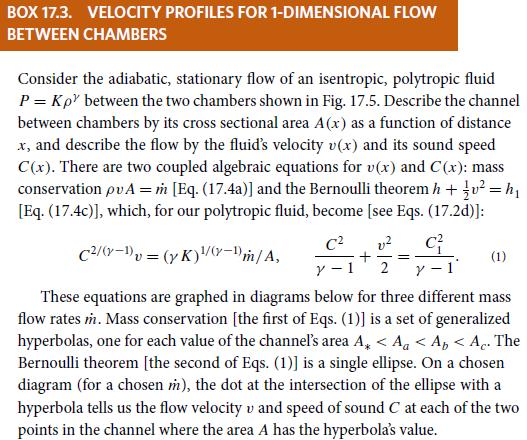
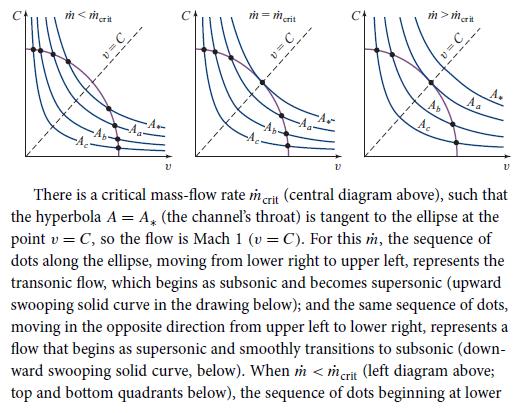
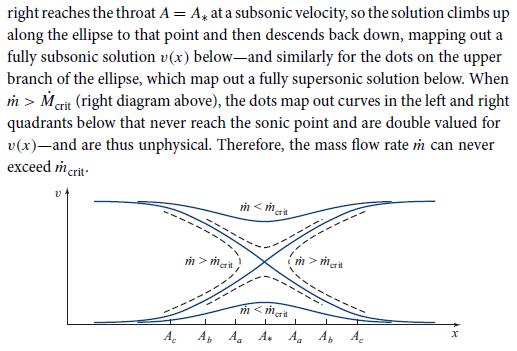
For γ = 3 and for a channel with A = A∗(1+ x2), solve the flow equations (1) of Box 17.3 analytically and explicitly for v(x), and verify that the solutions have the qualitative forms depicted in the last figure of Box 17.3.Box 17.3. BOX 17.3. VELOCITY PROFILES FOR 1-DIMENSIONAL FLOW BETWEEN
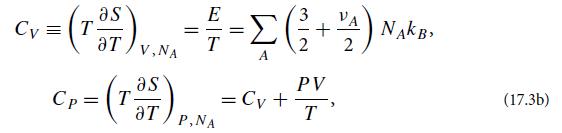
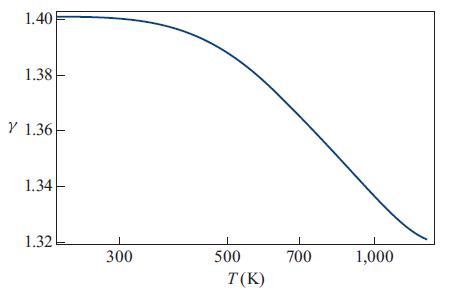
Consider an ideal gas consisting of several different particle species (e.g., diatomic oxygen molecules and nitrogen molecules in the case of Earth’s atmosphere).Consider a sample of this gas with volume V, containing NA particles of various species A, all in thermodynamic equilibrium at a
Redo the computation of radiation reaction for a radially oscillating ball immersed in a fluid without imposing the slow-motion assumption and approximation. Thereby obtain the following coupled equations for the radial displacement ξ(t) of the ball’s surface and the function Φ(t) ≡ a−2f (t
Consider the emission of quadrupolar soundwaves by a Kolmogorov spectrum of free turbulence. Show that the power radiated per unit frequency interval has a spectrumAlso show that the total power radiated is roughly a fraction M5 of the power dissipated in the turbulence, where M is the Mach number.
Idealize the trumpet as a bent pipe of length 1.2 m from the mouthpiece (a node of the air’s displacement) to the bell (an antinode). The lowest note is a first overtone and should correspond to B flat (233Hz). Does it?
Consider the G string (196Hz) of a violin. It is ∼30 cm from bridge to nut (the fixed endpoints), and the tension in the string is ∼40 N.(a) Infer the mass per unit length in the string and estimate its diameter. Hence estimate the strain in the string before being plucked. Estimate the
Viscosity and thermal conduction will attenuate sound waves. For the moment just consider a monatomic gas where the bulk viscosity can be neglected.(a) Consider the entropy equation (13.75), and evaluate the influence of the heat flux on the relationship between the pressure and the density
Consider a sound wave propagating through a static, inhomogeneous fluid with no gravity. Explain why the unperturbed fluid has velocity v = 0 and pressure Po = constant, but can have variable density and sound speed, ρo(x) and C(x, t). By repeating the analysis in Eqs. (16.47)–(16.50), show that
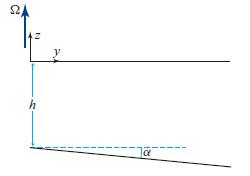
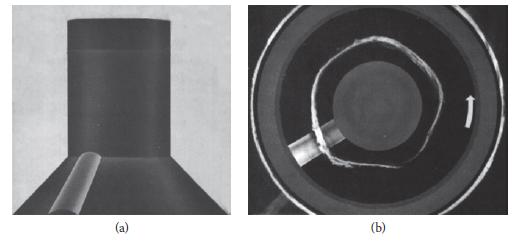
In the film Fultz (1969), about 20 min 40 s into the film, an experiment is described in which Rossby waves are excited in a rotating cylindrical tank with inner and outer vertical walls and a sloping bottom. Figure 16.10a is a photograph of the tank from the side, showing its bottom, which slopes
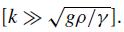
Consider deep-water gravity waves of short enough wavelength that surface tension must be included, so the dispersion relation is Eq. (16.14). Show that there is a minimum value of the group velocity, and find its value together with the wavelength of the associated wave. Evaluate these for water
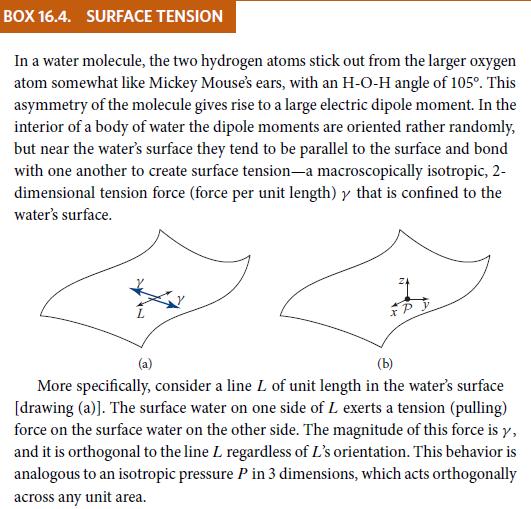
For a soap film that is attached to a bent wire (e.g., to the circular wire that a child uses to blow a bubble), the air pressure on the film’s two sides is the same. Therefore, Eq. (16.16) (with γ replaced by 2γ , since the film has two faces) tells us that at every point in the film, its two
Consider a point P in the curved interface between two fluids. Introduce Cartesian coordinates at P with x and y parallel to the interface and z orthogonal [as in diagram (b) in Box 16.4], and orient the x- and y-axes along the directions of the interface’s principal curvatures, so the local
What is the maximum size of water droplets that can form by water very slowly dripping out of a syringe? Out of a water faucet (whose opening is far larger than that of a syringe)?
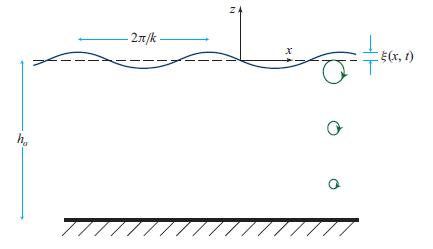
(a) Show that in a gravity wave in water of arbitrary depth (deep, shallow, or in between), each fluid element undergoes forward-rolling elliptical motion as shown in Fig. 16.1. (Assume that the amplitude of the water’s displacement is small compared to a wavelength.)(b) Calculate the
By using the matrix techniques discussed in the next-to-the-last paragraph of Box 12.2, deduce that the general solution to the algebraic wave equation (12.6) is the sum of a longitudinal mode with the properties deduced in Sec. 12.2.3 and two transverse modes with the properties deduced in Sec.
Optical fibers in which the refractive index varies with radius are commonly used to transport optical signals. When the diameter of the fiber is many wavelengths, we can use geometric optics. Let the refractive index bewhere n0 and α are constants, and r is radial distance from the fiber’s
Consider a harmonic oscillator (e.g., a pendulum), driven by bombardment with air molecules. Explain why the oscillator’s position x(t) and velocity ν(t) = dx/dt are random processes. Is x(t)Markov? Why? Is ν(t)Markov? Why? Is the pair {x(t), v(t)} a 2-dimensionalMarkov process? Why? We study
Re-express Box 4.3’s pedagogical example of quantum decoherence and entropy increase in the language of the quantum mechanical density operator p̂ (Box 4.2). Use this example to explain the meaning of the various statements made in the next-to-last paragraph of Sec. 4.7.2.Data from Section
Earth has normal modes of oscillation, many of which are in the milli-Hertz frequency range. Large earthquakes occasionally excite these modes strongly, but the quakes are usually widely spaced in time compared to the ringdown time of a particular mode (typically a few days). There is evidence of a
(a) Evaluate the scaling of the rate of mass flow (discharge) Ṁ(x) along the 3- dimensional turbulent jet of the previous exercise. Show that Ṁ increases with distance from the nozzle, so that mass must be entrained in the flow and become turbulent.(b) Compare the entrainment rate for a
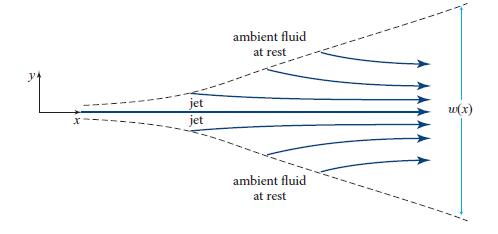
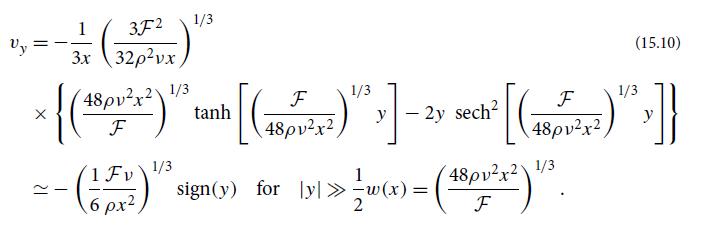
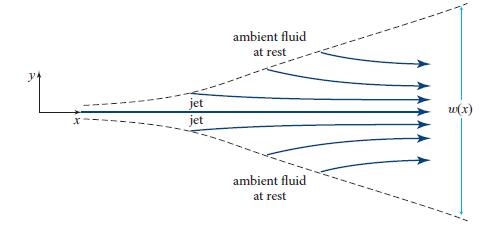
Consider a 2-dimensional turbulent jet emerging into an ambient fluid at rest, and contrast it to the laminar jet analyzed in Ex. 15.3.(a) Find how the mean jet velocity and the jet width scale with distance downstream from the nozzle.(b) Repeat the exercise for a 3-dimensional jet.Data from
(a) Derive the time-averaged Navier-Stokes equation (15.13b) from the time dependent form [Eq. (15.11b)], and thereby infer the definition (15.13c) for the Reynolds stress. Equation (15.13b) shows how the Reynolds stress affects the evolution of the mean velocity. However, it does not tell us how
One does not have to be a biologist to appreciate the strong evolutionary advantage that natural selection confers on animals that can reduce their drag coefficients. It should be no surprise that the shapes and skins of many animals are highly streamlined. This is particularly true for aquatic
Consider a narrow, 2-dimensional, incompressible (i.e., subsonic) jet emerging from a 2-dimensional nozzle into ambient fluid at rest with the same composition and pressure. (By 2-dimensionalwemean that the nozzle and jet are translation symmetric in the third dimension.) Let the Reynolds number be
Repeat Ex. 15.1 for the 3-dimensional laminar wake behind a sphere.Data from Exercises 15.1.We explore the structure of the wake behind the cylinder when the Reynolds number is high enough that the flow is turbulent. For comparison, here we compute the wake’s structure at lower Reynolds
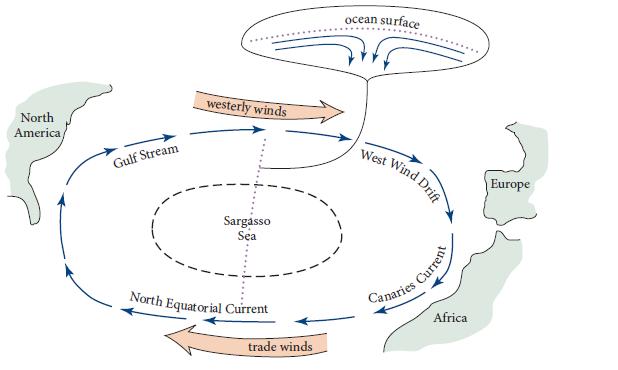
(a) In a shower or bathtub with the drain somewhere near the center, not the wall, set water rotating so a whirlpool forms over the drain. Perform an experiment to see where the water going down the drain comes from: the surface of the water, its bulk, or its bottom. For example, you could sprinkle
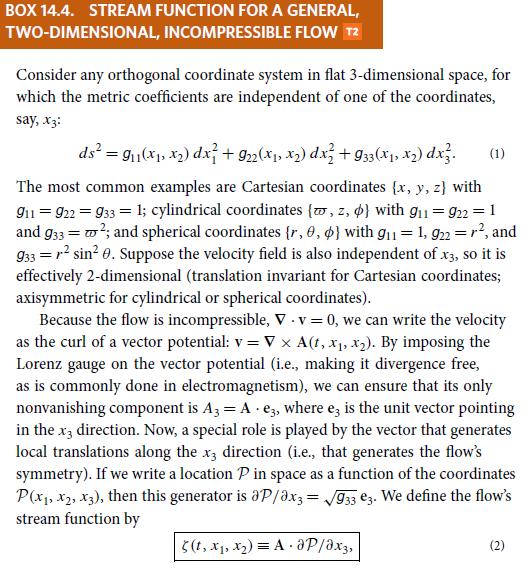
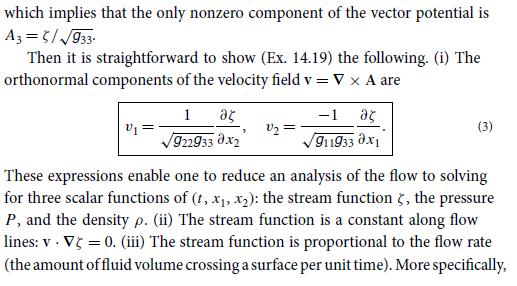
Consider low-Reynolds-number flow around a sphere. Derive the velocity field (14.30) using the stream function of Box 14.4. This method is more straightforward but less intuitive than that used in Sec. 14.3.2. Box 14.4. (14.30) D *** [G)-¹], G) -^ [G)¦- ()}-]-• D
Fluid flows down a long cylindrical pipe of length b much larger than radius a, from a reservoir maintained at pressure P0 (which connects to the pipe at x = 0) to a free end at large x, where the pressure is negligible. In this problem, we try to understand the velocity field vx(ω̅ , x) as a
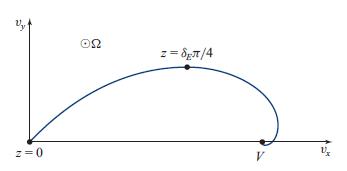
Many microorganisms propel themselves, at low Reynolds number, using undulatory motion. Examples include the helical motion of E. coli’s corkscrew tail (Box 14.3), and undulatory waves in a forest of cilia attached to an organism’s surface, or near a bare surface itself. As a 2-dimensional
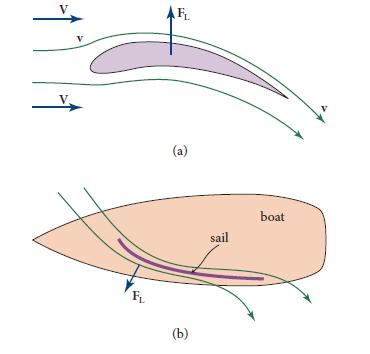
When an appropriately curved airfoil (e.g., an airplane wing) is introduced into a steady flow of air, the air has to flow faster along the upper surface than along the lower surface, which can create a lifting force (Fig. 14.7a). In this situation, compressibility and gravity are usually
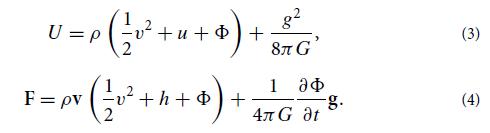
Consider an ideal fluid interacting with a (possibly dynamical) gravitational field that the fluid itself generates via ∇2Φ = 4πGρ. For this fluid, take the law of energy conservation, ∂U/∂t + ∇ · F = 0, and from it subtract the scalar product of v with the law of momentum conservation,
Showing 100 - 200
of 512
1
2
3
4
5
6
Step by Step Answers

 Get 50% OFF
Claim Now
Get 50% OFF
Claim Now