New Semester
Started
Get
50% OFF
Study Help!
--h --m --s
Claim Now
Question Answers
Textbooks
Find textbooks, questions and answers
Oops, something went wrong!
Change your search query and then try again
S
Books
FREE
Study Help
Expert Questions
Accounting
General Management
Mathematics
Finance
Organizational Behaviour
Law
Physics
Operating System
Management Leadership
Sociology
Programming
Marketing
Database
Computer Network
Economics
Textbooks Solutions
Accounting
Managerial Accounting
Management Leadership
Cost Accounting
Statistics
Business Law
Corporate Finance
Finance
Economics
Auditing
Tutors
Online Tutors
Find a Tutor
Hire a Tutor
Become a Tutor
AI Tutor
AI Study Planner
NEW
Sell Books
Search
Search
Sign In
Register
study help
physics
modern classical physics
Modern Classical Physics Optics Fluids Plasmas Elasticity Relativity And Statistical Physics 1st Edition Kip S. Thorne, Roger D. Blandford - Solutions
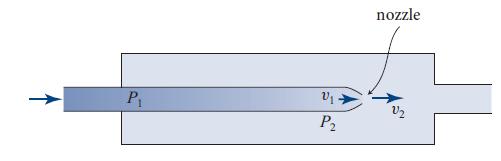
A good illustration of the importance of the Pv term in the energy flux is provided by the Joule-Kelvin method commonly used to cool gases (Fig. 13.8). Gas is driven from a high-pressure chamber 1 through a nozzle or porous plug into a low-pressure chamber 2, where it expands and cools.(a) Using
There’s a hole in my bucket. How long will it take to empty? (Try an experiment, and if the time does not agree with the estimate, explain why not.)
When dealing with differential equations describing a physical system, it is often helpful to convert to dimensionless variables. Polytropes (nonrotating, spherical fluid bodies with the polytropic equation of state P = Kρ1+1) are a nice example.(a) Combine the two equations of stellar structure
As mountaineers know, it gets cooler as you climb. However, the rate at which the temperature falls with altitude depends on the thermal properties of air. Consider two limiting cases.(a) In the lower stratosphere (Fig. 13.2), the air is isothermal. Use the equation of hydrostatic equilibrium
Fill in the details of the analysis of time-averaged seeing in Box 9.2.More specifically, do the following. If you have difficulty, Roddier (1981) may be helpful.(a) Give an order-of-magnitude derivation of Eq. (4a) in Box 9.2 for the mean-square phase fluctuation of light induced by propagation
X-rays with wavelength 8.33˚A (0.833 nm) coming from a point source can be reflected at shallow angles of incidence from a plane mirror. The direct ray from a point source to a detector 3m away interferes with the reflected ray to produce fringes with spacing 25 μm. Calculate the distance of the
Derive Eq. (7.94). M = (0²/+ 1/B²) (0²/+8²)¹/²B (7.94)
Consider hydrogen gas in statistical equilibrium at a temperature T ec2/kB ≈ 6 × 10⁹ K. Electrons at the high-energy end of the Boltzmann energy distribution can produce electron-positron pairs by scattering off protons:(a) In statistical equilibrium, the reaction (5.65) and its inverse must
(a) Consider H2O in contact with a heat and volume bath with temperature T and pressure P. For certain values of T and P the H2O will be liquid water; for others, ice; for others, water vapor—and for certain values it may be a two- or three-phase mixture of water, ice, and/or vapor. Show, using
For a nonrelativistic, classical, ideal gas (no interactions between particles), evaluate the statistical sum (5.50) to obtain G(P , T , N), and from it deduce the standard formula for the ideal-gas equation of state P V̅ = NkBT . e-G/(KBT) =Σe-(En+PV₁)/(KBT) = n (5.50)
In Sec. 5.4.1, we explained the experimental meaning of the free energy F for a system in contact with a heat bath so its temperature is held constant, and in Ex. 5.5h we did the same for contact with a pressure bath. By combining these, give an experimental interpretation of the Gibbs potential
In Part V, when studying fluid dynamics, we shall encounter an adiabatic index[Eq. (13.2)] that describes how the pressure P of a fluid changes when it is compressed adiabatically (i.e., compressed at fixed entropy, with no heat being added or removed).Derive an expression for Г for an ideal gas
Prove the properties of entropy enumerated in Sec. 4.11.4.Data from Sec. 4.11.4Because of the similarity of the general formulas for information and entropy (both proportional to ∑n −pn ln pn), information has very similar properties to entropy.1. Information is additive (just as entropy is
By using more accurate approximations to Eq. (4.48a), explore the onset of the condensation near T = Tc0 . More specifically, do the following.(a) Approximate the numerator in Eq. (4.48a) by q2 + 3q, and keep the 1/N0 term in the exponential. Thereby obtainHereis a special function called the
(a) When the early universe was ∼200 s old, its principal constituents were photons, protons, neutrons, electrons, positrons, and (thermodynamically isolated) neutrinos and gravitons. The photon temperature was ∼9 × 10⁸ K, and the baryon density was ∼0.02 kgm−3. The photons, protons,
We will study classical sound waves propagating through an isotropic, elastic solid. As we shall see, there are two types of sound waves: longitudinal with frequency-independent speed CL, and transverse with a somewhat smaller frequency independent speed CT . For each type of wave, s = L or T , the
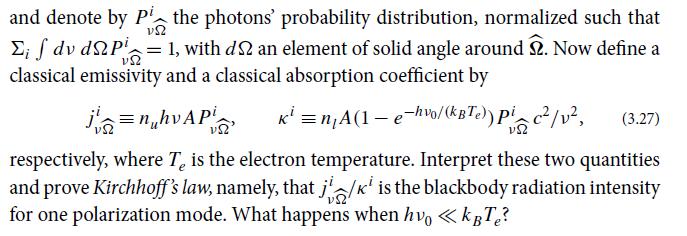
We have described distribution functions for particles and photons and the forms that they have in thermodynamic equilibrium. An extension of these principles can be used to constrain the manner in which particles and photons interact, specifically, to relate the emission and absorption of
The GPS satellites are in circular orbits at a height of 20,200 km above Earth’s surface, where their orbital period is 12 sidereal hours. If the ticking rates of the clocks on the satellites were not corrected for the gravitational redshift, roughly how long would it take them to accumulate a
Consider a weak, planar gravitational wave propagating in the z direction, written in a general Lorenz gauge [Eqs. (27.19)]. Show that by appropriate choices of new gauge-change generators that have the plane-wave form ξμ(t − z), one can (i) Keep the metric perturbation in Lorenz
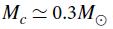
Gravitational waves from a distant source travel through the Sun with impunity (negligible absorption and scattering), and their rays are gravitationally deflected. The Sun is quite centrally condensed, so most of the deflection is produced by a central region with massand radius Rc ≈ 105 km ≈
Show that conditions (i), (ii), and (iii) preceding Eq. (27.48) guarantee that the multipolar expansion of the gravitational-wave fields will have the form (27.48).ConditionsThe wave fields h+ and h× in the source’s local wave zone must (i) Be dimensionless, (ii) Die out as
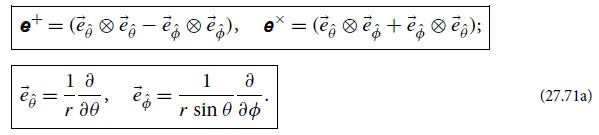
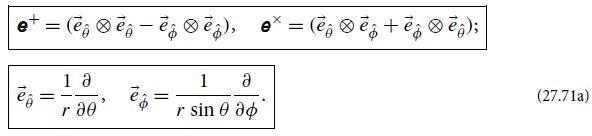
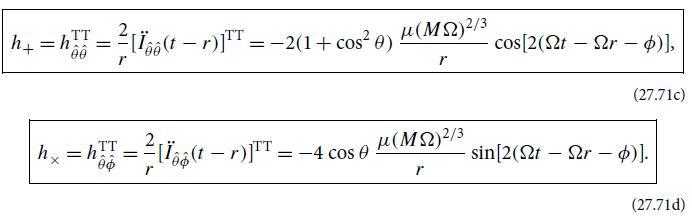
Consider a mass m attached to a spring, so it oscillates along the z-axis of a Cartesian coordinate system, moving along the world line z = a cos Ωt, y = x = 0. Use the quadrupole-moment formalism to compute the gravitational waves h+(t , r , θ , ∅) and h×(t , r , θ , ∅) emitted by this
Extrapolating Eqs. (27.71)–(27.73) into the strong-gravity regime, estimate the maximum gravitational- wave amplitude and emitted power for a nonspinning binary black hole with equal masses and with unequal masses. Compare with the results from numerical relativity discussed in the
Many precision tests of general relativity are associated with binary pulsars in elliptical orbits.(a) Verify that the radius of the relative orbit of the pulsars can be written as r = p/(1 + e cos ∅), where p is the semi-latus rectum, e is the eccentricity, and d∅/dt = (Mp)1/2/r2 with M the
We have hitherto focused on the statistical properties of the cosmological perturbations as probed by a variety of observations. However, we on Earth occupy a unique location in a specific realization of wave modes that we have argued are drawn from a specific set of waves with particular
Derive the dispersion relation ω2(k) for axisymmetric perturbations of the Θ-pinch configuration when the magnetic field is confined to the cylinder’s exterior, and conclude from it that the Θ-pinch is stable against axisymmetric perturbations. Repeat your analysis for a general, variable
Consider a particle that is at rest in the TT coordinate system of the gravitational-wave metric (27.80) before the gravitational wave arrives. In the text it is shown that the particle’s 4-velocity has ux = uy = 0 as the wave passes. Show that uz = 0 and ut = 1 as the wave passes, so the
Wave your arms rapidly, and thereby try to generate gravitational waves.(a) Using classical general relativity, compute in order of magnitude the wavelength of the waves you generate and their dimensionless amplitude at a distance of one wavelength away from you.(b) How many gravitons do you
(a) Derive the behavior [Eq. (27.31)] of h+ and h× under rotations in the transverse plane.(b) Show that, with the orientations of spatial basis vectors described after Eq. (27.31), h+ and h× are unchanged by boosts.Equation 27.31. (h+ + ihx) new = (h++ihx) olde²i, when (ex + iey) new = (x +
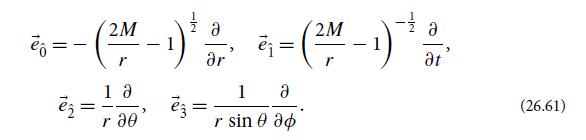
(a) One possible choice of slices of simultaneity for Schwarzschild spacetime is the set of 3-surfaces {t = const}, where t is the Schwarzschild time coordinate. Show that the unique family of observers for whom these are the simultaneities are the static observers, with world lines {(r, θ, ∅) =
(a) Show that, as the surface of an imploding star approaches R = 0, its world line in Schwarzschild coordinates asymptotes to the curve {(t , θ , ∅) = const, r variable}.(b) Show that this curve to which it asymptotes [part (a)] is a timelike geodesic.(c) Show that the basis vectors of the
Not surprisingly, there are several other approaches to deriving the possible forms of ∑(χ). Another derivation exploits the symmetries of the Riemann tensor.(a) The 3-dimensional Riemann curvature tensor of the hypersurface must be homogeneous and isotropic. Explain why it should therefore only
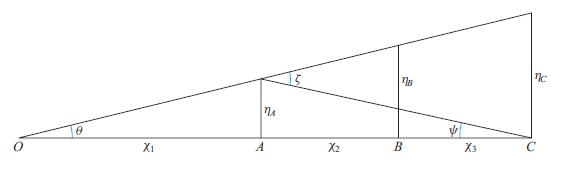
Consider the triangle formed by the three geodesics in Fig. 28.3. In a flat space, the exterior angle ζ must equal θ + ψ. However, if the space is homogeneous and positively curved, then the angle deficit △ ≡ θ + ψ − ζ will be positive.(a) By considering the geometry of the
Suppose that the universe contained a significant component in the form of isotropic but noninteracting particles with momentum p and rest mass m. Suppose that they were created with a distribution function f(p, a) ∝ p−q, with 4 < q < 5 extending from p ≪ m to p ≫ m.(a) Show that the
Astronomers find it convenient to use the redshift z = 1/a − 1 to measure the size of the universe when the light they observed was emitted.(a) Perform a Taylor expansion in z to show that the luminosity distance of a source is given to quadratic order by(b) The cubic term in this expansion
Assume that a fraction ∼0.2 of the baryons in the universe is associated with galaxies, split roughly equally between stars and gas. Also assume that a fraction ∼10−3 of the baryons in each galaxy is associated with a massive black hole and that most of the radiation from stars and black
Make a simple (numerical)model of a spherical galaxy in which the dark matter particles moving in the (Newtonian) gravitational field they create behave like collisionless plasma particles moving in an electromagnetic field. Ignore the baryons.(a) Adopt the fluid approximation, treat the pressure P
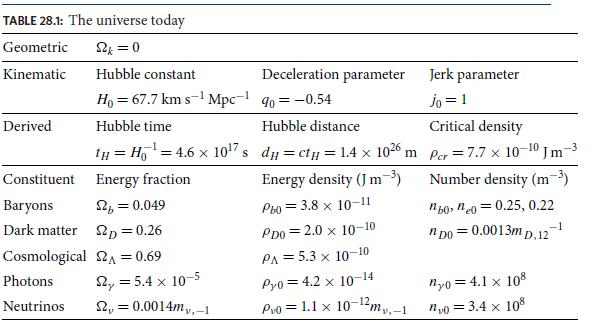
Calculate three contributions to the pressure of the contemporary universe.(a) Baryons. Assume that most of the baryons in the universe outside of stars make up a uniform, hot intergalactic medium with temperature 106 K.(b) Radiation.(c) Neutrinos. Assume that almost all the neutrino pressure is
(a) Estimate the minimum fraction of the rest mass energy of the hydrogen that must have undergone nuclear reactions inside stars to have ionized the remaining gas when a ∼ 0.1.(b) Suppose that these stars radiated 30 times this minimum energy at optical frequencies. Estimate the energy density
Explore nonlinear effects in the growth of perturbations in the gravitational age— when radiation and the cosmological constant can be ignored—by considering the evolution of a sphere in which the matter density is uniform and exceeds the external density by a small quantity.(a) Use the
Neutrinos have mass, which becomes measurable at late times through its influence on the growth of structure.(a) Explain how the expansion of the universe is changed if there is a single dominant neutrino species of mass 100 meV.(b) Modify the equations for neutrino phase-space trajectories
Assume that the universe will continue to expand according to Eq. (28.43).(a) Calculate the behavior of the angular diameter distance and the associated volume as a function of the scale factor for the next 20 billion years.(b) Interpret your answer physically.(c) Explain qualitatively what will
Rather surprisingly, it turns out that a certain type of supernova explosion (called “Type 1a” and associated with detonating white-dwarf stars) has a peak luminosity L that can be determined by studying the way its brightness subsequently declines. Astronomers can measure the peak fluxes F for
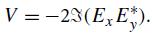
There are many ways to represent the polarization of electromagnetic radiation. A convenient one that is used in the description of CMB fluctuations was introduced by Stokes.(a) Consider a monochromatic wave propagating along ez with electric vector E = {Ex , Ey}eiωt, where the components are
The precision with which the low-l spherical harmonic power spectrum can be determined observationally is limited because of the low number of independent measurements that can be averaged over. Give an approximate expression for the cosmic variance that should be associated with the CMB
We have explained how the peaks in the CMB temperature fluctuation spectrum arise because the sound waves all began at the same time and are all effectively observed at the same time, while they entered the horizon at different times. Suppose that the universe had been radiation dominated up to
Consider an extended congruence propagating through an otherwise homogeneous universe, from which all matter has been removed. Show that the affine distance functions as an effective angular diameter distance in this congruence. Now reinstate the matter as compact galaxies and modify Eq. (28.79)
Consider a single light ray propagating across the universe from a source at log a = −0.5 to us. The cumulative effect of all the deflections caused by large-scale inhomogeneities makes the observed direction of this ray deviate by a small angle from the direction it would have had in the absence
A blind (but hearing) cosmologist observed the radiation-dominated universe. He detected faint tones and noted that their frequencies declined as t−1/2 and believed (correctly) that the sound speed is constant. As he was blind, he knew nothing of photons but did understand classical scalar field
We have made many simplifying assumptions in this chapter to demonstrate the strong connection to the principles and techniques developed in the preceding 27 chapters. It is possible to improve on our standard cosmological model by being more careful without introducing anything fundamentally new.
There are many elaborations of standard cosmology either involving new features following from known physics or involving new physics. While no convincing evidence exists for any of the mas of this writing, they are all being actively sought. Explain how to generalize standard cosmology to
We explore the structure of the wake behind the cylinder when the Reynolds number is high enough that the flow is turbulent. For comparison, here we compute the wake’s structure at lower Reynolds numbers, when the wake is laminar.This computation is instructive: using order-of-magnitude
One often hears the claim that water in a bathtub or basin swirls down a drain clockwise in the northern hemisphere and counterclockwise in the southern hemisphere. In fact, on YouTube you are likely to find video demonstrations of this (e.g., by searching on “water down drain at equator”).
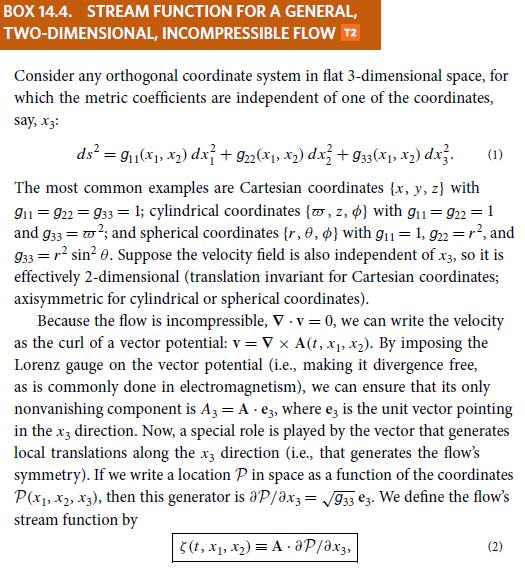
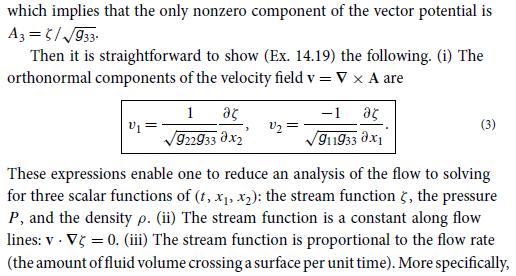
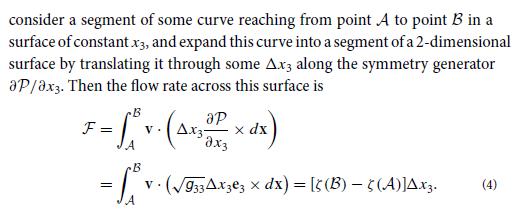
Derive results (i), (ii), and (iii) in the last paragraph of Box 14.4.Box 14.4. BOX 14.4. STREAM FUNCTION FOR A GENERAL, TWO-DIMENSIONAL, INCOMPRESSIBLE FLOW ™Z Consider any orthogonal coordinate system in flat 3-dimensional space, for which the metric coefficients are independent of one of the
Place tea leaves and water in a tea cup, glass, or other larger container. Stir the water until it is rotating uniformly, and then stand back and watch the motion of the water and leaves. Notice that the tea leaves tend to pile up at the cup’s center. An Ekman boundary layer on the bottom of the
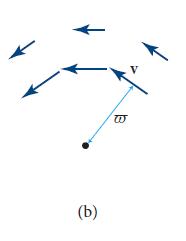
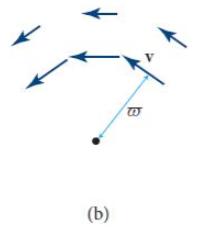
Verify that for the constant-angular-momentum flow of Fig. 14.1b, with v = j × x/ω̅2, two neighboring fluid elements move around each other with angular velocity +j/ω̅2 when separated tangentially and −j/ω̅2 when separated radially.Figure 14.1(b) (b) W
How much more would you weigh in a vacuum?
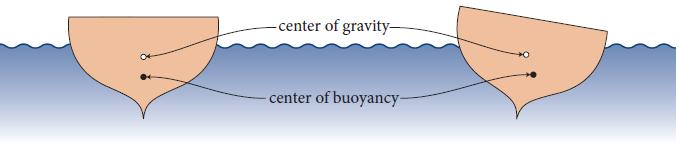
Use Archimedes’ law to explain qualitatively the conditions under which a boat floating in still water will be stable to small rolling motions from side to side. You might want to define and introduce a center of buoyancy and a center of gravity inside the boat, and pay attention to the change in
Consider a stationary, axisymmetric planet, star, or disk differentially rotating under the action of a gravitational field. In other words, the motion is purely in the azimuthal direction.(a) Suppose that the fluid has a barotropic equation of state P = P(ρ). Write down the equations of
For the microcanonical ensemble considered in this section, derive Eq. (5.5) for the pressure using a thought experiment involving a pressure-measuring device. p = - ᎧᏋ ( 5 ) . ᎯᏙ S, N (5.5)
For the fold caustic discussed in the text, assume that the phase change introduced by the imperfect lens is nondispersive, so that the φ(ã, x̃) in Eq. (8.45) satisfies φ ∝ λ−1. Show that the peak magnification of the interference fringes at the caustic scales with wavelength, ∝
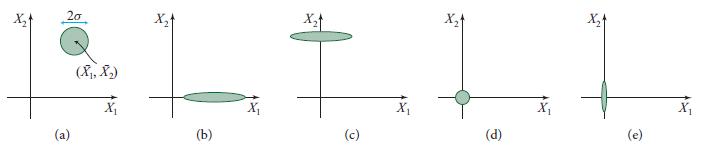
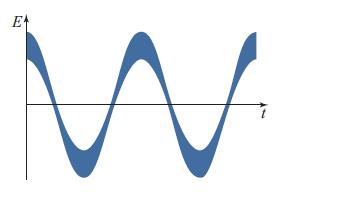
Consider a plane, monochromatic electromagnetic wave with angular frequency ω, whose electric field is expressed in terms of its complex amplitude X1 + iX by Eq. (10.58). Because the field (inevitably) is noisy, its quadrature amplitudes X1 and X2 are random processes with means X̅1, X̅2 and
(a) Derive Eq. (10.68) for the polarization induced in an isotropic medium by a linearly polarized electromagnetic wave.(b) Fill in the remaining details of the derivation of Eq. (10.69) for the optical Kerr effect. Px = €0X0Ex + 6€0X1111E² Ex- (10.68)
In some inertial reference frame, the vector A(vector) and second-rank tensor T have as their only nonzero components A0 = 1, A1 = 2; T00 = 3, T01 = T10 = 2, T11 = −1. Evaluate T (A(vector), A(vector)) and the components of T (A(vector) , ___) and A(vector) ⊗ T.
At low temperatures certain fluids undergo a phase transition to a superfluid state. A good example is 4He, for which the transition temperature is 2.2 K. As a superfluid has no viscosity, it cannot develop vorticity. How then can it rotate? The answer (e.g., Feynman 1972) is that not all the fluid
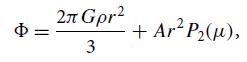
(a) Show that the spatially variable part of the gravitational potential for a uniform density, nonrotating planet can be written as Φ = 2πGρr2/3, where ρ is the density.(b) Hence argue that the gravitational potential for a slowly spinning planet can be written in the formwhere A is a
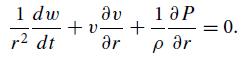
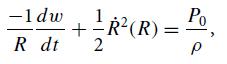
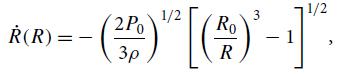
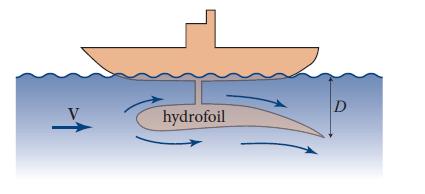
Suppose that a spherical bubble has just been created in the water above the hydrofoil in the previous exercise. Here we analyze its collapse—the decrease of the bubble’s radius R(t) from its value Ro at creation, using the incompressible approximation (which is rather good in this situation).
Consider the pulsatile flow of blood through one of the body’s larger arteries. The pressure gradient dP/dz = P'(t) consists of a steady term plus a term that is periodic, with the period of the heart’s beat.(a) Assuming laminar flow with v pointing in the z direction and being a function of
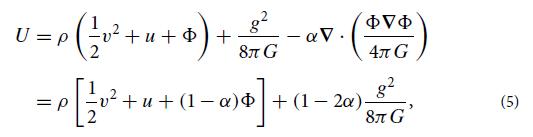
Integrate the energy density U of Eq. (5) of Box 13.4 over the interior and surroundings of an isolated gravitating system to obtain the system’s total energy. Show that the gravitational contribution to this total energy (i) Is independent of the arbitrariness (parameter α) in the energy’s
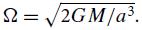
Consider two stars with the same mass M orbiting each other in a circular orbit with diameter (separation between the stars’ centers) a. Kepler’s laws tell us that the stars’ orbital angular velocity isAssume that each star’s mass is concentrated near its center, so that everywhere except
(a) Consider steady flow of an ideal fluid. The Bernoulli function (13.51) is conserved along streamlines. Show that the variation of B across streamlines is given by Crocco’s theorem:(b) As an example, consider the air in a tornado. In the tornado’s core, the velocity vanishes; it also
(a) Derive the Lagrangian equation (13.75) for the rate of increase of entropy in a dissipative fluid by carrying out the steps in the sentence preceding that equation.(b) From the Lagrangian equation of entropy increase (13.75) derive the corresponding Eulerian equation (13.76). T ds [P(d/²)
A hydrofoil moves with speed V at a depth D = 3m below the surface of a lake; see Fig. 13.7. Estimate how fast V must be to make the water next to the hydrofoil boil. This boiling, which is called cavitation, results from the pressure P trying to go negative.Fig. 13.7. X hydrofoil D
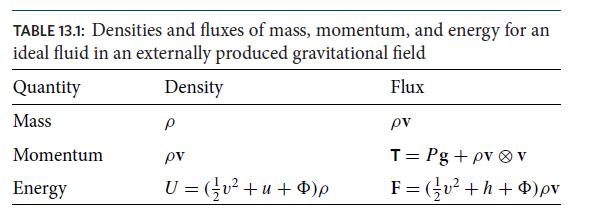
(a) Show that in the nonrelativistic limit, the components of the perfect-fluid stress energy tensor (13.85) take on the forms (13.91), and verify that these agree with the densities and fluxes of energy and momentum that are used in nonrelativistic fluid mechanics (Table 13.1).(b) Show that the
A viscous fluid flows steadily (no time dependence) in the z direction, with the flow confined between two plates that are parallel to the x-z plane and are separated by a distance 2a. Show that the flow’s velocity field isand the mass flow rate (the discharge) per unit width of the plates isHere
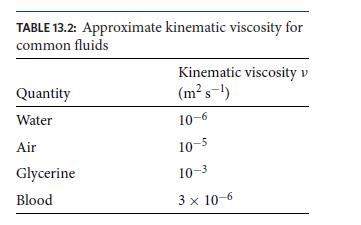
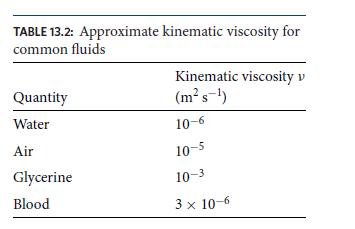
Estimate the collision mean free path of the air molecules around you. Hence verify the estimate for the kinematic viscosity of air given in Table 13.2. TABLE 13.2: Approximate kinematic viscosity for common fluids Quantity Water Air Glycerine Blood Kinematic viscosity v (m² s-¹) 10-6 10-5 10-3 3
By manipulating the differential forms of the law of rest-mass conservation and the law of energy conservation, derive the constancy of B = (ρ + P)γ/ρo along steady flow lines, Eq. (13.88). dB dt =yoj aB = = 0, axi where B = (p+P)r Po (13.88)
By taking the curl of the Euler equation (13.44), derive the vorticity evolution equation (14.9) for a compressible, barotropic, inviscid flow. dv dt = Əv at + (v. V)v: VP P +g for an ideal fluid. (13.44)
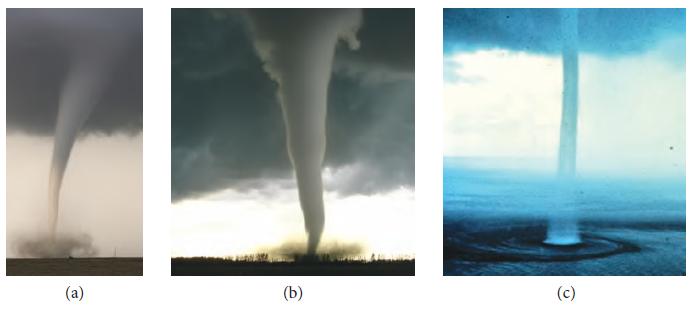
(a) Figure 14.5 shows photographs of two particularly destructive tornados and one waterspout (a tornado sucking water from the ocean). For the tornados the wind speeds near the ground are particularly high: about 450 km/hr. Estimate the wind speeds at the top, where the tornados merge with the
Consider a velocity field with non vanishing curl. Define a locally orthonormal basis at a point in the velocity field, so that one basis vector, ex, is parallel to the vorticity. Now imagine the remaining two basis vectors as being frozen into the fluid. Show that they will both rotate about the
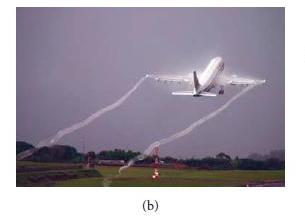
Explain why the pressure and temperature of the core of a wingtip vortex are significantly lower than the pressure and temperature of the ambient air. Under what circumstances will this lead to condensation of tiny water droplets in the vortex core, off which light can scatter, as in Fig.
At time t = 0, a 2-dimensional barotropic flowhas a velocity field, in circular polar coordinates, v = (j/ω̅)e∅ (Fig. 14.1b); correspondingly, its vorticity is ω = 2πjδ(x)δ(y)ez: it is a delta-function vortex. In this exercise you will solve for the full details of the subsequent evolution
Give an expression for the change in the thrust—the momentum crossing a surface perpendicular to the tube per unit time—along a slender stream tube when the discharge and power are conserved. Explain why the momentum has to change.
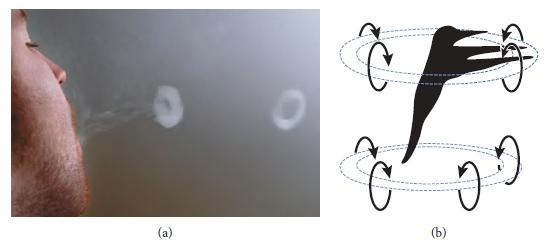
Smoke rings (ring-shaped vortices) blown by a person (Fig. 14.8a) propagate away from him. Similarly, a hovering hummingbird produces ring-shaped vortices that propagate downward (Fig. 14.8b). Sketch the velocity field of such a vortex and explain how it propels itself through the ambient air. For
Rooms are sometimes heated by radiators (hot surfaces) that have no associated blowers or fans. Suppose that, in a room whose air is perfectly still, a radiator is turned on to high temperature. The air will begin to circulate (convect), and that air motion contains vorticity. Explain how the
Sketch the streamlines for the following stationary 2-dimensional flows, determine whether the flow is compressible, and evaluate its vorticity. The coordinates are Cartesian in parts (a) and (b), and are circular polar with orthonormal bases {eω̅ , e∅} in (c) and (d).(a) vx = 2xy, vy =
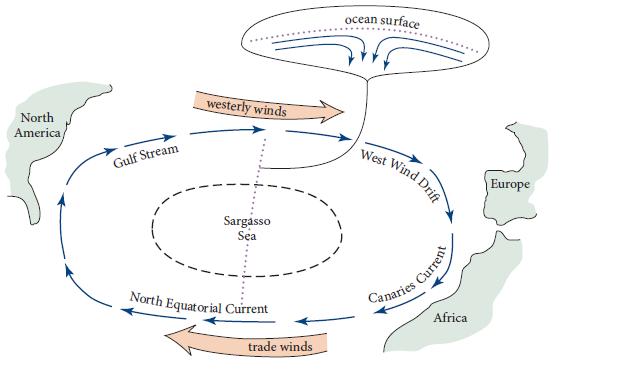
The north Atlantic Ocean exhibits the pattern of winds and ocean currents shown in Fig. 14.18. Westerly winds blow from west to east at 40° latitude. Trade winds blow from east to west at 20° latitude. In between, around 30° latitude, is the Sargasso Sea: a 1.5-m-high gyre (raised hump of
Insert gravity into the analysis of the Kelvin-Helmholtz instability (with the uniform gravitational acceleration g pointing perpendicularly to the fluid interface, from the upper “+” fluid to the lower “−” fluid). Thereby derive the dispersion relation (14.86). の一k P+V P_P+ - + [*
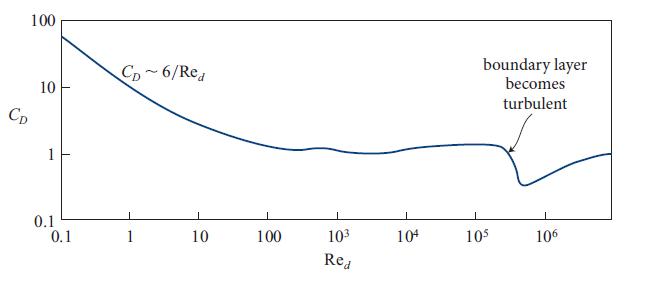
Consider stationary incompressible flow around a cylinder of radius a with sufficiently large Reynolds number that viscosity may be ignored except in a thin boundary layer, which is assumed to extend all the way around the cylinder. The velocity is assumed to have the uniform value V at large
Fill a bathtub with water and sprinkle baby powder liberally over the water’s surface to aid in viewing the motion of the surface water. Then take a spatula, insert it gently into the water, move it slowly and briefly perpendicular to its flat face, then extract it gently from the water. Twin
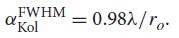
(a) Fill in the details of the dimensional-analysis derivation of the Kolmogorov spectrum (15.27) for a quantity such as n that is transported by the fluid and thus satisfies dn/dt = 0. In particular, convince yourself (or refute!) that the only quantities Sn can depend on are k, q, and qn,
Consider low-Reynolds-number flow past an infinite cylinder whose axis coincides with the z-axis. Try to repeat the analysis we used for a sphere to obtain an order-of magnitude estimate for the drag force per unit length.You will encounter difficulty in finding a solution for v that satisfies the
Episodic glaciation subjects Earth’s crust to loading and unloading by ice. The last major ice age was 10,000 years ago, and the subsequent unloading produces a nontidal contribution to the acceleration of Earth’s rotation rate of order |Ω|/|Ω̇| ≈ 6 × 10¹¹ yr, detectable from observing
Estimate the Reynolds numbers for the following flows. Make sketches of the flow fields, pointing out any salient features.(a) A hang glider in flight.(b) Plankton in the ocean.(c) A physicist waving her hands.
An auto manufacturer wishes to reduce the drag force on a new model by changing its design. She does this by building a one-sixth scale model and putting it into a wind tunnel. How fast must the air travel in the wind tunnel to simulate the flow at 40mph on the road?
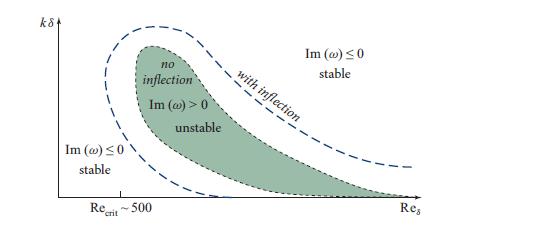
Consider an inviscid (ν = 0), incompressible flow near a plane wall where a laminar boundary layer is established. Introduce coordinates x parallel to the wall and y perpendicular to it. Let the components of the equilibrium velocity be vx(y).(a) Show that a weak propagating-wave perturbation in
A well-hit golf ball travels about 300 yards. A fast bowler or fastball pitcher throws a cricket ball or baseball at more than 90mph (miles per hour). A table-tennis player can hit a forehand return at about 30mph. The masses and diameters of each of these four types of balls are mg ∼ 46 g, dg
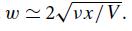
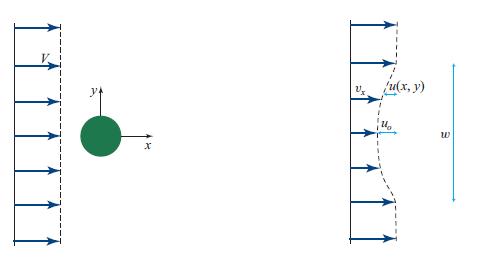
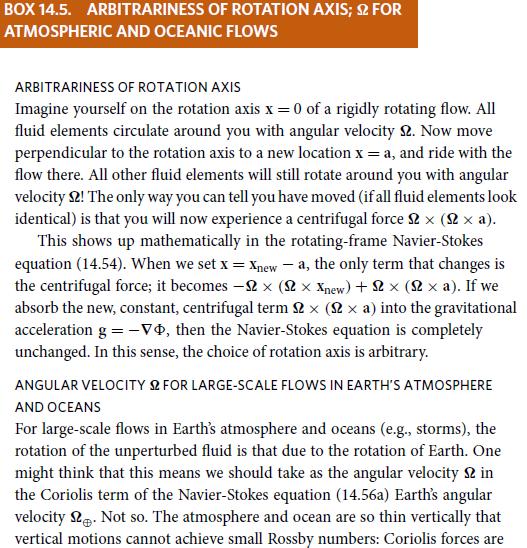
Compute the width w(x) and velocity deficit uo(x) for the 3-dimensional turbulent wake behind a sphere.
Consider the logistic equation (15.35) for the special case a = 1, which is large enough to ensure that chaos has set in.(a) Make the substitution xn = sin2πθn, and show that the logistic equation can be expressed in the form θn+1= 2θn (mod 1); that is, θn+1 equals the fractional part of
Use a computer to calculate the first five critical parameters aj for the sequence of numbers generated by the logistic equation (15.35). Hence verify that the ratio of successive differences tends toward the Feigenbaum number F quoted in Eq. (15.36). Xn+1=4axn(1-xn). (15.35)
Showing 200 - 300
of 512
1
2
3
4
5
6
Step by Step Answers

 Get 50% OFF
Claim Now
Get 50% OFF
Claim Now