New Semester
Started
Get
50% OFF
Study Help!
--h --m --s
Claim Now
Question Answers
Textbooks
Find textbooks, questions and answers
Oops, something went wrong!
Change your search query and then try again
S
Books
FREE
Study Help
Expert Questions
Accounting
General Management
Mathematics
Finance
Organizational Behaviour
Law
Physics
Operating System
Management Leadership
Sociology
Programming
Marketing
Database
Computer Network
Economics
Textbooks Solutions
Accounting
Managerial Accounting
Management Leadership
Cost Accounting
Statistics
Business Law
Corporate Finance
Finance
Economics
Auditing
Tutors
Online Tutors
Find a Tutor
Hire a Tutor
Become a Tutor
AI Tutor
AI Study Planner
NEW
Sell Books
Search
Search
Sign In
Register
study help
physics
modern classical physics
Modern Classical Physics Optics Fluids Plasmas Elasticity Relativity And Statistical Physics 1st Edition Kip S. Thorne, Roger D. Blandford - Solutions
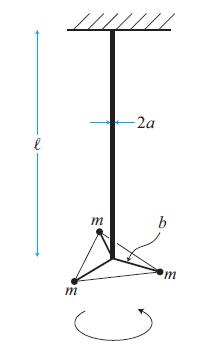
In any high-precision Foucault pendulum, it is important that the pendular restoring force be isotropic, since anisotropy will make the swinging period different in different planes and thereby cause precession of the plane of swing.(a) Consider a pendulum of mass m and length ℓ suspended (as
From Eq. (11.18) derive expression (11.30) for the elastostatic force density inside an elastic body. T = -K0g - 2μΣ. (11.18)
(a) Verify Eqs. (11.46) for the sag in a horizontal beam clamped at one end and allowed to hang freely at the other end.(b) Now consider a similar beam with constant cross section and loaded with weights, so that the total weight per unit length is W(x). What is the sag of the free end, expressed
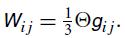
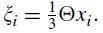
(a) Consider a W = ∇ξ that is pure expansion: Using Eq. (11.3) show that, in the vicinity of a chosen point, the displacement vector is Draw this displacement vector field.(b) Similarly, draw ξ(x) for a W that is pure rotation.(c) Draw ξ(x) for a W that is pure shear. To simplify the
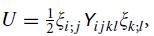
For an anisotropic, elastic medium with elastic energy densityintegrate this energy density over a 3-dimensional region V (not necessarily small) to get the total elastic energy E. Now consider a small variation δξi in the displacement field. Evaluate the resulting change δE in the elastic
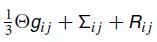
Using Eqs. (1), (2), and (3) of Box 11.2, show thatis equal to Wij.Data from Eqs. (1), (2), and (3) of Box 11.2. ©g;; + Σ;; + Rij gij
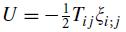
Beginning with[text following Eq. (11.23)], derive Eq. (11.24) for the elastic energy density inside a body. U =-{{Tij Ši;j
Explain why all animals, from fleas to humans to elephants, can jump to roughly the same height. The field of science that deals with topics like this is called allometry (Ex. 11.18).Data from Exercises 11.18Allometry is the study of biological scaling laws that relate various features of an animal
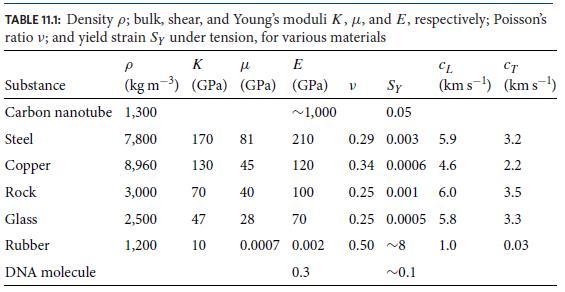
(a) What is the maximum size of a nonspherical asteroid?(b) What length of steel wire can hang vertically without breaking? What length of carbon nanotube? What are the prospects for creating a tether that hangs to Earth’s surface from a geostationary satellite?(c) Can a helium balloon lift the
Suppose a light beam is split in two by a beam splitter. One beam is reflected off an ordinary mirror and the other off a phase-conjugating mirror. The beams are then recombined at the beam splitter. Suppose that the powers returning to the beam splitter are nearly the same; they differ by a
Describe the creation and annihilation of photons that underlies a phase conjugating mirror’s four-wave mixing. Specifically, how many photons of each wave are created or annihilated?
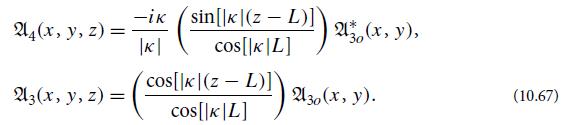
Suppose the thickness of the nonlinear medium of the text’s four-wave mixing analysis is L = π/(2κ), so the denominators in Eqs. (10.67) are zero. Explain the physical nature of the resulting evolution of waves 3 and 4. A4 (x, y, z) = Az(x, y, z) = -ik (sin[|k|(z - L)] COS[|K|L] |K| - cos[lk (z
Use the method of moments (Sec. 11.5) to derive the 2-dimensional shape equation (11.63a) for the stress-induced deformation of a thin plate, and expression (11.63b) for the 2-dimensional flexural rigidity. Here is a step-by-step guide, in case you want or need it.(a) Show on geometrical grounds
Show how to construct a paraboloidal mirror of radius R and focal length f by stress polishing.(a) Adopt a strategy of polishing the stressed mirror into a segment of a sphere with radius of curvature equal to that of the desired paraboloid at its center, r = 0. By comparing the shape of the
Consider a slender wire of rectangular cross section with horizontal thickness h and vertical thickness w that is resting on a horizontal surface, so gravity is unimportant. Let the wire be bent in the horizontal plane as a result of equal and opposite forces F that act at its ends; Fig. 11.10. The
Derive Eq. (11.55) relating the angle θo = (dη/dx)x = 0 = kηo = πηo/ℓ to the applied force F when the card has an n = 1, arched shape.(a) Derive the first integral of the elastica equationwhere θo is an integration constant. Show that the boundary condition of no bending torque (no
Explore numerically the free energy (11.57) of a bent beam with a compressive force F and lateral force Flat. Examine how the extrema (equilibrium states) evolve as F and Flat change, and deduce the physical consequences. 2 πηρ 72(F Fcrit) 1-1()-(F) (0) - () (0) 2 Ferit == 4 (11.57)
Allometry is the study of biological scaling laws that relate various features of an animal to its size or mass. One example concerns the ratio of the width to the length of leg bones. Explain why the width to the length of a thigh bone in a quadruped might scale as the square root of the stress
A DNA molecule consists of two long strands wound around each other as a helix, forming a cylinder with radius a ≈ 1nm. In this exercise, we explore three ways of measuring the molecule’s Young’s modulus E. For background and further details, see Marko and Cocco (2003) and Nelson (2008, Chap.
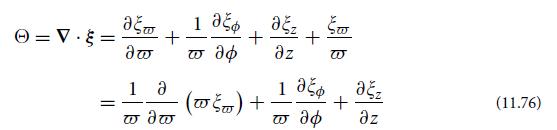
Derive Eqs. (11.76) and (11.77) for the divergence of the vector field ξ in cylindrical and spherical coordinates using the connection coefficients (11.70) and (11.71).In Equations Γεφφ σ > Τα φαφ = ω (11.70)
(a) By drawing pictures analogous to Fig. 11.15, show that(b) From these relations and antisymmetry on the first two indices [Eq. (11.69)], deduce the connection coefficients (11.71).Equation 11.69 and 11.71.Figure 11.15 1 1 Voe₁ = ²ea₁ Voe₁ = -²eu. Veer -eg, r r Voe = cot
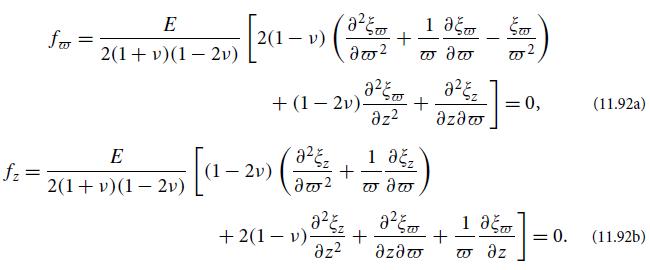
Derive Eqs. (11.92) for the cylindrical components of the internal elastostatic force per unit volumein a cylindrically symmetric situation.Eqs. (11.92) f = (K+u)V(V. §) + μV ²
A torsion pendulum is a very useful tool for testing the equivalence principle (Sec. 25.2), for seeking evidence for hypothetical fifth (not to mention sixth!) forces, and for searching for deviations from gravity’s inverse-square law on submillimeter scales, which could arise from gravity being
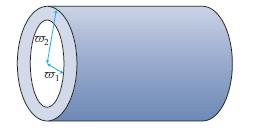
Fill in the details of the text’s analysis of the deformation of a pipe carrying a high pressure fluid, and the wall thickness required to protect the pipe against fracture. (See Fig. 11.16.)Fig. 11.16 1002 छ.
By a computation analogous to Eq. (11.72), derive Eq. (11.78) for the components of the gradient of a second-rank tensor in any orthonormal basis. Vk (Šjej) = (Vkšj)ej + šj (Vkej) = j,kej + Šjljke. (11.72)
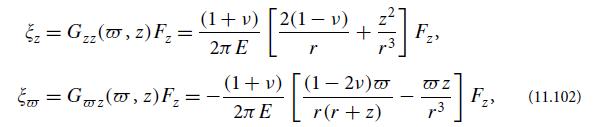
Suppose that a stress Tzjapplied (xo) is applied on the face z = 0 of a half-infinite elastic body (one that fills the region z >0). Then by virtue of the linearity of the elastostatics equation f = (K + 1/3μ)∇(∇ · ξ) + μ∇2ξ = 0 and the linearity of its boundary conditions,
Modify the wave equation (12.4b) to include the effect of gravity. Assume that the medium is homogeneous and the gravitational field is constant. By comparing the orders of magnitude of the terms in the wave equation, verify that the gravitational terms can be ignored for high-enough frequency
Just as in electromagnetic theory, it is sometimes useful to write the displacement ξ in terms of scalar and vector potentials:(The vector potential A is, as usual, only defined up to a gauge transformation, A → A + ∇φ, where φ is an arbitrary scalar field.) By inserting Eq. (12.13) into the
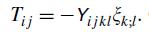
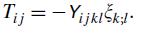
Derive the energy-density, energy-flux, and lagrangian properties of elastodynamic waves given in Sec. 12.2.5. Specifically, do the following.(a) For ease of calculation (and for greater generality), consider an elastodynamic wave in a possibly anisotropic medium, for whichwith Yij kl the tensorial
Verify Eqs. (12.35) and (12.37). Sketch the dispersion-induced evolution of a Gaussian wave packet as it propagates along a stretched beam. w² = C²k² =C²² (1+^). (12.35)
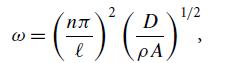
Consider a beam of length ℓ, whose weight is negligible in the elasticity equations, supported freely at both ends (so the slope of the beam is unconstrained at the ends). Show that the frequencies of standing flexural waves satisfywhere A is the cross sectional area, and n is an integer. Now
Show that the sound speeds for the following types of elastic waves in an isotropic material are in the ratiosThe elastic waves are (i) Longitudinal waves along a rod, (ii) Longitudinal waves along a sheet, (iii) Longitudinal waves along a rod embedded in an incompressible fluid.(iv) Shear waves
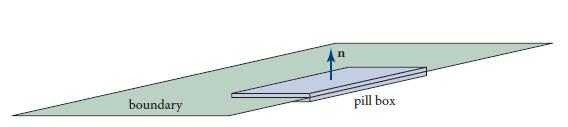
Derive the junction condition [Tjz] = 0 at a horizontal discontinuity between two media by the same method as one uses in electrodynamics to show that the normal component of the magnetic field must be continuous: Integrate the equation of motion ρdv/dt = −∇ · T over the volume of an
Using the boundary conditions (12.44), show that at a surface of discontinuity inside Earth, SV and P waves mix, but SH waves do not mix with the other waves. [j] = [Tj₂] = 0, (12.44)
The magnitude M of an earthquake, on modern variants of the Richter scale, is a quantitative measure of the strength of the seismic waves it creates. The earthquake’s seismic-wave energy release can be estimated using a rough semi-empirical formula due to Bath (1966):The largest earthquakes have
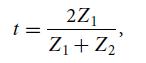
Consider a longitudinal elastic wave incident normally on the boundary between two media, labeled 1 and 2. By matching the displacement and the normal component of stress at the boundary, show that the ratio of the transmitted wave amplitude to the incident amplitude is given bywhere Z1, 2 = [ρ1,
Buckling plays a role in many natural and human-caused phenomena. Explore the following examples.(a) Mountain building. When two continental plates are in (very slow) collision, the compressional force near their interface drives their crustal rock to buckle upward, producing mountains. Estimate
The 4-acceleration of a particle or other object is defined by a(vector) ≡ du(vector)/dτ, where u(vector) is its 4-velocity and τ is proper time along its world line. Show that, if an observer carries an accelerometer, the magnitude |a| of the 3-dimensional acceleration a measured by the
A galaxy such as our Milky Way contains ∼1012 stars—easily enough to permit a kinetic-theory description of their distribution; each star contains so many atoms (∼1056) that the masses of the stars can be regarded as continuously distributed, not discrete. Almost everywhere in a galaxy, the
Consider a collection of identical test particles with rest mass m ≠ 0 that diffuse through a collection of thermalized scattering centers. (The test particles might be molecules of one species, and the scattering centers might be molecules of a much more numerous species.) The scattering centers
The universe is filled with cosmic microwave radiation left over from the big bang. At each event in spacetime the microwave radiation has a mean rest frame. As seen in that mean rest frame the radiation’s distribution function η is almost precisely isotropic and thermal with zero chemical
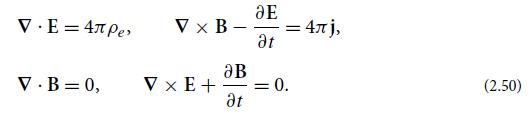
By performing a 3 + 1 split on the geometric version of Maxwell’s equations (2.48), derive the elementary, frame-dependent versionData from Equation 2.48 V.E=4л ре V.B = 0, V x B - VxE+ aB Ət 2E Ət = = 0. Алј, (2.50)
Consider a fluid with 4-velocity u(vector) and rest-mass density ρo as measured in the fluid’s rest frame.(a) From the physical meanings of u(vector), ρo, and the rest-mass-flux 4-vector S(vector)rm, deduce Eqs. (2.62).(b) Examine the components of S(vector)rm in a reference frame where the
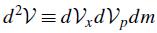
Use the 2-dimensional spacetime diagrams of Fig. 3.4 to show that are frame independent [Eqs. (3.7a) and (3.7b)].Fig 3.4 EdVx and dVp/E
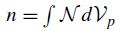
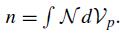
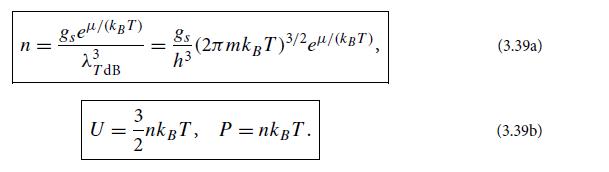
Consider a collection of thermalized, classical particles with nonzero rest mass, so they have the Boltzmann distribution. Assume that the temperature is low enough (kBT ≪ mc2) that they are nonrelativistic.(a) Explain why the total number density of particles n in physical space (as measured in
Consider a nonrelativistic fluid that, in the neighborhood of the origin, has fluid velocitywith σij symmetric and trace-free. As we shall see in Sec. 13.7.1, this represents a purely shearing flow, with no rotation or volume changes of fluid elements; σij is called the fluid’s rate of shear.
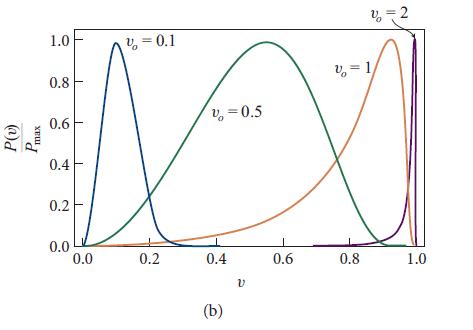
Show that for thermalized, classical relativistic particles the probability distribution for the speed isWhere K2 is the modified Bessel function of the second kind and order 2. This is sometimes called the Maxwell-Jutner distribution, and it is plotted in Fig. 3.6b for a sequence of four
(a) Cygnus X-1 is a source of X-rays that has been studied extensively by astronomers. The observations (X-ray, optical, and radio) show that it is a distance r ∼ 6,000 light-years from Earth. It consists of a very hot disk of X-ray-emitting gas that surrounds a black hole with mass ,and the hole
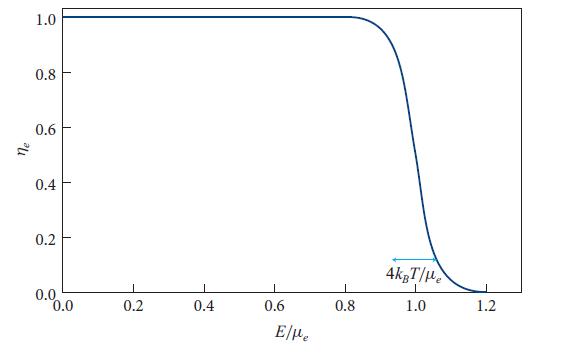
Consider a nonrelativistically degenerate electron gas at finite but small temperature.(a) Show that the inequalities kBT ≪ μe ≪ me are equivalent to the words “nonrelativistically degenerate.”(b) Show that the electron mean occupation number ηe(E) has the form depicted in Fig. 3.8: It is
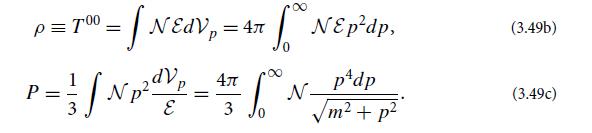
(a) Consider a collection of photons with a distribution function N that, in the mean rest frame of the photons, is isotropic. Show, using Eqs. (3.49b) and (3.49c), that this photon gas obeys the equation of state P = 1/3ρ.(b) Suppose the photons are thermalized with zero chemical potential (i.e.,
A simplified version of a commercial nuclear reactor involves fissile material such as enriched uranium12 and a moderator such as graphite, both of which will be assumed in this exercise. Slow (thermalized) neutrons, with kinetic energies ∼0.1 eV, are captured by the 235U nuclei and cause them to
(a) Show that the following is a solution to the diffusion equation (3.71) for particles in a homogeneous infinite medium:so N is the total number of particles. Note that this is a Gaussian distribution with width σ = √4Dt. Plot this solution for several values of σ. In the limit as t → 0,
Consider a mode S of a fermionic or bosonic field. Suppose that an ensemble of identical such modes is in statistical equilibrium with a heat and particle bath and thus is grand canonically distributed.(a) Show that if S is fermionic, then the ensemble’s entropy iswhere η is the mode’s
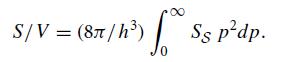
Consider a collection of identical, classical (i.e., with η ≪ 1) particles with a distribution function N that is thermalized at a temperature T such that kBT ≪ mc2 (nonrelativistic temperature).(a) Show that the distribution function, expressed in terms of the particles’ momenta or
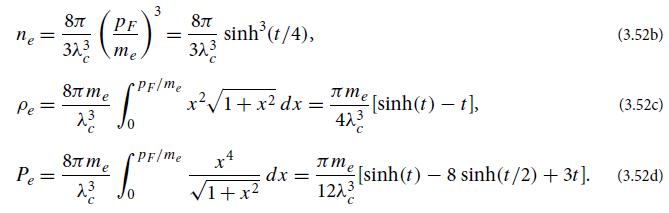
Derive the equations of state (3.52) for an electron-degenerate hydrogen gas. EF = μ = m₂ cosh(t/4), PF= |C –mẻ=mesinh(t/4). (3.52a)
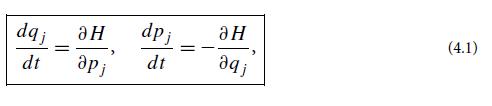
Canonical transformations are treated in advanced textbooks on mechanics, such as Goldstein, Poole, and Safko or, more concisely, Landau and Lifshitz (1976). This exercise gives a brief introduction. For simplicity we assume the hamiltionian is time independent.Let (qj , pk) be one set of
Derive Eq. (3.43) for the electron pressure in a nonrelativistic, electron-degenerate hydrogen gas. 5/3 2/3 3 m₂c² P. = 2/10 (²) ²0 m² (™. P Pe 23 mp/23) (3.43)
Use the law of energy conservation to show that, when heat diffuses through a homogeneous medium whose pressure is being kept fixed, the evolution of the temperature perturbation δT ≡ T − (average temperature) is governed by the diffusion equationis called the thermal diffusivity. Here cP is
Consider fully thermalized electromagnetic radiation at temperature T , for which the mean occupation number has the standard Planck (blackbody) form η = 1/(ex − 1) with x = hν/(kBT).(a) Show that the entropy per mode of this radiation is(b) Show that the radiation’s entropy per unit volume
Consider a collection of freely moving, noncolliding particles that satisfy the collisionless Boltzmann equation (a) Show that this equation guarantees that the Newtonian particle conservation law ∂n/∂t + ∇ · S = 0 and momentum conservation law ∂G/∂t + ∇ · T = 0 are satisfied, where
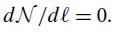
Consider a universe (not ours!) in which spacetime is flat and infinite in size and is populated throughout by stars that cluster into galaxies like our own and our neighbors, with interstellar and intergalactic distances similar to those in our neighborhood. Assume that the galaxies are not moving
Make rough estimates of the entropy of the following systems, assuming they are in statistical equilibrium.(a) An electron in a hydrogen atom at room temperature.(b) A glass of wine.(c) The Pacific ocean.(d) An ice cube.(e) The observable universe.
Consider an ensemble of classical systems with each system made up of a large number of statistically independent subsystems, so ρ = ∏a ρa. Show that the entropy of the full ensemble is equal to the sum of the entropies of the sub ensembles a: S = ∑a Sa.
Following the epoch of primordial element formation (Ex. 4.10), the universe continued to expand and cool. Eventually when the temperature of the photons was ∼3,000 K, the free electrons and protons combined to form atomic hydrogen; this was the epoch of recombination. Later, when the photon
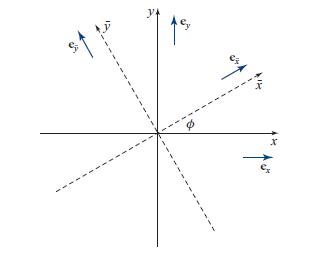
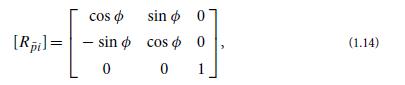
Consider two Cartesian coordinate systems rotated with respect to each other in the x-y plane as shown in Fig. 1.4.Fig. 1.4.(a) Show that the rotation matrix that takes the barred basis vectors to the unbarred basis vectors isand show that the inverse of this rotation matrix is, indeed, its
Derive, or at least give a plausibility argument for, Landauer’s theorem.
Consider a microcanonical ensemble of closed cubical cells with volume V . Let each cell contain precisely N particles of a classical, nonrelativistic, perfect gas and contain a nonrelativistic total energy For the moment (by contrast with the text’s discussion of the microcanonical ensemble),
Consider a classical, nonrelativistic gas whose particles do not interact and have no excited internal degrees of freedom (a perfect gas—not to be confused with perfect fluid). Let the gas be contained in a volume V and be thermalized at temperature T and chemical potential μ. Using the gas’s
(a) Consider two identical chambers, each with volume V, separated by an impermeable membrane. Into one chamber put energy E and N atoms of helium, and into the other, energy E and N atoms of xenon, with E/N and N/V small enough that the gases are nonrelativistic and nondegenerate. The membrane is
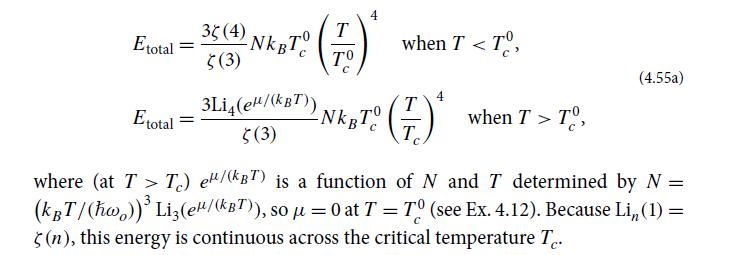
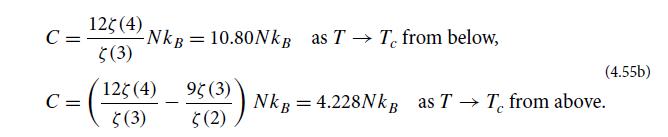
Analyze the behavior of the atoms’ total energy near the onset of condensation, in the limit of arbitrarily large N (i.e., keeping only the leading order in our 1/N1/3 expansion and approximating the condensation as turning on discontinuously at T = Tc0). More specifically, do the following.(a)
Show that in the Bose-Einstein condensate discussed in the text, the momentum distribution for the ground-state-mode atoms is Gaussian with rms momentumand that for the classical cloud it is Gaussian with rms momentum Pcondensate = √3/2h/oo = √3hmwo/2
Analyze Bose-Einstein condensation in a cubical box with edge lengths L [i.e., for a potential V (x, y, z) that is zero inside the box and infinite outside it]. In particular, using the analog of the text’s simplest approximation, show that the critical temperature at which condensation begins
Derive Eq. (4.70) for the average number of bits per symbol in a long message constructed from N distinct symbols, where the frequency of occurrence of symbol n is pn. N 1 = LΣ-Pn log₂ Pn³ n=1 (4.70)
Consider messages of length L >> 2 constructed from just two symbols (N = 2),which occur with frequencies p and (1− p). Plot the average information per symbol I̅ (p) in such messages, as a function of p. Explain why your plot has a maximum I̅ = 1 when p = 1/2, and has I̅ = 0 when p = 0
Two dice are thrown randomly, and the sum of the dots showing on the upper faces is computed. This sum (an integer n in the range 2 ≤ n ≤ 12) constitutes a symbol, and the sequence of results of L >> 12 throws is a message. Show that the amount of information per symbol in this message is
Energy-Momentum Conservation for a Perfect Fluid(a) Derive the frame-independent expression (2.74b) for the perfect fluid stress energy tensor from its rest-frame components (2.74a).(b) Explain why the projection of ∇(vector) · T = 0 along the fluid 4-velocity, u(vector) . (∇(vector) · T ) =
Consider, as in Ex. 2.9, an observer with 4-velocity U(vector) who measures the properties of a particle with 4-momentum p(vector).(a) Show that the Euclidean metric of the observer’s 3-space, when thought of as a tensor in 4-dimensional spacetime, has the formShow, further, that if A(vector) is
An observer with 4-velocity U(vector) measures the properties of a particle with 4-momentum p(vector). The energy she measures is E = −p(vector) · U(vector) [Eq. (2.29)].(a) Show that the particle’s rest mass can be expressed in terms of p(vector) as(b) Show that the momentum the observer
Suppose that some medium has a rest frame(unprimed frame) in which its energy flux and momentum density vanish, T0j = Tj0 = 0. Suppose that the medium moves in the x direction with speed very small compared to light, v ≪ 1, as seen in a (primed) laboratory frame, and ignore factors of order
(a) Express the electromagnetic field tensor as an anti-symmetrized gradient of a 4-vector potential: in slot-naming index notationShow that, whatever may be the 4-vector potential A(vector, the second of Maxwell’s equations (2.48) is automatically satisfied. Show further that the electromagnetic
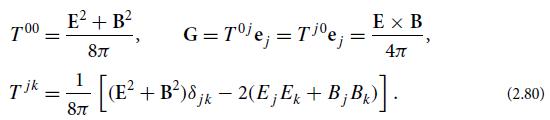
(a) From Eqs. (2.75) and (2.45) compute the components of the electromagnetic stress-energy tensor in an inertial reference frame (in Gaussian units). Your answer should be the expressions given in electrodynamics textbooks:(b) Show that the divergence of the stress-energy tensor (2.75) is given
(a) Show that, if nj is a 3-dimensional unit vector and β and γ are defined as in Eq. (2.37b), then the following is a Lorentz transformation [i.e., it satisfies Eq. (2.35b)]:Show, further, that this transformation is a pure boost along the direction n with speed β, and show that the inverse
(a) Convert the following expressions and equations into geometric, index-free notation(b) Convert T (___, S(R(C(vector), ___), ___), ___) into slot-naming index notation. Aa Bysi AaBys; SBY = SYBA B A B g B = Y α B.
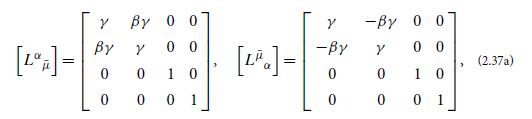
Show that the matrices (2.37a), with β and γ satisfying Eq. (2.37b), are the inverses of each other, and that they obey the condition (2.35b) for a Lorentz transformation. [2] - ν βγ 0 0 βγ ο ο Y Ο Ο 0 Ο 1 0 Ο 1 Y -βγ ο ο -βγ Y Ο Ο την α > 0 0 10 0 001 (2.37a)
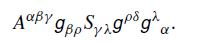
(a) Simplify the following expression so the metric does not appear in it:(b) The quantity gαβgαβ is a scalar since it has no free indices. What is its numerical value?(c) What is wrong with the following expression and equation? Apygpp Syngga
Use spacetime diagrams to prove the following:(a) Two events that are simultaneous in one inertial frame are not necessarily simultaneous in another. More specifically, if frame F̅ moves with velocity v(vector) = βe(vector)x as seen in frame F, where β > 0, then of two events that are
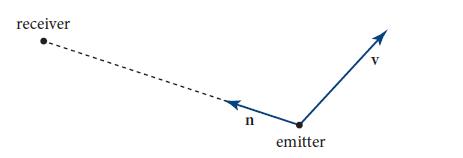
(a) An observer at rest in some inertial frame receives a photon that was emitted in direction n by an atom moving with ordinary velocity v (Fig. 2.6). The photon frequency and energy as measured by the emitting atom are νem and Eem; those measured by the receiving observer are νrec and Erec. By
Derive Eq. (2.47b) by the same method as was used to derive Eq. (2.47a). Then show, by a geometric, frame-independent calculation, that Eq. (2.47b) implies Eq. (2.47a). E = Faß wB, B² = ¹ € Ea³y³ Fyswa αβγδ 2 (2.47a)
Consider the 4-dimensional parallelepiped V whose legs arewhere (t , x, y, z) = (x0, x1, x2, x3) are the coordinates of some inertial frame. The boundary ∂V of this V has eight 3-dimensional “faces.” Identify these faces, and write the integral ∫∂V T0βd∑β as the sum of contributions
In Minkowski spacetime, the set of all events separated from the origin by a time like interval a2 is a 3-surface, the hyperboloid t2 − x2 − y2 − z2 = a2, where {t , x, y, z} are Lorentz coordinates of some inertial reference frame. On this hyperboloid, introduce coordinates {χ, θ , φ}
Show, using spacetime diagrams and also using frame-independent calculations, that the law of conservation of 4-momentum forbids a photon to be absorbed by an electron, e + γ → e, and also forbids an electron and a positron to annihilate and produce a single photon, e+ + e− → γ (in the
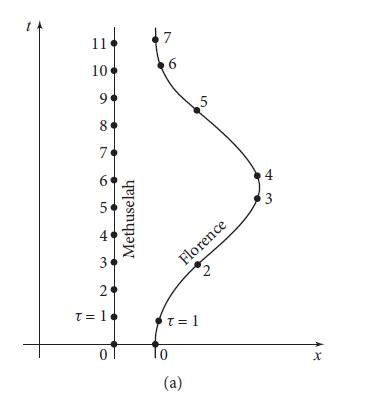
In a long-ago era when an airline named Trans World Airlines (TWA) flew around the world, Josef Hafele and Richard Keating (1972a) carried out a real live twins paradox experiment: They synchronized two atomic clocks and then flew one around the world eastward on TWA, and on a separate trip, around
Consider the global law of charge conservation ∫∂V Jαd∑α = 0 for a special choice of the closed 3-surface ∂V: The bottom of ∂V is the ball {t = 0, x2 + y2 + z2 ≤ a2}, where {t , x, y, z} are the Lorentz coordinates of some inertial frame. The sides are the spherical world tube {0 ≤
In Newtonian theory, the gravitational potential Φ exerts a force F = dp/dt = −m∇Φ on a particle with mass m and momentum p. Before Einstein formulated general relativity, some physicists constructed relativistic theories of gravity in which a Newtonian-like scalar gravitational field Φ
Show that Eq. (2.19) can be true for all time like, unit-length vectors u(vector) if and only if F is antisymmetric. F(u, ū) = 0. (2.19)
Do Ex. 1.15 in Chap. 1.Data from Exercises 1.15 of Chapter 1Convert the following equations from the geometrized units in which they are written to SI units.(a) The “Planck time” tP expressed in terms of Newton’s gravitation constant G and Planck’s reduced constant ℏ, tP =√Gℏ. What is
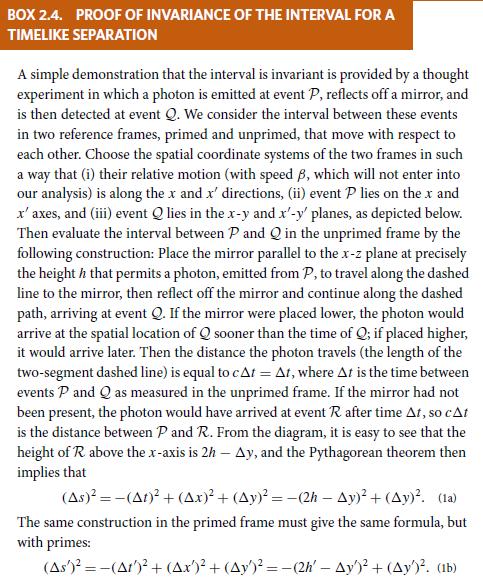
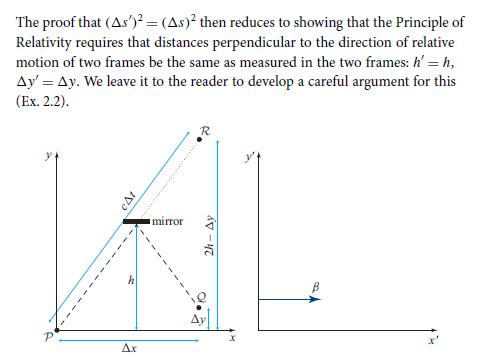
Complete the derivation of the invariance of the interval given in Box 2.4, using the Principle of Relativity in the form that the laws of physics must be the same in theprimed and unprimed frames. (a) Having carried out the construction in the unprimed frame, depicted at the bottom left of Box
Derive the relativistic component manipulation rules (2.23e)–(2.23g). [Contravariant components of T(____)S_₁_)] = Tage (2.23e)
Without introducing any coordinates or basis vectors, show that when a particle with charge q interacts with electric and magnetic fields, its kinetic energy changes at a rate dE/dt =qv. E. (1.8)
Consider a particle moving in a circle with uniform speed v = |v| and uniform magnitude a = |a| of acceleration. Without introducing any coordinates or basis vectors, do the following.(a) At any moment of time, let n = v/ν be the unit vector pointing along the velocity, and let s denote distance
Showing 400 - 500
of 512
1
2
3
4
5
6
Step by Step Answers

 Get 50% OFF
Claim Now
Get 50% OFF
Claim Now