New Semester
Started
Get
50% OFF
Study Help!
--h --m --s
Claim Now
Question Answers
Textbooks
Find textbooks, questions and answers
Oops, something went wrong!
Change your search query and then try again
S
Books
FREE
Study Help
Expert Questions
Accounting
General Management
Mathematics
Finance
Organizational Behaviour
Law
Physics
Operating System
Management Leadership
Sociology
Programming
Marketing
Database
Computer Network
Economics
Textbooks Solutions
Accounting
Managerial Accounting
Management Leadership
Cost Accounting
Statistics
Business Law
Corporate Finance
Finance
Economics
Auditing
Tutors
Online Tutors
Find a Tutor
Hire a Tutor
Become a Tutor
AI Tutor
AI Study Planner
NEW
Sell Books
Search
Search
Sign In
Register
study help
physics
particle physics
Principles And Practice Of Physics 2nd Global Edition Eric Mazur - Solutions
A particle that has mass \(m\) and charge \(q\) enters a uniform magnetic field that has magnitude \(B\) and is directed along the \(x\) axis. The initial velocity of the particle is in the \(x y\) plane. (a) Describe the particle's path as it travels through the magnetic field. (b) If the particle
A horizontal metal strip \(1.0 \mathrm{~mm}\) thick and \(20 \mathrm{~mm}\) wide carries a 20-A current along its length, and both the length and the width are perpendicular to a uniform magnetic field of magnitude \(2.0 \mathrm{~T}\) that is directed vertically up. The potential difference across
The cross section of a copper strip is \(1.0 \mathrm{~mm}\) thick and \(20 \mathrm{~mm}\) wide. There is a 10-A current through this cross section, with the charge carriers traveling down the length of the strip. The strip is placed in a uniform magnetic field that has a magnitude of \(2.0
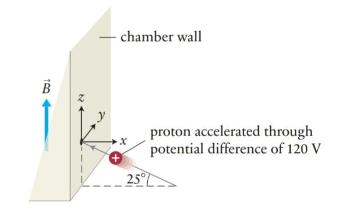
A proton is accelerated through a potential difference of \(120 \mathrm{~V}\), as shown in Figure P27.55, and fired into a chamber. There is no electric field in the chamber, but there is a \(0.15-\mathrm{T}\) magnetic field in the positive \(z\) direction. The proton enters the chamber at a
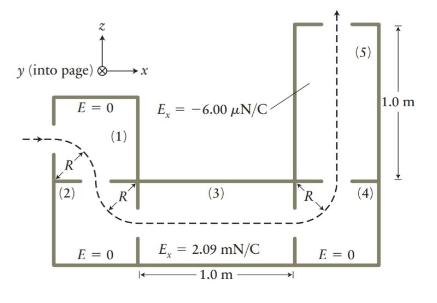
A beam of protons enters the network of five chambers shown in Figure P27.56 with an initial speed of \(300 \mathrm{~m} / \mathrm{s}\) and moves through the network along the path indicated by the dashed black line. In each chamber, the electric field is as specified, and the radius of curvature
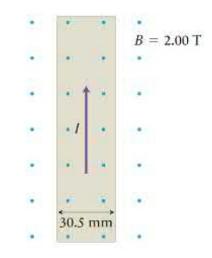
Electrons are made to flow through the copper strip of Figure P27.57. The strip's cross section is \(1.00 \mathrm{~mm}\) high and \(30.5 \mathrm{~mm}\) wide, and the strip is placed in a \(2.00-\mathrm{T}\) magnetic field that is directed out of the page. If the number of mobile electrons per unit
On average, the number density of free electrons in copper is \(8.46 \times 10^{19} \mathrm{~mm}^{-3}\). (a) Calculate what the linear charge density \(\lambda\) for a copper wire \(1.00 \mathrm{~mm}\) in radius would be if this quantity of electrons were missing. (b) Assume this copper wire is
A square loop of wire \(1.00 \mathrm{~m}\) on a side is at rest and has a linear charge density of zero in the Earth reference frame. The loop lies in the \(x y\) plane of an \(x y z\) coordinate system, and there is a clockwise electric current through the loop as seen by a person looking down the
Suppose electrons move through a copper wire at speed \(v\). Call the linear charge densities in the Earth reference frame \(\lambda_{E_{p}}\) for the fixed positive ions in the wire and \(\lambda_{\mathrm{Fn}}\) for the (negative) electrons. Observer E in the Earth reference frame (which is also
A long wire that is at rest in the Farth reference frame initially carries no current. Observer \(\mathrm{E}\) in this reference frame measures linear charge densities of \(\lambda_{\mathrm{En}}=\) \(45.00 \mu \mathrm{C} / \mathrm{m}\) for the (negative) electrons in the wire and
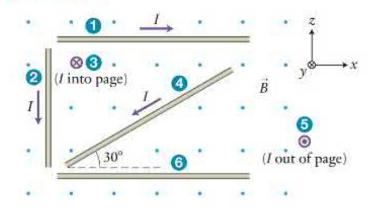
In Figure P27.62, an external magnetic field is directed out of the page, and six wires are placed, one at a time, in this field. Each wire carries a current in the direction indicated; if there is no indicated direction, the current is zero. Determine the direction of the magnetic force exerted by
Three charged particles initially have identical masses, charges, and speeds and are traveling perpendicular to the same magnetic field. Because they are all in the same magnetic field and have identical masses and charges, all particles have the same initial cyclotron frequency and revolve with
At the equator, the direction of Earth's magnetic field is horizontal and to the north, and the magnitude is \(3.5 \times 10^{-5} \mathrm{~T}\). (a) What is the magnetic flux through a circular loop of radius \(0.10 \mathrm{~m}\), lying flat on the ground at the equator? The loop is now balanced on
When a wire \(1.0 \mathrm{~m}\) long carries a \(20-\mathrm{A}\) current in the \(+x\) direction in a uniform external magnetic field, the magnetic force exerted by the field on the wire is given by \(F_{x}^{B}=0, F_{y}^{B}=3.0 \mathrm{~N}, F_{z}^{B}=2.0 \mathrm{~N}\). When the wire is rotated
Blood contains both positive and negative ions. In a certain patient being tested, the speed of these ions in a large artery is measured at \(0.60 \mathrm{~m} / \mathrm{s}\). The patient is placed in a uniform magnetic field of magnitude \(0.20 \mathrm{~T}\). If a potential difference of \(1.0
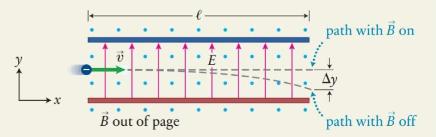
Electrons enter a region of perpendicular electric and magnetic fields (similar to Example 27. 5). The region occupied by the fields is \(40.0 \mathrm{~mm}\) long in the \(x\) direction, where \(x\) is taken to be the original direction of motion. After passing through this region, the electrons
A particle of mass \(m\) and charge \(q\) moves in a circle of radius \(r\) in a uniform magnetic field of magnitude \(B\). Show that \((a)\) the particle's momentum is given by \(B q r\) and \((b)\) its kinetic energy is given by \(B^{2} q^{2} r^{2} / 2 m\).
You are designing magnetic motors. A colleague insists that like magnetic poles attract-north poles attract north poles and south poles attract south poles. You feel the need to remove this idea from his head. You possess three unlabeled bar magnets. How can you use them to convince him?
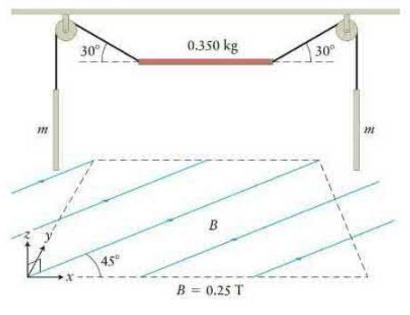
Figure P27.70 shows a \(1.0-\mathrm{m}, 0. 350-\mathrm{kg}\) horizontal metal rod attached to two ropes, each of which makes an angle of \(30^{\circ}\) with the horizontal. Each rope then drapes over a pulley and is attached to a vertical rod of mass \(m\). Assume the pulleys have negligible mass.
A wire bent into a semicircle of radius \(R\) lies in a plane that is perpendicular to a uniform external magnetic field \(\vec{B}\). If the wire carries a current \(I\), what are the magnitude and direction of the magnetic force exerted by the external field on the wire?
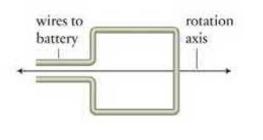
You are working with the square wire loop shown in Figure P27.72. The loop lies in a magnetic field, is connected to a battery, and is attached to an axis that runs through its center and is parallel to the plane of the loop. Initially the loop is held in place, but once it is released, it
Two parallel rods carry currents in opposite directions. Determine the direction of the magnetic force exerted by each rod on the other rod.
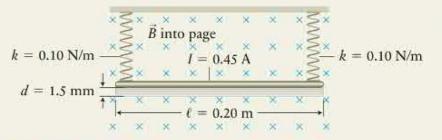
A metal bar \(0.20 \mathrm{~m}\) long is suspended from two springs, each with spring constant \(k=0.10 \mathrm{~N} / \mathrm{m}\), and the bar is in an external magnetic field directed perpendicular to the bar length (Figure 27.33). With a current of \(0.45 \mathrm{~A}\) in the bar, the bar rises
A square loop \(0.20 \mathrm{~m}\) on each side is placed in a uniform magnetic field of magnitude \(0.50 \mathrm{~T}\). The plane of the loop makes a \(30^{\circ}\) angle with the magnetic field. What is the magnetic flux through the loop?
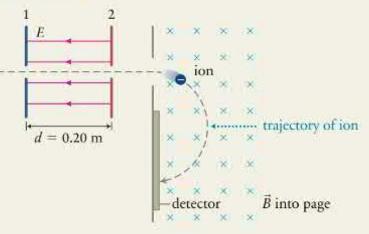
Figure 27.40 shows a schematic of a device, called a mass spectrometer, for determining the mass of ions or other charged particles. The ions that enter the mass spectrometer are first accelerated by an electric field and then deflected by a magnetic field. The mass of the ions is obtained from the
Figure 27.42 shows schematically part of the apparatus used in 1897 by J. J. Thomson to determine the charge-tomass ratio of the electron. A beam of electrons, all moving at the same speed \(v\), enters a region of electric and/or magnetic fields. When an electric field of magnitude \(1.0
A car merges onto a freeway, accelerating from \(60 \mathrm{~km} / \mathrm{h}\) to \(80 \mathrm{~km} / \mathrm{h}\). As it does this, a bus passes by in the fast lane, travelling at a constant \(100 \mathrm{~km} / \mathrm{h}\). Which vehicle has the greater magnitude of the vector sum of forces
You jump into the air from a level floor. Which of the following are exerting a force on you:(a) the floor,(b) the Earth,(c) the air,(d) your feet?
Two soccer players kick two identical balls at the same time. Player 1 sends his ball at an impressive \(90 \mathrm{~km} / \mathrm{hr}\) at an angle of \(30^{\circ}\) above the horizontal. Player 2 kicks at \(70 \mathrm{~km} / \mathrm{hr}\) at \(45^{\circ}\). Once in mid-air, which ball has a
The force of friction is one of the most common forces that affects our everyday lives, and there are many situations where we either want to minimize or maximize it. Consider a children's playground and think of a situation where a large force of friction is important, and also another situation
A boy bounces on a trampoline. When the boy is up in the air at the highest point, can you say that the total force on him is zero?
You and two other friends are pushing a car over the rough road ahead. A physicist observing the car's motion claims there is no net force acting on the car. Explain.
You want to climb up a rope attached to a tree branch overhead. You test the strength of the rope by holding it while slowly lifting your feet off the ground; the rope holds your weight. However, as you start to climb rapidly up the rope, it suddenly breaks. Your weight has not changed, so why did
A ball falling near the surface of the Earth where air friction is not negligible eventually slows down to a constant "terminal" velocity. How is that possible given that frictional force increases with increasing velocity? \(\cdot\)
A proton (inertia \(1.67 \times 10^{-27} \mathrm{~kg}\) ) and an electron (inertia \(9.11 \times 10^{-31} \mathrm{~kg}\) ) are being separately subjected to an electric force of \(3.2 \times 10^{-14} \mathrm{~N}\). Compare their ensuing accelerations.
An object moving along the \(x\)-axis experiences a constant force in its direction of motion, \(F_{x}=56 \mathrm{~N}\). At \(t=1.2 \mathrm{~s}\), the object is moving at \(2.0 \mathrm{~m} / \mathrm{s}\) and at \(t=3.5 \mathrm{~s}\) it is moving at \(2.8 \mathrm{~m} / \mathrm{s}\). What is the
You push a \(30 \mathrm{~kg}\) shopping cart initially at rest (loaded with groceries) with a constant \(12-\mathrm{N}\) force. How far does it travel after pushing it for \(4.5 \mathrm{~s}\) ?
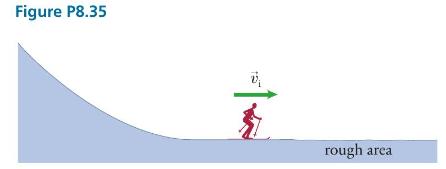
In Figure P8.35, a \(55-\mathrm{kg}\) skier heads down a slope, reaching a speed of \(27 \mathrm{~km} / \mathrm{h}\). They then slide across a horizontal snow field but hit a rough area. Assume the snow before the rough area is so slippery that you can ignore any friction between the skier and the
Two blocks of the same inertia \((10 \mathrm{~kg})\) but different sizes are falling freely. Compare the force exerted by the Earth on the two blocks.
You are collecting water from a well by lowering a bucket on a rope. The inertia of the empty bucket is \(0.72 \mathrm{~kg}\), and the inertia of the rope is negligible.(a) If you lower the empty bucket with a downward acceleration of \(4.8 \mathrm{~m} / \mathrm{s}^{2}\), what is the tension in the
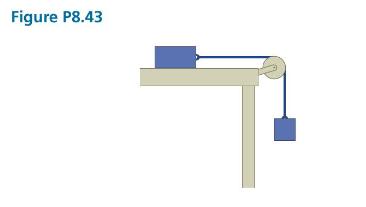
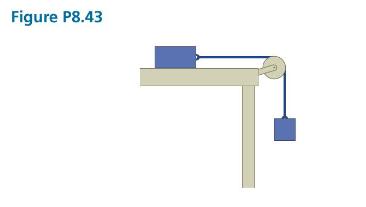
Figure P8.43 shows two blocks, one of which is placed on a low-friction table, and supports, by means of a massless rope that runs over a low-friction pulley, the other block, which is suspended in mid-air. If you hold the hanging block, and then release it, how big an inertia should this block
Consider figure P8.43. Let the inertia of the block on the table be \(M\) and that of the hanging bock be \(M / 4\). If the coefficient of kinetic friction between the table and the block is 0.2 , calculate the tension in the rope and the acceleration of the hanging block. Figure P8.43
A \(27-\mathrm{kg}\) child stands in the center of a trampoline.(a) If the trampoline center is \(0.32 \mathrm{~m}\) lower than before they got on, what is the spring constant of the trampoline?(b) Assuming the trampoline acts like a spring, how low would their \(65-\mathrm{kg}\) father sink if he
Use the relationship between force and impulse to explain how padded boxing gloves protect a boxer's hands.
An 1100-kg car stops at a red light, going from \(85 \mathrm{~km} / \mathrm{h}\) to stationary in 20 s.(a) What is the impulse delivered to the car?(b) What is the average vector sum of forces exerted on the car?
A 2-kg block resting on a low-friction floor is subjected to the time-dependent force \(F(t)=0.5 t^{2}\). The block starts out \(1.0 \mathrm{~m}\) away from the origin.(a) What is speed of the object at \(t=2.0 \mathrm{~s}\) ? (b) What is the position of the object at \(t=2.0 \mathrm{~s}\) ?
A 2.3-kg ball dropped from a height of \(2.0 \mathrm{~m}\) onto a steel plate rigidly attached to the ground bounces back to a height of \(1.7 \mathrm{~m}\).(a) What is the impulse delivered to the ball by the plate?(b) What is the coefficient of restitution of the collision?
Box \(\mathrm{A}\), which has an inertia of \(2 \mathrm{~kg}\), and box \(\mathrm{B}\), which has an inertia of \(3 \mathrm{~kg}\), are \(2.0 \mathrm{~m}\) apart on a low-friction floor. Box B is pushed toward box A by a steady force of 10.0 N. What is the acceleration of \((a)\) box \(\mathrm{A}\)
You are holding a basketball while standing on a bathroom scale. You now throw the basketball directly upwards, and catch it on its way down. Describe how the reading on the scale changes from its initial value(a) as you are throwing the basketball,(b) after the basketball has left your hands, (c)
A train is comprised of an engine car of inertia \(M\), and 3 more cars of inertias \(m_{1}, m_{2}\), and \(m_{3}\), respectively. The acceleration of the train is \(a\). Friction can be ignored.(a) What is the net force acting on the train?(b) What is the force in the coupler pulling the last car
An 80-kg man rides in an elevator from the ground to an upper floor. The elevator goes from rest to \(10 \mathrm{~m} / \mathrm{s}\) in 5 seconds, and then continues at the same constant speed for 10 seconds, before slowing down to a stop in \(5 \mathrm{sec}-\) onds. How much push from the elevator
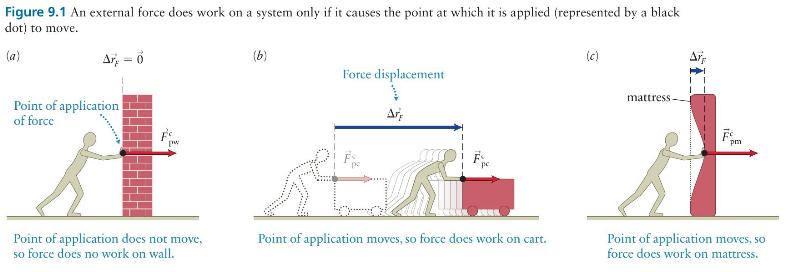
Imagine pushing against a brick wall as shown in Figure 9.1a. (Assume the wall is undeformable-a fair assumption at macroscopic scales.)(a) Considering the wall as the system, is the force you exert on it internal or external?(b) Does this force accelerate the wall? Change its shape? Raise its
You throw a ball straight up in the air. Which of the following forces do work on the ball while you throw it? Consider the interval from the instant the ball is at rest in your hand to the instant it leaves your hand at speed \(v\). (a) The force of gravity exerted by Earth on the ball. (b) The
A ball is thrown vertically upward.(a) As it moves upward, it slows down under the influence of gravity. Considering the changes in energy of the ball, is the work done by Earth on the ball positive or negative?(b) After reaching its highest position, the ball moves downward, gaining speed. Is the
Go back to Checkpoint 9.3 and answer the same two questions in terms of the directions of the applied forces and the force displacements. Do your answers agree with those you gave in Checkpoint 9.3?Data from Checkpoint 9.3A ball is thrown vertically upward.As it moves upward, it slows down under
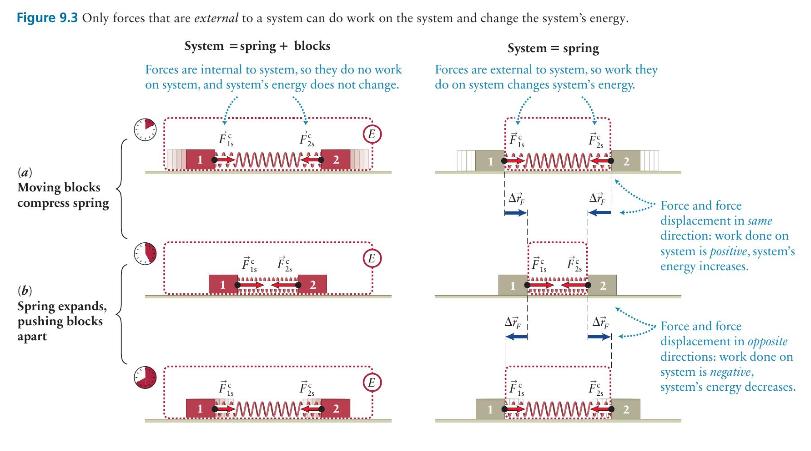
Suppose that instead of the two moving blocks in Figure \(9.3 a\), just one block is used to compress the spring while the other end of the spring is held against a wall.(a) Is the system comprising the block and the spring closed?(b) When the system is defined as being only the spring, is the work
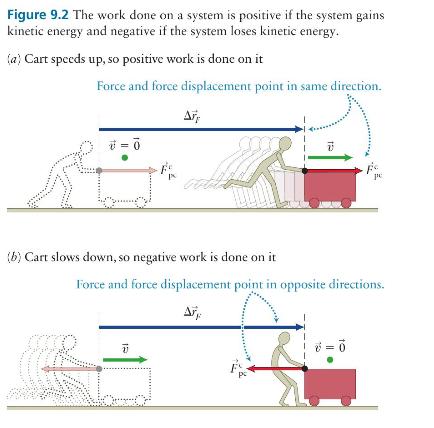
Draw an energy diagram for the cart in Figure 9.2 \(b\). Figure 9.2 The work done on a system is positive if the system gains kinetic energy and negative if the system loses kinetic energy. (a) Cart speeds up, so positive work is done on it Force and force displacement point in same direction. ta
Draw an energy diagram for the situation presented in Exercise 9.4, but choose the system that comprises block, spring, surface, and Earth.Data from Exercises 9.4 A block initially at rest is released on an inclined surface. The block slides down, compressing a spring at the bottom of the incline;
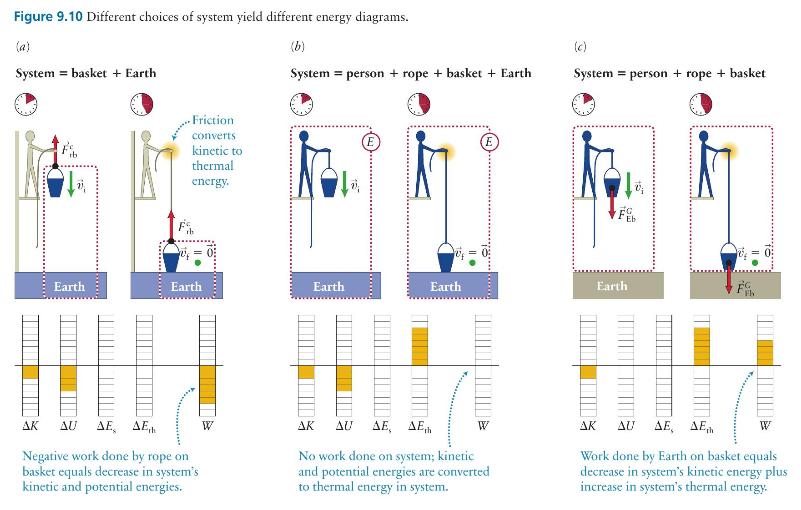
Draw an energy diagram for just the basket in Figure 9.10. Figure 9.10 Different choices of system yield different energy diagrams. (a) System basket + Earth (b) System person + rope + basket + Earth .Friction converts kinetic to thermal energy. (c) System person + rope + basket F Eb Earth Earth
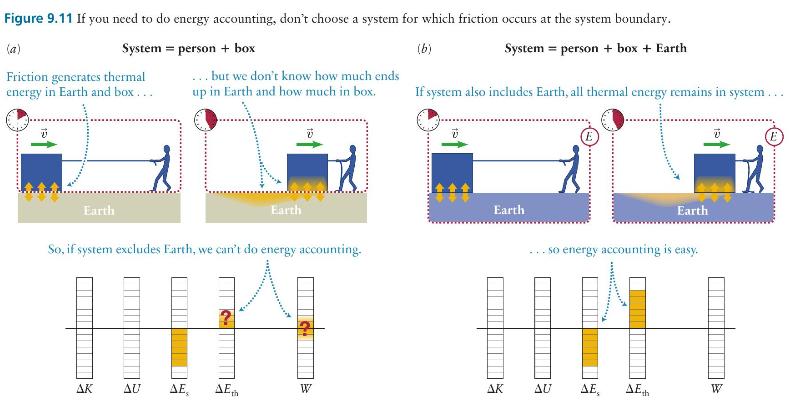
(a) Draw an energy diagram for the situation shown in Figure 9.11 for the system that comprises Earth and the box. Assume the box keeps moving at constant velocity, and consider the rope to be part of the person.(b) Explain each bar in the energy diagram of Figure 9.11b. (a) Figure 9.11 If you need
Verify that in Example 9.6 the momentum transferred to the ball by the gravitational force is \(\Delta p_{x}=m_{\mathrm{b}}\left(v_{x, \mathrm{f}}-v_{x, \mathrm{i}}\right)\).Data from Example 9.6A ball of inertia \(m_{\mathrm{b}}\) is released from rest and falls vertically. What is the ball's
Compare the rightmost terms of Eqs. 9.14 and 9.16 to determine whether, in any two-particle system subject to a single, constant external force, \(\Delta E\) is larger than, equal to, or smaller than \(\Delta K_{\mathrm{cm}}\). Explain your answer.Equations AKcm = macmxAxem = (Fexrx) Axcm (constant
Show that for a one-particle system, Eqs. 9.14 and 9.18 both reduce to Eq. 9.9.Equations W (F)Ax (constant forces exerted on particle, one dimension). (9.9)
Show that Eq. 9.22 reduces to Eq. 9.8 when the force is constant.Equations WFxAx (constant force exerted on particle, one dimension). (9.8)
In Example 9.8, consider the situation from the instant the brick is released to the instant at which it has zero velocity (when the spring compression is greatest). Draw an energy diagram for a system that comprises (a) the spring alone(b) Earth, spring, and brick.Data from Example 9.8 A brick
As the brick in Example 9.8 moves downward, why is the magnitude of the force it exerts on the spring given by Eq. 1 in Example 9.8 and not by simply the magnitude \(m g\) of the gravitational force exerted by Earth on the brick? Data from Example 9.8 A brick of inertia \(m\) compresses a spring
A \(0.50-\mathrm{kg}\) wood block slides \(0.50 \mathrm{~m}\) on a horizontal floor before colliding elastically with a wall and reversing its direction of travel. If the block has an initial speed of \(1.0 \mathrm{~m} / \mathrm{s}\) and comes to rest exactly at its starting position, what is the
(a) A gallon of gasoline contains about \(1.4 \times 10^{8} \mathrm{~J}\) of chemical energy. A car consumes this amount of gasoline in approximately \(30 \mathrm{~min}\) when cruising along a highway; a plane consumes the same amount in about \(1 \mathrm{~s}\) when flying at cruising altitude.
If a large force is applied to an object, does it necessarily follow that work in done on it? \(\bullet\)
Hitting a door with your bare fist hurts more than hitting a sofa cushion. In work terms, explain why this is so. \(\cdot\)
If you drop a brick from a height of \(50 \mathrm{~mm}\) onto your toe, it probably won't hurt much, but if you drop the brick from a height of \(0.5 \mathrm{~m}\), it will hurt. The force of gravity exerted on the brick is the same in both cases. Explain why it hurts more from the increased
An object moves with constant velocity. What can you say about the work done on a system that includes only this object? \(\cdot\)\(\cdot\)
You try to push a heavy box along the floor while you are dressed in socks, but your feet keep slipping. When you put on some shoes, your feet no longer slip, and you are able to do work on the box as you push it. Has the friction force between your shoes and the floor done positive or negative
You are in an elevator moving between two floors of a building at constant speed. Compare the work done on you by the elevator when you are moving upward to a higher floor to the work done when you are moving downward to a lower floor.
Give examples of cases where work is done on a system without changing its kinetic energy.
You throw a \(100-\mathrm{g}\) ball upward with a speed of \(19.8 \mathrm{~m} / \mathrm{s}\). How much work does the force of gravity do on the ball during its trip to its maximum height?
A 48-kg acrobat must jump high and land on his brother's shoulders. To accomplish this, she leaps from a crouched position to a height where her center of mass is \(1.60 \mathrm{~m}\) above the ground. Her center of mass is \(320 \mathrm{~mm}\) above the ground in the crouch and \(900
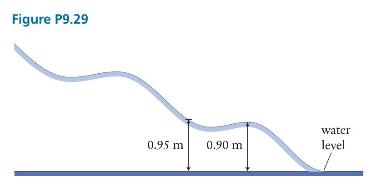
A 30-kg child slides down the amusement-park wave slide shown in Figure P9.29. When they are \(0.95 \mathrm{~m}\) above the water level their speed is \(2.2 \mathrm{~m} / \mathrm{s}\). At the top of the final hump, at a height of \(0.90 \mathrm{~m}\) above the water level, their speed is also \(2.2
Two \(0.25-\mathrm{kg}\) carts, one red and one green, are stationary on a low-friction track. The carts are initially separated by \(0.50 \mathrm{~m}\). You push on the red one with a constant force of 1.5 \(\mathrm{N}\) toward the green one. When the carts meet, they join together, and you
Spring A is stiffer than spring B. You stretch the springs such that the energy stored in each is the same.(a) Which spring has the greater change in length from its relaxed position?(b) Which spring requires the greater applied force?
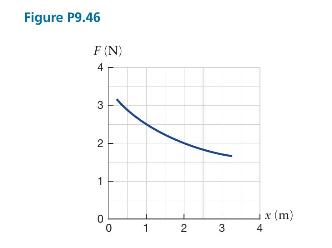
Figure P9.46 shows the force \(F(x)\) plotted as a function of position \(x\).(a) What average constant force applied between \(x=1 \mathrm{~m}\) and \(x=3 \mathrm{~m}\) will do the same amount of work?(b) What is the work done by \(F(x)\) as the object moves from \(x=3 \mathrm{~m}\) to \(x=1
Compressing a certain spring to \(50 \%\) of its relaxed length requires \(28 \mathrm{~J}\) of work. How much work would be required to compress the same spring by only half as much, to \(75 \%\) of its relaxed length?
A proton has mass \(m_{p}\) and charge \(+e\). The force it exerts on another proton at a distance \(r\) is given by \(F(r)=\frac{1}{4 \pi \in_{0}} \frac{e^{2}}{r^{2}}\) where \(\frac{1}{4 \pi \epsilon_{0}} \approx 9 \times 10^{9} \mathrm{~N} \cdot \mathrm{m}^{2} / \mathrm{C}^{2}\), and \(e=1.6
A particular cyclist can produce an average power output of \(180 \mathrm{~W}\) when cycling on level ground. While doing this, their speed is \(9.5 \mathrm{~m} / \mathrm{s}\). What is the magnitude of the net external dissipative force (predominantly air resistance) acting on the cyclist and their
What is the average power delivered when you raise a \(2-\mathrm{kg}\) object by \(50 \mathrm{~cm}\) in \(50 \mathrm{~ms}\) ?
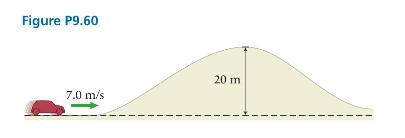
The \(1000-\mathrm{kg}\) car at the bottom of the hill in Figure P9.60 wants to make it to the top of the hill. What should be the minimum power output of the engine given that \(30 \%\) of the engine's power and \(30 \%\) of the car's kinetic energy are lost, and that it takes the car \(20
A constant external force \(F\) is the only force acting on an object. What is the work done on the object by \(F\) as a function of time?
A box of inertia \(10 \mathrm{~kg}\) is suspended by a vertical rope and lowered through a distance of \(10 \mathrm{~m}\) with a constant speed. How much work is done on the box by the gravitational force? How much work is done by the tension in the rope?
An object is moving in a circle with constant speed. Its kinetic energy is constant since the speed does not change. Would you conclude that the total external force acting on it is zero?
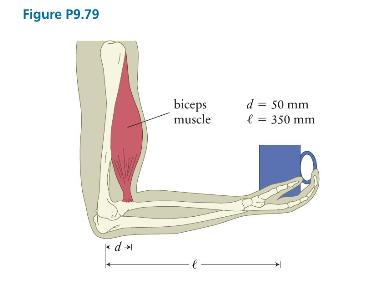
Taking a sip of coffee one day, you start thinking about the effort it takes to do so. Your forearm is a type of lever. As shown in Figure P9.79, the biceps muscle is attached to the forearm bone about \(50 \mathrm{~mm}\) in front of the elbow joint. The cup of coffee in your hand is \(350
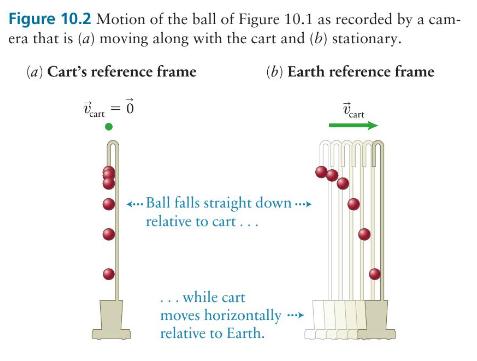
(a) In Figure 10.2, what is the ball's velocity the instant before it is released? (b) Is the ball's speed in the reference frame of the cart greater than, equal to, or smaller than its speed in the Earth reference frame? Figure 10.2 Motion of the ball of Figure 10.1 as recorded by a cam- era that
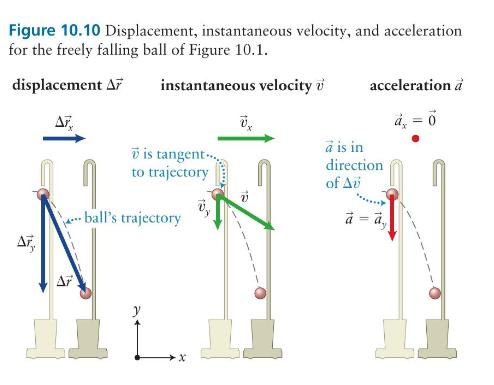
In Figure 10.10, the ball's instantaneous velocity \(\vec{v}\) does not point in the same direction as the displacement \(\Delta \vec{r}\) (it points above the final position of the ball). Why? Figure 10.10 Displacement, instantaneous velocity, and acceleration for the freely falling ball of Figure
A suitcase being loaded into an airplane moves at constant velocity on an inclined conveyor belt. Draw a free-body diagram for the suitcase as it moves up along with the belt. Show the normal and tangential components of the forces exerted on the suitcase.
You decide to move a heavy file cabinet by sliding it across the floor. You push against the cabinet, but it doesn't budge. Draw a free-body diagram for it.
(a) Suppose you push the file cabinet just enough to keep it moving at constant speed. Draw a free-body diagram for the cabinet while it slides at constant speed. (b) Suddenly you stop pushing. Draw a free-body diagram for the file cabinet at this instant.
Which type of friction-static or kinetic-plays a role in (a) holding a pencil, (b) chalk making marks on a chalkboard,(c) skiing downhill,(d) polishing a metal surface, and(e) walking (without sliding) down an incline?
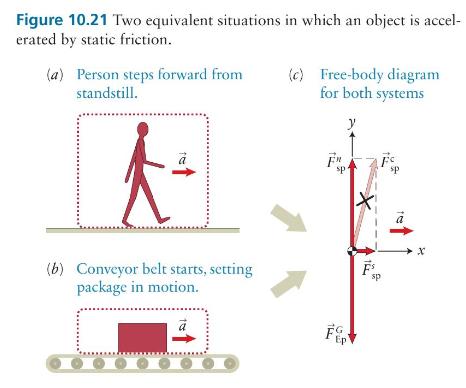
Draw energy diagrams for the person and the package in Figure 10.21. Figure 10.21 Two equivalent situations in which an object is accel- erated by static friction. (a) Person steps forward from standstill. (c) Free-body diagram for both systems (b) Conveyor belt starts, setting package in motion.
You navigate a ship from a pier to a buoy \(1500 \mathrm{~m}\) northeast of the pier. There you sail to a point \(300 \mathrm{~m}\) south and \(700 \mathrm{~m}\) east of the buoy. What is your distance from the pier at that point, if you do not move relative to the ship?
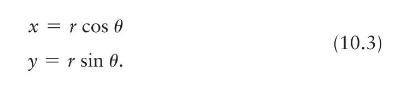
Suppose a projectile's initial velocity is specified by the initial speed \(v_{\mathrm{i}}\) and launch angle \(\theta\) instead of by its rectangular components as in Eq. 10.15 (a) Using Eqs. 10.3, write expressions for the projectile's maximum height and horizontal range in terms of
Is the collision in Example 10.7 elastic?Data from Example 10.7Pucks 1 and 2 slide on ice and collide. The inertia of puck 2 is twice that of puck 1 . Puck 1 initially moves at \(1.8 \mathrm{~m} / \mathrm{s}\); puck 2 initially moves at \(0.20 \mathrm{~m} / \mathrm{s}\) in a direction that makes an
Showing 1800 - 1900
of 4962
First
12
13
14
15
16
17
18
19
20
21
22
23
24
25
26
Last
Step by Step Answers

 Get 50% OFF
Claim Now
Get 50% OFF
Claim Now