New Semester
Started
Get
50% OFF
Study Help!
--h --m --s
Claim Now
Question Answers
Textbooks
Find textbooks, questions and answers
Oops, something went wrong!
Change your search query and then try again
S
Books
FREE
Study Help
Expert Questions
Accounting
General Management
Mathematics
Finance
Organizational Behaviour
Law
Physics
Operating System
Management Leadership
Sociology
Programming
Marketing
Database
Computer Network
Economics
Textbooks Solutions
Accounting
Managerial Accounting
Management Leadership
Cost Accounting
Statistics
Business Law
Corporate Finance
Finance
Economics
Auditing
Tutors
Online Tutors
Find a Tutor
Hire a Tutor
Become a Tutor
AI Tutor
AI Study Planner
NEW
Sell Books
Search
Search
Sign In
Register
study help
sciences
chemical principles
Chemical Principles The Quest For Insight 7th Edition Peter Atkins, Loretta Jones, Leroy Laverman - Solutions
You are given samples of propanal, 2-propanone, and ethanoic acid. Describe how you would use chemical tests including acid–base indicators to distinguish among the three compounds.
Consider the following organic molecules, which have approximately the same molar masses but might contain different functional groups:CH3CH2CH2CH2CH2CH3, CH3CH2CH2CH2CHCH2, CH3CH2CH2CH2CH2OH, CH3CH2CH2CH2CHO, CH3CH2CH2COOH, CH3CH2COOCH3, CH3CH2COCH2CH3, CH3CH2CH2CH2OCH3.(a) Draw a Lewis structure
You are given samples of 1-propanol, pentane, and ethanoic acid. Describe how you would use chemical tests such as aqueous solubility and acid–base indicators, to distinguish among the three compounds.
Write the structural formula of the product of(a) The reaction of glycerol (1,2,3-trihydroxypropane) with stearic acid, CH3(CH2)16COOH, to produce a saturated fat;(b) The oxidation of 4-hydroxybenzyl alcohol by sodium dichromate in an acidic organic solvent.
Rank the following acids in order of increasing acid strength: ClCH2COOH, Cl3CCOOH, CH3COOH, and CH3CH2COOH. Justify your answer.
Write the condensed structural formulas of the principal products of the reaction that takes place when(a) Ethylene glycol, 1,2-ethanediol, is heated with stearic acid, CH3(CH2)16COOH;(b) Ethanol is heated with oxalic acid, HOOCCOOH;(c) 1- butanol is heated with propanoic acid.
Rank methylamine, dimethylamine, and diethylamine in order of increasing base strength. Explain your rankings in relation to their molecular structure.
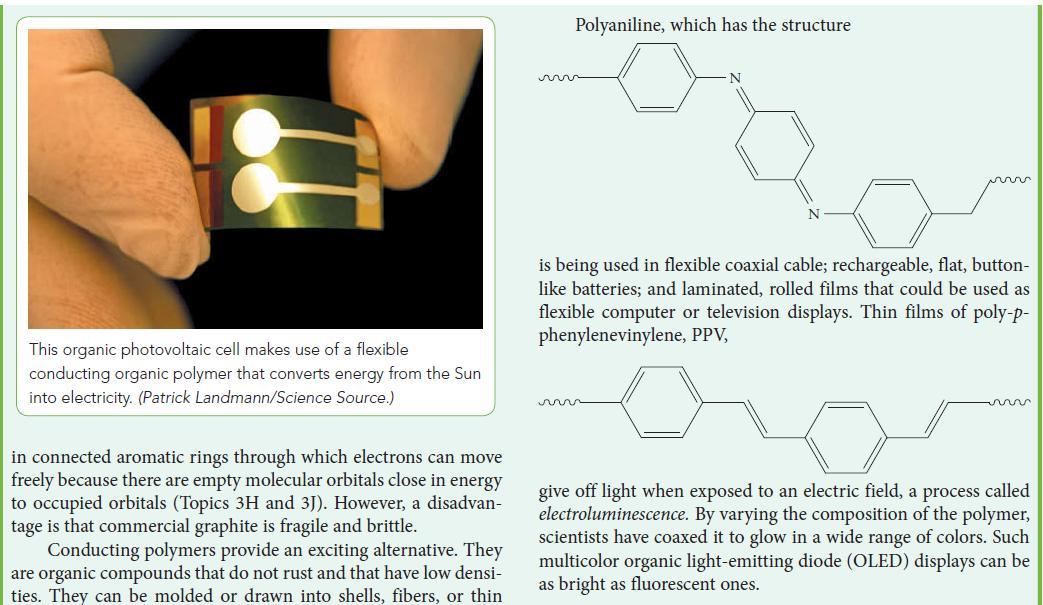
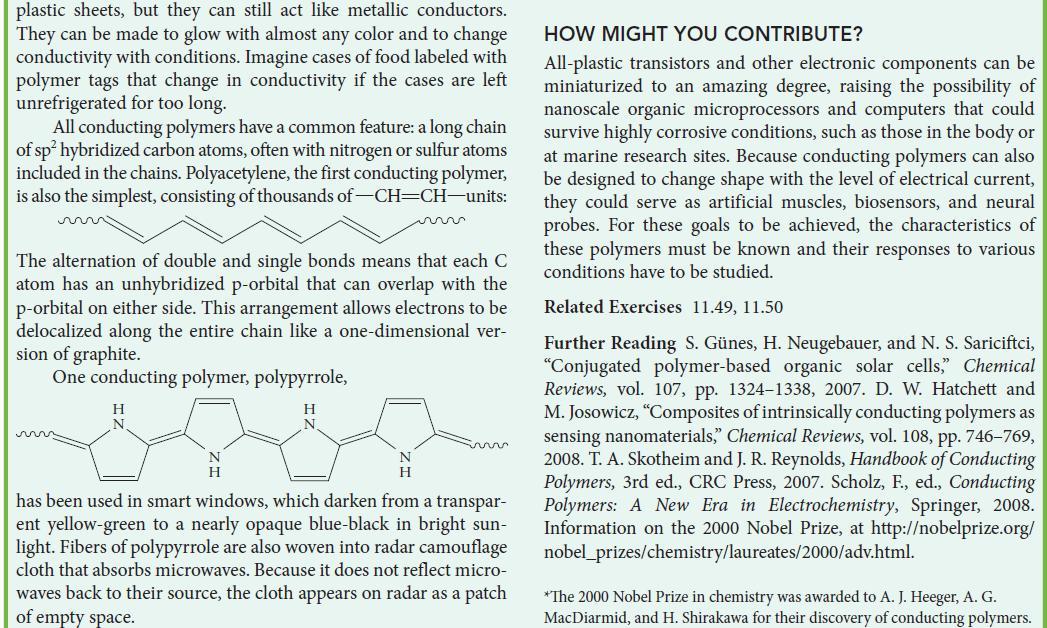
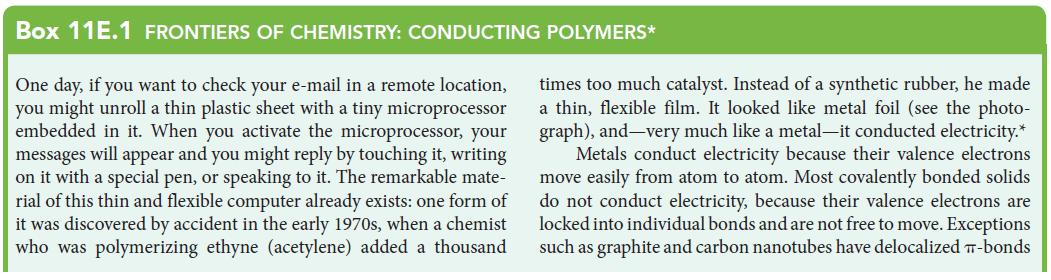
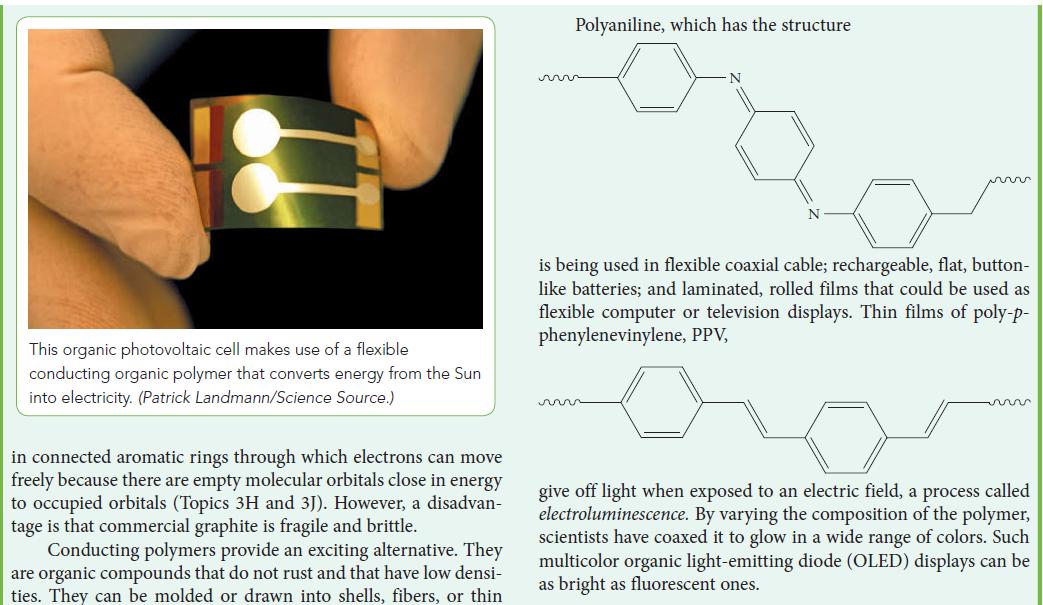
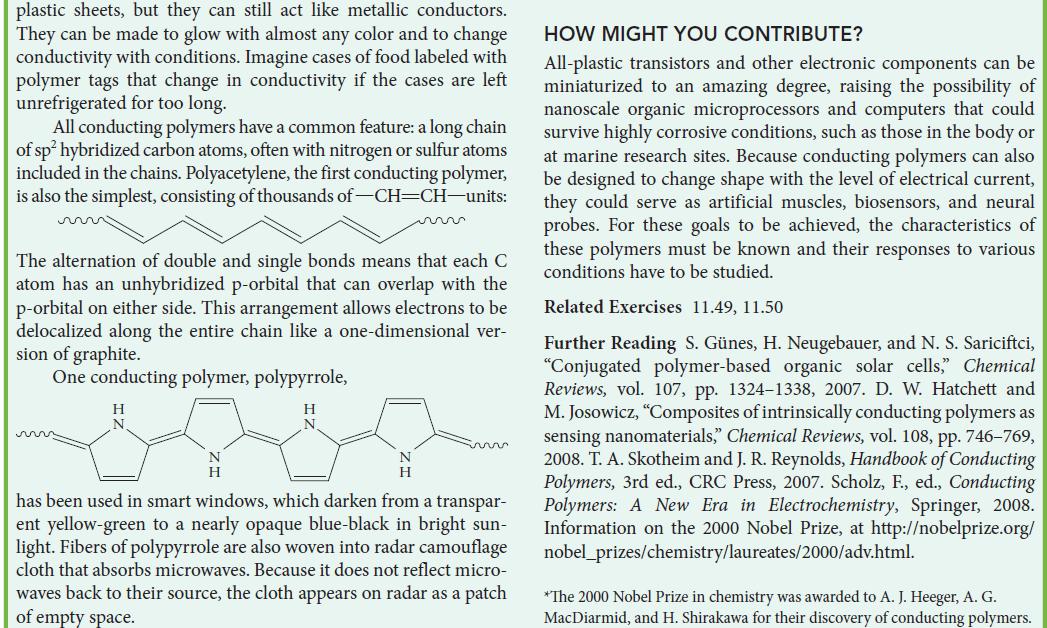
The monomer of the conducting polymer polyaniline is the compound aniline (aminobenzene).(a) Draw the structural formula of the aniline monomer.(b) What is the hybridization of the N atom in (i) aniline; (ii) polyaniline?(c) Indicate the locations of lone pairs, if any, in polyaniline.(d) Do
segment of a protein is analyzed and found to contain the amino acid sequence Glu-Leu-Asp. Draw the Lewis structure of this segment, showing the peptide bonds.
Fibers of the conducting polymer polypyrrole are woven into radar camouflage cloth. Because it absorbs microwaves, rather than reflecting them back to their source, the cloth appears to be a patch of empty space on radar.(a) What is the hybridization of the N atom in polypyrrole?(b) Explain why
The pKa values for phenol, o-nitrophenol, m-nitrophenol, and p-nitrophenol are 9.89, 7.17, 8.28, and 7.15, respectively. Explain the origin of these differences in pKa.
Acrylic resins are polymeric materials used to make warm yet lightweight garments. The osmotic pressure of a solution prepared by dissolving 47.7 g of an acrylic resin in enough water to make 500. mL of solution is 0.325 atm at 25°C.(a) What is the average molar mass of the polymer?(b) How many
The average molar mass of a sample of polypropylene was determined by measuring the osmotic pressure of 500. mL of a solution of 3.16 g of polypropylene in benzene. A pressure of 0.0112 atm was observed at 25°C.(a) What is the average molar mass of the polymer?(b) How many propene monomer units
(a) Explain the differences among the primary, secondary, tertiary, and quaternary structures of a protein.(b) Identify the forces holding each structure together as covalent bonds or primarily intermolecular forces.
Haloalkanes may react with hydroxide ions, undergoing nucleophilic displacement of the halide ion to form an alcohol. A complication of such reactions is competition from elimination reactions rather than substitution.(a) Predict the possible products from the reaction of 2-bromopentane with
The protonated form of glycine (+H3NCH2COOH) has Ka1 = 4.47 * 10–3, and Ka2 = 1.66 * 10–10.(a) Write the chemical equations for the proton transfer equilibria.(b) What is the dominant form of glycine in solution at pH = 2, pH = 5, and pH = 12?
In the amide group, rotation is restricted about the CON bond, so that the C, N, and O atoms in that group are normally in the same plane. This rigidity is partly responsible for the secondary structure of proteins. The amino acid glycine can form a dipeptide, composed of two glycine
Explain the process of condensation polymerization. How might the polymer obtained from benzene-1,2-dicarboxylic acid and ethylene glycol differ from Dacron?
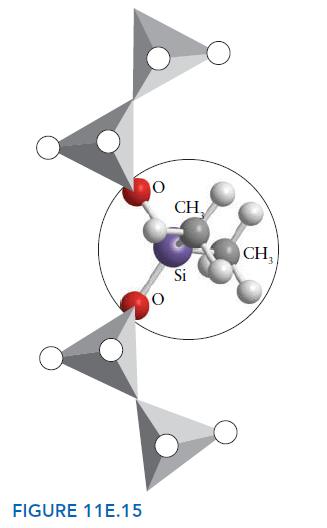
Polyphosphazenes, which are used as heat-resistant polymers in the aerospace industry and as flexible scaffolds for bone regeneration, are inorganic polymers with the repeating unit (—PR2=N—)n, in which R stands for side chains such as —CH3 groups. How would you expect the properties of the
The average molar mass of a hydrogen-bonded pair of nucleotides in a DNA molecule is 625 g · mol–1. Each successive pair is found at a distance of 340 pm along the chain. If the total length of one strand of a DNA molecule is 0.299 m, what is the molar mass of the molecule?
Propane torches are used for minor home repairs, but welders must use torches that burn acetylene (ethyne).(a) Write chemical equations for the combustion of propane and ethyne.(b) Calculate the enthalpy of combustion for each fuel per gram and per mole.(c) Use your data in part (b) to explain
Pheromones are commonly called sex attractants, although they have other signaling functions, too. A pheromone of the queen bee is trans-CH3CO(CH2)5CH=CHCOOH.(a) Write the structural formula of the pheromone.(b) Identify and name the functional groups in the molecule.
Why are hydrocarbons with between one and four carbon atoms not suitable for gasoline?
What are the major problems associated with using coal as a fuel?
Propene and butane can be combined by the process called alkylation to form a straight-chain hydrocarbon used in gasoline. Write a chemical equation for the reaction.
The compound C18H38 is a component of fuel oil that can be converted by a cracking process into two compounds suitable for use in gasoline. The compounds have the formulas CnH2n + 2 and CnH2n, with the value of n being the same in each. Each compound has a straight chain of carbon atoms, with no
Aromatization is a process used to improve the quality of gasoline by converting aliphatic hydrocarbons into aromatic ones.(a) When heptane is converted into toluene, a byproduct is formed. Does this byproduct make another valuable fuel, or is it a pollutant?(b) Write a balanced chemical equation
Isomerization is a process used to improve the quality of gasoline by converting straight-chain hydrocarbons into branched ones. If octane is isomerized into a branched pentane, several structural isomers are possible.(a) Draw the structures of these isomers.(b) One of these isomers has a chiral
A gaseous compound used to make both bubble gum and automobile tires was analyzed to determine its properties and toxicity.(a) When 0.108 g of the compound was analyzed by combustion analysis, 0.352 g of CO2 and 0.109 g of H2O were produced.What is the empirical formula of the compound?(b) The
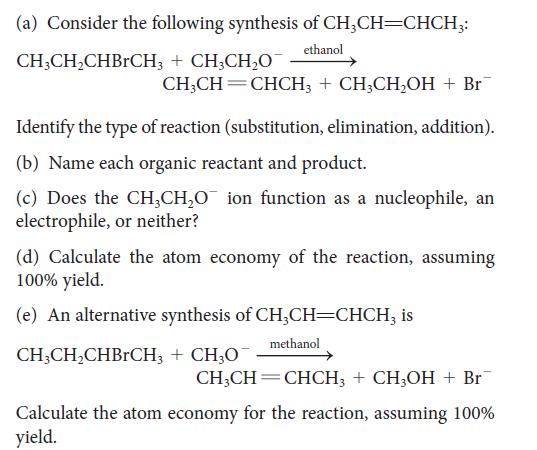
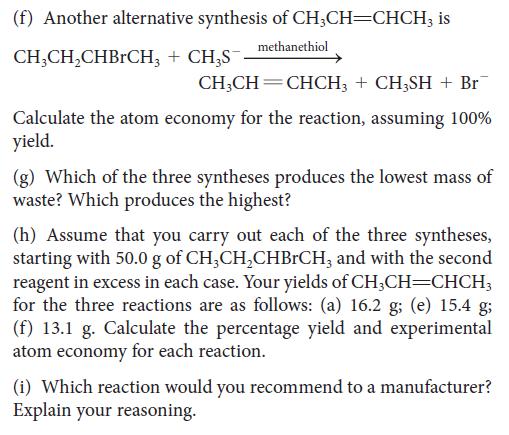
Waste reduction is an important goal of the green chemistry movement. In many chemical syntheses in industry, not all the atoms required for the reaction appear in the product.Some end up in byproducts and are wasted. “Atom economy” is the use of as few atoms as possible to reach an end product
Using concepts of ligand field theory, explain why ethylenediamine is a weaker field ligand than CO.
Using concepts of ligand field theory, explain why water is a weaker field ligand than ammonia.
Is the best description of the t2g-orbitals in [CoF6]3– bonding, antibonding, or nonbonding? Explain how you reached your conclusion.
Is the best description of the eg-orbitals in [Fe(OH2)6]3+ bonding, antibonding, or nonbonding? Explain how you reached your conclusion.
Is the best description of the t2g-orbitals in [Fe(CN)6]3– bonding, antibonding, or nonbonding? Explain how you reached your conclusion.
Is the best description of the t2g-orbitals in [Co(OH2)6]3+ bonding, antibonding, or nonbonding? Explain how you reached your conclusion.
(a) Describe each of the following ligands as either a π-acid, a π-base, or neither (see Exercise 9D.27):(i) NH3; (ii) ox; (iii) F–; (iv) CO.(b) Place them in order of increasing ligand field splitting.Exercise 9D.27Ligands that can interact with a metal center by forming a π-bond are
Ligands that can interact with a metal center by forming a π-bond are commonly called π-acids and p-bases. The definitions of π-acid and π-base are similar to those used for Lewis acidity. A π-acid is a ligand that can accept electrons by using π-orbitals, and a π-base donates electrons by
Which of the following complexes can have cis and trans isomers? If such isomerism exists, draw the two structures and label the ions as cis or trans:(a) [Fe(OH)2(OH2)4]+; (b) [RuBr2(NH3)4]2+; (c) [Co(NH3)3(OH2)3]3+.
Write the formulas for the oxoanions of the following elements in which the element is found with its highest oxidation number (see Fig. 9A.7). In each case, the charge of the oxoanion is given in parentheses.(a) Mn (–1);(b) Mo (–2).
(a) Draw all the possible isomers of the square planar complex PtBrCl(NH3)2 and name each isomer.(b) How can the existence of these isomers be used to show that the complex is square planar rather than tetrahedral?
Hemoglobin contains one heme group per subunit. The heme group is an Fe2+ complex that is coordinated to the four N atoms in a porphyrin ligand in a square planar arrangement and to an N atom on the histidine residue (see Table 11E.3) on the subunit. The hemoglobin molecule transports O2 through
Which d-orbitals on the metal ion are used to form π-bonds between metal ions and ligands in an octahedral complex?
Vanadium is used in steelmaking because it forms V4C3, which increases the strength of the steel and its resistance to wear. It is formed in the steel by adding V2O5 to iron ore as it is reduced by carbon during the refining process.(a) What is the likely oxidation state of vanadium in
An analytical chemist analyzed a yellow mineral salt found in the pigments used by a Renaissance artist. When hydrochloric acid was added, the mineral dissolved and formed an orange solution. The original salt was dissolved in water to form a yellow solution. When barium chloride was added to the
(a) Estimate the ligand field splitting for (i) [CoF6]3– (λmax = 700. nm), (ii) [Co(NH3)6]3+ (λmax = 435 nm), and (iii) [Co(OH2)6]3+ (λmax = 540. nm), where λmax is the wavelength of the most intensely absorbed light.(b) Arrange the ligands in order of increasing ligand field strength.
(a) Estimate the ligand field splitting for (i) [CrCl6]3– (λmax = 740. nm), (ii) [Cr(NH3)6]3+ (λmax = 460. nm), and (iii) [Cr(OH2)6]3+ (λmax = 575 nm), where λmax is the wavelength of the most intensely absorbed light.(b) Arrange the ligands in order of increasing ligand field strength.
An analytical chemistry team analyzed a green mineral salt found in the glaze of an ancient pot. When they heated the mineral, it gave off a colorless gas that turned limewater milky white. When they dissolved the mineral in sulfuric acid, the same colorless gas was released and a blue solution
Suggest a reason why copper(II) compounds are often colored but copper (I) compounds are colorless. Which oxidation number results in paramagnetic compounds?
Suggest a reason why copper(II) compounds are often colored but copper (I) compounds are colorless. Which oxidation number results in paramagnetic compounds?
Ligand field theory predicts that different types of metal ions will form more stable complexes with certain types of ligands. From your understanding of ligand field theory, predict what types of ligands (weak field or strong field) would form the more stable complexes with the early d-metals in
The concentration of Fe2+ ions in an acid solution can be determined by a redox titration with either KMnO4 or K2Cr2O7. The reduction products of these reactions are Mn2+ and Cr3+, and in each case the iron is oxidized to Fe3+. In one titration of an acidified Fe2+ solution, 25.20 mL of 0.0210 m
In aqueous solution, water competes effectively with bromide ions for coordination to Cu2+ ions. The hexaaquacopper(II) ion is the predominant species in solution. However, in the presence of a large concentration of bromide ions, the solution becomes deep violet. This violet color is due to the
cis-Platin is an anticancer drug with a three-dimensional structure that can be viewed on the Internet.(a) What are the formula and systematic name for the compound cis-platin?(b) Draw any isomers that are possible for this compound. Label any isomers that are optically active.(c) What is the
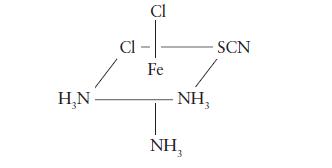
One structure of the octahedral complex FeCl2(NH3)3SCN is shown below. Draw all possible isomers of this complex. HN Cl CI Fe - SCN NH 3 NH
The complex [Co(CN)6]3– is pale yellow.(a) How many unpaired electrons are present in the complex?(b) If ammonia molecules replace the cyanide ions as ligands, will the wavelength of the radiation absorbed be longer or shorter?
Molecular models of the iridium complex IrCl(CO) [P(C6H5)3]2 (ChemSpider ID 21106488) can be found on the Internet.(a) View the three-dimensional structure and determine the coordination geometry of the iridium atom.(b) What is the oxidation number of the iridium atom?(c) Are isomers of this
Ethylenediamine (en) forms a chelate complex with Co3+, [Co(en)3]3+. Are isomers of this complex possible and, if so, what type of isomers are they? N N Co N. [Co(en),]³+ N 3+ N H₂C-CH₂ N = / H₂N NH₂
The complex [TiCl6]3– has a ligand field splitting of 160. kJ · mol–1 and forms an orange solution. What is the wavelength and color of the absorbed light?
Two chemists prepared a complex and determined its formula, which they wrote as [CrCl3NH3] · 2H2O. However, when they dissolved 2.11 g of the compound in water and added an excess of silver nitrate, 2.87 g of AgCl precipitated and they realized that the formula was incorrect. Write the correct
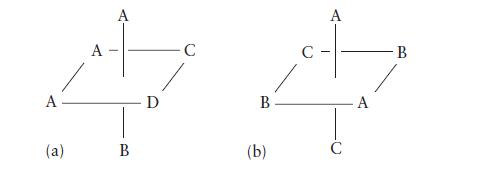
Is either of the following complexes chiral? If both complexes are chiral, do they form an enantiomeric pair? A (a) A B D C B (b) A · Α B
The complex [Ni(NH3)6]2+ has a ligand field splitting of 209 kJ · mol–1 and forms a purple solution. What is the wavelength and color of the absorbed light?
The complex [Ni(NH3)6]2+ has a ligand field splitting of 209 kJ · mol–1 and forms a purple solution. What is the wavelength and color of the absorbed light?
A solid pink salt has the formula CoCl3 · 5NH3 · H2O. When AgNO3 is added to the pink solution containing 0.0010 mol CoCl3 · 5NH3 · H2O, 0.43 g of AgCl precipitates. Heating the salt produces a purple solid with the formula CoCl3 ·5NH3.(a) Write the correct formula and name of the pink
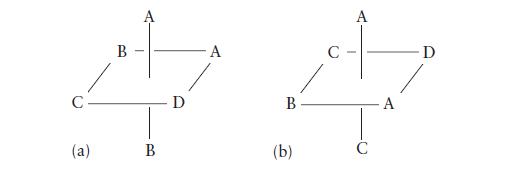
Is either of the following complexes chiral? If both complexes are chiral, do they form an enantiomeric pair? C (a) B A B D A B (b) A A D
Which of the complexes [Cu(OH2)6]2+ or [CuBr6]4– absorbs at the longer wavelength?
Is there a correlation between the ligand field strength of the halide ions F–, Cl–, Br–, and I– and the electronegativity of the halogen? If so, can this correlation be explained by ligand field theory? Justify your answer.
How many isomers are possible for [CoCl(NCS)(OH2)4]l · H2O? Consider all types of isomerism and draw each isomer.
Some of the properties of manganese differ markedly from those of its neighbors. For example, at constant pressure it takes 400 kJ (2 sf) to atomize 1.0 mol Cr(s) and 420 kJ to atomize 1.0 mol Fe(s), but only 280 kJ to atomize 1.0 mol Mn(s). Propose an explanation, using the electron configurations
Of the two complexes(a) [CoF6]3– and(b) [Co(en)3]3+, one appears yellow and the other appears blue. Match the complex to the color and explain your choice.
In a nickel-containing enzyme, various groups of atoms in the enzyme form a complex with the metal, which was found to have oxidation number +2 and to have no unpaired electrons. What is the most probable geometry of the Ni2+ complex:(a) Octahedral;(b) Tetrahedral;(c) Square planar (see Exercise
How many isomers are possible for [Cr(NH3)5(NO2)]Cl2? Consider all types of isomerism and draw each isomer.
(a) Explain why a chromium(III) salt produces an acidic solution in water.(b) Explain why the slow addition of hydroxide ions to a solution containing chromium(III) ions first produces a gelatinous precipitate that subsequently dissolves with further addition of hydroxide ions. Write chemical
Which of the elements scandium, molybdenum, and copper is most likely to form a chloride with the formula MCl4? Explain your decision.
Nickel(II) complexes with weak-field ligands such as the bromide ion have been found to be octahedral, but nickel(II) complexes with strong-field ligands have been found to be square planar. Explain these findings. (See Exercise 9.13.)Exercise 9.13Suggest the form that the orbital energy-level
When the paramagnetic [Co(CN)6]4– ion is oxidized to [Co(CN)6]3–, the ion becomes diamagnetic. However, when the paramagnetic [Co(ox)3]4– is oxidized to [Co(ox)3]3–, the ion remains paramagnetic. Explain these observations.
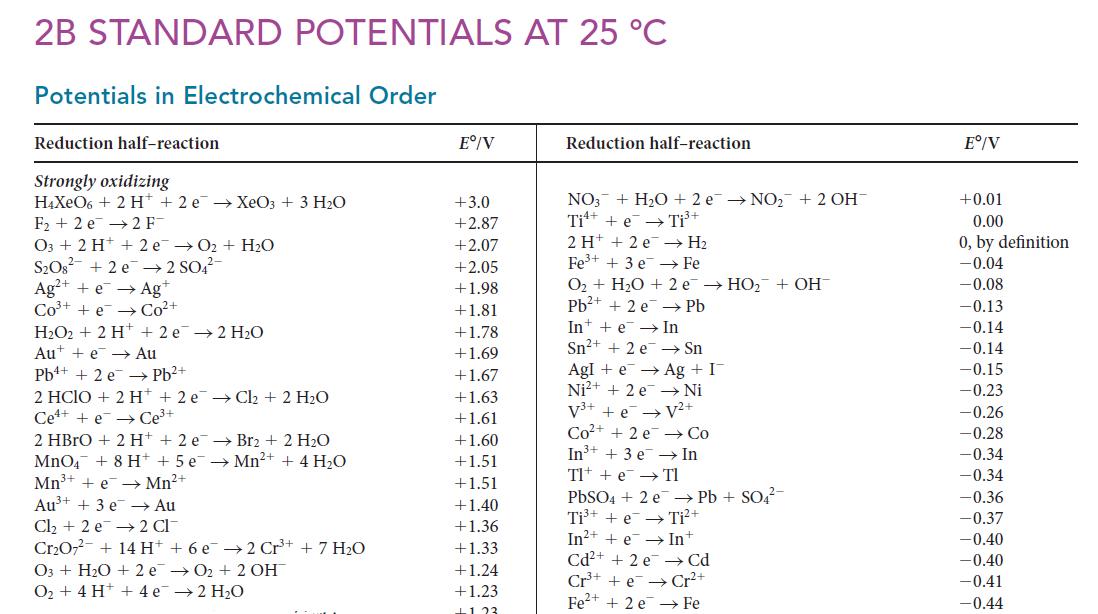
Use Appendix 2B to determine whether an acidic potassium permanganate solution can oxidize(a) Chloride ions to chlorine and(b) Mercury metal to mercury (I) ions under standard conditions. 2B STANDARD POTENTIALS AT 25 C Potentials in Electrochemical Order Reduction half-reaction Strongly
Suggest the form that the orbital energy-level diagram would take for a square planar complex with the ligands in the xy plane, and discuss how the building-up principle applies. The dz2-orbital has a greater electron density in the xy-plane than the dzx- or dyz-orbitals but less than the
Which of the elements vanadium, chromium, and manganese is most likely to form an oxide with the formula MO3? Explain your decision.
When the paramagnetic [Fe(CN)6]3– ion is reduced to [Fe(CN)6]4–, the ion becomes diamagnetic. However, when the paramagnetic [FeCl4]– ion is reduced to [FeCl4 ]2–, the ion remains paramagnetic. Explain these observations.
Which of the following coordination compounds can have cis and trans isomers? If such isomerism exists, draw the two structures and name the compound:(a) [CoCl2(NH3)4] Cl · H2O; (b) [CoCl(NH3)5]Br; (c) PtCl2(NH3)2, a square planar complex.
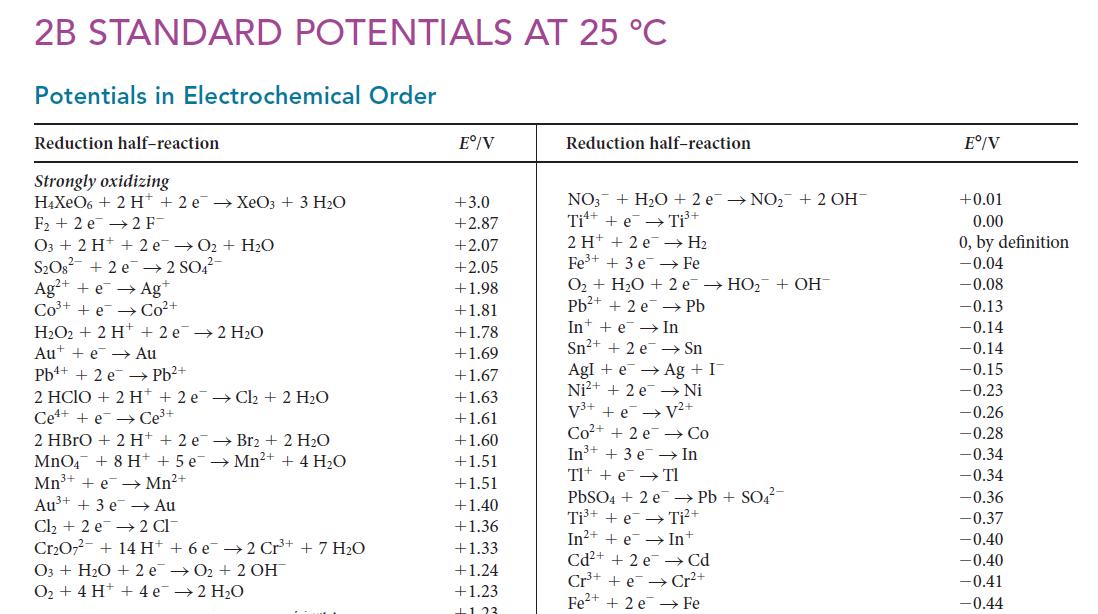
Use Appendix 2B to determine whether an acidic sodium dichromate solution can oxidize(a) Bromide ions to bromine and(b) Silver (I) ions to silver(II) ions under standard conditions. 2B STANDARD POTENTIALS AT 25 °C Potentials in Electrochemical Order Reduction half-reaction Strongly
Give the systematic name and chemical formula of the principal component of(a) Rutile;(b) Hematite;(c) Pyrolusite;(d) Chromite.
Suggest a chemical test for distinguishing between(a) [Ni(SO4)(en)2]Cl2 and [NiCl2(en)2]SO4;(b) [NiI2(en)2]Cl2 and [NiCl2(en)2]I2.
Draw the structures of all possible isomeric forms of CrBrClI(NH3)3. Which isomers are chiral?
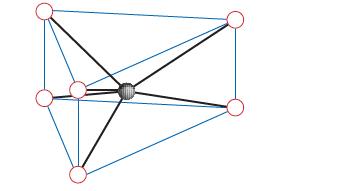
The trigonal prismatic structure shown in the illustration was once proposed for the complex CoCl2(NH3)4. Use the fact that only two isomers of the complex are known to rule out the prismatic structure.
Which oxoanion, MnO4– or ReO4–, is expected to be the stronger oxidizing agent? Explain your choice.
Iron in blood serum can be measured by reducing it to Fe2+ and reacting it with ferrozine to form [Fe(ferrozine)3]4–, a purple complex that has a maximum absorbance at 562 nm.The molar absorption coefficient, ε, for the complex at 562 nm is 2.79 * 104 L · mol–1 · cm–1. A solution of the
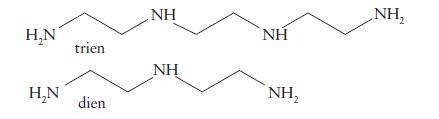
How many chelate rings are present in(a) [Ru(ox)3]3–;(b) [Fe(trien)]3+ (trien is triethylenetetramine);(c) [Cu(dien)2]2+? H₂N H₂N triển dien NH ΝΗ ΝΗ NH₂ NH,
Identify the type of structural isomerism that exists in each of the following pairs of compounds or ions: (a) [Pt(OH₂)4] [PtCl6] and [PtCl₂(OH₂)4] [PtCl4] (b) [Cr(en)3] [Co(ox)3] and [Co(en)3][Cr(ox)3] (c) [Fe(CN) (OH),] and [Fe(CN)(OH);]³- (d) [CoBr₂ (NH3)4] Br H₂O and
By considering electron configurations, suggest a reason why iron(III) is readily prepared from iron(II) but the conversion of nickel(II) and cobalt(II) into nickel(III) and cobalt(III) is much more difficult.
(a) Describe the trend in the stability of oxidation states moving down a group in the d-block (for example, from chromium to molybdenum to tungsten).(b) How does this trend compare with the trend in the stabilities of oxidation states observed for the p-block elements when moving down a group?
The total concentration of cis- and trans-[CoCl(en)2SCN]+ in a solution can be studied at 540 nm, where both isomers have ε = 175 L · mol–1 · cm–1. In one experiment the absorbance of a solution of the isomers in a cuvette with a path length of 1.00 cm was 0.262 at 540 nm. What was the
A hexagonal planar structure was once proposed for the CrCl3(NH3)3 complex. Use the fact that only two isomers of the complex are known to rule out the hexagonal planar structure.
Before the structures of octahedral complexes were established, various means were used to explain the fact that d-metal ions could bind to a greater number of ligands than expected on the basis of their charges. For example, Co3+ can bind to six ligands, not just three. An early theory attempted
Identify the type of structural isomerism that exists in each of the following pairs of compounds: (a) [Co(NH3),(NO₂)] Br₂ and [Co(NH3),(ONO)] Br₂ (b) [Pt(NH3)4(SO4)](OH), and [Pt(NH3)4(OH)₂ ]SO4 (c) [COCI(NCS) (NH3)4] Cl and [CoCl(NCS) (NH3)4] Cl (d) [CrCI (NH3)5 ] Br and [CrBr(NH3)5] Cl
By considering electron configurations, explain why gold and silver are less reactive than copper.
Explain why the density of vanadium (6.11 g · cm–3) is significantly less than that of chromium (7.19 g · cm–3). Both vanadium and chromium crystallize in a body-centered cubic lattice.
Describe the changes that may take place in a compound’s properties when weak-field ligands are replaced by strong-field ligands.
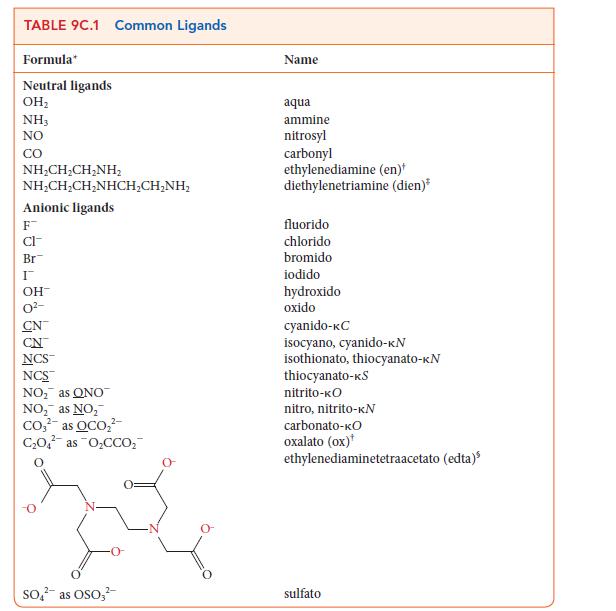
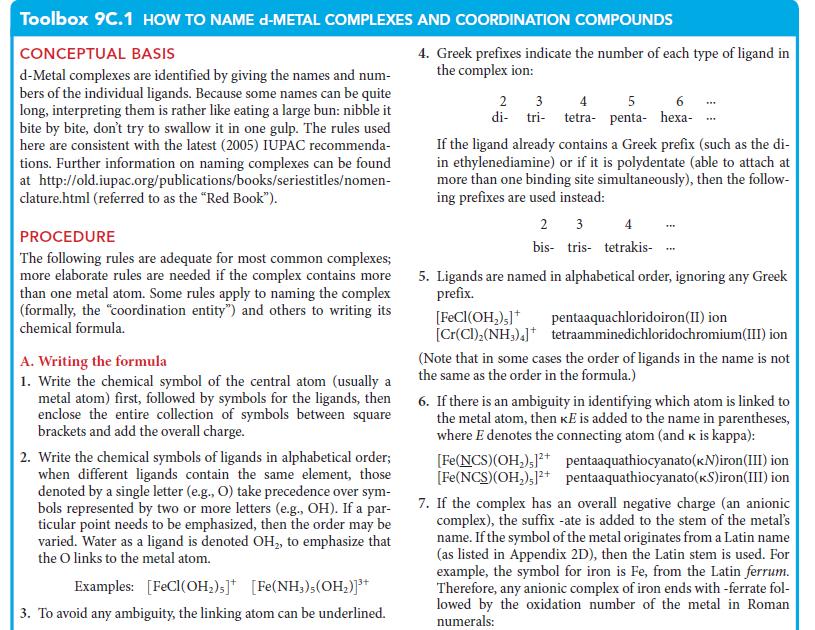
With the help of Table 9C.1, determine the coordination number of the metal ion in each of the following complexes:(a) PtBr2(NH3)2;(b) [Ni(en)2I2]+;(c) [Co(ox)3]3–;(d) [Mn(CO)5]–. TABLE 9C.1 Common Ligands Formula Neutral
Showing 700 - 800
of 3011
1
2
3
4
5
6
7
8
9
10
11
12
13
14
15
Last
Step by Step Answers

 Get 50% OFF
Claim Now
Get 50% OFF
Claim Now


![Examples: [Fe(NCS) (OH), ]2+ [Fe(NCS) (OH), ]+ B. Naming the complex 1. Name the ligands first, and then the](https://dsd5zvtm8ll6.cloudfront.net/images/question_images/1704/1/1/0/5806592a9f48feaf1704110579446.jpg)
![N N Co N. [Co(en),]+ N 3+ N HC-CH N = / HN NH](https://dsd5zvtm8ll6.cloudfront.net/images/question_images/1704/1/0/2/64565928af5df7201704102644833.jpg)
![(a) [Pt(OH)4] [PtCl] and [PtCl(OH)4] [PtCl4] (b) [Cr(en)3] [Co(ox)3] and [Co(en)3][Cr(ox)3] (c) [Fe(CN)(OH),]](https://dsd5zvtm8ll6.cloudfront.net/images/question_images/1704/1/0/2/45865928a3a10dc21704102455681.jpg)
![(a) [Co(NH3),(NO)] Br and [Co(NH3), (ONO)] Br (b) [Pt(NH3)4(SO)](OH) and [Pt(NH3)4(OH)]SO4 (c) [COCI(NCS)](https://dsd5zvtm8ll6.cloudfront.net/images/question_images/1704/1/0/2/44665928a2e978651704102445504.jpg)