New Semester
Started
Get
50% OFF
Study Help!
--h --m --s
Claim Now
Question Answers
Textbooks
Find textbooks, questions and answers
Oops, something went wrong!
Change your search query and then try again
S
Books
FREE
Study Help
Expert Questions
Accounting
General Management
Mathematics
Finance
Organizational Behaviour
Law
Physics
Operating System
Management Leadership
Sociology
Programming
Marketing
Database
Computer Network
Economics
Textbooks Solutions
Accounting
Managerial Accounting
Management Leadership
Cost Accounting
Statistics
Business Law
Corporate Finance
Finance
Economics
Auditing
Tutors
Online Tutors
Find a Tutor
Hire a Tutor
Become a Tutor
AI Tutor
AI Study Planner
NEW
Sell Books
Search
Search
Sign In
Register
study help
sciences
chemical principles
Chemical Principles 6th Edition Steven S Zumdahl - Solutions
What do we mean when we say that a liquid is volatile? Do volatile liquids have large or small vapor pressures at room temperature? What strengths of intermolecular forces occur in highly volatile liquids?
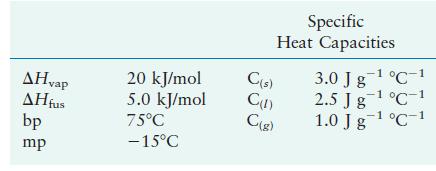
A substance has the following properties:Sketch a heating curve for the substance, starting at \(-50^{\circ} \mathrm{C}\). AHvap AHfus bp mp 20 kJ/mol 5.0 kJ/mol 75C -15C C(s) Specific Heat Capacities C(1) C(g) -1 3.0 J g C 1 2.5 Jg- C-1 1.0 J g C 1
Given the data in Exercise 87 on substance X, calculate the energy that must be removed to convert 250 . g of substance \(\mathrm{X}\) from a gas at \(100 .{ }^{\circ} \mathrm{C}\) to a solid at \(-50 .{ }^{\circ} \mathrm{C}\). Assume \(\mathrm{X}\) has a molar mass of \(75.0 \mathrm{~g} /
How much energy does it take to convert \(0.500 \mathrm{~kg}\) of ice at \(-20 .{ }^{\circ} \mathrm{C}\) to steam at \(250 .{ }^{\circ} \mathrm{C}\) ? Specific heat capacities: ice, \(2.1 \mathrm{~J} \mathrm{~g}^{-1}{ }^{\circ} \mathrm{C}^{-1}\); liquid, \(4.2 \mathrm{~J} \mathrm{~g}^{-1}{
A \(20.0 \mathrm{~g}\) sample of ice at \(-10.0^{\circ} \mathrm{C}\) is mixed with \(100.0 \mathrm{~g}\) of water at \(80.0^{\circ} \mathrm{C}\). Calculate the final temperature of the mixture assuming no heat loss to the surroundings. The heat capacities of \(\mathrm{H}_{2} \mathrm{O}(s)\) and
Silver crystallizes in a cubic closest packed structure. The radius of a silver atom is 1.44 Å (144 pm). Calculate the density of solid silver.
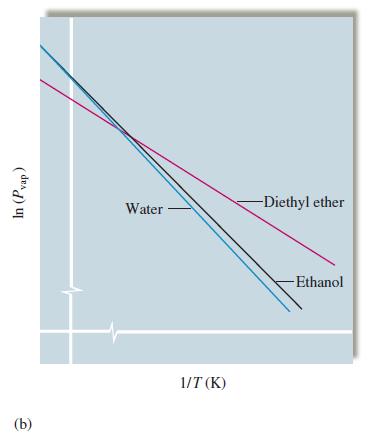
Using the plots in Fig. 16.48(b), determine whether water or diethyl ether has the smaller enthalpy of vaporization.Figure 16.48(b) In (Pvap) (b) Water 1/T (K) -Diethyl ether -Ethanol
A solution was prepared by adding 20.0 g of urea to 125 g of water at 25°C, a temperature at which pure water has a vapor pressure of 23.76 torr. The observed vapor pressure of the solution was found to be 22.67 torr. Calculate the molar mass of urea.
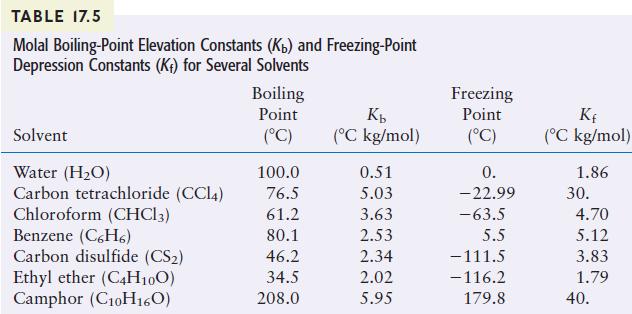
A solution was prepared by dissolving 18.00 g of glucose in 150.0 g of water. The resulting solution was found to have a boiling point of 100.34°C at 1 atm. Calculate the molar mass of glucose. Glucose is a molecular solid that is present as individual molecules in solution. TABLE 17.5 Molal
What mass of ethylene glycol (C2H6O2), the main component of antifreeze, must be added to 10.0 L of water to produce a solution for use in a car’s radiator that freezes at –10.0°F (–23.3°C)? Assume that the density of water is exactly 1 g/mL.
To determine the molar mass of a certain protein, 1.00 × 10⁻³ g of the protein was dissolved in enough water to make 1.00 mL of solution. The osmotic pressure of this solution was found to be 1.12 torr at 25.0°C. Calculate the molar mass of the protein.
What concentration of sodium chloride in water is needed to produce an aqueous solution isotonic with blood (π = 7.70 atm at 25°C)?
The observed osmotic pressure for a 0.10 M solution of Fe(NH4)2(SO4)2 at 25°C is 10.8 atm. Compare the expected and experimental values for i.
In a lab you need at least \(100 \mathrm{~mL}\) of each of the following solutions. Explain how you would proceed by using the given information.a. \(2.0 \mathrm{~m} \mathrm{KCl}\) in water (density of \(\mathrm{H}_{2} \mathrm{O}=1.00 \mathrm{~g} / \mathrm{cm}^{3}\) )b. \(15 \% \mathrm{NaOH}\) by
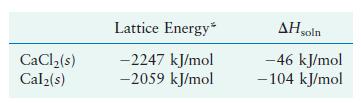
a. Use the following data to calculate the enthalpy of hydration for calcium chloride and calcium iodide.b. Based on your answers to part a, which ion, \(\mathrm{Cl}^{-}\)or \(\mathrm{I}^{-}\), is more strongly attracted to water? CaCl(s) Cal(s) Lattice Energy* -2247 kJ/mol -2059 kJ/mol AH soln -46
What factors cause one solute to be more strongly hydrated than another? For each of the following pairs, predict which substance would be more soluble in water.a. \(\mathrm{CH}_{3} \mathrm{CH}_{2} \mathrm{OH}\) or \(\mathrm{CH}_{3} \mathrm{CH}_{2} \mathrm{CH}_{3}\)b. \(\mathrm{CHCl}_{3}\) or
Glycerin \(\left(\mathrm{C}_{3} \mathrm{H}_{8} \mathrm{O}_{3}ight)\) is a nonvolatile liquid. What is the vapor pressure of a solution made by adding \(164 \mathrm{~g}\) of glycerin to \(338 \mathrm{~mL}\) of \(\mathrm{H}_{2} \mathrm{O}\) at \(39.8^{\circ} \mathrm{C}\) ? The vapor pressure of pure
Which of the following will have the lowest total vapor pressure at \(25^{\circ} \mathrm{C}\) ?a. pure waterb. a solution of glucose in water with \(\chi_{\text {glucose }}=0.01\)c. a solution of sodium chloride in water with \(\chi_{\mathrm{NaCl}}=0.01\)d. a solution of methanol in water with
Which of the choices in Exercise 40 has the highest vapor pressure?Data from Exercises 40Which of the following will have the lowest total vapor pressure at \(25^{\circ} \mathrm{C}\) ?pure waterA solution of glucose in water with \(\chi_{\text {glucose }}=0.01\)A solution of sodium chloride in
A solution is made by mixing \(50.0 \mathrm{~g}\) of acetone \(\left(\mathrm{CH}_{3} \mathrm{COCH}_{3}ight)\) and \(50.0 \mathrm{~g}\) of methanol \(\left(\mathrm{CH}_{3} \mathrm{OH}ight)\). What is the vapor pressure of this solution at \(25^{\circ} \mathrm{C}\) ? What is the composition of the
What is osmotic pressure? How is osmotic pressure calculated? Molarity units are used in the osmotic pressure equation. When does the molarity of a solution approximately equal the molality of the solution?
Calculate the freezing-point depression and osmotic pressure in torr at \(25^{\circ} \mathrm{C}\) for an aqueous solution of \(1.0 \mathrm{~g} / \mathrm{L}\) of a protein (molar mass \(\left.=9.0 \times 10^{4} \mathrm{~g} / \mathrm{mol}ight)\) if the density of the solution is \(1.0 \mathrm{~g} /
Before refrigeration became common, many foods were preserved by salting them heavily. Fruits were preserved by mixing them with a large amount of sugar (fruit preserves). How do salt and sugar act as preservatives?
Distinguish between a strong electrolyte and a weak electrolyte. How can colligative properties be used to distinguish between strong and weak electrolytes?
Consider an aqueous solution containing sodium chloride that has a density of \(1.01 \mathrm{~g} / \mathrm{mL}\). Assume that the solution behaves ideally. The freezing point of this solution at 1.00 atm is \(-1.28^{\circ} \mathrm{C}\). Calculate the percent composition of this solution (by mass).
What is the van't Hoff factor? Why is the observed freezing-point depression for electrolyte solutions sometimes less than the calculated value? Is the discrepancy greater for concentrated or dilute solutions?
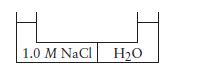
Consider the following:What would happen to the level of liquid in the two arms if the semipermeable membrane separating the two liquids was permeable to the following?a. \(\mathrm{H}_{2} \mathrm{O}\) onlyb. \(\mathrm{H}_{2} \mathrm{O}, \mathrm{Na}^{+}\), and \(\mathrm{Cl}^{-}\) 1.0 M NaCl HO
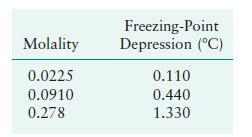
Use the data in the following table for three different aqueous solutions of \(\mathrm{CaCl}_{2}\) to calculate the apparent value of the van't Hoff factor. Molality 0.0225 0.0910 0.278 Freezing-Point Depression (C) 0.110 0.440 1.330
The Tyndall effect is often used to distinguish between a colloidal suspension and a true solution. Explain.
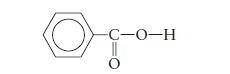
The solubility of benzoic acid,is \(0.34 \mathrm{~g} / 100 \mathrm{~mL}\) in water at \(25^{\circ} \mathrm{C}\) and \(10.0 \mathrm{~g} / 100 \mathrm{~mL}\) in benzene \(\left(\mathrm{C}_{6} \mathrm{H}_{6}ight)\) at \(25^{\circ} \mathrm{C}\). Rationalize this solubility behavior. For a \(1.0
A sample containing \(0.0500 \mathrm{~mol}\) of \(\mathrm{Fe}_{2}\left(\mathrm{SO}_{4}ight)_{3}\) is dissolved in enough water to make \(1.00 \mathrm{~L}\) of solution. This solution contains hydrated \(\mathrm{SO}_{4}{ }^{2-}\) and \(\mathrm{Fe}\left(\mathrm{H}_{2} \mathrm{O}ight)_{6}{ }^{3+}\)
The compound \(\mathrm{VCl}_{4}\) undergoes dimerization in solution:\[2 \mathrm{VCl}_{4} ightleftharpoons \mathrm{V}_{2} \mathrm{Cl}_{8}\]When \(6.6834 \mathrm{~g}\) of \(\mathrm{VCl}_{4}\) is dissolved in \(100.0 \mathrm{~g}\) of carbon tetrachloride, the freezing point is lowered by
Liquid A has vapor pressure \(x\), and liquid \(\mathrm{B}\) has vapor pressure \(y\). What is the mole fraction of the liquid mixture if the vapor above the solution is \(30 . \% \mathrm{~A}\) by moles? \(50 . \% \mathrm{~A}\) ? \(80 . \% \mathrm{~A}\) ? (Calculate in terms of \(x\) and \(y\).)
Using the following information, identify the strong electrolyte whose general formula is\[\mathrm{M}_{x}(\mathrm{~A})_{y} \cdot z \mathrm{H}_{2} \mathrm{O}\]Ignore the effect of interionic attractions in the solution. a. \(\mathrm{A}^{n-}\) is a common oxyanion. When \(30.0 \mathrm{mg}\) of the
What are the three types of hydrides? How do they differ?
Slaked lime \(\left[\mathrm{Ca}(\mathrm{OH})_{2}ight]\) is used to soften hard water by removing calcium ions from hard water through the reaction\[\mathrm{Ca}(\mathrm{OH})_{2}(a q)+\mathrm{Ca}^{2+}(a q)+2 \mathrm{HCO}_{3}^{-}(a q) \longrightarrow{ }_{2 \mathrm{CaCO}_{3}(s)}+2 \mathrm{H}_{2}
What are three-centered bonds?
Use bond energies to estimate the maximum wavelength of light that will cause the reaction\[\mathrm{O}_{3} \xrightarrow{h v} \mathrm{O}_{2}+\mathrm{O}\]
Sulfur forms a wide variety of compounds in which it has \(+6,+4,+2,0\), and -2 oxidation states. Give examples of sulfur compounds having each of these oxidation states.
Give two reasons why \(\mathrm{F}_{2}\) is the most reactive of the halogens.
Calculate the \(\mathrm{pH}\) of a \(0.050 \mathrm{M} \mathrm{Al}\left(\mathrm{NO}_{3}ight)_{3}\) solution. The \(K_{\text {a }}\) value for \(\mathrm{Al}\left(\mathrm{H}_{2} \mathrm{O}ight)_{6}{ }^{3+}\) is \(1.4 \times 10^{-5}\).
The inert pair effect is sometimes used to explain the tendency of heavier members of Group 3A to exhibit +1 and +3 oxidation states. What does the inert pair effect reference? (Consider the valence electron configuration for Group 3A elements.)
Sodium tripolyphosphate \(\left(\mathrm{Na}_{5} \mathrm{P}_{3} \mathrm{O}_{10}ight)\) is used in many synthetic detergents. Its major effect is to soften the water by complexing \(\mathrm{Mg}^{2+}\) and \(\mathrm{Ca}^{2+}\) ions. It also increases the efficiency of surfactants, or wetting agents
A balloon is inflated to its full extent by heating the air inside it. In the final stages of this process the volume of the balloon changes from 4.00 × 10⁶ L to 4.50 × 10⁶ L by addition of 1.3 × 10⁸ J of energy as heat. Assuming the balloon expands against a constant pressure of 1.0 atm,
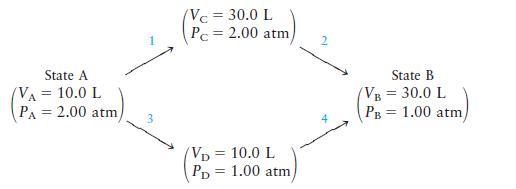
Consider 2.00 mol of a monatomic ideal gas that is taken from state A (PA × 2.00 atm, VA = 10.0 L) to state B (PB = 1.00 atm, VB = 30.0 L) by two different pathways:Calculate q, w, ΔE, and ΔH for both pathways. State A (VA = 10.0 L PA= 2.00 atm/ (Vc = 30.0 L Pc = 2.00 atm, VD = 10.0 L PD 1.00
When 1.00 L of 1.00 M Ba(NO3)2 at 25.0°C is mixed with 1.00 L of 1.00 M Na2SO4 at 25°C in a calorimeter, the white solid BaSO4 forms, and the temperature of the mixture increases to 28.1°C. Assuming that the calorimeter absorbs only a negligible quantity of heat, that the specific heat capacity
When 2.00 mol of SO2(g) reacts completely with 1.00 mol of O2(g) to form 2.00 mol of SO3(g) at 25°C and a constant pressure of 1.00 atm, 198 kJ of energy is released as heat. Calculate ΔH and ΔE for this process.
It has been suggested that hydrogen gas obtained from the decomposition of water might be a substitute for natural gas (principally methane). To compare the energies of combustion of these fuels, the following experiment was carried out using a bomb calorimeter with a heat capacity of 11.3 kJ/°C.
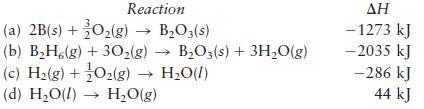
Diborane (B2H6) is a highly reactive boron hydride that was once considered as a possible rocket fuel for the U.S. space program. Calculate ΔH for the synthesis of diborane from its elements, according to the equationusing the following data: 2B(s) + 3H(g) - BH6(g)
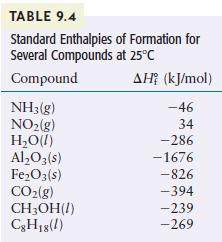
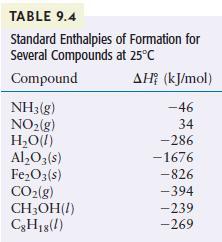
Using the standard enthalpies of formation listed in Table 9.4, calculate the standard enthalpy change for the overall reaction that occurs when ammonia is burned in air to form nitrogen dioxide and water. This is the first step in the manufacture of nitric acid. 4NH3(g) + 702(g) 4NO(g) + 6HO(l)
Methanol (CH3OH) is sometimes used as a fuel in high-performance engines. Using the data in Table 9.4, compare the standard enthalpy of combustion per gram of methanol with that of gasoline. Gasoline is actually a mixture of compounds, but assume for this problem that gasoline is pure liquid octane
Assuming that the combustion of hydrogen gas provides three times as much energy per gram as gasoline, calculate the volume of liquid H2 (density = 0.0710 g/mL) required to furnish the energy contained in 80.0 L (about 20 gal) of gasoline (density = 0.740 g/mL). Calculate also the volume that this
A friend tells you "Free energy \(G\) and pressure \(P\) are directly related by the equation \(G=G^{\circ}+R T \ln (P)\). Also, \(G\) is related to the equilibrium constant \(K\) in that when \(G_{\text {products }}=G_{\text {reactants }}\), the system is at equilibrium. Therefore it must be true
You remember that \(\Delta G^{\circ}\) is related to \(R T \ln (K)\) but can't remember if it is \(R T \ln (K)\) or \(-R T \ln (K)\). Realizing what \(\Delta G^{\circ}\) and \(K\) mean, how can you figure out the correct sign?
Which is larger: \(\Delta S\) at constant pressure or \(\Delta S\) at constant volume? Provide a conceptual rationale.
At 1 atm, liquid water is heated above \(100^{\circ} \mathrm{C}\). For this process which of the following choices (i-iv) is correct for \(\Delta S_{\text {surr }}\) ? \(\Delta S\) ? \(\Delta S_{\text {univ }}\) ? Explain each answer.i. greater than zeroii. less than zero iii. equal to zeroiv.
Which of the following processes require energy as they occur?a. Salt dissolves in \(\mathrm{H}_{2} \mathrm{O}\).b. A clear solution becomes a uniform color after a few drops of dye are added.c. A cell produces proteins from amino acids.d. Iron rusts.e. A house is built.f. A satellite is launched
Choose the compound with the greatest positional probability in each case.a. \(1 \mathrm{~mol}_{\text {of }} \mathrm{H}_{2}\) at STP or \(1 \mathrm{~mol}_{\text {of }} \mathrm{H}_{2}\) at \(100^{\circ} \mathrm{C}\) and \(0.5 \mathrm{~atm}\)b. \(1 \mathrm{~mol}\) of \(\mathrm{N}_{2}\) at STP or \(1
Calculate \(\Delta S_{\text {surr }}\) for the following reactions at \(25^{\circ} \mathrm{C}\) and \(1 \mathrm{~atm}\). a. C3H8(g) + 5O(g) 3CO2(g) + 4HO(l) b. 2NO2(g) 2NO(g) + O(g) AH = -2221 kJ AH = 112 kJ
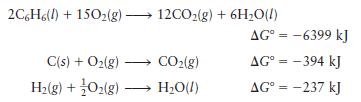
Given the following data:calculate \(\Delta G^{\circ}\) for the reaction\[6 \mathrm{C}(s)+3 \mathrm{H}_{2}(g) \longrightarrow \mathrm{C}_{6} \mathrm{H}_{6}(l)\] 2C6H6(l) +150(g) 12CO(g) + 6HO(l) C(s) + O(g) H(g) + O2(g) - CO(g) HO(l) AG = -6399 kJ AG = -394 kJ AG = -237 kJ
For each of the following pairs, choose the substance with the higher positional probability (per mole) at a given temperature.a. solid CO2 and gaseous CO2b. N2 gas at 1 atm and N2 gas at 1.0 × 10⁻² atm
Predict the sign of the change in positional probability for each of the following processes.a. Solid sugar is added to water to form a solution.b. Iodine vapor condenses on a cold surface to form crystals.
Calculate the change in entropy that occurs when a sample containing 2.00 mol of water is heated from 50.°C to 150.°C at 1 atm pressure. The molar heat capacities for H2O(l) and H2O(g) are 75.3 J K–1 mol–1 and 36.4 J K–1 mol–1, respectively, and the enthalpy of vaporization for water is
In the metallurgy of antimony, the pure metal is recovered by different reactions, depending on the composition of the ore. For example, iron is used to reduce antimony in sulfide ores:Carbon is used as the reducing agent in oxide ores:Calculate ΔSsurr for each of these reactions at 25°C and 1
At what temperatures is the following process spontaneous at 1 atm?What is the normal boiling point of liquid Br2? Br(1) Br(g) where AH 31.0 kJ/mol and AS= 93.0 J K mol-
Predict the sign of ΔS° for each of the following reactions.a. the thermal decomposition of solid calcium carbonate:b. the oxidation of SO2 in air: CaCO3(s) CaO(s) + CO,(g)
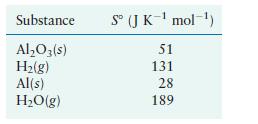
Calculate ΔS° for the reduction of aluminum oxide by hydrogen gasusing the following standard entropy values. AlO3(s) + 3H(g) 2Al(s) + 3HO(g)
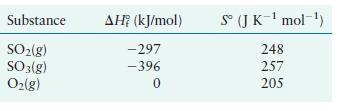
Consider the reactioncarried out at 25°C and 1 atm. Calculate ΔH° ΔS°, and ΔG° using the following data: 2SO2(g) + O2(g) 2SO3(g)
Using the following data (at 25°C),calculate ΔG° for the reaction Cdiamond "(s) + O(g) Cgraphite + O(g) - '(s) CO(g) CO(g) AG = -397 kJ AG = -394 kJ (10.5) (10.6)
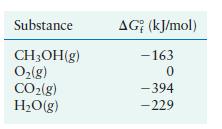
Methanol is a high-octane fuel used in high-performance racing engines. Calculate ΔG° for the reactiongiven the following free energies of formation: 2CHOH(g) + 30(g) 2CO(g) + 4HO(g)
A chemical engineer wants to determine the feasibility of making ethanol (C2H5OH) by reacting water with ethylene (C2H4) according to the equationIs this reaction spontaneous under standard conditions? CH4(g) + HO(1) CH5OH(I)
One method for synthesizing methanol (CH3OH) involves reacting gaseouscarbon monoxide and hydrogen:Calculate ΔG at 25°C for this reaction, in which carbon monoxide gas at 5.0 atm and hydrogen gas at 3.0 atm are converted to liquid methanol. CO(g) + 2H(g) CHOH(/)
Consider the ammonia synthesis reactionwhere ΔG =–33.3 kJ per mole of N2 consumed at 25°C. For each of thefollowing mixtures of reactants and products at 25°C, predict the direction inwhich the system will shift to reach equilibrium. N(g) + 3H(g) = 2NH3(g)
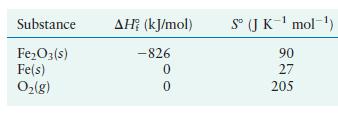
The overall reaction for the corrosion (rusting) of iron by oxygen isUsing the following data, calculate the equilibrium constant for this reaction at 25°C. 4Fe(s) + 30(g) 2FeO3(s)
The value of Kp is 3.7 × 10⁻⁶ at 900. K for the ammonia synthesis reaction. Assuming the value of ΔH° for this reaction is –92 kJ, calculate the value of Kp at 550. K.
Consider a sample containing 5.00 mol of a monatomic ideal gas at 25.0°C and an initial pressure of 10.0 atm. Suppose the external pressure is lowered to 1.00 atm in a reversible manner. Calculate the final pressure and volume of the gas sample and compute the work for the process.
What is the difference between \(\mathscr{E}\) and \(\mathscr{E}^{\circ}\) ? When is \(\mathscr{E}\) equal to zero? When is \(\mathscr{E}^{\circ}\) equal to zero? (Consider "regular" galvanic cells as well as concentration cells.)
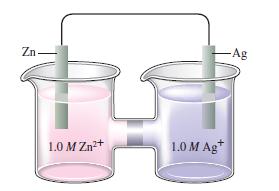
Consider the following galvanic cell:What happens to \(\mathscr{E}\) as the concentration of \(\mathrm{Zn}^{2+}\) is increased? as the concentration of \(\mathrm{Ag}^{+}\)is increased? What happens to \(\mathscr{E}^{\circ}\) in these cases? Zn 1.0 M Zn+ 1.0 M Ag+ -Ag
The saturated calomel electrode, abbreviated SCE, is often used as a reference electrode in making electrochemical measurements. The SCE is composed of mercury in contact with a saturated solution of calomel \(\left(\mathrm{Hg}_{2} \mathrm{Cl}_{2}ight)\). The electrolyte solution is saturated
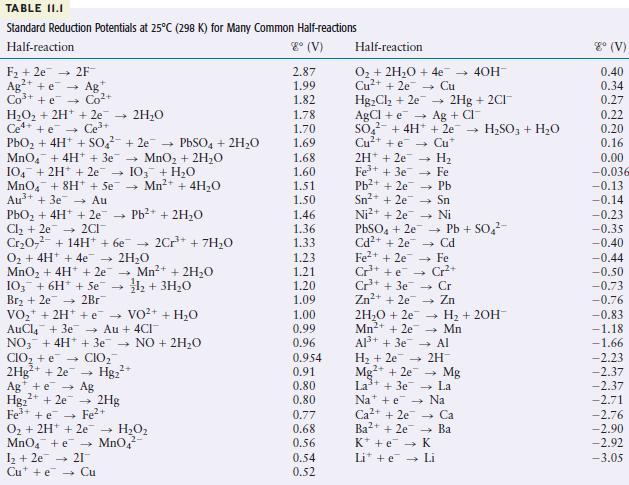
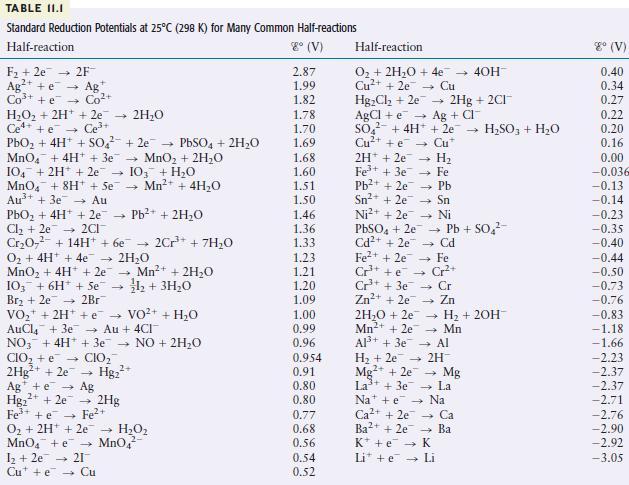
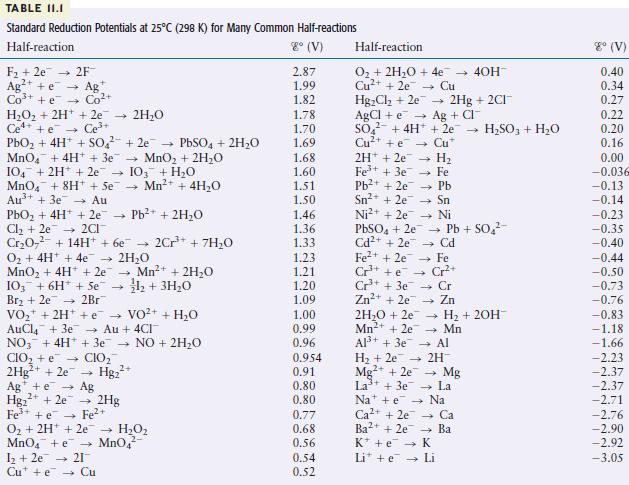
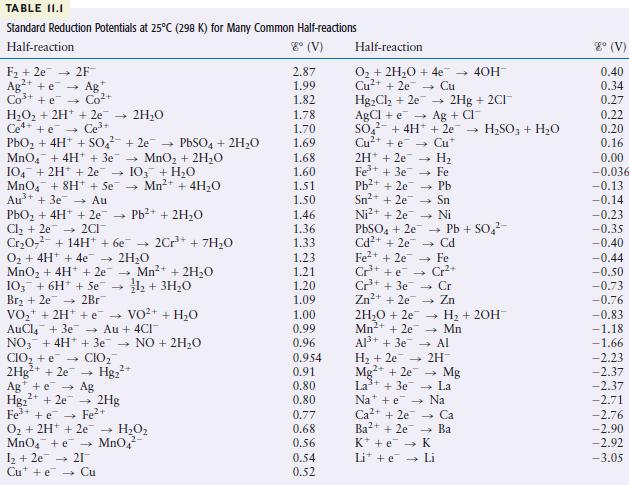
Consider only the species (at standard conditions)\[\mathrm{Na}^{+}, \mathrm{Cl}^{-}, \mathrm{Ag}^{+}, \mathrm{Ag}, \mathrm{Zn}^{2+}, \mathrm{Zn} \text {, and } \mathrm{Pb}\]in answering the following questions. Give reasons for your answers. (Use data from Table 11.1.)a. Which is the strongest
Use the table of standard reduction potentials (Table 11.1) to pick a reagent that is capable of each of the following oxidations (under standard conditions in acidic solution).a. oxidizes \(\mathrm{Br}^{-}\)to \(\mathrm{Br}_{2}\) but does not oxidize \(\mathrm{Cl}^{-}\)to \(\mathrm{Cl}_{2}\)b.
Use the table of standard reduction potentials (Table 11.1) to pick a reagent that is capable of each of the following reductions (under standard conditions in acidic solution).a. reduces \(\mathrm{Cu}^{2+}\) to \(\mathrm{Cu}\) but does not reduce \(\mathrm{Cu}^{2+}\) to \(\mathrm{Cu}^{+}\)b.
The amount of manganese in steel is determined by changing it to permanganate ion. The steel is first dissolved in nitric acid, producing \(\mathrm{Mn}^{2+}\) ions. These ions are then oxidized to the deeply colored \(\mathrm{MnO}_{4}{ }^{-}\)ions by periodate ion
For the following half-reaction, \(\mathscr{E}^{\circ}=-2.07 \mathrm{~V}\) :\[\mathrm{AlF}_{6}{ }^{3-}+3 \mathrm{e}^{-} \longrightarrow \mathrm{Al}+6 \mathrm{~F}^{-}\]Using data from Table 11.1, calculate the equilibrium constant at \(25^{\circ} \mathrm{C}\) for the reaction\[\mathrm{Al}^{3+}(a
The solubility product for \(\mathrm{CuI}(s)\) is \(1.1 \times 10^{-12}\). Calculate the value of \(\mathscr{E}^{\circ}\) for the half-reaction\[\mathrm{CuI}+\mathrm{e}^{-} \longrightarrow \mathrm{Cu}+\mathrm{I}^{-}\]
Calculate the \(\mathrm{pH}\) of the cathode compartment for the following reaction given \(\mathscr{E}_{\text {cell }}=3.01 \mathrm{~V}\) when \(\left[\mathrm{Cr}^{3+}ight]=\) \(0.15 \mathrm{M},\left[\mathrm{Al}^{3+}ight]=0.30 \mathrm{M}\), and \(\left[\mathrm{Cr}_{2} \mathrm{O}_{7}{
The overall reaction in the lead storage battery isa. Calculate \(\mathscr{E}\) at \(25^{\circ} \mathrm{C}\) for this battery when \(\left[\mathrm{H}_{2} \mathrm{SO}_{4}ight]=4.5 \mathrm{M}\); that is, \(\left[\mathrm{H}^{+}ight]=\left[\mathrm{HSO}_{4}{ }^{-}ight]=4.5 \mathrm{M}\). At \(25^{\circ}
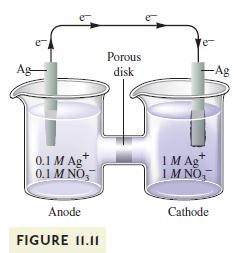
Concentration cells are commonly used to calculate the value of equilibrium constants for various reactions. For example, the silver concentration cell illustrated in Fig. 11.11 can be used to determine the \(K_{\text {sp }}\) value for \(\mathrm{AgCl}(s)\). To do so, \(\mathrm{NaCl}\) is added to
In the electrolysis of a sodium chloride solution, what volume of \(\mathrm{Cl}_{2}(\mathrm{~g})\) is produced in the same time it takes to produce \(6.00 \mathrm{~L}\) of \(\mathrm{H}_{2}(\mathrm{~g})\), both volumes measured at \(0^{\circ} \mathrm{C}\) and \(1.00 \mathrm{~atm}\) ?
The black silver sulfide discoloration of silverware can easily be removed by heating the silver article in a sodium carbonate solution in an aluminum pan. The reaction is\[3 \mathrm{Ag}_{2} \mathrm{~S}(s)+2 \mathrm{Al}(s) ightleftharpoons 6 \mathrm{Ag}(s)+3 \mathrm{~S}^{2-}(a q)+2
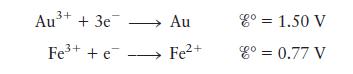
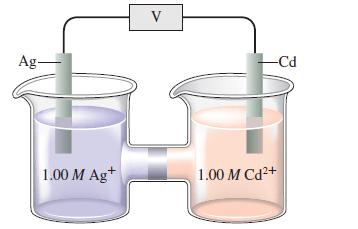
Consider a cell based on the following half-reactions:a. Draw this cell under standard conditions, labeling the anode, the cathode, the direction of electron flow, and the concentrations, as appropriate.b. When enough \(\mathrm{NaCl}(s)\) is added to the compartment containing gold to make
A zinc-copper battery is constructed as follows:\[\mathrm{Zn}\left|\mathrm{Zn}^{2+}(0.10 M)ight|\left|\mathrm{Cu}^{2+}(2.50 M)ight| \mathrm{Cu}\]The mass of each electrode is 200 . \(\mathrm{g}\).a. Calculate the cell potential when this battery is first connected.b. Calculate the cell potential
The measurement of \(\mathrm{F}^{-}\)ion concentration by ionselective electrodes at \(25.00^{\circ} \mathrm{C}\) obeys the equation\[\mathscr{E}_{\text {meas }}=\mathscr{E}_{\text {ref }}-0.05916 \log \left[\mathrm{F}^{-}ight]\]a. For a given solution, \(\mathscr{E}_{\text {meas }}\) is \(0.4462
You make a galvanic cell with a piece of nickel, \(1.0 \mathrm{M}\) \(\mathrm{Ni}^{2+}(a q)\), a piece of silver, and \(1.0 \mathrm{M} \mathrm{Ag}^{+}(a q)\). Calculate the concentrations of \(\mathrm{Ag}^{+}(a q)\) and \(\mathrm{Ni}^{2+}(a q)\) once the cell is "dead."
Consider the following galvanic cell:A 15.0-mol sample of \(\mathrm{NH}_{3}\) is added to the Ag compartment (assume 1.00 L of total solution after the addition). The silver ion reacts with ammonia to form complex ions as shown:\(\mathrm{Ag}^{+}(a q)+\mathrm{NH}_{3}(a q) ightleftharpoons
Describe completely the galvanic cell based on the following half-reactions under standard conditions: Ag + e Fe+ + e Ag Fe2+ 8 = 0.80 V 8 = 0.77 V (1) (2)
Using the data in Table 11.1, calculate ΔG° for the reactionIs this reaction spontaneous? Cu+ (aq) + Fe(s) Cu(s) + Fe+ (aq)
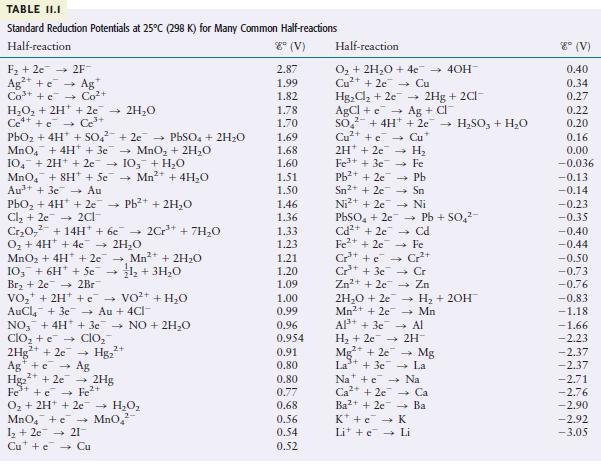
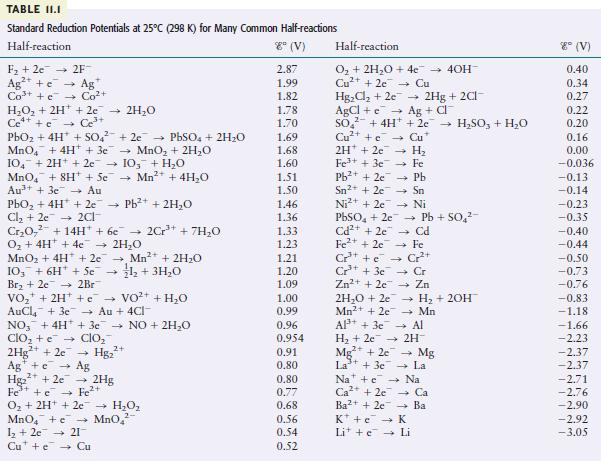
Using the data from Table 11.1, predict whether 1 M HNO3 will dissolve gold metal to form a 1 M Au3+ solution. TABLE II.I Standard Reduction Potentials at 25C (298 K) for Many Common Half-reactions Half-reaction 8 (V) F + 2e 2F Ag+ + Ag+ Co+ + e Co+ HO + 2H+ + 2e 2HO C++ c Ce + PbO + 4H+ + SO4
For the cell reactionpredict whether ξcell will be larger or smaller than ξ°cell for the following cases. 2Al(s) + 3Mn+ (aq) 2A1+ (aq) + 3Mn(s) Ecell = 0.48 V
Describe the cell based on the following half-reactions:where VO+ + 2H+ + e Zn+ +2e= VO+ + HO 2+ Zn 8 = 1.00 V 8 = -0.76 V (1) (2)
Showing 100 - 200
of 3011
1
2
3
4
5
6
7
8
9
10
11
12
13
14
15
Last
Step by Step Answers

 Get 50% OFF
Claim Now
Get 50% OFF
Claim Now


























![a. [A1+] = 2.0 M, [Mn+] = 1.0 M b. [Al+] = 1.0 M, [Mn+] = 3.0 M](https://dsd5zvtm8ll6.cloudfront.net/images/question_images/1706/0/8/9/90265b0ddaec97da1706089902283.jpg)

![T = 25C [VO+] = 2.0 M [H] = 0.50 M [VO+] = 1.0 x 10- M [Zn+] = 1.0 10- M](https://dsd5zvtm8ll6.cloudfront.net/images/question_images/1706/0/8/9/95565b0dde3d628f1706089955983.jpg)


