New Semester
Started
Get
50% OFF
Study Help!
--h --m --s
Claim Now
Question Answers
Textbooks
Find textbooks, questions and answers
Oops, something went wrong!
Change your search query and then try again
S
Books
FREE
Study Help
Expert Questions
Accounting
General Management
Mathematics
Finance
Organizational Behaviour
Law
Physics
Operating System
Management Leadership
Sociology
Programming
Marketing
Database
Computer Network
Economics
Textbooks Solutions
Accounting
Managerial Accounting
Management Leadership
Cost Accounting
Statistics
Business Law
Corporate Finance
Finance
Economics
Auditing
Tutors
Online Tutors
Find a Tutor
Hire a Tutor
Become a Tutor
AI Tutor
AI Study Planner
NEW
Sell Books
Search
Search
Sign In
Register
study help
sciences
chemical principles
Chemical Principles The Quest For Insight 7th Edition Peter Atkins, Loretta Jones, Leroy Laverman - Solutions
Identify five elements in the d-block that have positive standard potentials.
Which of the following ligands can be polydentate? If the ligand can be polydentate, give the maximum number of places on the ligand that can bind simultaneously to a single metal center:(a) HN(CH2CH2NH2)2;(b) CO3 2–;(c) H2O;(d) Oxalate.
Give the systematic name and chemical formula of the principal component of(a) Pyrite;(b) Chalcopyrite;(c) Basic copper carbonate;(d) Cinnabar.
Write the formulas for the oxoanions of the following elements in which the element is found with its highest oxidation number (see Fig. 9A.7). In each case, the charge of the oxoanion is given in parentheses.(a) V (–3);(b) Ti (–4).
(a) What is the overall reaction for the following mechanism?(b) Write the rate law based on this mechanism. (c) How will the reaction rate depend on the pH of the solution? (d) How would the rate law differ if the reactions were carried out in an organic solvent? CIO + H₂O HCIO + I HIO +
The pre-equilibrium and the steady-state approximations are two different approaches to deriving a rate law from a proposed mechanism. For the following mechanism, determine the rate law(a) By the pre-equilibrium approximation and(b) By the steady-state approximation.(c) Under what conditions do
Which of the following plots will be linear?(a) [A] against time for a reaction that is first order in A;(b) [A] against time for a reaction that is zeroth order in A;(c) ln [A] against time for a reaction that is first order in A;(d) 1/[A] against time for a reaction that is second order in
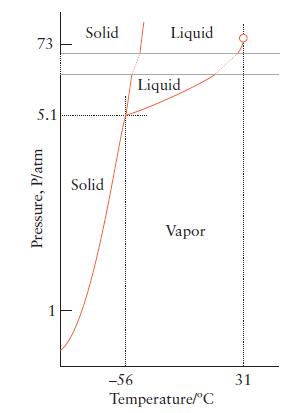
Use Fig. 5B.3 to predict the phase of a sample of CO2 under the following conditions:(a) 6 atm, –80 °C;(b) 1 atm, –56 °C;(c) 80. atm, 25 °C;(d) 5.1 atm, –56 °C.FIGURE 5B.3 73 5.1 Pressure, P/atm 1 Solid Solid -56 Liquid Liquid Vapor Temperature/C 31
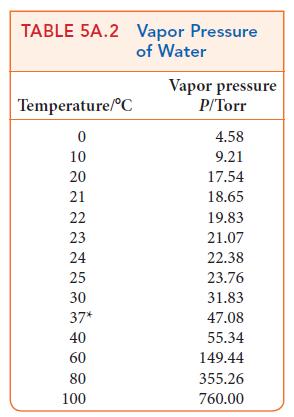
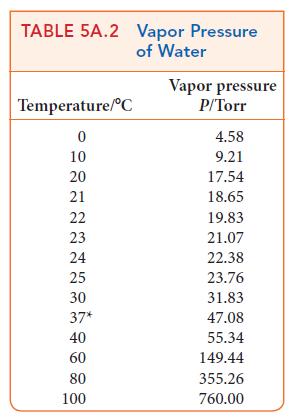
Calculate the vapor pressure of the solvent in each of the following solutions. Use Table 5A.2 to find the vapor pressure of water in(a) An aqueous solution at 100 °C in which the mole fraction of sucrose is 0.100;(b) An aqueous solution at 100 °C in which the concentration of sucrose is 0.100
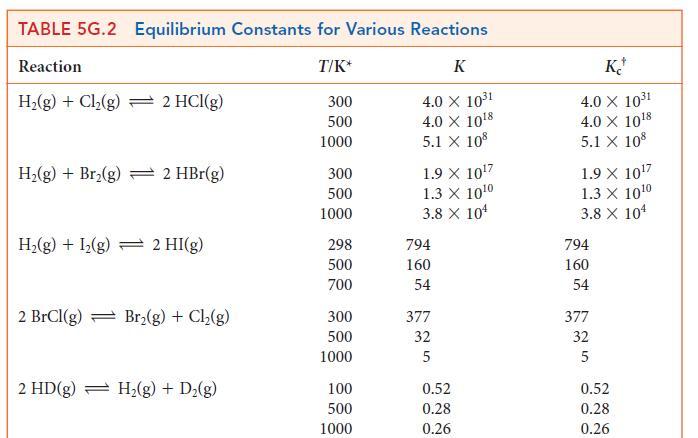
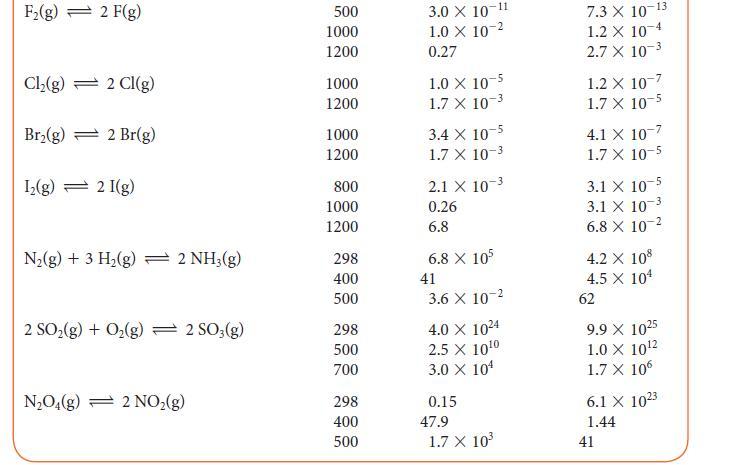
In a gas-phase equilibrium mixture of H2, Cl2, and HCl at 1000. K, [HCl] = 0.352 mmol · L–1 and [Cl2] = 7.21 mmol · L–1.Use the information in Table 5G.2 to calculate the equilibrium molar concentration of H2. TABLE 5G.2 Equilibrium Constants for Various Reactions Reaction T/K* K 4.0 X
What is the vapor pressure of the solvent in each of the following solutions:(a) The mole fraction of glucose is 0.0316 in an aqueous solution at 40°C;(b) An aqueous solution at 23°C is 0.0240 m CO(NH2)2, urea, a nonelectrolyte? Use the data in Table 5A.2 for the vapor pressure of water at
Ethanol is produced for use as a fuel from corn and agricultural waste. Ethanol plant engineers need to know at what temperature ethanol boils at different pressures. The vapor pressure of ethanol at 34.9 °C is 13.3 kPa. Use the data in Table 4C.1 to estimate the boiling temperature of ethanol at
Permanganate ions are powerful oxidizing agents used in water treatment facilities to remove metals, such as iron, and toxic and malodorous chemicals, such as H2S. If you are using permanganate solutions, you need to know the exact concentrations. Titration with oxalic acid is commonly used to
Calculate the standard Gibbs free energy for each of the following reactions: 2 HI(g), K = 54 at 700. K (a) H₂(g) + 1₂(g) (b) CCl3COOH (aq) + H₂O(1) = CCl₂CO₂ (aq) + H3O+ (aq), K = 0.30 at 298 K
What is the molality of acetone, C3H6O, in an aqueous solution for which the mole fraction of acetone is 0.112?
Iodine is an essential element for proper thyroid health. Seawater contains trace amounts of iodide, and you are exploring electrolysis of solutions of iodide as a means to purify the element. You need to know whether iodide or water will be oxidized at lower potentials. Suppose that an aqueous
You are working in a medical laboratory monitoring the recovery of patients in intensive care. The pH of their blood must be carefully monitored and controlled because even small deviations from normal levels can be fatal. What is the pH of (a) Human blood, in which the concentration of H3O+ ions
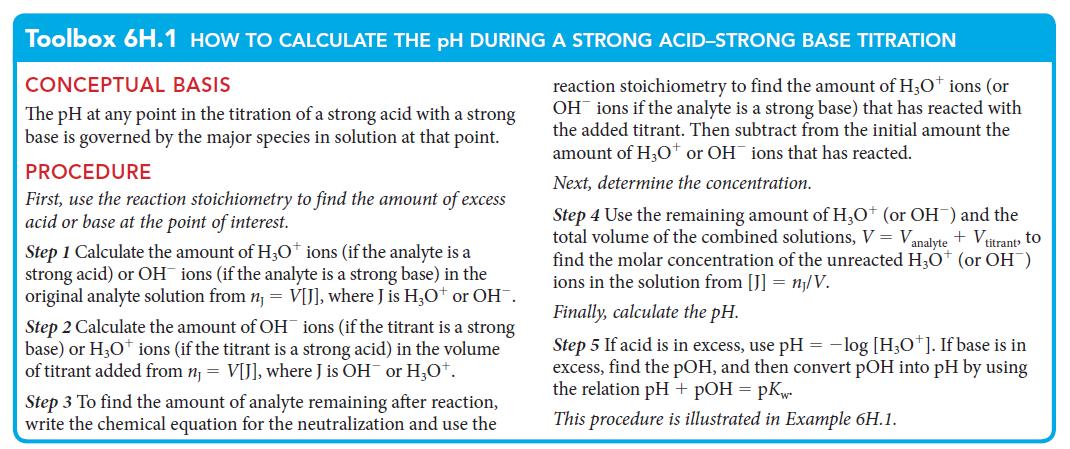
You want to check the accuracy of a pH meter used for titrations and so calculate the expected pH at various points in a titration. The analyte consists of 25.00 mL of 0.250 m NaOH(aq), and the titrant is 0.340 m HCl(aq). Calculate(a) The pH of the original analyte solution and(b) The pH after
You are an inorganic chemist with an interest in compounds of silver. One of your tasks is to compile a table of solubility products for its compounds from a list of their molar solubilities. The molar solubility of silver chromate, Ag2CrO4, is 65 μmol · L–1 at 25°C (so s = 6.5 * 10–5).
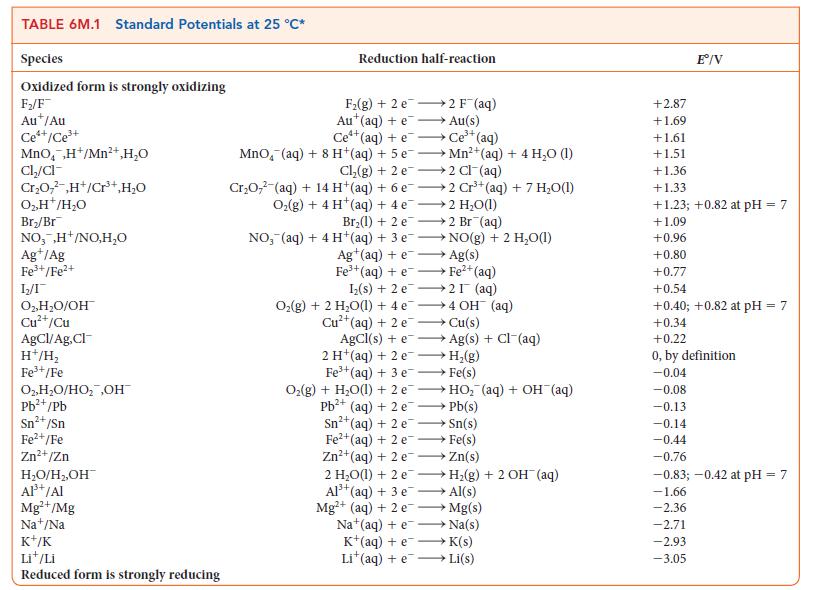
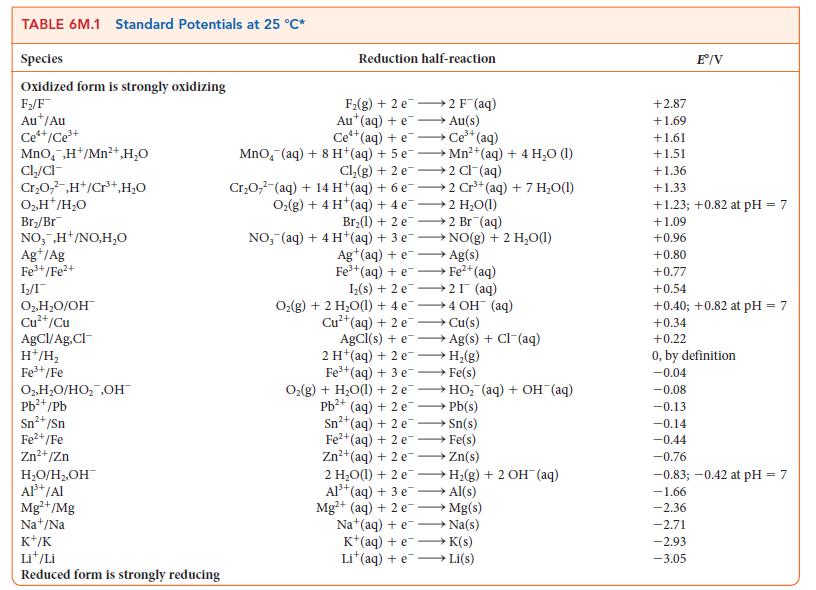
Suppose that you are in an engineering competition in which commercial power sources are prohibited. You might decide to use a Daniell cell to power a model electric car. You will need to know the potential of the cell corresponding to the concentrations of reagents you intend to use. The potential
Determine Ksp for each of the following sparingly soluble compounds, given their molar solubilities:(a) AgBr, 8.8 * 10–7 mol · L–1;(b) PbCrO4, 1.3 * 10–7 mol · L–1;(c) Ba(OH)2, 0.11 mol · L–1;(d) MgF2, 1.2 * 10–3 mol · L–1.
Calculate the standard reaction Gibbs free energy for the following cell reactions: 4+ (a) 2 Ce¹¹ (aq) + 3I (aq) →2 Ce³(aq) + 13 (aq), Ecell +1.08 V (b) 6 Fe³+(aq) +2 Cr³+(aq) + 7 H₂O(1)→ 6 Fe²+ (aq) + Cr₂O2 (aq) + 14 H*(aq), Ecellº = - 1.29 V
Salts are often used to create solutions with specific pH values. Suppose you need to prepare a salt solution with a pH of about 4.5 and have available sodium dihydrogen phosphate, NaH2PO4, and sodium citrate, Na2HC6H5O7. Which should you use? Estimate the pH of(a) 0.20 m NaH2PO4(aq);(b) 0.20 m
The molar concentration of HCl in hydrochloric acid is reduced to 12% of its initial value by dilution. What is the difference in the pH values of the two solutions?
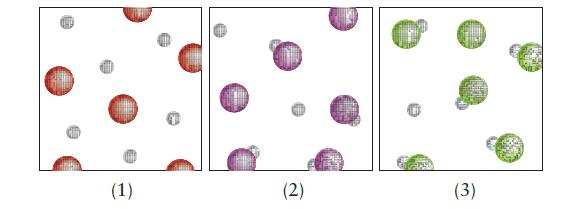
The images below represent the solutes in the solutions of three acids (water molecules are not shown, hydrogen atoms and hydronium ions are represented by small gray spheres, conjugate bases by large colored spheres).(a) Which acid is a strong acid?(b) Which acid has the strongest conjugate
You are working in the research laboratory of a company developing new forms of batteries for installation in satellites. As a part of your investigation, you have decided to study various combinations of metal electrodes. The standard potential of a Zn2+/Zn electrode is 20.76 V, and the standard
A student was given a standard Cu(s)|Cu2+(aq) half-cell and another half-cell containing an unknown metal M in 1.00 m M(NO3)2(aq) and formed the cell M(s)|M+(aq)||Cu2+(aq)|Cu(s). The cell potential was found to be 20.689 V. What is the value of E°(M2+/M)?
You are working in a microbiology laboratory culturing bacteria that require an acidic environment and you need to prepare a buffer to keep the culture at an appropriate pH. You prepare a buffer solution that is 0.040 m NaCH3CO2(aq) and 0.080 m CH3COOH(aq) at 25°C. What is the pH of the
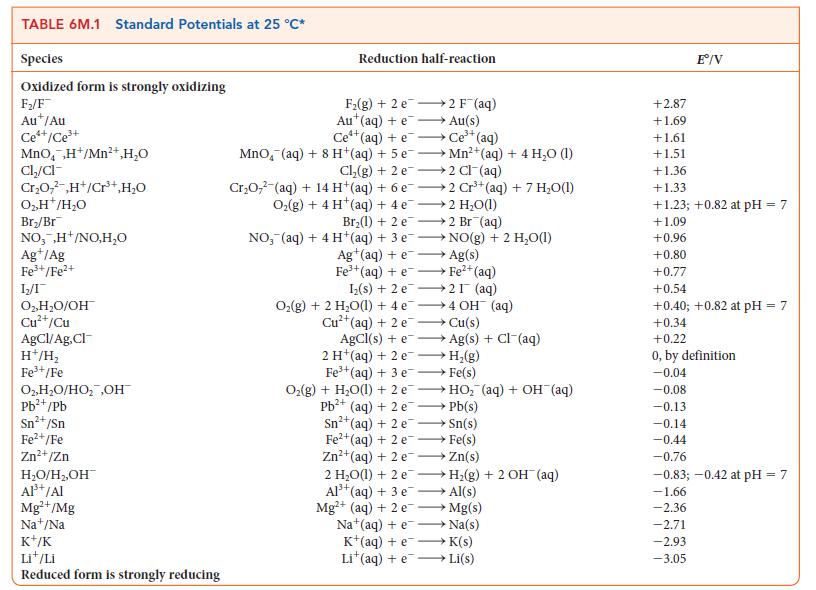
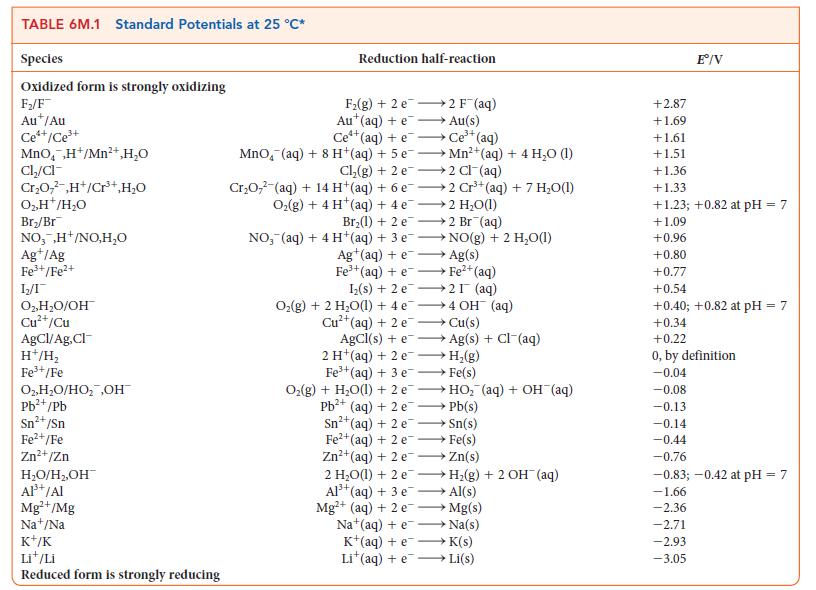
For the exercise in this topic, base your answers on the potentials listed in Table 6M.1 or Appendix 2B, with the exception of the reduction and oxidation of water at pH = 7:A 1.0 m NiSO4(aq) solution was electrolyzed by using inert electrodes. Write (a) The cathode reaction; (b) The anode
Write the formulas of the conjugate acids of(a) CH3NH2, methylamine;(b) NH2NH2, hydrazine;(c) HCO3 –; and the conjugate bases of(d) HCO3 –;(e) C6H5OH, phenol;(f) CH3COOH.
Suppose you are conducting research relating acid and base strength to molecular structure. You might begin by comparing compounds with known acidity and basicity constants. Decide which member of each of the following pairs is the stronger acid or base in water:(a) Acid: HF or HIO3;(b) Base:
Calculate the pH of 0.15 m H2SO4(aq) at 25°C.
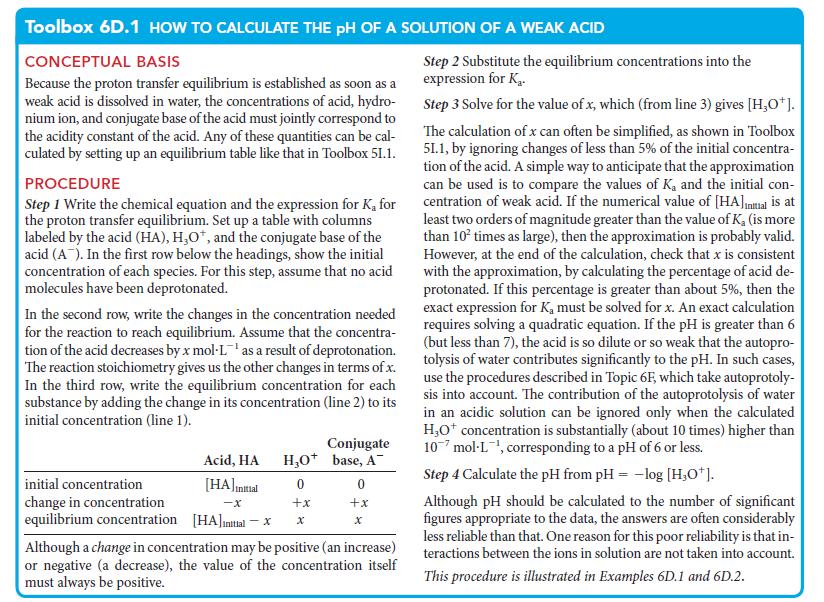
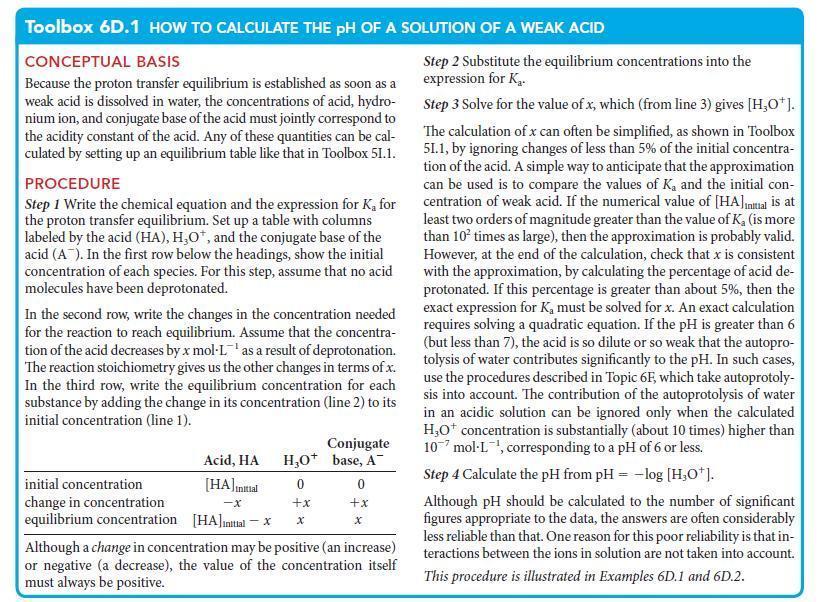
Acetic acid is a weak acid commonly found in both laboratory and household, but to what extent have its molecules actually been deprotonated? Calculate the pH and percentage deprotonation of CH3COOH molecules in 0.080 m CH3COOH(aq), given that Ka for acetic acid is 1.8 * 10–5.ANTICIPATE Because
Write(a) The chemical equation for the proton transfer equilibrium in water and the corresponding expression for Ka and(b) The chemical equation for the proton transfer equilibrium of the conjugate base and the corresponding expression for Kb for each of the following weak acids: (i)
Explain what happens to(a) The concentration of H3O+ ions in an acetic acid solution when solid sodium acetate is added;(b) The percentage deprotonation of benzoic acid in a benzoic acid solution when hydrochloric acid is added;(c) The pH of the solution when solid ammonium chloride is added to
(a) Sketch the titration curve for the titration of 5.00 mL 0.010 m NaOH(aq) with 0.0050 m HCl(aq), indicating the pH of the initial and final solutions and the pH at the stoichiometric point. What volume of titrant has been added at(b) The stoichiometric point;(c) The halfway point of the
For reactions in which the equilibrium constant is very large or very small, it can be difficult to measure the concentration of all species in solution in order to determine K. An alternative method is to measure the cell potential for a reaction and then to use Eq. 1b to obtain the equilibrium
You are an analytical chemist and are working out a procedure for precipitating lead from a solution of lead nitrate. You know that lead(II) iodide is insoluble, so you decide to use potassium iodide solution. Will the lead precipitate from the solutions that you have available? Will lead(II)
Calculate the equilibrium constants for the following reactions: (a) Mn(s) + Ti²+ (aq) = (b) In³+ (aq) + U³+ (aq) U³+ (aq) Mn²+ (aq) + Ti(s) In²+ (aq) + U4+ (aq)
Suppose you need to predict the products of a given reaction between an acid and a base. To do that you need to be able to write the formulas of the conjugate base and conjugate acid formed. Write the formulas of(a) The conjugate base of HCO3– and(b) The conjugate acid of O2–.PLAN Remove a
When chemists are using compounds as catalysts, sometimes only a very low concentration is needed. Suppose you are using 8.0 * 10–8 m HCl(aq) as a catalyst for an organic reaction and you are using a pH meter to gauge its acidity. What pH value should you expect?ANTICIPATE Although the acid is
Calculate the pH, pOH, and percentage deprotonation of each of the following aqueous solutions:(a) 0.20 m CH3COOH(aq);(b) 0.20 m CCl3COOH(aq);(c) 0.20 m HCOOH(aq).(d) Explain any differences in pH on the basis of molecular structure.
You are working in an analytical laboratory and have been asked to use the permanganate solution you prepared in Example 6K.1 to determine the concentration of bromide ions in a sample of groundwater sent to you by an environmental agency. The products of the reaction between bromide ions and
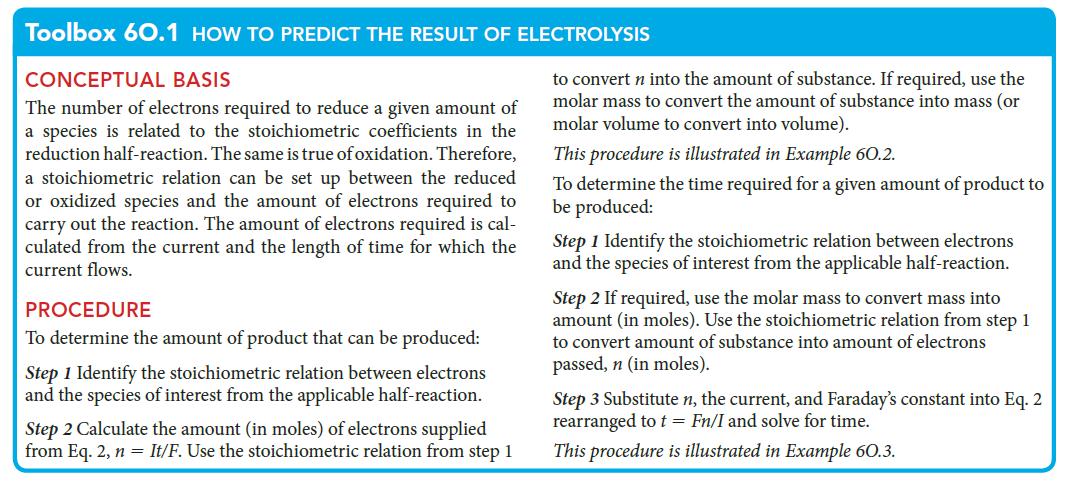
One of the largest uses of electricity is in the production of aluminum by electrolysis of its oxide dissolved in molten cryolite (Na3AlF6). As an engineer, you might need to predict how much aluminum can be produced by this process. Find the mass of aluminum that can be produced in 1.00 day in an
Calculate the pH of 6.55 * 10–7 m HClO4(aq).
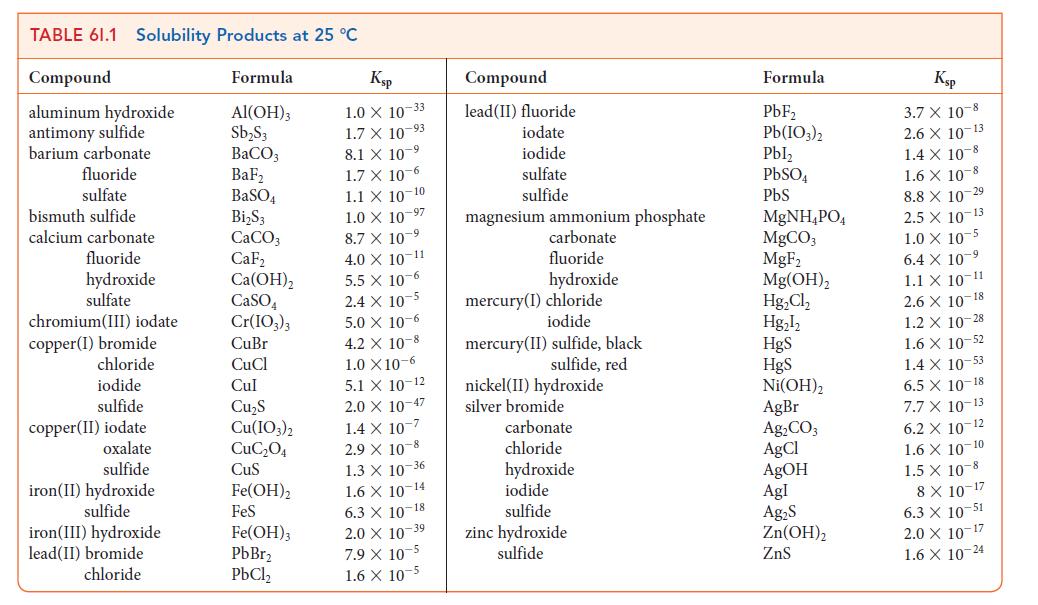
Although molar solubilities are often of interest, you might find it difficult to locate the appropriate data. Solubility constants, however, are often easier to find, and can be converted to molar solubilities. According to Table 6I.1, Ksp = 5.0 * 10–6 for chromium(III) iodate in water at 25°C.
(a) What concentration (in moles per liter) of Ag+ ions is required for the formation of a precipitate in 1.0 * 10–5 m NaCl(aq)?(b) What mass (in micrograms) of solid AgNO3 needs to be added for the onset of precipitation in 100. mL of the solution in part (a)?
For the exercise in this topic, base your answers on the potentials listed in Table 6M.1 or Appendix 2B, with the exception of the reduction and oxidation of water at pH = 7:A 1.0 m KBr(aq) solution was electrolyzed by using inert electrodes. Write(a) The cathode reaction;(b) The anode
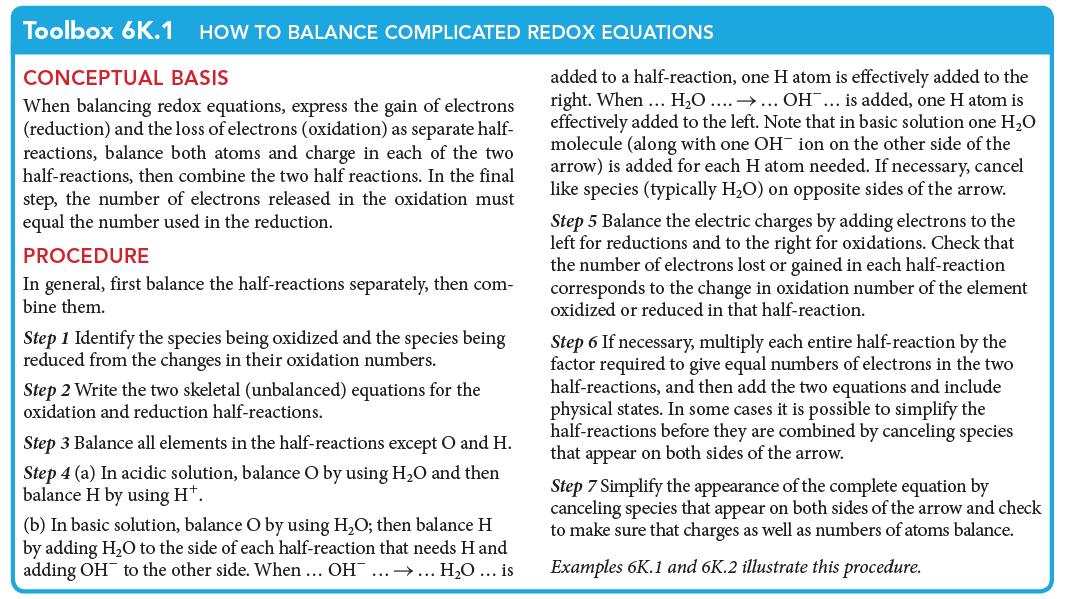
The following redox reaction is used in acidic solution to prepare orthotelluric acid:Identify the elements undergoing oxidation or reduction and indicate their initial and final oxidation numbers.(b) Write and balance the oxidation half-reaction.(c) Write and balance the reduction
The concentration of mercury, a toxic heavy metal pollutant, in aqueous solution depends in part on the redox properties of its compounds. Suppose you are studying the properties of mercury. You might need to construct an electrochemical cell and write the chemical equation for the cell reaction.
Determine Ksp for each of the following sparingly soluble compounds, given their molar solubilities:(a) AgI, 9.1 * 1029 mol · L–1;(b) Ca(OH)2, 0.011 mol · L–1;(c) Ag3PO4, 2.7 * 1026 mol · L–1;(d) Hg2Cl2, 5.2 * 1027 mol · L–1.
Ant venom contains formic acid (HCOOH; “formica” is the Latin word for ant). Suppose you are at a pharmaceutical company working on a quick antidote and need to estimate the pH at the stoichiometric point when titrating a solution of formic acid. Estimate the pH at the stoichiometric point of
Sometimes the pH must be converted into the hydronium ion concentration. The quickest way to find the hydronium ion concentration in a solution is to use a pH meter to measure the pH and then calculate [H3O+] from the pH. What is the molar concentration of hydronium ions in a solution with pH =
Calculate the standard reaction Gibbs free energy for the following cell reactions: (a) 3 Cr³+ (aq) + Bi(s) →3 Cr²+ (aq) + Bi³+ (aq), Ecell = -0.61 V (b) Mg(s) + 2 H₂O(1)→ Mg²+(aq) + H₂(g) + 2 OH (aq), Ecell +2.36 V
Calcium acetate, Ca(CH3CO2)2(aq), is used to treat patients with a kidney disease that results in high levels of phosphate ions in the blood. The calcium binds to the phosphates so that they can be excreted. If you are using calcium acetate for this purpose, it is important to know the pH of the
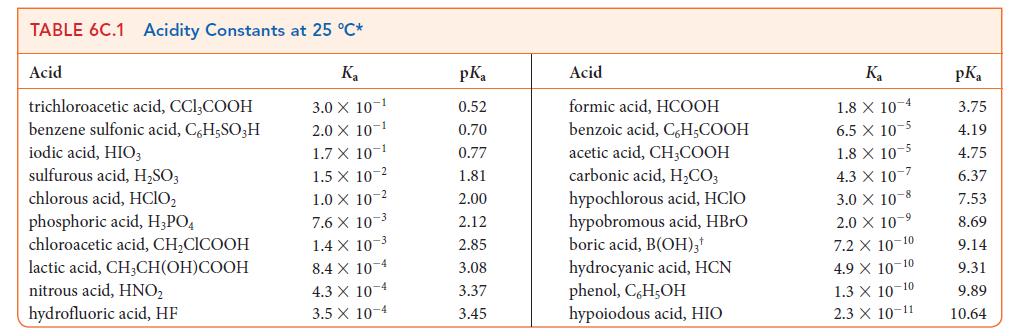
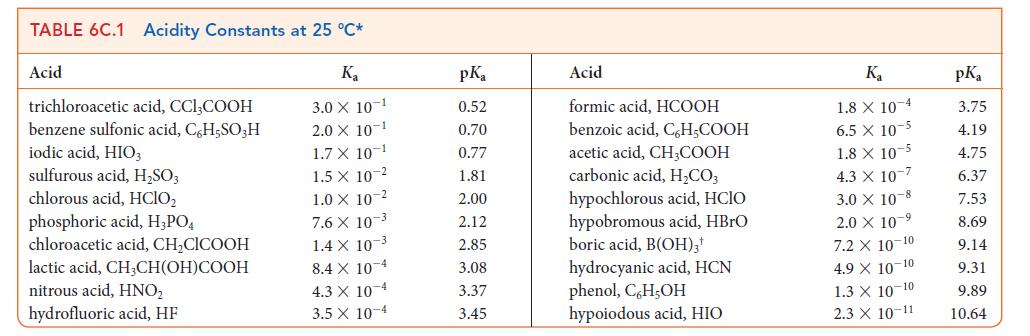
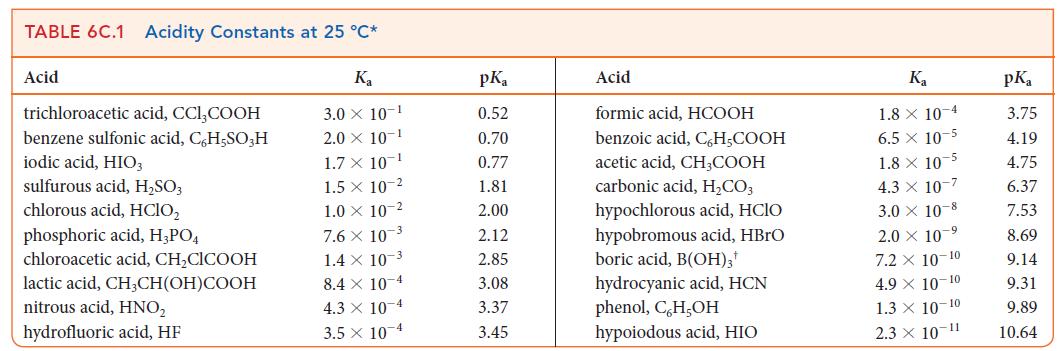
Write the chemical formula for the conjugate base of formic acid, HCOOH and calculate its pKb from the pKa of formic acid (see Table 6C.1). TABLE 6C.1 Acidity Constants at 25 °C* K₂ 3.0 X 10⁻¹ 2.0 X 10⁻¹ 1.7 X 10⁻¹ 1.5 X 1.0 X 10-2 Acid trichloroacetic acid, CCI,COOH benzene sulfonic acid,
Identify(a) The Brønsted acid and base in the following reaction, and(b) The conjugate base and acid formed: HNO3(aq) + HPO² (aq) NO3 (aq) + H₂PO4 (aq)
What is the concentration of hydronium ions in(a) A solution that is 0.075 m HCN(aq) and 0.060 m NaCN(aq);(b) A solution that is 0.20 m NH2NH2(aq) and 0.30 m NaCl(aq); (c) A solution that is 0.015 m HCN(aq) and 0.030 m NaCN(aq); (d) A solution that is 0.125 m NH2NH2(aq) and 0.125 m
Estimate the pH of(a) 0.15 m NaHSO3(aq);(b) 0.050 m NaHSO3(aq).
Calculate the pH at each stage in the titration for the addition of 0.150 m HCl(aq) to 25.0 mL of 0.110 m NaOH(aq):(a) Initially;(b) After the addition of 5.0 mL of acid;(c) After the addition of a further 5.0 mL;(d) At the stoichiometric point;(e) After the addition of 5.0 mL of acid beyond
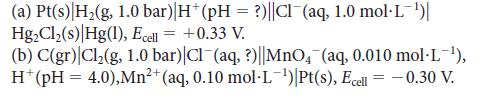
Evaluate the unknown quantity in each of the following cells: (a) Pt(s) |H₂(g, 1.0 bar) H*(pH = ?)||Cl¯(aq, 1.0 mol-L-¹) Hg₂Cl₂ (s) Hg(1), Ecell = +0.33 V. (b) C(gr) C1₂(g, 1.0 bar) |Cl¯(aq, ?)||MnO4 (aq, 0.010 mol-L-¹), H*(pH = 4.0),Mn²+ (aq, 0.10 mol.L-¹)|Pt(s), Ecell = -0.30 V.
Calculate the pH, pOH, and percentage protonation of solute in each of the following aqueous solutions:(a) 0.057 m NH3(aq);(b) 0.162 m NH2OH(aq);(c) 0.35 m (CH3)3N(aq);(d) 0.0073 m codeine, given that the pKa of its conjugate acid is 8.21.
The neglect of the autoprotolysis of water is invalid for 6 < pH < 8. What is the lowest concentration of aqueous acetic acid that does not require you to take into account the autoprotolysis of water when calculating the pH of the solution to within ±0.1?
For the exercise in this topic, base your answers on the potentials listed in Table 6M.1 or Appendix 2B, with the exception of the reduction and oxidation of water at pH = 7:A total charge of 67.2 kC is passed through an electrolytic cell. Determine the amount of substance produced in each
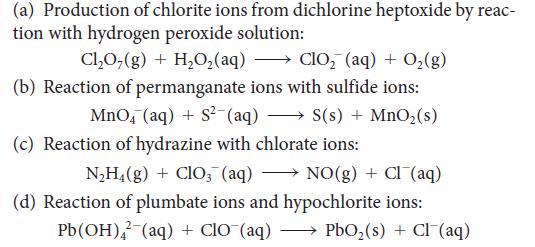
Balance each of the following skeletal equations by using oxidation and reduction half-reactions. All the reactions take place in basic solution. Identify the oxidizing agent and reducing agent in each reaction. (a) Production of chlorite ions from dichlorine heptoxide by reac- tion with hydrogen
Suppose that there are typically 20 average-sized drops in 1.0 mL of an aqueous solution. Will a precipitate form when 1 drop of 0.010 m NaCl(aq) is added to 10.0 mL of(a) 0.0040 m AgNO3(aq);(b) 0.0040 m Pb(NO3)2(aq)?
Assume 20 drops per milliliter. Will a precipitate form if (a) 7 drops of 0.0029 m K2CO3(aq) are added to 25.0 mL of 0.0018 m CaCl2(aq);(b) 10 drops of 0.010 m Na2CO3(aq) are added to 10.0 mL of 0.0040 m AgNO3(aq)? For the purpose of these calculations, ignore any reaction of the anion with water.
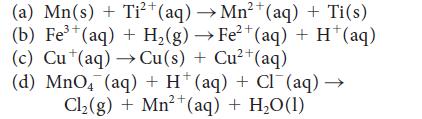
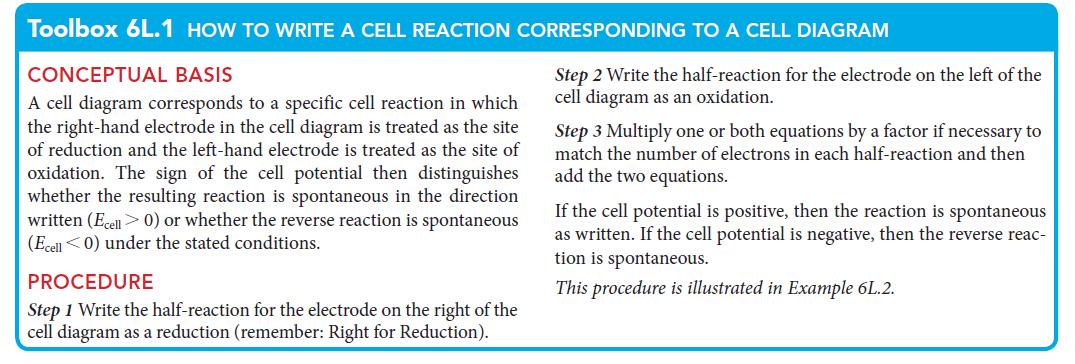
Write the half-reactions, the balanced equation for the cell reaction, and the cell diagram for each of the following skeletal equations: 2+ (a) Mn(s) + Ti²+ (aq) →→Mn²+ (aq) + Ti(s) 3+ (b) Fe³+ (aq) + H₂(g) → Fe²+ (aq) + H*(aq) (c) Cu (aq) →Cu(s) + Cu²+(aq) (d) MnO4 (aq) + H(aq) +
Calculate the molar solubility in water of(a) PbBr2;(b) Ag2CO3;(c) Fe(OH)2.
Calculate the pH and pOH of each of the following aqueous solutions of strong acid or base: (a) 0.0356 m HI(aq); (b) 0.0725 m HCl(aq);(c) 3.46 * 10–3 m Ba(OH)2(aq); (d) 10.9 mg of KOH dissolved in 10.0 mL of solution; (e) 10.0 mL of 5.00 m NaOH(aq) after dilution to 2.50 L;(f) 5.0 mL of 3.5 *
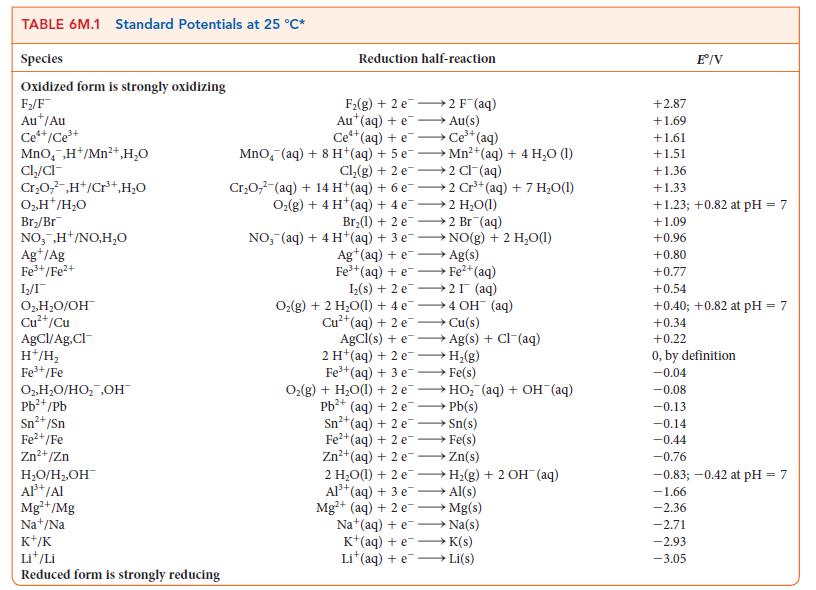
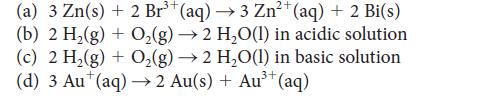
Predict the standard cell potential and calculate the standard reaction Gibbs free energy for galvanic cells having the following cell reactions: (a) 3 Zn(s) + 2 Br³ (aq) →3 Zn²+ (aq) + 2 Bi(s) (b) 2 H₂(g) + O₂(g) → 2 H₂O(l) in acidic solution - (c) 2 H₂(g) + O₂(g) → 2 H₂O(1) in
Dinitrogen monoxide, N2O, reacts with water to form hyponitrous acid, H2N2O2(aq), in a Lewis acid–base reaction.(a) Write the chemical equation for the reaction.(b) Draw the Lewis structures of N2O and H2N2O2 (the atoms are attached in the order HONNOH).(c) Identify the Lewis acid and Lewis
Identify(a) The Brønsted acid and base in the following reaction, and(b) The conjugate base and acid formed: HSO₂ (aq) + CH3NH3+ (aq) H₂SO3(aq) + CH₂NH₂ (aq)
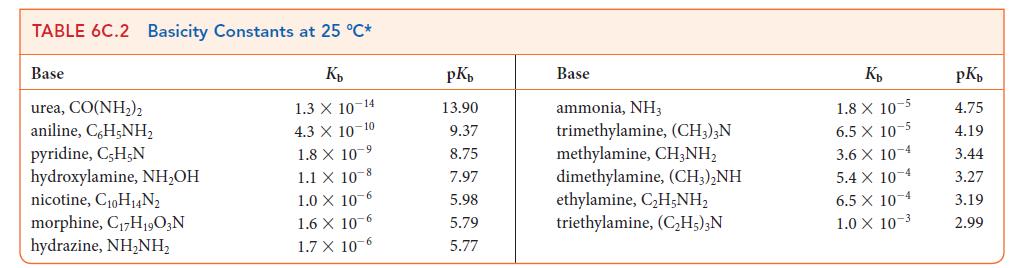
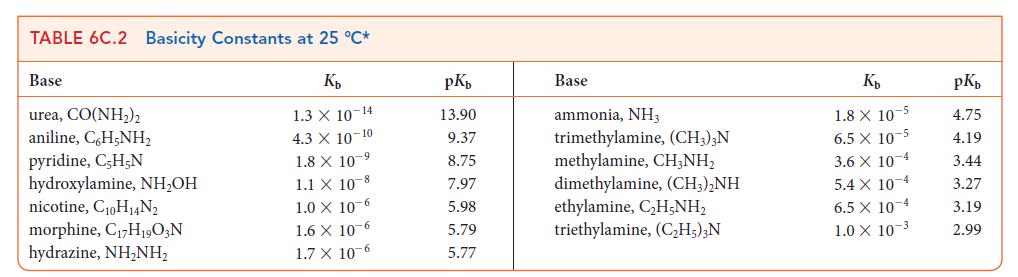
Write the chemical formula for the conjugate acid of triethylamine, (C2H5)3N, and calculate its pKa from the pKb of triethylamine (see Table 6C.2). TABLE 6C.2 Basicity Constants at 25 °C* Kb 1.3 X 10⁻¹⁴ 4.3 X 10⁻¹⁰ 1.8 X 10 9 Base urea, CO(NH,) aniline, C6H5NH₂ pyridine, C,H-N hydroxylamine,
What is the concentration of hydronium ions in(a) A solution that is 0.12 m HBrO(aq) and 0.160 m NaBrO(aq);(b) A solution that is 0.250 m CH3NH2(aq) and 0.150 m CH3NH3Cl(aq);(c) A solution that is 0.160 m HBrO(aq) and 0.320 m NaBrO(aq);(d) A solution that is 0.250 m CH3NH2(aq) and 0.250 m
Evaluate the unknown quantity in each of the following cells: (a) Pt(s) H₂(g, 1.0 bar) |H* (pH = ?)||Cl(aq,1.0 mol·L¹) AgCl(s) Ag(s), Ecell = +0.47 V. (b) Pb(s) Pb²+ (aq, ?)||Ni²+ (aq, 0.20 mol·L¹)|Ni(s), Ecell = +0.045 V.
Estimate the pH of(a) 0.0153 m NaHCO3(aq);(b) 0.110 m KHCO3(aq).
Calculate the pH at each stage in the titration in which 0.116 m HCl(aq) is added to 25.0 mL of 0.215 m KOH(aq): (a) Initially;(b) After the addition of 5.0 mL of acid;(c) After the addition of a further 5.0 mL;(d) At the stoichiometric point; (e) After the addition of 5.0 mL of acid beyond
Calculate the pOH, pH, and percentage protonation of solute in each of the following aqueous solutions:(a) 0.082 m C5H5N(aq), pyridine;(b) 0.0103 m C10H14N2(aq), nicotine;(c) 0.060 m aqueous quinine, given that the pKa of its conjugate acid is 8.52;(d) 0.045 m aqueous strychnine, given that the
For the exercise in this topic, base your answers on the potentials listed in Table 6M.1 or Appendix 2B, with the exception of the reduction and oxidation of water at pH = 7:(a) How much time is required to electroplate 1.50 g of silver from a silver nitrate solution by using a current of 13.6
The neglect of the autoprotolysis of water is invalid for 6 < pH < 8. At what concentration is it necessary to take into account the autoprotolysis of water when calculating the pH of an aqueous chloroacetic acid solution, ClCH2COOH, to within ±0.1? Account for any difference between this value
The concentrations of magnesium, calcium, and nickel(II) ions in an aqueous solution are 0.0010 mol · L–1.(a) In what order do they precipitate when solid KOH is added?(b) Determine the pH at which each salt precipitates.
The compound P4S3 is oxidized by nitrate ions in acid solution to give phosphoric acid, sulfate ions, and nitric oxide, NO.Write the balanced equation for each half-reaction and the overall equation for the reaction.
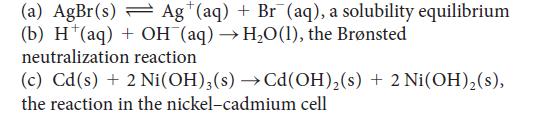
Write the half-reactions and devise a galvanic cell (write a cell diagram) to study each of the following reactions: (a) AgBr(s) Ag (aq) + Br (aq), a solubility equilibrium (b) H¹(aq) + OH (aq) →H₂O(1), the Brønsted neutralization reaction (c) Cd(s) + 2 Ni(OH)3(s) →Cd(OH)₂ (s)+ 2
Calculate the molar solubility of each substance in its respective solution:(a) Silver chloride in 0.20 m NaCl(aq);(b) Mercury(I) chloride in 0.150 m NaCl(aq);(c) Lead(II) chloride in 0.025 m CaCl2(aq);(d) Iron(II) hydroxide in 2.5 * 10–3 m FeCl2(aq).
Use data from Tables 6C.1 and 6C.2 to place the following acids in order of increasing strength: HNO2, HClO2, +NH3OH, (CH3)2NH2+. TABLE 6C.1 Acidity Constants at 25 °C* K₂ 3.0 X 10⁻¹ 2.0 X 10⁻¹ 1.7 X 10⁻¹ 1.5 X 1.0 X 10-2 Acid trichloroacetic acid, CCI,COOH benzene sulfonic acid, C,H,SO3H iodic
A combustion analysis of 1.200 g of an anhydrous sodium salt gave 0.942 g of CO2, 0.0964 g of H2O, and 0.246 g of Na. The molar mass of the salt is 112.02 g · mol–1.(a) What is the chemical formula of the salt?(b) The salt contains carboxylate groups (OCO2 –), and the carbon atoms are bonded
The pH of several solutions was measured in the research laboratories of a food company; convert each of the following pH values into the molar concentration of H3O+ ions: (a) 3.3 (the pH of sour orange juice); (b) 6.7 (the pH of a saliva sample); (c) 4.4 (the pH of beer); (d) 5.3 (the pH of a
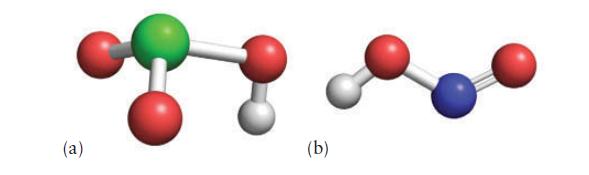
Below are molecular models of two oxoacids. Write the name of each acid and then draw the model of its conjugate base.(Red = O, white = H, green = Cl, and blue = N.) (a) (b)
Arrange the following metals in order of increasing strength as reducing agents for species in aqueous solution:(a) Cu, Zn, Cr, Fe;(b) Li, Na, K, Mg;(c) U, V, Ti, Al;(d) Ni, Sn, Au, Ag.
Is the criterion 6 In Example 6D.4, the pH of 0.15 m NH4Cl(aq) is found to be 5.04. However, the contribution to the pH from the autoprotolysis of water was ignored. Repeat the calculation of the pH of this solution, taking into account the autoprotolysis of water.Example 6D.4You are working in the
Is the criterion 6 3CO2)2(aq) is found to be 9.11. However, the contribution to the pH from the autoprotolysis of water was ignored. Repeat the calculation of the pH of this solution, taking into account the autoprotolysis of water.Example 6D.5Calcium acetate, Ca(CH3CO2)2(aq), is used to treat
Citric acid, which is extracted from citrus fruits and pineapples, undergoes three successive deprotonations with pKa values of 3.14, 5.95, and 6.39. Estimate the pH of(a) A 0.15 m aqueous solution of the monosodium salt;(b) A 0.075 m aqueous solution of the disodium salt.
Suppose that 1.436 g of impure sodium hydroxide is dissolved in 300. mL of aqueous solution and that 25.00 mL of this solution is titrated to the stoichiometric point with 34.20 mL of 0.0695 m HCl(aq). What is the (mass) percentage purity of the original sample?
Calculate Ecell for each of the following concentration cells: (a) Cu(s) Cu²+ (aq, 0.0010 mol-L-¹)||Cu²+ (aq, 0.010 mol-L-¹')|Cu(s) (b) Pt(s) |H₂(g, 1 bar)|H*(aq, pH = 4.0)||H+ (aq, pH = 3.0)| H₂(g, 1 bar) Pt(s)
Calculate the pH and pOH of(a) A solution that is 0.50 m NaHSO4(aq) and 0.25 m Na2SO4(aq);(b) A solution that is 0.50 m NaHSO4(aq) and 0.10 m Na2SO4(aq);(c) A solution that is 0.50 m NaHSO4(aq) and 0.50 m Na2SO4(aq).
Find the initial concentration of the weak acid or base in each of the following aqueous solutions:(a) A solution of HClO with pH = 4.60;(b) A solution of hydrazine, NH2NH2, with pH = 10.20.
For the exercise in this topic, base your answers on the potentials listed in Table 6M.1 or Appendix 2B, with the exception of the reduction and oxidation of water at pH = 7:(a) What current is required to electroplate 6.66 μg of gold in 30.0 min from a gold(III) chloride aqueous
Suppose that two hydroxides, MOH and M′(OH)2, both have Ksp = 1.0 * 10–12 and that initially both cations are present accompanied by nitrate ions in a solution at concentrations of 0.0010 mol · L–1. Which hydroxide precipitates first, and at what pH, when solid NaOH is added?
Iron(II) hydrogen phosphite, FeHPO3, is oxidized by hypochlorite ions in basic solution. The products are chloride ions, phosphate ions, and iron(III) hydroxide. Write the balanced equation for each half-reaction and the overall equation for the reaction.
Showing 1000 - 1100
of 3011
First
4
5
6
7
8
9
10
11
12
13
14
15
16
17
18
Last
Step by Step Answers

 Get 50% OFF
Claim Now
Get 50% OFF
Claim Now






![(1b) - = [+0H] 801- pH =](https://dsd5zvtm8ll6.cloudfront.net/images/question_images/1703/7/6/9/652658d7634c25601703769654222.jpg)




![[H30+] - [HC] initial[H30+] - Kw = 0 (1)](https://dsd5zvtm8ll6.cloudfront.net/images/question_images/1703/8/3/3/174658e6e56c86531703833174651.jpg)

![[HO+] = 10 PH mol-L-1 (2)](https://dsd5zvtm8ll6.cloudfront.net/images/question_images/1703/7/6/9/645658d762d6288c1703769643224.jpg)