New Semester
Started
Get
50% OFF
Study Help!
--h --m --s
Claim Now
Question Answers
Textbooks
Find textbooks, questions and answers
Oops, something went wrong!
Change your search query and then try again
S
Books
FREE
Study Help
Expert Questions
Accounting
General Management
Mathematics
Finance
Organizational Behaviour
Law
Physics
Operating System
Management Leadership
Sociology
Programming
Marketing
Database
Computer Network
Economics
Textbooks Solutions
Accounting
Managerial Accounting
Management Leadership
Cost Accounting
Statistics
Business Law
Corporate Finance
Finance
Economics
Auditing
Tutors
Online Tutors
Find a Tutor
Hire a Tutor
Become a Tutor
AI Tutor
AI Study Planner
NEW
Sell Books
Search
Search
Sign In
Register
study help
sciences
chemical principles
Chemical Principles The Quest For Insight 7th Edition Peter Atkins, Loretta Jones, Leroy Laverman - Solutions
A galvanic cell functions only when the electrical circuit is complete. In the external circuit the current is carried by the flow of electrons through a metal wire. Explain how the current is carried through the cell itself.
A technical handbook contains tables of thermodynamic quantities for common reactions. If you want to know whether a certain cell reaction has a positive standard potential, which of the following properties would give you that information directly (on inspection)? Which would not? Explain your
(a) If you were to construct a concentration cell in which one half-cell contains 1.0 m CrCl3(aq) and the other half-cell contains 0.0010 m CrCl3(aq), and both electrodes were chromium, at which electrode would reduction be spontaneous? How will each of the following changes affect the cell
Dental amalgam, a solid solution of silver and tin in mercury, was used for filling tooth cavities. Two of the reduction halfreactions that the filling can undergo areSuggest a reason why, if you accidentally bite on a piece of aluminum foil with a tooth containing a silver filling, you may feel
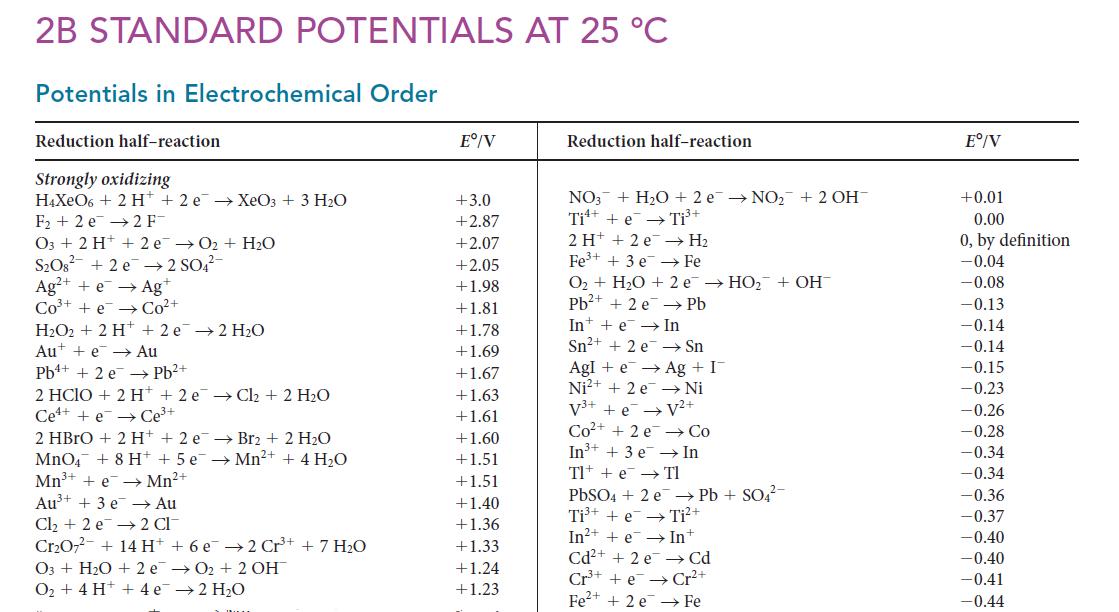
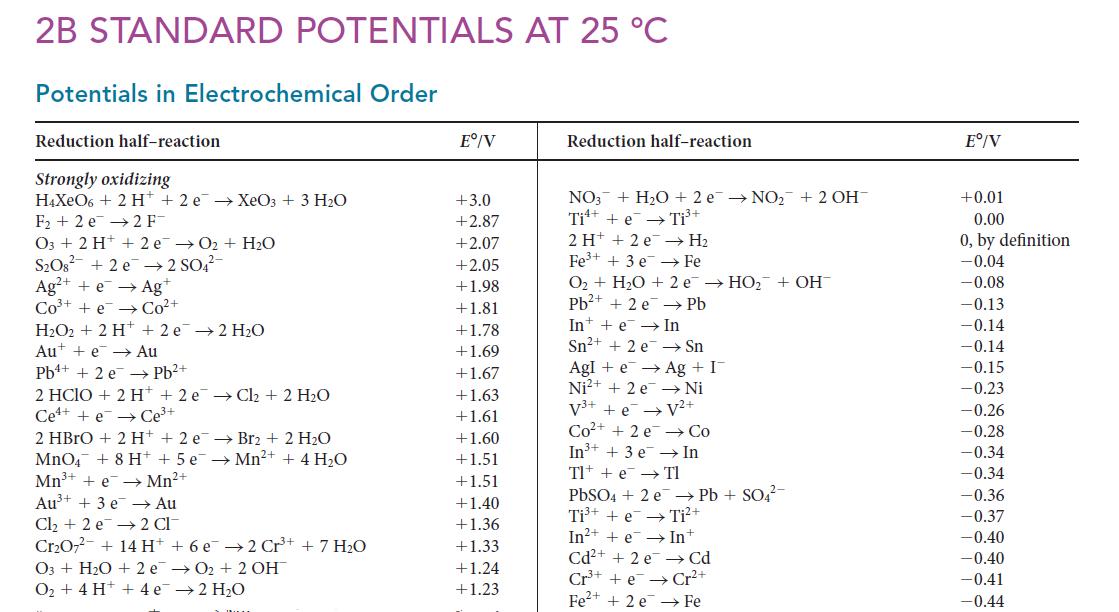
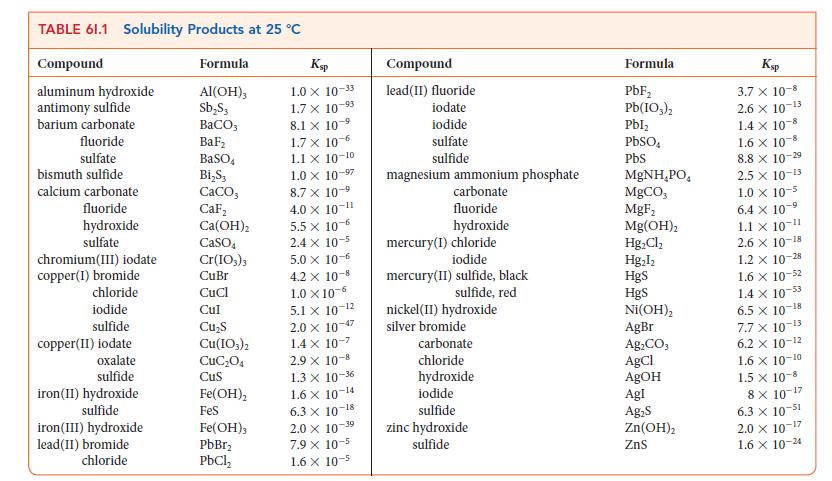
Use the data in Appendix 2B and the fact that, for the half-reaction F2(g) + 2 H+(aq) + 2 e– → 2 HF(aq), E° = 13.03 V, to calculate the value of Ka for HF. 2B STANDARD POTENTIALS AT 25 °C Potentials in Electrochemical Order Reduction half-reaction Strongly oxidizing H4XeO6+ 2 H+2 e → XeO3 +
Suppose that 25.0 mL of a solution of Ag+ ions of unknown concentration is titrated with 0.015 m KI(aq) at 25°C. A silver electrode is immersed in this solution, and its potential is measured relative to a standard hydrogen electrode. A total of 16.7 mL of KI(aq) was required to reach the
Suppose that 35.0 mL of 0.012 m Cu+(aq) is titrated with 0.010 m KBr(aq) at 25°C. A copper electrode is immersed in this solution, and its potential is measured relative to a standard hydrogen electrode. What volume of the KBr solution must be added to reach the stoichiometric point, and what will
The following items are obtained from a stockroom for the construction of a galvanic cell: two 250-mL beakers and a salt bridge, a voltmeter with attached wires and clips, 200 mL of 0.0080 m CrCl3(aq), 200 mL of 0.12 m CuSO4(aq), a piece of copper wire, and a chrome-plated piece of
(a) What is the standard cell potential (Ecell°) for the reaction below at 298 K?(b) What is the standard cell potential for the reaction at 335 K?(c) What is the cell potential for the reaction at 335 K when [Zn2+] = 2.0 * 10–4 mol · L–1 and [Pb2+] = 1.0 mol · L–1? 2+ Pb²+ (aq) +
(a) By considering the dependence of the Gibbs free energy of reaction on potential and on temperature, derive an equation for the temperature dependence of Ecell°.(b) Use your equation to predict the standard potential for the formation of water from hydrogen and oxygen in a fuel cell at 80°C.
In a neuron (a nerve cell), the concentration of K+ ions inside the cell is about 20–30 times as great as that outside. What potential difference between the inside and the outside of the cell would you expect to measure if the difference is due only to the imbalance of potassium ions?
(a) The potential of the cell Zn(s)|Zn2+(aq, ?)||Pb2+(aq, 0.10 mol · L–1)|Pb(s) is 10.661 V. What is the molar concentration of Zn2+ ions?(b) Write an equation showing how the Zn2+ ion concentration varies with the cell potential, assuming that all other aspects of the cell remain constant.
When a pH meter was calibrated with a boric acid–borate buffer with a pH of 9.40, the cell potential was +0.060 V. When the buffer was replaced with a solution of unknown hydronium ion concentration, the cell potential was +0.22 V. What is the pH of the solution?
What is the standard potential for the reduction of oxygen to water in(a) An acidic solution and(b) A basic solution?(c) Is MnO4– more likely to be reduced to MnO4 2– in an acidic or a basic oxygenated solution (a solution saturated with oxygen gas at 1 atm)? Explain your conclusion.
What range (in volts) does a voltmeter need to have to measure pH in the range of 1 to 14 at 25°C if the voltage is zero when pH = 7?
The entropy change of a cell reaction can be determined from the change of the cell potential with temperature.(a) Show that ΔS° = nF(Ecell,2° – Ecell,1°)/(T2 – T1). Assume that ΔS° and ΔH° are constant over the temperature range considered. (b) Calculate ΔS° and ΔH° for the cell
A silver concentration cell is constructed with the electrolyte at both electrodes being initially 0.10 m AgNO3(aq) at 25°C.The electrolyte at one electrode is diluted by a factor of 10 five times in succession and the cell potential measured each time. (a) Plot the potential of this cell against
Use only the data in Appendix 2B to calculate the acidity constant of HClO in water. 2B STANDARD POTENTIALS AT 25 °C Potentials in Electrochemical Order Reduction half-reaction Strongly oxidizing H4XeO6 + 2 H+ 2 e → XeO3 + 3 H₂O F₂2 e 2 F- O3 + 2H+ + 2 e→O₂ + H₂O S₂O8² +2e →2
Consider the electroplating of a metal +1 cation from a solution of unknown concentration according to the half-reaction M+(aq) + e– → M(s), with a standard potential E°. When the half-cell is connected to an appropriate oxidation half-cell and current is passed through it, the M+ cation
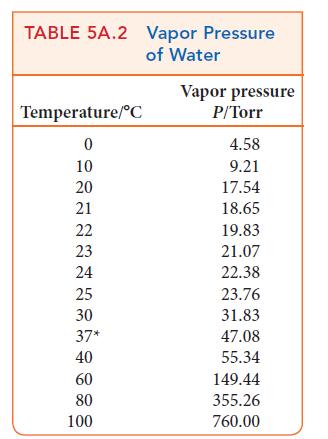
An aqueous solution of Na2SO4 was electrolyzed for 30.0 min; 25.0 mL of oxygen was collected at the anode over water at 22°C and a total pressure of 722 Torr. Determine the current that was used to produce the gas. See Table 5A.2 for the vapor pressure of water. TABLE 5A.2 Vapor Pressure of
The magnitudes of the standard potentials of two metals M and X were determined to beWhen the two electrodes are connected, current flows from M to X in the external circuit. When the electrode corresponding to half-reaction 1 is connected to the standard hydrogen electrode (SHE), current flows
A photoelectrochemical cell is an electrochemical cell that uses light to carry out an electrochemical reaction. The silicon electrodes in a photoelectrochemical cell being considered for the production of hydrogen react with water:Calculate the standard cell potential for the reaction between
The “aluminum–air fuel cell” is used as a reserve battery in remote locations. In this cell, aluminum reacts with the oxygen in air in basic solution.(a) Write the oxidation and reduction halfreactions for this cell.(b) Calculate the standard cell potential.
What is(a) The electrolyte and(b) The oxidizing agent during discharge in a lead–acid battery?(c) Write the reaction that takes place at the cathode during the charging of the lead–acid battery.
(a) Write the cell reaction for the lead–acid battery. (b) Explain how each of the following change in a lead–acid battery during discharge: pH; amount of PbO2; total amount of lead in the battery.
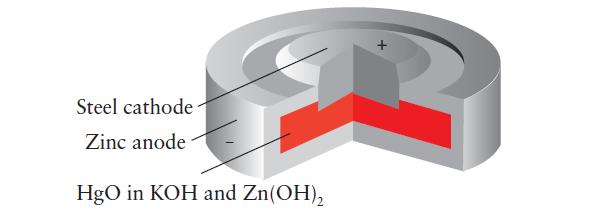
What is(a) The electrolyte and(b) The oxidizing agent in the mercury cell shown here?(c) Write the overall cell reaction for a mercury cell. Steel cathode Zinc anode HgO in KOH and Zn(OH)₂
(a) Why are lead–antimony grids used as electrodes in the lead–acid battery rather than smooth plates?(b) What is the reducing agent in the lead–acid battery?(c) The lead–acid cell potential is about 2 V. How, then, does a car battery produce 12 V for its electrical system?
Soluble nontoxic salts such as Fe2(SO4)3 are often used during water purification to remove soluble toxic contaminants, because they form gelatinous hydroxides that encapsulate the contaminants and allow them to be filtered from the water.(a) Calculate the molar solubility in water of Fe(OH)3 at
The body functions as a kind of fuel cell that uses oxygen from the air to oxidize glucose:During normal activity, a person uses the equivalent of about 10 MJ of energy a day. Assume that this value represents ΔG and estimate the average current through your body in the course of a day, assuming
A fuel cell in which hydrogen reacts with nitrogen instead of oxygen is proposed.(a) Write the chemical equation for the reaction in water, which produces aqueous ammonia.(b) What would be the maximum free energy output of the cell for the consumption of 28.0 kg nitrogen?(c) Is this type of fuel
Suppose you need highly pure HI. You could prepare it by reacting hydrogen and iodine directly by the reaction H2(g) + I2(g) → 2 HI(g), provided that the reaction is sufficiently fast. You might conduct an experiment to study the reaction rate to check if the preparation of HI in this process is
Many important biological reactions involve electron transfer. Because the pH of bodily fluids is close to 7, the “biological standard potential” of an electrode, E*, is measured at pH = 7.(a) Calculate the biological standard potential for (i) the reduction of hydrogen ions to hydrogen gas;
Complete the following statements relating to the production of ammonia by the Haber process, for which the overall reaction is N2(g) + 3 H2(g) →2 NH3(g). (a) The rate of consumption of N2 is ______________ times the rate of consumption of H2. (b) The rate of formation of NH3 is
You are working for a manufacturer of cleaning supplies and are investigating the use of hydrogen peroxide, H2O2, as a stain removal agent in laundry detergent. However, the water available in the market test region contains an iron oxide component and you want to know if this will interfere with
The rate constant of the first-order reaction 2 N2O(g) → 2 N2(g) + O2(g) is 0.76 s–1 at 1000. K and 0.87 s–1 at 1030. K. Calculate the activation energy of the reaction.
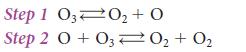
The decomposition of ozone in the stratosphere is an issue of great concern because stratospheric ozone protects life on Earth. Suppose you are studying the mechanism of ozone decomposition. The following rate law has been determined for the decomposition of ozone discussed at the beginning of this
How does a catalyst affect(a) The rate of the reverse reaction;(b) The value of ΔHr° for the reaction?
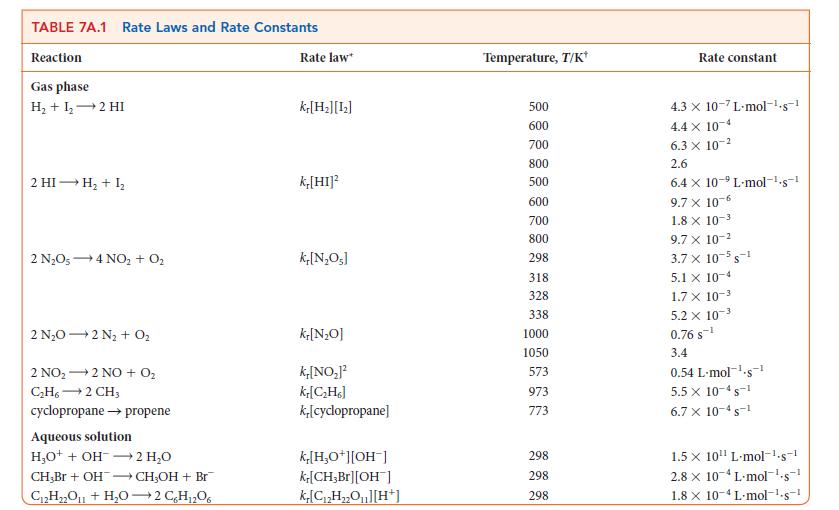
In polar stratospheric clouds, nitrogen can be found as N2O5, which takes part in the ozone cycle that protects life on Earth. However, N2O5 decomposes over time. If you were studying the role of the atmosphere in climate change, you might need to know how much N2O5 remains after a given period of
Each of the following is an elementary reaction. Write its rate law and state its molecularity.(a) NO + NO → N2O2;(b) Cl2 → Cl + Cl.
An important reaction in organic chemistry is that of organic halides with hydroxide ion to form alcohols. You are interested in learning about the impact of temperature on the rate of this kind of reaction, so you decide to determine the Arrhenius parameters for one such reaction.The rate constant
Beta blockers are drugs that are used to manage hypertension. It is important for doctors to know how rapidly a beta blocker is eliminated from the body. A certain beta blocker is eliminated in a first-order process with a rate constant of 7.6 * 10–3 min–1 at normal body temperature (37°C). A
If you pursue a career in inorganic or physical chemistry, you may one day be studying the rate of the reaction of bromate ion with bromide ion. Suppose you conduct four experiments to discover how the initial rate of consumption of BrO3– ions varies as the concentrations of the reactants are
The hydrolysis of sucrose is a part of the digestive process. Suppose you want to investigate how strongly the rate depends on body temperature and decide to calculate the rate constant for the hydrolysis of sucrose at 35.0 °C, given that kr = 1.0 mL · mol–1 · s–1 at 37.0 °C (normal body
Complete the following statements for the reaction 6 Li(s) + N2(g) →2 Li3N(s). (a) The rate of consumption of N2 is ________________ times the rate of formation of Li3N. (b) The rate of formation of Li3N is ________________ times the rate of consumption of Li. (c) The rate of consumption of N2
The rate constant of the second-order reaction 2 HI(g) → H2(g) + I2(g) is 2.4 * 10–6 L · mol–1 · s–1 at 575 K and 6.0 * 10–5 L · mol–1 · s–1 at 630. K. Calculate the activation energy of the reaction.
How does a homogeneous catalyst affect(a) The rate law;(b) The equilibrium constant of a reaction?
Many organic compounds can isomerize (turn into another compound with the same molecular formula) when heated. Suppose you are an organic chemist studying cyclopropane. You find that when cyclopropane (C3H6, 1) is heated to 500. °C (773 K), it converts into an isomer, propene (2). You collect the
Each of the following is an elementary reaction. Write its rate law and state its molecularity.(a) OH + NO2 + N2 → HNO3 + N2 (N2 takes part in the collision, but is unchanged chemically);(b) ClO2 + H2O → HClO + OH2.
In the brewing of beer, ethanal, which smells like green apples, is an intermediate in the formation of ethanol. Ethanal decomposes in the following first-order reaction: CH3CHO(g) → CH4(g) + CO(g). At a certain temperature, the rate constant for the decomposition is 1.5 * 10–3 s–1. What
Ethene is a component of natural gas, and its combustion has been thoroughly studied. At a certain temperature and pressure, the unique rate of the combustion reaction C2H4(g)+ 3 O2(g) →2 CO2(g) + 2 H2O(g) is 0.44 mol · L–1 · s–1. (a) What is the rate at which oxygen reacts? (b) What is
Volta discovered that when he used different metals in his “pile,” some combinations had a stronger effect than others. From that information he constructed an electrochemical series. How would Volta have ordered the following metals, if he put the most strongly reducing metal first: Fe, Ag,
(a) Use a graphing calculator or standard graphing software to make an Arrhenius plot of the data shown here for the conversion of cyclopropane into propene and calculate the activation energy for the reaction.(b) What is the value of the rate constant at 600°C? T/K k/s¹ 750. 800. 850. 900. 1.8
As in Example 7B.1, you are studying the decomposition of N2O5, but now you need to know how long it takes for a given amount of N2O5 to decompose. A sample of N2O5 is allowed to decompose by the reaction 2 N2O5(g) → 4 NO2(g) + O2(g). How long will it take for the concentration of N2O5 to
Write the overall reaction for the mechanism proposed below and identify any reaction intermediates. Step 1 AC + BAB+C Step 2 AC + AB →→→ A₂B + C
The presence of a catalyst provides a reaction pathway in which the activation energy of a certain reaction is reduced from 125 kJ · mol−1 to 75 kJ · mol−1.(a) By what factor does the rate of the reaction increase at 298 K, all other factors being equal?(b) By what factor would the rate
Determine the rate constant for each of the following first-order reactions, in each case expressed for the rate of loss of A:(a) A → B, given that the concentration of A decreases to one-half its initial value in 1000. s; (b) A → B, given that the concentration of A decreases from 0.67 mol ·
(a) Use a graphing calculator or standard graphing software to make an Arrhenius plot of the data shown here for the decomposition of iodoethane into ethene and hydrogen iodide, C2H5I(g) → C2H4 (g) + HI(g), and determine the activation energy for the reaction.(b) What is the value of the rate
The “iodine clock reaction” is a popular chemical demonstration. As part of that demonstration, the I3– ion is generated in the reaction S2O82– (aq) + 3 I–(aq) →2 SO4 2–(aq) + I3–(aq). In one trial, the unique rate of reaction was 4.5 μmol · L–1 · s–1.(a) What was the
Write the overall reaction for the mechanism proposed below and identify any reaction intermediates. + CH₂ + Br¯ Step 1 C,H,Br + Step 2 C₂H₂ + H₂O →C₂H₂OH₂+ Step 3 C₂H,OH₂++ H₂OC₂H,OH + H₂0+
In 1989, a teenager in Ohio was poisoned by breathing vapors from spilled mercury. The mercury level in his urine, which is proportional to its concentration in his body, was found to be 1.54 mg · L–1. Suppose you are working in a toxicology laboratory. You need to know from a urine analysis how
The presence of a catalyst provides a reaction pathway in which the activation energy of a certain reaction is reduced from 75 kJ · mol−1 to 52 kJ · mol−1.(a) By what factor does the rate of the reaction increase at 200. K, all other factors being equal?(b) By what factor would the rate
Determine the rate constant for each of the following first-order reactions:(a) A → B + C, given that the concentration of A decreases to one-fourth its initial value in 125 min;(b) 2 A → D + E, given that [A]0 = 0.0421 mol · L–1 and that after 63 s the concentration of D increases to
The decomposition of gaseous hydrogen iodide, 2 HI(g) → H2(g) 1 I2(g), gives the data shown here for 700. K.(a) Use a graphing calculator or standard graphing soft ware to plot the concentration of HI as a function of time. (b) Estimate the rate of decomposition of HI at each time. (c) Plot the
The rate constant of the reaction between CO2 and OH– in aqueous solution to give the HCO3– ion is 1.5 * 1010 L · mol–1 · s–1 at 25°C. Determine the rate constant at human body temperature (37°C), given that the activation energy for the reaction is 38 kJ · mol–1.
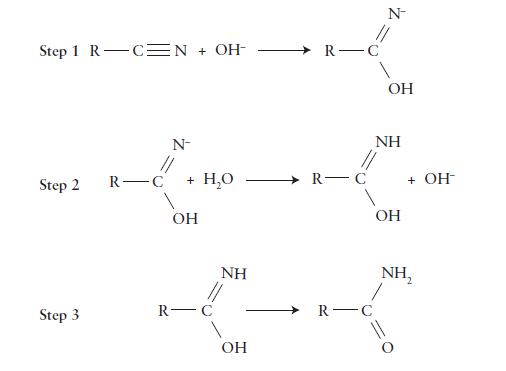
The hydrolysis of an organic nitrile, a compound containing a—C≡N group, in basic solution, is proposed to proceed by the following mechanism. Write a complete balanced equation for the overall reaction, list any intermediates, and identify the catalyst in this reaction. Step 1 R C N + OH- Step
The following mechanism has been proposed for the gasphase reaction between HBr and NO2:(a) Write the overall reaction. (b) Write the rate law for each step and indicate its molecularity. (c) What is the reaction intermediate? Step 1 HBr + NO₂ HBrO + NO Step 2 HBr + HBrO → H₂O +
Dinitrogen pentoxide, N2O5, decomposes by first-order kinetics with a rate constant of 3.7 * 10–5 s–1 at 298 K. (a) What is the half-life (in hours) of N2O5 at 298 K?(b) If [N2O5]0 = 0.0567 mol · L–1, what will be the concentration of N2O5 after 3.5 h?(c) How much time (in minutes) will
Dinitrogen pentoxide, N2O5, decomposes by first-order kinetics with a rate constant of 0.15 s–1 at 353 K.(a) What is the half-life (in seconds) of N2O5 at 353 K?(b) If [N2O5]0 = 0.0567 mol · L–1, what will be the concentration of N2O5 after 2.0 s?(c) How much time (in minutes) will elapse
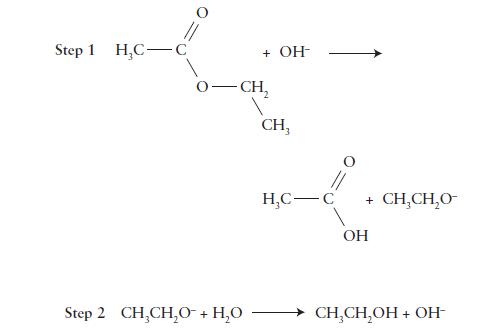
Consider the following mechanism for the hydrolysis of ethyl acetate. Write a complete balanced equation for the overall reaction, list any intermediates, and identify the catalyst in this reaction. Step 1 H₂C-C + OH- o–CH, Step 2 CH₂CH₂O + H₂O CH3 H₂C- с + CHỊCH,O- OH CH₂CH₂OH +
Ethane, C2H6, dissociates into methyl radicals at 700.°C with a rate constant kr = 5.5 * 10–4 s–1. Determine the rate constant at 870. °C, given that the activation energy of the reaction is 384 kJ · mol–1.
The decomposition of gaseous dinitrogen pentoxide in the reaction 2 N2O5(g) →4 NO2(g) + O2(g) gives the data shown here at 298 K. (a) Using a graphing calculator or standard graphing software, plot the concentration of N2O5 as a function of time.(b) Estimate the rate of decomposition of N2O5 at
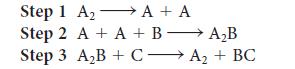
A reaction was believed to occur by the following mechanism.(a) Write the overall reaction.(b) Write the rate law for each step and indicate its molecularity.(c) What are the reaction intermediates?(d) A catalyst is a substance that accelerates the rate of a reaction and is regenerated in the
Substance A decomposes in a first-order reaction and its half life is 355 s. How much time must elapse for the concentration of A to decrease to(a) One-eighth of its initial concentration;(b) One-fourth of its initial concentration;(c) 15% of its initial concentration;(d) One-ninth of its
For the reversible, one-step reaction A 1 A ⇄ B + C, the forward rate constant for the formation of B is 265 L · mol–1 · min–1 and the rate constant for the reverse reaction is 392 L · mol–1 · min–1. The activation energy for the forward reaction is 39.7 kJ · mol–1 and that of
Decide which of the following statements about catalysts are true. If the statement is false, explain why.(a) In an equilibrium process, a catalyst increases the rate of the forward reaction but leaves the rate of the reverse reaction unchanged.(b) A catalyst is not consumed in the course of a
Express the units for rate constants when the concentrations are in moles per liter and time is in seconds for(a) Zeroth-order reactions;(b) First-order reactions;(c) Second-order reactions.
The following mechanism has been proposed for the reaction between nitric oxide and bromine:Write the rate law for the formation of NOBr implied by this mechanism. Step 1 NO Br₂ NOBr₂ Step 2 NOBr₂ + NONOBr + NOBr (slow) (fast)
The first-order rate constant for the photodissociation of A is 1.24 * 10–3 min–1. Calculate the time needed for the concentration of A to decrease to(a) 25 % of its initial concentration;(b) One-sixth of its initial concentration.
For the reversible, one-step reaction A 1 B ⇄ C + D the forward rate constant is 52.4 L · mol–1 · h–1 and the rate constant for the reverse reaction is 32.1 L · mol–1 · h–1. The activation energy was found to be 35.2 kJ · mol–1 for the forward reaction and 44.0 kJ · mol–1 for
Decide which of the following statements about catalysts are true. If the statement is false, explain why.(a) A heterogeneous catalyst works by binding one or more of the molecules undergoing reaction to the surface of the catalyst.(b) Enzymes are naturally occurring proteins that serve as
The mechanism proposed for the oxidation of iodide ion by the hypochlorite ion in aqueous solution is as follows:Write the rate law for the formation of HIO implied by this mechanism. Step 1 ClO + H₂0HCIO + OH and its reverse (both fast, equilibrium) Step 2 I + HClO →→ HIO + Cl¯ Step 3 HIO +
Rate laws for gas-phase reactions can also be expressed in terms of partial pressures, for instance, as Rate 5 krPJ for a firstorder reaction of a gas J. What are the units for the rate constants when partial pressures are expressed in Torr and time is expressed in seconds for(a) Zeroth-order
The Michaelis–Menten rate equation for enzyme reactions is typically written as the rate of formation of product (Eq. 1a).This equation implies that 1/rate (where rate is the rate of formation of product) depends linearly on the inverse of the substrate concentration [S]. This relation allows KM
For the first-order reaction A → 3 B + C, when [A]0 = 0.015 mol · L–1, the concentration of B increases to 0.018 mol · L–1 in 3.0 min.(a) What is the rate constant for the reaction expressed as the rate of loss of A?(b) How much more time would be needed for the concentration of B to
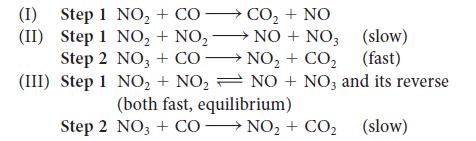
Three mechanisms for the reaction NO2(g) + CO(g) → CO2(g) + NO(g) have been proposed:Which mechanism agrees with the following rate law: Rate = kr[NO2]2? Explain your reasoning. Step 1 NO₂ + Step 1 Step 2 (III) Step 1 (1) (II) Step 2 COCO₂ + NO NO + NO3 NO₂ CO₂ NO+ NO3 and its
Dinitrogen pentoxide, N2O5, decomposes by a first-order reaction. What is the initial rate of decomposition of N2O5 when 3.45 g of N2O5 is confined in a container of volume 0.750 L and heated to 65°C? For this reaction, kr = 5.2 * 10–3 s–1 in the rate law (for the rate of decomposition of
Pyruvic acid is an intermediate in the fermentation of grains. During fermentation the enzyme pyruvate decarboxylase causes the pyruvate ion to release carbon dioxide. In one experiment, an aqueous solution of pyruvate ions of volume 200 mL at an initial concentration of 3.23 mmol · L–1 is
The following data were collected for the reaction 2 HI(g) → H2(g) + I2(g) at 580 K. (a) Use a graphing calculator or software to plot the data in an appropriate fashion to determine the order of the reaction. (b) From the graph, determine the rate constant for (i) the rate law for the loss of
The Michaelis constant (KM) is an index of the stability of an enzyme–substrate complex. Does a high Michaelis constant indicate a long-lived or short-lived enzyme–substrate complex?Explain your reasoning.
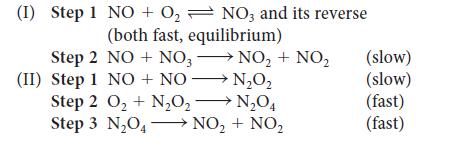
When the rate of the reaction 2 NO(g) + O2(g) → 2 NO2(g) was studied, the rate was found to double when the O2 concentration alone was doubled but to quadruple when the NO concentration alone was doubled. Which of the following mechanisms accounts for these observations? Explain your reasoning.
Ethane, C2H6, dissociates into methyl radicals by a firstorder reaction at 700°C. If 820. mg of ethane is confined to a reaction vessel of volume 2.00 L and heated to 700°C, what is the initial rate of ethane decomposition if kr = 5.5 * 10–4 s–1 in the rate law (for the rate of dissociation
When 0.52 g of H2 and 0.19 g of I2 are confined to a reaction vessel of volume 750. mL and heated to 700. K, they react by a second-order process (first order in each reactant), with kr 5 0.063 L · mol–1 · s–1 in the rate law (for the rate of formation of HI).(a) What is the initial reaction
The following data were collected for the reaction H2(g) + I2(g) → 2 HI(g) at 780 K. (a) Using a graphing calculator or software, plot the data in an appropriate fashion to determine the order of the reaction. (b) From the graph, determine the rate constant for the consumption of I2. Time, t/s
Indicate whether each of the following statements is true or false. If a statement is false, explain why.(a) For a reaction with a very large equilibrium constant, the rate constant of the forward reaction is much larger than the rate constant of the reverse reaction.(b) At equilibrium, the rate
When 510. mg of NO2 is confined to a reaction vessel of volume 180. mL and heated to 300°C, it decomposes by a second-order process. In the rate law for the decomposition of NO2, kr = 0.54 L · mol–1 · s–1.(a) What is the initial reaction rate?(b) How does the reaction rate change (and by
Indicate whether each of the following statements is true or false. If a statement is false, explain why.(a) The equilibrium constant for a reaction equals the rate constant for the forward reaction divided by the rate constant for the reverse reaction.(b) In a reaction that is a series of
The half-life of A in a second-order reaction is 50.5 s when [A]0 = 0.84 mol · L–1. Calculate the time needed for the concentration of A to decrease to (a) One-sixteenth; (b) One-fourth; (c) One-fifth of its original value.
In the reaction CH3Br(aq) + OH2(aq) → CH3OH(aq)+ Br2(aq), when the OH2 concentration alone was doubled, the rate doubled; when the CH3Br concentration alone was increased by a factor of 1.2, the rate increased by a factor of 1.2. Write the rate law for the reaction.
Consider the reaction A ⇄ B, which is first order in each direction with rate constants kr and kr′. Initially, only A is present. Show that the concentrations approach their equilibrium values at a rate that depends on kr and kr′.
Determine the rate constant for each of the following second-order reactions:(a) 2 A → B + 2 C, given that the concentration of A decreases from 2.50 mmol · L–1 to 1.25 mmol · L–1 in 100 s;(b) A → C + 2 D, given that [A]0 = 0.300 mol · L–1 and that the concentration of C increases to
Showing 1300 - 1400
of 3011
First
7
8
9
10
11
12
13
14
15
16
17
18
19
20
21
Last
Step by Step Answers

 Get 50% OFF
Claim Now
Get 50% OFF
Claim Now







![Average rate of formation of P = A[P] At (1b)](https://dsd5zvtm8ll6.cloudfront.net/images/question_images/1703/9/3/3/147658ff4db9fd501703933145120.jpg)
![2 03(g) 3 0(g) [03] [0] Rate of decomposition of O3 = k,-](https://dsd5zvtm8ll6.cloudfront.net/images/question_images/1703/9/4/4/399659020cf2669b1703944398822.jpg)
![[A] = [A]oekt (1b)](https://dsd5zvtm8ll6.cloudfront.net/images/question_images/1703/9/3/9/60665900e16217261703939605741.jpg)


![Experiment 1234 4 Initial concentration, [J]/(mol.L-) BrO3 0.10 0.20 0.10 0.20 Br 0.10 0.10 0.30 0.10 H3O+](https://dsd5zvtm8ll6.cloudfront.net/images/question_images/1703/9/3/3/272658ff55825c4b1703933269798.jpg)


![[A], [A]o [A] = [A]oe In -k,t -ket (la) (1b)](https://dsd5zvtm8ll6.cloudfront.net/images/question_images/1703/9/4/0/2036590106be56ef1703940203735.jpg)




![[A], [A]oe k -k,t (1b)](https://dsd5zvtm8ll6.cloudfront.net/images/question_images/1703/9/4/0/07765900fede245d1703940077724.jpg)
![Time, t/s [HI]/(mmol-L-) 0. 10.0 1000. 2000. 3000. 4000. 5000. 4.4 2.8 2.1 1.6 1.3](https://dsd5zvtm8ll6.cloudfront.net/images/question_images/1703/9/3/4/371658ff9a4003c41703934369042.jpg)

![Time, t/s [NO5]/(mmol-L-) 0. 2.15 1.11 1.88 2.22 1.64 3.33 4.44 1.43 1.25](https://dsd5zvtm8ll6.cloudfront.net/images/question_images/1703/9/3/4/732658ffb0cd1b1c1703934731134.jpg)


![Rate of formation of product = k [E]o[S] KM + [S] (1a)](https://dsd5zvtm8ll6.cloudfront.net/images/question_images/1703/9/5/1/94965903e4d2fbd11703951946570.jpg)
![Time, t/s [HI]/(mol.L-) 0 1.0 1000. 2000. 0.11 0.061 3000. 4000. 0.041 0.031](https://dsd5zvtm8ll6.cloudfront.net/images/question_images/1703/9/4/2/611659019d333e2a1703942607413.jpg)
![Time, t/s [1]/(mmol.L-) 0 1.00 1.0 0.43 2.0 0.27 3.0 4.0 0.20 0.16](https://dsd5zvtm8ll6.cloudfront.net/images/question_images/1703/9/4/2/85465901ac6c04481703942854536.jpg)


