New Semester
Started
Get
50% OFF
Study Help!
--h --m --s
Claim Now
Question Answers
Textbooks
Find textbooks, questions and answers
Oops, something went wrong!
Change your search query and then try again
S
Books
FREE
Study Help
Expert Questions
Accounting
General Management
Mathematics
Finance
Organizational Behaviour
Law
Physics
Operating System
Management Leadership
Sociology
Programming
Marketing
Database
Computer Network
Economics
Textbooks Solutions
Accounting
Managerial Accounting
Management Leadership
Cost Accounting
Statistics
Business Law
Corporate Finance
Finance
Economics
Auditing
Tutors
Online Tutors
Find a Tutor
Hire a Tutor
Become a Tutor
AI Tutor
AI Study Planner
NEW
Sell Books
Search
Search
Sign In
Register
study help
sciences
chemical principles
Chemical Principles The Quest For Insight 7th Edition Peter Atkins, Loretta Jones, Leroy Laverman - Solutions
In the reaction 4 Fe2+(aq)+ O2(g)+ 4 H3O+(aq)→ 4 Fe3+(aq)+ 6 H2O(l), when the Fe2+ concentration alone was doubled, the rate increased by a factor of 8; when both the Fe2+ and the O2 concentrations were increased by a factor of 2, the rate increased by a factor of 16. When the concentrations of
Repeat Exercise 7C.13 for the same reaction taken to be second order in each direction.Exercise 7C.13Consider the reaction A ⇄ B, which is first order in each direction with rate constants kr and kr′. Initially, only A is present. Show that the concentrations approach their equilibrium values
The following rate data were collected for the reaction 2 A(g) + 2 B(g) + C(g) → 3 G(g) + 4 F(g):(a) What is the order for each reactant and the overall order of the reaction? (b) Write the rate law for the reaction. (c) Determine the reaction rate constant. (d) Predict the initial rate for
Sulfuryl chloride, SO2Cl2, decomposes by first-order kinetics, and kr = 2.81 * 10–3 min–1 at a certain temperature.(a) Determine the half-life for the reaction.(b) Determine the time needed for the concentration of SO2Cl2 to decrease to 10% of its initial concentration.(c) If 14.0 g of
The following kinetic data were obtained for the reaction A(g) + 2 B(g) → product.(a) What is the order with respect to each reactant, and the overall order of the reaction? (b) Write the rate law for the reaction. (c) From the data, determine the value of the rate constant. (d) Use the data
Ethane, C2H6, forms ·CH3 radicals at 700. °C in a first-order reaction, for which kr = 1.98 h–1.(a) What is the half-life for the reaction? (b) Calculate the time needed for the amount of ethane to fall from 2.26 * 10–3 mol to 1.45 * 10–4 mol in a reaction vessel of volume 500. mL at 700.
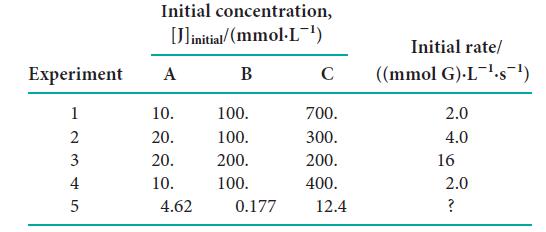
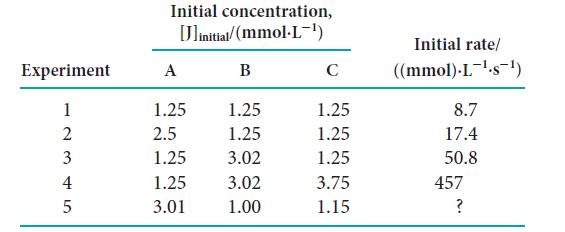
The following data were obtained for the reaction A + B + C → products:(a) Write the rate law for the reaction. (b) What is the order of the reaction? (c) Determine the value of the rate constant. (d) Use the data to predict the reaction rate for Experiment 5. Experiment 12345 Initial
Calculate the time required for each of the following second-order reactions to take place:(a) 2 A → B + C, for the concentration of A to decrease from 0.10 mol · L–1 to 0.080 mol · L–1, given that kr = 0.015 L · mol–1 · min–1 for the rate law expressed in terms of the loss of
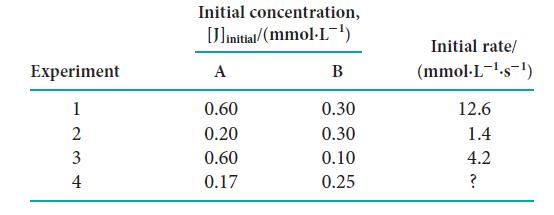
The following kinetic data were obtained for the reaction 3 A(g) + B(g) → product:(a) What is the order with respect to each reactant, and the overall order of the reaction? (b) Write the rate law for the reaction.(c) From the data, determine the value of the rate constant. (d) Use the data to
The second-order rate constant for the decomposition of NO2 (to NO and O2) at 573 K is 0.54 L · mol–1 · s–1. Calculate the time for an initial NO2 concentration of 0.20 mol · L–1 to decrease to(a) One-half;(b) One-sixteenth;(c) One-ninth of its initial concentration.
Suppose a reaction has the form a A → products and the rate of the reaction is written Rate = kr[A]. Derive expressions for the concentration of A at a time t and for the half-life of A in terms of a and kr.
Suppose a reaction has the form a A → products and the rate of the reaction is written Rate = kr[A]2. Derive an expression for the concentration of A at a time t in terms of a and kr.
Derive an expression for the half-life of a reactant A that decays by a third-order reaction with rate constant kr.
Derive an expression for the half-life of a reactant A that decays by an nth-order reaction (with n > 1) with rate constant kr.
You find a bottle of a pure silver halide that could be AgCl or AgI. Develop a simple chemical test that would allow you to distinguish which compound was in the bottle.
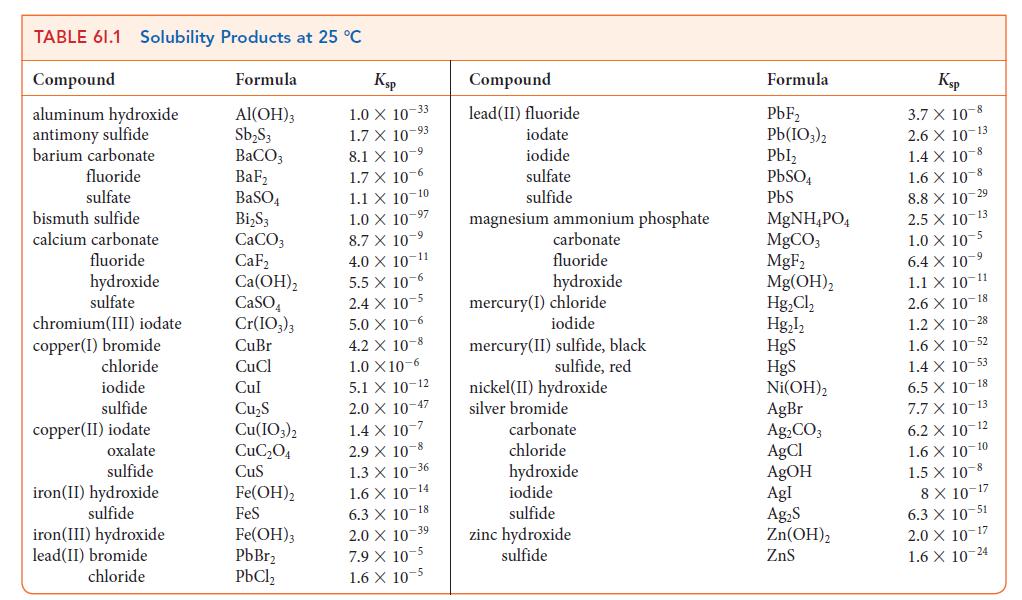
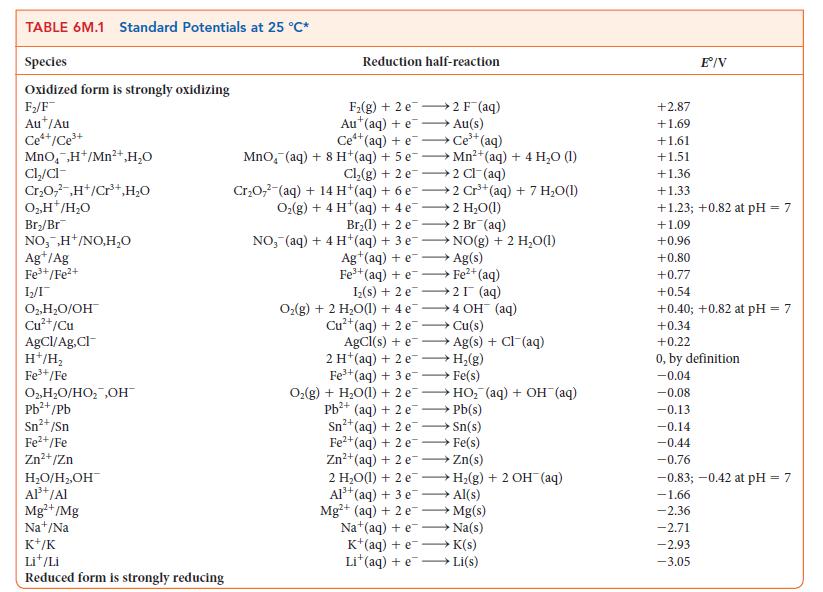
Calculate the potential of a cell constructed with two nickel electrodes. The electrolyte in one compartment is 1.0 m Ni(NO3)2(aq).In the other compartment, NaOH has been added to a Ni(NO3)2 solution until the pH = 11.0 at 298 K. See Table 6I.1. TABLE 61.1 Solubility Products at 25
The pKa of HIO(aq), hypoiodous acid, is 10.64 and that of HIO3(aq), iodic acid, is 0.77. Account for the difference in strength.
At what point in the titration of a weak base with a strong acid does the solution have its greatest buffer capacity?
Calculate the pH of each of the following acid solutions at 25°C; ignore second deprotonations only when that approximation is justified.(a) 1.0 * 10–4 m H3BO3(aq), boric acid acts as a monoprotic acid;(b) 0.015 m H3PO4(aq);(c) 0.10 m H2SO3(aq).
Sodium hypochlorite, NaClO, is the active ingredient in many bleaches. Calculate the ratio of the concentrations of ClO– and HClO in a bleach solution having a pH adjusted to 6.50 by the use of strong acid or strong base.
Calculate the pH of(a) 0.19 m NH4Cl(aq);(b) 0.055 m AlCl3(aq).
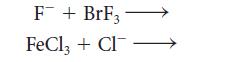
Draw the Lewis structure or symbol of each reactant, identify the Lewis acid and the Lewis base, and then draw the Lewis structure of the product (a complex) for the following Lewis acid–base reactions: F+BrF31 FeCl3 + Cl
Which of the following compounds, if either, will dissolve in 1.00 m HNO3(aq):(a) Bi2S3(s);(b) FeS(s)? Justify your answer by giving an appropriate calculation.
The pKa of HClO(aq), hypochlorous acid, is 7.53 and that of HBrO(aq), hypobromous acid, is 8.69. Account for the difference in strength.
Why are indicators not used to identify the point at which a solution has its greatest buffer capacity?
Calculate the molar concentrations of (COOH)2, HOOCCO2–, (CO2)2 2–, H3O+, and OH– in 0.12 m (COOH)2(aq), oxalic acid.
Aspirin (acetylsalicylic acid, Ka = 3.2 * 10–4) is a product of the reaction of salicylic acid with acetic anhydride. Calculate the ratio of the concentrations of the acetylsalicylate ion to acetylsalicylic acid in a solution that has a pH adjusted to 4.13 by the use of strong acid or strong base.
A cell was constructed with two lead electrodes. The electrolyte in one compartment is 1.0 m Pb(NO3)2(aq). In the other compartment, NaI has been added to a Pb(NO3)2 solution until a yellow precipitate forms and the concentration of I– ions is 0.050 mol · L–1. The potential of this cell is
Calculate the pH of(a) 0.15 m CH3NH3Cl(aq);(b) 0.063 m FeCl3(aq).
Suppose that 15.0 mL of 0.15 m NH3(aq) is titrated with 0.10 m HCl(aq).(a) What is the initial pH of the 0.15 m NH3(aq)?(b) What is the pH after the addition of 15.0 mL of 0.10 m HCl(aq)?(c) What volume of 0.10 m HCl(aq) is required to reach halfway to the stoichiometric point?(d) Calculate the
A metal alloy sample is believed to contain silver, bismuth, and nickel. Explain how it could be determined qualitatively that all three of these metals are present.
Which is the stronger base, the hypobromite ion, BrO2, or morphine, C17H19O3N? Justify your answer.
State whether the following oxides are acidic, basic, or amphoteric:(a) BaO; (b) SO3; (c) As2O3; (d) Bi2O3.
Calculate the molar concentrations of all phosphate species in H3PO4(aq) at pH = 2.25, given that their total concentration is 15 mmol · L–1.
Predict the pH region in which each of the following buffers will be effective, assuming equal molar concentrations of the acid and its conjugate base:(a) Sodium lactate and lactic acid;(b) Sodium benzoate and benzoic acid;(c) Potassium hydrogen phosphate and potassium phosphate;(d) Potassium
Consider the cell Ag(s)|Ag+(aq, 5.0 mmol · L–1)||Ag+(aq, 0.15 mol · L–1)|Ag(s). Can this cell do work? If so, what is the maximum work that it can perform (per mole of Ag)?
Calculate the pH of(a) 0.63 m NaCH3CO2(aq);(b) 0.65 m KCN(aq).
Zinc(II) readily forms the complex ion Zn(OH)4 2–. Explain how this fact can be used to distinguish a solution of ZnCl2 from MgCl2.
Suppose that 50.0 mL of 0.25 m CH3NH2(aq) is titrated with 0.35 m HCl(aq).(a) What is the initial pH of the 0.25 m CH3NH2(aq)?(b) What is the pH after the addition of 15.0 mL of 0.35 m HCl(aq)?(c) What volume of 0.35 m HCl(aq) is required to reach half way to the stoichiometric
Which is the stronger acid, hydrocyanic acid, HCN, or the ammonium ion, NH4–? Justify your answer.
State whether the following oxides are acidic, basic, or amphoteric:(a) SO2; (b) CaO; (c) P4O10; (d) TeO2.
Ammonium acetate is prepared by the reaction of equal amounts of aqueous ammonia and acetic acid. Calculate the concentration of all solute species present in 0.100 m NH4CH3CO2(aq).
Predict the pH region in which each of the following buffers will be effective, assuming equal molar concentrations of the acid and its conjugate base:(a) Sodium nitrite and nitrous acid;(b) Sodium formate and formic acid;(c) Sodium carbonate and sodium hydrogen carbonate;(d) Ammonia and
Consider the cell Ag(s)|Ag+(aq, 3.6 mmol · L–1)||Pb–1(aq, 0.25 mol · L–1)|Pb(s).(a) Can this cell do work? If so, what is the maximum work that it can perform (per mole of Pb)?(b) What is the value of ΔH for the cell reaction (use standard enthalpies of formation), and the value of ΔS?
Calculate the pH of(a) 0.015 m Na2SO3(aq);(b) 0.086 m NaF(aq).
Decide which acid in each of the following pairs is the stronger and explain why:(a) HF or HCl;(b) HClO or HClO2;(c) HBrO2 or HClO2;(d) HClO4 or H3PO4;(e) HNO3 or HNO2;(f) H2CO3 or H2GeO3.
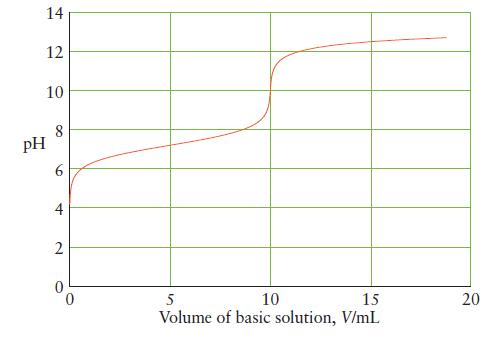
Below is the titration curve for the neutralization of 25 mL of a monoprotic acid with a strong base. Answer the following questions about the reaction and explain your reasoning in each case.(a) Is the acid strong or weak?(b) What is the initial hydronium ion concentration of the acid?(c) What
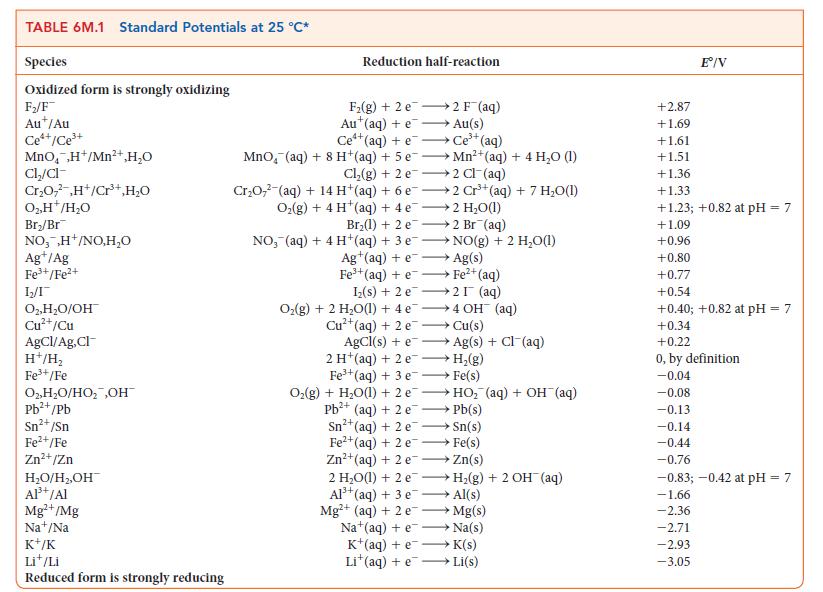
Suppose the reference electrode for Table 6M.1 were the standard calomel electrode, Hg2Cl2/Hg, Cl2([Cl2] = 1.00 mol · L–1), with its E° set equal to 0. Under this system, what would be the potential for(a) The standard hydrogen electrode;(b) The standard Cu2+/Cu redox couple? TABLE 6M.1
Calculate the molar concentration of OH– in solutions with the following molar concentrations of H3O+:(a) 0.020 mol · L–1;(b) 1.0 * 10–5 mol · L–1;(c) 3.1 mol · L–1.
Suggest a conjugate acid–base system that would be an effective buffer at a pH close to(a) 2;(b) 7;(c) 3;(d) 12.
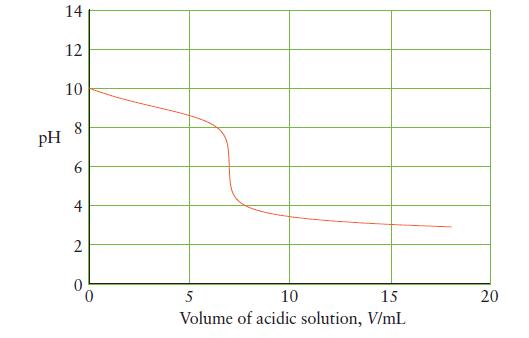
Below is the titration curve for the neutralization of 25 mL of a base with a strong monoprotic acid. Answer the following questions about the reaction and explain your reasoning in each case.(a) Is the base strong or weak?(b) What is the initial hydroxide ion concentration of the base?(c) What
A sample of CH3NH3Cl of mass 15.5 g is dissolved in water to make 450. mL of solution. What is the pH of the solution?
Consider the question posed in Exercise 6N.19 except that a saturated calomel electrode (the solution is saturated with KCl instead of having [Cl–] = 1.00 mol · L–1) is used in place of the standard calomel electrode. How will this replacement change your answers to Exercise 6N.19? The
A sample of C6H5NH3Cl of mass 7.8 g is dissolved in water to make 350. mL of solution. What is the percentage deprotonation of the cations?
Decide which acid in each of the following pairs is the stronger and explain why:(a) H3AsO4 or H3PO4;(b) HBrO3 or HBrO;(c) H3PO4 or H3PO3;(d) H2Te or H2Se;(e) H2S or HCl;(f) HClO or HIO.
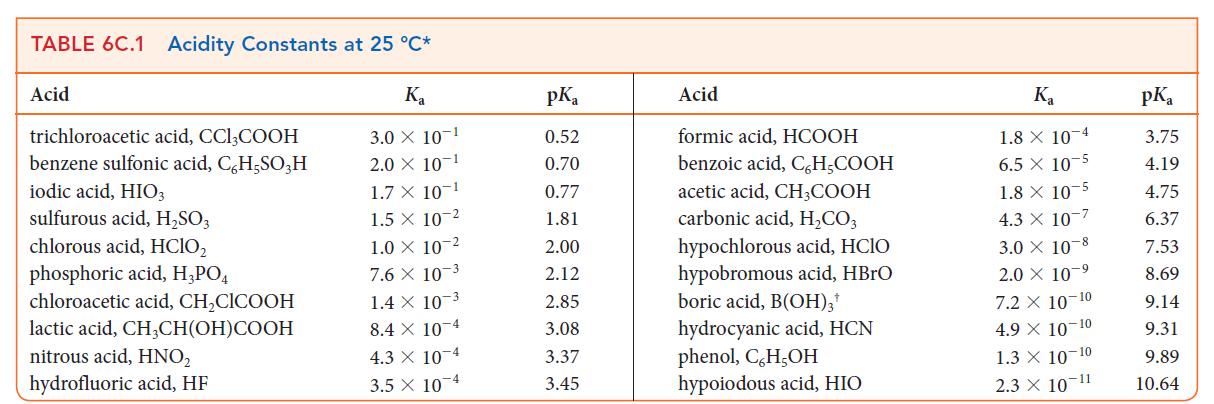
During the analysis of an unknown acid HA, a 0.010 m solution of the sodium salt of the acid was found to have a pH of 10.35. Use Table 6C.1 to identify the acid. TABLE 6C.1 Acidity Constants at 25 °C* K₂ 3.0 X 10⁻¹ 2.0 X 10⁻¹ 1.7 X 10⁻¹ 1.5 X 10⁻² 1.0 × 10⁻² 7.6 X 10⁻³ 1.4 x 10⁻³ 8.4 X
Calculate the molar concentration of H3O+ in solutions with the following molar concentrations of OH–:(a) 0.0021 mol· L–1;(b) 3.4 * 10–3 mol · L–1;(c) 7.60 mmol· L–1
Suggest a conjugate acid–base system that would be an effective buffer at a pH close to(a) 4;(b) 9;(c) 5;(d) 11.
Suggest an explanation for the different strengths of(a) Acetic acid and trichloroacetic acid;(b) Acetic acid and formic acid.
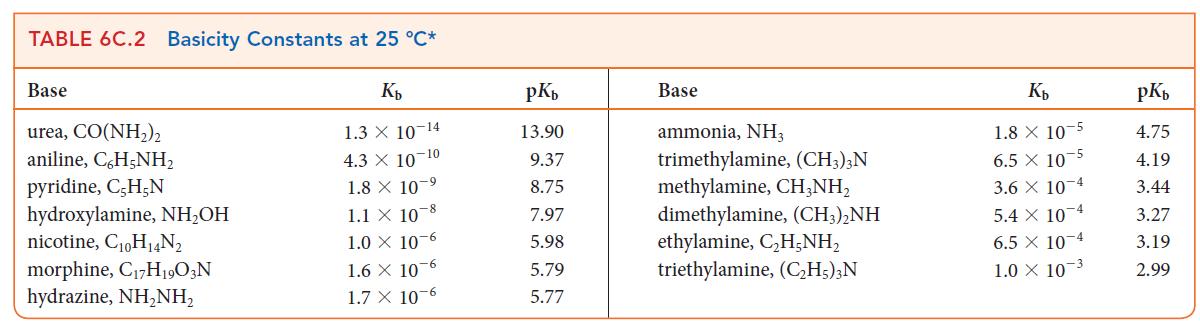
During the analysis of an unknown weak base B, a 0.10 m solution of the nitrate salt of the base was found to have a pH of 3.13. Use Table 6C.2 to identify the base. TABLE 6C.2 Basicity Constants at 25 °C* Kb 1.3 X 10⁻¹⁴ 4.3 X 10⁻¹⁰ 1.8 X 10⁻⁹ 1.1 X 10 8 1.0 x 10⁻⁶ 1.6 x 10⁻⁶ 1.7 X 10⁻⁶ Base urea,
The value of Kw for water at body temperature (37°C) is 2.1 * 10–14.(a) What is the molar concentration of H3O+ ions at 37°C?(b) What is the molar concentration of OH– in neutral water at 37 °C?
(a) What must be the ratio of the molar concentrations of CO32– and HCO3– ions in a buffer solution having a pH of 11.0?(b) What mass of K2CO3 must be added to 1.00 L of 0.100 m KHCO3(aq) to prepare a buffer solution with a pH of 11.0?(c) What mass of KHCO3 must be added to 1.00 L of 0.100 m
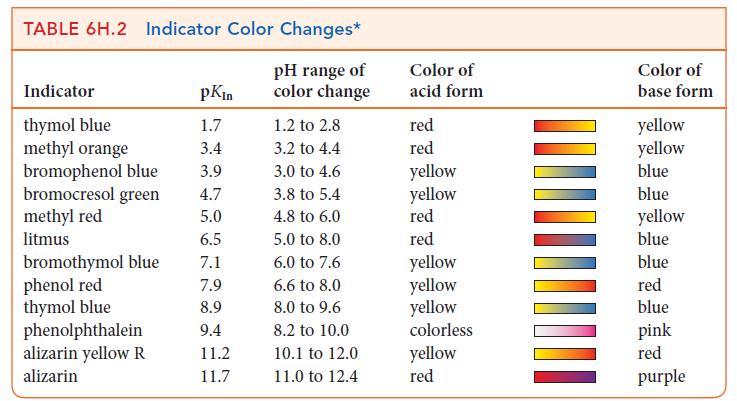
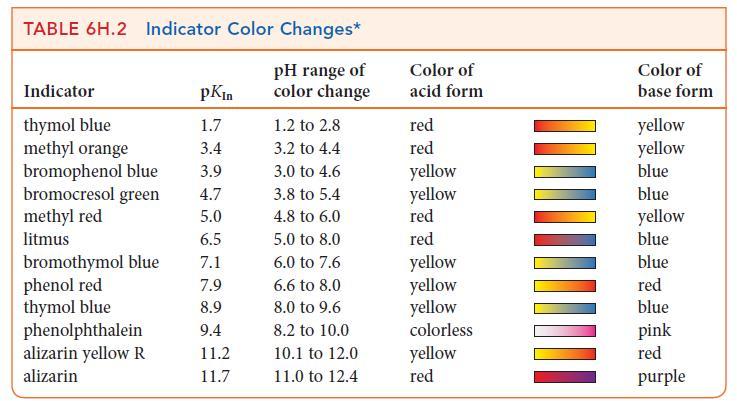
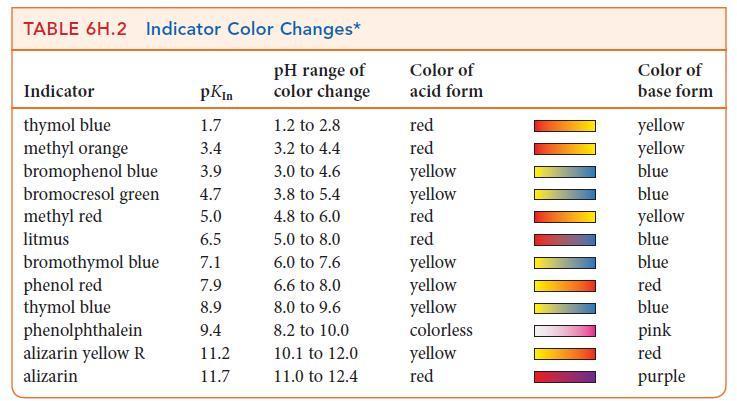
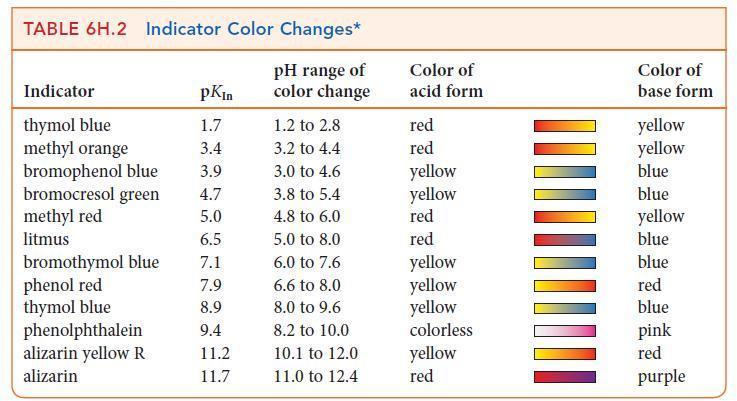
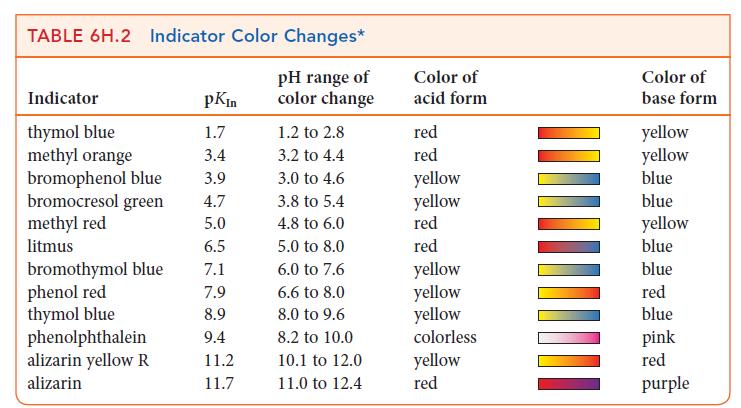
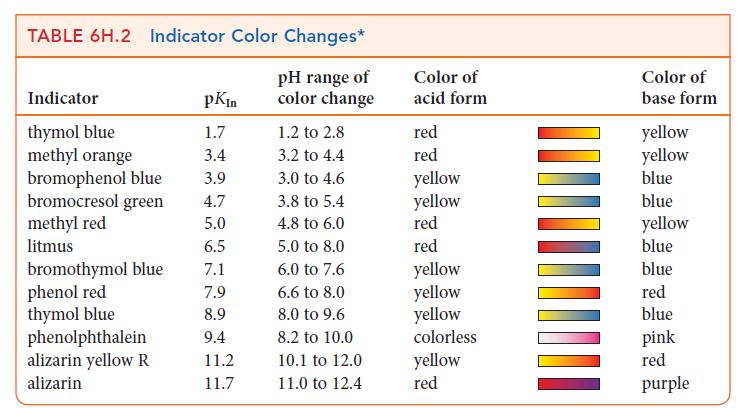
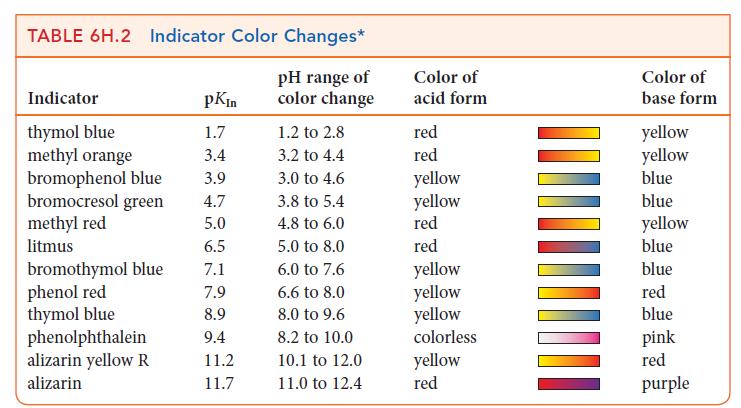
Which of the following indicators in Table 6H.2 could you use for a titration of 0.20 m NH3(aq) with 0.20 m HCl(aq):(a) Bromocresol green;(b) Methyl red;(c) Phenol red;(d) Thymol blue? Explain your selections. TABLE 6H.2 Indicator Color Changes* pH range of color change Indicator thymol
(a) What is the approximate chemical formula of rust? (b) What is the oxidizing agent in the formation of rust?(c) How does the presence of salt accelerate the rusting process?
Suggest an explanation for the different strengths of(a) Ammonia and methylamine;(b) Hydrazine and hydroxylamine.
Use Table 6H.2 to suggest suitable indicators for the titrations described in Exercises 6H.9 and 6H.14.Exercises 6H.9Benzoic acid, C6H5COOH, is used as a preservative in food and cosmetics because it is considered to be relatively safe.Suppose you are studying benzoic acid and need to predict the
The molar concentration of H3O+ ions at the freezing point of water is 3.9 * 10–8 mol · L–1. Calculate Kw at 0°C.
Use Table 6H.2 to suggest suitable indicators for the titrations described in Exercises 6H.10 and 6H.12.Exercises 6H.10Morphine, C17H19O3N, is a potent painkiller. Suppose you are studying morphine and need to predict the pH of a morphine solution during a titration. Calculate the pH at the
(a) What must be the ratio of the molar concentrations of PO4 3– and HPO42– ions in a buffer solution having a pH of 12.0?(b) What mass of K3PO4 must be added to 1.00 L of 0.100 m K2HPO4(aq) to prepare a buffer solution with a pH of 12.0?(c) What mass of K2HPO4 must be added to 1.00 L of
(a) What is the electrolyte solution in the formation of rust?(b) How are steel (iron) objects protected by galvanizing and by sacrificial anodes?(c) Suggest two metals that could be used in place of zinc for galvanizing iron.
Calculate the molar concentration of Ba(OH)2(aq) and the molar concentrations of Ba2+, OH2, and H3O+ in an aqueous solution that contains 0.43 g of Ba(OH)2 in 0.100 L of solution.
(a) Suggest two metals that could be used for the cathodic protection of a titanium pipeline.(b) What factors other than relative positions in the electrochemical series need to be considered in practice?(c) Often copper piping is connected to iron pipes in household plumbing systems. What is a
Calculate the molar concentration of KNH2(aq) and the molar concentrations of K+, NH2 –, OH–, and H3O+ in an aqueous solution that contains 0.40 g of KNH2 in 0.450 L of solution.
(a) Can aluminum be used for the cathodic protection of a steel underground storage container?(b) Which of the metals zinc, silver, copper, and magnesium cannot be used as a sacrificial anode in the protection of a buried iron pipeline? Explain your answer.(c) What is the electrolyte solution
What volume of 0.275 m KOH(aq) must be added to 75.0 mL of 0.137 m H3AsO4(aq) to reach(a) The first stoichiometric point;(b) The second stoichiometric point;(c) The third stoichiometric point?
What volume of 0.102 m NaOH(aq) must be added to 50.0 mL of 0.0510 m H2SO3(aq) to reach(a) The first stoichiometric point;(b) The second stoichiometric point?
What volume of 0.255 m HNO3(aq) must be added to 35.5 mL of 0.158 m Na2HPO3(aq) to reach(a) The first stoichiometric point;(b) The second stoichiometric point?
What volume of 0.650 m HCl(aq) must be added to 64.2 mL of 0.188 m Na3PO4(aq) to reach(a) The first stoichiometric point;(b) The second stoichiometric point;(c) The third stoichiometric point?
(a) Sketch the titration curve for the titration of 5.00 mL 0.010 m H2S2O3(aq) with 0.010 m KOH(aq), identifying the initial and final points, the stoichiometric points, and each of the halfway points.(b) What volume of KOH has been added at each stoichiometric point?(c) Determine the pH at each
(a) Sketch the titration curve for the titration of 5.00 mL 0.010 m H3AsO4(aq) with 0.010 m KOH(aq), identifying the initial and final points, the stoichiometric points, and each of the halfway points.(b) What volume of KOH has been added at each stoichiometric point?(c) Determine the pH at each
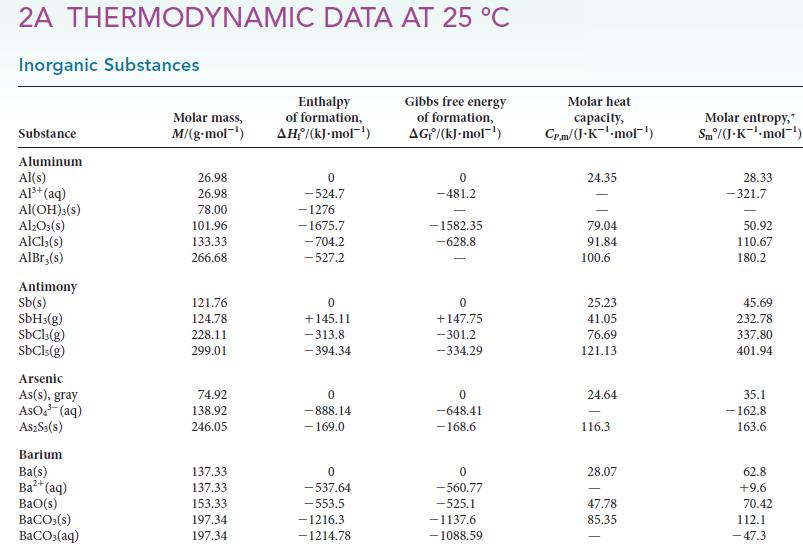
(a) Using values in Appendix 2A, calculate the standard Gibbs free energy for the vaporization of water at 25.0°C, 100.0°C, and 150.0°C.(b) What should the value at 100.0°C be?(c) Why is there a discrepancy? 2A THERMODYNAMIC DATA AT 25 °C Inorganic Substances Substance Aluminum Al(s) Al³+
Given that the atomic orbitals used to form hybrids are normalized to 1 and mutually orthogonal,(a) Show that the two tetrahedral hybrids h1 = s + px + py + pz and h3 = s - px = py - pz are orthogonal.(b) Construct the remaining two tetrahedral hybrids that are orthogonal to these two hybrids.
Consider the equilibrium CO(g) + H2O(g) ⇌ CO2(g) + H2(g). (a) If the partial pressure of CO2 is increased, what happens to the partial pressure of H2? (b) If the partial pressure of CO is decreased, what happens to the partial pressure of CO2? (c) If the concentration of CO is increased, what
Are the water molecules oriented in the same way or differently around the cations and anions when sodium chloride dissolves? Explain your answer.
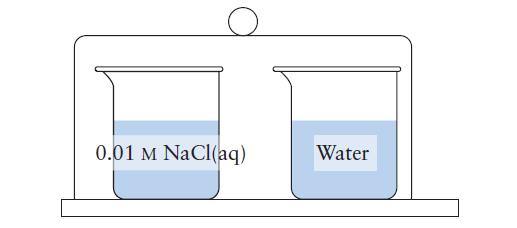
Two beakers, one containing 0.010 m NaCl(aq) and the other containing pure water, are placed inside a bell jar and sealed. The beakers are left until the water vapor has come to equilibrium with any liquid in the container. The levels of the liquid in each beaker at the beginning of the experiment
Suppose that you are a food scientist and are studying the contribution of various sugars to obesity in the hope of identifying one that, though very sweet, has a low calorie count. What is the molality of the sugar fructose (C6H12O6, 180.15 g · mol–1) in a solution prepared by dissolving 90.5 g
The yearly production of ammonia is of the order of 1.3 Gt (1 Gt = 109 t), making this commodity one of the top ten chemicals produced globally. If you were studying the synthesis of ammonia, you would need to work with the equilibrium constant for the reaction. Write the equilibrium constant for
At 500. K, the equilibrium constant for the reaction Cl2(g) + Br2(g) ⇌ 2 BrCl(g) is Kc = 0.031. If the equilibrium composition is 0.495 mol · L–1 Cl2 and 0.145 mol · L–1 BrCl, what is the equilibrium molar concentration of Br2?
State whether the following statements are true or false. If false, explain why.(a) A reaction stops when equilibrium is reached.(b) An equilibrium reaction is not affected by increasing the concentrations of products.(c) If one starts with a higher pressure of reactant, the equilibrium constant
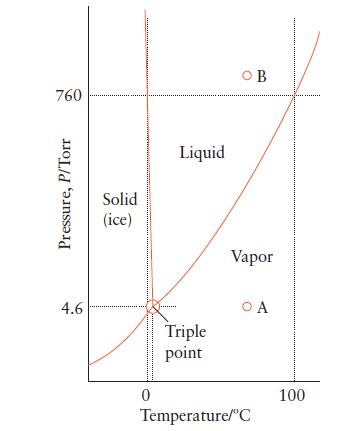
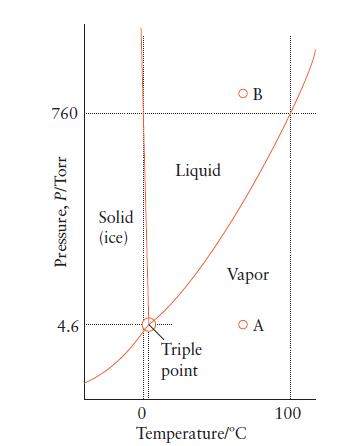
Phase diagrams are very useful for predicting the changes that substances will undergo when the conditions are changed and are widely used in geology and metallurgy. Even a phase diagram of a simple, familiar substance can be revealing. Use the phase diagram in Fig. 5B.2 to describe the physical
If you are an environmental scientist, you need to know the theoretical limits on the amount of oxygen that water can dissolve in order to monitor the capacity of natural waters to sustain life. Verify that the concentration of oxygen in lake water is normally adequate to sustain aquatic life,
Use Fig. 5B.2 to predict the phase of a sample of water under the following conditions:(a) 1 atm, 200°C;(b) 100. atm, 50.0°C;(c) 3 Torr, 10.0°C. 760 Pressure, P/Torr 4.6 Solid (ice) 0 Liquid Triple point OB Vapor O A Temperature/C 100
Which would be the better solvent, water or benzene, for each of the following substances:(a) KCl;(b) CCl4;(c) CH3COOH?
Tetrachloromethane, CCl4, which is now known to be carcinogenic, was once used as a dry-cleaning solvent and is a volatile liquid still used in the manufacture of coolants. The enthalpy of vaporization of CCl4 is 33.05 kJ · mol–1, and its vapor pressure at 57.8°C is 405 Torr. What is the vapor
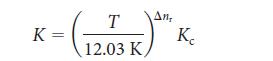
Suppose you are a scientist studying the reactions of SO2 and O2. If you wish to use gas molar concentrations, you must first convert the equilibrium constant K to Kc. At 400 8C, the equilibrium constant K for 2 SO2(g) + O2(g) ⇌ 2 SO3(g) is 3.1 * 104. What is the value of Kc at this
Calculate(a) The molality of sodium chloride in a solution prepared by dissolving 25.0 g of NaCl in 500.0 g of water;(b) The mass (in grams) of NaOH that must be mixed with 345 g of water to prepare 0.18 m NaOH(aq);(c) The molality of urea, CO(NH2)2, in a solution prepared by dissolving 0.978 g
Which do you expect to have the higher vapor pressure at room temperature, ammonia, NH3, or phosphine, PH3? Why?
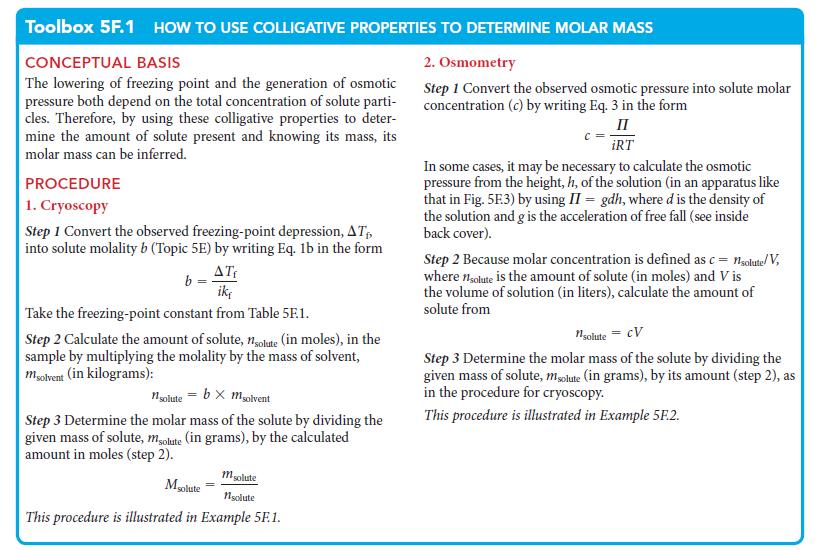
In modern laboratories, sophisticated instruments are used to determine molar mass. However, if you don’t have access to such an instrument, you could still determine molar mass using nothing more complicated than a thermometer and a balance. The addition of 0.24 g of sulfur to 100. g of the
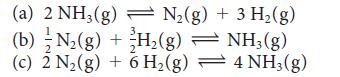
For the reaction N2(g) + 3 H2(g) ⇌ 2 NH3(g) at 400. K, K = 41. Find the value of K for each of the following reactions at the same temperature: (a) 2 NH3(g) N₂(g) + 3 H₂(g) (b) N₂(g) + H₂(g) H₂(g) 2 (c) 2 N₂(g) + 6 H₂(g) NH3(g) 4 NH3(g)
Nitric oxide, NO, is an intermediate in the production of nitric acid. It is produced commercially by the controlled oxidation of ammonia. Suppose you are considering how to increase the amount of NO produced each day in the equilibrium 4 NH3(g) + 5 O2(g) ⇌ 4 NO(g) + 6 H2O(g). Predict the effect
Showing 1400 - 1500
of 3011
First
8
9
10
11
12
13
14
15
16
17
18
19
20
21
22
Last
Step by Step Answers

 Get 50% OFF
Claim Now
Get 50% OFF
Claim Now


![Experiment 123 + 2 4 Initial concentration, [J]initial/(mmol.L-) A 1.72 3.44 1.72 2.91 B 2.44 2.44 0.10 1.33](https://dsd5zvtm8ll6.cloudfront.net/images/question_images/1703/9/3/5/808658fff4040c1a1703935805719.jpg)