New Semester
Started
Get
50% OFF
Study Help!
--h --m --s
Claim Now
Question Answers
Textbooks
Find textbooks, questions and answers
Oops, something went wrong!
Change your search query and then try again
S
Books
FREE
Study Help
Expert Questions
Accounting
General Management
Mathematics
Finance
Organizational Behaviour
Law
Physics
Operating System
Management Leadership
Sociology
Programming
Marketing
Database
Computer Network
Economics
Textbooks Solutions
Accounting
Managerial Accounting
Management Leadership
Cost Accounting
Statistics
Business Law
Corporate Finance
Finance
Economics
Auditing
Tutors
Online Tutors
Find a Tutor
Hire a Tutor
Become a Tutor
AI Tutor
AI Study Planner
NEW
Sell Books
Search
Search
Sign In
Register
study help
sciences
chemical principles
Chemical Principles 6th Edition Steven S Zumdahl - Solutions
For the oxidation–reduction reactionthe appropriate half-reactions areBalance the redox reaction and calculate ξ° and K (at 25°C). S406 (aq) + Cr+ (aq) 3+ Cr+ (aq) + S03 (aq)
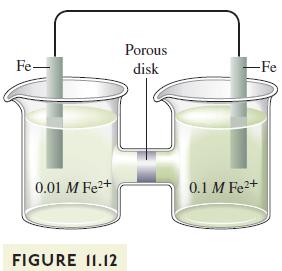
Determine the direction of electron flow, designate the anode and cathode,and calculate the potential at 25°C for the cell represented in Fig. 11.12. Fe- 0.01 M Fe+ FIGURE 11.12 Porous disk -Fe 0.1 M Fe+
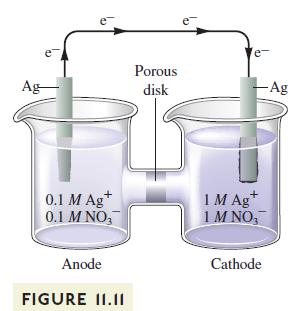
A silver concentration cell similar to the one shown in Fig. 11.11 is set up at 25°C with 1.0 M AgNO3 in the left compartment and 1.0 M NaCl along with excess AgCl(s) in the right compartment. The measured cell potential is 0.58 V. Calculate the Ksp value for AgCl at 25°C. Ag e 0.1 M Ag+ 0.1 M
The first ionization energy for magnesium is \(735 \mathrm{~kJ} / \mathrm{mol}\). Which electron is this for? Estimate \(Z_{\text {eff }}\) for this electron, and explain your reasoning. Calculate \(Z_{\text {eff }}\) for this electron, and compare it to your estimate.
Consider the following statement: "The ionization energy for the potassium atom is negative because when \(\mathrm{K}\) loses an electron to become \(\mathrm{K}^{+}\)it achieves a noble gas electron configuration." Indicate what is incorrect. Explain.
How does the energy of a hydrogen \(1 s\) orbital compare with that of a lithium \(1 s\) orbital? Why? What is meant by the term energy of the orbital? What is its sign? Why? What is meant by the term lower in energy?
Calculate the wavelength of light emitted in each of the following spectral transitions in the hydrogen atom. What type of electromagnetic radiation is emitted in each transition?a. \(n=3 \longrightarrow n=2\)b. \(n=4 \longrightarrow n=2\)c. \(n=2 \longrightarrow n=1\)d. \(n=4 \longrightarrow n=3\)
How do \(2 p\) orbitals differ from each other? How do \(2 p\) and \(3 p\) orbitals differ from each other? What is a nodal surface in an atomic orbital? What is wrong with \(1 p, 1 d, 2 d\), \(1 f, 2 f\), and \(3 f\) orbitals? Explain what we mean when we say that a \(4 s\) electron is more
An ionic compound of potassium and oxygen has the empirical formula KO. Would you expect this compound to be potassium(II) oxide or potassium peroxide? Explain.
The blue color in fireworks is often achieved by heating copper(I) chloride (CuCl) to about 1200°C. The hot compound emits blue light having a wavelength of 450 nm. What is the increment of energy (the quantum) that is emitted at 4.50 × 10² nm by CuCl?
Compare the wavelength for an electron (mass = 9.11 × 10⁻³¹kg) traveling at a speed of 1.0 × 10⁷ m/s with that for a ball (mass = 0.10 kg) traveling at 35 m/s.
Calculate the energy required to excite the hydrogen electron from level n = 1 to level n = 2. Also calculate the wavelength of light that must be absorbed by a hydrogen atom in its ground state to reach this excited state.
Calculate the minimum energy required to remove the electron from a hydrogen atom in its ground state.
The hydrogen atom has a radius on the order of 0.05 nm. Assuming that we know the position of an electron to an accuracy of 1% of the hydrogen radius, calculate the uncertainty in the velocity of the electron using the Heisenberg uncertainty principle. Then compare this value with the uncertainty
Assume that an electron is confined to a one-dimensional box 1.50 nm in length. Calculate the lowest three energy levels for this electron, and calculate the wavelength of light necessary to promote the electron from the ground state to the first excited state.
For principal quantum level n = 5, determine the number of subshells (different values of ℓ) and give the designation of each.
Give the electron configurations for sulfur (S), cadmium (Cd), hafnium (Hf), and radium (Ra), using the periodic table.
The first ionization energy for phosphorus is 1060 kJ/mol, and that for sulfur is 1005 kJ/mol. Why?
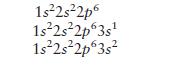
Consider atoms with the following electron configurations:Which atom has the largest first ionization energy, and which has the smallest second ionization energy? Explain your choices. 1s2s2p6 1s2s2p63s 1s2s2p 3s
Predict the trend in radius of the following ions: Be2+ , Mg2+ , Ca2+, and Sr2+.
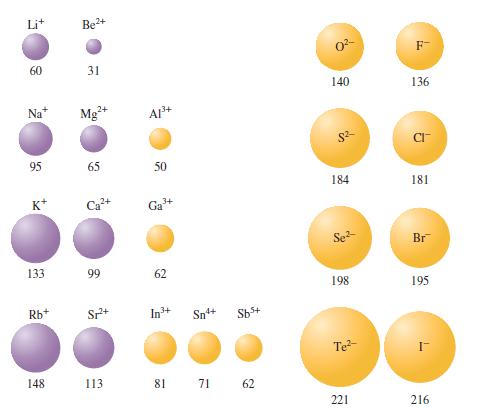
Using only the periodic table, predict the most stable ion for \(\mathrm{Na}, \mathrm{Mg}, \mathrm{Al}, \mathrm{S}, \mathrm{Cl}, \mathrm{K}, \mathrm{Ca}\), and \(\mathrm{Ga}\). Arrange these from largest to smallest radius and explain why the radius varies as it does. Compare your predictions with
Which has the greater bond lengths: \(\mathrm{NO}_{2}{ }^{-}\)or \(\mathrm{NO}_{3}{ }^{-}\)? \(\mathrm{Ex}-\) plain.
Hydrogen has an electronegativity value between boron and carbon and identical to phosphorus. With this in mind, rank the following bonds in order of decreasing polarity: \(\mathrm{P}-\mathrm{H}, \mathrm{O}-\mathrm{H}, \mathrm{N}-\mathrm{H}, \mathrm{F}-\mathrm{H}, \mathrm{C}-\mathrm{H}\).
Rank the following bonds in order of increasing ionic character: \(\mathrm{N}-\mathrm{O}, \mathrm{Ca}-\mathrm{O}, \mathrm{C}-\mathrm{F}, \mathrm{Br}-\mathrm{Br}, \mathrm{K}-\mathrm{F}\).
Write electron configurations for each of the following.a. the cations: \(\mathrm{Mg}^{2+}, \mathrm{Sn}^{2+}, \mathrm{K}^{+}, \mathrm{Al}^{3+}, \mathrm{Tl}^{+}, \mathrm{As}^{3+}\)b. the anions: \(\mathrm{N}^{3-}, \mathrm{O}^{2-}, \mathrm{F}^{-}, \mathrm{Te}^{2-}\)c. the most stable ion formed by:
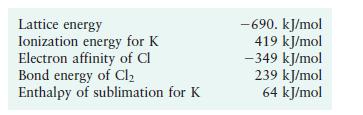
Use the following data to estimate \(\Delta H_{\mathrm{f}}^{\circ}\) for potassium chloride.\[\mathrm{K}(s)+\frac{1}{2} \mathrm{Cl}_{2}(g) \longrightarrow \mathrm{KCl}(s)\] Lattice energy Ionization energy for K Electron affinity of Cl Bond energy of Cl Enthalpy of sublimation for K -690. kJ/mol
\(\operatorname{LiI}(s)\) has a heat of formation of \(-272 \mathrm{~kJ} / \mathrm{mol}\) and a lattice energy of \(-753 \mathrm{~kJ} / \mathrm{mol}\). The ionization energy of \(\mathrm{Li}(\mathrm{g})\) is \(520 . \mathrm{kJ} / \mathrm{mol}\), the bond energy of \(\mathbf{I}_{2}(g)\) is \(151
Use bond energies to predict \(\Delta H\) for the isomerization of methyl isocyanide to acetonitrile.\[\mathrm{CH}_{3} \mathrm{~N} \equiv \mathrm{C}(g) \longrightarrow \mathrm{CH}_{3} \mathrm{C} \equiv \mathrm{N}(g)\]
Use bond energies to predict \(\Delta H\) for the combustion of ethanol:\[\mathrm{C}_{2} \mathrm{H}_{5} \mathrm{OH}(l)+3 \mathrm{O}_{2}(g) \longrightarrow 2 \mathrm{CO}_{2}(g)+3 \mathrm{H}_{2} \mathrm{O}(g)\]
What is the relationship between ΔH∘fΔHf∘ for H(g)H(g) given in Exercise 49 and the H−HH−H bond energy listed in Table 13.6?Data from Exercises 49Use the following standard enthalpies of formation to estimate the N−HN−H bond energy in ammonia. Compare this with the value in Table
Considering your answers to Exercise 52, what conclusions can you draw concerning the structures of species containing the same number of atoms and the same number of valence electrons?Data from Exercises 52Draw a Lewis structure that obeys the octet rule for each of the following molecules and
Place the species below in order of shortest to longest nitrogen-nitrogen bond.\[\mathrm{N}_{2}, \mathrm{~N}_{2} \mathrm{~F}_{4}, \mathrm{~N}_{2} \mathrm{~F}_{2}\]( \(\mathrm{N}_{2} \mathrm{~F}_{4}\) exists as \(\mathrm{F}_{2} \mathrm{~N}-\mathrm{NF}_{2}\), and \(\mathrm{N}_{2} \mathrm{~F}_{2}\)
Write Lewis structures for \(\mathrm{CO}_{3}{ }^{2-}, \mathrm{HCO}_{3}{ }^{-}\), and \(\mathrm{H}_{2} \mathrm{CO}_{3}\). When acid is added to an aqueous solution containing carbonate or bicarbonate ions, carbon dioxide gas is formed. We generally say that carbonic acid \(\left(\mathrm{H}_{2}
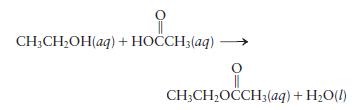
Using bond energies, estimate \(\Delta H\) for the following reaction: CH3CHOH(aq) + HOCCH3(aq) CH3CHOCCH(aq) + HO(l)
Give a rationale for the octet rule and the duet rule for \(\mathrm{H}\) in terms of orbitals.
Do the Lewis structures obtained in Exercises 71 and 72 predict the same molecular structure for each case?Data from Exercises 71 Draw Lewis structures that obey the octet rule for the following species. Assign the formal charge to each central
When is \(\Delta H=\frac{5}{2} R T\) ? When is \(\Delta E=\frac{5}{2} R T\) ? When is \(\Delta H=\) \(\frac{3}{2} R T\) ? When is \(\Delta E=\frac{3}{2} R T\) ? When is \(\Delta H=\Delta E\) ? What does this say, if anything, about \(\Delta E\) and \(\Delta H\) as state functions?
For a liquid, which would you expect to be larger: \(\Delta H_{\text {vaporization }}\) or \(\Delta H_{\text {fusion }}\) ? Explain.
A 0.1964 -g sample of quinone \(\left(\mathrm{C}_{6} \mathrm{H}_{4} \mathrm{O}_{2}ight)\) is burned in a bomb calorimeter that has a heat capacity of \(1.56 \mathrm{~kJ} /{ }^{\circ} \mathrm{C}\). The temperature of the calorimeter increases by \(3.2^{\circ} \mathrm{C}\). Calculate the energy of
Le Châtelier's principle is stated as "If a gaseous reactant or product is added to a system at equilibrium, the system will shift away from the added component." The system \(\mathrm{N}_{2}(g)+3 \mathrm{H}_{2}(g) ightleftharpoons 2 \mathrm{NH}_{3}(g)\) is used as an example in which the
Characterize a system at chemical equilibrium with respect to each of the following.a. The rates of the forward and reverse reactionsb. The overall composition of the reaction mixture
The equilibrium constant is \(2.4 \times 10^{3}\) at a certain temperature for the reaction\[2 \mathrm{NO}(g) ightleftharpoons \mathrm{N}_{2}(g)+\mathrm{O}_{2}(g)\]For which of the following sets of conditions is the system at equilibrium? For those that are not at equilibrium, in which direction
A type of reaction we will study is that having a very small \(K\) value \((K
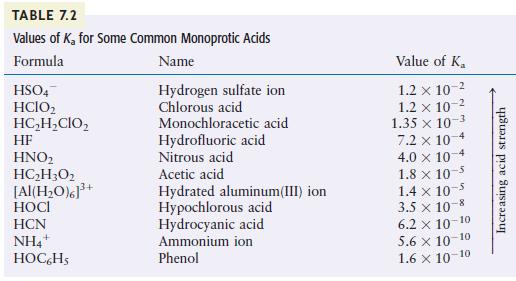
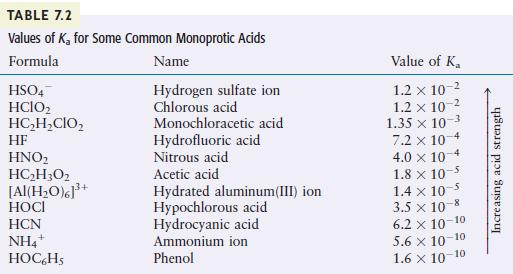
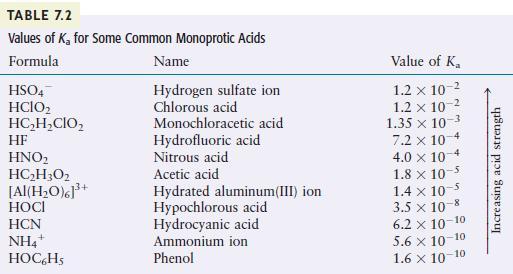
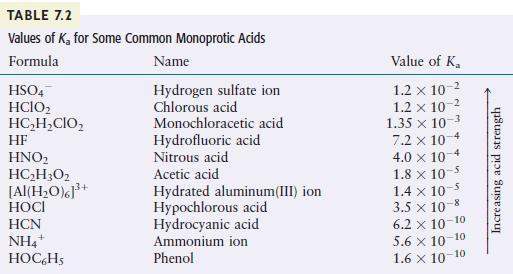
Using Table 7.2, arrange the following species according to their strength as bases: H2O, F–, Cl–, NO2–, and CN–. TABLE 7.2 Values of K for Some Common Monoprotic Acids Formula Name Hydrogen sulfate ion Chlorous acid HSO4 HCIO HCHCIO HF HNO HCH302 [Al(HO)]+ HCN NH4 HOCHS + 3+
At 60°C the value of Kw is 1 × 10–13.a. Using Le Châtelier’s principle, predict whether the reactionis exothermic (releases energy) or endothermic (absorbs energy).b. Calculate [H+] and [OH–] in a neutral solution at 60°C. 2HO(1) H3O+ (aq) + OH(aq)
Calculate the pH of a solution that contains 1.00 M HCN (Ka = 6.2 × 10⁻¹⁰) and 5.00 M HNO2 (Ka = 4.0 × 10⁻⁴). Also calculate the concentration of cyanide ion (CN–) in this solution at equilibrium.
Lactic acid (HC3H5O3) is a waste product that accumulates in muscle tissue during exertion, leading to pain and a feeling of fatigue. In a 0.100 M aqueous solution, lactic acid is 3.7% dissociated. Calculate the value of Ka for this acid.
Calculate the pH of a 5.0 × 10⁻² M NaOH solution.
Calculate the pH of a 1.0 M solution of methylamine (Kb = 4.38 × 10⁻⁴).
Calculate the fractions of H2CO3, HCO3–, and CO32– at pH 9.00.
Calculate the pH of a 5.0 M H3PO4 solution and determine equilibrium concentrations of the species H3PO4, H2PO4–, HPO42–, and PO43–.
A 0.200-mol sample of sodium phosphate is dissolved in water, and hydrochloric acid is added to give a total volume of 1.00 L and a final pH of 4.630. Calculate the concentrations of all phosphate-containing species in this solution.
Calculate the pH of a 1.0 M H2SO4 solution.
Calculate the pH of a 1.00 × 10⁻² M H2SO4 solution.
Calculate the pH of a 0.30 M NaF solution. The Ka value for HF is 7.2 × 10⁻⁴.
Calculate the pH of a 0.10 M NH4Cl solution. The Kb value for NH3 is 1.8 × 10⁻⁵.
Calculate the pH of a 0.010 M AlCl3 solution. The Ka value for Al(H2O)63+ is 1.4 × 10⁻⁵.
Predict whether an aqueous solution of each of the following salts will be acidic, basic, or neutral.a. NH4C2H3O2b. NH4CNc. Al2(SO4)3
Calculate the pH of a 0.100 M solution of NH4CN.
Calculate the [H+] ina. 1.0 M HCN (Ka = 6.2 × 10⁻¹⁰).b. 1.0 × 10⁻⁴ M HCN (Ka = 6.2 × 10⁻¹⁰).
Consider a solution formed by mixing \(100.0 \mathrm{~mL}\) of \(0.10 \mathrm{M}\) HA \(\left(K_{\mathrm{a}}=1.0 \times 10^{-6}ight), 100.0 \mathrm{~mL}\) of \(0.10 \mathrm{M} \mathrm{NaA}\), and \(100.0 \mathrm{~mL}\) of \(0.05 \mathrm{M} \mathrm{HCl}\). In calculating the \(\mathrm{pH}\) for the
Match the following \(\mathrm{pH}\) values: \(1,2,5,6,6.5,8,11,11\), and 13 with the following chemicals (of equal concentration): \(\mathrm{HBr}, \mathrm{NaOH}, \mathrm{NaF}, \mathrm{NaCN}, \mathrm{NH}_{4} \mathrm{~F}, \mathrm{CH}_{3} \mathrm{NH}_{3} \mathrm{~F}, \mathrm{HF}\), \(\mathrm{HCN}\),
For each of the following aqueous reactions, identify the acid, the base, the conjugate base, and the conjugate acid.a. \(\mathrm{H}_{2} \mathrm{O}+\mathrm{H}_{2} \mathrm{CO}_{3} ightleftharpoons \mathrm{H}_{3} \mathrm{O}^{+}+\mathrm{HCO}_{3}^{-}\)b. \(\mathrm{C}_{5} \mathrm{H}_{5}
Use Table 7.2 to order the following from the strongest to the weakest acid.\[\mathrm{HClO}_{2}, \mathrm{H}_{2} \mathrm{O}, \quad \mathrm{NH}_{4}^{+}, \quad \mathrm{HClO}_{4}\] TABLE 7.2 Values of K for Some Common Monoprotic Acids Formula Name Hydrogen sulfate ion Chlorous acid HSO4 HCIO HCHCIO HF
You may need Table 7.2 to answer the following questions.a. Which is the stronger acid, \(\mathrm{H}_{2} \mathrm{SO}_{4}\) or \(\mathrm{H}_{2} \mathrm{O}\) ?b. Which is the stronger acid, \(\mathrm{H}_{2} \mathrm{O}\) or \(\mathrm{HOCl}\) ?c. Which is the stronger acid, \(\mathrm{NH}_{4}{ }^{+}\)or
You may need Table 7.2 to answer the following questions.a. Which is the stronger base, \(\mathrm{HSO}_{4}{ }^{-}\)or \(\mathrm{H}_{2} \mathrm{O}\) ?b. Which is the stronger base, \(\mathrm{H}_{2} \mathrm{O}\) or \(\mathrm{OCl}^{-}\)?c. Which is the stronger base, \(\mathrm{NH}_{3}\) or
Classify each of the following as a strong acid, weak acid, strong base, or weak base in aqueous solution.a. \(\mathrm{HNO}_{2}\)b. \(\mathrm{HNO}_{3}\)c. \(\mathrm{CH}_{3} \mathrm{NH}_{2}\)d. \(\mathrm{NaOH}\)e. \(\mathrm{NH}_{3}\)f. HFg. h. \(\mathrm{Ca}(\mathrm{OH})_{2}\)i. \(\mathrm{H}_{2}
At \(40 .^{\circ} \mathrm{C}\) the value of \(K_{\mathrm{w}}\) is \(2.92 \times 10^{-14}\).a. Calculate the \(\left[\mathrm{H}^{+}ight]\)and \(\left[\mathrm{OH}^{-}ight]\)in pure water at \(40 .{ }^{\circ} \mathrm{C}\).b. What is the \(\mathrm{pH}\) of pure water at \(40 .^{\circ} \mathrm{C}\) ?c.
Calculate the \(\mathrm{pH}\) of each of the following solutions of a strong acid in water.a. \(0.10 \mathrm{M} \mathrm{HCl}\)b. \(5.0 \mathrm{M} \mathrm{HClO}_{4}\)c. \(1.0 \times 10^{-11} \mathrm{M} \mathrm{HI}\)
List the major species present in \(0.250 \mathrm{M}\) solutions of each of the following acids, and then calculate the \(\mathrm{pH}\) for each.a. \(\mathrm{HBr}\)b. \(\mathrm{HClO}_{4}\)c. \(\mathrm{HNO}_{3}\)d. \(\mathrm{HNO}_{2}\)e. \(\mathrm{CH}_{3} \mathrm{CO}_{2}
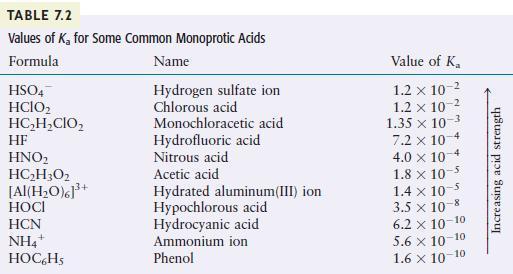
Using the KaKa values given in Table 7.2, calculate the concentrations of all species present and the pHpH for each of the following.a. 0.20MHOCl0.20MHOClb. 1.5MHOC6H51.5MHOC6H5c. 0.020MHF0.020MHF TABLE 7.2 Values of K for Some Common Monoprotic Acids Formula Name Hydrogen sulfate ion Chlorous acid
Monochloroacetic acid \(\left(\mathrm{HC}_{2} \mathrm{H}_{2} \mathrm{ClO}_{2}ight)\) is a skin irritant that is used in "chemical peels" intended to remove the top layer of dead skin from the face and ultimately improve the complexion. The value of \(K_{\mathrm{a}}\) for monochloroacetic acid is
Calculate the \(\mathrm{pH}\) of each of the following.a. a solution containing \(0.10 \mathrm{M} \mathrm{HCl}\) and \(0.10 \mathrm{M} \mathrm{HOCl}\)b. a solution containing \(0.050 \mathrm{M} \mathrm{HNO}_{3}\) and \(0.50 \mathrm{M}\) \(\mathrm{HC}_{2} \mathrm{H}_{3} \mathrm{O}_{2}\)
The \(\mathrm{pH}\) of a \(1.00 \times 10^{-2} \mathrm{M}\) solution of cyanic acid \((\mathrm{HOCN})\) is 2.77 at \(25^{\circ} \mathrm{C}\). Calculate \(K_{\mathrm{a}}\) for \(\mathrm{HOCN}\) from this result.
Calculate the \(\mathrm{pH}\) of the following solutions.a. \(0.10 \mathrm{M} \mathrm{NaOH}\)b. \(1.0 \times 10^{-10} \mathrm{M} \mathrm{NaOH}\)c. \(2.0 \mathrm{M} \mathrm{NaOH}\)
Calculate the concentration of an aqueous \(\mathrm{Ba}(\mathrm{OH})_{2}\) solution that has \(\mathrm{pH}=10.50\).
Calculate \(\left[\mathrm{OH}^{-}ight],\left[\mathrm{H}^{+}ight]\), and the \(\mathrm{pH}\) of \(0.20 \mathrm{M}\) solutions of each of the following amines.a. triethylamine \(\left[\left(\mathrm{C}_{2} \mathrm{H}_{5}ight)_{3} \mathrm{~N}, K_{\mathrm{b}}=4.0 \times 10^{-4}ight]\)b. hydroxylamine
Calculate the \(\mathrm{pH}\) of a \(0.20 \mathrm{M} \mathrm{C}_{2} \mathrm{H}_{5} \mathrm{NH}_{2}\) solution \(\left(K_{\mathrm{b}}=ight.\) \(\left.5.6 \times 10^{-4}ight)\).
Calculate the pH of a \(0.050 \mathrm{M}\left(\mathrm{C}_{2} \mathrm{H}_{5}ight)_{2} \mathrm{NH}\) solution \(\left(K_{\mathrm{b}}=ight.\) \(\left.1.3 \times 10^{-3}ight)\).
Codeine is a derivative of morphine that is used as an analgesic, narcotic, or antitussive. It was once commonly used in cough syrups but is now available only by prescription because of its addictive properties. The formula of codeine is \(\mathrm{C}_{18} \mathrm{H}_{21} \mathrm{NO}_{3}\) and the
Arsenic acid \(\left(\mathrm{H}_{3} \mathrm{AsO}_{4}ight)\) is a triprotic acid with \(K_{\mathrm{a}_{1}}=5 \times\) \(10^{-3}, K_{\mathrm{a}_{2}}=8 \times 10^{-8}\), and \(K_{\mathrm{a}_{3}}=6 \times 10^{-10}\). Calculate \(\left[\mathrm{H}^{+}ight],\left[\mathrm{OH}^{-}ight],\left[\mathrm{H}_{3}
Calculate the \(\mathrm{pH}\) and \(\left[\mathrm{S}^{2-}ight]\) in a \(0.10 \mathrm{M} \mathrm{H}_{2} \mathrm{~S}\) solution. Assume \(K_{\mathrm{a}_{1}}=1.0 \times 10^{-7} ; K_{\mathrm{a}_{2}}=1.0 \times 10^{-19}\).
Calculate the \(\mathrm{pH}\) of a \(2.0 \mathrm{M}\) solution of \(\mathrm{H}_{2} \mathrm{SO}_{4}\).
Calculate the \(\mathrm{pH}\) of a \(5.0 \times 10^{-3} \mathrm{M}\) solution of \(\mathrm{H}_{2} \mathrm{SO}_{4}\).
Calculate the \(\mathrm{pH}\) of each of the following solutions.a. 0.10 M CH3NH3Clb. \(0.050 \mathrm{M} \mathrm{NaCN}\)
Calculate the \(\mathrm{pH}\) of each of the following solutions.a. \(0.12 \mathrm{M} \mathrm{KNO}_{2}\)b. \(0.45 \mathrm{M} \mathrm{NaOCl}\)c. \(0.40 \mathrm{M} \mathrm{NH}_{4} \mathrm{ClO}_{4}\)
Is an aqueous solution of \(\mathrm{NaHSO}_{4}\) acidic, basic, or neutral? What reaction occurs with water? Calculate the \(\mathrm{pH}\) of a \(0.10 \mathrm{M}\) solution of \(\mathrm{NaHSO}_{4}\). If solid \(\mathrm{Na}_{2} \mathrm{CO}_{3}\) is added to a solution of \(\mathrm{NaHSO}_{4}\), what
Calculate the \(\mathrm{pH}\) of a \(0.10 \mathrm{M}\) solution of \(\mathrm{CoCl}_{3}\). The \(K_{\mathrm{a}}\) value for \(\mathrm{Co}\left(\mathrm{H}_{2} \mathrm{O}ight)_{6}{ }^{3+}\) is \(1.0 \times 10^{-5}\).
Calculate the \(\mathrm{pH}\) of a \(0.200 \mathrm{M}\) solution of \(\mathrm{C}_{5} \mathrm{H}_{5} \mathrm{NHF}\).
Determine the \(\mathrm{pH}\) of a \(0.50 \mathrm{M}\) solution of \(\mathrm{NH}_{4} \mathrm{OCl}\).
Calculate the \(\mathrm{pH}\) of a \(0.10 \mathrm{M}\) solution of sodium phosphate.
Calculate the \(\mathrm{pH}\) of \(5.0 \times 10^{-4} \mathrm{M} \mathrm{HCN}\).
Calculate the \(\mathrm{pH}\) of \(5.0 \times 10^{-8} \mathrm{M} \mathrm{HNO}_{3}\).
Calculate the \(\mathrm{pH}\) of a \(7.0 \times 10^{-7} \mathrm{M} \mathrm{HCl}\) solution.
Calculate the \(\mathrm{pH}\) of a \(1.0 \times 10^{-7} \mathrm{M}\) solution of \(\mathrm{NaOH}\) in water.
Isocyanic acid ( \(\mathrm{HNCO}\) ) can be prepared by heating sodium cyanate in the presence of solid oxalic acid according to the equation\(2 \mathrm{NaOCN}(s)+\mathrm{H}_{2} \mathrm{C}_{2} \mathrm{O}_{4}(s) \longrightarrow 2 \mathrm{HNCO}(l)+\mathrm{Na}_{2} \mathrm{C}_{2}
Acrylic acid \(\left(\mathrm{CH}_{2}=\mathrm{CHCO}_{2} \mathrm{H}ight)\) is a precursor for many important plastics. ( \(K_{\mathrm{a}}\) for acrylic acid is \(5.6 \times 10^{-5}\).) a. Calculate the \(\mathrm{pH}\) of a \(0.10 \mathrm{M}\) solution of acrylic acid.b. Calculate the percent
The equilibrium constant \(K_{\mathrm{a}}\) for the reactionis \(6.0 \times 10^{-3}\).a. Calculate the \(\mathrm{pH}\) of a \(0.10 \mathrm{M}\) solution of \(\mathrm{Fe}\left(\mathrm{H}_{2} \mathrm{O}ight)_{6}{ }^{3+}\).b. Calculate the \(\mathrm{pH}\) necessary for \(99.90 \%\) of the iron(III) to
Calculate \(\left[\mathrm{OH}^{-}ight]\)in a solution obtained by adding 0.0100 mol of solid \(\mathrm{NaOH}\) to \(1.00 \mathrm{~L}\) of \(15.0 \mathrm{M} \mathrm{NH}_{3}\).
Calculate the \(\mathrm{pH}\) of an aqueous solution containing \(1.0 \times 10^{-2} \mathrm{M} \mathrm{HCl}, 1.0 \times 10^{-2} \mathrm{M} \mathrm{H}_{2} \mathrm{SO}_{4}\), and \(1.0 \times\) \(10^{-2} \mathrm{M} \mathrm{HCN}\).
Showing 200 - 300
of 3011
1
2
3
4
5
6
7
8
9
10
11
12
13
14
15
Last
Step by Step Answers

 Get 50% OFF
Claim Now
Get 50% OFF
Claim Now