New Semester
Started
Get
50% OFF
Study Help!
--h --m --s
Claim Now
Question Answers
Textbooks
Find textbooks, questions and answers
Oops, something went wrong!
Change your search query and then try again
S
Books
FREE
Study Help
Expert Questions
Accounting
General Management
Mathematics
Finance
Organizational Behaviour
Law
Physics
Operating System
Management Leadership
Sociology
Programming
Marketing
Database
Computer Network
Economics
Textbooks Solutions
Accounting
Managerial Accounting
Management Leadership
Cost Accounting
Statistics
Business Law
Corporate Finance
Finance
Economics
Auditing
Tutors
Online Tutors
Find a Tutor
Hire a Tutor
Become a Tutor
AI Tutor
AI Study Planner
NEW
Sell Books
Search
Search
Sign In
Register
study help
sciences
chemical principles
Chemical Principles The Quest For Insight 7th Edition Peter Atkins, Loretta Jones, Leroy Laverman - Solutions
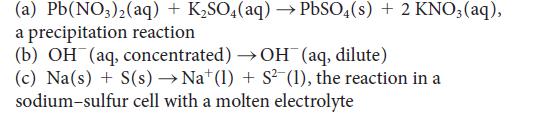
Write balanced half-reactions and devise a galvanic cell (write a cell diagram) to study each of the following reactions: (a) Pb(NO3)2(aq) + K₂SO4(aq) → PbSO4(s) + 2 KNO3(aq), a precipitation reaction (b) OH(aq, concentrated) →OH(aq, dilute) (c) Na(s) + S(s) → Nat (1) + S²(1), the reaction
Calculate the molar solubility of each substance in its respective solution:(a) Silver iodide in 0.020 m NaI(aq);(b) Calcium carbonate in 2.3 * 10–4 m Na2CO3(aq);(c) Lead(II) fluoride in 0.21 m NaF(aq);(d) Nickel(II) hydroxide in 0.450 m NiSO4(aq)
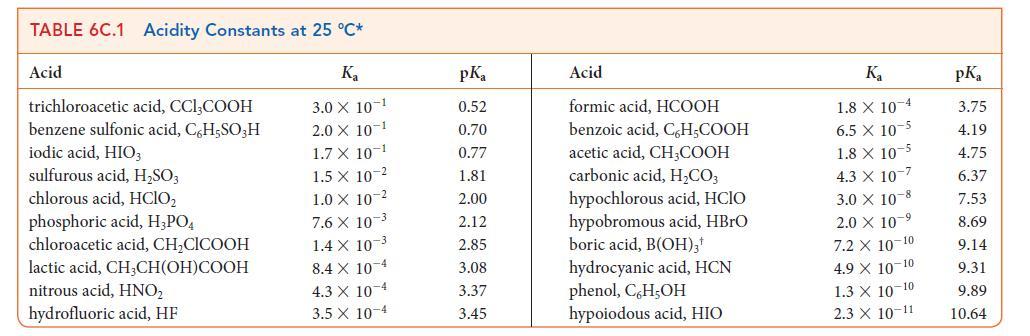
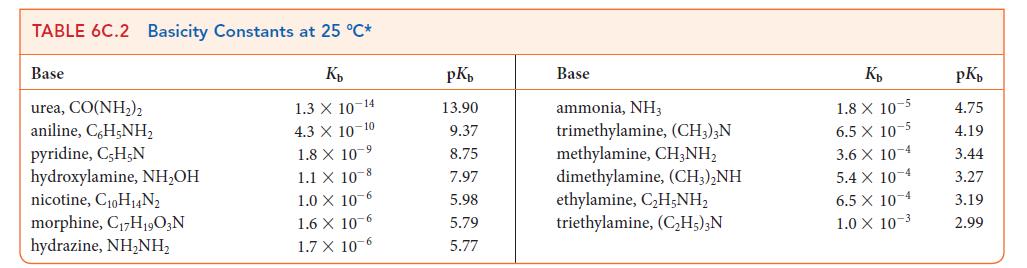
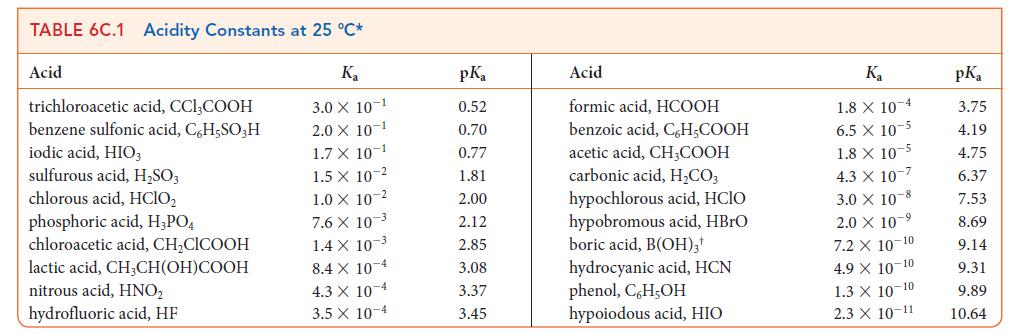
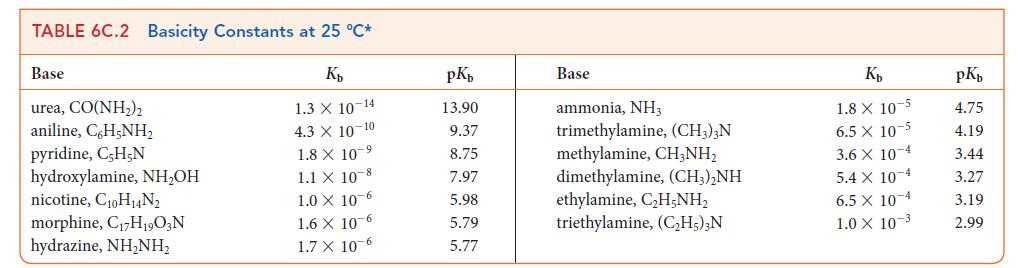
Use data from Tables 6C.1 and 6C.2 to place the following acids in order of increasing strength: HCOOH, (CH3)3NH+, N2H5+, HF. TABLE 6C.1 Acidity Constants at 25 C* K 3.0 X 10⁻¹ 2.0 X 10- 1.7 X 10⁻¹ Acid trichloroacetic acid, CCI,COOH benzene sulfonic acid, C6H,SO3H iodic acid, HIO3 sulfurous acid,
The pH of several solutions was measured in a hospital laboratory; convert each of the following pH values into the molar concentration of H3O+ ions:(a) 4.8 (the pH of a urine sample);(b) 0.7 (the pH of a sample of fluid extracted from a stomach);(c) 7.4 (the pH of blood); (d) 8.1 (the pH of
Many reactions that take place in water have analogous reactions in liquid ammonia (normal boiling point, –33°C).(a) Write the chemical equation for the autoprotolysis of NH3.(b) Write the formulas of the acid and base species that result from the autoprotolysis of liquid ammonia. (c) The
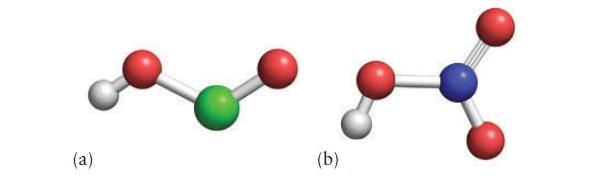
Below are molecular models of two oxoacids. Write the name of each acid and then draw the model of its conjugate base.(Red = O, white = H, green = Cl, and blue = N.) (a) (b)
Arrange the following species in order of increasing strength as oxidizing agents for species in aqueous solution:(a) Co2+, Cl2, Ce4+, In3+;(b) NO3 –, ClO4 –, HBrO, Cr2O7 2–, all in acidic solution;(c) O2, O3, HClO, and HBrO, all in acidic solution;(d) O2, O3, ClO–, BrO–, all in
Like sulfuric acid, a certain diprotic acid, H2A, is a strong acid in its first deprotonation and a weak acid in its second deprotonation. A solution that is 0.015 m H2A(aq) has a pH of 1.72. What is the value of Ka2 for this acid?
Suppose that 1.773 g of impure barium hydroxide is dissolved in enough water to produce 200. mL of solution and that 25.0 mL of this solution is titrated to the stoichiometric point with 13.1 mL of 0.0810 m HCl(aq). What is the (mass) percentage purity of the original sample?
Calculate the unknown concentration of the ion in each of the following cells: 2+ (a) Pb(s) Pb²+ (aq, ?)||Pb²+ (aq, 0.10 mol-L-¹) Pb(s), Ecell = +0.083 V. (b) Pt(s)| Fe³+ (aq, 0.10 mol-L-¹), Fe²+ (aq, 1.0 mol-L-¹)|| 2+ Fe³+ (aq, ?), Fe²+ (aq, 0.0010 mol-L-¹)|Pt(s), Ecell = +0.14 V.
Calculate the pH and pOH of(a) A solution that is 0.23 m Na2HPO4(aq) and 0.18 m Na3PO4(aq);(b) A solution that is 0.45 m Na2HPO4(aq) and 0.62 m Na3PO4(aq);(c) A solution that is 0.16 m Na2HPO4(aq) and 0.16 m Na3PO4(aq).
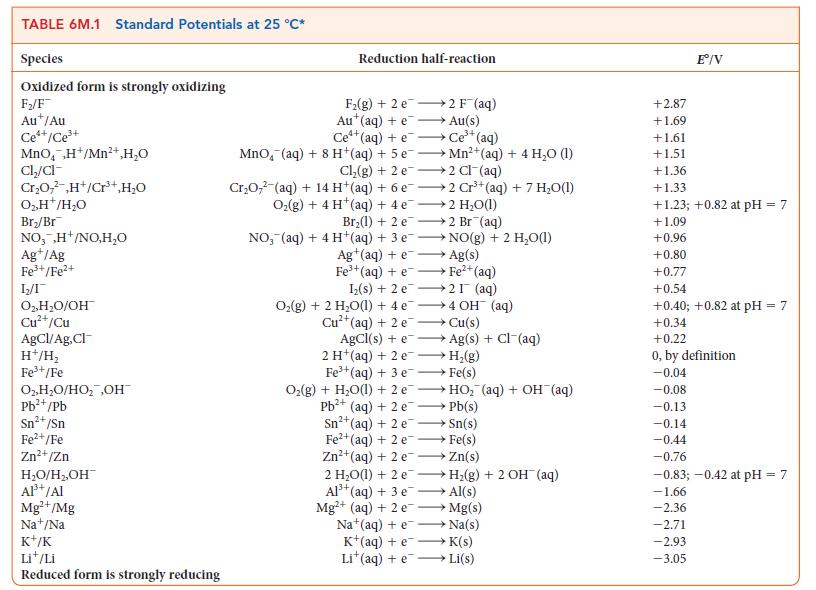
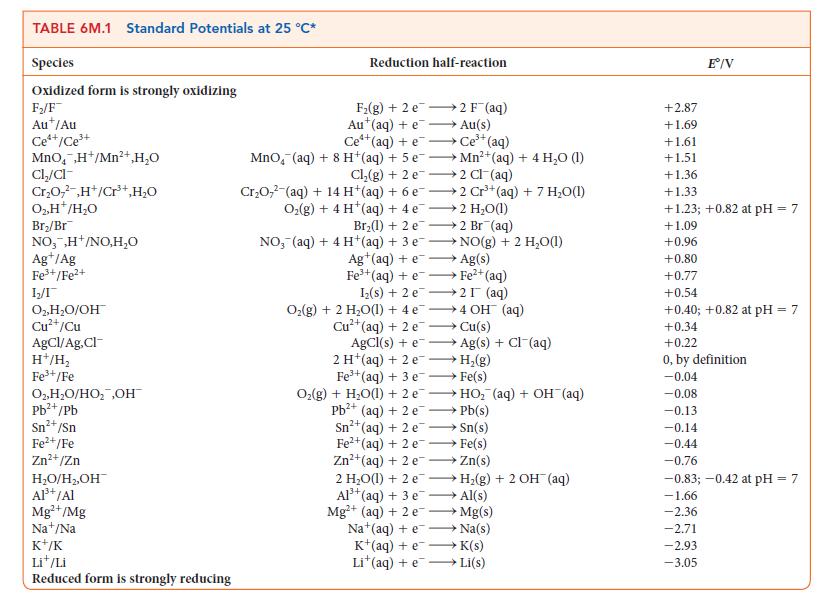
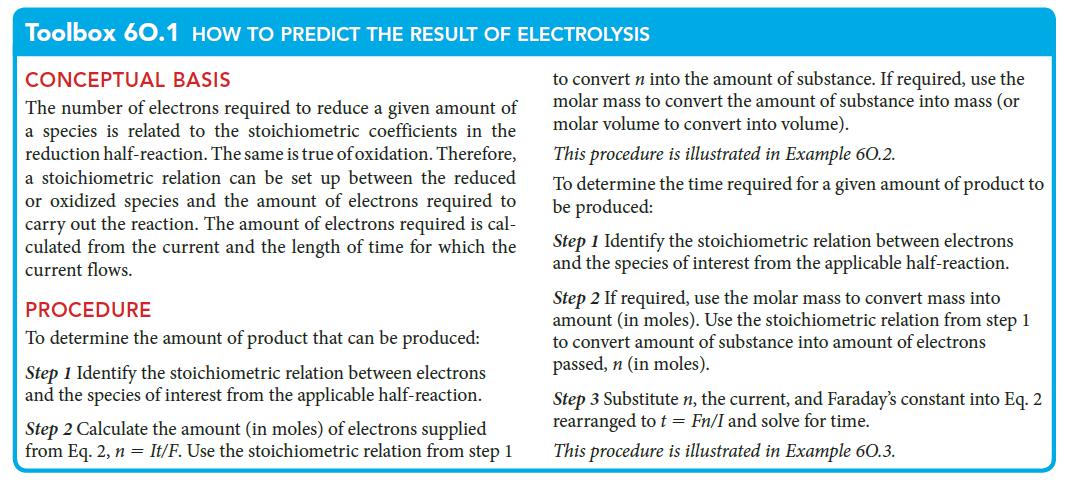
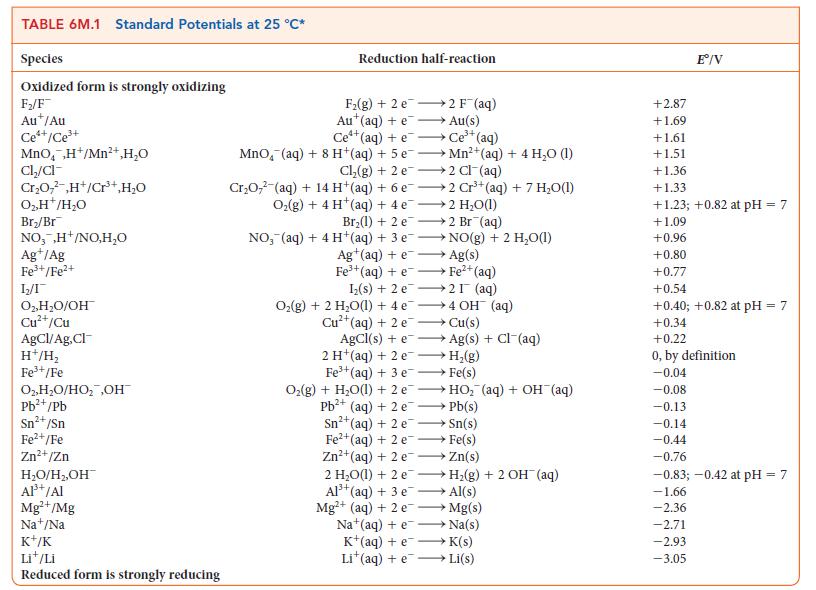
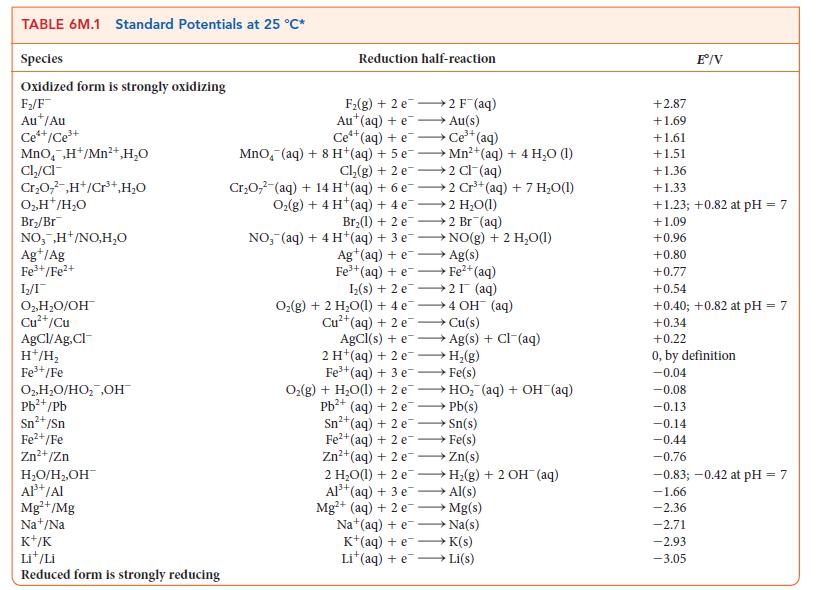
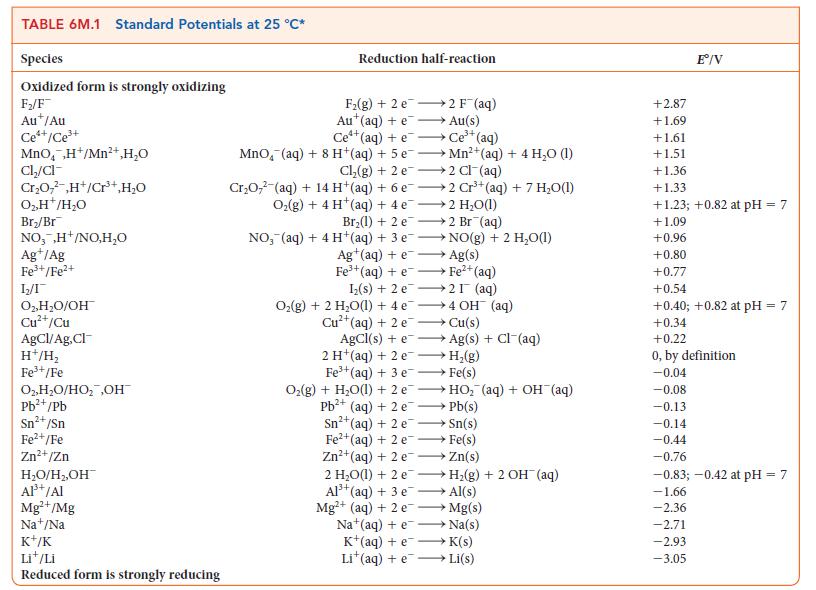
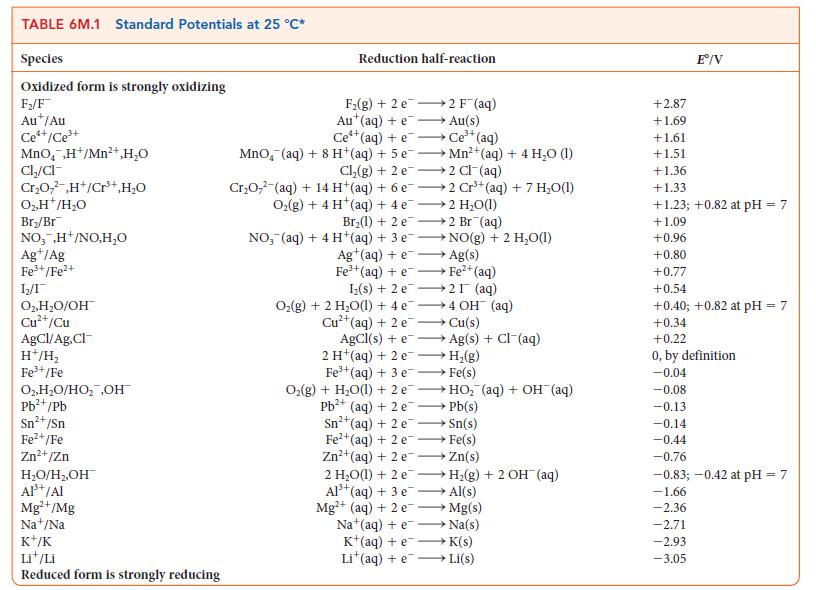
For the exercise in this topic, base your answers on the potentials listed in Table 6M.1 or Appendix 2B, with the exception of the reduction and oxidation of water at pH = 7:(a) What current is required to produce 8.2 g of chromium metal from chromium(VI) oxide in 24 h?(b) What current is
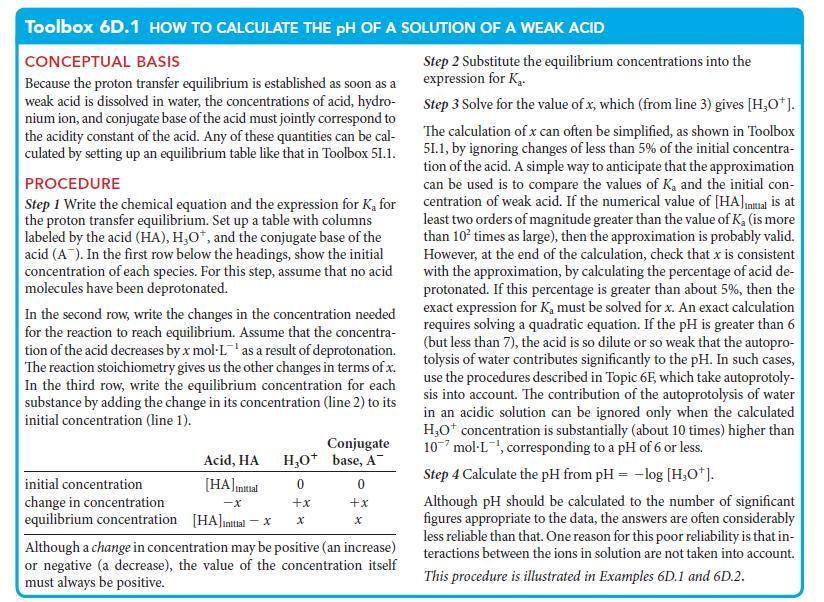
Find the initial concentration of the weak acid or base in each of the following aqueous solutions:(a) A solution of HClO with pH = 5.4;(b) A solution of pyridine, C5H5N, with pH = 8.8.
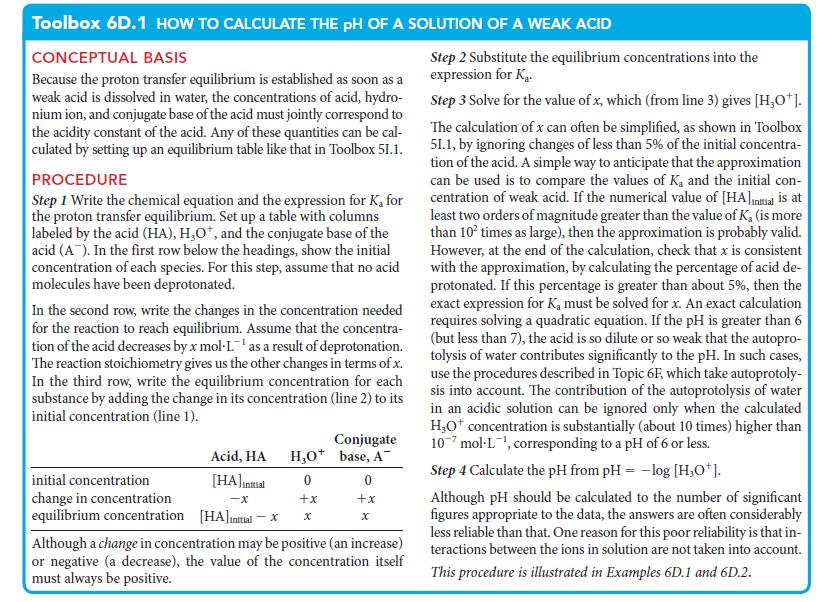
(a) Calculate the pH of 8.50 * 10–5 m and 7.37 * 10–6 m HCN(aq), ignoring the effect of the autoprotolysis of water.(b) Repeat the calculations, taking into account the autoprotolysis of water.
You wish to separate magnesium ions and barium ions by selective precipitation. Which anion, fluoride or carbonate, would be the better choice for achieving this precipitation? Why?
(a) Write balanced half-reactions for the redox reaction of an acidified solution of potassium permanganate and iron(II) chloride.(b) Write the balanced equation for the cell reaction and devise a galvanic cell to study the reaction (write its cell diagram)
(a) Complete the following table.(b) Rank the four solutions in order of increasing acidity. [H3O+] (i) 1.50 mol-L-¹ (ii) (iii) (iv) [OH-] 1.50 mol-L-¹ PH 0.75 POH 0.75
Calculate the molar solubility of each of the following sparingly soluble substances in its respective solution: aluminum hydroxide at(a) pH = 7.0;(b) pH = 4.5; zinc hydroxide at(c) pH = 7.0;(d) pH = 6.0.
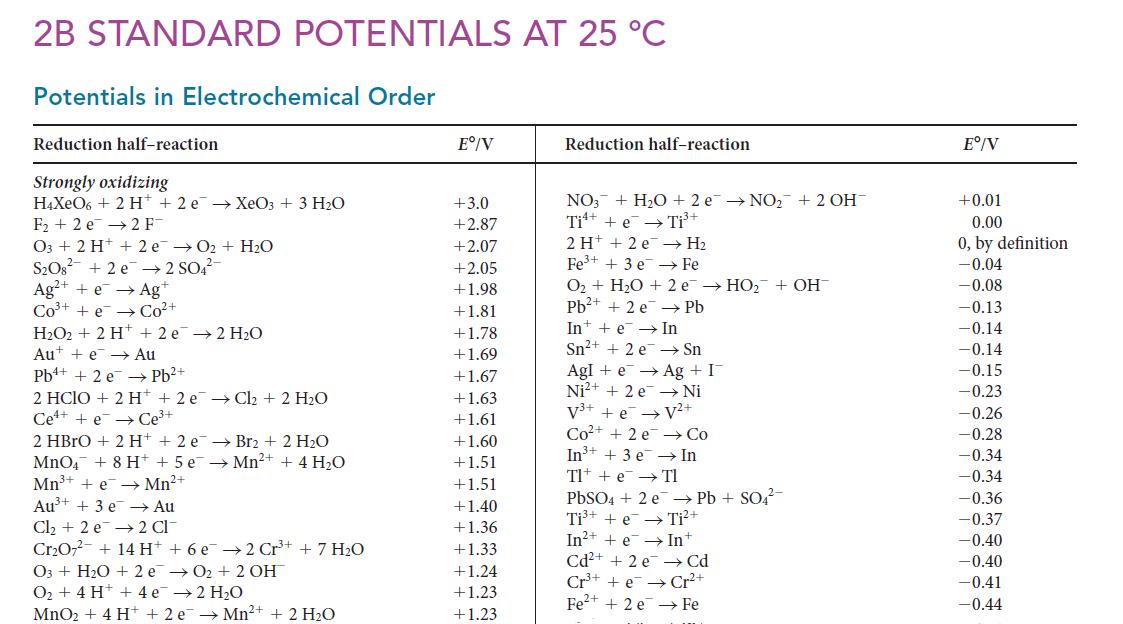
You continue exploring different combinations of electrodes in pursuit of better batteries. You know that the Ce4+/Ce3+ couple has been used in combination with Zn2+/Zn to develop new power sources with high potentials and a large storage capacity. Use the information in Appendix 2B to determine
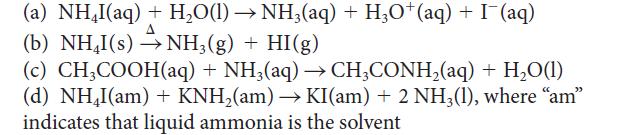
Which of the following can be classified as reactions between Brønsted acids and bases? For those that can be so classified, identify the acid and the base. (a) NHI(aq) + H,O(l)→NH,(aq) + HgO*(aq) +I(aq) (b) NH₂I(s) →→NH3(g) + HI(g) (c) CH3COOH(aq) + NH3(aq) → CH3CONH₂(aq) +
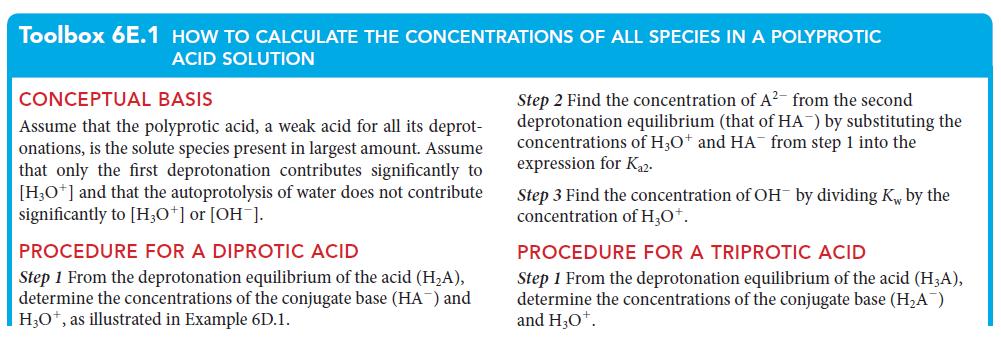
You are an environmental chemist studying a local waterway and need to know the amounts of all forms of phosphate in the stream. You might begin by making up some solutions of phosphoric acid to use as standards. Calculate the concentrations of all solute species in 0.10 m H3PO4(aq).ANTICIPATE
Acetic acid is used as a solvent for some reactions between acids and bases.(a) Nitrous acid and carbonic acids are both weak acids in water. Will either of them act as a strong acid in acetic acid? Explain your answer.(b) Will ammonia act as a strong or weak base in acetic acid? Explain your
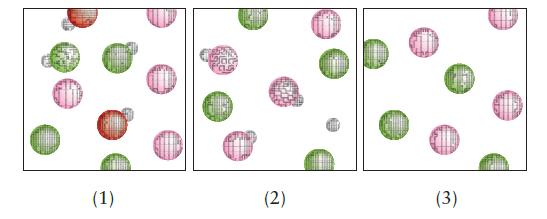
The images below represent the solutes in the solutions of three salts (water molecules are not shown, hydrogen atoms and hydronium ions are represented by small gray spheres, hydroxide ions by red and gray spheres, cations by pink spheres, and anions by green spheres).(a) Which salt has a cation
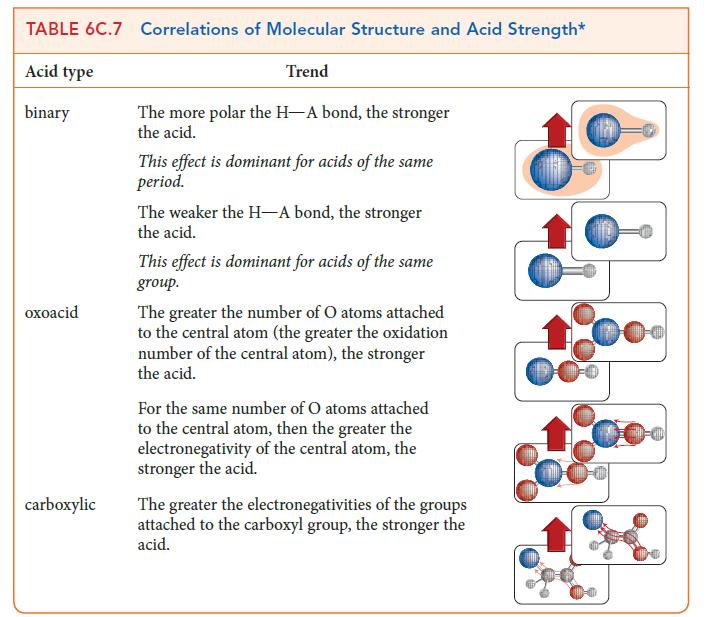
If you are working in a research laboratory preparing a series of compounds, you might be faced with having to make a choice between acids based on their strengths. Can you decide which to use based only on their formulas? Predict from their molecular structures which acid in each of the following
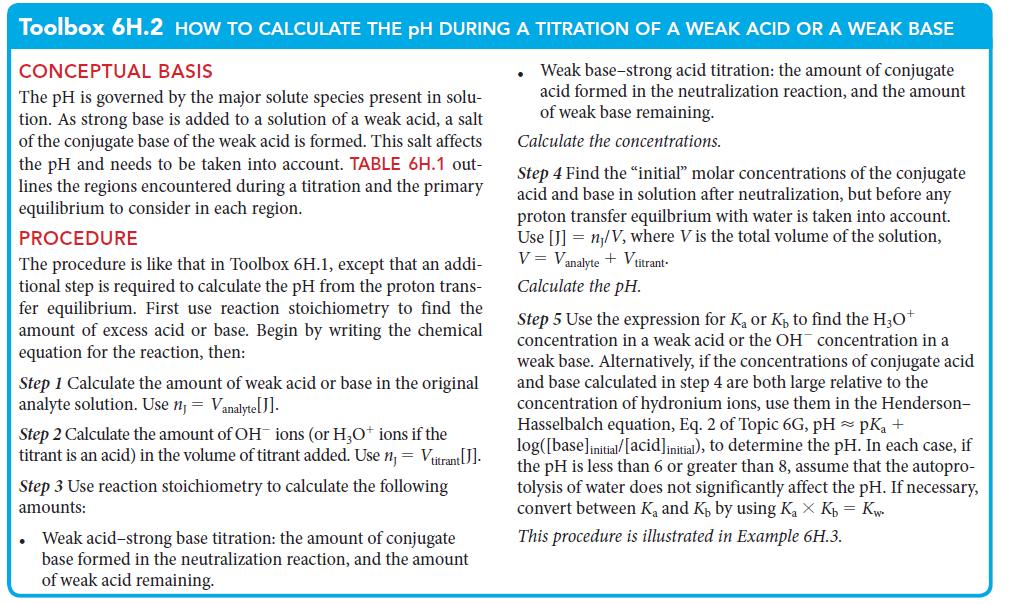
You continue to use the buffer that you prepared in Example 6G.1 but are worried about how adding sodium hydroxide to the buffer solution will affect the pH, which could upset your experiment. Suppose 1.2 g of sodium hydroxide (0.030 mol NaOH) is dissolved in 500. mL of the buffer solution
A student was given a standard Fe(s)|Fe2+(aq) half-cell and another half-cell containing an unknown metal M in 1.00 m MNO3(aq) and formed the cell M(s)|M+(aq)||Fe2+(aq)|Fe(s). At 25°C, Ecell = 11.24 V. The reaction was allowed to continue overnight and the two electrodes were weighed. The iron
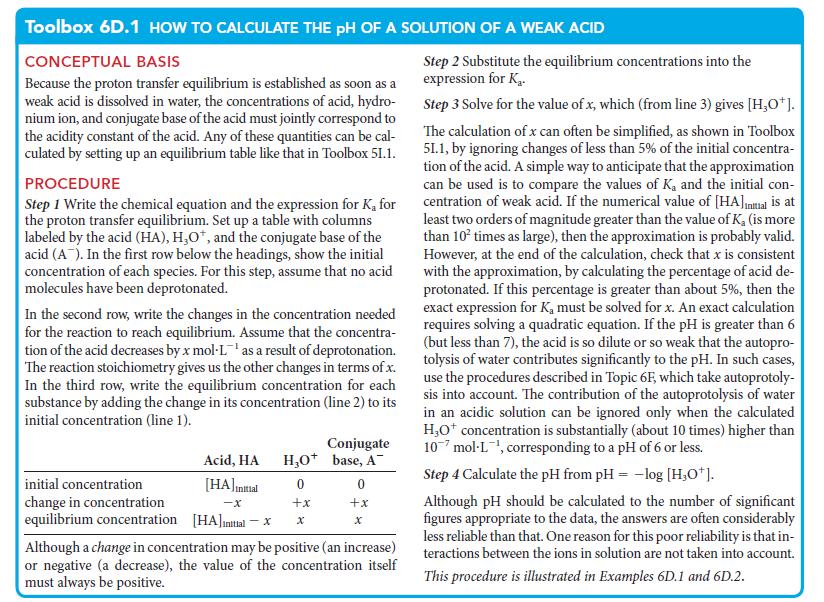
Although there are extensive tables available for the pKa of weak acids, you might be dealing with an unknown acid or a known acid at an unlisted temperature. You could then use a procedure like this to determine the Ka and pKa. The pH of a 0.010 m aqueous solution of a certain carboxylic acid is
Write the formulas of the conjugate acids of(a) C2O4 2–, the oxalate ion;(b) C6H5NH2, aniline;(c) NH2OH, hydroxylamine; and the conjugate bases of(d) H2O2, hydrogen peroxide;(e) HNO2;(f) HCrO4 –.
Calculate the pH of 0.010 m H2SeO4(aq), given that Ka1 is very large and Ka2 = 1.2 * 10–2.
As in Example 6L.1, you are planning to use a Daniell cell to power a model electric car. However, you find that you do not have standard solutions available. You have only dilute solutions, and you need to know whether they will be adequate to power the car. Calculate the potential of a Daniell
Explain what happens to(a) The pH of a solution of phosphoric acid after the addition of solid sodium dihydrogen phosphate;(b) The percentage deprotonation of HCN in a hydrocyanic acid solution after the addition of hydrobromic acid;(c) The concentration of H3O+ ions when pyridinium chloride is
Write(a) The chemical equation for the proton transfer equilibrium in water and the corresponding expression for Kb and(b) The chemical equation for the proton transfer equilibrium of the conjugate acid and the corresponding expression for Ka for each of the following weak acids: (i) (CH3)2NH,
(a) Sketch the titration curve for the titration of 5.00 mL 0.010 m HCl(aq) with 0.010 m Ca(OH)2(aq), indicating the pH of the initial and final solutions and the pH at the stoichiometric point. What volume of titrant has been added at(b) The stoichiometric point;(c) The halfway point of the
Calculate the equilibrium constants for the following reactions: 2+ (a) 2 Fe³+ (aq) + H₂(g) 2 Fe²+ (aq) + 2 H+(aq) (b) 2 Cr(s) + O₂(g) + 2 H₂O(l) — 2 Cr²+ (aq) + 4 OH (aq)
Barium hydroxide is a base that is sometimes used for titrating acids. When using it, you need to know the actual concentration of hydroxide ion in the solution. What are the molar concentrations of H3O+ and OH– in 0.0030 m Ba(OH)2(aq) at 25°C?ANTICIPATE Because the compound provides OH– ions,
You have a sample of seawater collected off Hawaii, where there is a lot of volcanic activity. As part of an oceanographic study, you are going to analyze it to see if its composition is markedly different from a sample taken farther out in the ocean. The sample of seawater contains, among other
Wine is a complex mixture of over 1000 compounds, many at very low concentrations. A large number of flavorful components are derivatives of phenol, C6H5OH, a weak acid. If you are an enologist studying wine chemistry, you may wish to know how dilute compounds such as phenol affect the acidity of
You are working in a plant that produces copper for use in electrical circuits by electrolysis of acidic solutions of CuSO4(aq). A customer has placed an order for a small quantity of high-purity copper, and you need to tell the customer how long it will take to produce the metal. How many hours
Muscles produce lactic acid during exercise. Calculate the pH, pOH, and percentage deprotonation of the following aqueous solutions of lactic acid, CH3CH(OH)COOH:(a) 0.11 m;(b) 3.7 * 10–3 m;(c) 8.2 * 10–5 m.
As a part of your research program on formic acid, you need to titrate a solution of formic acid with sodium hydroxide solution and want to know what to expect. Calculate the pH of(a) 0.100 m HCOOH(aq) and(b) The solution resulting when 5.00 mL of 0.150 m NaOH(aq) is added to 25.00 mL of the
Balance each of the following skeletal equations by using oxidation and reduction half-reactions. All the reactions take place in acidic solution. Identify the oxidizing agent and reducing agent in each reaction.(a) Reaction of thiosulfate ion with chlorine gas:(b) Reaction of permanganate ion
Calculate the pH of 6.50 * 10–8 m HBr(aq).
Iodide ions can be used to precipitate lead(II) ions from 0.010 m Pb(NO3)2(aq).(a) What minimum iodide ion concentration is required for the onset of PbI2 precipitation?(b) What mass (in grams) of KI must be added to 25.0 mL of the Pb(NO3)2(aq) solution for PbI2 to form?
For the exercise in this topic, base your answers on the potentials listed in Table 6M.1 or Appendix 2B, with the exception of the reduction and oxidation of water at pH = 7:Aqueous solutions of (a) Mn2+; (b) Al3+; (c) Ni2+; (d) Au3+ with concentrations of 1.0 mol · L–1 are electrolyzed at pH =
You know that silver chloride is not very soluble in water, but what do you know about its solubility in seawater? You decide to investigate the solubility of silver chloride in solutions with various concentrations of sodium chloride. Estimate the molar solubility of silver chloride in 10 * 10–4
The concentration of CrO4 2– in a saturated Tl2CrO4 solution is 6.3 * 10–5 mol · L–1. What is the Ksp of Tl2CrO4?
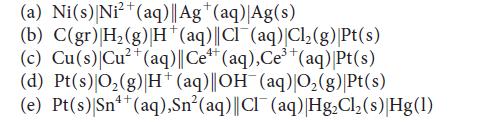
Write the half-reactions and the balanced equation for the cell reaction for each of the following galvanic cells: (a) Ni(s) Ni²+ (aq)|| Ag+(aq) Ag(s) (b) C(gr) |H₂(g) H*(aq)||Cl¯(aq)|Cl₂(g)|Pt(s) (c) Cu(s) Cu²+ (aq)||Ce+ (aq), Ce³+ (aq) |Pt(s) (d) Pt(s)|O₂(g) |H+
A careless laboratory technician wants to prepare 200.0 mL of a 0.025 m HCl(aq) solution but uses a volumetric flask of volume 250.0 mL by mistake.(a) What would the pH of the desired solution have been?(b) What will be the actual pH of the solution as prepared?
Estimate the enthalpy of deprotonation of formic acid at 25°C, given that Ka = 1.765 * 10–4 at 20°C and 1.768 * 10–4 at 30°C.
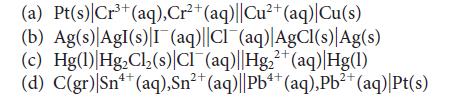
Predict the standard potential of each of the following galvanic cells: 3+ (a) Pt(s) Cr³+ (aq), Cr²+ (aq)||Cu²+ (aq) |Cu(s) (b) Ag(s) AgI(s) I (aq)||CI (aq)|AgCl(s) Ag(s) (c) Hg(1) Hg₂Cl₂ (s) CIT(aq) |Hg₂+ (aq) Hg(1) 2+ 4+ (d) C(gr) |Sn¹+ (aq),Sn²+ (aq)||Pb4+ (aq), Pb²+ (aq)|Pt(s) 2+
Carbonate and hydrogen carbonate (bicarbonate) ions contribute to buffering in a variety of natural systems. You are investigating their role in groundwater percolating through limestone hills into a recently discovered cave system, and need to understand how the pH of the water is controlled.
Write the chemical equations for the proton transfer equilibria of the following acids in aqueous solution and identify the conjugate acid–base pairs in each case:(a) H2SO4;(b) C6H5NH3 +, anilinium ion;(c) H2PO4 –;(d) HCOOH, formic acid;(e) NH2NH3 +, hydrazinium ion.
Methylamine, CH3NH2, is a weak base used as a building block for some pharmaceuticals. If you prepare an aqueous solution of methylamine for use in a synthesis, you might need to know its pH to avoid unwanted side reactions. Calculate the pH and percentage protonation of a 0.20 m aqueous solution
Calculate the pH of each of the following solutions of diprotic acids at 25°C, ignoring second deprotonations only when the approximation is justified:(a) 0.010 m H2CO3(aq);(b) 0.10 m (COOH)2(aq);(c) 0.20 m H2S(aq).
A solution of equal molar concentrations of glyceric acid and sodium glycerate was found to have pH = 3.52.(a) What are pKa and Ka for glyceric acid?(b) What would the pH be if the concentration of acid was twice that of the salt?
(a) Give the Ka value of each of the following acids:(i) Phosphoric acid, H3PO4, pKa = 2.12; (ii) Phosphorous acid, H3PO3, pKa = 2.00; (iii) Selenous acid, H2SeO3, pKa = 2.46; (iv) Hydrogen selenate ion, HSeO4 –, pKa = 1.92.(b) List the acids in order of increasing strength.
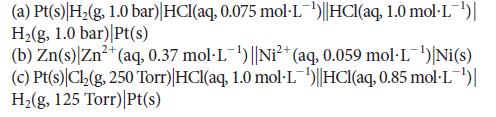
Predict the potential of each of the following cells: (a) Pt(s) H₂(g, 1.0 bar) |HCl(aq, 0.075 mol-L¯¹)||HCl(aq, 1.0 mol-L¯¹)| H₂(g, 1.0 bar) |Pt(s) (b) Zn(s) Zn²+ (aq, 0.37 mol·L¹) ||Ni²+ (aq, 0.059 mol·L¯¹)|Ni(s) (c) Pt(s) Ch₂2(g, 250 Torr) |HCl(aq, 1.0 mol·L¹)||HCl(aq, 0.85
Calculate the volume of 0.150 m HCl(aq) required to neutralize(a) one-half and(b) all the hydroxide ions in 25.0 mL of 0.110 m NaOH(aq).(c) What is the molar concentration of Na+ ions at the stoichiometric point?(d) Calculate the pH of the solution after the addition of 20.0 mL of 0.150 m
Measurement of ion concentrations with electrodes is used in a wide range of applications. Suppose you are interested in removing silver ions from exhausted electroplating solutions by precipitating the silver as silver chloride. To test the efficiency of your process, you decide to build an
Balance each of the following skeletal equations by using oxidation and reduction half-reactions. All the reactions take place in acidic solution. Identify the oxidizing agent and reducing agent in each reaction.(a) Reaction of the selenite ion with chlorate ion:(b) Formation of propanone
(a) When the pH of 0.10 m HClO2(aq) was measured, it was found to be 1.2. What are the values of Ka and pKa of chlorous acid?(b) The pH of a 0.10 m propylamine, C3H7NH2, aqueous solution was measured as 11.86. What are the values of Kb and pKb of propylamine?
For the exercise in this topic, base your answers on the potentials listed in Table 6M.1 or Appendix 2B, with the exception of the reduction and oxidation of water at pH = 7:The anode of an electrolytic cell was constructed from (a) Cr; (b) Pt; (c) Cu; (d) Ni. For each case, determine whether
Calculate the pH of 9.78 * 10–8 m KOH(aq).
Estimate the pH required for the onset of precipitation of Ni(OH)2 from(a) 0.060 m NiSO4(aq);(b) 0.030 m NiSO4(aq).
Silver emulsion photographic film is now largely obsolete for amateur photography, but it is still used in a variety of medical and technical applications. You are working on the improvement of a particularly sensitive emulsion and need to investigate the solubility of silver chloride in various
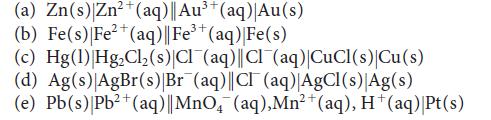
Write the half-reactions and the balanced equation for the cell reaction for each of the following galvanic cells: 2+ (a) Zn(s) Zn²+ (aq)|| Au³+ (aq)| Au(s) 3+ (b) Fe(s) | Fe²+ (aq) || Fe³+ (aq) |Fe(s) (c) Hg(1) Hg₂Cl₂ (s)|Cl(aq)||Cl(aq)|CuCl(s) Cu(s) (d) Ag(s)|AgBr(s)|Br (aq)||CI
The molar solubility of silver sulfite, Ag2SO3, is 1.55 * 10–5 mol · L–1. What is the Ksp of silver sulfite?
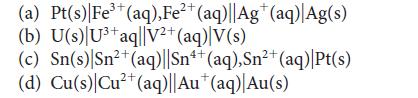
Predict the standard potential of each of the following galvanic cells: 3+ (a) Pt(s)| Fe³+ (aq), Fe²+ (aq)||Ag* (aq) Ag(s) (b) U(s) U³+ aq||V²+ (aq) V(s) 2+ (c) Sn(s) Sn²+ (aq)||Sn4+ (aq),Sn²+ (aq)|Pt(s) 2+ (d) Cu(s) Cu²+ (aq)||Au* (aq)| Au(s)
A careless laboratory technician prepares 300.0 mL of 0.0175 m KOH(aq) and pipets 25.0 mL of the solution into a beaker.The beaker is allowed to stand in a warm place for two days before use, during which time some of the water evaporates and the volume is reduced to 18.0 mL.(a) What would the pH
How many hydronium ions are present at any moment in 100. mL of pure water at 25°C?
You are working in the emergency room of a hospital where a patient suffering from influenza has developed metabolic alkalosis, a condition in which the pH of the blood is too high. You have available a stock solution of ammonium chloride, which is used to lower the pH of the blood of patients
Write the chemical equations for the proton transfer equilibria of the following bases in aqueous solution and identify the conjugate acid–base pairs in each case:(a) CN–;(b) NH2NH2, hydrazine;(c) CO3 2–;(d) HPO4 2–;(e) CO(NH2)2, urea.
Calculate the pH of each of the following solutions of diprotic acids at 25°C, ignoring second deprotonations only when that approximation is justified:(a) 0.10 m H2S(aq);(b) 0.15 m H2C4H4O6(aq), tartaric acid;(c) 1.1 * 10–3 m H2TeO4(aq), telluric acid, for which Ka1 = 2.1 * 10–8 and Ka2 =
solution of equal molar concentrations of the artificial sweetener saccharin and its sodium salt was found to have pH = 3.08.(a) What are the values of pKa and Ka of saccharin?(b) What would the pH be if the concentration of acid was twice that of the salt?
(a) Give the pKb values of the following bases: (i) Ammonia, NH3, Kb = 1.8 * 10–5; (ii) Deuterated ammonia, ND3, Kb = 1.1 * 10–5; (iii) Hydrazine, NH2NH2, Kb = 1.7 * 10–6; (iv) Hydroxylamine, NH2OH, Kb = 1.1 * 10–8. (b) List the bases in order of increasing strength.
Calculate the volume of 0.120 m HCl(aq) required to neutralize(a) One-half and(b) All the hydroxide ions in 25.0 mL of 0.412 m KOH(aq).(c) What is the molar concentration of Cl– ions at the stoichiometric point?(d) Calculate the pH of the solution after the addition of 30.0 mL of 0.120 m HCl(aq)
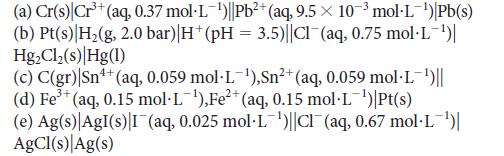
Predict the potential of each of the following cells: 3+ (a) Cr(s) Cr³+ (aq, 0.37 mol-L-¹)||Pb²+ (aq, 9.5 10³ mol-L-¹) Pb(s) (b) Pt(s) H₂(g, 2.0 bar) |H* (pH = 3.5)||Cl¯(aq, 0.75 mol·L-¹)| Hg₂Cl₂ (s) Hg(1) (c) C(gr) |Sn¹+ (aq, 0.059 mol-L-¹),Sn²+ (aq, 0.059 mol-L-¹)|| 3+ (d) Fe³+
(a) The pH of 0.015 m HNO2(aq) was measured as 2.63. What are the values of Ka and pKa of nitrous acid?(b) The pH of 0.10 m C4H9NH2(aq), butylamine, was measured as 12.04. What are the values of Kb and pKb of butylamine?
For the exercise in this topic, base your answers on the potentials listed in Table 6M.1 or Appendix 2B, with the exception of the reduction and oxidation of water at pH = 7:A total charge of 4.5 kC is passed through an electrolytic cell. Determine the quantity of substance produced in each
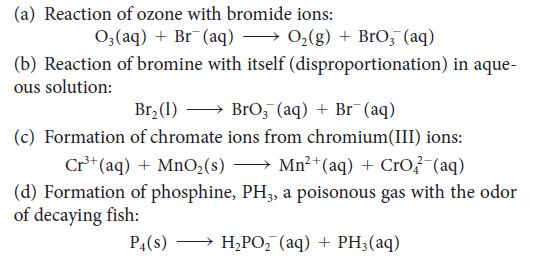
Balance each of the following skeletal equations by using oxidation and reduction half-reactions. All the reactions take place in basic solution. Identify the oxidizing agent and reducing agent in each reaction. (a) Reaction of ozone with bromide ions: O₂ (aq) + Br (aq) → O₂(g) + BrO₂
Calculate the pH of 8.23 * 10–7 m NaNH2(aq)
Decide whether a precipitate will form when each of the following pairs of solutions are mixed:(a) 5.0 mL of 0.10 m K2CO3(aq) and 1.00 L of 0.010 m AgNO3(aq);(b) 3.3 mL of 1.0 m HCl(aq), 4.9 mL of 0.0030 m AgNO3(aq), and enough water to dilute the solution to 50.0 mL. For the purpose of these
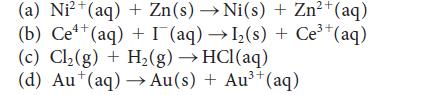
Write the half-reactions, the balanced equation for the cell reaction, and the cell diagram for each of the following skeletal equations: (a) Ni²+(aq) + Zn (s) → Ni(s) + Zn²+(aq) Ce4+ (b) Ce¹¹ (aq) + I (aq) →1₂(s) + Ce³+(aq) (c) Cl₂(g) + H₂(g) → HCl(aq) (d) Au¹(aq) →→ Au(s) +
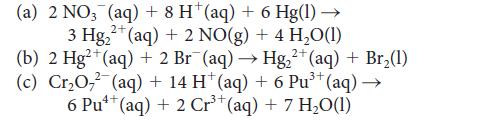
For each reaction that is spontaneous under standard conditions (that is, K > 1), write a cell diagram, determine the standard cell potential, and calculate ΔG° for the reaction: (a) 2 NO3 (aq) + 8 H¹ (aq) + 6 Hg(1) → 3 Hg₂2 (aq) + 2 NO(g) + 4 H₂O(1) 2+ 2+ 3+ (b) 2 Hg2+ (aq) + 2
Calculate the molar solubility in water of(a) BiI3 (Ksp = 7.71 * 10–19);(b) CuCl;(c) CaCO3.
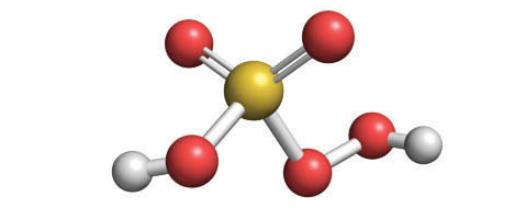
Hydrogen peroxide, H2O2, reacts with sulfur trioxide to form peroxomonosulfuric acid, H2SO5, in a Lewis acid–base reaction.(a) Write the chemical equation for the reaction.(b) Draw the Lewis structures of the reactants and product (in the product, one —OH group in sulfuric acid is replaced by
Calculate the pH and pOH of each of the following aqueous solutions of a strong acid or base: (a) 0.0146 m HNO3(aq); (b) 0.11 m HCl(aq); (c) 0.0092 m Ba(OH)2(aq); (d) 2.00 mL of 0.175 m KOH(aq) after dilution to 0.500 L; (e) 13.6 mg of NaOH dissolved in 0.350 L of solution; (f) 75.0 mL of 3.5
Use data from Tables 6C.1 and 6C.2 to place the following bases in order of increasing strength: F–, NH3, CH3CO2–, C5H5N (pyridine). TABLE 6C.1 Acidity Constants at 25 °C* K₂ 3.0 X 10⁻¹ 2.0 X 10⁻¹ 1.7 X 10⁻¹ 1.5 X 1.0 X 10-2 Acid trichloroacetic acid, CCI,COOH benzene sulfonic acid,
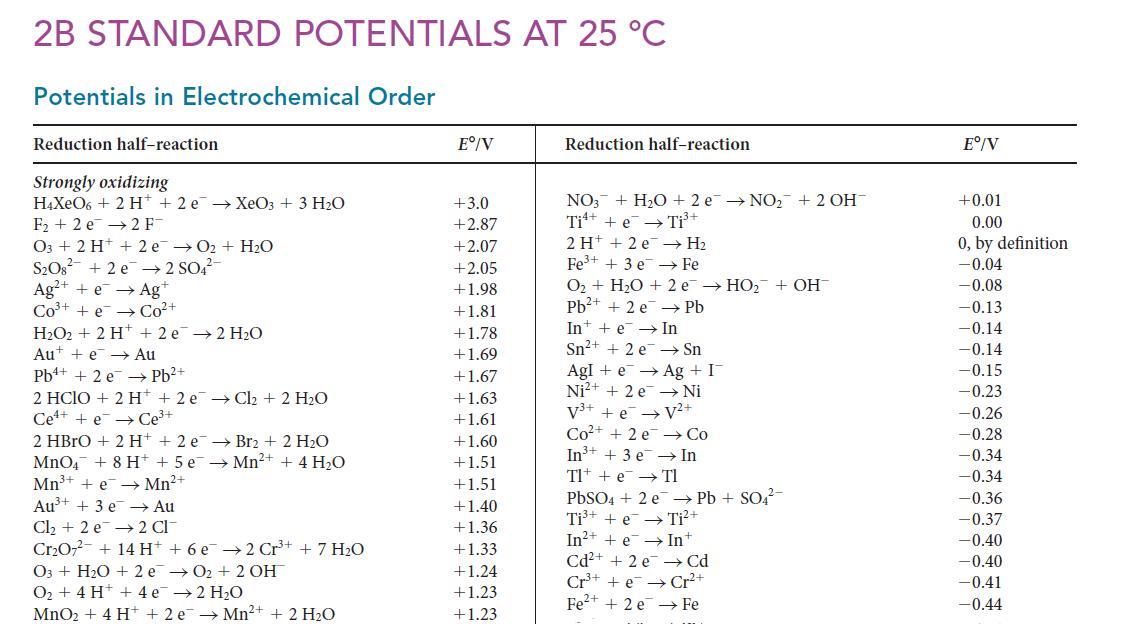
Use the data in Appendix 2B to calculate E°(U4+/U). 2B STANDARD POTENTIALS AT 25 °C Potentials in Electrochemical Order Reduction half-reaction Strongly oxidizing H4XeO6 + 2 H+ 2 e → XeO3 + 3 H₂O F₂+2 e 2 FT 03 + 2 H+ + 2 e → O₂ + H₂O S₂O8² +2e →2 SO4² Ag+ + e → Ag+ CO³+
Calculate the molar concentrations of H2CO3, HCO3–, CO32–, H3O+, and OH– present in 0.0456 m H2CO3(aq).
Benzoic acid, C6H5COOH, is used as a preservative in food and cosmetics because it is considered to be relatively safe.Suppose you are studying benzoic acid and need to predict the pH of a benzoic acid solution during a titration. Calculate the pH at the stoichiometric point of the titration of
Calculate the pH of the solution that results from mixing(a) 30.0 mL of 0.050 m HCN(aq) with 70.0 mL of 0.030 m NaCN(aq);(b) 40.0 mL of 0.030 m HCN(aq) with 60.0 mL of 0.050 m NaCN(aq);(c) 25.0 mL of 0.105 m HCN(aq) with 25.0 mL of 0.105 m NaCN(aq).
A tin electrode in 0.015 m Sn(NO3)2(aq) is connected to a hydrogen electrode in which the pressure of H2 is 1.0 bar. If the cell potential is 0.061 V at 25°C, what is the pH of the electrolyte at the hydrogen electrode?
For the exercise in this topic, base your answers on the potentials listed in Table 6M.1 or Appendix 2B, with the exception of the reduction and oxidation of water at pH = 7:(a) When a current of 324 mA is used for 15 h, what volume (measured in liters at 298 K and 1.0 atm) of fluorine gas can be
The percentage deprotonation of benzoic acid in a 0.110 m solution is 2.4%. What is the pH of the solution and the Ka of benzoic acid?
(a) Calculate the pH of 1.89 * 10–5 m and 9.64 * 10–7 m HClO(aq), ignoring the effect of the autoprotolysis of water.(b) Repeat the calculations, taking into account the autoprotolysis of water.
You wish to separate barium ions from calcium ions by selective precipitation. Which anion, fluoride or carbonate, would be the better choice for achieving this precipitation? Why?
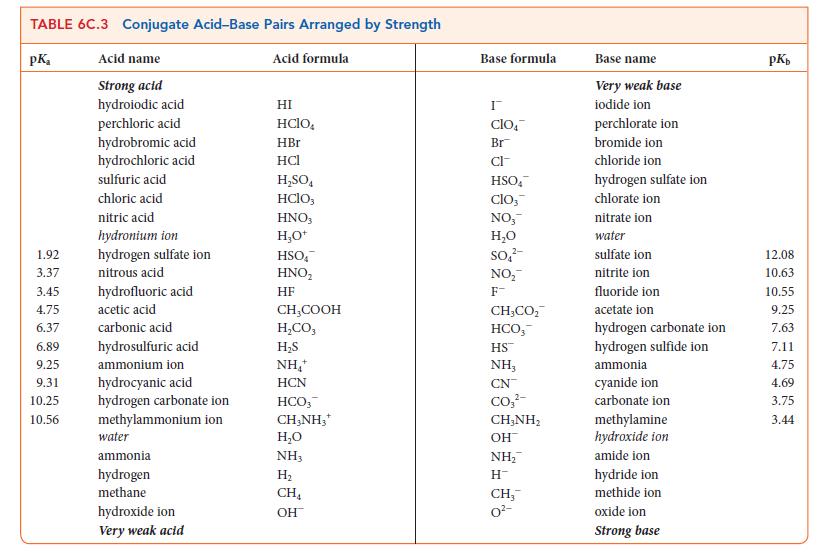
Decide on the basis of the information in Table 6C.3 whether carbonic acid is a strong or weak acid in liquid ammonia solvent. Explain your answer. TABLE 6C.3 Conjugate Acid-Base Pairs Arranged by Strength pK₂ 1.92 3.37 3.45 4.75 6.37 6.89 9.25 9.31 10.25 10.56 Acid name Strong acid hydroiodic
(a) Complete the following table.(b) Rank the four solutions in order of increasing acidity. [H3O+] (i) 0.50 mol-L-¹ (ii) (iii) (iv) [OH-] -1 0.50 mol-L-¹ pH -0.10 POH -0.10
(a) Write balanced half-reactions for the redox reaction between sodium perchlorate and copper (I) nitrate in an acidic solution.(b) Write the balanced equation for the cell reaction and devise a galvanic cell to study the reaction (write its cell diagram).
Showing 1100 - 1200
of 3011
First
5
6
7
8
9
10
11
12
13
14
15
16
17
18
19
Last
Step by Step Answers

 Get 50% OFF
Claim Now
Get 50% OFF
Claim Now




![[H3O+] (i) 1.50 mol-L- (ii) (iii) (iv) [OH-] 1.50 mol-L- PH 0.75 POH 0.75](https://dsd5zvtm8ll6.cloudfront.net/images/question_images/1703/7/7/1/403658d7d0b6d0db1703771404326.jpg)



![[H3O+]+ K[H3O+]2 - (Kw + Ka[HA] initial) [H3O+] KKw = 0 (3b)](https://dsd5zvtm8ll6.cloudfront.net/images/question_images/1703/8/3/3/287658e6ec79fc7b1703833287138.jpg)







![[H3O+] (i) 0.50 mol-L- (ii) (iii) (iv) [OH-] -1 0.50 mol-L- pH -0.10 POH -0.10](https://dsd5zvtm8ll6.cloudfront.net/images/question_images/1703/7/7/1/414658d7d16b86221703771415926.jpg)


