New Semester
Started
Get
50% OFF
Study Help!
--h --m --s
Claim Now
Question Answers
Textbooks
Find textbooks, questions and answers
Oops, something went wrong!
Change your search query and then try again
S
Books
FREE
Study Help
Expert Questions
Accounting
General Management
Mathematics
Finance
Organizational Behaviour
Law
Physics
Operating System
Management Leadership
Sociology
Programming
Marketing
Database
Computer Network
Economics
Textbooks Solutions
Accounting
Managerial Accounting
Management Leadership
Cost Accounting
Statistics
Business Law
Corporate Finance
Finance
Economics
Auditing
Tutors
Online Tutors
Find a Tutor
Hire a Tutor
Become a Tutor
AI Tutor
AI Study Planner
NEW
Sell Books
Search
Search
Sign In
Register
study help
sciences
chemical principles
Chemical Principles 6th Edition Steven S Zumdahl - Solutions
Determine the \(\mathrm{pH}\) of a \(0.100 \mathrm{M}\) solution of \(\left(\mathrm{NH}_{4}ight)_{2} \mathrm{C}_{2} \mathrm{O}_{4}\).
Calculate the \(\mathrm{pH}\) of a solution initially with \(0.10 \mathrm{M}\) \(\mathrm{NaHSO}_{4}\) and \(0.10 \mathrm{M} \mathrm{NH}_{3}\).
A chemist dissolves \(0.135 \mathrm{~mol}\) of \(\mathrm{CO}_{2}(\mathrm{~g})\) in \(2.50 \mathrm{~L}\) of \(0.105 \mathrm{M} \mathrm{Na}_{2} \mathrm{CO}_{3}\). Calculate the \(\mathrm{pH}\) of the resulting solution.
Calculate the \(\mathrm{pH}\) of \(6.0 \times 10^{-4} \mathrm{M} \mathrm{NaNO}_{2}\).
Calculate the \(\mathrm{pH}\) of a solution prepared by mixing equal volumes of \(1.0 \times 10^{-4} \mathrm{M} \mathrm{NH}_{3}\) and \(1.0 \times 10^{-4} \mathrm{M} \mathrm{HCl}\).
Calculate \(\left[\mathrm{OH}^{-}ight]\)in a \(3.0 \times 10^{-7} \mathrm{M}\) solution of \(\mathrm{Ca}(\mathrm{OH})_{2}\).
" Captain Kirk, of the Starship Enterprise, has been told by his superiors that only a chemist can be trusted with the combination to the safe containing the dilithium crystals that power the ship. The combination is the pHpH of solution A described below, followed by the pHpH of solution C.
We found that the equilibrium concentration of H+ in a 1.0 M HF solution is 2.7 × 10⁻² M and the percent dissociation of HF is 2.7%. Calculate [H+] and the percent dissociation of HF in a solution containing both 1.0 M HF (Ka = 7.2 × 10⁻⁴) and 1.0 M NaF.
A buffered solution contains 0.50 M acetic acid (HC2H3O2, Ka = 1.8 × 10⁻⁵) and 0.50 M sodium acetate (NaC2H3O2).a. Calculate the pH of this solution.b. Calculate the change in pH that occurs when 0.010 mol of solid NaOH is added to 1.0 L of the buffered solution. Compare this pH change with the
A buffered solution contains 0.25 M NH3 (Kb = 1.8 × 10⁻⁵) and 0.40 M NH4Cl.a. Calculate the pH of this solution.b. Calculate the pH of the solution that results when 0.10 mol of gaseous HCl is added to 1.0 L of the buffered solution from part a.
Calculate the pH of a buffered solution containing 3.0 × 10⁻⁴ M HOCl (Ka = 3.5 × 10⁻⁸) and 1.0 × 10⁻⁴ M NaOCl.
Calculate the change in pH that occurs when 0.010 mol of gaseous HCl is added to 1.0 L of each of the following solutions.Solution A: 5.00 M HC2H3O2 and 5.00 M NaC2H3O2Solution B: 0.050 M HC2H3O2 and 0.050 M NaC2H3O2For acetic acid, Ka = 1.8 × 10⁻⁵.
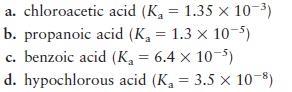
A chemist needs to prepare a solution buffered at pH 4.30 using one of the following acids (and its sodium salt):Calculate the ratio of [HA]/[A–] required for each system to yield a pH of 4.30. Which system will work best? a. chloroacetic acid (K = 1.35 x 10-) b. propanoic acid (K = 1.3 x 10⁻⁵)
Hydrogen cyanide gas (HCN) is a powerful respiratory inhibitor that is highly toxic. It is a very weak acid (Ka = 6.2 × 10⁻¹⁰) when dissolved in water. If a 50.0-mL sample of 0.100 M HCN is titrated with 0.100 M NaOH, calculate the pH of the solution at the following points.a. After 8.00 mL of
A chemist has synthesized a monoprotic weak acid and wants to determine its Ka value. To do so, the chemist dissolves 2.00 mmol of the solid acid in 100.0 mL of water and titrates the resulting solution with 0.0500 M NaOH. After 20.0 mL of NaOH has been added, the pH is 6.00. What is the Ka value
Bromthymol blue, an indicator with a Ka value of 1.0 × 10⁻⁷, is yellow in its HIn form and blue in its In– form. Suppose we put a few drops of this indicator in a strongly acidic solution. If the solution is then titrated with NaOH, at what pH will the indicator color change first be visible?
Calculate the pH of a 1.0 M solution of NaH2PO4. (For H3PO4, Ka1 = 7.5 × 10⁻³, Ka2 = 6.2 × 10⁻⁸, and Ka3 = 4.8 × 10⁻¹³.)
Calculate the Ksp value for bismuth sulfide (Bi2S3), which has a solubility of 1.0 × 10⁻¹⁵ mol/L at 25°C.
The Ksp value for copper(II) iodate [Cu(IO3)2] is 1.4 × 10⁻⁷ at 25°C. Calculate its solubility at 25°C.
A solution contains 1.0 × 10⁻⁴ M Cu+ and 2.0 × 10⁻³ M Pb2+. If a source of I– is added to this solution gradually, will PbI2 (Ksp = 1.4 × 10⁻⁸) or CuI (Ksp = 5.3 × 10⁻¹²) precipitate first? Specify the concentration of I– necessary to begin precipitation of each salt.
Calculate the concentrations of Ag+, Ag(S2O3)–, and Ag(S2O3)23– in a solution prepared by mixing 150.0 mL of 1.00 × 10⁻³ M AgNO3 with 200.0 mL of 5.00 M Na2S2O3. The stepwise formation equilibria are Ag+ (aq) + SO3 (aq) Ag(S03) (aq) + SO3- (aq) Ag(S03) (aq) Ag(SO3)2(aq) K = 7.4 x 10⁸ K = 3.9
You have two salts \(\mathrm{AgX}\) and \(\mathrm{AgY}\) with very similar \(K_{\mathrm{sp}}\) values. You know that the \(K_{\mathrm{a}}\) value for \(\mathrm{HX}\) is much greater than the \(K_{\mathrm{a}}\) value for HY. Which salt is more soluble in an acidic solution? Explain.
Under what circumstances can the relative solubilities of two salts be compared by directly comparing values of their solubility products?
Calculate the \(\mathrm{pH}\) of each of the following solutions.a. \(0.100 \mathrm{M}\) propanoic acid \(\left(\mathrm{HC}_{3} \mathrm{H}_{5} \mathrm{O}_{2}, K_{\mathrm{a}}=1.3 \times 10^{-5}ight)\)b. \(0.100 \mathrm{M}\) sodium propanoate \(\left(\mathrm{NaC}_{3} \mathrm{H}_{5}
Calculate the pH after 0.020 mol of HCl is added to 1.00 L of each of the four solutions in Exercise 19.Data from Exercises 19Calculate the pH of each of the following solutions.0.100 M propanoic acid (HC3H5O2, Ka = 1.3 × 10⁻⁵)0.100 M sodium propanoate (NaC3H5O2) Pure H2O0.100 M HC3H5O2 and
Calculate the \(\mathrm{pH}\) after \(0.020 \mathrm{~mol}\) of \(\mathrm{NaOH}\) is added to \(1.00 \mathrm{~L}\) of each of the four solutions in Exercise 19.Data from Exercises 19Calculate the pH of each of the following solutions.0.100 M propanoic acid (HC3H5O2, Ka = 1.3 × 10⁻⁵)0.100 M sodium
The results of Exercises 19-21 illustrate an important property of buffered solutions. Which solution in Exercise 19 is the buffered solution and what important property is illustrated by the results?Data from Exercises 21Calculate the pH after 0.020 mol of NaOH is added to 1.00 L of each of the
Calculate the \(\mathrm{pH}\) of a solution that is \(0.60 \mathrm{M} \mathrm{HF}\) and \(1.00 \mathrm{M} \mathrm{KF}\).
Calculate the \(\mathrm{pH}\) of a solution that is \(0.100 \mathrm{M} \mathrm {HONH}_{2}\) and \(0.100 \mathrm{M} \mathrm {HONH}_{3} \mathrm{Cl}\).
Calculate the \(\mathrm{pH}\) after \(0.10 \mathrm{~mol}\) of \(\mathrm{NaOH}\) is added to 1.00 L of the solution in Exercise 23, and calculate the \(\mathrm{pH}\) after \(0.20 \mathrm{~mol}\) of \(\mathrm{HCl}\) is added to \(1.00 \mathrm{~L}\) of the solution in Exercise 23.Data from Exercises
Calculate the \(\mathrm{pH}\) after \(0.020 \mathrm{~mol}\) of \(\mathrm{NaOH}\) is added to \(1.00 \mathrm{~L}\) of the solution in Exercise 24, and calculate the \(\mathrm{pH}\) after \(0.020 \mathrm{~mol}\) of \(\mathrm{HCl}\) is added to \(1.00 \mathrm{~L}\) of the solution in Exercise 24.Data
Calculate the \(\mathrm{pH}\) of a buffered solution prepared by dissolving \(21.5 \mathrm{~g}\) of benzoic acid \(\left(\mathrm{HC}_{7} \mathrm{H}_{5} \mathrm{O}_{2}ight)\) and \(37.7 \mathrm{~g}\) of sodium benzoate in \(200.0 \mathrm{~mL}\) of solution.
How many moles of \(\mathrm{NaOH}\) must be added to \(1.0 \mathrm{~L}\) of \(2.0 \mathrm{M} \mathrm{HC}_{2} \mathrm{H}_{3} \mathrm{O}_{2}\) to produce a solution buffered at each \(\mathrm{pH}\) ?a. \(\mathrm{pH}=\mathrm{p} K_{\mathrm{a}}\)b. \(\mathrm{pH}=4.00\)c. \(\mathrm{pH}=5.00\)
Calculate the number of moles of \(\mathrm{HCl}(\mathrm{g})\) that must be added to \(1.0 \mathrm{~L}\) of \(1.0 \mathrm{M} \mathrm{NaC}_{2} \mathrm{H}_{3} \mathrm{O}_{2}\) to produce a solution buffered at each \(\mathrm{pH}\).a. \(\mathrm{pH}=\mathrm{p} K_{\mathrm{a}}\)b. \(\mathrm{pH}=4.20\)c.
Calculate the \(\mathrm{pH}\) after \(0.010 \mathrm{~mol}\) of gaseous \(\mathrm{HCl}\) is added to \(250.0 \mathrm{~mL}\) of each of the following buffered solutions.a. \(0.050 \mathrm{M} \mathrm{NH}_{3}\) and \(0.15 \mathrm{M} \mathrm{NH}_{4} \mathrm{Cl}\)b. \(0.50 \mathrm{M} \mathrm{NH}_{3}\)
a. Carbonate buffers are important in regulating the \(\mathrm{pH}\) of blood at 7.40. What is the concentration ratio of \(\mathrm{CO}_{2}\) (usually written \(\mathrm{H}_{2} \mathrm{CO}_{3}\) ) to \(\mathrm{HCO}_{3}{ }^{-}\)in blood at \(\mathrm{pH}=7.40\) ?b. Phosphate buffers are important in
Which of the following mixtures would result in a buffered solution when \(1.0 \mathrm{~L}\) of each of the two solutions are mixed?a. \(0.1 \mathrm{M} \mathrm{KOH}\) and \(0.1 \mathrm{M} \mathrm{CH}_{3} \mathrm{NH}_{3} \mathrm{Cl}\)b. \(0.1 \mathrm{M} \mathrm{KOH}\) and \(0.2 \mathrm{M}
In Section 8.3 an equation was derived for the exact treatment of HA/NaA-type buffers. What would be the expression for \(\mathrm{B} / \mathrm{BHCl}\)-type buffers stated in terms of \(\mathrm{K}_{\mathrm{b}}\), \(\left[\mathrm{OH}^{-}ight],[\mathrm{B}]\), and \(\left[\mathrm{BH}^{+}ight]\)? Would
Consider a weak acid HA with a \(K_{a}\) value of \(1.6 \times 10^{-7}\). Calculate the \(\mathrm{pH}\) of a solution that is \(5.0 \times\) \(10^{-7} \mathrm{M} \mathrm{HA}\) and \(5.0 \times 10^{-7} \mathrm{M} \mathrm{NaA}\).
A \(25.0-\mathrm{mL}\) sample of \(0.100 \mathrm{M}\) lactic acid \(\left(\mathrm{HC}_{3} \mathrm{H}_{5} \mathrm{O}_{3}, \mathrm{pK}ight.\) =3.86) is titrated with \(0.100 \mathrm{M} \mathrm{NaOH}\) solution. Calculate the \(\mathrm{pH}\) after the addition of \(0.0 \mathrm{~mL}, 4.0 \mathrm{~mL},
Two drops of indicator HIn \(\left(K_{\mathrm{a}}=1.0 \times 10^{-9}ight)\), where HIn is yellow and \(\mathrm{In}^{-}\)is blue, are placed in \(100.0 \mathrm{~mL}\) of \(0.10 \mathrm{M} \mathrm{HCl}\).a. What color is the solution initially?b. The solution is titrated with \(0.10 \mathrm{M}
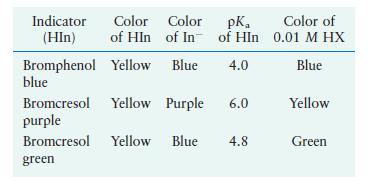
Indicators can be used to estimate the \(\mathrm{pH}\) values of solutions. To determine the \(\mathrm{pH}\) of a \(0.01 \mathrm{M}\) weak acid (HX) solution, a few drops of three different indicators are added to separate portions of \(0.01 \mathrm{M} \mathrm{HX}\). The resulting colors of the HX
Consider the titration of \(100.0 \mathrm{~mL}\) of a \(0.0500 \mathrm{M}\) solution of the hypothetical weak acid \(\mathrm{H}_{3} \mathrm{X}\left(K_{\mathrm{a}_{1}}=1.0 \timesight.\) \(10^{-3}, K_{\mathrm{a}_{2}}=1.0 \times 10^{-7}, K_{\mathrm{a}_{3}}=1.0 \times 10^{-12}\) ) with 0.100 \(M
Consider \(100.0 \mathrm{~mL}\) of a \(0.100 \mathrm{M}\) solution of \(\mathrm{H}_{3}\mathrm{~A}\) \(\left(K_{\mathrm{a}_{1}}=1.5 \times 10^{-4}, K_{\mathrm{a}_{2}}=3.0 \times 10^{-8}, K_{\mathrm{a}_{3}}=5.0 \times 10^{-12}ight)\).a. Calculate the \(\mathrm{pH}\) of this solution.b. Calculate the
A 0.200 -g sample of a triprotic acid (molar mass \(=165.0\) \(\mathrm{g} / \mathrm{mol}\) ) is dissolved in a \(50.00-\mathrm{mL}\) aqueous solution and titrated with \(0.0500 \mathrm{M} \mathrm{NaOH}\). After \(10.50 \mathrm{~mL}\) of the base was added, the \(\mathrm{pH}\) was observed to be
A student was given a \(0.10 \mathrm{M}\) solution of an unknown diprotic acid \(\mathrm{H}_{2} \mathrm{~A}\) and asked to determine the \(K_{\mathrm{a}_{1}}\) and \(K_{\mathrm{a}_{2}}\) values for the diprotic acid. The student titrated 50.0 \(\mathrm{mL}\) of the \(0.10 \mathrm{M} \mathrm{H}_{2}
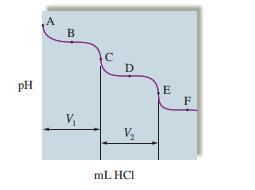
The titration of \(\mathrm{Na}_{2} \mathrm{CO}_{3}\) with \(\mathrm{HCl}\) has the following qualitative profile:a. Identify the major species in solution as points A-F.b. For the titration of \(25.00 \mathrm{~mL}\) of \(0.100 \mathrm{M} \mathrm{Na}_{2} \mathrm{CO}_{3}\) with \(0.100 \mathrm{M}
Consider \(100.0 \mathrm{~mL}\) of a solution of \(0.200 \mathrm{M} \mathrm{Na}_{2} \mathrm{~A}\), where \(\mathrm{A}^{2-}\) is a base with corresponding acids \(\mathrm{H}_{2} \mathrm{~A}\) \(\left(K_{\mathrm{a}}=1.0 \times 10^{-3}ight)\) and \(\mathrm{HA}^{-}\left(K_{\mathrm{a}}=1.0 \times
Calculate the solubility of each of the following compounds in moles per liter and grams per liter. (Ignore any acid-base properties.)a. \(\mathrm{Ag}_{3} \mathrm{PO}_{4}, K_{\text {sp }}=1.8 \times 10^{-18}\)b. \(\mathrm{CaCO}_{3}, K_{\mathrm{sp}}=8.7 \times 10^{-9}\)c. \(\mathrm{Hg}_{2}
The concentration of \(\mathrm{Ag}^{+}\)in a solution saturated with \(\mathrm{Ag}_{2} \mathrm{C}_{2} \mathrm{O}_{4}(s)\) is \(2.2 \times 10^{-4} M\). Calculate \(K_{\text {sp }}\) for \(\mathrm{Ag}_{2} \mathrm{C}_{2} \mathrm{O}_{4}\).
The solubility of \(\mathrm{Ce}\left(\mathrm{IO}_{3}ight)_{3}\) in a \(0.20 \mathrm{M} \mathrm{KIO}_{3}\) solution is \(4.4 \times 10^{-8} \mathrm{~mol} / \mathrm{L}\). Calculate \(K_{\text {sp }}\) for \(\mathrm{Ce}\left(\mathrm{IO}_{3}ight)_{3}\).
Explain the following phenomenon. You have a test tube with about \(20 \mathrm{~mL}\) of silver nitrate solution. Upon adding a few drops of sodium chromate solution, you notice a red solid forming in a relatively clear solution. Upon adding a few drops of sodium chloride solution to the same test
A solution is prepared by mixing \(75.0 \mathrm{~mL}\) of \(0.020 \mathrm{M}\) \(\mathrm{BaCl}_{2}\) and \(125 \mathrm{~mL}\) of \(0.040 \mathrm{M} \mathrm{K}_{2} \mathrm{SO}_{4}\). What are the concentrations of barium and sulfate ions in this solution? Assume only \(\mathrm{SO}_{4}{ }^{2-}\) ions
A solution is prepared by mixing \(50.0 \mathrm{~mL}\) of \(0.10 \mathrm{M}\) \(\mathrm{Pb}\left(\mathrm{NO}_{3}ight)_{2}\) with \(50.0 \mathrm{~mL}\) of \(1.0 \mathrm{M} \mathrm{KCl}\). Calculate the concentrations of \(\mathrm{Pb}^{2+}\) and \(\mathrm{Cl}^{-}\)at equilibrium.
A solution contains \(1.0 \times 10^{-5} \mathrm{M} \mathrm{Na}_{3} \mathrm{PO}_{4}\). What is the minimum concentration of \(\mathrm{AgNO}_{3}\) that would cause precipitation of solid \(\mathrm{Ag}_{3} \mathrm{PO}_{4}\left(K_{\text {sp }}=1.8 \times 10^{-18}ight)\) ?
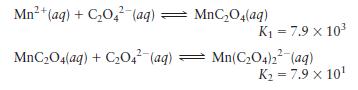
Given the following data,calculate the value for the overall formation constant for \(\mathrm{Mn}\left(\mathrm{C}_{2} \mathrm{O}_{4}ight)_{2}{ }^{2-}\) :\[K=\frac{\left[\mathrm{Mn}\left(\mathrm{C}_{2} \mathrm{O}_{4}ight)_{2}^{2-}ight]}{\left[\mathrm{Mn}^{2+}ight]\left[\mathrm{C}_{2} \mathrm{O}_{4}{
The overall formation constant for \(\mathrm{HgI}_{4}{ }^{2-}\) is \(1.0 \times 10^{30}\). That is,\[1.0 \times 10^{30}=\frac{\left[\mathrm{HgI}_{4}{ }^{2-}ight]}{\left[\mathrm{Hg}^{2+}ight]\left[\mathrm{I}^{-}ight]^{4}}\]What is the concentration of \(\mathrm{Hg}^{2+}\) in \(500.0 \mathrm{~mL}\)
A solution is prepared by adding \(0.090 \mathrm{~mol}\) of \(\mathrm{K}_{3}\left[\mathrm{Fe}(\mathrm{CN})_{6}ight]\) to \(0.60 \mathrm{~L}\) of \(2.0 \mathrm{M} \mathrm{NaCN}\). Assuming no volume change, calculate the concentrations of \(\mathrm{Fe}(\mathrm{CN})_{6}{ }^{3-}\) and
Consider a solution made by mixing \(500.0 \mathrm{~mL}\) of 4.0 \(M \mathrm{NH}_{3}\) and \(500.0 \mathrm{~mL}\) of \(0.40 \mathrm{M} \mathrm{AgNO}_{3} . \mathrm{Ag}^{+}\)reacts with \(\mathrm{NH}_{3}\) to form \(\mathrm{AgNH}_{3}{ }^{+}\)and \(\mathrm{Ag}\left(\mathrm{NH}_{3}ight)_{2}{
Solutions of sodium thiosulfate are used to dissolve unexposed \(\mathrm{AgBr}\) in the developing process for black-andwhite film. What mass of \(\mathrm{AgBr}\) can dissolve in \(1.00 \mathrm{~L}\) of \(0.500 \mathrm{M} \mathrm{Na}_{2} \mathrm{~S}_{2} \mathrm{O}_{3}\) ? Assume the overall
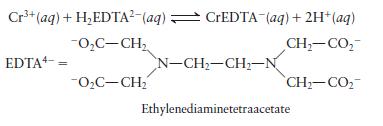
The equilibrium constant for the following reaction is \(1.0 \times 10^{23}\) :EDTA is used as a complexing agent in chemical analysis. Solutions of EDTA, usually containing the disodium salt \(\mathrm{Na}_{2} \mathrm{H}_{2}\) EDTA, are used to treat heavy metal poisoning. Calculate
Calculate the concentration of \(\mathrm{Pb}^{2+}\) in each of the following.a. a saturated solution of \(\mathrm{Pb}(\mathrm{OH})_{2} ; K_{\mathrm{sp}}=1.2 \times 10^{-15}\)b. a saturated solution of \(\mathrm{Pb}(\mathrm{OH})_{2}\) buffered at \(\mathrm{pH}=\) 13.00c. \(0.010 \mathrm{~mol}\) of
The solubility rules outlined in Chapter 4 say that \(\mathrm{Ba}(\mathrm{OH})_{2}, \mathrm{Sr}(\mathrm{OH})_{2}\), and \(\mathrm{Ca}(\mathrm{OH})_{2}\) are marginally soluble hydroxides. Calculate the \(\mathrm{pH}\) of a saturated solution of each of these marginally soluble hydroxides.
When phosphoric acid is titrated with a \(\mathrm{NaOH}\) solution, only two stoichiometric points are seen. Why?
For solutions containing salts of the form \(\mathrm{NH}_{4} \mathrm{X}\), the \(\mathrm{pH}\) is determined by using the equation\[\mathrm{pH}=\frac{\mathrm{p} K_{\mathrm{a}}\left(\mathrm{NH}_{4}^{+}ight)+\mathrm{p} K_{\mathrm{a}}(\mathrm{HX})}{2}\]a. Derive this equation. (Hint: Review Section
Consider the titration of \(100.0 \mathrm{~mL}\) of a solution that contains a mixture of \(0.050 \mathrm{M} \mathrm{H}_{2} \mathrm{SO}_{4}\) and \(0.20 \mathrm{M}\) \(\mathrm{H}_{2} \mathrm{C}_{6} \mathrm{H}_{6} \mathrm{O}_{6}\). Calculate the \(\mathrm{pH}\)a. before any \(0.10 \mathrm{M}
a. Show that the solubility of \(\mathrm{Al}(\mathrm{OH})_{3}\), as a function of \(\left[\mathrm{H}^{+}ight]\), obeys the equation\[S=\left[\mathrm{H}^{+}ight]^{3} K_{\mathrm{sp}} / K_{\mathrm{w}}{ }^{3}+K K_{\mathrm{w}} /\left[\mathrm{H}^{+}ight]\]where \(S=\) solubility
Consider the titration of \(100.0 \mathrm{~mL}\) of a \(1.00 \times 10^{-4} \mathrm{M}\) solution of an acid HA \(\left(K_{\mathrm{a}}=5.0 \times 10^{-10}ight)\) with \(1.00 \times\) \(10^{-3} \mathrm{M} \mathrm{NaOH}\). Calculate the \(\mathrm{pH}\) for the following conditions.a. before any
Consider a solution formed by mixing \(200.0 \mathrm{~mL}\) of \(0.250 \mathrm{M} \mathrm{Na}_{3} \mathrm{PO}_{4}, 135.0 \mathrm{~mL}\) of \(1.000 \mathrm{M} \mathrm{HCl}\), and \(100.0 \mathrm{~mL}\) of \(0.100 \mathrm{M} \mathrm{NaCN}\).a. Calculate the \(\mathrm{pH}\) of this solution.b.
Calculate the \(\mathrm{pH}\) of a solution prepared by mixing 500.0 \(\mathrm{mL}\) of \(0.50 \mathrm{M} \mathrm{Na}_{3} \mathrm{PO}_{4}\) and \(500.0 \mathrm{~mL}\) of \(0.10 \mathrm{M} \mathrm{H}_{2} \mathrm{SO}_{4}\).
In the titration of \(100.0 \mathrm{~mL}\) of a \(0.0500 \mathrm{M}\) solution of acid \(\mathrm{H}_{3} \mathrm{~A}\left(K_{\mathrm{a}_{1}}=1.0 \times 10^{-3}, K_{\mathrm{a}_{2}}=5.0 \times 10^{-8}, K_{\mathrm{a}_{3}}=ight.\) \(2.0 \times 10^{-12}\) ), calculate the volume of \(1.00 \mathrm{M}
A 225-mg sample of a diprotic acid is dissolved in enough water to make \(250 . \mathrm{mL}\) of solution. The \(\mathrm{pH}\) of this solution is 2.06. A saturated solution of calcium hydroxide \(\left(K_{\mathrm{sp}}=1.3 \times 10^{-6}ight)\) is prepared by adding excess calcium hydroxide to
Predict the signs of \(q\) and \(w\) for the process of boiling water.
In the equation \(w=-P \Delta V\), why is there a negative sign?
You have an ideal gas with an initial volume of \(1.0 \mathrm{~L}\) and initial pressure of \(1.0 \mathrm{~atm}\). You decide to change the conditions such that \(P_{\text {final }}=2.0 \mathrm{~atm}\) and \(V_{\text {final }}=2.0 \mathrm{~L}\). To make things more interesting, you and a friend
What is the difference between \(\Delta H\) and \(\Delta E\) at constant \(P\) ?
For the process \(\mathrm{H}_{2} \mathrm{O}(l) \longrightarrow \mathrm{H}_{2} \mathrm{O}(g)\) at \(298 \mathrm{~K}\) and 1.0 atm, \(\Delta H\) is more positive than \(\Delta E\) by \(2.5 \mathrm{~kJ} / \mathrm{mol}\). What does the \(2.5 \mathrm{~kJ} / \mathrm{mol}\) quantity represent?
In a coffee cup calorimeter \(50.0 \mathrm{~mL}\) of \(0.100 \mathrm{M} \mathrm{AgNO}_{3}\) and \(50.0 \mathrm{~mL}\) of \(0.100 \mathrm{M} \mathrm{HCl}\) are mixed. The following reaction occurs:\[\mathrm{Ag}^{+}(a q)+\mathrm{Cl}^{-}(a q) \longrightarrow \mathrm{AgCl}(s)\]If the two solutions are
Consider the dissolution of \(\mathrm{CaCl}_{2}\) :\[\mathrm{CaCl}_{2}(s) \longrightarrow \mathrm{Ca}^{2+}(a q)+2 \mathrm{Cl}^{-}(a q) \quad \Delta H=-81.5 \mathrm{~kJ}\]An 11.0-g sample of \(\mathrm{CaCl}_{2}\) is dissolved in \(125 \mathrm{~g}\) of water, with both substances at \(25.0^{\circ}
Consider the reactionCalculate the heat when \(100.0 \mathrm{~mL}\) of \(0.500 \mathrm{M} \mathrm{HCl}\) is mixed with \(300.0 \mathrm{~mL}\) of \(0.100 \mathrm{M} \mathrm{Ba}(\mathrm{OH})_{2}\). Assuming that the temperature of both solutions was initially \(25.0^{\circ} \mathrm{C}\) and that the
Calculate the molarity of a solution prepared by bubbling 1.56 g of gaseous HCl into enough water to make 26.8 mL of solution.
Calculate the number of moles of Cl– ions in 1.75 L of 1.0 × 10⁻³ M AlCl3.
Typical blood serum is about 0.14 M NaCl. What volume of blood contains 1.0 mg of NaCl?
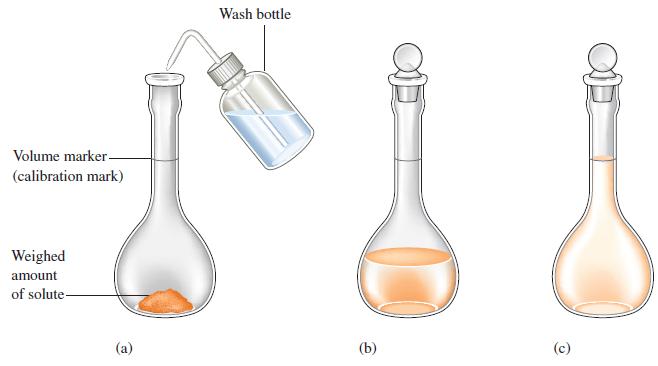
To analyze the alcohol content of a certain wine, a chemist needs 1.00 L of an aqueous 0.200 M K2Cr2O7 (potassium dichromate) solution. How much solid K2Cr2O7 must be weighed out to make this solution?Figure 4.9 Volume marker- (calibration mark) Weighed amount of solute- (a) Wash bottle (b) (c)
Using the solubility rules in Table 4.1, predict what will happen when the following pairs of solutions are mixed.a. KNO3(aq) and BaCl2(aq)b. Na2SO4(aq) and Pb(NO3)2(aq)c. KOH(aq) and Fe(NO3)3(aq)
For each of the following reactions, write the molecular equation, the complete ionic equation, and the net ionic equation.a. Aqueous potassium chloride is added to aqueous silver nitrate to form a silver chloride precipitate plus aqueous potassium nitrate.b. Aqueous potassium hydroxide is mixed
Calculate the mass of solid NaCl that must be added to 1.50 L of a 0.100 M AgNO3 solution to precipitate all the Ag+ ions in the form of AgCl.
When aqueous solutions of Na2SO4 and Pb(NO3)2 are mixed, PbSO4 precipitates. Calculate the mass of PbSO4 formed when 1.25 L of 0.0500 M Pb(NO3)2 and 2.00 L of 0.0250 M Na2SO4 are mixed.
Phosphorite, also called phosphate rock, is a mineral containing PO43– and OH– anions and Ca2+ cations. It is treated with sulfuric acid in the manufacture of phosphate fertilizers (see Chapter 3). A chemist finds the calcium content in an impure sample of phosphate rock by weighing out a
What volume of a 0.100 M HCl solution is needed to neutralize 25.0 mL of a 0.350 M NaOH solution?
In a certain experiment 28.0 mL of 0.250 M HNO3 and 53.0 mL of 0.320 M KOH are mixed. Calculate the amount of water formed in the resulting reaction. What is the concentration of H+ or OH– ions in excess after the reaction goes to completion?
An environmental chemist analyzed the effluent (the released waste material) from an industrial process known to produce the compounds carbon tetrachloride (CCl4) and benzoic acid (HC7H5O2), a weak acid that has one acidic hydrogen atom per molecule. A sample of this effluent weighing 0.3518 g was
Assign oxidation states to all of the following atoms.a. CO2 b. SF6 c. NO3–
Because metals are so reactive, very few are found in nature in pure form. Metallurgy involves reducing the metal ions in ores to the elemental form. The production of manganese from the ore pyrolusite, which contains MnO2, uses aluminum as the reducing agent. Using oxidation states, balance the
Cerium(IV) ion is a strong oxidizing agent that accepts one electron to produce cerium(III) ion:A solution containing an unknown concentration of Sn2+ ions was titrated with a solution containing Ce4+ ions, which oxidize the Sn2+ ions to Sn4+ ions. In one titration 1.00 L of the unknown solution
Iron ores often involve a mixture of oxides and contain both Fe2+ and Fe3+ ions. Such an ore can be analyzed for its iron content by dissolving it in acidic solution, reducing all the iron to Fe2+ ions, and then titrating with a standard solution of potassium permanganate. In the resulting
You have a sugar solution (solution A) with concentration \(x\). You pour one-third of this solution into a beaker and add an equivalent volume of water (solution B).a. What is the ratio of sugar in solutions A and B? b. Compare the volumes of solutions A and B.c. What is the ratio of the
Which of the following must be known to calculate the molarity of a salt solution (there may be more than one answer)?a. The mass of salt addedb. The molar mass of the saltc. The volume of water addedd. The total volume of the solutionExplain.
Consider separate aqueous solutions of \(\mathrm{HCl}\) and \(\mathrm{H}_{2} \mathrm{SO}_{4}\), each with the same molar concentration. An aqueous solution of \(\mathrm{NaOH}\) is added to each solution to neutralize the acid. Which acid solution requires the largest volume of \(\mathrm{NaOH}\)
Which of the following statements is (are) true? Correct the false statements.a. A concentrated solution in water will always contain a strong or weak electrolyte.b. A strong electrolyte will break up into ions when dissolved in water.c. An acid is a strong electrolyte.d. All ionic compounds are
Showing 300 - 400
of 3011
1
2
3
4
5
6
7
8
9
10
11
12
13
14
15
Last
Step by Step Answers

 Get 50% OFF
Claim Now
Get 50% OFF
Claim Now