New Semester
Started
Get
50% OFF
Study Help!
--h --m --s
Claim Now
Question Answers
Textbooks
Find textbooks, questions and answers
Oops, something went wrong!
Change your search query and then try again
S
Books
FREE
Study Help
Expert Questions
Accounting
General Management
Mathematics
Finance
Organizational Behaviour
Law
Physics
Operating System
Management Leadership
Sociology
Programming
Marketing
Database
Computer Network
Economics
Textbooks Solutions
Accounting
Managerial Accounting
Management Leadership
Cost Accounting
Statistics
Business Law
Corporate Finance
Finance
Economics
Auditing
Tutors
Online Tutors
Find a Tutor
Hire a Tutor
Become a Tutor
AI Tutor
AI Study Planner
NEW
Sell Books
Search
Search
Sign In
Register
study help
sciences
chemical principles
Chemical Principles The Quest For Insight 7th Edition Peter Atkins, Loretta Jones, Leroy Laverman - Solutions
What justification is there for regarding the ammonium ion as an analog of a Group 1 metal cation? Consider properties such as solubility, charge, and radius. The radius of NH4 + treated as a sphere is 151 pm.
(a) Arrange the hypohalous acids in order of increasing acid strength.(b) Suggest an interpretation of that order in terms of electronegativities.
State which atom of each of the following pairs is larger:(a) Fluorine, nitrogen;(b) Potassium, calcium;(c) Gallium, arsenic;(d) Chlorine, iodine.
Sodium azide is used to inflate protective air bags in automobiles. What mass of solid sodium azide is needed to provide 65.0 L of N2(g) at 1.2 atm and 25°C?
Explain from structural considerations why water and hydrogen peroxide have similar physical properties but different chemical properties.
The diatomic molecule BF can be obtained by the reaction between BF3 and B at a high temperature and low pressure.(a) Identify the electron configuration of the molecule in terms of the occupied molecular orbitals and calculate the bond order.(b) CO is isoelectronic with BF. How do the molecular
Balance the following skeletal equations and classify them as acid–base or redox: (a) CH4(g) + Sg(s) → CS₂ (1)+ H₂S(g) (b) Sn(s) + KOH(aq) + H₂O(1)→K₂Sn(OH),(aq) + H₂(g)
Write the chemical equation for the reaction between(a) Cesium and oxygen (cesium reacts with oxygen in the same way as potassium);(b) Sodium oxide and water;(c) Lithium and hydrochloric acid;(d) Cesium and iodine.
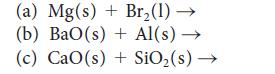
Predict the products of each of the following reactions and then balance each equation: (a) Mg(s) + Br₂(1)→ (b) BaO(s) + Al(s)→ (c) CaO(s) + SiO₂ (s) →
Arrange the following atoms in order of increasing first ionization energy: boron, thallium, gallium.
Identify the products and write a balanced equation for the reaction of hydrogen with(a) Nitrogen;(b) Fluorine;(c) Cesium;(d) Copper(II) Ions.
Xenon tetrafluoride is a powerful oxidizing agent. In an acidic solution, it is reduced to xenon. Write the corresponding half-reaction.
Describe evidence for the statement that hydrogen can act as both a reducing agent and an oxidizing agent. Give chemical equations to support your evidence.
Explain from structural considerations why the dipole moment of the NH3 molecule is smaller than that of the H2O molecule.
(a) Arrange the chlorine oxoacids in order of increasing oxidizing strength.(b) Suggest an interpretation of that order in terms of oxidation numbers.
Balance the following skeletal equations and classify them as acid–base or redox: (a) MgC₂ (s) + H₂O(1)→C₂H₂(g) + Mg(OH)₂(s) (b) Pb(NO)₂(s) PbO (s) + NO₂(g) + O₂(g)
Lead azide, Pb(N3)2, is used as a detonator.(a) What volume of nitrogen at STP (1 atm, 0 °C) does 1.5 g of lead azide produce when it decomposes into lead metal and nitrogen gas?(b) Would 1.5 g of mercury(II) azide, Hg(N3)2, which is also used as a detonator, produce a larger or smaller volume,
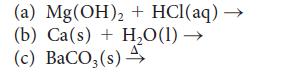
Predict the products of each of the following reactions and then balance each equation: (a) Mg (OH)₂ + HCl(aq) — (b) Ca(s) + H₂O(1)→ (c) BaCO3(s) 4
Suggest a Lewis structure for B4H10 and deduce the formal charges on the atoms. There are four B—H—B bridges.
Write the chemical equation for the reaction between(a) Sodium and oxygen;(b) Lithium and nitrogen;(c) Sodium and water;(d) Potassium superoxide and water.
Indicate whether the following statements about Group 16 elements are true or false. If false, explain what is wrong with the statement.(a) Four of the elements are nonmetals.(b) H2SeO3 is a stronger acid than H2SO3.(c) The oxides of all the elements are acidic.
Arrange the following elements in order of increasing first ionization energy: oxygen, tellurium, selenium.
Write the balanced chemical equation for the reaction of chlorine with water in(a) A neutral aqueous solution;(b) A dilute basic solution;(c) A concentrated basic solution.(d) Verify that each reaction is a disproportionation reaction.
Identify the oxidation number of the noble-gas element in(a) XeO3;(b) XeO6 4–;(c) XeF2;(d) HXeO4 –.
(a) Nitrous acid reacts with hydrazine in acidic solution to form hydrazoic acid, HN3. Write the chemical equation and determine the mass of hydrazoic acid that can be produced from 15.0 g of hydrazine.(b) Suggest a method for preparing sodium azide, NaN3.(c) Is the production of hydrazoic acid
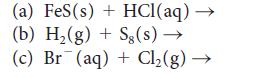
Complete and balance each of the following equations: (a) FeS (s) + HCl(aq) → (b) H₂(g) + Sg(s) → (c) Br(aq) + Cl₂(g) →
Complete and balance the following equations: (a) Al₂O3(s) + OH¯ (aq) → (b) Al₂O3(s) + H3O+(aq) + H₂O(1) → (c) B(s) + NH3(g) →
Identify the oxidation number of tin in the following compounds and ions:(a) Sn(OH)6 2–;(b) SnHPO3;(c) NaSn2F5.
Explain why LiI and CsF are highly soluble in water, but LiF and CsI are only slightly soluble.
Aluminum and beryllium have a diagonal relationship. Write the chemical equations for the reaction of aluminum with aqueous sodium hydroxide to that of beryllium with aqueous sodium hydroxide.
State which element of each of the following pairs is less electronegative:(a) Calcium, barium;(b) Gallium, arsenic;(c) Tellurium, sulfur;(d) Tin, germanium.
Write a balanced chemical equation for(a) The reaction between sodium hydride and water;(b) The formation of synthesis gas;(c) The hydrogenation of ethene, H2C=CH2, and give the oxidation numbers of the carbon atoms in the reactant and product;(d) The reaction of magnesium with hydrochloric
Indicate whether the following statements about Group 14 elements are true or false. If false, explain what is wrong with the statement.(a) Only two of the elements are metals.(b) The oxides of all the elements are amphoteric.(c) The outer s- and p-orbitals become closer in energy on going down
Identify the oxidation number of the noble-gas element in(a) KrF2;(b) XeF6;(c) KrF4;(d) XeO4 2–.
Write the balanced chemical equation for(a) The thermal decomposition of potassium chlorate without a catalyst;(b) The reaction of bromine with water;(c) The reaction between sodium chloride and concentrated sulfuric acid.(d) Identify each reaction as a Brønsted acid–base, Lewis acid–base,
Urea, CO(NH2)2, reacts with water to form ammonium carbonate. Write the chemical equation and calculate the mass of ammonium carbonate that can be obtained from 4.0 kg of urea.
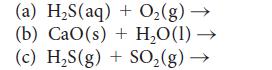
Complete and balance each of the following equations: (a) H₂S(aq) + O₂(g) → (b) CaO (s) + H₂O(1)→ (c) H₂S(g) + SO₂(g) -
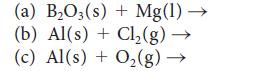
Complete and balance the following equations: (a) B₂O3(s) + Mg(1)→ (b) Al(s) + Cl₂(g) → (c) Al(s) + O₂(g) →
Identify the oxidation number of germanium in the following compounds and ions:(a) GeO4 4–;(b) K4Ge4Te10;(c) Ca3GeO5.
(a) Write the valence electron configurations of the alkali metal atoms.(b) Explain why the alkali metals are strong reducing agents in terms of electron configurations, ionization energies, and the hydration of their ions.
The compounds CaO and BaO are sometimes used as drying agents for organic solvents such as pyridine, C5H5N. The drying agent and the product of the drying reaction are both insoluble in the organic solvent.(a) Write the balanced chemical equation corresponding to the reaction that dries the
Write a balanced chemical equation for(a) The hydrogenation of ethyne (acetylene, C2H2) to ethene (C2H4) by hydrogen (give the oxidation numbers of the carbon atoms in the reactant and product);(b) The shift reaction;(c) The reaction of barium hydride with water.
State which element of each of the following pairs is more electronegative:(a) Sulfur, phosphorus;(b) Selenium, tellurium;(c) Sodium, cesium;(d) Silicon, oxygen.
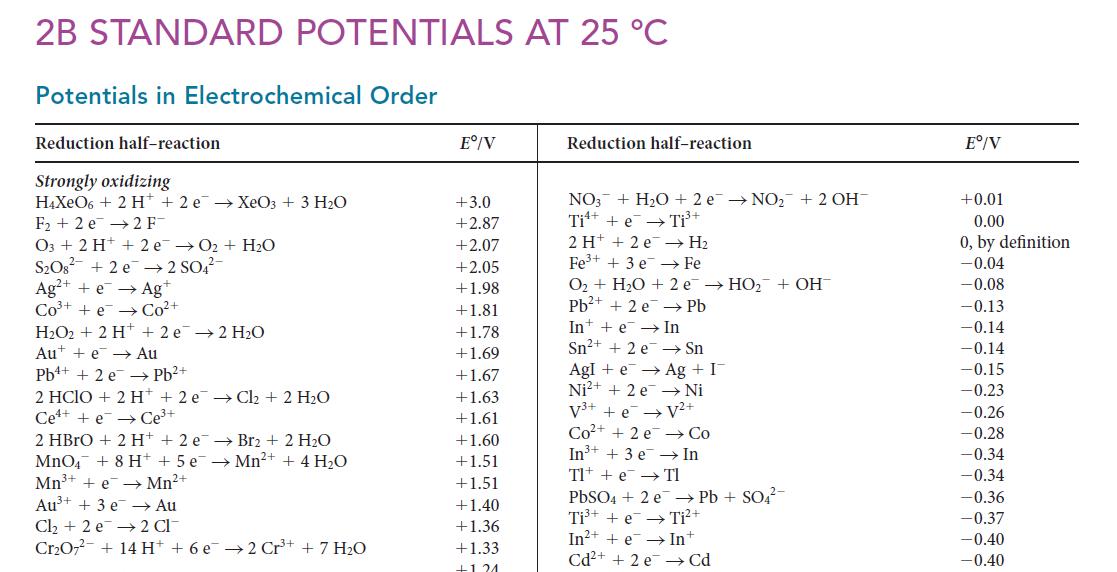
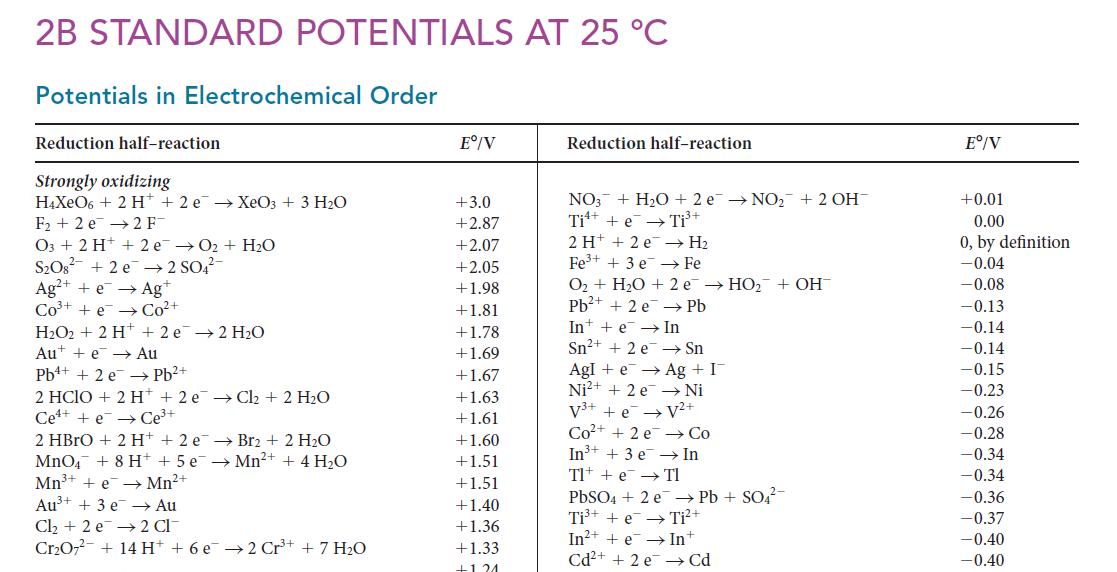
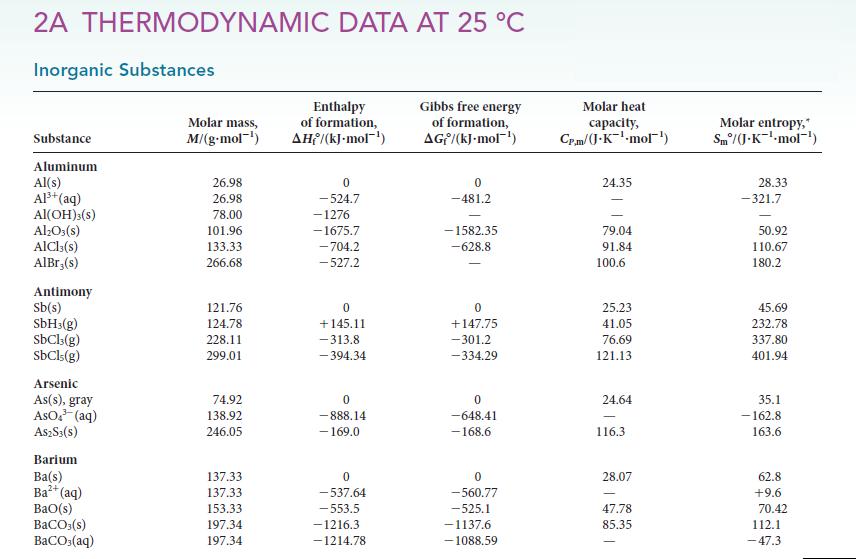
Use graphing software and data from Appendix 2B to plot ionization energy against standard potential for the elements of Groups 1 and 2. What generalizations can be drawn from the graph? 2B STANDARD POTENTIALS AT 25 C Potentials in Electrochemical Order Reduction half-reaction Strongly oxidizing
Identify the oxidation number of the halogen atoms in (a) Iodine heptafluoride;(b) Sodium periodate;(c) Hypobromous acid;(d) Sodium chlorite.
What are the sources for the production of krypton and xenon?
Give the oxidation number of phosphorus in(a) Ehite phosphorus;(b) Red phosphorus;(c) Ca5P8;(d) PH4I;(e) Dihydrogen phosphate ion, H2PO4–;(f) P5H5;(g) P2O5.
Write chemical equations for the reaction of(a) Sodium oxide and water;(b) Sodium peroxide and water;(c) Sulfur dioxide and water;(d) Sulfur dioxide and oxygen, with the use of a vanadium pentoxide catalyst.
State which atom of each of the following pairs is larger:(a) Tellurium, tin;(b) Silicon, lead;(c) Calcium, rubidium;(d) Germanium, oxygen.
Write a balanced chemical equation for the industrial preparation of impure boron.
Suggest a reason why the size of the silicon atom does not permit a silicon analog of the graphite structure.
Explain why K+ ions move more rapidly through water than Li+ ions.
Write the chemical equation for the reaction between strontium metal and hydrogen gas.
Is there any chemical support for the view that hydrogen should be classified as a member of Group 17? Give evidence that supports this view.
(a) Use graphing software to plot standard potential against atomic number for the elements of Groups 1 and 2.(b) What generalizations can be deduced from the graph? 2B STANDARD POTENTIALS AT 25 °C Potentials in Electrochemical Order Reduction half-reaction Strongly oxidizing H4XeO6+ 2 H2e →
What are the sources for the production of helium and argon?
Identify the oxidation number of the halogen in(a) Hypoiodous acid;(b) ClO2;(c) Dichlorine heptoxide;(d) NaIO3.
Write chemical equations for(a) The burning of lithium in oxygen;(b) The reaction of sodium metal with water;(c) The reaction of fluorine gas with water;(d) The oxidation of water at the anode of an electrolytic cell.
Nitrogen can be found in compounds with oxidation numbers ranging from –3 to +5. For each of the possible integral oxidation numbers, give one example of a nitrogen compound or ion.
Describe the sources of silicon and write balanced chemical equations for the three steps in the industrial preparation of silicon.
Write the chemical equation for the reaction between magnesium metal and hot water.
Write a balanced chemical equation for the industrial preparation of aluminum from its oxide.
Explain why lithium differs from its congeners in its chemical and physical properties. Give two examples to support your explanation.
Is there any chemical support for the view that hydrogen should be classified as a member of Group 1? Give evidence that supports this view.
Cyanomethane, commonly known as acetonitrile, CH3CN, is a toxic volatile liquid which is used as a solvent to purify steroids and to extract fatty acids from fish oils. Acetonitrile can be synthesized from methyl isonitrile by the isomerization reaction CH3NC(g) → CH3CN(g).(a) Draw the Lewis
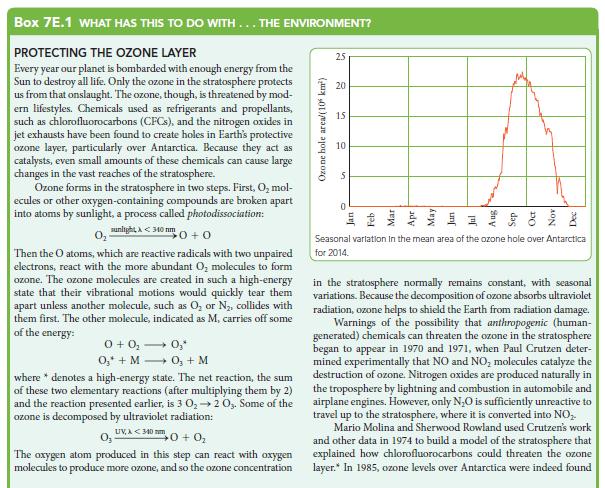
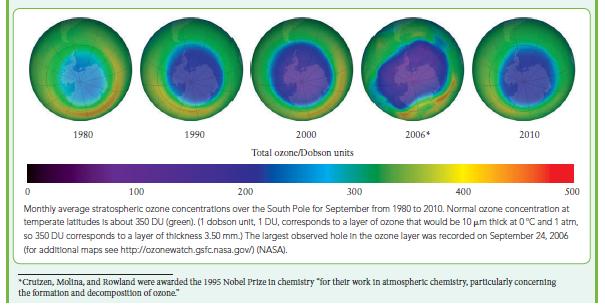
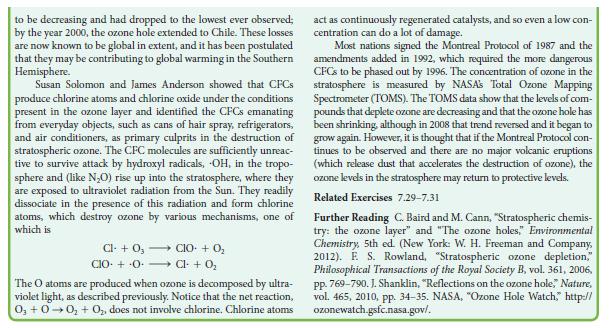
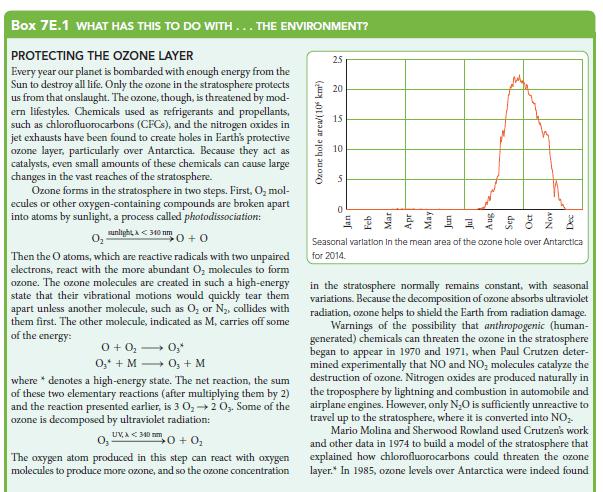
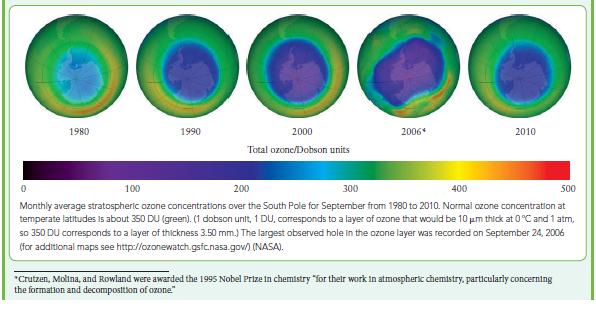
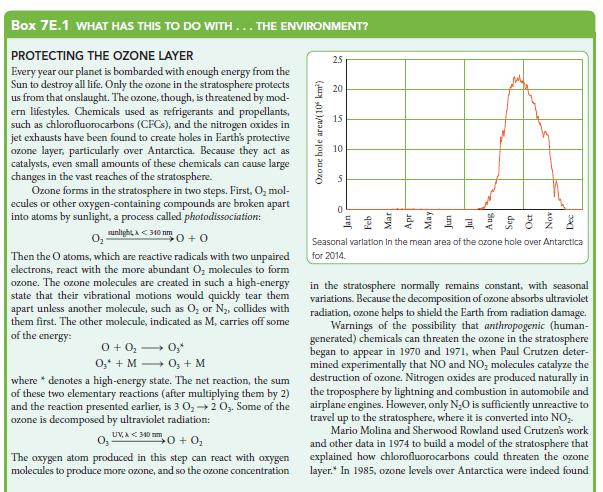
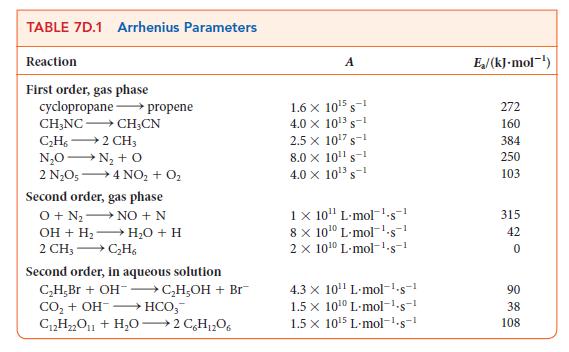
The rate constant of the reaction O(g) + N2(g) → NO(g) + N(g), which takes place in the stratosphere, is 9.7 * 1010 L · mol–1 · s–1 at 800. °C. The activation energy of the reaction is 315 kJ · mol–1. What is the rate constant at 700. °C? (See Box 7E.1.) Box 7E.1 WHAT HAS THIS TO DO
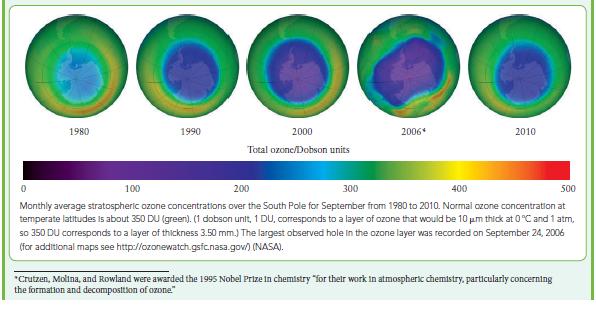
The contribution to the destruction of the ozone layer caused by high-flying aircraft has been attributed to the following mechanism:(a) Write the overall reaction.(b) Write the rate law for each step and indicate its molecularity.(c) What is the reaction intermediate? (d) A catalyst is a
The following mechanism has been suggested to explain the contribution of chlorofluorocarbons to the destruction of the ozone layer:(a) What is the reaction intermediate, and what is the catalyst? (b) Identify the radicals in the mechanism. (c) Identify the steps as initiating, propagating, or
Models of population growth are analogous to chemical reaction rate equations. In the model developed by Malthus in 1798, the rate of change of the population N of Earth is dN/dt = births – deaths. The numbers of births and deaths are proportional to the population, with proportionality constants
Raw milk sours in about 4 h at 28°C but in about 48 h in a refrigerator at 5°C. What is the activation energy for the souring of milk?
To prepare a dog of mass 1.5 kg for surgery, 150 mg of the anesthetic phenobarbitol is administered intravenously. The reaction in which the anesthetic is metabolized (decomposed in the body) is first order in phenobarbitol and has a half-life of 4.5 h. After about 2 h, the drug begins to lose its
Vision depends on the protein rhodopsin, which absorbs light in the retina of the eye in a reaction in which one form, metarhodopsin I, is converted to another, metarhodopsin II. The half-life of this reaction in cattle eyes is 600 μs at 37°C but 1 s at 0°C, whereas in frog eyes the same process
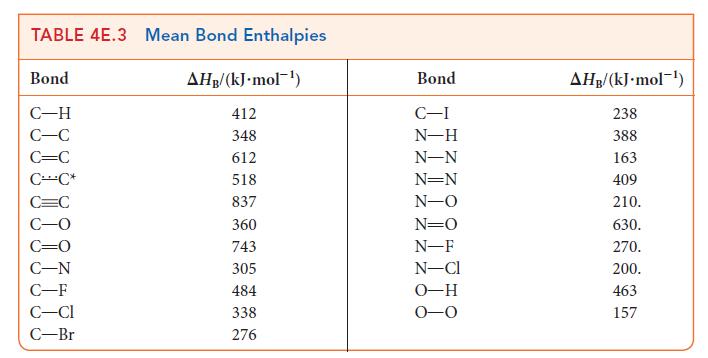
The second-order reactions in Table 7D.1 show wide variations in activation energy. In an activated complex, the reactant bonds are lengthened while the product bonds are beginning to form. Consider what bonds need to be stretched to form the activated complex for each reaction and use bond
Suppose that a pollutant is entering the environment at a steady rate R and that, once there, its concentration decays by a first-order reaction. Derive an expression for(a) The concentration of the pollutant at equilibrium in terms of R(b) The half-life of the pollutant species when R = 0.
The half-life of a substance taking part in a third-order reaction A → products is inversely proportional to the square of the initial concentration of A. How can this half-life be used to predict the time needed for the concentration to fall to(a) One-half;(b) One-fourth;(c) One-sixteenth of its
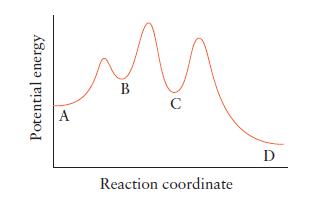
The following schematic reaction profile is for the reaction A → D. (a) Is the overall reaction exothermic or endothermic? Explain your answer.(b) How many intermediates are there? Identify them.(c) Identify each activated complex and reaction intermediate.(d) Which step is rate determining?
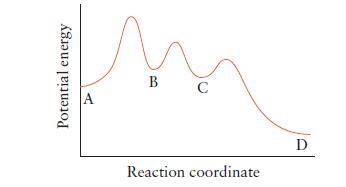
Refer to the illustration below for the reaction A → D.(a) How many steps does this reaction have?(b) Which is the rate-determining step in this reaction?(c) Which step is the fastest?(d) How many intermediates must form in the reaction?(e) A catalyst is added that accelerates the third step
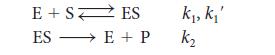
(a) From the following mechanism, derive Eq. 1a in Topic 7E, which Michaelis and Menten proposed to represent the rate of formation of products in an enzyme-catalyzed reaction.(b) Show that the rate is independent of substrate concentration at high concentrations of substrate.where E is the free
A gas composed of molecules of diameter 0.50 nm takes part in a chemical reaction at 300. K and 1.0 atm with another gas (present in large excess) consisting of molecules of about the same size and mass to form a gas-phase product at 300. K. The activation energy for the reaction is 25 kJ ·
The decomposition of A has the rate law Rate = kr[A]a. Show that for this reaction the ratio t1/2/t3/4, where t1/2 is the half-life and t3/4 is the time for the concentration of A to decrease to three-fourths of its initial concentration, can be written in terms of a alone and can therefore be used
(a) Use a graphing calculator or graphing software to calculate the activation energy for the acid hydrolysis of sucrose to give glucose and fructose (see Exercise 7.9) from an Arrhenius plot of the data below.(b) Calculate the rate constant at 37°C (human body temperature).(c) From data in
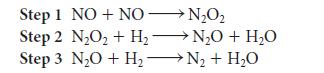
The rate law of the reaction 2 NO(g) + 2 H2(g) → N2(g) + 2 H2O(g) is Rate = kr[NO]2[H2], and the mechanism that has been proposed is(a) Which step in the mechanism is likely to be rate determining? Explain your answer. (b) Sketch a reaction profile for the overall reaction, which is known to be
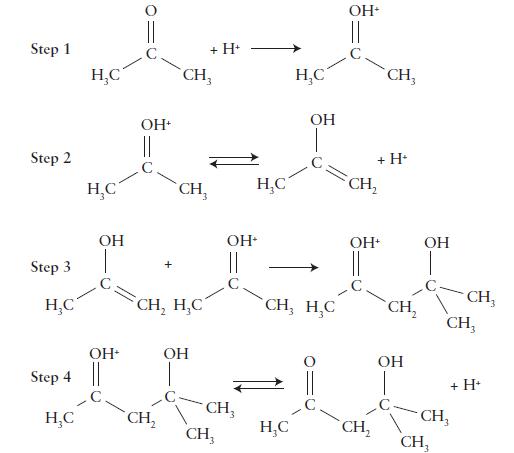
Some organic compounds containing the C=O group can react with themselves in a process known as aldol condensation.The mechanism for this reaction in acidic solution is shown here.Write the overall reaction, identify any intermediates, and determine the role of the hydrogen ion. Step 1 Step 2 Step
The hydrolysis of sucrose (C12H22O11) produces fructose and glucose: C12H22O11(aq) + H2O(l) → C6H12O6(glucose, aq) + C6H12O6 (fructose, aq). Two mechanisms are proposed for this reaction:Under what conditions can these two mechanisms be distinguished by using kinetic data? (1) Step 1
The following mechanism has been proposed for the formation of hydrazine in the overall reaction, N2(g) + 2 H2(g) → N2H4(g):The rate law for the overall reaction is Rate = kr[N2][H2]2. Which step is the slow step? Show your work. Step 1 N₂ + H₂ →→→→N₂H₂ Step 2 H₂ + N₂H₂ →
The following rate laws were each derived from an elementary reaction. In each case, write the chemical equation for the reaction, state its molecularity, and propose a structure for the activated complex: (a) Rate = k,[CH3CHO ] (Products are CH3 and CHO.) (b) Rate = k,[1][Ar] (Products are 1₂
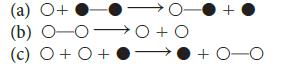
Determine the molecularity of the following symbolic elementary reactions: (a) O+ (b) 0-0- (c) O + 0 + →O+O +0-0
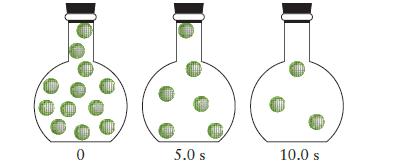
The first-order decomposition of compound X, a gas, is carried out and the data are represented in the following pictures.The green spheres represent the compound; the decomposition products are not shown. The times at which the images were taken are shown below each flask.(a) Determine the
Compounds A and B both decompose by first-order reactions.At 398 K, the rate constant for the decomposition of A is 3.6 * 10–5 s–1. Separate containers of A and B were prepared, with initial concentrations of 0.120 (mol A) · L–1 and 0.240 (mol B) · L–1. After 5.0 h, it was found that the
The equilibrium constant for the binding of a substrate to the active site of an enzyme was found to be 326 at 310 K. At the same temperature, the rate constant for the second-order binding reaction is 7.4 * 107 L · mol−1 · s−1. What is the rate constant for the loss of unreacted substrate
An organic compound A can decompose by either of two kinetically controlled pathways to form product B or C (see Exercise 7.1). The activation energy for the formation of B is greater than that for the formation of C. Will the ratio [B]/[C] increase or decrease as the temperature is increased?
In some reactions, two or more different products can be formed. If the product formed by the fastest reaction predominates, the reaction is considered to be under “kinetic control.” If the predominant product is the most thermodynamically stable, the reaction is considered to be under
The molar concentration of Ca(OH)2 in an aqueous solution is reduced to 5.2% of its initial value by dilution. What is the difference in the pH values of the two solutions?
The following redox reaction is used in acidic solution in the Breathalyzer test to determine the level of alcohol in blood:Identify the elements undergoing oxidation or reduction and indicate their initial and final oxidation numbers.(b) Write and balance the oxidation half-reaction.(c) Write
You are analyzing water samples from a local stream and want to use the intense red color of Fe(SCN)2+ to measure the concentration of Fe3+. You need to know the formation constant (Topic 6I) for this complex to determine the concentration of Fe3+.The molar absorption coefficient, ε, for Fe(SCN)2+
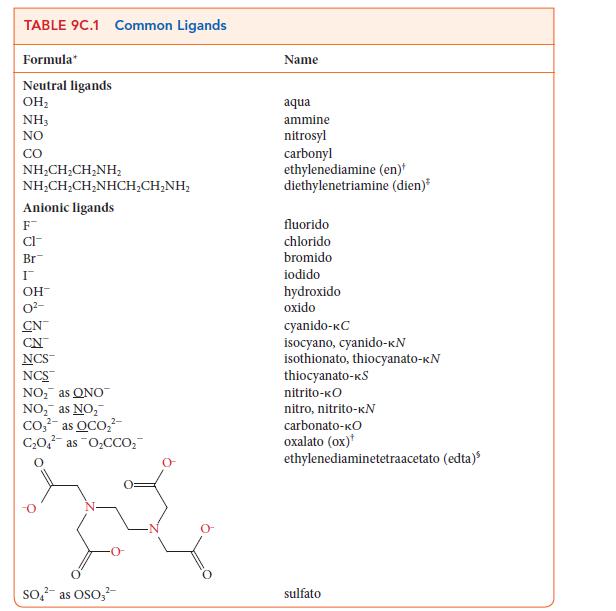
Use the information in Table 9C.1 to write the formula for each of the following coordination compounds:(a) Potassium hexacyanidochromate(III)(b) Pentaamminesulfatocobalt(III) chloride(c) Tetraamminediaquacobalt(III) bromide(d) Sodium bisoxalato(diaqua)ferrate(III) TABLE 9C.1 Common
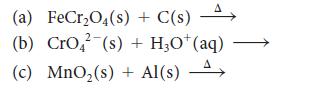
Predict the major products of each of the following reactions and then balance the equations: (a) FeCr₂O4(s) + C(s) A (b) CrO² (s) + HạO*(aq) (c) MnO₂ (s) + Al(s) A
Name each of the following complex ions and identify the oxidation number of the metal:(a) [CrCl3(NH3)2(OH2)]+;(b) [Rh(en)3]3+;(c) [Fe(Br)4(ox)]3–;(d) [Ni(OH)(OH2)5]2+.
The complex ion [Ni(NH3)6]2+ forms in a solution containing 0.16 mol · L–1 NH3(aq) and 0.015 mol · L–1 Ni–1(aq). If the formation constant of [Ni(NH3)6]2+ is 1.0 * 109, what are the equilibrium molar concentrations?
Identify the number of valence electrons (including d-electrons) present in each of the following metal ions:(a) Co2+;(b) Mo4+; (c) Ru4+; (d) Pt2+; (e) Os3+; (f) V3+.
Showing 900 - 1000
of 3011
First
3
4
5
6
7
8
9
10
11
12
13
14
15
16
17
Last
Step by Step Answers

 Get 50% OFF
Claim Now
Get 50% OFF
Claim Now











![(a) Rate = k[CH3CHO] (Products are CH3 and CHO.) (b) Rate = k,[1][Ar] (Products are 1 and Ar; the role of the](https://dsd5zvtm8ll6.cloudfront.net/images/question_images/1704/0/8/2/96765923e176e6541704082966937.jpg)

![Fe+ (aq) + SCN(aq) Fe(SCN)+ (aq) 2+ Kf= [Fe(SCN)+] [Fe+][SCN]](https://dsd5zvtm8ll6.cloudfront.net/images/question_images/1704/1/0/3/85265928facd2c731704103851944.jpg)