New Semester
Started
Get
50% OFF
Study Help!
--h --m --s
Claim Now
Question Answers
Textbooks
Find textbooks, questions and answers
Oops, something went wrong!
Change your search query and then try again
S
Books
FREE
Study Help
Expert Questions
Accounting
General Management
Mathematics
Finance
Organizational Behaviour
Law
Physics
Operating System
Management Leadership
Sociology
Programming
Marketing
Database
Computer Network
Economics
Textbooks Solutions
Accounting
Managerial Accounting
Management Leadership
Cost Accounting
Statistics
Business Law
Corporate Finance
Finance
Economics
Auditing
Tutors
Online Tutors
Find a Tutor
Hire a Tutor
Become a Tutor
AI Tutor
AI Study Planner
NEW
Sell Books
Search
Search
Sign In
Register
study help
sciences
chemistry the central science
Chemistry The Central Science 13th Edition Theodore E. Brown, H. Eugene LeMay, Bruce E. Bursten, Catherine Murphy, Patrick Woodward, Matthew E. Stoltzfus - Solutions
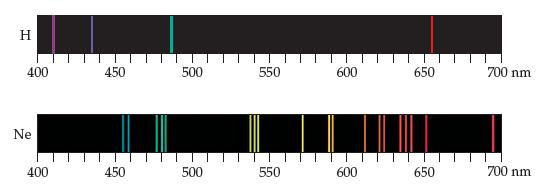
The visible emission lines observed by Balmer all involved nf = 2.(a) Which of the following is the best explanation of why the lines with nf = 3 are not observed in the visible portion of the spectrum: (i) Transitions to nf = 3 are not allowed to happen, (ii) transitions to nf = 3 emit photons in
Place the following transitions of the hydrogen atom in order from shortest to longest wavelength of the photon emitted: n = 5 to n = 3, n = 4 to n = 2, n = 7 to n = 4, and n = 3 to n = 2.
Order the following transitions in the hydrogen atom from smallest to largest frequency of light absorbed: n = 3 to n = 6, n = 4 to n = 9, n = 2 to n = 3, and n = 1 to n = 2.
Consider a transition of the electron in the hydrogen atom from n = 4 to n = 9.(a) Is ΔE for this process positive or negative?(b) Determine the wavelength of light that is associated with this transition. Will the light be absorbed or emitted?(c) In which portion of the electromagnetic spectrum
(a) Consider the following three statements: (i) A hydrogen atom in the n = 3 state can emit light at only two specific wavelengths, (ii) A hydrogen atom in the n = 2 state is at a lower energy than the n = 1 state, (iii) The energy of an emitted photon equals the energy difference
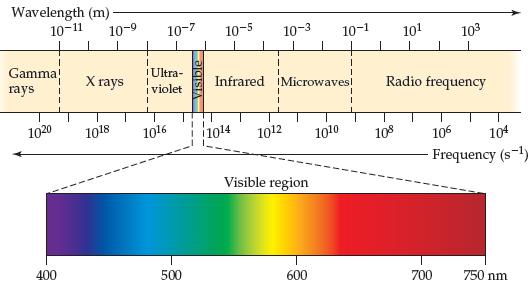
A laser pointer used in a lecture hall emits light at 650 nm. What is the frequency of this radiation? Using Figure 6.4, predict the color associated with this wavelength. Wavelength (m)- 10-9 10-11 10-7 10-5 10-3 10-1 101 103 Gamma! X rays !Ultra- i violet rays Infrared iMicrowavesi Radio
The energy from radiation can be used to cause the rupture of chemical bonds. A minimum energy of 242 kJ/mol is required to break the chlorine–chlorine bond in Cl2. What is the longest wavelength of radiation that possesses the necessary energy to break the bond? What type of electromagnetic
(a) A green laser pointer emits light with a wavelength of 532 nm. What is the frequency of this light?(b) What is theenergy of one of these photons?(c) The laser pointer emits light because electrons in the material are excited (by a battery) from their ground state to an upper excited state. When
(a) Calculate the energy of a photon of electromagnetic radiation whose frequency is 2.94 × 10¹⁴ s-1.(b) Calculate the energy of a photon of radiation whose wavelength is 413 nm. (c) What wavelength of radiation has photons of energy 6.06 × 10⁻¹⁹ J?
(a) What is the frequency of radiation whose wavelength is 0.86 nm?(b) What is the wavelength of radiation that has a frequency of 6.4 × 10¹¹ s-1?(c) Would the radiations in part (a) or part (b) be detected by an X-ray detector?(d) What distance does electromagnetic radiation travel in 0.38 ps?
The accompanying drawing shows the shape of a d orbital.(a) Based on the shape, how many of the d orbitals could it be?(b) Which of the following would you need to determine which of the d orbitals it is: (i) the direction of the z-axis, (ii) the identity of the element, (iii) the number of
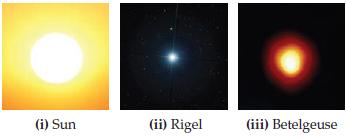
Stars do not all have the same temperature. The color of light emitted by stars is characteristic of the light emitted by hot objects. Telescopic photos of three stars are shown below: (i) the Sun, which is classified as a yellow star, (ii) Rigel, in the constellation Orion, which is classified as
We can use Hess’s law to calculate enthalpy changes that cannot be measured. One such reaction is the conversion of methane to ethylene:2CH4(g)→C2H4(g) + H2(g)Calculate the ΔH° for this reaction using the following thermochemical data:CH4(g) + 2O2(g)→CO2(g) + 2H2O(l) ΔH° = -890.3
The air bags that provide protection in automobiles in the event of an accident expand because of a rapid chemical reaction. From the viewpoint of the chemical reactants as the system, what do you expect for the signs of q and w in this process?
At the end of 2012, global population was about 7.0 billion people. What mass of glucose in kg would be needed to provide 1500 cal/person/day of nourishment to the global population for one year? Assume that glucose is metabolized entirely to CO2(g) and H2O(l) according to the following
Given the data:N2(g) + O2(g)→2NO(g) ΔH = +180.7 kJ2NO(g) + O2(g)→2NO2(g) ΔH = -113.1 kJ2N2O(g)→2N2(g) + O2(g) ΔH = -163.2 kJUse Hess’s law to calculate ΔH for the reactionN2O(g) + NO2(g)→3NO(g)
Consider the data about gold metal in Exercise 5.26(b).Data from Exercise 5.26(b).A 100.0-g bar of gold is heated from 25 °C to 50 °C during which it absorbs 322 J of heat. Assume the volume of the gold bar remains constant.(a) Based on the data, calculate the specific heat of Au(s).(b) Suppose
When solutions containing silver ions and chloride ions are mixed, silver chloride precipitates:Ag+(aq)+Cl-(aq)→AgCl(s) ΔH = -65.5 kJ(a) Calculate ΔH for the production of 0.450 mol of AgCl by this reaction.(b) Calculate ΔH for the production of 9.00 g of AgCl.(c) Calculate ΔH when 9.25 ×
Consider the following reaction:2Mg(s) + O2(g)→2MgO(s) ΔH = -1204 kJ(a) Is this reaction exothermic or endothermic?(b) Calculate the amount of heat transferred when 3.55 g of Mg(s) reacts at constant pressure.(c) How many grams of MgO are produced during an enthalpy change of -234 kJ?(d) How
Assume that the following reaction occurs at constant pressure:2Al(s) + 3Cl2(g)→2 AlCl3(s)(a) If you are given ΔH for the reaction, what additional information do you need to determine ΔE for the process?(b) Which quantity is larger for this reaction?(c) Explain your answer to part (b).
How much work (in J) is involved in a chemical reaction if the volume decreases from 5.00 to 1.26L against a constant pressure of 0.857 atm?
(a) State the Pauli exclusion principle in your own words.(b) The Pauli exclusion principle is, in an important sense, the key to understanding the periodic table.(c) Explain.
A hydrogen atom orbital has n = 5 and ml = -2.(a) What are the possible values of l for this orbital?(b) What are the possible values of ms for the orbital?
A certain orbital of the hydrogen atom has n = 4 and l = 2.(a) What are the possible values of ml for this orbital?(b) What are the possible values of ms for the orbital?
Neutron diffraction is an important technique for determining the structures of molecules. Calculate the velocity of a neutron needed to achieve a wavelength of 1.25 Å. (Refer to the inside cover for the mass of the neutron.)
The electron microscope has been widely used to obtain highly magnified images of biological and other types of materials. When an electron is accelerated through a particular potential field, it attains a speed of 9.47 × 10⁶ m/s. What is the characteristic wavelength of this electron? Is the
Titanium metal requires a photon with a minimum energy of 6.94 × 10⁻¹⁹ J to emit electrons.(a) What is the minimum frequency of light necessary to emit electrons from titanium via the photoelectric effect?(b) What is the wavelength of this light?(c) Is it possible to eject electrons from titanium
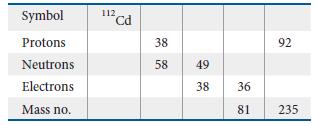
Fill in the gaps in the following table, assuming each column represents a neutral atom. Symbol 112 Cd Protons 38 92 Neutrons 58 49 Electrons 38 36 Mass no. 81 235
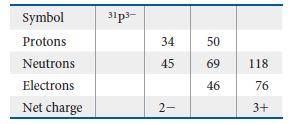
Fill in the gaps in the following table: Symbol 31p)- Protons 34 50 Neutrons 45 69 118 Electrons 46 76 Net charge 2- 3+
The concept of chemical equilibrium is very important. Which one of the following statements is the most correct way to think about equilibrium?(a) If a system is at equilibrium, nothing is happening.(b) If a system is at equilibrium, the rate of the forward reaction is equal to the rate of the
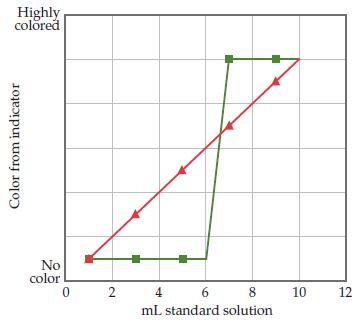
Which data set, of the two graphed here, would you expect to observe from a titration like that shown in Figure 4.18? Highly colored No color 2 4 6 8. 10 12 mL standard solution Color from indicator
You are titrating an acidic solution with a basic one, and just realized you forgot to add the indicator that tells you when the equivalence point is reached. In this titration, the indicator turns blue at the equivalence point from an initially colorless solution. You quickly grab a bottle of
State whether each of the statements below is true or false. Justify your answer in each case.(a) Electrolyte solutions conduct electricity because electrons are moving through the solution.(b) If you add a nonelectrolyte to an aqueous solution that already contains an electrolyte, the electrical
State whether each of the statements below is true or false. Justify your answer in each case.(a) When methanol, CH3OH, is dissolved in water, a conducting solution results.(b) When acetic acid, CH3COOH, dissolves in water, the solution is weakly conducting and acidic in nature.
We have learned in this chapter that many ionic solids dissolve in water as strong electrolytes, that is, as separated ions in solution. Which statement is most correct about this process?(a) Water is a strong acid and therefore is good at dissolving ionic solids.(b) Water is good at solvating ions
Would you expect that anions would be physically closer to the oxygen or to the hydrogens of water molecules that surround it in solution?
During a normal breath, our lungs expand about 0.50 L against an external pressure of 1.0 atm. How much work is involved in this process (in J)?
Specify what ions are present in solution upon dissolving each of the following substances in water:(a) FeCl2(b) HNO3(c) (NH4)2SO4(d) Ca(OH)2.
Specify what ions are present upon dissolving each of the following substances in water:(a) MgI2(b) K2CO3(c) HClO4(d) NaCH3COO.
Which ions remain in solution, unreacted, after each of the following pairs of solutions is mixed?(a) Potassium carbonate and magnesium sulfate.(b) Lead nitrate and lithium sulfide.(c) Ammonium phosphate and calcium chloride.
You know that an unlabeled bottle contains an aqueous solution of one of the following: AgNO3, CaCl2, or Al2(SO4)3. A friend suggests that you test a portion of the solution with Ba(NO3)2 and then with NaCl solutions. According to your friend’s logic, which of these chemical reactions could
Write balanced molecular and net ionic equations for the following reactions, and identify the gas formed in each:(a) Solid cadmium sulfide reacts with an aqueous solution of sulfuric acid(b) Solid magnesium carbonate reacts with an aqueous solution of perchloric acid.
Three solutions are mixed together to form a single solution in the final solution, there are 0.2 mol Pb(CH3COO)2, 0.1 mol Na2S, and 0.1 mol CaCl2 present. What solid(s) will precipitate?
Which of the following solutions is the most acidic?(a) 0.2M LiOH(b) 0.2M HI(c) 1.0M methyl alcohol (CH3OH).
State whether each of the following statements is true or false. Justify your answer in each case.(a) Sulfuric acid is a monoprotic acid.(b) HCl is a weak acid.(c) Methanol is a base.
State whether each of the following statements is true or false. Justify your answer in each case.(a) NH3 contains no OH- ions, and yet its aqueous solutions are basic.(b) HF is a strong acid.(c) Although sulfuric acid is a strong electrolyte, an aqueous solution of H2SO4 contains more HSO4- ions
True or false:(a) If a substance is oxidized, it is gaining electrons.(b) If an ion is oxidized, its oxidation number increases.
The following reactions (note that the arrows are pointing only one direction) can be used to prepare an activity series for the halogens:Br2(aq) + 2NaI(aq)→2NaBr(aq) + I2(aq)Cl2(aq) + 2NaBr(aq)→2NaCl(aq) + Br2(aq)(a) Which elemental halogen would you predict is the most stable, upon mixing
Your lab partner tells you that he has prepared a solution that contains 1.50 moles of NaOH in 1.50 L of aqueous solution, and therefore that the concentration of NaOH is 1.5 M.(a) Is he correct?(b) If not, what is the correct concentration?
(a) Calculate the molarity of a solution that contains 0.175 mol ZnCl2 in exactly 150 mL of solution.(b) How many moles of protons are present in 35.0 mL of a 4.50 M solution of nitric acid?(c) How many milliliters of a 6.00 M NaOH solution are needed to provide 0.350 mol of NaOH?
(a) Calculate the molarity of a solution made by dissolving 12.5 grams of Na2CrO4 in enough water to form exactly 750 mL of solution.(b) How many moles of KBr are present in 150 mL of a 0.112 M solution?(c) How many milliliters of 6.1 M HCl solution are needed to obtain 0.150 mol of HCl?
(a) How many grams of ethanol, CH3CH2OH, should youdissolve in water to make 1.00 L of vodka (which is an aqueous solution that is 6.86 M ethanol)?(b) Using the density of ethanol (0.789 g/mL), calculate the volume of ethanol you need to make 1.00 L of vodka.
One cup of fresh orange juice contains 124 mg of ascorbic acid (vitamin C, C6H8O6). Given that one cup = 236.6 mL calculate the molarity of vitamin C in organic juice.
In each of the following pairs, indicate which has the higher concentration of I- ion:(a) 0.10M BaI2 or 0.25M KI solution(b) 100 mL of 0.10M KI solution or 200 mL of 0.040M ZnI2(c) 3.2M HI solution or a solution made by dissolving 145 g of NaI in water to make 150 mL of solution.
(a) How many grams of solid silver nitrate would you need to prepare 200.0 mL of a 0.150M AgNO3 solution?(b) An experiment calls for you to use 100 mL of 0.50M HNO3 solution.All you have available is a bottle of 3.6M HNO3.How many milliliters of the 3.6M HNO3 solution and of water do you need to
You want to analyze a silver nitrate solution.(a) You could add HCl(aq) to the solution to precipitate out AgCl(s). What volume of a 0.150 M HCl(aq) solution is needed to precipitate the silver ions from 15.0 mL of a 0.200 M AgNO3 solution?(b) You could add solid KCl to the solution to precipitate
Uranium hexafluoride, UF6, is processed to produce fuel for nuclear reactors and nuclear weapons. UF6 is made from the reaction of elemental uranium with ClF3, which also produces Cl2 as a by-product.(a) Write the balanced molecular equation for the conversion of U and ClF3 into UF6 and Cl2.(b) Is
A fertilizer railroad car carrying 34,300 gallons of commercial aqueous ammonia (30% ammonia by mass) tips over and spills. The density of the aqueous ammonia solution is 0.88 g/cm3. What mass of citric acid, C(OH)(COOH)(CH2)(COOH)2, (which contains three acidic protons) is required to neutralize
A sample of 7.75 g of Mg(OH)2 is added to 25.0 mL of 0.200 M HNO3.(a) Write the chemical equation for the reaction that occurs.(b) Which is the limiting reactant in the reaction?(c) How many moles of Mg(OH)2, HNO3, and Mg(NO3)2 are present after the reaction is complete?
Lead glass contains 18–40% by mass of PbO (instead of CaO in regular glass). Lead glass is still used industrially, but “lead crystal” drinking goblets are no longer considered safe, as the lead may leach out and cause toxic responses in humans. A particular 286-g lead crystal goblet that
The average concentration of gold in seawater is 100 fM (femtomolar).Given that the price of gold is $1764.20 per troy ounce (1 troy ounce = 31.103 g), how many liters of seawater would you need to process to collect $5000 worth of gold, assuming your processing technique captures only 50% of the
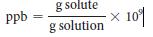
The U.S. standard for arsenate in drinking water requires that public water supplies must contain no greater than 10 parts per billion (ppb) arsenic. If this arsenic is present as arsenate, AsO43-, what mass of sodium arsenate would be present in a 1.00-L sample of drinking water that just meets
What exponential notation do the following abbreviations represent?(a) d(b) c(c) μ(d) M(e) n(f) m(g) p.
What are the differences in the compositions of the following pairs of atomic nuclei?(a) 21083 Bi, 21082 Pb(b) 147 N, 157 N(c) 2010Ne, 4018Ar
(a) Thomson’s cathode–ray tube (Figure 2.4) and the mass spectrometer (Figure 2.11) both involve the use of electric or magnetic fields to deflect charged particles. What are the charged particles involved in each of these experiments?(b) What are the labels on the axes of a mass spectrum?(c)
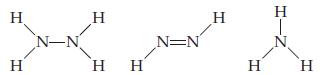
What are the molecular and empirical formulas for each of the following compounds? H H H N=N N-N H. H H H H
Which of the following pairs of atoms are isotopes of one another?(a) 11B, 11C(b) 55Mn, 54Mn(c)11850 Sn, 12050 Sn
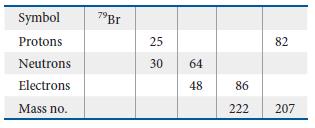
Fill in the gaps in the following table, assuming each column represents a neutral atom. Symbol Protons 25 82 Neutrons 30 64 Electrons 48 86 Mass no. 222 207
The radius of an atom of gold (Au) is about 1.35 A°. (a) Express this distance in nanometers (nm) and in picometers (pm).(b) How many gold atoms would have to be lined up to span 1.0 mm? (c) If the atom is assumed to be a sphere, what is the volume in cm3 of a single Au atom?
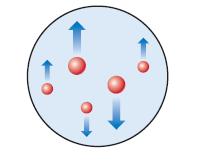
In the Millikan oil–drop experiment (see Figure 2.5) the tiny oil drops are observed through the viewing lens as rising, stationary, or falling, as shown here.(a) What causes their rate of fall to vary from their rate in the absence of an electric field?(b) Why do some drops move upward?
The three targets from a rifle range shown on the next page were produced by: (A) The instructor firing a newly acquired target rifle; (B) The instructor firing his personal target rifle; (C) A student who has fired his target rifle only a few times. (a) Comment on the accuracy
Two substances have the same molecular and empirical formulas.Does this mean that they must be the same compound?
Give the chemical formula for(a) Chlorite ion(b) Chloride ion(c) Chlorate ion(d) Perchlorate ion(e) Hypoid ion.
How many of the indicated atoms are represented by each chemical formula:(a) Carbon atoms in C4H8COOCH3(b) Oxygen atoms in Ca(ClO3)2(c) Hydrogen atoms in (NH4)2HPO4?
(a) What is meant by the term isomer?(b) Among the four alkanes, ethane, propane, butane, and pentane, which is capable of existing in isomeric forms?
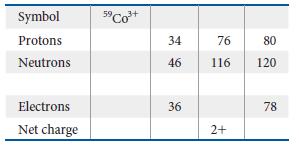
Fill in the gaps in the following table: Symbol 59 3+ Protons 34 76 80 Neutrons 46 116 120 Electrons 36 78 Net charge 2+
(a) What is a functional group?(b) What functional group characterizes an alcohol?(c) Write a structural formula for 1-pentanol, the alcohol derived from pentane by making a substitution on one of the carbon atoms.
The nucleus of 6Li is a powerful absorber of neutrons. It exists in the naturally occurring metal to the extent of 7.5%. In the era of nuclear deterrence, large quantities of lithium were processed to remove 6Li for use in hydrogen bomb production. The lithium metal remaining after removal of 6Li
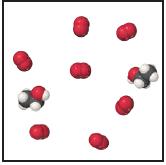
Consider the mixture of propane, C3H8, and O2 shown below.(a) Write a balanced equation for the combustion reaction that occurs between propane and oxygen.(b) Which reactant is the limiting reactant?(c) How many molecules of CO2, H2O, C3H8, and O2 will be present if the reaction goes to completion?
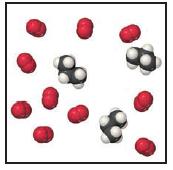
Consider the mixture of ethanol, C2H5OH, and O2 shown in the accompanying diagram.(a) Write a balanced equation for the combustion reaction that occurs between ethanol and oxygen.(b) Which reactant is the limiting reactant?(c) How many molecules of CO2, H2O, C2H5OH, and O2 will be present if the
If Avogadro’s number of pennies is divided equally among the 314 million men, women, and children in the United States, how many dollars would each receive? How does this compare with the gross domestic product (GDP) of the United States, which was $15.1 trillion in 2011? (The GDP is the total
Without doing any detailed calculations (but using a periodic table to give atomic weights), rank the following samples in order of increasing numbers of atoms:42 g of NaHCO3, 1.5 mol CO2, 6.0 ×1024 Ne atoms.
(a) The world population is estimated to be approximately 7 billion people. How many moles of people are there?(b) What units are typically used to express formula weight?(c) What units are typically used to express molar mass?
Write a balanced chemical equation for the reaction that occurs when(a) Titanium metal undergoes a combination reaction with O2(g)(b) Silver(I) oxide decomposes into silver metal and oxygen gas when heated(c) Propanol, C3H7OH(l) burns in air(d) Methyl tert-butyl ether, C5H12O(l), burns in air.
Balance the following equations and indicate whether they are combination, decomposition, or combustion reactions:(a) PbCO3(s)→PbO(s) + CO2(g)(b) C2H4(g) + O2(g)→CO2(g) + H2O(g)(c) Mg(s) + N2(g)→Mg3N2(s)(d) C7H8O2(s) + O2(g)→CO2(g) + H2O(g)(e) Al(s) + Cl2(g)→AlCl3(s)
(a) When the metallic element sodium combines with the nonmetallic element bromine, Br2(l), what is the chemical formula of the product?(b) Is the product a solid, liquid, or gas at room temperature?(c) In the balanced chemical equation for this reaction, what is the coefficient in front of the
(a) When a compound containing C, H, and O is completely combusted in air, what reactant besides the hydrocarbon is involved in the reaction?(b) What products form in this reaction?(c) What is the sum of the coefficients in the balanced chemical equation for the combustion of acetone, C3H6O(l), in
Write balanced chemical equations corresponding to each of the following descriptions:(a) Solid calcium carbide, CaC2, reacts with water to form an aqueous solution of calcium hydroxide and acetylene gas, C2H2.(b) When solid potassium chlorate is heated, it decomposes to form solid potassium
Balance the following equations:(a) Ca3P2(s) + H2O(l)→Ca(OH)2(aq) + PH3(g)(b) Al(OH)3(s) + H2SO4(aq)→Al2(SO4)3(aq) + H2O(l)(c) AgNO3(aq) + Na2CO3(aq)→Ag2CO3(s) + NaNO3(aq)(d) C2H5NH2(g) + O2(g)→CO2(g) + H2O(g) + N2(g)
Balance the following equations:(a) Al4C3(s) + H2O(l)→Al(OH)3(s) + CH4(g)(b) C5H10O2(l) + O2(g)→CO2(g) + H2O(g)(c) Fe(OH)3(s) + H2SO4(aq)→Fe2(SO4)3(aq) + H2O(l)(d) Mg3N2(s) + H2SO4(aq) →MgSO4(aq) + (NH4)2SO4(aq)
Balance the following equations:(a) Li(s) + N2(g)→Li3N(s)(b) TiCl4(l) + H2O(l)→TiO2(s) + HCl(aq)(c) NH4NO3(s)→N2(g) + O2(g) + H2O(g)(d) AlCl3(s) + Ca3N2(s)→AlN(s) + CaCl2(s)
Balance the following equations:(a) CO(g) + O2(g)→CO2(g)(b) N2O5(g) + H2O(l)→HNO3(aq)(c) CH4(g) + Cl2(g)→CCl4(l) + HCl(g)(d) Zn(OH)2(s) + HNO3(aq)→Zn(NO3)2(aq) + H2O(l)
A key step in balancing chemical equations is correctly identifying the formulas of the reactants and products. For example, consider the reaction between calcium oxide, CaO(s), and H2O(l) to form aqueous calcium hydroxide.(a) Write a balanced chemical equation for this combination reaction, having
(a) What scientific principle or law is used in the process of balancing chemical equations?(b) In balancing equations is it acceptable to change the coefficients, the subscripts in the chemical formula, or both?
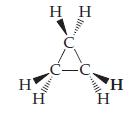
Cyclopropane is an interesting hydrocarbon. Instead of having three carbons in a row, the three carbons form a ring, as shown in this perspective drawing (see Figure 2.17 for a prior example of this kind of drawing):Cyclopropane was at one time used as an anesthetic, but its use was discontinued,
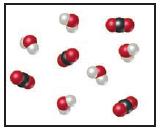
The following diagram represents the collection of CO2 and H2O molecules formed by complete combustion of a hydrocarbon. What is the empirical formula of the hydrocarbon?
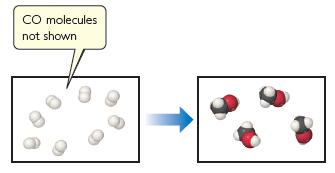
The following diagram shows the combination reaction between hydrogen, H2, and carbon monoxide, CO, to produce methanol, CH3OH (white spheres are H, black spheres are C, red spheres are O). The correct number of CO molecules involved in this reaction is not shown.(a) Determine the number of CO
In what part of the atom does the strong nuclear force operate?
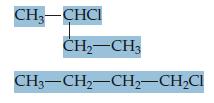
Are these two compounds isomers? Explain. CH-CHCI ČH-CH3 CH3-CH2-CH-CH2CI
The liquid substances mercury (density = 13.6 g/mL), water (1.00 g/mL), and cyclohexane (0.778 g/mL) do not form a solution when mixed but separate in distinct layers. Sketch how the liquids would position themselves in a test tube.
Showing 900 - 1000
of 1009
1
2
3
4
5
6
7
8
9
10
11
Step by Step Answers

 Get 50% OFF
Claim Now
Get 50% OFF
Claim Now