New Semester
Started
Get
50% OFF
Study Help!
--h --m --s
Claim Now
Question Answers
Textbooks
Find textbooks, questions and answers
Oops, something went wrong!
Change your search query and then try again
S
Books
FREE
Study Help
Expert Questions
Accounting
General Management
Mathematics
Finance
Organizational Behaviour
Law
Physics
Operating System
Management Leadership
Sociology
Programming
Marketing
Database
Computer Network
Economics
Textbooks Solutions
Accounting
Managerial Accounting
Management Leadership
Cost Accounting
Statistics
Business Law
Corporate Finance
Finance
Economics
Auditing
Tutors
Online Tutors
Find a Tutor
Hire a Tutor
Become a Tutor
AI Tutor
AI Study Planner
NEW
Sell Books
Search
Search
Sign In
Register
study help
sciences
chemistry the central science
Chemistry The Central Science 13th Edition Theodore E. Brown, H. Eugene LeMay, Bruce E. Bursten, Catherine Murphy, Patrick Woodward, Matthew E. Stoltzfus - Solutions
At 50°C, the ion-product constant for H2O has the value Kw = 5.48 × 10⁻¹⁴. What is the pH of pure water at 50°C?
Which of these statements about the common-ion effect is most correct?(a) The solubility of a salt MA is decreased in a solution that already contains either M+ or A-.(b) Common ions alter the equilibrium constant for the reaction of an ionic solid with water.
Consider the equilibriumB(aq) + H2O(I) ⇌ HB+(aq) + OH-(aq).Suppose that a salt of HB+ is added to a solution of B at equilibrium.(a) Will the equilibrium constant for the reaction increase, decrease, or stay the same?(b) Will the concentration of B(aq) increase, decrease, or stay the same?(c)
Which of the following solutions is a buffer?(a) 0.10 M CH3COOH and 0.10 M CH3COONa(b) 0.10 M CH3COOH(c) 0.10 M HCl and 0.10 M NaCl(d) Both a and c(e) All of a, b, and c.
Compare the titration of a strong, monoprotic acid with a strong base to the titration of a weak, monoprotic acid with a strong base. Assume the strong and weak acid solutions initially have the same concentrations. Indicate whether the following statements are true or false.(a) More base is
For each statement, indicate whether it is true or false.(a) The solubility of a slightly soluble salt can be expressed in units of moles per liter.(b) The solubility product of a slightly soluble salt is simply the square of the solubility.(c) The solubility of a slightly soluble salt is
The solubility of two slightly soluble salts of M2+ , MA and MZ2, are the same, 4 × 10⁻⁴ mol/L.(a) Which has the larger numerical value for the solubility product constant?(b) In a saturated solution of each salt in water, which has the higher concentration of M2+ ?(c) If you added an equal volume
Rainwater is acidic because CO2(g) dissolves in the water, creating carbonic acid, H2CO3. If the rainwater is too acidic, it will react with limestone and seashells (which are principally made of calcium carbonate, CaCO3). Calculate the concentrations of carbonic acid, bicarbonate ion (HCO3-) and
A weak monoprotic acid is titrated with 0.100 M NaOH. It requires 50.0 mL of the NaOH solution to reach the equivalence point. After 25.0 mL of base is added, the pH of the solution is 3.62. Estimate the pKa of the weak acid.
Baking soda (sodium bicarbonate, NaHCO3) reacts with acids in foods to form carbonic acid (H2CO3), which in turn decomposes to water and carbon dioxide gas. In a cake batter, the CO2(g) forms bubbles and causes the cake to rise.(a) A rule of thumb in baking is that 1/2 teaspoon of baking soda is
In non-aqueous solvents, it is possible to react HF to create H2F+. Which of these statements follows from this observation?(a) HF can act like a strong acid in non-aqueous solvents(b) HF can act like a base in non-aqueous solvents(c) HF is thermodynamically unstable(d) There is an acid in the
Rank the following gases from least dense to most dense at 1.00 atm and 298 K: SO2, HBr, CO2. Explain.
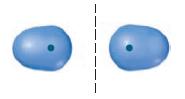
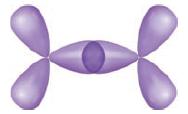
One of the molecular orbitals of the H2- ion is sketched below:(a) Is the molecular orbital a σ or π MO? Is it bonding or antibonding?(b) In H2-, how many electrons occupy the MO shown above?(c) What is the bond order in the H2- ion?
The vapor pressure of ethanol (C2H5OH) at 19°C is 40.0 torr. A 1.00-g sample of ethanol is placed in a 2.00 L container at 19°C. If the container is closed and the ethanol is allowed to reach equilibrium with its vapor, how many grams of liquid ethanol remain?
Naphalene, (C10H8) is the main ingredient in traditional mothballs. Its normal melting point is 81°C, its normal boiling point is 218°C, and its triple point is 80°C at 1000 Pa. Using the data, construct a phase diagram for naphthalene, labeling all the regions of your diagram.
The table below lists the density of O2 at various temperatures and at 1 atm. Graph the data and predict the substance’s normal boiling point.Temperature (K) Density (mol/L)60 ............................................
Consider the following XF4 ions: PF4-, BrF4-, ClF4+, and AlF4-.(a) Which of the ions have more than an octet of electrons around the central atom?(b) For which of the ions will the electrondomain and molecular geometries be the same?(c) Which of the ions will have an octahedral electron-domain
Based on their composition and structure, list CH2Cl2, CH3CH2CH3, and CH3CH2OH in order of(a) Increasing intermolecular forces(b) Increasing viscosity(c) Increasing surface tension.
(a) What is the relationship between surface tension and temperature?(b) What is the relationship between viscosity and temperature?(c) Why do substances with high surface tension also tend to have high viscosities?
(a) Which is generally stronger, intermolecular interactions or intramolecular interactions?(b) Which of these kinds of interactions are broken when a liquid is converted to a gas?
At room temperature, Si is a solid, CCl4 is a liquid, and Ar is a gas. List these substances in order of(a) Increasing intermolecular energy of attraction(b) Increasing boiling point.
As a metal such as lead melts, what happens to(a) The average kinetic energy of the atoms(b) The average distance between the atoms?
Gas pipelines are used to deliver natural gas (methane, CH4) to the various regions of the United States. The total volume of natural gas that is delivered is on the order of 2.7 × 10¹²L per day, measured at STP. Calculate the total enthalpy change for combustion of this quantity of methane.
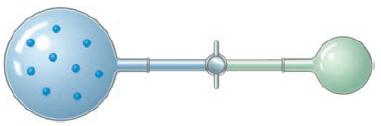
An ideal gas at a pressure of 1.50 atm is contained in a bulb of unknown volume. A stopcock is used to connect this bulb with a previously evacuated bulb that has a volume of 0.800L as shown here. When the stopcock is opened the gas expands into the empty bulb. If the temperature is held constant
A gas bubble with a volume of 1.0 mm3 originates at the bottom of a lake where the pressure is 3.0 atm. Calculate its volume when the bubble reaches the surface of the lake where the pressure is 730 torr, assuming that the temperature doesn’t change.
WF6 is one of the heaviest known gases. How much slower is the root-mean-square speed of WF6 than He at 300 K?
Which assumptions are common to both kinetic-molecular theory and the ideal-gas equation?
Determine whether each of the following changes will increase, decrease, or not affect the rate with which gas molecules collide with the walls of their container:(a) Increasing the volume of the container(b) Increasing the temperature(c) Increasing the molar mass of the gas.
If 5.15 g of Ag2O is sealed in a 75.0-mL tube filled with 760 torr of N2 gas at 32°C, and the tube is heated to 320°C, the Ag2O decomposes to form oxygen and silver. What is the total pressure inside the tube assuming the volume of the tube remains constant?
A rigid vessel containing a 3:1 mol ratio of carbon dioxide and water vapor is held at 200°C where it has a total pressure of 2.00 atm. If the vessel is cooled to 10°C so that all of the water vapor condenses, what is the pressure of carbon dioxide? Neglect the volume of the liquid water that
A 334-mL cylinder for use in chemistry lectures contains 5.225 g of helium at 23°C. How many grams of helium must be released to reduce the pressure to 75 atm assuming ideal gas behavior?
A 35.1 g sample of solid CO2 (dry ice) is added to a container at a temperature of 100 K with a volume of 4.0 L. If the container is evacuated (all of the gas removed), sealed and then allowed to warm to room temperature (T = 298 K) so that all of the solid CO2 is converted to a gas, what is the
To derive the ideal-gas equation, we assume that the volumeof the gas atoms/molecules can be neglected. Given the atomic radius of neon, 0.69 Å, and knowing that a sphere has a volume of 4πr3/3, calculate the fraction of space that Ne atoms occupy in a sample of neon at STP.
(a) Amonton’s law expresses the relationship between pressure and temperature. Use Charles’s law and Boyle’s law to derive the proportionality relationship between P and T.(b) If a car tire is filled to a pressure of 32.0 lbs/in.2 (psi) measured at 75 °F, what will be the tire pressure if
You have a gas at 25 °C confined to a cylinder with a movable piston. Which of the following actions would double the gas pressure?(a) Lifting up on the piston to double the volume while keeping the temperature constant.(b) Heating the gas so that its temperature rises from 25 °C to 50 °C, while
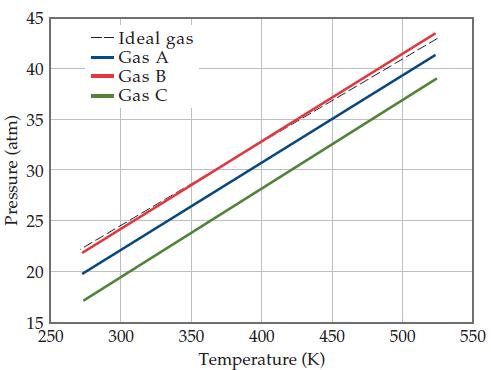
The graph below shows the change in pressure as the temperature increases for a 1-mol sample of a gas confined to a 1-L container. The four plots correspond to an ideal gas and three real gases: CO2, N2, and Cl2.(a) At room temperature, all three real gases have a pressure less than the ideal gas.
Place the following molecules and ions in order from smallest to largest bond order: H2+, B2, N2+, F2+, and Ne2.
Suppose that silicon could form molecules that are precisely the analogs of ethane (C2H6), ethylene (C2H4), and acetylene (C2H2). How would you describe the bonding about Si in terms of hydrid orbitals? Silicon does not readily form some of the analogous compounds containing p bonds. Why might this
The structure of borazine, B3N3H6, is a six-membered ring of alternating B and N atoms. There is one H atom bonded to each B and to each N atom. The molecule is planar.(a) Write a Lewis structure for borazine in which the formal charges on every atom is zero.(b) Write a Lewis structure for borazine
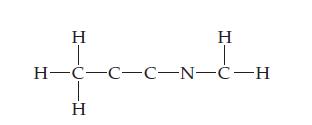
Consider the molecule C4H5N, which has the connectivity shown below.(a) After the Lewis structure for the molecule is completed, how many s and how many p bonds are there in this molecule?(b) How many atoms in the molecule exhibit (i) sp hybridization, (ii) sp2 hybridization, (iii)
Which of the following statements about hybrid orbitals is or are true? (i) After an atom undergoes sp hybridization there is one unhybridized p orbital on the atom, (ii) Under sp2 hybridization, the large lobes point to the vertices of an equilateral triangle, (iii) The angle between the large
In the formate ion, HCO2-, the carbon atom is the central atom with the other three atoms attached to it.(a) Draw a Lewis structure for the formate ion.(b) What hybridization is exhibited by the C atom?(c) Are there multiple equivalent resonance structures for the ion?(d) Which of the atoms in the
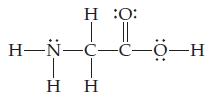
Consider the Lewis structure for glycine, the simplest amino acid:(a) What are the approximate bond angles about each of the two carbon atoms, and what are the hybridizations of the orbitals on each of them?(b) What are the hybridizations of the orbitals on the two oxygens and the nitrogen atom,
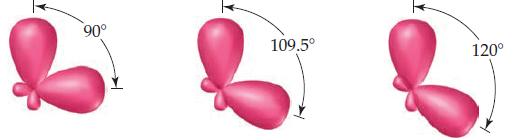
Shown here are three pairs of hybrid orbitals, with each set at a characteristic angle. For each pair, determine the type of hybridization, if any, that could lead to hybridorbitals at the specified angle. 90° 109.5° 120°
(a) Consider the AF3 molecules in Exercise 9.27. Which of these will have a nonzero dipole moment?(b) Which of the AF4 molecules in Exercise 9.28 will have a zero dipole moment?
The following is part of a molecular orbital energy-level diagram for MOs constructed from 1s atomic orbitals.(a) What labels do we use for the two MOs shown?(b) For which of the following molecules or ions could this be the energy-level diagram: H2, He2, H2+, He2+, or H2-?(c) What is the bond
The molecule shown below is called furan. It is represented in typical shorthand way for organic molecules, with hydrogen atoms not shown.(a) What is the molecular formula for furan?(b) How many valence electrons are there in the molecule?(c) What is the hybridization at each of the carbon
The drawing below shows the overlap of two hybrid orbitals to form a bond in a hydrocarbon. (a) Which of the following types of bonds is being formed: (i) C—C s, (ii) C—C p or (iii) C—H s? (b) Which of the following could be the identity of the hydrocarbon: (i)
Silicon, the element, is the heart of integrated circuits and computer chips in almost all of our electronic devices. Si has the same structure as diamond; each atom is singly bonded to four neighbors. Unlike diamond, silicon has a tendency to oxidize (to SiO2, another extended solid) if exposed to
The compound chloral hydrate, known in detective stories as knockout drops, is composed of 14.52% C, 1.83% H, 64.30% Cl, and 13.35% O by mass, and has a molar mass of 165.4 g/mol.(a) What is the empirical formula of this substance?(b) What is the molecular formula of this substance?
Consider the hypothetical molecule B—A=B. Are the following statements true or false?(a) This molecule cannot exist.(b) If resonance was important, the molecule would have identical A–B bond lengths.
Although I3- is known, F3- is not. Which statement is the most correct explanation?(a) Iodine is more likely to be electron-deficient.(b) Fluorine is too small to accommodate three nonbonding electron pairs and two bonding electron pairs.(c) Fluorine is too electronegative to form anions.(d) I2 is
A classmate of yours is convinced that he knows everything about electronegativity.(a) In the case of atoms X and Y having different electronegativities, he says, the diatomic molecule X—Y must be polar. Is your classmate correct?(b) Your classmate says that the farther the two atoms are apart in
Draw the dominant Lewis structures for these chlorine–oxygen molecules/ions: ClO, ClO-, ClO2-, ClO3-, ClO4-. Which of these do not obey the octet rule?
Fill in the blank with the appropriate numbers for both electrons and bonds (considering that single bonds are counted as one, double bonds as two, and triple bonds as three).(a) Fluorine has ____ valence electrons and makes ____ bond(s) in compounds.(b) Oxygen has ____ valence electrons and makes
Indicate whether each statement is true or false:(a) The octet rule is based on the fact that filling in all s and p valence electrons in a shell gives eight electrons.(b) The Si in SiH4 does not follow the octet rule because hydrogen is in an unusual oxidation state.(c) Boron compounds are
(a) Do the C—C bond lengths in benzene alternate shortlong-short-long around the ring? Why or why not?(b) Are C—C bond lengths in benzene shorter than C—C single bonds?(c) Are C—C bond lengths in benzene shorter than C=C double bonds?
Which one of these statements about formal charge is true?(a) Formal charge is the same as oxidation number.(b) To draw the best Lewis structure, you should minimize formal charge.(c) Formal charge takes into account the different electronegativities of the atoms in a molecule.(d) Formal charge is
Which of the following statements about electronegativity is false?(a) Electronegativity is the ability of an atom in a molecule to attract electron density toward itself.(b) Electronegativity is the same thing as electron affinity.(c) The numerical values for electronegativity have no units.(d)
(a) Construct a Lewis structure for O2 in which each atom achieves an octet of electrons.(b) How many bonding electrons are in the structure?(c) Would you expect the O—O bond in O2 to be shorter or longer than the O—O bond in compounds that contain an O—O single bond? Explain.
(a) State whether the bonding in each compound is likely to be covalent or not: (i) iron, (ii) sodium chloride, (iii) water, (iv) oxygen, (v) argon.(b) A substance XY, formed from two different elements, boils at -33°C. Is XY likely to be a covalent or an ionic substance?
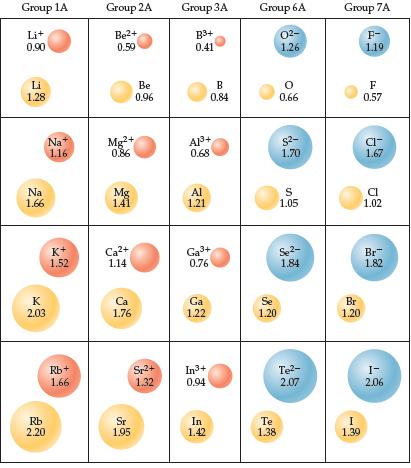
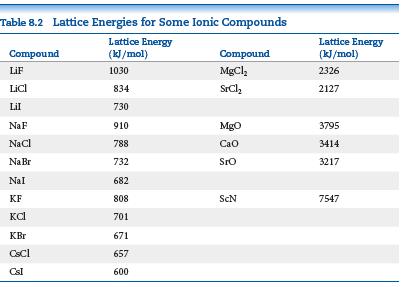
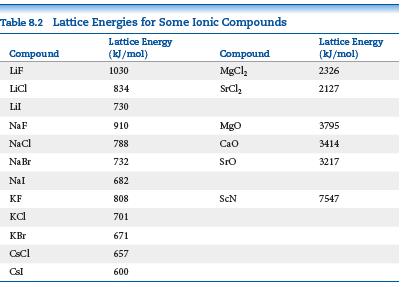
Consider the ionic compounds KF, NaCl, NaBr, and LiCl.(a) Use ionic radii (Figure 7.8) to estimate the cation–anion distance for each compound.(b) Based on your answer to part (a), arrange these four compounds in order of decreasing lattice energy.(c) Check your predictions in part (b) with the
The ionic substances NaF, CaO, and ScN are isoelectronic (they have the same number of electrons). Examine the lattice energies for these substances in Table 8.2. Make a graph of lattice energy on the vertical axis versus the charge on the cation on the horizontal axis.(a) What is the slope of the
(a) Is lattice energy usually endothermic or exothermic?(b) Write the chemical equation that represents the process of lattice energy for the case of NaCl.(c) Would you expect salts like NaCl, which have singly-charged ions, to have larger or smaller lattice energies compared to salts like CaO
(a) Use Lewis symbols to represent the reaction that occurs between Ca and F atoms.(b) What is the chemical formula of the most likely product?(c) How many electrons are transferred?(d) Which atom loses electrons in the reaction?
Consider the element silicon, Si.(a) Write its electron configuration.(b) How many valence electrons does a silicon atom have?(c) Which subshells hold the valence electrons?
(a) True or false: An element’s number of valence electrons is the same as its atomic number.(b) How many valence electrons does a nitrogen atom possess?(c) An atom has the electron configuration 1s2 2s2 2p6 3s2 3p2. How many valence electrons does the atom have?
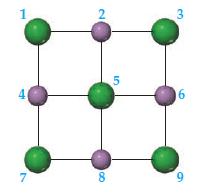
A portion of a two-dimensional “slab” of NaCl(s) is shown here (see Figure 8.3) in which the ions are numbered.(a) Which colored balls must represent sodium ions?(b) Which colored balls must represent chloride ions?(c) Consider ion 5. How many attractive electrostatic interactions are shown for
Elemental cesium reacts more violently with water than does elemental sodium. Which of the following best explains this difference in reactivity?(i) Sodium has greater metallic character than does cesium.(ii) The first ionization energy of cesium is less than that of sodium.(iii) The electron
Which of the following is the expected product of the reaction of K(s) and H2(g)?(i) KH(s)(ii) K2H(s)(iii) KH2(s)(iv) K2H2(s)(v) K(s) and H2(g) will not react with one another.
Which of the following chemical equations is connected to the definitions of:(a) The first ionization energy of oxygen.(b) The second ionization energy of oxygen.(c) The electron affinity of oxygen?(i) O(g) + e-→O-(g) (ii) O(g)→O+(g) + e- (iii) O(g) + 2e-→O2-(g) (iv) O(g)→O2+(g) +
The following observations are made about two hypothetical elements A and B: The A—A and B—B bond lengths in elemental A and B are 2.36 and 1.94 Å, respectively. A and B react to form the binary compound AB2, which has a linear structure (that is ∠B - A - B = 180°). Based on these
The As—As bond length in elemental arsenic is 2.48 Å. The Cl—Cl bond length in Cl2 is 1.99 Å.(a) Based on these data, what is the predicted As—Cl bond length in arsenic trichloride, AsCl3, in which each of the three Cl atoms is bonded to the As atom?(b) What bond length is predicted for
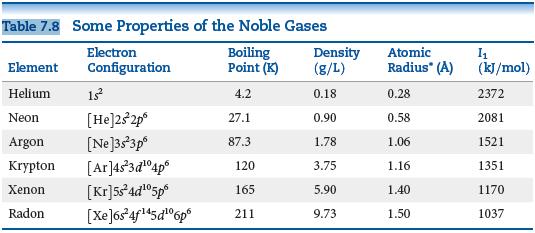
In Table 7.8, the bonding atomic radius of neon is listed as 0.58 Å, whereas that for xenon is listed as 1.40 Å. A classmate of yours states that the value for Xe is more realistic than the one for Ne. Is she correct? If so, what is the basis for her statement? Table 7.8 Some Properties of the
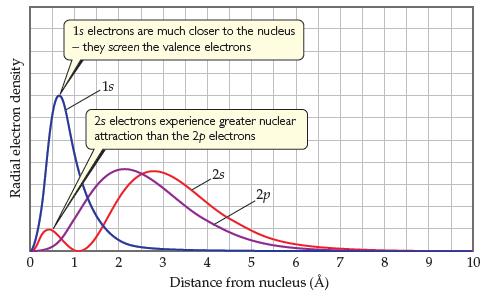
Figure 7.4 shows the radial probability distribution functions for the 2s orbitals and 2p orbitals.(a) Which orbital, 2s or 2p, has more electron density close to the nucleus?(b) How would you modify Slater’s rules to adjust for the difference in electronic penetration of the nucleus for the 2s
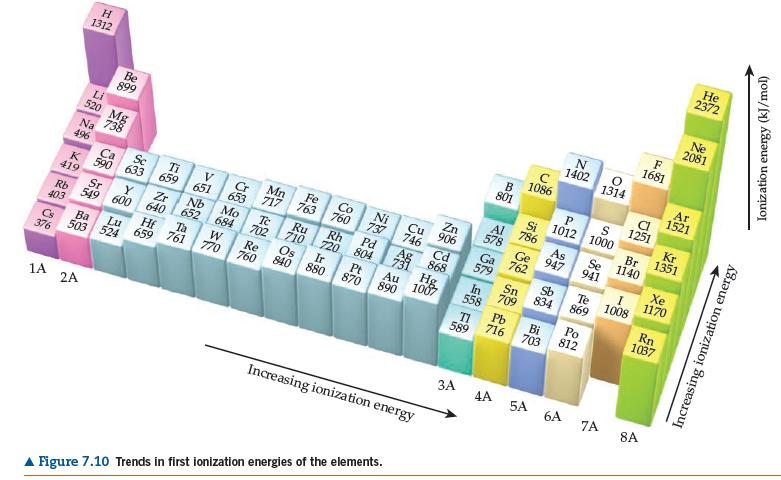
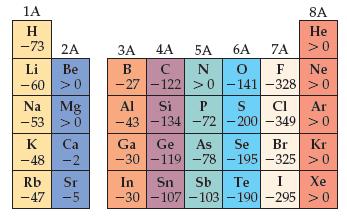
Potassium and hydrogen react to form the ionic compound potassium hydride.(a) Write a balanced equation for this reaction.(b) Use data in Figures 7.10 and 7.12 to determine the energy change in kJ/mol for the following two reactions:Figures 7.12K(g) + H(g) → K+(g) + H-(g)K(g) + H(g) → K-(g) +
You read the following statement about two elements X and Y: One of the elements is a good conductor of electricity, and the other is a semiconductor. Experiments show that the first ionization energy of X is twice as great as that of Y. Which element has the greater metallic character?
(a) Does metallic character increase, decrease, or remain unchanged as one goes from left to right across a row of the periodic table?(b) Does metallic character increase, decrease, or remain unchanged as one goes down a column of the periodic table?(c) Are the periodic trends in (a) and (b) the
Consider the following equation:Ca+(g) + e-→Ca(g)Which of the following statements are true?(i) The energy change for this process is the electron affinity of the Ca+ ion.(ii) The energy change for this process is the negative of the first ionization energy of the Ca atom.(iii) The energy change
Write the electron configurations for the following ions, and determine which have noble-gas configurations:(a) Ru3+(b) As3-(c) Y3+(d) Pd2+(e) Pb2+(f) Au3+
Write the electron configurations for the following ions, and determine which have noble-gas configurations: (a) Co2+(b) Sn2+(c) Zr4+(d) Ag+(e) S2-
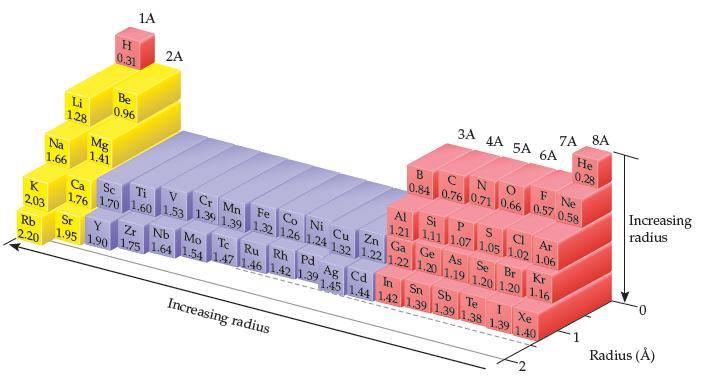
Using only the periodic table, arrange each set of atoms in order of increasing radius:(a) Ba, Ca, Na(b) Sn, Sb, As(c) Al, Be, Si.
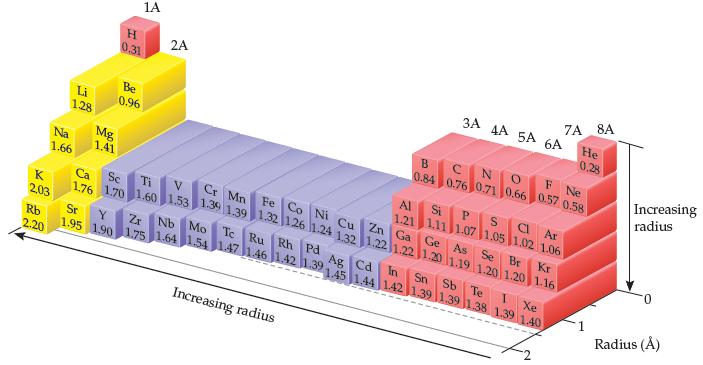
Which of the following statements about the bonding atomic radii in Figure 7.7 is incorrect?(i) For a given period, the radii of the representative elements generally decrease from left to right across period.(ii) The radii of the representative elements for the n = 3 period are all larger than
Which of the following statements about effective nuclear charge for the outermost valence electron of an atom is incorrect?(i) The effective nuclear charge can be thought of as the true nuclear charge minus a screening constant due to the other electrons in the atom.(ii) Effective nuclear charge
(a) Evaluate the express ions 2 × 1, 2 × (1 + 3), 2 × (1 + 3 + 5), and 2 × (1 + 3 + 5 + 7).(b) How do the atomic numbers of the noble gases relate to the numbers from part (a)?(c) What topic discussed in Chapter 6 is the source of the number “2” in the expressions in part (a)?
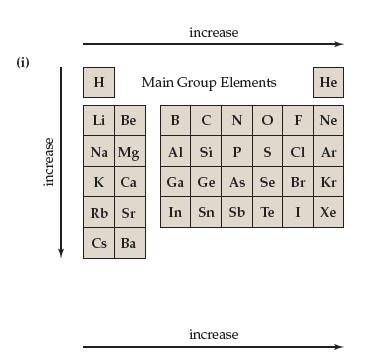
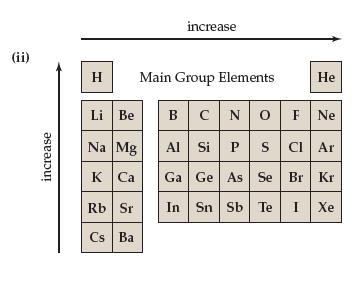
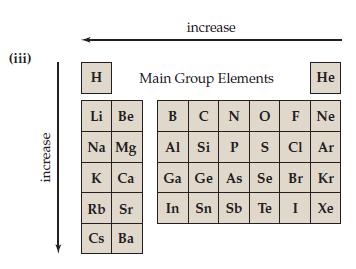
(a) Which of the following charts below shows the general periodic trends for each of the following properties of the main-group elements (you can neglect small deviations going either across a row or down a column of the periodic table)?(i) Bonding atomic radius.(ii) First ionization energy.(iii)
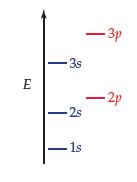
Shown below is a qualitative diagram of the atomic orbital energies for an Na atom. The number of orbitals in each subshell is not shown.(a) Are all of the subshells for n = 1, n = 2, and n = 3 shown? If not, what is missing?(b)The 2s and 2p energy levels are shown as different. Which of the
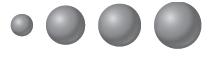
Consider the Mg2+, Cl-, K+, and Se2- ions. The four spheres below represent these four ions, scaled according to ionic size.(a) Without referring to Figure 7.8, match each ion to its appropriate sphere.(b) In terms of size, between which of the spheres would you find the (i) Ca2+ and (ii) S2-
In August 2011, the Juno spacecraft was launched from Earth with the mission of orbiting Jupiter in 2016. The closest distance between Jupiter and Earth is 391 million miles.(a) If it takes 5.0 years for Juno to reach Jupiter, what is its average speed in mi/hr over this period?(b) Once Juno
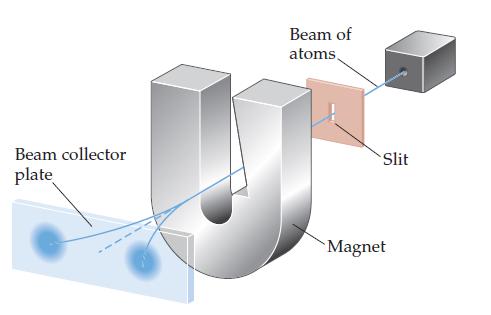
In the experiment shown schematically below, a beam of neutral atoms is passed through a magnetic field. Atoms that have unpaired electrons are deflected in different directions in the magnetic field depending on the value of the electron spin quantum number. In the experiment illustrated, we
Using the periodic table as a guide, write the condensed electron configuration and determine the number of unpaired electrons for the ground state of (a) Br, (b) Ga, (c) Hf, (d) Sb, (e) Bi, (f) Sg.
Determine whether each of the following sets of quantum numbers for the hydrogen atom are valid. If a set is not valid, indicate which of the quantum numbers has a value that is not valid:(a) n = 4, l = 1, ml = 2, ms = -12(b) n = 4, l = 3, ml = -3, ms = +12(c) n = 3, l = 2, ml = -1, ms = +12(d) n =
As discussed in the A Closer Look box on “Measurement and the Uncertainty Principle,” the essence of the uncertainty principle is that we can’t make a measurement without disturbing the system that we are measuring.(a) Why can’t we measure the position of a subatomic particle without
An electron is accelerated through an electric potential to a kinetic energy of 13.4keV. What is its characteristic wavelength?Recall that the kinetic energy of a moving object is E = 12mv2, where m is the mass of the object and n is the speed of the object.
Consider a transition in which the hydrogen atom is excited from n = 1 to n = ∞.(a) What is the end result of this transition?(b) What is the wavelength of light that must be absorbed to accomplish this process?(c) What will occur if light with a shorter wavelength than that in part (b) is used
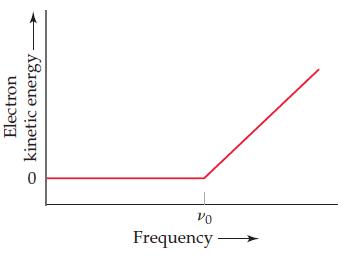
In an experiment to study the photoelectric effect, a scientist measures the kinetic energy of ejected electrons as a function of the frequency of radiation hitting a metal surface. She obtains the following plot. The point labeled “ν0” corresponds to light with a wavelength of 542 nm.(a) What
The following electron configurations represent excited states. Identify the element and write its ground-state condensed electron configuration.(a) 1s2 2s2 2p4 3s1(b) [Ar] 4s1 3d10 4p2 5p1(c) [Kr] 5s2 4d2
For each element, indicate the number of valence electrons, core electrons, and unpaired electrons in the ground state:(a) Nitrogen(b) Silicon(c) Chlorine.
What is the maximum number of electrons in an atom that can have the following quantum numbers?(a) n = 3, ml = -2(b) n = 4, l = 3(c) n = 5, l = 3, ml = 2(d) n = 4, l = 1, ml = 0.
The hydrogen atom can absorb light of wavelength 1094 nm.(a) In what region of the electromagnetic spectrum is this absorption found?(b) Determine the initial and final values of n associated with this absorption.
Showing 800 - 900
of 1009
1
2
3
4
5
6
7
8
9
10
11
Step by Step Answers

 Get 50% OFF
Claim Now
Get 50% OFF
Claim Now