New Semester
Started
Get
50% OFF
Study Help!
--h --m --s
Claim Now
Question Answers
Textbooks
Find textbooks, questions and answers
Oops, something went wrong!
Change your search query and then try again
S
Books
FREE
Study Help
Expert Questions
Accounting
General Management
Mathematics
Finance
Organizational Behaviour
Law
Physics
Operating System
Management Leadership
Sociology
Programming
Marketing
Database
Computer Network
Economics
Textbooks Solutions
Accounting
Managerial Accounting
Management Leadership
Cost Accounting
Statistics
Business Law
Corporate Finance
Finance
Economics
Auditing
Tutors
Online Tutors
Find a Tutor
Hire a Tutor
Become a Tutor
AI Tutor
AI Study Planner
NEW
Sell Books
Search
Search
Sign In
Register
study help
sciences
chemistry the central science
Chemistry The Central Science 13th Edition Theodore E. Brown, H. Eugene LeMay, Bruce E. Bursten, Catherine Murphy, Patrick Woodward, Matthew E. Stoltzfus - Solutions
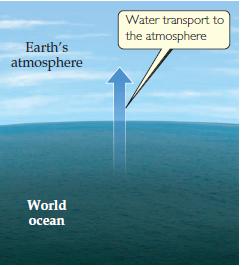
Where does the energy come from to evaporate the estimated 425,000 km3 of water that annually leaves the oceans, as illustrated here? Water transport to the atmosphere Earth's atmosphere World осean
Oxalic acid (H2C2O4) is a diprotic acid. By using data in Appendix D as needed, determine whether each of the following statements is true:(a) H2C2O4 can serve as both a Brønsted– Lowry acid and a Brønsted–Lowry base.(b) C2O4 2- is the conjugate base of HC2O4-.(c) An aqueous solution of the
(a) If Qc < Kc, in which direction will a reaction proceed in order to reach equilibrium? (b) What condition must be satisfied so that Qc = Kc?(b) What condition must be satisfied so that Qc = Kc?
(a) If Qc > Kc, how must the reaction proceed to reach equilibrium?(b) At the start of a certain reaction, only reactants are present; no products have been formed. What is the value of Qc at this point in the reaction?
At 100 °C, the equilibrium constant for the reactionCOCl2(g) ⇌ CO(g) + Cl2(g) has the value Kc = 2.19 × 10⁻¹⁰.Are the following mixtures of COCl2, CO, and Cl2 at 100°C at equilibrium? If not, indicate the direction that the reaction must proceed to achieve equilibrium.(a) [COCl2] = 2.00 ×
For the reaction H2(g) + I2(g) ⇌ 2HI(g), Kc = 55.3 at 700 K. In a 2.00-L flask containing an equilibrium mixture of the three gases, there are 0.056 g H2 and 4.36 g I2. What is the mass of HI in the flask?
For 2SO2(g) + O2(g) ⇌ 2SO3(g), Kp = 3.0 × 10⁴ at 700 K. In a 2.00-L vessel, the equilibrium mixture contains 1.17 g of SO3 and 0.105 g of O2. How many grams of SO2 are in the vessel?
Consider the reactionCaSO4(s) ⇌ Ca2+(aq) + SO42-(aq)At 25°C, the equilibrium constant is Kc = 2.4 × 10⁻⁵ for this reaction.(a) If excess CaSO4(s) is mixed with water at 25°C to produce a saturated solution of CaSO4, what are the equilibrium concentrations of Ca2+ and SO42-?(b) If the resulting
At 25°C, the reaction CaCrO4(s) ⇌ Ca2+(aq) + CrO42-(aq) has an equilibrium constant Kc = 7.1 × 10⁻⁴. What are the equilibrium concentrations of Ca2+ and CrO42- in a saturated solution of CaCrO4?
Consider the reaction4NH3(g) + 5O2(g) ⇌ 4NO(g) + 6H2O(g), ΔH = -904.4 kJDoes each of the following increase, decrease, or leave unchanged the yield of NO at equilibrium?(a) Increase [NH3](b) Increase [H2O](c) Decrease [O2]
The water–gas shift reactionCO(g) + H2O(g) ⇌ CO2(g) + H2(g) is used industrially to produce hydrogen.The reaction enthalpy is ΔH° = -41 kJ.(a) To increase the equilibrium yield of hydrogen would you use high or low temperature?(b) Could you increase the equilibrium yield of hydrogen by
Consider the hypothetical reaction A(g) ⇌ 2 B(g). A flask is charged with 0.75 atm of pure A, after which it is allowed to reach equilibrium at 0°C. At equilibrium, the partial pressure of A is 0.36 atm.(a) What is the total pressure in the flask at equilibrium?(b) What is the value of Kp?(c)
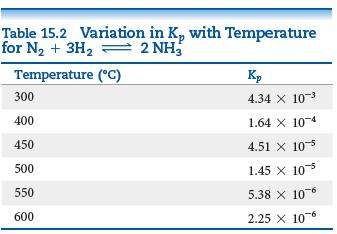
As shown in Table 15.2, the equilibrium constant for the reaction N2(g) + 3H2(g) ⇌ 2 NH3(g) is Kp = 4.34 × 10⁻³ at 300°C. Pure NH3 is placed in a 1.00-L flask and allowed to reach equilibrium at this temperature. There are 1.05 g NH3 in the equilibrium mixture.(a) What are the masses of N2 and
For the equilibriumPH3BCl3(s) ⇌ PH3(g) + BCl3(g) Kp = 0.052 at 60 °C.(a) Calculate Kc.(b) After 3.00 g of solid PH3BCl3 is added to a closed 1.500-L vessel at 60°C, the vessel is charged with 0.0500 g of BCl3(g). What is the equilibrium concentration of PH3?
Consider the hypothetical reaction A(g) + 2B(g) ⇌ 2C(g), for which Kc = 0.25 at a certain temperature. A 1.00-L reaction vessel is loaded with 1.00 mol of compound C, which is allowed to reach equilibrium. Let the variable x represent the number of mol/L of compound A present at equilibrium.(a)
Silver chloride, AgCl(s), is an “insoluble” strong electrolyte.(a) Write the equation for the dissolution of AgCl(s) in H2O(I).(b) Write the expression for Kc for the reaction in part (a).(c) Based on the thermochemical data in Appendix C and Le Châtelier’s principle, predict whether the
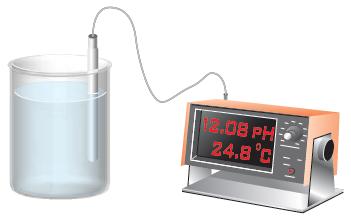
The probe of the pH meter shown here is sitting in a beaker that contains a clear liquid. (a) You are told the liquid is pure water, a solution of HCl(aq), or a solution of KOH(aq). Which one is it?(b) If the liquid is one of the solutions, what is its molarity?(c) Why is the temperature given
The graph given below shows [H+] vs. concentration for an aqueous solution of an unknown substance.(a) Is the substance a strong acid, a weak acid, a strong base, or a weak base?(b) Based on your answer to (a), can you determine the value of the pH of the solution when the concentration is 0.18
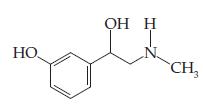
Phenylephrine, an organic substance with molecular formula C9H13NO2, is used as a nasal decongenstant in over-thecounter medications. The molecular structure of phenylephrine is shown below using the usual shortcut organic nomenclature.(a) Would you expect a solution of phenylephrine to be acidic,
If a neutral solution of water, with pH = 7.00, is cooled to 10°C, the pH rises to 7.27. Which of the following three statements is correct for the cooled water:(i) [H+] > [OH-](ii) [H+] = [OH-](iii) [H+] < [OH-] ?
Addition of the indicator methyl orange to an unknown solution leads to a yellow color. The addition of bromthymol blue to the same solution also leads to a yellow color.(a) Is the solution acidic, neutral, or basic?(b) What is the range (in whole numbers) of possible pH values for the solution?(c)
Addition of phenolphthalein to an unknown colorless solution does not cause a color change. The addition of bromthymol blue to the same solution leads to a yellow color.(a) Is the solution acidic, neutral, or basic?(b) Which of the following can you establish about the solution: (i) A minimum pH,
Is each of the following statements true or false?(a) All strong acids contain one or more H atoms.(b) A strong acid is a strong electrolyte.(c) A 1.0-M solution of a strong acid will have pH = 1.0.
Determine whether each of the following is true or false:(a) All strong bases are salts of the hydroxide ion. (b) The addition of a strong base to water produces a solution of pH > 7.0. (c) Because Mg(OH)2 is not very soluble, it cannot be a strong base.
Calculate [OH-] and pH for(a) 1.5 × 10⁻³M Sr(OH)2(b) 2.250 g of LiOH in 250.0 mL of solution(c) 1.00 mL of 0.175 M NaOH diluted to 2.00 L(d) A solution formed by adding 5.00 mL of 0.105 M KOH to 15.0 mL of 9.5 × 10⁻² M Ca(OH)2.
A solution of sodium acetate (NaCH3COO) has a pH of 9.70. What is the molarity of the solution?
Pyridinium bromide (C5H5NHBr) is a strong electrolyte that dissociates completely into C5H5NH+ and Br-. A solution of pyridinium bromide has a pH of 2.95. What is the molarity of the solution?
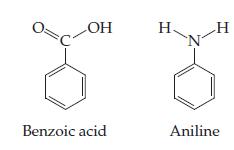
Benzoic acid (C6H5COOH) and aniline (C6H5NH2) are both derivatives of benzene. Benzoic acid is an acid with Ka = 6.3 × 10⁻⁵ and aniline is a base with Ka = 4.3 × 10⁻¹⁰.(a) What are the conjugate base of benzoic acid and the conjugate acid of aniline?(b) Anilinium chloride (C6H5NH3Cl) is a strong
The equilibrium 2NO(g) + Cl2(g) ⇌ 2NOCl(g) is established at 500K. An equilibrium mixture of the three gases has partial pressures of 0.095 atm, 0.171 atm, and 0.28 atm for NO, Cl2, and NOCl, respectively.(a) Calculate Kp for this reaction at 500.0 K.(b) If the vessel has a volume of
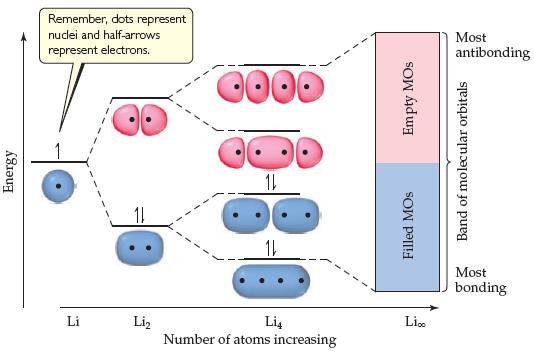
Repeat Exercise 12.47 for a linear chain of eight lithium atoms.Data from Repeat exercise 12.47The molecular-orbital diagrams for two- and four-atom linear chains of lithium atoms are shown in Figure 12.22. Construct a molecular-orbital diagram for a chain containing six lithium atoms and use it to
Determine if each statement is true or false:(a) Substitutional alloys are solid solutions, but interstitial alloys are heterogenous alloys.(b) Substitutional alloys have “solute” atoms that replace “solvent” atoms in a lattice, but interstitial alloys have “solute” atoms that are in
Which of these molecular fragments would you expect to be more likely to give rise to electrical conductivity? Explain your reasoning.a.b.
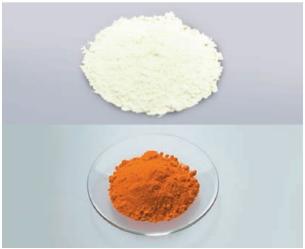
Two solids are shown below. One is a semiconductor and one is an insulator. Which one is which? Explain your reasoning.
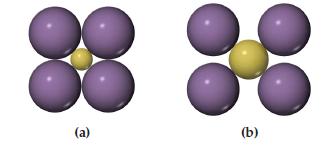
Which arrangement of cations (yellow) and anions (blue) in a lattice is the more stable? Explain your reasoning. (a) (b)
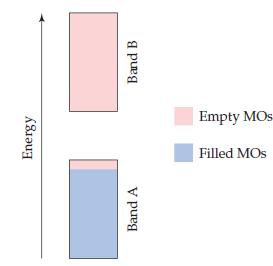
The electronic structure of a doped semiconductor is shown here.(a) Which band, A or B, is the valence band?(b) Which band is the conduction band?(c) Which band consists of bonding molecular orbitals?(d) Is this an example of an ntype or p-type semiconductor?(e) If the semiconductor is germanium,
You are given a white substance that sublimes at 3000°C; the solid is a nonconductor of electricity and is insoluble in water. Which type of solid (molecular, metallic, covalent-network, or ionic) might this substance be?
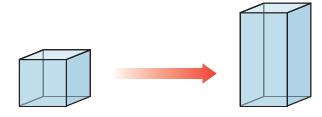
Imagine the primitive cubic lattice. Now imagine grabbing the top of it and stretching it straight up. All angles remain 90°. What kind of primitive lattice have you made?
Imagine the primitive cubic lattice. Now imagine pushing on top of it, straight down. All angles remain 90°. What kind of primitive lattice have you made?
Which of the three-dimensional primitive lattices has a unit cell where none of the internal angles is 90°?(a) Orthorhombic(b) Hexagonal(c) Rhombohedral(d) Triclinic(e) Both rhombohedral and triclinic.
Besides the cubic unit cell, which other unit cell(s) has edge lengths that are all equal to each other?(a) Orthorhombic(b) Hexagonal(c) Rhombohedral(d) Triclinic(e) Both rhombohedral and triclinic.
For each of these solids, state whether you would expect it to possess metallic properties:(a) TiCl4(b) NiCo alloy(c) W(d) Ge(e) ScN.
Which of these statements about alloys and intermetallic compounds is false?(a) Bronze is an example of an alloy.(b) “Alloy” is just another word for “a chemical compound of fixed composition that is made of two or more metals.”(c) Inter metallics are compounds of two or more metals that
State whether each sentence is true or false:(a) Metals have high electrical conductivities because the electrons in the metal are delocalized.(b) Metals have high electrical conductivities because they are denser than other solids.(c) Metals have large thermal conductivities because they expand
Imagine that you have a metal bar sitting half in the Sun and half in the dark. On a sunny day, the part of the metal that has been sitting in the Sun feels hot. If you touch the part of the metal bar that has been sitting in the dark, will it feel hot or cold? Justify your answer in terms of
Which of the following statements does not follow from the fact that the alkali metals have relatively weak metal–metal bonding?(a) The alkali metals are less dense than other metals.(b) The alkali metals are soft enough to be cut with a knife.(c) The alkali metals are more reactive than other
(a) What is a monomer?(b) Which of these molecules can be used as a monomer: benzene, ethene (also called ethylene), methane?
State whether each of these numbers is a reasonable value for a polymer’s molecular weight: 100 amu, 10,000 amu, 100,000 amu, 1,000,000 amu?
Indicate whether the following statement is true or false: For an addition polymerization, there are no by-products of the reaction (assuming 100% yield).
(a) What molecular features make a polymer flexible?(b) If you cross-link a polymer, is it more flexible or less flexible than it was before?
If you want to make a polymer for plastic wrap, should you strive to make a polymer that has a high or low degree of crystallinity?
Indicate whether each statement is true or false:(a) Elastomers are rubbery solids.(b) Thermosets cannot be reshaped.(c) Thermoplastic polymers can be recycled.
Which statement correctly describes a difference between graphene and graphite?(a) Graphene is a molecule but graphite is not.(b) Graphene is a single sheet of carbon atoms and graphite contains many, and larger, sheets of carbon atoms.(c) Graphene is an insulator but graphite is a metal.(d)
What evidence supports the notion that buckyballs are actual molecules and not extended materials?(a) Buckyballs are made of carbon.(b) Buckyballs have a well-defined atomic structure and molecular weight.(c) Buckyballs have a well-defined melting point.(d) Buckyballs are semiconductors.(e) More
The electrical conductivity of aluminum is approximately 109 times greater than that of its neighbor in the periodic table, silicon. Aluminum has a face-centered cubic structure, and silicon has the diamond structure. A classmate of yours tells you that density is the reason aluminum is a metal but
When you shine light of band gap energy or higher on a semiconductor and promote electrons from the valence band to the conduction band, do you expect the conductivity of the semiconductor to(a) Remain unchanged(b) Increase(c) Decrease?
Look up the diameter of a silicon atom, in Å. The latest semiconductor chips have fabricated lines as small as 22 nm. How many silicon atoms does this correspond to?
Consider two ionic solids, both composed of singly-charged ions, that have different lattice energies.(a) Will the solids have the same solubility in water?(b) If not, which solid will be more soluble in water, the one with the larger lattice energy or the one with the smaller lattice energy?
Are gases always miscible with each other? Explain
You take a sample of water that is at room temperature and in contact with air and put it under a vacuum. Right away, you see bubbles leave the water, but after a little while, the bubbles stop. As you keep applying the vacuum, more bubbles appear. A friend tells you that the first bubbles were
Indicate whether each statement is true or false:(a) A solute will dissolve in a solvent if solute–solute interactions are stronger than solute-solvent interactions.(b) In making a solution, the enthalpy of mixing is always a positive number.(c) An increase in entropy favors mixing.
Indicate whether each statement is true or false:(a) NaCl dissolves in water but not in benzene (C6H6) because benzene is denser than water.(b) NaCl dissolves in water but not in benzene because water has a large dipole moment and benzene has zero dipole moment.(c) NaCl dissolves in water but not
Two nonpolar organic liquids, hexane (C6H14) and heptane (C7H16), are mixed.(a) Do you expect ΔHsoln to be a large positive number, a large negative number, or close to zero? Explain.(b) Hexane and heptane are miscible with each other in all proportions. In making a solution of them, is the
For the dissolution of LiCl in water, ΔHsoln = -37 kJ/mol. Which term would you expect to be the largest negative number: ΔHsolvent, ΔHsolute, or ΔHmix?
Consider water and glycerol, CH2(OH)CH(OH)CH2OH.(a) Would you expect them to be miscible in all proportions? Explain.(b) List the intermolecular attractions that occur between a water molecule and a glycerol molecule.
Oil and water are immiscible. Which is the most likely reason?(a) Oil molecules are denser than water.(b) Oil molecules are composed mostly of carbon and hydrogen.(c) Oil molecules have higher molar masses than water.(d) Oil molecules have higher vapor pressures than water.(e) Oil molecules have
You make a solution of a nonvolatile solute with a liquid solvent. Indicate whether each of the following statements is true or false.(a) The freezing point of the solution is higher than that of the pure solvent.(b) The freezing point of the solution is lower than that of the pure solvent.(c) The
You make a solution of a nonvolatile solute with a liquid solvent. Indicate if each of the following statements is true or false.(a) The freezing point of the solution is unchanged by addition of the solvent.(b) The solid that forms as the solution freezes is nearly pure solute.(c) The freezing
In the 1850’s, Michael Faraday prepared ruby-red colloids of gold nanoparticles in water that are still stable today. These brightly colored colloids look like solutions. What experiment(s) could you do to determine whether a given colored preparation is a solution or colloid?
Choose the best answer: A colloidal dispersion of one liquid in another is called(a) A gel(b) An emulsion(c) A foam(d) An aerosol.
An “emulsifying agent” is a compound that helps stabilize a hydrophobic colloid in a hydrophilic solvent (or a hydrophilic colloid in a hydrophobic solvent). Which of the following choices is the best emulsifying agent?(a) CH3COOH(b) CH3CH2CH2COOH(c) CH3(CH2)11COOH(d) CH3(CH2)11COONa.
Aerosols are important components of the atmosphere. Does the presence of aerosols in the atmosphere increase or decrease the amount of sunlight that arrives at the Earth’s surface, compared to an “aerosol-free” atmosphere? Explain your reasoning.
Proteins can be precipitated out of aqueous solution by the addition of an electrolyte; this process is called “salting out” the protein.(a) Do you think that all proteins would be precipitated out to the same extent by the same concentration of the same electrolyte?(b) If a protein has been
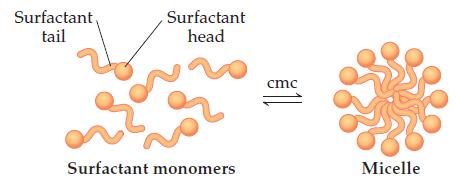
Compounds like sodium stearate, called “surfactants” in general, can form structures known as micelles in water, once the solution concentration reaches the value known as the critical micelle concentration (cmc). Micelles contain dozens to hundreds of molecules. The cmc depends on the
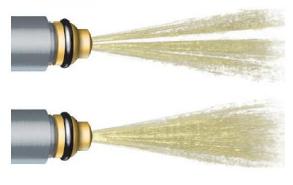
An automotive fuel injector dispenses a fine spray of gasoline into the automobile cylinder, as shown in the bottom drawing here. When an injector gets clogged, as shown in the top drawing, the spray is not as fine or even and the performance of the car declines. How is this observation related to
Which of the following linear plots do you expect for a reaction A→products if the kinetics are(a) Zero order(b) First order(c) Second order? (i) (ii) Time Time (iii) (iv) Time Time (v) (vi) Time Time 1/[A] [v]u] [v] In[A] 1/[A] [V]
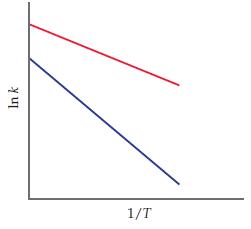
The accompanying graph shows plots of ln k versus 1/T for two different reactions. The plots have been extrapolated to the y-intercepts. Which reaction (red or blue) has(a) The larger value for Ea(b) The larger value for the frequency factor, A? 1/T In k
The reaction 2NO(g) + Cl2(g) → 2NOCl(g) was performed and the following data obtained under conditions of constant [Cl2]:(a) Is the following mechanism consistent with the data?NO(g) + Cl2 (g) → NOCl2 (g) (fast)NOCl2 (g) + NO(g) → 2 NOCl (g) (slow)(b) Does the linear plot guarantee that the
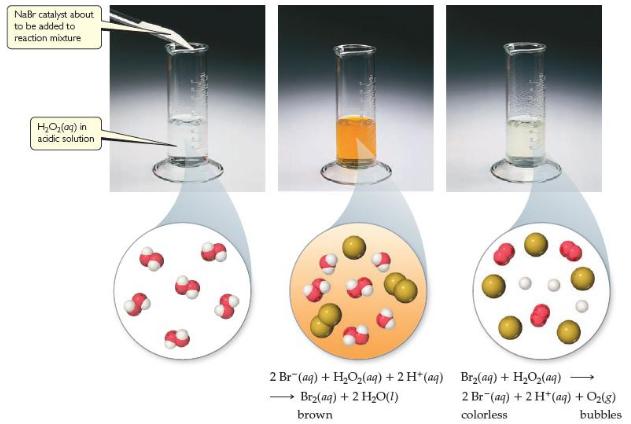
In Figure 14.22, we saw that Br - (aq) catalyzes the decomposition of H2O2(aq) into H2O(l) and O2(g). Suppose that some KBr(s) is added to an aqueous solution of hydrogen peroxide. Make a sketch of [Br - (aq)] versus time from the addition of the solid to the end of the reaction. NaBr catalyst
Consider the reaction A + B → C + D. Is each of the following statements true or false?(a) The rate law for the reaction must be Rate = k[A][B].(b) If the reaction is an elementary reaction, the rate law is second order.(c) If the reaction is an elementary reaction, the rate law of the reverse
The following kinetic data are collected for the initial rates of a reaction 2X + Z → products:(a) What is the rate law for this reaction?(b) What is the value of the rate constant with proper units?(c) What is the reaction rate when the initial concentration of X is 0.75 M and that of Z is 1.25
A first-order reaction A → B has the rate constant k = 3.2 × 10⁻³ s-1. If the initial concentration of A is 2.5 × 10⁻² M, what is the rate of the reaction at t = 660 s?
At 28 °C, raw milk sours in 4.0 h but takes 48 h to sour in a refrigerator at 5°C. Estimate the activation energy in kJ/mol for the reaction that leads to the souring of milk?
At 1000 K, Kp = 1.85 for the reactionSO2(g) + 1/2O2(g) ⇌ SO3(g)(a) What is the value of Kp for the reaction SO3(g) ⇋ SO2(g) + 1/2O2(g)?(b) What is the value of Kp for the reaction 2SO2(g) + O2(g) ⇌ 2SO3(g)?(c) What is the value of Kc for the reaction in part (b)?
The following equilibria were attained at 823 K:CoO(s) + H2(g) ⇌ Co(s) + H2O(g) Kc = 67CoO(s) + CO(g) ⇌ Co(s) + CO2(g) Kc = 490Based on these equilibria, calculate the equilibrium constant for H2(g) + CO2(g) ⇌ CO(g)+ H2O(g) at 823K.
Consider the equilibriumN2(g) + O2(g) + Br2(g) ⇌ 2NOBr(g) Calculate the equilibrium constant Kp for this reaction, given the following information (at 298 K):2NO(g) + Br2(g) ⇌ 2NOBr(g) Kc = 2.02NO(g) ⇌ N2(g) + O2(g) Kc = 2.1 × 1030
Consider the following equilibrium:2H2(g) + S2(g) ⇋ 2H2S(g)Kc = 1.08 Χ 107at 700 °C(a) Calculate Kp.(b) Does the equilibrium mixture contain mostly H2 and S2 or mostly H2S?(c) Calculate the value of Kc if you rewrote the equation H2(g) + 1/2S2(g) ⇌ H2S(g).
Which of the following statements are true and which are false?(a) For the reaction 2A(g) + B(g) ⇋ A2B(g) Kc and Kp are numerically the same.(b) It is possible to distinguish Kc from Kp by comparing the units used to express the equilibrium constant.(c) For the equilibrium in (a), the value of Kc
Consider the hypothetical reaction 2 A + B → 2 C + D. The following two-step mechanism is proposed for the reaction:Step 1: A + B → C + XStep 2: A + X → C + DX is an unstable intermediate.(a) What is the predicted rate law expression if Step 1 is rate determining?(b) What is the predicted
Which of the following statements are true and which are false?(a) The equilibrium constant can never be a negative number.(b) In reactions that we draw with a single-headed arrow, the equilibrium constant has a value that is very close to zero.(c) As the value of the equilibrium constant increases
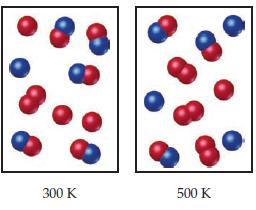
The following diagrams represent equilibrium mixtures for the reaction A2 + B ⇌ A + AB at 300 K and 500K. The A atoms are red, and the B atoms are blue. Is the reaction exothermic or endothermic? 300 K 500 K
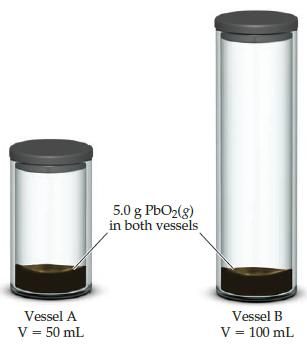
When lead (IV) oxide is heated above 300°C it decomposes according to the following reaction PbO2(s) ⇋ PbO(s) + O2(g). Consider the two sealed vessels of PbO2shown here. If both vessels are heated to 400°C and allowed to come to equilibitum which of the following statements is true?(a) There
Suppose that, in the absence of a catalyst, a certain biochemical reaction occurs x times per second at normal body temperature (37°C). In order to be physiologically useful, the reaction needs to occur 5000 times faster than when it is uncatalyzed. By how many kJ/mol must an enzyme lower the
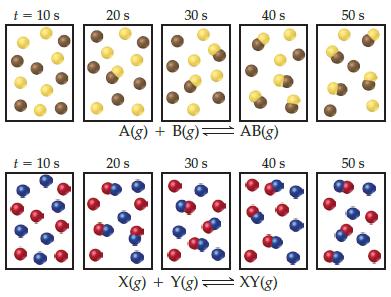
Snapshots of two hypothetical reactions, A(g) +B(g) ⇌ AB(g) and X(g) + Y(g) ⇌ XY(g) at five different times are shown here. Which reaction has a larger equilibrium constant? t = 10 s 20 s 30 s 40 s 50 s A(g) + B(g)= AB(g) t= 10 s 20 s 30 s 40 s 50 s X(g) + Y(g) : = XY(g)
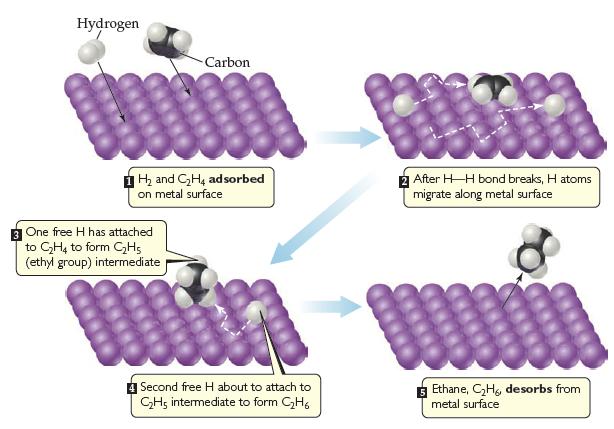
As shown in Figure 14.24, the first step in the heterogeneous hydrogenation of ethylene is adsorption of the ethylene molecule on a metal surface. One proposed explanation for the “sticking” of ethylene to a metal surface is the interaction of the electrons in the C—C p bond with vacant
A solution is made by adding 0.300 g Ca(OH)2(s), 50.0 mL of 1.40 M HNO3, and enough water to make a final volume of 75.0 mL Assuming that all of the solid dissolves, what is the pH of the final solution?
The following observations are made about a diprotic acid H2A:(i) A 0.10 M solution of H2A has pH = 3.30.(ii) A 0.10 M solution of the salt NaHA is acidic.Which of the following could be the value of pKa2 for H2A:(i) 3.22(ii) 5.30(iii) 7.47(iv) 9.82?
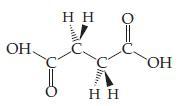
Succinic acid (H2C4H6O4), which we will denote H2Suc, is a biologically relevant diprotic acid with the structure shown below. It is closely related to tartaric acid and malic acid (Figure 16.1). At 25 °C, the acid-dissociation constants for succinic acid are Ka1 = 6.9 × 10⁻⁵ and Ka2 = 2.5 ×
Which of the following solutions is a buffer?(a) A solution made by mixing 100 mL of 0.100 M CH3COOH and 50 mL of 0.100 M NaOH(b) A solution made by mixing 100 mL of 0.100 M CH3COOH and 500 mL of 0.100 M NaOH(c) A solution made by mixing 100 mL of 0.100 M CH3COOH and 50 mL of 0.100 M HCl(d) A
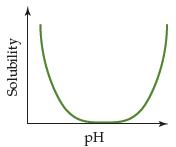
The graph below shows the solubility of a salt as a function of pH. Which of the following choices explain the shape of this graph?(a) None; this behavior is not possible.(b) A soluble salt reacts with acid to form a precipitate, and additional acid reacts with this product to dissolve it.(c) A
A 0.25 M solution of a salt NaA has pH = 9.29. What is the value of Ka for the parent acid HA?
Showing 700 - 800
of 1009
1
2
3
4
5
6
7
8
9
10
11
Step by Step Answers

 Get 50% OFF
Claim Now
Get 50% OFF
Claim Now


![0.060 0.12 0.18 Concentration (M) 4 H]](https://dsd5zvtm8ll6.cloudfront.net/si.question.images/images/question_images/1603/1/0/0/4575f8d5f29cd7b01603100457972.jpg)



![(i) (ii) Time Time (iii) (iv) Time Time (v) (vi) Time Time 1/[A] [v]u] [v] In[A] 1/[A] [V]](https://dsd5zvtm8ll6.cloudfront.net/si.question.images/images/question_images/1602/7/6/3/8675f883c5b5d2ea1602763864858.jpg)
![(under conditions of constant [Cl2]) Time ION]/I](https://dsd5zvtm8ll6.cloudfront.net/si.question.images/images/question_images/1602/8/2/1/8525f891edc6da911602821851365.jpg)
![Experiment [X]o(M) [Z]o(M) Rate (M/s) 1 0.25 0.25 4.0 X 10' 0.50 0.50 3.2 x 10² 3 0.50 0.75 7.2 x 10](https://dsd5zvtm8ll6.cloudfront.net/si.question.images/images/question_images/1602/8/2/2/1265f891feeec3011602822125920.jpg)