New Semester
Started
Get
50% OFF
Study Help!
--h --m --s
Claim Now
Question Answers
Textbooks
Find textbooks, questions and answers
Oops, something went wrong!
Change your search query and then try again
S
Books
FREE
Study Help
Expert Questions
Accounting
General Management
Mathematics
Finance
Organizational Behaviour
Law
Physics
Operating System
Management Leadership
Sociology
Programming
Marketing
Database
Computer Network
Economics
Textbooks Solutions
Accounting
Managerial Accounting
Management Leadership
Cost Accounting
Statistics
Business Law
Corporate Finance
Finance
Economics
Auditing
Tutors
Online Tutors
Find a Tutor
Hire a Tutor
Become a Tutor
AI Tutor
AI Study Planner
NEW
Sell Books
Search
Search
Sign In
Register
study help
sciences
chemistry the central science
Chemistry The Central Science 14th Edition Theodore Brown, H. LeMay, Bruce Bursten, Catherine Murphy, Patrick Woodward, Matthew Stoltzfus - Solutions
(a) Can an intermediate appear as a reactant in the first step of a reaction mechanism? (b) On a reaction energy profile diagram, is an intermediate represented as a peak or a valley? (c) If a molecule like Cl2 falls apart in an elementary reaction, what is the molecularity of the
Write the expression for Kc for the following reactions. In each case indicate whether the reaction is homogeneous or heterogeneous.(a) 3NO(g) ⇌ N2O(g) + NO2(g)(b) CH4(g) + 2H2S(g) ⇌ CS2(g) + 4H2(g)(c) Ni(CO)4(g) ⇌ Ni(s) + 4CO(g)(d) HF(aq) ⇌ H+(aq) + F-(aq)(e) 2Ag(s) + Zn2+(aq) ⇌ 2Ag+(aq)
Write the expressions for Kc for the following reactions. In each case indicate whether the reaction is homogeneous or heterogeneous.(a) 2O3(g) ⇌ 3O2(g)(b) Ti(s) + 2 Cl2(g) Δ TiCl4(l)(c) 2C2H4(g) + 2 H2O(g) ⇌ 2C2H6(g) + O2(g)(d) C(s) + 2H2(g) ⇌ CH4(g)(e) 4HCl(aq) + O2(g) ⇌ 2H2O(l) +
When the following reactions come to equilibrium, does the equilibrium mixture contain mostly reactants or mostly products?(a) N2(g) + O2(g) ⇌ 2NO(g) Kc = 1.5 x 10⁻¹⁰(b) 2SO2(g) + O2(g) ⇌ 2SO3(g) Kp = 2.5 x 10⁹
(a) Is the dissociation of fluorine molecules into atomic fluorine, F2(g) ⇌ 2F(g) an exothermic or endothermic process?(b) If the temperature is raised by 100 K, does the equilibrium constant for this reaction increase or decrease?(c) If the temperature is raised by 100 K, does the forward rate
True or false: When the temperature of an exothermic reaction increases, the rate constant of the forward reaction decreases, which leads to a decrease in the equilibrium constant, Kc.
If Kc = 1 for the equilibrium 2 A(g) ⇌ B(g) , what is the relationship between [A] and [B] at equilibrium?
At a temperature of 700 K, the forward and reverse rate constants for the reaction 2 HI(g) ⇌ H2(g) + I2(g) are kf = 1.8 x 10⁻³ M-1 s-1 and kr = 0.063 M-1 s-1. (a) What is the value of the equilibrium constant Kc at 700 K? (b) Is the forward reaction endothermic or exothermic if
At 800 K, the equilibrium constant for the reaction A2(g) ⇌ 2A(g) is Kc = 3.1 x 10⁻⁴. (a) Assuming both forward and reverse reactions are elementary reactions, which rate constant do you expect to be larger, kf or kr? (b) If the value of kf = 0.27 s-1, what is the value of kr at 800
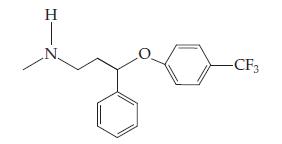
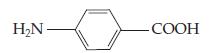
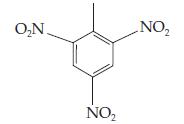
Predict how each molecule or ion would act, in the Brønsted- Lowry sense, in aqueous solution by writing “acid,” “base,” “both,” or “neither” on the line provided.(a) HCO3-, the bicarbonate ion: ______(b) Prozac: _____(c) PABA (formerly in sunscreen): ______(d) TNT,
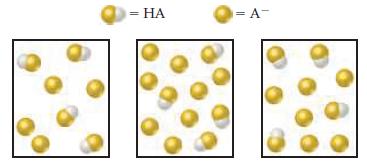
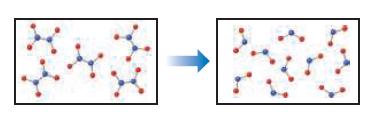
The following boxes represent aqueous solutions containing a weak acid, HA and its conjugate base, A-. Water molecules, hydronium ions, and cations are not shown. Which solution has the highest pH? Explain. - HA = A-
Predict the products of the following acid–base reactions, and predict whether the equilibrium lies to the left or to the right of the reaction arrow:(a) O2-(aq) + H2O(l) ⇌(b) CH3COOH(aq) + HS-(aq) ⇌(c) NO2-(aq) + H2O(l) ⇌
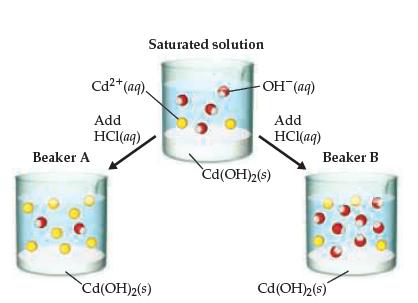
A saturated solution of Cd(OH)2 is shown in the middle beaker. If hydrochloric acid solution is added, the solubility of Cd(OH)2 will increase, causing additional solid todissolve. Which of the two choices, Beaker A or Beaker B, accurately represents the solution after equilibrium is reestablished?
(a) Write a chemical equation that illustrates the autoionization of water. (b) Write the expression for the ion product constant for water, Kw. (c) If a solution is described as basic, which of the following is true: (i) [H+] > [OH-], (ii) [H+] = [OH-], or (iii) [H+]
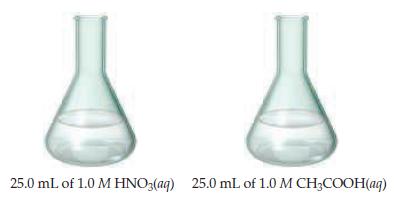
The samples of nitric and acetic acids shown here are both titrated with a 0.100 M solution of NaOH(aq).Determine whether each of the following statements concerning these titrations is true or false.(a) A larger volume of NaOH(aq) is needed to reach the equivalence point in the titration of
Ephedrine, a central nervous system stimulant, is used in nasal sprays as a decongestant. This compound is a weak organic base:C10H15ON(aq) + H2O(l) ⇌ C10H15ONH+(aq) + OH-(aq)A 0.035 M solution of ephedrine has a pH of 11.33.(a) What are the equilibrium concentrations of C10H15ON, C10H15ONH+, and
Phenol, C6H5OH, has a Ka of 1.3 x 10⁻¹⁰.(a) Write out the Ka reaction for phenol.(b) Calculate Kb for phenol’s conjugate base.(c) Is phenol a stronger or weaker acid than water?
Ammonia, NH3, acts as an Arrhenius base, a Brønsted-Lowry base, and a Lewis base, in aqueous solution. Write out the reaction NH3 undergoes with water and explain what properties of ammonia correspond to each of the three definitions of “base.”
The fluoride ion reacts with water to produce HF.(a) Write out the chemical equation for this reaction.(b) Will a concentrated solution of NaF in water be acidic, basic, or neutral?(c) Is fluoride acting as a Lewis acid or as a Lewis base when reacting with water?
Which, if any, of the following statements are true?(a) The stronger the base, the smaller the pKb.(b) The stronger the base, the larger the pKb.(c) The stronger the base, the smaller the Kb.(d) The stronger the base, the larger the Kb.(e) The stronger the base, the smaller the pKa of its conjugate
The pKb of water is _______.(a) 1 (b) 7 (c) 14 (d) Not defined(e) None of the above
At 50 °C, the ion-product constant for H2O has the value Kw = 5.48 x 10⁻¹⁴. (a) What is the pH of pure water at 50 °C? (b) Based on the change in Kw with temperature, predict whether ΔH is positive, negative, or zero for the autoionization reaction of water:2H2O(l) ⇌ H3O+(aq) +
(a) If the molar solubility of CaF2 at 35°C i s 1.24 x 10⁻³ mol/L, what is Ksp at this temperature? (b) It is found that 1.1 x 10⁻² g SrF2 dissolves per 100 mL of aqueous solution at 25°C. Calculate the solubility product for SrF2. (c) The Ksp of Ba(IO3)2 at 25°C is 6.0 x 10⁻¹⁰. What
Calculate the solubility of LaF3 in grams per liter in (a) Pure water, (b) 0.010 M KF solution, (c) 0.050 M LaCl3 solution.
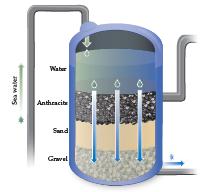
The first stage of treatment at the reverse osmosis plant in Carlsbad, California, is to flow the water through rock, sand, and gravel as shown here. Would this step remove particulate matter? Would this step remove dissolved salts? Sea water Anthracite Sand Gravel
A solution containing several metal ions is treated with dilute HCl; no precipitate forms. The pH is adjusted to about 1, and H2S is bubbled through. Again, no precipitate forms. The pH of the solution is then adjusted to about 8. Again, H2S is bubbled through. This time a precipitate forms. The
Lead(II) carbonate, PbCO3, is one of the components of the passivating layer that forms inside lead pipes. (a) If the Ksp for PbCO3 is 7.4 x 10⁻¹⁴ what is the molarity of Pb2+ in a saturated solution of lead(II) carbonate? (b) What is the concentration in ppb of Pb2+ ions in a saturated
Salts containing the phosphate ion are added to municipal water supplies to prevent the corrosion of lead pipes. (a) Based on the pKa values for phosphoric acid (pKa1 = 7.5 x 10⁻³, pKa2 = 6.2 x 10⁻⁸, pKa3 = 4.2 x 10⁻¹³) what is the Kb value for the PO43- ion?(b) What is the pH of a 1 x 10⁻³ M
Calculate the solubility of Mg(OH)2 in 0.50 MNH4Cl.
The value of Ksp for Mg3(AsO4)2 is 2.1 x 10⁻²⁰. The AsO43- ion is derived from the weak acid H3AsO4 (pKa1 = 2.22; pKa2 = 6.98; pKa3 = 11.50). (a) Calculate the molar solubility of Mg3(AsO4)2 in water. (b) Calculate the pH of a saturated solution of Mg3(AsO4)2 in water.
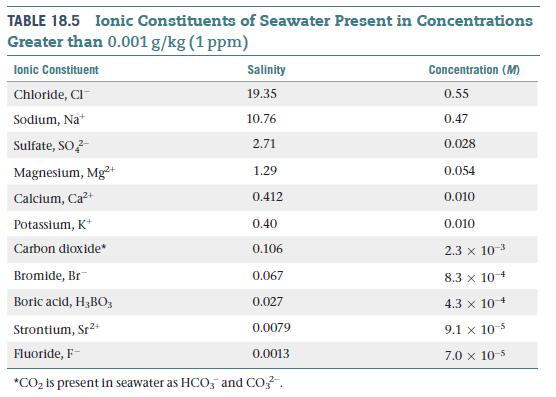
Although there are many ions in seawater, the overall charges of the dissolved cations and anions must maintain charge neutrality. Consider only the six most abundant ions in seawater, as listed in Table 18.5 (Cl−, Na+, SO42−, Mg2+, Ca2+, and K+), calculate the total charge in Coulombs of the
(a) How are the boundaries between the regions of the atmosphere determined? (b) Explain why the stratosphere, which is about 35 km thick, has a smaller total mass than the troposphere, which is about 12 km thick.
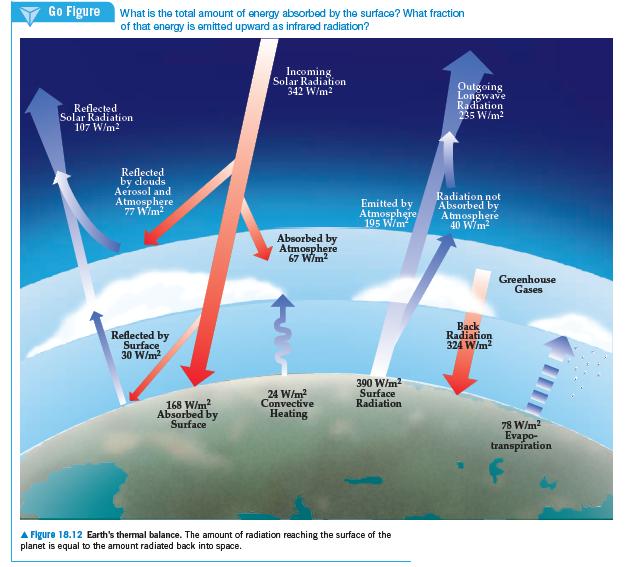
Consider the Earth’s energy balance shown in Figure 18.12.Figure 18.12(a) How many different sources transfer energy to the atmosphere? Which makes the largest contribution? What is the total amount of energy transferred into the atmosphere in W/m2? (b) To maintain a balance the atmosphere
The dissociation energy of a carbon–bromine bond is typically about 276 kJ/mol. (a) What is the maximum wavelength of photons that can cause C-Br bond dissociation?(b) Which kind of electromagnetic radiation—ultraviolet, visible, or infrared—does the wavelength you calculated in part (a)
The wavelength at which the O2 molecule most strongly absorbs light is approximately 145 nm. (a) In which region of the electromagnetic spectrum does this light fall?(b) Would a photon whose wavelength is 145 nm have enough energy to photodissociate O2 whose bond energy is 495 kJ/mol? Would it
The ultraviolet spectrum can be divided into three regions based on wavelength: UV-A (315–400 nm), UV-B (280–315 nm), and UV-C (100–280 nm). (a) Photons from which region have the highest energy and therefore are the most harmful to living tissue? (b) In the absence of ozone, which
The average bond enthalpies of the C-F and C-Cl bonds are 485 kJ/mol and 328 kJ/mol, respectively.(a) What is the maximum wavelength that a photon can possess and still have sufficient energy to break the C-F and C-Cl bonds, respectively? (b) Given the fact that O2, N2, and O in the upper
(a) When chlorine atoms react with atmospheric ozone, what are the products of the reaction? (b) Based on average bond enthalpies, would you expect a photon capable of dissociating a C-Cl bond to have sufficient energy to dissociate a C-Br bond? (c) Would you expect the substance CFBr3 to
Nitrogen oxides like NO2 and NO are a significant source of acid rain. For each of these molecules write an equation that shows how an acid is formed from the reaction with water.
Predict the signs of ΔH and ΔS for this reaction. Explain your choice. $4
The atmosphere of Mars is 96% CO2, with a pressure of approximately 6 x 10⁻³ atm at the surface. Based on measurements taken over a period of several years by the Rover Environmental Monitoring Station (REMS), the average daytime temperature at the REMS location on Mars is –5.7°C (22°F),
Phosphorus is present in seawater to the extent of 0.07 ppm by mass. Assuming that the phosphorus is present as dihydrogenphosphate, H2PO4-, calculate the corresponding molar concentration of H2PO4- in seawater.
(a) The EPA threshold for acceptable levels of lead ions in water is <15 ppb. What is the molarity of an aqueous solution with a concentration of 15 ppb?(b) Concentrations of lead in the bloodstream are often quoted in units of μg/dL. Averaged over the entire country, the mean concentration of
Indicate whether each statement is true or false. (a) A reaction that is spontaneous in one direction will be nonspontaneous in the reverse direction under the same reaction conditions. (b) All spontaneous processes are fast. (c) Most spontaneous processes are reversible. (d) An
Does the entropy of the system increase, decrease, or stay the same when (a) A solid melts, (b) A gas liquefies, (c) A solid sublimes?
The reaction 2Mg(s) + O2(g) → 2MgO(s) is highly spontaneous. A classmate calculates the entropy change for this reaction and obtains a large negative value for ΔS°. Did your classmate make a mistake in the calculation? Explain.
(a) Write the chemical equations that correspond to ΔG°f for NH3(g) and for CO(g). (b) For which of these formation reactions will the value of ΔG°f be more positive (less negative) than ΔH°f ? (c) In general, under which condition is ΔG°f more positive (less negative) than ΔH°f
Which of the following statements is false?(a) Gases are far less dense than liquids.(b) Gases are far more compressible than liquids.(c) Because liquid water and liquid carbon tetrachloride do not mix, neither do their vapors.(d) The volume occupied by a gas is determined by the volume of its
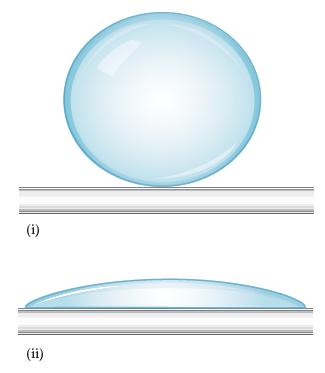
Liquids can interact with flat surfaces just as they can with capillary tubes; the cohesive forces within the liquid can be stronger or weaker than the adhesive forces between liquid and surface:(a) In which of these diagrams, i or ii, do the adhesive forces between surface and liquid exceed the
(a) Are you more likely to see the density of a gas reported in g/mL, g/L, or kg/cm3? (b) Which units are appropriate for expressing atmospheric pressures, N, Pa, atm, kg/m2?(c) Which is most likely to be a gas at room temperature and ordinary atmospheric pressure, F2, Br2, K2O.
Rank the following gases from least dense to most dense at 1.00 atm and 298 K: CO, N2O, Cl2, HF.
The atmospheric concentration of CO2 gas is presently 407 ppm (parts per million, by volume; that is, 407 L of every 106 L of the atmosphere are CO2). What is the mole fraction of CO2 in the atmosphere?
Which one or more of the following statements are true?(a) O2 will effuse faster than Cl2.(b) Effusion and diffusion are different names for the same process.(c) Perfume molecules travel to your nose by the process of effusion.(d) The higher the density of a gas, the shorter the mean free path.
Which statement concerning the van der Waals constants a and b is true?(a) The magnitude of a relates to molecular volume, whereas b relates to attractions between molecules.(b) The magnitude of a relates to attractions between molecules, whereas b relates to molecular volume.(c) The magnitudes of
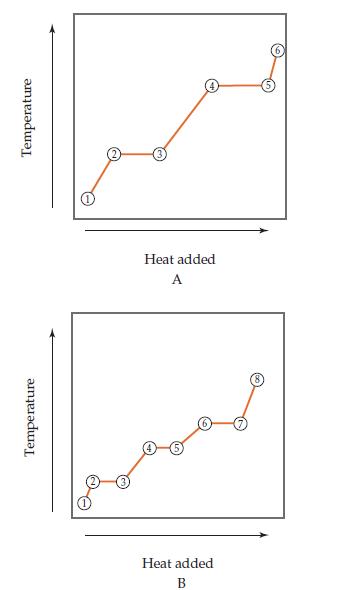
Two heating curves, A and B, are shown. In both cases, point 1 corresponds to the crystalline solid phase.(a) One of these graphs shows data for a liquid crystalline material. Which one? (b) In graph A, what process does the 2–3 line segment correspond to? (c) In graph B, what process
Torricelli, who invented the barometer, used mercury in its construction because mercury has a very high density, which makes it possible to make a more compact barometer than one based on a less dense fluid. Calculate the density of mercury using the observation that the column of mercury is 760
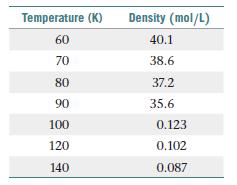
The table below lists the density of O2 at various temperatures and at 1 atm. The normal melting point of O2 is 54 K.(a) Over what temperature range is O2 a solid? (b) Over what temperature range is O2 a liquid? (c) Over what temperature range in the table is O2 a gas? (d) Estimate
Carbon tetrachloride, CCl4, and chloroform, CHCl3, are common organic liquids. Carbon tetrachloride’s normal boiling point is 77°C; chloroform’s normal boiling point is 61°C. Which statement is the best explanation of these data?(a) Chloroform can hydrogen-bond, but carbon tetrachloride
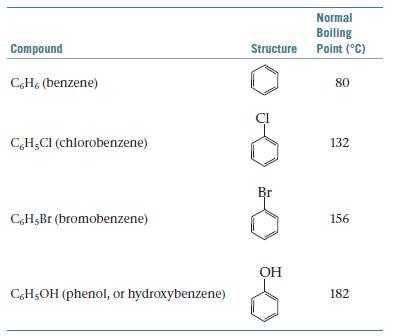
The table below shows the normal boiling points of benzene and benzene derivatives.(a) How many of these compounds exhibit dispersion interactions?(b) How many of these compounds exhibit dipole-dipole interactions? (c) How many of these compounds exhibit hydrogen bonding? (d) Why is the
(a) What phase change is represented by the “heat of fusion” of a substance? (b) Is the heat of fusion endothermic or exothermic? (c) If you compare a substance’s heat of fusion to its heat of vaporization, which one is generally larger?
Indicate whether each statement is true or false: (a) The critical pressure of a substance is the pressure at which it turns into a solid at room temperature. (b) The critical temperature of a substance is the highest temperature at which the liquid phase can form. (c) Generally
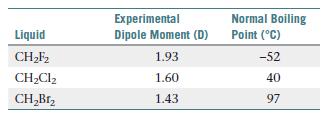
The table below shows some physical properties of halogenated liquids.Which of the following statements best explains these data?(a) The larger the dipole moment, the stronger the intermolecular forces, and therefore the boiling point is lowest for the molecule with the largest dipole
You are high up in the mountains and boil water to make some tea. However, when you drink your tea, it is not as hot as it should be. You try again and again, but the water is just not hot enough to make a hot cup of tea. Which is the best explanation for this result? (a) High in the
Indicate whether each statement is true or false: (a) The liquid crystal state is another phase of matter, just like solid, liquid, and gas. (b) Liquid crystalline molecules are generally spherical in shape. (c) Molecules that exhibit a liquid crystalline phase do so at well-defined
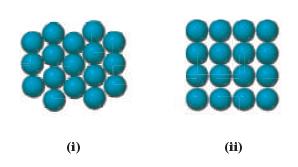
Which arrangement of atoms in a lattice represents close-packing? (i)
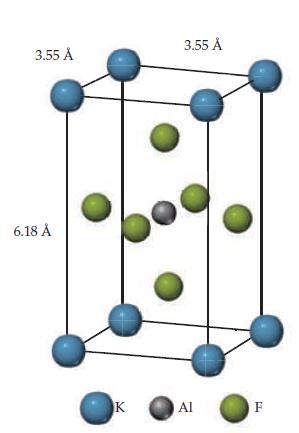
The unit cell of a compound containing potassium, aluminum, and fluorine is shown here.(a) What type of lattice does this crystal possess (all three lattice vectors are mutually perpendicular)? (b) What is the empirical formula? 3.55 Å 6.18 Å K 3.55 Å | Al F
Covalent bonding occurs in both molecular and covalent-network solids. Which of the following statements best explains why these two kinds of solids differ so greatly in their hardness and melting points?(a) The molecules in molecular solids have stronger covalent bonding than covalent-network
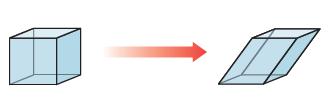
Imagine the primitive cubic lattice. Now imagine grabbing opposite corners and stretching it along the body diagonal while keeping the edge lengths equal. The three angles between the lattice vectors remain equal but are no longer 90°. What kind of primitive lattice have you made?
Indicate the type of solid (molecular, metallic, ionic, or covalent-network) for each compound:(a) CaSO4, (b) Pd, (c) Ta2O5 (melting point, 1872 °C), (d) Caffeine (C8H10N4O2),(e) Toluene (C7H8), (f) P4.
Indicate the type of solid (molecular, metallic, ionic, or covalent network) for each compound:(a) InAs, (b) MgO, (c) HgS, (d) In, (e) HBr.
You are given a white substance that melts at 100 °C. The substance is soluble in water. Neither the solid nor the solution is a conductor of electricity. Which type of solid (molecular, metallic, covalent-network, or ionic) might this substance be?
Amorphous silica, SiO2, has a density of about 2.2 g/cm3, whereas the density of crystalline quartz, another form of SiO2, is 2.65 g/cm3. Which of the following statements is the best explanation for the difference in density?(a) Amorphous silica is a network-covalent solid, but quartz is
The densities of the elements K, Ca, Sc, and Ti are 0.86, 1.5, 3.2, and 4.5 g/cm3, respectively. One of these elements crystallizes in a body-centered cubic structure; the other three crystallize in a face-centered cubic structure. Which one crystallizes in the body-centered cubic structure?
Calcium crystallizes in a face-centered cubic unit cell at room temperature that has an edge length of 5.588 Å.(a) Calculate the atomic radius of a calcium atom. (b) Calculate the density of Ca metal at this temperature.
Calculate the volume in Å3 of each of the following types of cubic unit cells if it is composed of atoms with an atomic radius of 1.82 Å. (a) Primitive (b) Face-centered cubic.
An element crystallizes in a face-centered cubic lattice. The edge of the unit cell is 4.078 Å, and the density of the crystal is 19.30 g/cm3. Calculate the atomic weight of the element and identify the element.
An increase in temperature causes most metals to undergo thermal expansion, which means the volume of the metal increases upon heating. How does thermal expansion affect the unit cell length? What is the effect of an increase in temperature on the density of a metal?
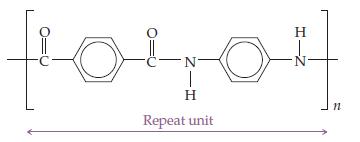
The polymer Kevlar, a condensation polymer, is used as reinforcement in car tires, strings of archery bows, and as a component of bulletproof vests.Draw the structures of the two monomers that yield Kevlar. for C- NIH Η Repeat unit Η 4 -N HIZ n
Arrange the following metals in increasing order of expected melting point: Mo, Zr, Y, Nb. Explain this trend in melting points.
Alabandite is a mineral composed of manganese(II) sulfide (MnS). The mineral adopts the rock salt structure. The length of an edge of the MnS unit cell is 5.223 Å at 25 °C. Determine the density of MnS in g/cm3.
The semiconductor CdSe has a band gap of 1.74 eV. What wavelength of light would be emitted from an LED made from CdSe? What region of the electromagnetic spectrum is this?
Write a balanced chemical equation for the formation of a polymer via a condensation reaction from the monomers succinic acid (HOOCCH2CH2COOH) and ethylenediamine (H2NCH2CH2NH2).
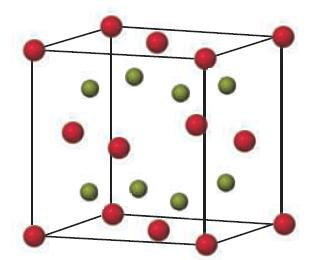
Sodium oxide (Na2O) adopts a cubic structure with Na atoms represented by green spheres and O atoms by red spheres.(a) How many atoms of each type are there in the unit cell?(b) Determine the coordination number and describe the shape of the coordination environment for the sodium ion.(c) The unit
An ideal quantum dot for use in TVs does not contain any cadmium due to concerns about disposal. One potential material for this purpose is InP, which adopts the zinc blende (ZnS) structure (face-centered cubic). The unit cell edge length is 5.869 Å. (a) If the quantum dot is shaped like a
Selected chlorides have the following melting points: NaCl (801 °C), MgCl2 (714 °C), PCl3 (-94 °C), SCl2 (-121 °C)(a) For each compound, indicate what type its solid form is (molecular, metallic, ionic, or covalent-network).(b) Predict which of the following compounds has a higher melting
Cinnabar (HgS) was utilized as a pigment known as vermillion. It has a band gap of 2.20 eV near room temperature for the bulk solid. What wavelength of light (in nm) would a photon of this energy correspond to?
Energy bands are considered continuous due to the large number of closely spaced energy levels. The range of energy levels in a crystal of copper is approximately 1 x 10–19 J. Assuming equal spacing between levels, the spacing between energy levels may be approximated by dividing the range of
One method to synthesize ionic solids is by the heating of two reactants at high temperatures. Consider the reaction of FeO with TiO2 to form FeTiO3. Determine the amount of each of the two reactants to prepare 2.500 g FeTiO3, assuming the reaction goes to completion.(a) Write a balanced chemical
Write an equation for the second electron affinity of chlorine. Would you predict a positive or a negative energy value for this process? Is it possible to directly measure the second electron affinity of chlorine?
Gold is isolated from rocks by reaction with aqueous cyanide, CN-: 4 Au(s) + 8 NaCN(aq) + O2(g) + H2O(l) → 4 Na[Au(CN)2](aq) + 4 NaOH(aq). (a) Which atoms from which compounds are being oxidized, and which atoms from which compounds are being reduced? (b) The [Au(CN)2]- ion can be
Would you expect manganese(II) oxide, MnO, to react more readily with HCl(aq) or NaOH(aq)?
Energy is required to remove two electrons from Ca to form Ca2+, and energy is required to add two electrons to O to form O2 -. Yet CaO is stable relative to the free elements. Which statement is the best explanation? (a) The lattice energy of CaO is large enough to overcome these
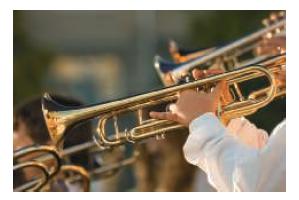
Musical instruments like trumpets and trombones are made from an alloy called brass. Brass is composed of copper and zinc atoms and appears homogeneous under an optical microscope. The approximate composition of most brass objects is a 2:1 ratio of copper to zinc atoms, but the exact ratio varies
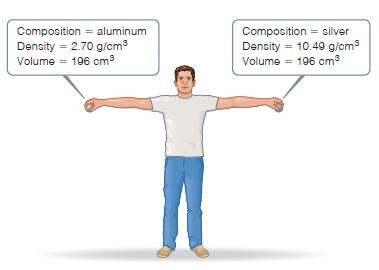
Consider the two spheres shown here, one made of silver and the other of aluminum. (a) What is the mass of each sphere in kg? (b) The force of gravity acting on an object is F = mg, where m is the mass of an object and g is the acceleration of gravity (9.8 m/s2). How much work do you do
Two beakers contain clear, colorless liquids. When the contents of the beakers are mixed a white solid is formed. (a) Is this an example of a chemical or a physical change? (b) What would be the most convenient way to separate the newly formed white solid from the liquid
Two positively charged particles are first brought close together and then released. Once released, the repulsion between particles causes them to move away from each other. (a) This is an example of potential energy being converted into what form of energy? (b) Does the potential energy
For each of the following processes, does the potential energy of the object(s) increase or decrease? (a) The distance between two oppositely charged particles is increased. (b) Water is pumped from ground level to the reservoir of a water tower 30 m above the ground. (c) The bond in
(a) Which is more likely to eventually be shown to be incorrect: an hypothesis or a theory? (b) A(n) _________ reliably predicts the behavior of matter, while a(n) _________ provides an explanation for that behavior.
Is the use of significant figures in each of the following statements appropriate? (a) The 2005 circulation of National Geographic was 7,812,564. (b) On July 1, 2005, the population of Cook County, Illinois, was 5,303,683. (c) In the United States, 0.621% of the population has the
A 1.0-g sample of carbon dioxide (CO2) is fully decomposed into its elements, yielding 0.273 g of carbon and 0.727 g of oxygen. (a) What is the ratio of the mass of O to C? (b) If a sample of a different compound decomposes into 0.429 g of carbon and 0.571 g of oxygen, what is its ratio
Showing 400 - 500
of 1009
1
2
3
4
5
6
7
8
9
10
11
Step by Step Answers

 Get 50% OFF
Claim Now
Get 50% OFF
Claim Now