New Semester
Started
Get
50% OFF
Study Help!
--h --m --s
Claim Now
Question Answers
Textbooks
Find textbooks, questions and answers
Oops, something went wrong!
Change your search query and then try again
S
Books
FREE
Study Help
Expert Questions
Accounting
General Management
Mathematics
Finance
Organizational Behaviour
Law
Physics
Operating System
Management Leadership
Sociology
Programming
Marketing
Database
Computer Network
Economics
Textbooks Solutions
Accounting
Managerial Accounting
Management Leadership
Cost Accounting
Statistics
Business Law
Corporate Finance
Finance
Economics
Auditing
Tutors
Online Tutors
Find a Tutor
Hire a Tutor
Become a Tutor
AI Tutor
AI Study Planner
NEW
Sell Books
Search
Search
Sign In
Register
study help
sciences
chemistry the central science
Chemistry The Central Science 13th Edition Theodore E. Brown, H. Eugene LeMay, Bruce E. Bursten, Catherine Murphy, Patrick Woodward, Matthew E. Stoltzfus - Solutions
Which statement best explains the chemical differences between DNA and RNA?(a) DNA has two different sugars in its sugar–phosphate backbone, but RNA only has one.(b) Thymine is one of the DNA bases, whereas RNA’s corresponding base is thymine minus a methyl group.(c) The RNA sugar–phosphate
Indicate whether each statement is true or false:(a) Fatty acids are long-chain carboxylic acids.(b) Monounsaturated fatty acids have one CC single bond in the chain, while the rest are double or triple bonds.
Indicate whether each statement is true or false:(a) Fat molecules contain amide bonds.(b) Phosphoplipids can be zwitterions.(c) Phospholipids form bilayers in water in order to have their long hydrophobic tails interact favorably with each other, leaving their polar heads to the aqueous
(a) What is the empirical formula of starch?(b) What is the monomer that forms the basis of the starch polymer?(c) What bond connects the monomer units in starch: amide, acid, ether, ester, or alcohol?
(a) What is the empirical formula of cellulose?(b) What is the monomer that forms the basis of the cellulose polymer?(c) What bond connects the monomer units in cellulose: amide, acid, ether, ester, or alcohol?
(a) Are α-glucose and β-glucose enantiomers?(b) Show the condensation of two glucose molecules to form a disaccharide with an a linkage.(c) Repeat part (b) But with a β linkage.
Indicate whether each statement is true or false:(a) Disaccharides are a type of carbohydrate.(b) Sucrose is a monosaccharide.(c) All carbohydrates have the formula CnH2mOm.
Indicate whether each statement is true or false:(a) In the alpha helical structure of proteins, hydrogen bonding occurs between the side chains (R groups).(b) Dispersion forces, not hydrogen bonding, holds beta sheet structures together.
Indicate whether each statement is true or false.(a) The sequence of amino acids in a protein, from the amine end to the acid end, is called the primary structure of the protein.(b) Alpha helix and beta sheet structures are examples of quaternary protein structure.(c) It is impossible for more than
Draw the two possible dipeptides formed by condensation reactions between histidine and aspartic acid.
Indicate whether each statement is true or false.(a) Tryptophan is an aromatic amino acid.(b) Lysine is positively charged at pH 7.(c) Asparagine has two amide bonds.(d) Isoleucine and leucine are enantiomers.
(a) Draw the chemical structure of a generic amino acid, using R for the side chain.(b) When amino acids react to form proteins, do they do so via substitution, addition, or condensation reactions?(c) Draw the bond that links amino acids together in proteins. What is this called?
How many chiral carbons are in 2-bromo-2-chloro-3-methylpentane?(a) 0(b) 1(c) 2(d) 3(e) 4 or more.
Pure acetic acid is a viscous liquid, with high melting and boiling points (16.7°C and 118°C) compared to compounds of similar molecular weight. Suggest an explanation.
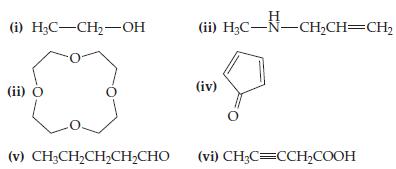
(a) Which of the following compounds, if any, is an ether?(b) Which compound, if any, is an alcohol?(c) Which compound, if any, would produce a basic solution if dissolved in water? (Assume solubility is not a problem).(d) Which compound, if any, is a ketone?(e) Which compound, if any, is an
Indicate whether each statement is true or false.(a) Two geometric isomers of pentane are n-pentane and neopentane.(b) Alkenes can have cis and trans isomers around the CC double bond.(c) Alkynes can have cis and trans isomers around the CC triple bond.
Give the molecular formula of a hydrocarbon containing six carbon atoms that is(a) A cyclic alkane(b) A cyclic alkene(c) A linear alkyne(d) An aromatic hydrocarbon.
Indicate whether each statement is true or false.(a) Alkanes do not contain any carbon–carbon multiple bonds.(b) Cyclo-butane contains a four-membered ring.(c) Alkenes contain carbon–carbon triple bonds.(d) Alkynes contain carbon–carbon double bonds.(e) Pentane is a saturated hydrocarbon but
Is ammonia an organic molecule? Explain.
Indicate whether each statement is true or false.(a) Pentane has a higher molar mass than hexane.(b) The longer the linear alkyl chain for straight-chain hydrocarbons, the higher the boiling point.(c) The local geometry around the alkyne group is linear.(d) Propane has two structural isomers.
Indicate whether each statement is true or false.(a) Butane contains carbons that are sp2 hybridized.(b) Cyclohexane is another name for benzene.(c) The isopropyl group contains three sp3-hybridized carbons.(d) Olefin is another name for alkyne.
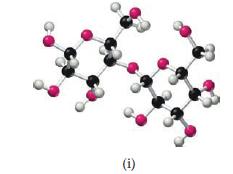
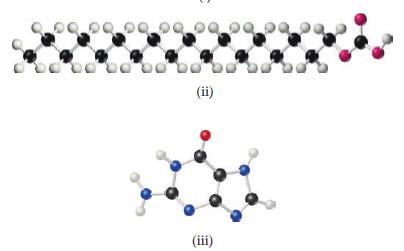
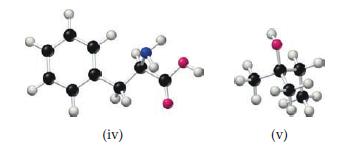
From examination of the molecular models i–v, choose the substance that(a) Can be hydrolyzed to form a solution containing glucose(b) Is capable of forming a zwitterion(c) Is one of the four bases present in DNA(d) Reacts with an acid to form an ester(e) Is a lipid. (i)
The coordination complex [Cr(CO)6] forms colorless, diamagnetic crystals that melt at 90°C. (a) What is the oxidation number of chromium in this compound?(b) Given that [Cr(CO)6] is diamagnetic, what is the electron configuration of chromium in this compound?(c) Given that [Cr(CO)6] is
Carbon monoxide, CO, is an important ligand in coordination chemistry. When CO is reacted with nickel metal the product is [Ni(CO)4], which is a toxic, pale yellow liquid.(a) What is the oxidation number for nickel in this compound?(b) Given that [Ni(CO)4] is diamagnetic molecule with a tetrahedral
Which transition metal atom is present in each of the following biologically important molecules:(a) Hemoglobin(b) Chlorophylls(c) Siderophores.
Give the number of (valence) d electrons associated with the central metal ion in each of the following complexes:(a) K3[Fe(CN)6](b) [Mn(H2O)6](NO3)2(c) Na[Ag(CN)2](d) [Cr(NH3)4Br2]ClO4(e) [Sr(EDTA)]2-
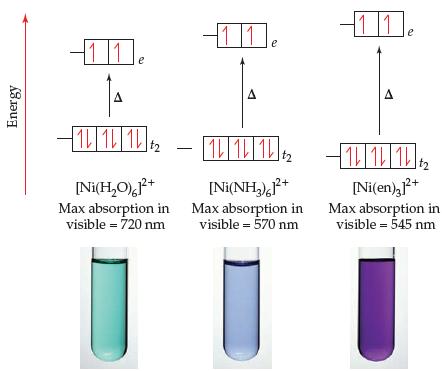
The color and wavelength of the absorption maximum for [Ni(H2O)6]2+, [Ni(NH3)6]2+, and [Ni(en)3]2+ are given in Figure 23.30. The absorption maximum for the [Ni(bipy)3]2+ ion occurs at about 520 nm.(a) What color would you expect for the [Ni(bipy)3]2+ ion?(b) Based on these data, where would you
The colors in the copper-containing minerals malachite (green) and azurite (blue) come from a single d-d transition in each compound.(a) What is the electron configuration of the copper ion in these minerals?(b) Based on their colors in which compound would you predict the crystal field splitting
The lobes of which d orbitals point directly between the ligands in(a) Octahedral geometry(b) Tetrahedral geometry?
Identify each of the following coordination complexes a either diamagnetic or paramagnetic: [Ag(NH3)2]+
Identify each of the following coordination complexes as either diamagnetic or paramagnetic:(a) [ZnCl4]2-(b) [Pd(NH3)2Cl2](c) [V(H2O)6]3+(d) [Ni(en)3]2+
(a) A complex absorbs photons with an energy of 4.51 × 10⁻¹⁹ J. What is the wavelength of these photons?(b) If this is the only place in the visible spectrum where the complex absorbs light, what color would you expect the complex to be?
(a) If a complex absorbs light at 610 nm, what color would you expect the complex to be?(b) What is the energy in Joules of a photon with a wavelength of 610 nm?(c) What is the energy of this absorption in kJ/mol?
Consider the following three complexes:(Complex 1) [Co(NH3)5SCN]2+(Complex 2) [Co(NH3)3Cl3]2+(Complex 3) CoClBr · 5NH3Which of the three complexes can have(a) Geometric isomers(b) Linkage isomers(c) Optical isomers(d) Coordination sphere isomers?
Consider the following three complexes:(Complex 1) [Co(NH3)4Br2]Cl(Complex 2) [Pd(NH3)2(ONO)2](Complex 3) [V(en)2Cl2]+Which of the three complexes can have(a) Geometric isomers(b) Linkage isomers(c) Optical isomers(d) Coordination sphere isomers?
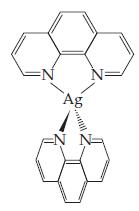
When silver nitrate is reacted with the molecular base ortho-phenanthroline, colorless crystals form that contain the transition-metal complex shown below.(a) What is the coordination geometry of silver in this complex?(b) Assuming no oxidation or reduction occurs during the reaction, what is
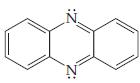
True or false? The following ligand can act as a bidentate ligand?
Crystals of hydrated chromium(III) chloride are green, have an empirical formula of CrCl3 · 6H2O, and are highly soluble,(a) Write the complex ion that exists in this compound.(b) If the complex is treated with excess AgNO3(aq), how many moles of AgCl will precipitate per mole of CrCl3 · 6H2O
(a) Using Werner’s definition of valence, which property is the same as oxidation number, primary valence or secondary valence?(b) What term do we normally use for the other type of valence?(c) Why can the NH3 molecule serve as a ligand but the BH3 molecule cannot?
Which type of substance is attracted by a magnetic field, a diamagnetic substance or a paramagnetic substance?
Among the period 4 transition metals (Sc–Zn), which elements do not form ions where there are partially filled 3d orbitals?
For each of the following compounds determine the electron configuration of the transition metal ion.(a) TiO(b) TiO2(c) NiO(d) ZnO.
Which periodic trend is responsible for the observation that the maximum oxidation state of the transition-metal elements peaks near groups 7B and 8B?(a) The number of valence electrons reaches a maximum at group 8B.(b) The effective nuclear charge increases on moving left across each period.(c)
The lanthanide contraction explains which of the following periodic trends?(a) The atomic radii of the transition metals first decrease and then increase when moving horizontally across each period.(b) When forming ions the transition metals lose their valence s orbitals before their valence d
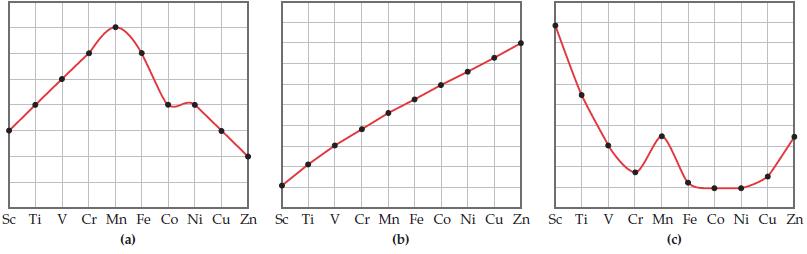
The three graphs below show the variation in radius, effective nuclear charge, and maximum oxidation state for the transition metals of period 4. In each part below identify which property is being plotted. Sc Ti V Cr Mn Fe Co Ni Cu Zn Sc Ti V Cr Mn Fe Co Ni Cu Zn Sc Ti V Cr Mn Fe Co Ni Cu Zn (a)
Using ΔG°f for ozone from Appendix C, calculate the equilibrium constant for Equation 22.24 at 298.0 K, assuming no electrical input. electricity 3 02(g) 2 03(g) AH° 285 k %3D
Determine the charge of the aluminosilicate ion whose composition is AlSi3O10.
Indicate whether each of the following statements is true or false(a) H2 (g) and D2 (g) are allotropic forms of hydrogen.(b) ClF3 is an interhalogen compound.(c) MgO (s) is an acidic anhydride.(d) SO2 (g) is an acidic anhydride.(e) 2H3PO4 (I) → H4P2O7 (I) + H2O (g) is an example of a
(a) Determine the number of sodium ions in the chemical formula of albite, NaxAlSi3O8.(b) Determine the number of hydroxide ions in the chemical formula of tremolite, Ca2Mg5(Si4O11)2(OH)x.
(a) Determine the number of calcium ions in the chemical formula of the mineral hdystonite, CaxZn(Si2O7).(b) Determine the number of hydroxide ions in the chemical formula of the mineral pyrophyllite, Al2(Si2O5)2(OH)x.
Explain the following observations:(a) For a given oxidation state, the acid strength of the oxyacid in aqueous solution decreases in the order chlorine > bromine > iodine.(b) Hydrofluoric acid cannot be stored in glass bottles.(c) HI cannot be prepared by treating NaI with sulfuric acid.(d)
Explain each of the following observations:(a) At room temperature I2 is a solid, Br2 is a liquid, and Cl2 and F2 are both gases(b) F2 cannot be prepared by electrolytic oxidation of aqueous F solutions.(c) The boiling point of HF is much higher than those of the other hydrogen halides.(d) The
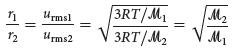
Naturally found uranium consists of 99.274% 238U, 0.720% 235U, and 0.006% 233U. As we have seen, 235U is the isotope that can undergo a nuclear chain reaction. Most of the 235U used in the first atomic bomb was obtained by gaseous diffusion of uranium hexafluoride, UF6(g).(a) What is the mass of
Each of the following transmutations produces a radionuclide used in positron emission tomography (PET).(a) In equations (i) and (ii), identify the species signified as “X.”(b) In equation (iii), one of the species is indicated as “d.” What do you think it represents? (i) 14N(p, a) X (ii)
In 2010, a team of scientists from Russia and the U.S. reported creation of the first atom of element 117, which is not yet named and is denoted [117]. The synthesis involved the collision of a target of 24997Bk with accelerated ions of an isotope which we will denote Q. The product atom, which we
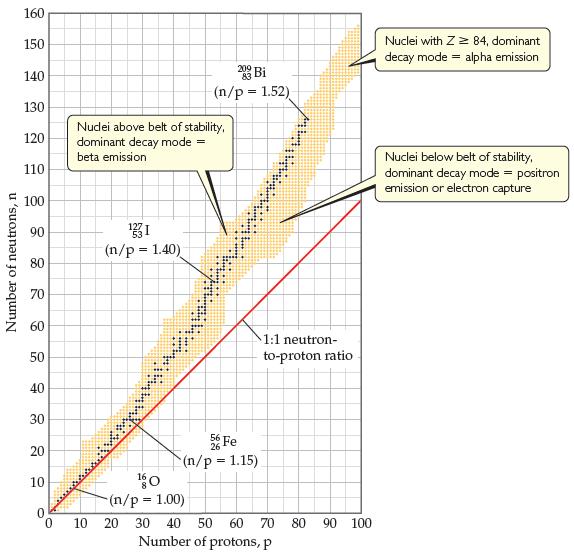
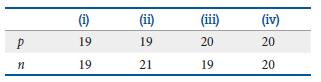
The table to the right gives the number of protons (p) and neutrons (n) for four isotopes.(a) Write the symbol for each of the isotopes.(b) Which of the isotopes is most likely to be unstable?(c) Which of the isotopes involves a magic number of protons and/or neutrons?(d) Which isotope will yield
Complete and balance the nuclear equations for the following fission or fusion reactions:(a) 21H + 21H → 32He + __(b) 23992U + 10n → 13351Sb + 9841Nb + __ 10n
Which of the following statements about the uranium used in nuclear reactors is or are true?(i) Natural uranium has too little 235U to be used as a fuel.(ii) 238U cannot be used as a fuel because it forms a supercritical mass too easily.(iii) To be used as fuel, uranium must be enriched so that it
(a) Which of the following are required characteristics of an isotope to be used as a fuel in a nuclear power reactor? (i) It must emit gamma radiation. (ii) On decay, it must release two or more neutrons. (iii) It must have a half-life less than one hour. (iv) It must undergo fission upon the
It takes 4 h 39 min for a 2.00-mg sample of radium-230 to decay to 0.25 mg. What is the half-life of radium-230?
Complete and balance the following nuclear equations by supplying the missing particle:(a) 147N + 42He → ? + 11H(b) 4019K + 0-1e (orbital electron) → ?(c) ? + 42He → 3014Si + 11H(d) 5826Fe + 210n → 6027Co + ?(e) 23592U + 10n → 13554Xe + 210n + ?
Which of the following nuclides would you expect to be radioactive: 5826Fe, 6027Co, 9241Nb, Mercury-202, Radium-226 ? Justify your choices.
Indicate the number of protons and neutrons in the following nuclei:(a) 12953I(b) 138Ba(c) Neptunium-237
Indicate the number of protons and neutrons in the following nuclei:(a) 5624Cr(b) 193Tl(c) Argon-38.
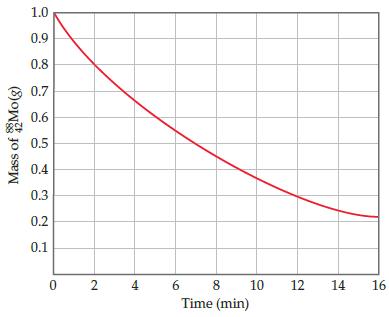
The accompanying graph illustrates the decay of 8842Mo, which decays via positron emission.(a) What is the half-life of the decay?(b) What is the rate constant for the decay?(c) What fraction of the original sample of 8842Mo remains after 12 min?(d) What is the product of the decay process? 1.0 0.9
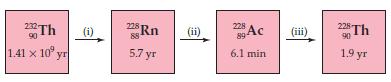
The steps below show three of the steps in the radioactive decay chain for 23290Th. The half-life of each isotope is shown below the symbol of the isotope.(a) Identify the type of radioactive decay for each of the steps (i), (ii), and (iii).(b) Which of the isotopes shown has the highest
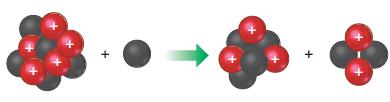
In the sketch below, the red spheres represent protons and the gray spheres represent neutrons.(a) What are the identities of the four particles involved in the reaction depicted?(b) Write the transformation represented below using condensed notation.(c) Based on its atomic number and mass number,
Magnesium is obtained by electrolysis of molten MgCl2.(a) Why is an aqueous solution of MgCl2 not used in the electrolysis?(b) Several cells are connected in parallel by very large copper bars that convey current to the cells. Assuming that the cells are 96% efficient in producing the desired
A common shorthand way to represent a voltaic cell is anode| anode solution || cathode solution |cathode A double vertical line represents a salt bridge or a porous barrier. A single vertical line represents a change in phase, such as from solid to solution.(a) Write the half-reactions and overall
Li-ion batteries used in automobiles typically use a LiMn2O4 cathode in place of the LiCoO2 cathode found in most Li-ionbatteries.(a) Calculate the mass percent lithium in each electrode material?(b) Which material has a higher percentage of lithium? Does this help to explain why batteries made
In a Li-ion battery the composition of the cathode is LiCoO2 when completely discharged. On charging approximately 50% of the Li+ ions can be extracted from the cathode and transported to the graphite anode where they intercalate between the layers.(a) What is the composition of the cathode when
In some applications nickel–cadmium batteries have been replaced by nickel–zinc batteries. The overall cell reaction for this relatively new battery is:2H2O(I) + 2NiO(OH)(s) + Zn(s) → 2Ni(OH)2(s) + Zn(OH)2(s)(a) What is the cathode half-reaction?(b) What is the anode half-reaction?(c) A
(a) In the Nernst equation what is the numerical value of the reaction quotient, Q, under standard conditions?(b) Can the Nernst equation be used at temperatures other than room temperature?
Based on the data in Appendix E(a) which of the following is the strongest oxidizing agent and which is the weakest in acidic solution: Br2, H2O2, Zn, Cr2O72- ?(b) Which of the following is the strongest reducing agent, and which is the weakest in acidic solution: F-, Zn, N2H5+, I2, NO?
From each of the following pairs of substances, use data in Appendix E to choose the one that is the stronger reducing agent:(a) Fe(s) or Mg(s)(b) Ca(s) or Al(s)(c) H2(g, acidic solution) or H2S(g)(d) BrO3-(aq) or IO3-(aq)
(a) What is the standard reduction potential of a standard hydrogen electrode?(b) Why is it impossible to measure the standard reduction potential of a single half-reaction?
Complete and balance the following equations, and identify the oxidizing and reducing agents:(a) Cr2O72-(aq) + I-(aq) → Cr3+(aq) + IO3- (aq) (acidic solution)(b) MnO4- (aq) + CH3OH(aq) → Mn2+(aq) + HCO2H(aq) (acidic solution)(c) I2(s) + OCl-(aq) → IO3- (aq) +
Complete and balance the following half-reactions. In each case indicate whether the half-reaction is an oxidation or a reduction.(a) Mo3+ (aq) → Mo(s) (acidic solution)(b) H2SO3 (aq) → SO42- (aq) (acidic solution)(c) NO3- (aq) → NO(g) (acidic solution)(d) O2 (g) → H2O(I) (acidic
Complete and balance the following half-reactions. In each case indicate whether the half-reaction is an oxidation or a reduction.(a) Sn2+(aq) → Sn4+(aq) (acidic solution)(b) TiO2(s) → Ti2+(aq) (acidic solution)(c) ClO3-(aq) → Cl-(aq) (acidic solution)(d) N2(g) → NH4+(aq) (acidic
Indicate whether the following balanced equations involve oxidation–reduction. If they do, identify the elements that undergo changes in oxidation number.(a) 2AgNO3(aq) + CoCl2(aq) → 2AgCl(s) + Co(NO3)2(aq)(b) 2PbO2(s) → 2PbO(s) + O2(g)(c) 2H2SO4(aq) + 2 NaBr(s) → Br2(I) + SO2(g) +
In each of the following balanced oxidation–reduction equations, identify those elements that undergo changes in oxidation number and indicate the magnitude of the change in each case.2MnO4-(aq) + 3S2-(aq) + 4H2O(I) → 3S(s) + 2MnO2(s) + 8OH-(aq)
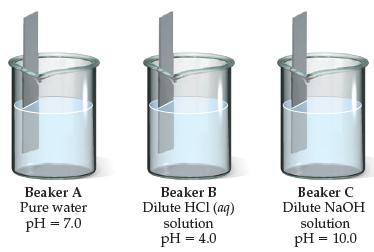
Bars of iron are put into each of the three beakers as shown here. In which beaker—A, B, or C—would you expect the iron to show the most corrosion? Beaker A Pure water Beaker B Dilute HCI (aq) solution Beaker C Dilute NaOH pH = 7.0 solution pH = 4.0 pH = 10.0
The electrodes in a silver oxide battery are silver oxide (Ag2O) and zinc. Which electrode acts as the anode?
An ice cube with a mass of 20g at -20°C (typical freezer temperature) is dropped into a cup that holds 500 mL of hot water, initially at 83°C. What is the final temperature in the cup? The density of liquid water is 1.00 g/mL; the specific heat capacity of ice is 2.03 J/g-C; the specific heat
At what temperatures is the following reaction, the reduction of magnetite by graphite to elemental iron, spontaneous?Fe3O4(s) + 2C (s, graphite) → 2CO2(g) + 3 Fe(s)
Indicate whether ΔG increases, decreases, or stays the same for each of the following reactions as the partial pressure of O2 is increased:(a) 2CO(g) + O2(g) → 2CO2(g)(b) 2H2O2(I) → 2H2O(I) + O2(g)(c) 2KClO3(s) → 2KCl(s) + 3O2(g)
Indicate whether each statement is true or false.(a) Unlike enthalpy, where we can only ever know changes in H, we can know absolute values of S.(b) If you heat a gas such as CO2, you will increase its degrees of translational, rotational and vibrational motions.(c) CO2(g) and Ar(g) have nearly the
Indicate whether each statement is true or false.(a) The third law of thermodynamics says that the entropy of a perfect, pure crystal at absolute zero increases with the mass of the crystal.(b) “Translational motion” of molecules refers to their change in spatial location as a function of
Does the entropy of the system increase, decrease, or stay the same when(a) The temperature of the system increases.(b) The volume of a gas increases.(c) Equal volumes of ethanol and water are mixed to form a solution?
Indicate whether each statement is true or false.(a) ΔS for an isothermal process depends on both the temperature and the amount of heat reversibly transferred.(b) ΔS is a state function.(c) The second law of thermodynamics says that the entropy of the system increases for all spontaneous
Indicate whether each statement is true or false. All spontaneous processes are irreversible?
Indicate whether each statement is true or false.(a) If a system undergoes a reversible process, the entropy of the universe increases.(b) If a system undergoes a reversible process, the change in entropy of the system is exactly matched by an equal and opposite change in the entropy of the
(a) Can endothermic chemical reactions be spontaneous?(b) Can a process that is spontaneous at one temperature be nonspontaneous at a different temperature?
The Henry’s law constant for CO2 in water at 25°C is 3.1 × 10⁻²M atm-1.What is the solubility of CO2 in water at this temperature if the solution is in contact with air at normal atmospheric pressure?
It was estimated that the eruption of the Mount Pinatubo volcano resulted in the injection of 20 million metric tons of SO2 into the atmosphere. Most of this SO2 underwent oxidation to SO3, which reacts with atmospheric water to form an aerosol.(a) Write chemical equations for the processes leading
(a) Suppose that tests of a municipal water system reveal the presence of bromate ion, BrO3-. What are the likely origins of this ion?(b) Is bromate ion an oxidizing or reducing agent? Write a chemical equation for the reaction of bromate ion with hyponitrite ion.
In the lime soda process at one time used in large scale municipal water softening, calcium hydroxide prepared from lime and sodium carbonate are added to precipitate Ca2+ as CaCO3(s) and Mg2+ as Mg(OH)2 (s):Ca2+(aq) + CO32-(aq) ⇌ CaCO3(s)Mg2+(aq) + 2OH-(aq) ⇌ MgOH2 (aq)How many moles of
The Ogallala aquifer described in the Closer Look box in Section 18.3, provides 82% of the drinking water for the people who live in the region, although more than 75% of the water that is pumped from it is for irrigation. Irrigation withdrawals are approximately 18 billion gallons per day.(a)
Which of the following reactions in the stratosphere cause an increase in temperature there?(a) O(g) + O2(g) ⇌ O3* (g)(b) O3* (g) + M(g) ⇌ O3(g) + M* (g)(c) O2(g) + hν ⇌ 2O(g)(d) O(g) + N2(g) ⇌ NO(g) + N(g)(e) All of the above
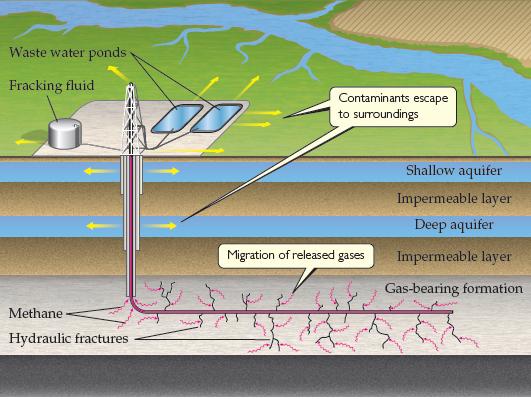
From study of Figure 18.22 describe the various ways in which operation of a fracking well site could lead to environmental contamination. Waste water ponds Fracking fluid Contaminants escape to surroundings Shallow aquifer Impermeable layer Deep aquifer Migration of released gases Impermeable
Showing 600 - 700
of 1009
1
2
3
4
5
6
7
8
9
10
11
Step by Step Answers

 Get 50% OFF
Claim Now
Get 50% OFF
Claim Now