New Semester
Started
Get
50% OFF
Study Help!
--h --m --s
Claim Now
Question Answers
Textbooks
Find textbooks, questions and answers
Oops, something went wrong!
Change your search query and then try again
S
Books
FREE
Study Help
Expert Questions
Accounting
General Management
Mathematics
Finance
Organizational Behaviour
Law
Physics
Operating System
Management Leadership
Sociology
Programming
Marketing
Database
Computer Network
Economics
Textbooks Solutions
Accounting
Managerial Accounting
Management Leadership
Cost Accounting
Statistics
Business Law
Corporate Finance
Finance
Economics
Auditing
Tutors
Online Tutors
Find a Tutor
Hire a Tutor
Become a Tutor
AI Tutor
AI Study Planner
NEW
Sell Books
Search
Search
Sign In
Register
study help
sciences
college physics reasoning
College Physics A Strategic Approach 3rd Edition Randall D. Knight, Brian Jones, Stuart Field - Solutions
The nuclei of \({ }^{4} \mathrm{He}\) and \({ }^{16} \mathrm{O}\) are very stable and are often referred to as "doubly magic" nuclei. Use what you know about energy levels to explain what is special about these particular nuclei.
You have seen that filled electron energy levels correspond to chemically stable atoms. A similar principle holds for nuclear energy levels; nuclei with equally filled proton and neutron energy levels are especially stable. What are the three lightest isotopes whose proton and neutron energy levels
\({ }^{15} \mathrm{O}\) and \({ }^{131} \mathrm{I}\) are isotopes used in medical imaging. \({ }^{15} \mathrm{O}\) is a BIO beta-plus emitter, \({ }^{131}\) I a beta-minus emitter. What are the daughter nuclei of the two decays?
Spacecraft have been powered with energy from the alpha decay of \({ }^{238} \mathrm{Pu}\). What is the daughter nucleus?
Identify the unknown isotope \(\mathrm{X}\) in the following decays.a. \({ }^{234} \mathrm{U} \rightarrow \mathrm{X}+\alpha\)b. \({ }^{32} \mathrm{P} \rightarrow \mathrm{X}+\mathrm{e}^{-}\)c. \(\mathrm{X} \rightarrow{ }^{30} \mathrm{Si}+\mathrm{e}^{+}\)d. \({ }^{24} \mathrm{Mg} \rightarrow
Identify the unknown isotope \(\mathrm{X}\) in the following decays.a. \(\mathrm{X} \rightarrow{ }^{224} \mathrm{Ra}+\alpha\)b. \(\mathrm{X} \rightarrow{ }^{207} \mathrm{~Pb}+\mathrm{e}^{-}\)c. \({ }^{7} \mathrm{Be}+\mathrm{e}^{-} \rightarrow \mathrm{X}\)d. \(\mathrm{X} \rightarrow{ }^{60}
What is the energy (in \(\mathrm{MeV}\) ) released in the alpha decay of \({ }^{228} \mathrm{Th}\) ?
Medical gamma imaging is generally done with the technetium isotope \({ }^{99} \mathrm{Tc}^{*}\), which decays by emitting a gammaray photon with energy \(140 \mathrm{keV}\). What is the mass loss of the nucleus, in \(\mathrm{u}\), upon emission of this gamma ray?
Cobalt has one stable isotope, \({ }^{59} \mathrm{Co}\). What are the likely decay modes and daughter nuclei for(a) \({ }^{56} \mathrm{Co}\) and(b) \({ }^{62} \mathrm{Co}\) ?
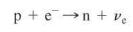
Give a description of the electron capture process in terms of quarks.The following two questions concern an uncommon nuclear decay mode known as electron capture. Certain nuclei that are proton-rich but energetically prohibited from undergoing beta-plus decay can capture an electron from the \(1
Manganese has one stable isotope, \({ }^{55} \mathrm{Mn}\). What are the likely decay modes and daughter nuclei for(a) \({ }^{51} \mathrm{Mn}\) and(b) \({ }^{59} \mathrm{Mn}\) ?
Electron capture is usually followed by the emission of an \(\mathrm{x}\) ray. Why?The following two questions concern an uncommon nuclear decay mode known as electron capture. Certain nuclei that are proton-rich but energetically prohibited from undergoing beta-plus decay can capture an electron
The radioactive hydrogen isotope \({ }^{3} \mathrm{H}\) is called tritium. It decays by beta-minus decay with a half-life of 12.3 years.a. What is the daughter nucleus of tritium?b. A watch uses the decay of tritium to energize its glowing dial. What fraction of the tritium remains 20 years after
\({ }^{74} \mathrm{As}\) is a beta-plus emitter used for locating tumors with PET. What is the daughter nucleus?A. \({ }_{33}^{73} \mathrm{As}\)B. \({ }_{32}^{74} \mathrm{Ge}\)C. \({ }_{34}^{74} \mathrm{Se}\)D. \({ }_{33}^{75} \mathrm{As}\)
The barium isotope \({ }^{133} \mathrm{Ba}\) has a half-life of 10.5 years. A sample begins with \(1.0 \times 10^{10}{ }^{133} \mathrm{Ba}\) atoms. How many are left after(a) 2 years,(b) 20 years, and(c) 200 years?
When uranium fissions, the fission products are radioactive because the nuclei are neutron-rich. What is the most likely decay mode for these nuclei?A. Alpha decay C. Beta-plus decay B. Beta-minus decay D. Gamma decay
The cadmium isotope \({ }^{109} \mathrm{Cd}\) has a half-life of 462 days. A sample begins with \(1.0 \times 10^{12}{ }^{109} \mathrm{Cd}\) atoms. How many are left after(a) 50 days,(b) 500 days, and(c) 5000 days?
What is the unknown isotope in the following fission reaction: \(\mathrm{n}+{ }^{235} \mathrm{U} \rightarrow{ }^{131} \mathrm{I}+\) ? + \(3 \mathrm{n}\)A. \({ }^{86} \mathrm{Rb}\)B. \({ }^{102} \mathrm{Rb}\)C. \({ }^{89} \mathrm{Y}\)D. \({ }^{102} \mathrm{Y}\)
The Chernobyl reactor accident in what is now Ukraine was the worst nuclear disaster of all time. Fission products from the reactor core spread over a wide area. The primary radiation exposure to people in western Europe was due to the short-lived (half-life 8.0 days) isotope \({ }^{131}
An investigator has \(0.010 \mu \mathrm{g}\) samples of two isotopes of strontium, \({ }^{89} \mathrm{Sr}\left(t_{1 / 2}=51\right.\) days \()\) and \({ }^{90} \mathrm{Sr}\left(t_{1 / 2}=28\right.\) years \()\). The samples contain approximately the same number of atoms. What can you say about the
The uranium in the earth's crust is \(0.7 \%{ }^{235} \mathrm{U}\) and \(99.3 \%{ }^{238} \mathrm{U}\). Two billion years ago, \({ }^{235} \mathrm{U}\) comprised approximately \(3 \%\) of the uranium in the earth's crust. This tells you something about the relative half-lives of the two isotopes.
Suppose you have a \(1 \mathrm{~g}\) sample of \({ }^{226} \mathrm{Ra}\), half-life 1600 years. How long will it be until only \(0.1 \mathrm{~g}\) of radium is left? \(\begin{array}{llll}\text { A. } 1600 \mathrm{yr} & \text { B. } 3200 \mathrm{yr} & \text { C. } 5300 \mathrm{yr} & \text { D. }
A sample of \({ }^{131} \mathrm{I}\), half-life 8.0 days, is registering 100 decays per second. How long will be it before the sample registers only 1 decay per second?A. 8 days B. 53 days C. 80 days D. 800 days
What is the activity, in \(\mathrm{Bq}\) and \(\mathrm{Ci}\), of \(1.0 \mathrm{~g}\) of \({ }^{226} \mathrm{Ra}\) ? Marie Curie was the discoverer of radium; can you see where the unit of activity named after her came from?
The complete expression for the decay of the radioactive hydrogen isotope tritium may be written as \({ }^{3} \mathrm{H} \rightarrow{ }^{3} \mathrm{He}+\mathrm{X}+\mathrm{Y}\). The symbols \(\mathrm{X}\) and \(\mathrm{Y}\) represent A. \(\mathrm{X}=\mathrm{e}^{+},
The quark compositions of the proton and neutron are, respectively, uud and udd, where \(\mathrm{u}\) is an up quark (charge \(+\frac{2}{3} e\) ) and \(\mathrm{d}\) is a down quark (charge \(-\frac{1}{3} e\) ). There are also antiup \(\overline{\mathrm{u}}\) (charge \(-\frac{2}{3} e\) ) and
An investigator collects a sample of a radioactive isotope with an activity of \(370,000 \mathrm{~Bq}\). 48 hours later, the activity is 120,000 Bq. What is the half-life of the sample?
A passenger on an airplane flying across the Atlantic receives an extra radiation dose of about \(5 \mu \mathrm{Sv}\) per hour from cosmic rays. How many hours of flying would it take in one year for a person to double his or her yearly radiation dose? Assume there are no other significant
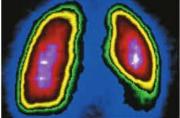
A gamma scan showing the active volume of a patient's lungs can be created by having a patient breathe the radioactive isotope \({ }^{133} \mathrm{Xe}\), which undergoes beta-minus decay with a subsequent gamma emission from the daughter nucleus. A typical procedure gives a dose of \(0.30
The decay chain of uranium includes radon, a noble gas. When uranium in the soil decays to radon, it may seep into houses; this can be a significant source of radiation exposure. Most of the exposure comes from the decay products of radon, but some comes from alpha decay of the radon itself. If
\(1 \mid 1{ }^{90} \mathrm{Sr}\) decays with the emission of a \(2.8 \mathrm{MeV}\) beta particle Strontium is chemically similar to calcium and is taken up by bone. A \(75 \mathrm{~kg}\) person exposed to waste from a nuclear accident absorbs \({ }^{90} \mathrm{Sr}\) with an activity of \(370,000
A patient receives a gamma scan/ of his liver. He ingests 3.7 MBq of \({ }^{198} \mathrm{Au}\), which decays with a 2.7 day half-life by emitting a \(1.4 \mathrm{MeV}\) beta particle. Medical tests show that \(60 \%\) of this isotope is absorbed and retained by the liver. If all of the radioactive
A \(75 \mathrm{~kg}\) patient swallows a \(30 \mu \mathrm{Ci}\) beta emitter with a half life of 5.0 days, and the radioactive nuclei are quickly distributed throughout his body. The beta particles are emitted with an average energy of \(0.35 \mathrm{MeV}, 90 \%\) of which is absorbed by the body.
What are the minimum energies of the two oppositely directed gamma rays in a PET procedure?
Positive and negative pions, denoted \(\pi^{+}\)and \(\pi^{-}\), are antiparticles of each other. Each has a rest mass of \(140 \mathrm{MeV} / \mathrm{c}^{2}\). Suppose a collision between an electron and positron, each with kinetic energy \(K\), produces a \(\pi^{+}, \pi^{-}\)pair. What is the
In a particular beta-minus decay of a free neutron (that is, one not part of an atomic nucleus), the emitted electron has exactly the same kinetic energy as the emitted electron antineutrino. What is the value, in \(\mathrm{MeV}\), of that kinetic energy? Assume that the recoiling proton has
What is the activity in \(\mathrm{Bq}\) and in \(\mathrm{Ci}\) of a \(2.0 \mathrm{mg}\) sample of \({ }^{3} \mathrm{H}\) ?
The activity of a sample of the cesium isotope \({ }^{137} \mathrm{Cs}\) is \(2.0 \times 10^{8} \mathrm{~Bq}\). Many years later, after the sample has fully decayed, how many beta particles will have been emitted?
You are assisting in an anthropology lab over the summer by carrying out \({ }^{14} \mathrm{C}\) dating. \(\mathrm{A}\) graduate student found a bone he believes to be 20,000 years old. You extract the carbon from the bone and prepare an equal-mass sample of carbon from modern organic material. To
A sample contains radioactive atoms of two types, A and B. Initially there are five times as many A atoms as there are B atoms. Two hours later, the numbers of the two atoms are equal. The half-life of A is 0.50 hours. What is the half-life of B?
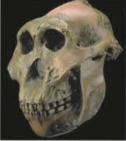
The technique known as potassiumargon dating is used to date volcanic rock and ash, and thus establish dates for nearby fossils, like this 1.8 -millionyear-old hominid skull. The potassium isotope \({ }^{40} \mathrm{~K}\) decays with a 1.28 -billionyear half-life and is naturally present at very
About \(12 \%\) of your body mass is carbon; some of this is radioactive \({ }^{14} \mathrm{C}\), a beta-emitter. If you absorb \(100 \%\) of the\(49 \mathrm{keV}\) energy of each \({ }^{14} \mathrm{C}\) decay, what dose equivalent in Sv do you receive each year from the \({ }^{14} \mathrm{C}\) in
Ground beef may be irradiated with high-energy electrons from a linear accelerator to kill pathogens. In a standard treatment, \(1.0 \mathrm{~kg}\) of beef receives \(4.5 \mathrm{kGy}\) of radiation in \(40 \mathrm{~s}\).a. How much energy is deposited in the beef?b. What is the average rate (in W)
Most battery-powered devices won't work if you put the battery in backward. But for a device that you plug in, you can often reverse the orientation of the plug with no problem. Explain the difference.
If a lightbulb is connected to a \(120 \mathrm{~V}, 60 \mathrm{~Hz}\) electric outlet, how many times a second does the bulb reach peak brightness?
A soldering gun contains a transformer that lowers the \(120 \mathrm{~V}\) from an outlet to a few volts. It's possible to have a current of \(150 \mathrm{~A}\) in the tip of the soldering iron even though the outlet has a circuit breaker that permits no more than \(15 \mathrm{~A}\). Explain how
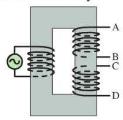
Figure Q26.7 shows three wires wrapped around an iron core. The figure shows the number of turns and the direction of each of the windings. At one particular instant, \(V_{\mathrm{A}}-V_{\mathrm{B}}=20 \mathrm{~V}\). At that same instant, what is \(V_{\mathrm{C}}-V_{\mathrm{D}}\) ?Figure Q26.7 A B
If you work out enough to visibly increase the diameter of your biceps, will this increase or decrease your susceptibility to electric shock? Explain.
The peak current through a resistor is \(2.0 \mathrm{~A}\). What is the peak current ifa. The resistance \(R\) is doubled?b. The peak emf \(\mathcal{E}_{0}\) is doubled?c. The frequency \(f\) is doubled?
The peak current through a capacitor is \(2.0 \mathrm{~A}\). What is the peak current ifa. The peak emf \(\mathcal{E}_{0}\) is doubled?b. The capacitance \(C\) is doubled?c. The frequency \(f\) is doubled?
An inductive loop buried in a roadway detects the presence of cars above it, as described in the chapter. If the loop is connected to an AC supply, will the current increase or decrease when a car drives above the loop?
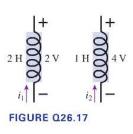
Figure Q26.17 shows two inductors and the potential difference across them at time \(t=0 \mathrm{~s}\).a. Can you tell which of these inductors has the larger current flowing through it at \(t=0 \mathrm{~s}\) ? If so, which one? If not, why not?b. Can you tell through which inductor the current is
The peak current passing through an inductor is \(2.0 \mathrm{~A}\). What is the peak current ifa. The peak emf \(\mathcal{E}_{0}\) is doubled?b. The inductance \(L\) is doubled?c. The frequency \(f\) is doubled?
The resonance frequency of a driven \(R L C\) circuit is \(1000 \mathrm{~Hz}\). What is the resonance frequency ifa. The resistance \(R\) is doubled?b. The inductance \(L\) is doubled?c. The capacitance \(C\) is doubled?d. The peak emf \(\mathcal{E}_{0}\) is doubled?e. The emf frequency \(f\) is
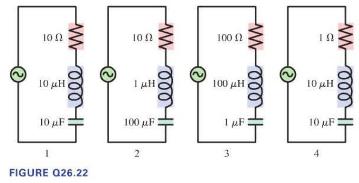
Consider the four circuits in Figure Q26.22. They all have the same resonance frequency \(f_{0}\) and are driven by the same emf. Rank in order, from largest to smallest, the maximum currents \(\left(I_{\max }\right)_{1}\) to \(\left(I_{\max }\right)_{4}\). Explain. 100 10 10 eee-w 100 100 10 F
An inductor is connected to an \(\mathrm{AC}\) generator. As the generator's frequency is increased, the current in the inductor A. Increases.B. Decreases.C. Does not change.
A capacitor is connected to an AC generator. As the generator's frequency is increased, the current in the capacitorA. Increases.B. Decreases.C. Does not change.
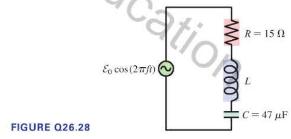
The circuit shown in Figure Q26.28 has a resonance frequency of \(15 \mathrm{kHz}\). What is the value of \(L\) ?A. \(1.6 \mu \mathrm{H}\)B. \(2.4 \mu \mathrm{H}\)C. \(5.2 \mu \mathrm{H}\)D. \(18 \mu \mathrm{H}\)E. \(59 \mu \mathrm{H}\) FIGURE Q26.28 R=152 cation Eo cos (2) C=47 uF
At resonance, a driven \(R L C\) circuit has \(V_{\mathrm{C}}=5.0 \mathrm{~V}\), \(V_{\mathrm{R}}=8.0 \mathrm{~V}\), and \(V_{\mathrm{L}}=5.0 \mathrm{~V}\). What is the peak voltage across the entire circuit?A. \(18 \mathrm{~V}\)B. \(10 \mathrm{~V}\)C. \(8.0 \mathrm{~V}\)D. \(5.0 \mathrm{~V}\)E.
A driven \(R L C\) circuit has \(V_{\mathrm{C}}=5.0 \mathrm{~V}, V_{\mathrm{R}}=7.0 \mathrm{~V}\), and \(V_{\mathrm{L}}=9.0 \mathrm{~V}\). The driving frequency is A. Higher than the resonance frequency.B. Equal to the resonance frequency.C. Lower than the resonance frequency.
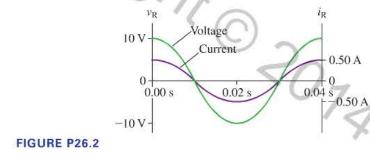
Figure P26.2 shows voltage and current graphs for a resistor.a. What is the value of the resistance \(R\) ?b. What is the emf frequency \(f\) ? FIGURE P26.2 VR 10 V- Voltage Current 0.50 A 0+ 0.00 s 0.02s 0.04 s 0.50 A -10V-
A small electric space heater uses a wire that has a resistance of \(24 \Omega\). When it is connected to a \(120 \mathrm{~V}\) electric outlet, what is the power output?
A science hobbyist has purchased a surplus transformer that converts \(7.2 \mathrm{kV}\) from neighborhood distribution lines into \(120 \mathrm{~V}\) for homes. He connects the transformer "backward," connecting \(120 \mathrm{~V}\) power to the secondary coil and connecting a load to the primary
A generator produces \(250 \mathrm{~kW}\) of electric power at \(7.2 \mathrm{kV}\). The current is transmitted to a remote village through wires with a total resistance of \(15 \Omega\).a. What is the power loss due to resistance in the wires?b. What is the power loss if the voltage is increased to
In an old house, the wires leading to a \(120 \mathrm{~V}\) outlet have a total resistance of \(0.45 \Omega\). When you plug in a hair dryer, it draws a 12 A current.a. How much does the outlet voltage decrease due to the voltage drop across the wires?b. What is the power dissipated as heat in the
A typical American family uses \(1000 \mathrm{kWh}\) of electricity a month. What is the average rms current in the \(120 \mathrm{~V}\) power line to a typical house?
The wiring in the wall of your house to and from an outlet\(\mathbb{N T}\) has a total resistance of typically \(0.10 \Omega\). Suppose a device plugged into a \(120 \mathrm{~V}\) outlet draws \(10.0 \mathrm{~A}\) of current.a. What is the voltage drop along the wire?b. How much power is dissipated
Your refrigerator uses \(220 \mathrm{~W}\) when the compressor is running, and the compressor runs \(30 \%\) of the time. How many \(\mathrm{kWh}\) will your refrigerator use over the course of a year?
The manufacturer of an electric table saw claims that it has a 3.0 horsepower motor. 1 horsepower is approximately \(750 \mathrm{~W}\). It is designed to be used on a normal \(120 \mathrm{~V}\) outlet with a \(15 \mathrm{~A}\) circuit breaker. Is this claim reasonable? Explain.
John is changing a lightbulb in a lamp. It's a warm summer B10 evening, and the resistance of his damp skin is only \(4000 \Omega\). While one hand is holding the grounded metal frame of the lamp, the other hand accidentally touches the hot electrode in the base of the socket. What is the current
In some countries AC outlets near bathtubs are restricted to a Bi. 0 maximum of \(25 \mathrm{~V}\) to minimize the chance of dangerous shocks while bathing. A man is in the tub; the lower end of his torso is well grounded, and the skin resistance of his wet, soapy hands is negligible. He reaches
Electrodes used to make electrical measurements of the body (such as those used when recording an electrocardiogram) use a conductive paste to reduce the skin resistance to very low values. Great care must be exercised when a patient is wearing such electrodes. If a patient is wearing one such
A bird is perched on the wire with its feet \(2.0 \mathrm{~cm}\) apart. What INT BIO is the potential difference between its feet?Concern a high-voltage transmission line. Such lines are made of bare wire; they are not insulated. Assume that the wire is \(100 \mathrm{~km}\) long, has a resistance
Would it be possible for a person to safely hang from this wire? Assume that the hands are \(15 \mathrm{~cm}\) apart, and assume a skin resistance of \(2200 \Omega\).Concern a high-voltage transmission line. Such lines are made of bare wire; they are not insulated. Assume that the wire is \(100
The peak current through a capacitor is \(10.0 \mathrm{~mA}\). What is the current ifa. The emf frequency is doubled?b. The emf peak voltage is doubled (at the original frequency)?c. The frequency is halved and, at the same time, the emf is doubled?
A capacitor is connected to a \(15 \mathrm{kHz}\) oscillator that produces an rms voltage of \(6.0 \mathrm{~V}\). The peak current is \(65 \mathrm{~mA}\). What is the value of the capacitance \(C\) ?
What is the potential difference across a \(10 \mathrm{mH}\) inductor if the current through the inductor drops from \(150 \mathrm{~mA}\) to \(50 \mathrm{~mA}\) in \(10 \mu \mathrm{s}\) ?
The peak current through an inductor is \(10.0 \mathrm{~mA}\). What is the current ifa. The emf frequency is doubled?b. The emf peak voltage is doubled (at the original frequency)?c. The frequency is halved and, at the same time, the emf is doubled?
An inductor is connected to a \(15 \mathrm{kHz}\) oscillator that produces an rms voltage of \(6.0 \mathrm{~V}\). The peak current is \(65 \mathrm{~mA}\). What is the value of the inductance \(L\) ?
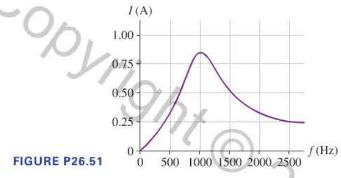
An \(R L C\) circuit with a \(10 \mu \mathrm{F}\) capacitor is connected to a variable-frequency power supply with an rms output voltage of \(6.0 \mathrm{~V}\). The rms current in the circuit as a function of the driving frequency appears as in Figure P26.51. What are the values of the resistor and
A series \(R L C\) circuit consists of a \(280 \Omega\) resistor, a \(25 \mu \mathrm{H}\) inductor, and an \(18 \mu \mathrm{F}\) capacitor. What is the rms current if the emf is supplied by a standard \(120 \mathrm{~V}, 60 \mathrm{~Hz}\) wall outlet?
Electric outlets in England are 230 V. Alice brings her electric kettle from England, where it draws \(13 \mathrm{~A}\), and wants to use it in the United States. She uses a step-up transformer to increase the \(120 \mathrm{~V}\) outlet voltage to \(230 \mathrm{~V}\), then plugs her kettle into the
The voltage-to-current ratio in the primary coil of a transformer can be thought of as the transformer's effective resistance. A step-down transformer converts \(120 \mathrm{~V}\) at the primary to \(24 \mathrm{~V}\) at the secondary, which is connected to a load of resistance \(8.0 \Omega\). What
A 15 -km-long, \(230 \mathrm{kV}\) aluminum transmission line delivers 34 MW to a city. If we assume a solid cylindrical cable, what minimum diameter is needed if the voltage decrease along this run is to be no more than \(1.0 \%\) of the transmission voltage? The resistivity of aluminum is \(2.7
The voltage across a \(60 \mu \mathrm{F}\) capacitor is described by the equation \(v_{\mathrm{C}}=(18 \mathrm{~V}) \cos (200 t)\), where \(t\) is in seconds.a. What is the voltage across the capacitor at \(t=0.010 \mathrm{~s}\) ?b. What is the capacitive reactance?c. What is the peak current?
The voltage across a \(75 \mu \mathrm{H}\) inductor is described by the equation \(v_{\mathrm{L}}=(25 \mathrm{~V}) \cos (60 t)\), where \(t\) is in seconds.a. What is the voltage across the inductor at \(t=0.10 \mathrm{~s}\) ?b. What is the inductive reactance?c. What is the peak current?
An electronics hobbyist is building a radio set to receive the \(\mathrm{AM}\) band, with frequencies from \(520 \mathrm{kHz}\) to \(1700 \mathrm{kHz}\). The antenna, which also serves as the inductor in an \(L C\) circuit, has an inductance of \(230 \mu \mathrm{H}\). She needs to add a variable
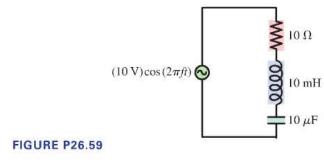
For the circuit of Figure P26.59,a. What is the resonance frequency?b. At resonance, what is the peak current through the circuit? FIGURE P26.59 1092 (10 V) cos (2ft) 10 mH 10 F
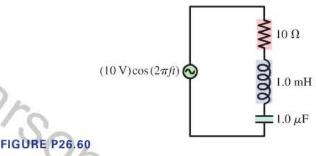
For the circuit of Figure P26.60,a. What is the resonance frequency?b. At resonance, what is the peak current through the circuit? FIGURE P26.60 (10 V) cos (2ft) i eeee-ww 1002 1.0 mH 1.0 F
An \(R L C\) circuit consists of a \(48 \Omega\) resistor, a \(200 \mu \mathrm{F}\) capacitor, and an inductor. The rms current is \(2.5 \mathrm{~A}\) when the circuit is connected to a \(120 \mathrm{~V}, 60 \mathrm{~Hz}\) outlet. What is the inductance?
If the frequency is doubled to \(80 \mathrm{kHz}\) and the current is kept the same, what will be the peak out-of-phase voltage?A. \(0.32 \mathrm{~V}\)B. \(0.16 \mathrm{~V}\)C. \(0.080 \mathrm{~V}\)D. \(0.040 \mathrm{~V}\)The capacitance of biological membranes is about \(1.0 \mu \mathrm{F}\) per
What is the approximate capacitance of the cell membrane?A. \(20 \times 10^{-11} \mathrm{~F}\)B. \(10 \times 10^{-11} \mathrm{~F}\)C. \(5.0 \times 10^{-11} \mathrm{~F}\)D. \(2.5 \times 10^{-11} \mathrm{~F}\)The capacitance of biological membranes is about \(1.0 \mu \mathrm{F}\) per
If the capacitance of a cell membrane is measured to be \(6.0 \times 10^{-11} \mathrm{~F}\), what is the area?A. \(6.0 \times 10^{-13} \mathrm{~m}^{2}\)B. \(6.0 \times 10^{-11} \mathrm{~m}^{2}\)C. \(6.0 \times 10^{-9} \mathrm{~m}^{2}\)D. \(6.0 \times 10^{-7} \mathrm{~m}^{2}\)The capacitance of
If the investigator applies a \(1.0 \mu \mathrm{A}\) peak current at \(40 \mathrm{kHz}\) to a cell with twice the membrane area of the cell noted in the passage, what will be the peak out-of-phase voltage?A. \(0.32 \mathrm{~V}\)B. \(0.16 \mathrm{~V}\)C. \(0.080 \mathrm{~V}\)D. \(0.040
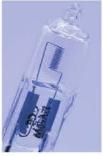
The \(12 \mathrm{~V}\) rating of the bulb refers to the rms voltage. What is the peak voltage across the bulb?A. \(8.5 \mathrm{~V}\)B. \(12 \mathrm{~V}\)C. \(17 \mathrm{~V}\)D. \(24 \mathrm{~V}\)Halogen bulbs have some differences from standard incandescent lightbulbs. They are generally smaller,
Suppose the transformer in the base of the lamp has 500 turns of wire on its primary coil. How many turns are on the secondary coil?A. 50B. 160C. 500D. 5000Halogen bulbs have some differences from standard incandescent lightbulbs. They are generally smaller, the filament runs at a higher
How much current is drawn by the lamp at the outlet? That is, what is the rms current in the primary?A. \(0.42 \mathrm{~A}\)B. \(1.3 \mathrm{~A}\)C. \(4.2 \mathrm{~A}\)D. \(13 \mathrm{~A}\)Halogen bulbs have some differences from standard incandescent lightbulbs. They are generally smaller, the
What will be the voltage across the bulb if the lamp's power cord is accidentally plugged into a \(240 \mathrm{~V}, 60 \mathrm{~Hz}\) outlet?A. \(2 \mathrm{~V}\)B. \(24 \mathrm{~V}\)C. \(36 \mathrm{~V}\)D. \(48 \mathrm{~V}\)Halogen bulbs have some differences from standard incandescent lightbulbs.
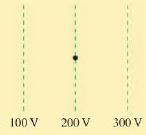
An electron is released from rest at the dot. Afterward, the electron A. Starts moving to the right.B. Starts moving to the left.C. Remains at rest. 100 V 200 V 300 V
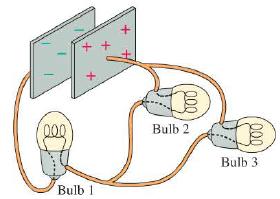
The discharge of a capacitor lights three bulbs. Comparing the current in bulbs 1 and 2, we can say that A. The current in bulb l is greater than the current in bulb 2.B. The current in bulb l is less than the current in bulb 2.C. The current in bulb 1 is equal to the current in bulb 2. + 000 Bulb
Showing 1100 - 1200
of 4913
First
5
6
7
8
9
10
11
12
13
14
15
16
17
18
19
Last
Step by Step Answers

 Get 50% OFF
Claim Now
Get 50% OFF
Claim Now