New Semester
Started
Get
50% OFF
Study Help!
--h --m --s
Claim Now
Question Answers
Textbooks
Find textbooks, questions and answers
Oops, something went wrong!
Change your search query and then try again
S
Books
FREE
Study Help
Expert Questions
Accounting
General Management
Mathematics
Finance
Organizational Behaviour
Law
Physics
Operating System
Management Leadership
Sociology
Programming
Marketing
Database
Computer Network
Economics
Textbooks Solutions
Accounting
Managerial Accounting
Management Leadership
Cost Accounting
Statistics
Business Law
Corporate Finance
Finance
Economics
Auditing
Tutors
Online Tutors
Find a Tutor
Hire a Tutor
Become a Tutor
AI Tutor
AI Study Planner
NEW
Sell Books
Search
Search
Sign In
Register
study help
sciences
college physics reasoning
College Physics A Strategic Approach 3rd Edition Randall D. Knight, Brian Jones, Stuart Field - Solutions
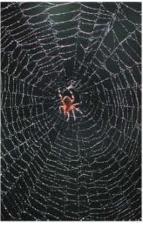
Assuming that the web acts like a spring, what is the spring constant of the web?A. \(0.039 \mathrm{~N} / \mathrm{m}\)B. \(0.39 \mathrm{~N} / \mathrm{m}\)C. \(3.9 \mathrm{~N} / \mathrm{m}\)D. \(39 \mathrm{~N} / \mathrm{m}\)All spiders have special organs that make them exquisitely sensitive to
A typical timber wolf has a mass of \(40 \mathrm{~kg}\), a typical jackrabbit a mass of \(2.5 \mathrm{~kg}\). Given the scaling law presented in the passage, we'd expect the specific metabolic rate of the jackrabbit to be higher by a factor of A. 2 B. 4 C. 8 D. 16
A standard gold bar stored at Fort Knox, Kentucky, is 7.00 inches long, 3.63 inches wide, and 1.75 inches tall. Gold has a density of \(19,300 \mathrm{~kg} / \mathrm{m}^{3}\). What is the mass of such a gold bar?
A typical timber wolf has a mass of \(40 \mathrm{~kg}\), a typical jackrabbit a mass of \(2.5 \mathrm{~kg}\). Given the scaling law presented in the passage, we'd expect the wolf to use times more energy than a jackrabbit in the course of a day.A. 2 B. 4 C. 8 D. 16
Given the data of the graph, approximately how much energy, in Calories, would a \(200 \mathrm{~g}\) rat use during the course of a day?A. 10 B. 20 C. 100 D. 200
Air enclosed in a cylinder has density \(ho=1.4 \mathrm{~kg} / \mathrm{m}^{3}\).a. What will be the density of the air if the length of the cylinder is doubled while the radius is unchanged?b. What will be the density of the air if the radius of the cylinder is halved while the length is unchanged?
All other things being equal, species that inhabit cold climates tend to be larger than related species that inhabit hot climates. For instance, the Alaskan hare is the largest North American hare, with a typical mass of \(5.0 \mathrm{~kg}\), double that of a jackrabbit. A likely explanation is
The passage proposes that there are quantitative "laws" of biology that have their basis in physical principles, using the scaling of specific metabolic rate with body mass as an example. Which of the following regularities among animals might also be an example of such a "law"?A. As a group, birds
If the cyclist reaches his \(15 \mathrm{~km} / \mathrm{h}\) cruising speed by rolling down a hill, what is the approximate height of the hill?A. \(22 \mathrm{~m}\)B. \(11 \mathrm{~m}\)C. \(2 \mathrm{~m}\)D. \(1 \mathrm{~m}\)A \(68 \mathrm{~kg}\) cyclist is pedaling down the road at \(15
As he cycles at a constant speed on level ground, at what rate is chemical energy being converted to thermal energy in his body, assuming a typical efficiency of \(25 \%\) for the conversion of chemical energy to the mechanical energy of motion?A. \(480 \mathrm{~W}\)B. \(360 \mathrm{~W}\)C. \(240
To keep from overheating, the cyclist must get rid of the excess thermal energy generated in his body. If he cycles at this rate for 2 hours, how many liters of water must he perspire, to the nearest 0.1 liter?A. \(0.4 \mathrm{~L}\)B. \(0.9 \mathrm{~L}\)C. \(1.1 \mathrm{~L}\)D. \(1.4 \mathrm{~L}\)A
A tall cylinder contains \(25 \mathrm{~cm}\) of water. Oil is carefully poured into the cylinder, where it floats on top of the water, until the total liquid depth is \(40 \mathrm{~cm}\). What is the gauge pressure at the bottom of the cylinder?
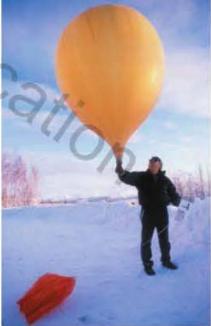
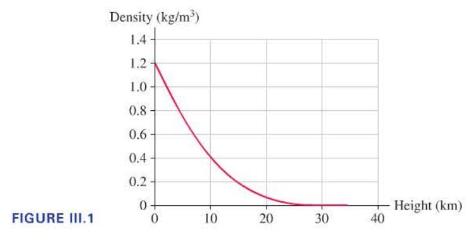
A balloon launched from sea level has a volume of approximately \(4 \mathrm{~m}^{3}\). What is the approximate buoyant force on the balloon?A. \(50 \mathrm{~N}\)B. \(40 \mathrm{~N}\)C. \(20 \mathrm{~N}\)D. \(10 \mathrm{~N}\)The data used to generate weather forecasts are gathered by hundreds of
Being able to exhaust this thermal energy is very important. If he isn't able to get rid of any of the excess heat, by how much will the temperature of his body increase in 10 minutes of riding, to the nearest \(0.1^{\circ} \mathrm{C}\) ?A. \(0.3^{\circ} \mathrm{C}\)B. \(0.6^{\circ} \mathrm{C}\)C.
A balloon launched from sea level with a volume of \(4 \mathrm{~m}^{3}\) will have a volume of about \(12 \mathrm{~m}^{3}\) on reaching an altitude of \(10 \mathrm{~km}\). What is the approximate buoyant force now?A. \(50 \mathrm{~N}\)B. \(40 \mathrm{~N}\)C. \(20 \mathrm{~N}\)D. \(10
The gauge pressure at the bottom of a cylinder of liquid is \(p_{\mathrm{g}}=0.40 \mathrm{~atm}\). The liquid is poured into another cylinder with twice the radius of the first cylinder. What is the gauge pressure at the bottom of the second cylinder?
The balloon expands as it rises, keeping the pressures inside and outside the balloon approximately equal. If the balloon rises slowly, heat transfers will keep the temperature inside the same as the outside air temperature. A balloon with a volume of \(4.0 \mathrm{~m}^{3}\) is launched at sea
If the balloon rises quickly, so that no heat transfer is possible, the temperature inside the balloon will drop as the gas expands. If a \(4.0 \mathrm{~m}^{3}\) balloon is launched at a pressure of \(100 \mathrm{kPa}\) and rapidly rises to a point where the pressure is \(50 \mathrm{kPa}\), the
The highest that George can suck water up a very long straw is \(2.0 \mathrm{~m}\). (This is a typical value.) What is the lowest pressure that he can maintain in his mouth?
At the end of the flight, the radiosonde is dropped and falls to earth by parachute. Suppose the parachute achieves its terminal speed at a height of \(30 \mathrm{~km}\). As it descends into the atmosphere, how does the terminal speed change?A. It increases.B. It stays the same.C. It decreases.The
A balloon is launched at sea level, where the air pressure is \(100 \mathrm{kPa}\). The helium has a volume of \(1000 \mathrm{~m}^{3}\) at this altitude. What is the volume of the helium when the balloon has risen to a height where the atmospheric pressure is \(33 \mathrm{kPa}\) ?A. \(330
A balloon is launched at sea level, where the air pressure is \(100 \mathrm{kPa}\). The density in the hot-air chamber is \(1.0 \mathrm{~kg} / \mathrm{m}^{3}\). What is the density of the air when the balloon has risen to a height where the atmospheric pressure is \(33 \mathrm{kPa}\) ?A. \(3.0
A balloon is at a height of \(5.0 \mathrm{~km}\) and is descending at a constant rate. The buoyancy force is directed ; the drag force is directedA. Up, upB. Up, downC. Down, upD. Down, downLong-distance balloon flights are usually made using a hot-airballoon/helium-balloon hybrid. The balloon has
When you exhale, all of the air in your lungs must exit through the trachea. If you exhale through your nose, this air subsequently leaves through your nostrils. The area of your nostrils is less than that of your trachea. How does the speed of the air in the trachea compare to that in the
Sneezing requires an increase in pressure of the air in the lungs;a typical sneeze might result in an extra pressure of \(7.0 \mathrm{kPa}\). Estimate how much force this exerts on the diaphragm, the large muscle at the bottom of the ribcage.Long-distance balloon flights are usually made using a
A \(20 \mathrm{~kg}\) block of aluminum sits on the bottom of a tank of water. How much force does the block exert on the bottom of the tank?Long-distance balloon flights are usually made using a hot-airballoon/helium-balloon hybrid. The balloon has a sealed, flexible chamber of helium gas that
Postural hypotension is the occurrence of low (systolic) blood pressure when standing up too quickly from a reclined position, causing fainting or lightheadedness. For most people, a systolic pressure less than \(90 \mathrm{~mm} \mathrm{Hg}\) is considered low. If the blood pressure in your brain
We've seen that fish can control their buoyancy through the use of a swim bladder, a gas-filled organ inside the body. You can assume that the gas pressure inside the swim bladder is roughly equal to the external water pressure. A fish swimming at a particular depth adjusts the volume of its swim
To determine an athlete's body fat, she is weighed first in air and then again while she's completely underwater, as discussed on page
It is found that she weighs \(690 \mathrm{~N}\) when weighed in air and \(42 \mathrm{~N}\) when weighed underwater. What is her average density?
A person's percentage of body fat can be estimated by weighing the person both in air and underwater, from which the average density \(ho_{\text {avg }}\) can be calculated. A widely used equation that relates average body density to fat percentage is the Siri equation, \% body fat \(=\left(495 /
Water flows into a horizontal, cylindrical pipe at \(1.4 \mathrm{~m} / \mathrm{s}\). The pipe then narrows until its diameter is halved. What is the pressure difference between the wide and narrow ends of the pipe?
There are two carotid arteries that feed blood to the brain, one on each side of the neck and head. One patient's carotid arteries are each \(11.2 \mathrm{~cm}\) long and have an inside diameter of \(5.2 \mathrm{~mm}\). Near the middle of the left artery, however, is a \(2.0-\mathrm{cm}\)-long
Smoking tobacco is bad for your circulatory health. In an attempt to maintain the blood's capacity to deliver oxygen, the body increases its red blood cell production, and this increases the viscosity of the blood. In addition, nicotine from tobacco causes arteries to constrict. For a nonsmoker,
A stiff, 10-cm-long tube with an inner diameter of \(3.0 \mathrm{~mm}\) is attached to a small hole in the side of a tall beaker. The tube sticks out horizontally. The beaker is filled with \(20^{\circ} \mathrm{C}\) water to a level \(45 \mathrm{~cm}\) above the hole, and it is continually topped
There is a limit to how long your neck can be. If your neck were too long, no blood would reach your brain! What is the maximum height a person's brain could be above his heart, given the noted pressure and assuming that there are no valves or supplementary pumping mechanisms in the neck? The
Because the flow speed in your capillaries is much less than in the aorta, the total cross-section area of the capillaries considered together must be much larger than that of the aorta. Given the flow speeds noted, the total area of the capillaries considered together is equivalent to the
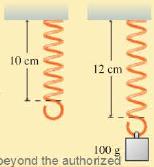
A hanging spring has length 10 cm. A 100 g mass is hung from the spring, stretching it to 12 cm. What will be the length of the spring if this mass is replaced by a 200 g mass? A. 14 cm B. 16 cm C. 20 cm D. 24 cm www. 10 cm. www. 12 cm 100 g Deyond the authorized
Suppose that in response to some stimulus a small blood vessel narrows to \(90 \%\) of its original diameter. If there is no change in the pressure across the vessel, what is the ratio of the new volume flow rate to the original flow rate?A. 0.66B. 0.73C. 0.81D. 0.90The blood pressure at your heart
Give three real-world examples of oscillatory motion. (Note that circular motion is similar to, but not the same as oscillatory motion.)
Two oscillating systems have periods T1 and T2, with T12. How are the frequencies of the two systems related? A. fi f
A ball is hung from a rope, making a pendulum. When it is pulled 5° to the side, the restoring force is 1.0 N. What will be the magnitude of the restoring force if the ball is pulled 10° to the side?A. 0.5 N B. 1.0 N C. 1.5 N D. 2.0 N
The graphs in the table above apply to pendulum motion as well as the motion of a mass on a spring. A pendulum in a clock has a period of 2.0 seconds.You pull the pendulum to the right-a positive displacement-and Jet it go; we call this time t = 0 s. At what time will the pendulum(a) first be at
A tall building is swaying back and forth on a gusty day. The wind picks up and doubles the amplitude of the oscillation. By what factor does the maximum speed of the top of the building increase? The maximum acceleration?
A spring scale hung from the ceiling stretches by \(6.4 \mathrm{~cm}\) when a \(1.0 \mathrm{~kg}\) mass is hung from it. The \(1.0 \mathrm{~kg}\) mass is removed and replaced with a \(1.5 \mathrm{~kg}\) mass. What is the stretch of the spring?
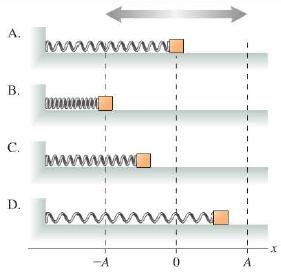
The figures show Elastic cords lead to the up-and-down motion of a bungee jump.four identical oscillators at different points in their motion. Which is moving fastest at the time shown? A. wwwww. B. C. D. www A
A child is on a swing, gently swinging back and forth with a maximum angle of \(5^{\circ}\). A friend gives her a small push so that she now swings with a maximum angle of \(10^{\circ}\). By what factor does this increase her maximum speed?
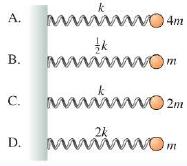
Four mass-spring systems have masses and spring constants shown here. Rank in order, from highest to lowest, the frequencies of the oscillations. A. B. www.4mm M m M wwwo" wwwww2.m M C. D. M www.m 2k
A pendulum clock is made with a metal rod. It keeps perfect time at a temperature of 20°C. At a higher temperature, the metal rod lengthens.How will this change the clock's timekeeping?A. The clock will run fast; the dial will be ahead of the actual time.B. The clock will keep perfect time.C. The
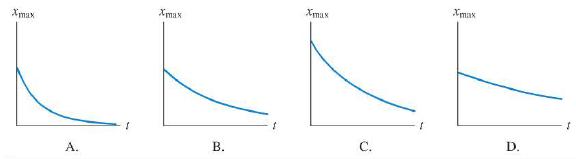
Rank in order, from largest to smallest, the time constants TA to To of the decays in the figures. The scales on all the graphs are the same. Xmax Xmax Xmax Xmas A. B. C. D.
A block oscillating on a spring has period \(T=2.0 \mathrm{~s}\).a. What is the period if the block's mass is doubled?b. What is the period if the value of the spring constant is quadrupled?c. What is the period if the oscillation amplitude is doubled while \(m\) and \(k\) are unchanged?Note: You
A pendulum on Planet \(X\), where the value of \(g\) is unknown, oscillates with a period of \(2.0 \mathrm{~s}\). What is the period of this pendulum if:a. Its mass is doubled?b. Its length is doubled?c. Its oscillation amplitude is doubled?
Denver is at a higher elevation than Miami; the free-fall acceleration is slightly less at this higher elevation. If a pendulum clock keeps perfect time in Miami, will it run fast or slow in Denver? Explain.
We can model the motion of a dragonfly's wing as simple harmonic motion. The total distance between the upper and lower limits of motion of the wing tip is \(1.0 \mathrm{~cm}\). The wing oscillates at \(40 \mathrm{~Hz}\). What is the maximum speed of the wing tip?
We can model the motion of a bumblebee's wing as simple harmonic motion. A bee beats its wings 250 times per second, and the wing tip moves at a maximum speed of \(2.5 \mathrm{~m} / \mathrm{s}\). What is the amplitude of the wing tip's motion?
It is possible to identify promising locations for oil drilling by making accurate measurements of the local value of \(g\) : A low value means there is low-density material under the surface, which often means that oil is present. For many years, prospectors used pendulums to make such
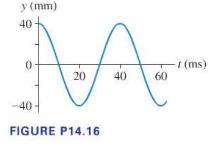
Hummingbirds may seem fragile, but their wings are capable of sustaining very large forces and accelerations. Figure P14.16 shows data for the vertical position of the wing tip of a rufous hummingbird. What is the maximum acceleration of the wing tips, in \(\mathrm{m} / \mathrm{s}^{2}\) and in
A 50-cm-long spring is suspended from the ceiling. A \(250 \mathrm{~g}\) mass is connected to the end and held at rest with the spring unstretched. The mass is released and falls, stretching the spring by \(20 \mathrm{~cm}\) before coming to rest at its lowest point. It then continues to oscillate
A spring has an unstretched length of \(20 \mathrm{~cm}\). A \(100 \mathrm{~g}\) mass hanging from the spring stretches it to an equilibrium length of \(30 \mathrm{~cm}\).a. Suppose the mass is pulled down to where the spring's length is \(40 \mathrm{~cm}\). When it is released, it begins to
A \(200 \mathrm{~g}\) mass attached to a horizontal spring oscillates at a frequency of \(2.0 \mathrm{~Hz}\). At one instant, the mass is at \(x=5.0 \mathrm{~cm}\) and has \(v_{x}=-30 \mathrm{~cm} / \mathrm{s}\). Determine:a. The period.b. The amplitude.c. The maximum speed.d. The total energy.
I A ball of mass \(m\) oscillates on a spring with spring constant \(k=200 \mathrm{~N} / \mathrm{m}\). The ball's position is \(x=(0.350 \mathrm{~m}) \cos (15.0 t)\), with \(t\) measured in seconds.a. What is the amplitude of the ball's motion?A. \(0.175 \mathrm{~m}\)\(\begin{array}{lll}\text { B.
I A car bounces up and down on its springs at \(1.0 \mathrm{~Hz}\) with only the driver in the car. Now the driver is joined by four friends. The new frequency of oscillation when the car bounces on its springs is A. Greater than \(1.0 \mathrm{~Hz}\).B. Equal to \(1.0 \mathrm{~Hz}\).C. Less than
The mass in a pendulum clock completes one complete swing in \(1.00 \mathrm{~s}\). What is the length of the rod?
A heavy brass ball is used to make a pendulum with a period of \(5.5 \mathrm{~s}\). How long is the cable that connects the pendulum ball to the ceiling?A. \(4.7 \mathrm{~m}\)B. \(6.2 \mathrm{~m}\)C. \(7.5 \mathrm{~m}\)D. \(8.7 \mathrm{~m}\)
Interestingly, there have been several studies using cadavers to determine the moment of inertia of human body parts by letting them swing as a pendulum about a joint. In one study, the center of gravity of a \(5.0 \mathrm{~kg}\) lower leg was found to be \(18 \mathrm{~cm}\) from the knee. When
An elephant's legs have a reasonably uniform cross section from top to bottom, and they are quite long, pivoting high on the animal's body. When an elephant moves at a walk, it uses very little energy to bring its legs forward, simply allowing them to swing like pendulums. For fluid walking motion,
A physics department has a Foucault pendulum, a longperiod pendulum suspended from the ceiling. The pendulum has an electric circuit that keeps it oscillating with a constant amplitude. When the circuit is turned off, the oscillation amplitude decreases by \(50 \%\) in 22 minutes. What is the
Taipei 101 (a 101-story building in Taiwan) is sited in an area that is prone to earthquakes and typhoons, both of which can lead to dangerous oscillations of the building. To reduce the maximum amplitude, the building has a tuned mass damper, a 660,000 \(\mathrm{kg}\) mass suspended from 42
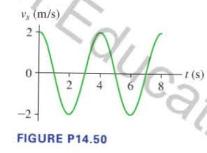
An object oscillating on a spring has the velocity graph shown in Figure P14.50. Draw a velocity graph if the following changes are made.a. The amplitude is doubled and the frequency is halved.b. The amplitude and spring constant are kept the same, but the mass is quadrupled. Parts \(\mathrm{a}\)
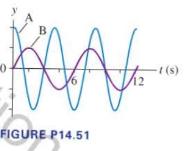
The two graphs in Figure P14.51 are for two different vertical mass-spring systems.a. What is the frequency of system \(\mathrm{A}\) ? What is the first time at which the mass has maximum speed while traveling in the upward direction?b. What is the period of system B? What is the first time at
A \(100 \mathrm{~g}\) ball attached to a spring with spring constant \(2.50 \mathrm{~N} / \mathrm{m}\) oscillates horizontally on a frictionless table. Its velocity is \(20.0 \mathrm{~cm} / \mathrm{s}\) when \(x=-5.00 \mathrm{~cm}\).a. What is the amplitude of oscillation?b. What is the speed of
A compact car has a mass of \(1200 \mathrm{~kg}\). When empty, the car bounces up and down on its springs 2.0 times per second. What is the car's oscillation frequency when it is carrying four \(70 \mathrm{~kg}\) passengers?
A car with a total mass of \(1400 \mathrm{~kg}\) (including passengers) is driving down a washboard road with bumps spaced \(5.0 \mathrm{~m}\) apart. The ride is roughest-that is, the car bounces up and down with the maximum amplitude-when the car is traveling at \(6.0 \mathrm{~m} / \mathrm{s}\).
Figure P14.59 shows two springs, each with spring constant \(20 \mathrm{~N} / \mathrm{m}\), connecting a \(2.5 \mathrm{~kg}\) block to two walls. The block slides on a frictionless surface. The block is displaced \(1.0 \mathrm{~cm}\) from equilibrium.a. What is the magnitude of the restoring
Orangutans can move by brachiation, swinging like a pendulum beneath successive handholds. If an orangutan has arms that are \(0.90 \mathrm{~m}\) long and repeatedly swings to a \(20^{\circ}\) angle, taking one swing immediately after another, estimate how fast it is moving in \(\mathrm{m} /
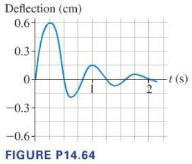
A jellyfish can propel Deflection \((\mathrm{cm})\) itself with jets of water pushed out of its bell, a flexible structure on top of its body. The elastic bell and the water it contains function as a mass-spring system, greatly increasing efficiency. Normally, the jellyfish emits one jet right
An infant's toy has a \(120 \mathrm{~g}\) wooden animal hanging from a spring. If pulled down gently, the animal oscillates up and down with a period of \(0.50 \mathrm{~s}\). His older sister pulls the spring a bit more than intended. She pulls the animal \(30 \mathrm{~cm}\) below its equilibrium
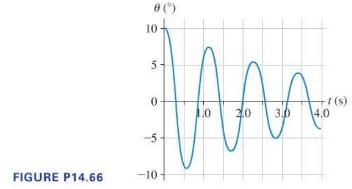
While seated on a tall bench, extend your lower leg a small amount and then let it swing freely about your knee joint, with no muscular engagement. It will oscillate as a damped pendulum. Figure P14.66 is a graph of the lower leg angle versus time in such an experiment. Estimate(a) the period
Modeling the motion of the fly on the web as a mass on a spring, at what frequency will the web vibrate when the fly hits it?A. \(0.91 \mathrm{~Hz}\)B. \(2.9 \mathrm{~Hz}\)C. \(9.1 \mathrm{~Hz}\)D. \(29 \mathrm{~Hz}\)In fact, spiders carefully adjust the tension of strands to "tune" their web.
If the web were vertical rather than horizontal, how would the frequency of oscillation be affected?A. The frequency would be higher.B. The frequency would be lower.C. The frequency would be the same.In fact, spiders carefully adjust the tension of strands to "tune" their web. Suppose an insect
Spiders are more sensitive to oscillations at higher frequencies. For example, a low-frequency oscillation at \(1 \mathrm{~Hz}\) can be detected for amplitudes down to \(0.1 \mathrm{~mm}\), but a high-frequency oscillation at \(1 \mathrm{kHz}\) can be detected for amplitudes as small as \(0.1 \mu
A wooden toy hangs from a spring. When you pull it down and release it, it reaches the highest point of its motion after 1.0 s. What is the frequency of the oscillation?A. 2.0 Hz B. 1.5 Hz C. 1.0 Hz D. 0.5 Hz
Spectators at a sporting event do "The Wave," as shown in the photo on the preceding page. Is this a transverse or longitudinal wave?
Suppose you shake the end of a stretched string to produce a wave. Which of the following actions would increase the speed of the wave down the string? There may be more than one correct answer; if so, give all that are correct.A. Move your hand up and down more quickly as you generate the wave.B.
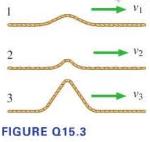
The wave pulses shown in Figure Q15.3 travel along the same string. Rank in order, from largest to smallest, their wave speeds \(v_{1}, v_{2}\), and \(v_{3}\). Explain. V V2 2 3. FIGURE Q15.3 V3
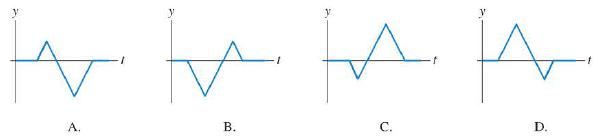
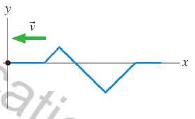
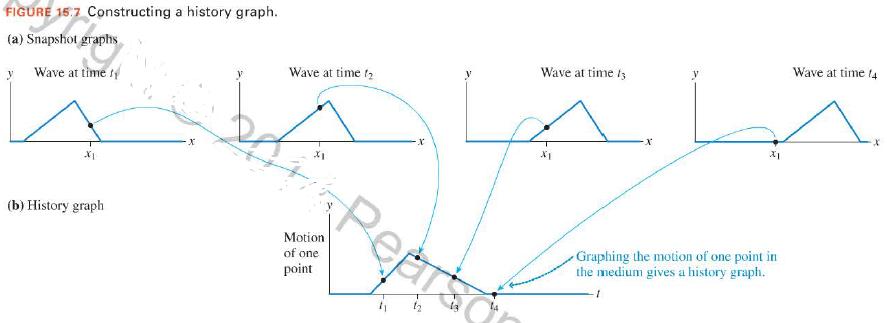
The figure at right is a snapshot graph of a wave moving to the left. The wave is to the right of the origin, but it will reach the origin as it moves. Construct a history graph for the motion of the marked point at the origin following the approach shown in Figure 15.7. Which of the graphs below
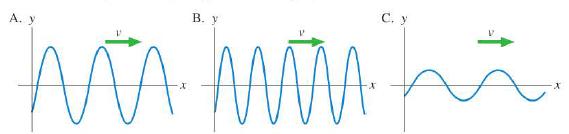
Three waves travel to the right with the same speed. Which wave has the highest frequency? All three graphs have the same horizontal scale. A. y B. Y C. y win win. x
Comparing two different types of electromagnetic waves, infrared and ultraviolet, we can say thatA. Infrared has a longer wavelength and higher frequency than ultraviolet.B. Infrared has a shorter wavelength and higher frequency than ultraviolet.C. Infrared has a longer wavelength and lower
Harbor seals, like many animals, determine the direction from which a sound is coming by sensing the difference in arrival times at their two ears. A small difference in arrival times means that the object is in front of the seal; a larger difference means it is to the left or right. There is a
A medical ultrasound imaging system sends out a steady B10 stream of very short pulses. To simplify analysis, the reflection of one pulse should be received before the next is transmitted. If the system is being used to create an image of tissue \(12 \mathrm{~cm}\) below the skin, what is the
A plane wave, a circular wave, and a spherical wave all have the same intensity. Each of the waves travels the same distance. Afterward, which wave has the highest intensity?A. The plane wave B. The circular wave C. The spherical wave.
An earthquake \(45 \mathrm{~km}\) from a city produces \(\mathrm{P}\) and \(\mathrm{S}\) waves that travel outward at 5000 and \(3000 \mathrm{~m} / \mathrm{s}\), respectively. Once city residents feel the shaking of the \(\mathrm{P}\) wave, how much time do they have before the \(\mathrm{S}\) wave
You are overhearing a very heated conversation that registers 80 dB. You walk some distance away so that the intensity decreases by a factor of 100. What is the sound intensity level now?A. 70 dB B. 60 dB C. 50 dB D. 40dB E. 30dB F. 20 dB
A stationary boat in the ocean is experiencing waves from a storm. The waves move at \(56 \mathrm{~km} / \mathrm{h}\) and have a wavelength of \(160 \mathrm{~m}\), both typical values. The boat is at the crest of a wave. How much time elapses until the boat is first at the trough of a wave?
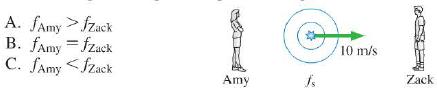
Amy and Zack are both listening to the source of sound waves that is moving to the right. Compare the frequencies each hears. A. JAmy >Zack B. fAmy=fzack C. JAmy zack Amy 10 m/s Zack
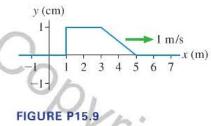
Figure P15.9 is a snapshot graph of a wave at \(t=0 \mathrm{~s}\). Draw the history graph for this wave at \(x=6 \mathrm{~m}\), for \(t=0 \mathrm{~s}\) to \(6 \mathrm{~s}\). y (cm) I m/s 1 2 3 4 567 FIGURE P15.9 x (m)
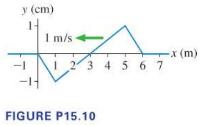
Figure P15.10 is a snapshot graph of a wave at \(t=2 \mathrm{~s}\). Draw the history graph for this wave at \(x=0 \mathrm{~m}\), for \(t=0 \mathrm{~s}\) to \(8 \mathrm{~s}\). y (cm) 1 m/s- 1 2 3 4 5 6 7 FIGURE P15.10 -x (m)
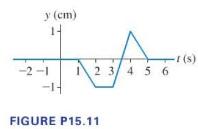
Figure P15.11 is a history graph at \(x=0 \mathrm{~m}\) of a wave moving to the right at \(1 \mathrm{~m} / \mathrm{s}\). Draw a snapshot graph of this wave at \(t=1 \mathrm{~s}\). y (cm) -2-1 1 2 3 4 5 6 FIGURE P15.11 -1(s).
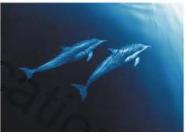
Bottlenose dolphins use echolocation pulses with a frequency of about \(100 \mathrm{kHz}\), higher than the frequencies used by most bats. Why might you expect these water-dwelling creatures to use higher echolocation frequencies than bats?
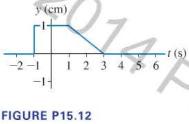
Figure P15.12 is a history graph at \(x=2 \mathrm{~m}\) of a wave moving to the left at \(1 \mathrm{~m} / \mathrm{s}\). Draw the snapshot graph of this wave at \(t=0 \mathrm{~s}\). -I (cm) 1 1 2 3 4 5 6 FIGURE P15.12 t(s)
Showing 1800 - 1900
of 4913
First
12
13
14
15
16
17
18
19
20
21
22
23
24
25
26
Last
Step by Step Answers

 Get 50% OFF
Claim Now
Get 50% OFF
Claim Now