New Semester
Started
Get
50% OFF
Study Help!
--h --m --s
Claim Now
Question Answers
Textbooks
Find textbooks, questions and answers
Oops, something went wrong!
Change your search query and then try again
S
Books
FREE
Study Help
Expert Questions
Accounting
General Management
Mathematics
Finance
Organizational Behaviour
Law
Physics
Operating System
Management Leadership
Sociology
Programming
Marketing
Database
Computer Network
Economics
Textbooks Solutions
Accounting
Managerial Accounting
Management Leadership
Cost Accounting
Statistics
Business Law
Corporate Finance
Finance
Economics
Auditing
Tutors
Online Tutors
Find a Tutor
Hire a Tutor
Become a Tutor
AI Tutor
AI Study Planner
NEW
Sell Books
Search
Search
Sign In
Register
study help
sciences
college physics reasoning
College Physics A Strategic Approach 3rd Edition Randall D. Knight, Brian Jones, Stuart Field - Solutions
The electric potential is \(300 \mathrm{~V}\) at \(x=0 \mathrm{~cm}\), is \(-100 \mathrm{~V}\) at \(x=5 \mathrm{~cm}\), and varies linearly with \(x\). If a positive charge is released from rest at \(x=2.5 \mathrm{~cm}\), and is subject only to electric forces, the charge willA. Move to the
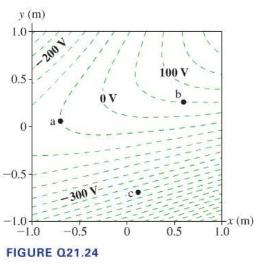
What is the potential at point \(\mathrm{c}\) ?A. \(-400 \mathrm{~V}\)B. \(-350 \mathrm{~V}\)C. \(-100 \mathrm{~V}\)D. \(350 \mathrm{~V}\)E. \(400 \mathrm{~V}\)Refer to Figure Q21.24, which shows equipotential lines in a region of space. The equipotential lines are spaced by the same difference in
At which point, a, b, or \(\mathrm{c}\), is the magnitude of the electric field the greatest?Refer to Figure Q21.24, which shows equipotential lines in a region of space. The equipotential lines are spaced by the same difference in potential, and several of the potentials are given. y (m) 1.0- 0.5
What is the approximate magnitude of the electric field at point \(c\) ?A. \(100 \mathrm{~V} / \mathrm{m}\)B. \(300 \mathrm{~V} / \mathrm{m}\)C. \(800 \mathrm{~V} / \mathrm{m}\)D. \(1500 \mathrm{~V} / \mathrm{m}\)E. \(3000 \mathrm{~V} / \mathrm{m}\)Refer to Figure Q21.24, which shows equipotential
The direction of the electric field at point \(b\) is closest to which direction?A. RightB. UpC. LeftD. DownRefer to Figure Q21.24, which shows equipotential lines in a region of space. The equipotential lines are spaced by the same difference in potential, and several of the potentials are given.
\(\mathrm{A}+10 \mathrm{nC}\) charge is moved from point \(\mathrm{c}\) to point \(\mathrm{a}\). How much work is required in order to do this?A. \(3.5 \times 10^{-6} \mathrm{~J}\)B. \(4.0 \times 10^{-6} \mathrm{~J}\)C. \(3.5 \times 10^{-3} \mathrm{~J}\)D. \(4.0 \times 10^{-3} \mathrm{~J}\)Refer to
A bug zapper consists of two metal plates connected to a }\end{array}\) high-voltage power supply. The voltage between the plates is set to give an electric field slightly less than \(1 \times 10^{6} \mathrm{~V} / \mathrm{m}\). When a bug flies between the two plates, it increases the field enough
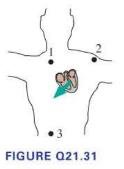
The dipole moment of the heart is shown at a particular instant in Figure Q21.31. Which of the following potential differences will have the largest positive value?A. \(V_{1}-V_{2}\)B. \(V_{1}-V_{3}\)C. \(V_{2}-V_{1}\)D. \(V_{3}-V_{1}\) 3 FIGURE Q21.31
A 170 Hz sound wave in air has a wavelength of 2.0 m. The frequency is now doubled to 340 Hz. What is the new wavelength?A. 4.0 m B. 3.0 m C. 2.0 m D. 1.0 m
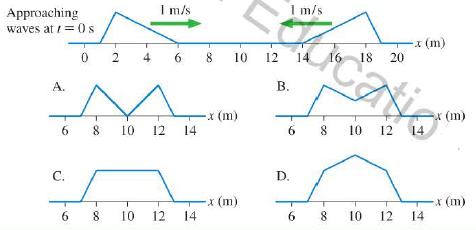
Two pulses on a string approach each other at speeds of 1m/s.What is the shape of the string at t = 6 s? Approaching waves at 7=0s I m/s 02 6 8 10 A. 1 m/s 12 14 16 18 B. x (m) 6 8 10 12 14 6 C. 9 x (m) 20 ca 0 x (m) 10 10 12 14 D. T x (m) -x (m) 8 10 12 14 6 8 10 12 14
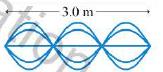
A standing wave is set up on a string.A series of snapshots of the wave are superimposed to produce the diagram at right. What is the wavelength? -3.0 m-
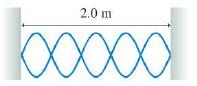
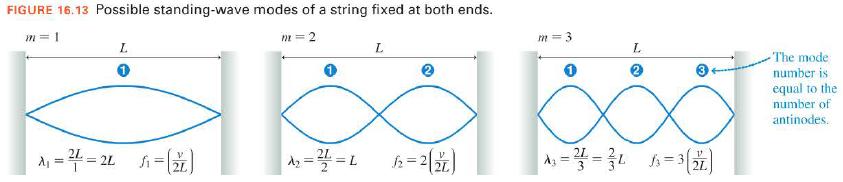
A 2.0-m-long string carries a standing wave as in the figure at right. Extend the pattern and the formulas shown in Figure 16. 13 to determine the mode number and the wavelength of this particular standing-wave mode. A. m = 6, A=0.67 m D. m 5, A = 1.0 m B. m 6, A = 0.80 m E. m C. m 5,A=0.80 m
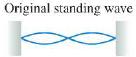
A standing wave on a string is shown.Which of the modes shown below (on the same string) has twice the frequency of the original wave? Original standing wave
A tube that is open at both ends supports a standing wave with harmonics at 300 Hz and 400 Hz, with no harmonics between. What is the fundamental frequency of this tube?A. 50Hz B. 100 Hz C. 150 Hz D. 200Hz E. 300 Hz
If you speak at a certain pitch, then hold your nose and continue speaking at the same pitch, your voice sounds very different. This is because A. The fundamental frequency of your vocal cords has changed.B. The frequencies of the harmonics of your vocal cords have changed.C. The pattern of
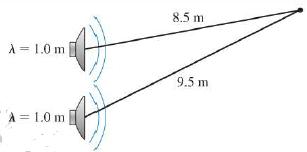
These speakers emit identical sound waves with a wavelength of 1.0 m. At the point indicated, is the interference constructive, destructive, or something in between? A = 1.0 m 8.5 m 9.5 m A=1.0 m
You hear three beats per second when two sound tones are generated. The frequency of one tone is known to be 6 10 Hz. The frequency of the other is A. 604 Hz D. 616 Hz B. 607 Hz E. Either A or D C. 6 13 Hz F. Either B or C
A guitarist finds that the pitch of one of her strings is slightly flat-the frequency is a bit too low. Should she increase or decrease the tension of the string? Explain.
A synthesizer is a keyboard instrument that can be made to sound like a flute, a trumpet, a piano-or any other musical instrument. Pressing a key sets the fundamental frequency of the note that is produced. Other settings that the player can adjust change the sound quality of the synthesizer
Two sinusoidal waves with the same amplitude \(A\) and frequency \(f\) travel in opposite directions along a long string. You stand at one point and watch the string. The maximum displacement of the string at that point isA. \(A\)B. \(2 A\)C. 0D. There is not enough information to decide.
Resonances of the ear canal lead to increased sensitivity of hearing, as we've seen. Dogs have a much longer ear canal\(5.2 \mathrm{~cm}\)-than humans. What are the two lowest frequencies at which dogs have an increase in sensitivity? The speed of sound in the warm air of the ear is \(350
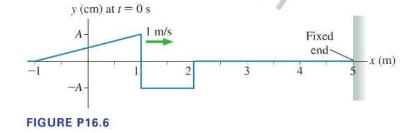
Figure P16.6 is a snapshot graph at \(t=0 \mathrm{~s}\) of a pulse on a string moving to the right at \(1 \mathrm{~m} / \mathrm{s}\). The string is fixed at \(x=5 \mathrm{~m}\). Draw a history graph spanning the time interval \(t=0 \mathrm{~s}\) to \(t=10 \mathrm{~s}\) for the location \(x=3
An experimenter finds that standing waves on a string fixed at both ends occur at \(24 \mathrm{~Hz}\) and \(32 \mathrm{~Hz}\), but at no frequencies in between.a. What is the fundamental frequency?b. Draw the standing-wave pattern for the string at \(32 \mathrm{~Hz}\).
Ocean waves of wavelength \(26 \mathrm{~m}\) are moving directly toward a concrete barrier wall at \(4.4 \mathrm{~m} / \mathrm{s}\). The waves reflect from the wall, and the incoming and reflected waves overlap to make a lovely standing wave with an antinode at the wall. (Such waves are a common
An organ pipe is made to play a low note at \(27.5 \mathrm{~Hz}\), the same as the lowest note on a piano. Assuming a sound speed of \(343 \mathrm{~m} / \mathrm{s}\), what length open-open pipe is needed? What length open-closed pipe would suffice?
The speed of sound in room temperature \(\left(20^{\circ} \mathrm{C}\right)\) air is \(343 \mathrm{~m} / \mathrm{s}\); in room temperature helium, it is \(1010 \mathrm{~m} / \mathrm{s}\). The fundamental frequency of an open-closed tube is \(315 \mathrm{~Hz}\) when the tube is filled with air. What
Some pipe organs create sounds lower than humans can hear. This "infrasound" can still create physical sensations. What is the fundamental frequency of the sound from an open-open pipe that is 32 feet long (a common size for large organs)? What length open-closed tube is necessary to produce this
Although the vocal tract is quite complicated, we can make a simple model of it as an open-closed tube extending from the opening of the mouth to the diaphragm, the large muscle separating the abdomen and the chest cavity. What is the length of this tube if its fundamental frequency equals a
You know that you sound better when you sing in the shower. This has to do with the amplification of frequencies that correspond to the standing-wave resonances of the shower enclosure. A shower enclosure is created by adding glass doors and tile walls to a standard bathtub, so the enclosure has
When a sound wave travels directly toward a hard wall, the incoming and reflected waves can combine to produce a standing wave. There is an antinode right at the wall, just as at the end of a closed tube, so the sound near the wall is loud. You are standing beside a brick wall listening to a \(50
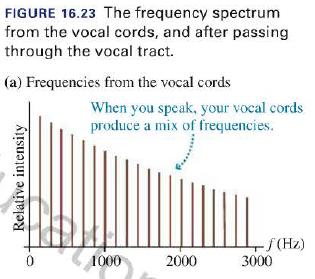
The first formant of your vocal system can be modeled as the resonance of an open-closed tube, the closed end being your vocal cords and the open end your lips. Estimate the frequency of the first formant from the graph of Figure 16.23, and then estimate the length of the tube of which this is a
When you voice the vowel sound in "hat," you narrow the opening where your throat opens into the cavity of your mouth so that your vocal tract appears as two connected tubes. The first is in your throat, closed at the vocal cords and open at the back of the mouth. The second is the mouth itself,
The first and second formants when you make an "ee" vowel sound are approximately \(270 \mathrm{~Hz}\) and \(2300 \mathrm{~Hz}\). The speed of \(\mathbb{N} T\) sound in your vocal tract is approximately \(350 \mathrm{~m} / \mathrm{s}\). If you breathe a mix of oxygen and helium (as deep-sea divers
Two loudspeakers in a \(20^{\circ} \mathrm{C}\) room emit \(686 \mathrm{~Hz}\) sound waves along the \(x\)-axis. What is the smallest distance between the speakers for which the interference of the sound waves is destructive?
In noisy factory environments, it's possible to use a loudspeaker to cancel persistent low-frequency machine noise at the position of one worker. The details of practical systems are complex, but we can present a simple example that gives you the idea. Suppose a machine \(5.0 \mathrm{~m}\) away
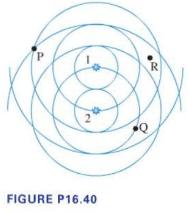
Figure P16.40 shows the circular wave fronts emitted by two sources. Make a table with rows labeled P, Q, and R and columns labeled \(r_{1}, r_{2}, \Delta r\), and \(\mathrm{C} / \mathrm{D}\). Fill in the table for points \(\mathrm{P}, \mathrm{Q}\), and \(R\), giving the distances as multiples of
Two identical loudspeakers \(2.0 \mathrm{~m}\) apart are emitting \(1800 \mathrm{~Hz}\) sound waves into a room where the speed of sound is \(340 \mathrm{~m} / \mathrm{s}\). Is the point \(4.0 \mathrm{~m}\) directly in front of one of the speakers, perpendicular to the plane of the speakers, a
An engine whose sparkplugs fire 120 times a second generates noise at \(120 \mathrm{~Hz}\). The sound level can be reduced by fitting the engine with an exhaust resonator that cancels this primary "note." The resonator is an open-closed tube, with the open end connected to the exhaust system. Sound
Musicians can use beats to tune their instruments. One flute is properly tuned and plays the musical note A at exactly \(440 \mathrm{~Hz}\). A second player sounds the same note and hears that her instrument is slightly "flat" (that is, at too low a frequency). Playing at the same time as the first
A student waiting at a stoplight notices that her turn signal, which has a period of \(0.85 \mathrm{~s}\), makes one blink exactly in sync with the turn signal of the car in front of her. The blinker of the car ahead then starts to get ahead, but \(17 \mathrm{~s}\) later the two are exactly in sync
A child's train whistle replicates a classic conductor's whistle from the early 1900 s. This whistle has two open-open tubes that produce two different frequencies. When you hear these two different frequencies simultaneously, you may have the perception of also hearing a lower note, called a
In addition to producing images, ultrasound can be used to heat tissues of the body for therapeutic purposes. An emitter is placed against the surface of the skin; the amplitude of the ultrasound wave at this point is quite large. When a sound wave hits the boundary between soft tissue and bone,
A \(12 \mathrm{~kg}\) hanging sculpture is suspended by a \(90-\mathrm{cm}-\) long, \(5.0 \mathrm{~g}\) steel wire. When the wind blows hard, the wire hums at its fundamental frequency. What is the frequency of the hum?
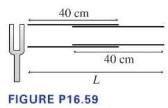
A \(40-\mathrm{cm}-\) long tube has a \(40-\mathrm{cm}-\) long insert that can be pulled in and out, as shown in Figure P16.59. A vibrating tuning fork is held next to the tube. As the insert is slowly pulled out, the sound from the tuning fork creates standing waves in the tube when the total
The width of a particular microwave oven is exactly right to support a standing-wave mode. Measurements of the temperature across the oven show that there are cold spots at each edge of the oven and at three spots in between. The wavelength of the microwaves is \(12 \mathrm{~cm}\). How wide is the
Two loudspeakers \(42.0 \mathrm{~m}\) apart and facing each other emit identical \(115 \mathrm{~Hz}\) sinusoidal sound waves in a room where the sound speed is \(345 \mathrm{~m} / \mathrm{s}\). Susan is walking along a line between the speakers. As she walks, she finds herself moving through loud
Piano tuners tune pianos by listening to the beats between the harmonics of two different strings. When properly tuned, the note A should have the frequency \(440 \mathrm{~Hz}\) and the note \(\mathrm{E}\) should be at \(659 \mathrm{~Hz}\). The tuner can determine this by listening to the beats
Police radars determine speed by measuring the Doppler shift of \(\mathbb{N T}\) radio waves reflected by a moving vehicle. They do so by determining the beat frequency between the reflected wave and the \(10.5 \mathrm{GHz}\) emitted wave. Some units can be calibrated by using a tuning fork;
An ultrasound unit is being used to measure a patient's heart-beat by combining the emitted \(2.0 \mathrm{MHz}\) signal with the sound waves reflected from the moving tissue of one point on the heart. The beat frequency between the two signals has a maximum value of \(520 \mathrm{~Hz}\). What is
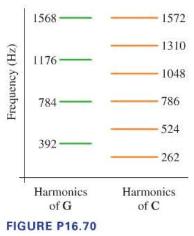
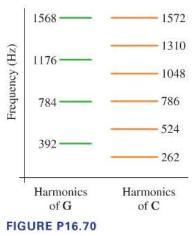
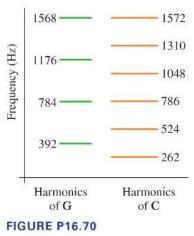
What is the beat frequency between the second harmonic of \(\mathrm{G}\) and the third harmonic of \(\mathrm{C}\) ?A. \(1 \mathrm{~Hz}\)B. \(2 \mathrm{~Hz}\)C. \(4 \mathrm{~Hz}\)D. \(6 \mathrm{~Hz}\)
Would a G-flat (frequency \(370 \mathrm{~Hz}\) ) and a C played together be consonant or dissonant?A. ConsonantB. Dissonant.You know that certain musical notes sound good together harmonious-whereas others do not. This harmony is related to the various harmonics of the notes.The musical notes
An organ pipe open at both ends is tuned so that its fundamental frequency is a G. How long is the pipe?A. \(43 \mathrm{~cm}\)B. \(87 \mathrm{~cm}\)C. \(130 \mathrm{~cm}\)D. \(173 \mathrm{~cm}\)You know that certain musical notes sound good togetherharmonious-whereas others do not. This harmony is
If the \(\mathrm{C}\) were played on an organ pipe that was open at one end and closed at the other, which of the harmonic frequencies in Figure P16.70 would be present?A. All of the harmonics in the figure would be present.B. 262,786 , and \(1310 \mathrm{~Hz}\)C. 524,1048 , and \(1572
Rank from fastest to slowest the following waves according to their speed of propagation:A. An earthquake wave B. A tsunami C. A sound wave in air D. A light wave
The increase in height as a tsunami approaches shore is due to A. The increase in frequency as the wave approaches shore.B. The increase in speed as the wave approaches shore.C. The decrease in speed as the wave approaches shore D. The constructive interference with the wave reflected from shore.
In the middle of the Indian Ocean, the tsunami referred to in the passage was a train of pulses approximating a sinusoidal wave with speed \(200 \mathrm{~m} / \mathrm{s}\) and wavelength \(150 \mathrm{~km}\). What was the approximate period of these pulses?A. \(1 \mathrm{~min}\)B. \(3
If a train of pulses moves into shallower water as it approaches a shore, A. The wavelength increases.B. The wavelength stays the same.C. The wavelength decreases.
The tsunami described in the passage produced a very erratic pattern of damage, with some areas seeing very large waves and nearby areas seeing only small waves. Which of the following is a possible explanation?A. Certain areas saw the wave from the primary source, others only the reflected
Approximately how much time elapses between one crest reaching your ship and the next?A. \(3 \mathrm{~s}\)B. \(5 \mathrm{~s}\)C. \(7 \mathrm{~s}\)D. \(12 \mathrm{~s}\)Water waves are called deep-water waves when the depth of the water is much greater than the wavelength of the wave. The speed of
The captain starts the engines and sails directly opposite the motion of the waves at \(4.5 \mathrm{~m} / \mathrm{s}\). Now how much time elapses between one crest reaching your ship and the next?A. \(3 \mathrm{~s}\)B. \(5 \mathrm{~s}\)C. \(7 \mathrm{~s}\)D. \(12 \mathrm{~s}\)Water waves are called
In the deep ocean, a longer-wavelength wave travels faster than a shorter-wavelength wave. Thus, a higher-frequency wave travels a lower-frequency wave.A. Faster than B. At the same speed as C. Slower than Water waves are called deep-water waves when the depth of the water is much greater than the
A beam of \(1.0 \mathrm{MHz}\) ultrasound begins with an intensity of \(1000 \mathrm{~W} / \mathrm{m}^{2}\). After traveling \(12 \mathrm{~cm}\) through tissue with no significant reflection, the intensity is about A. \(750 \mathrm{~W} / \mathrm{m}^{2}\)B. \(500 \mathrm{~W} / \mathrm{m}^{2}\)C.
A physician is making an image with ultrasound of initial intensity \(1000 \mathrm{~W} / \mathrm{m}^{2}\). When the frequency is set to \(1.0 \mathrm{MHz}\), the intensity drops to \(500 \mathrm{~W} / \mathrm{m}^{2}\) at a certain depth in the patient's body. What will be the intensity at this
A physician is using ultrasound to make an image of a patient's heart. Increasing the frequency will provide A. Better penetration and better resolution.B. Less penetration but better resolution.C. More penetration but worse resolution.D. Less penetration and worse resolution.Ultrasound is absorbed
A physician is using Doppler ultrasound to measure the motion of a patient's heart. The device measures the beat frequency between the emitted and the reflected waves. Increasing the frequency of the ultrasound will A. Increase the beat frequency.B. Not affect the beat frequency.C. Decrease the
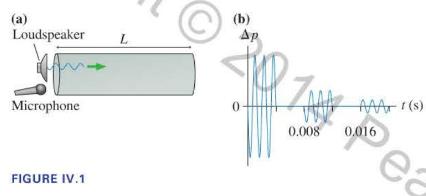
What was the approximate frequency of the sound wave used in this experiment?A. \(250 \mathrm{~Hz}\)B. \(500 \mathrm{~Hz}\)C. \(750 \mathrm{~Hz}\)D. \(1000 \mathrm{~Hz}\)A student investigator is measuring the speed of sound by looking at the time for a brief, sinusoidal pulse from a loudspeaker to
What can you say about the reflection of sound waves at the ends of a tube?A. Sound waves are inverted when reflected from both open and closed tube ends.B. Sound waves are inverted when reflected from a closed end, not inverted when reflected from an open end.C. Sound waves are inverted when
What was the approximate length of the tube?A. \(0.35 \mathrm{~m}\)B. \(0.70 \mathrm{~m}\)C. \(1.4 \mathrm{~m}\)D. \(2.8 \mathrm{~m}\)A student investigator is measuring the speed of sound by looking at the time for a brief, sinusoidal pulse from a loudspeaker to travel down a tube, reflect from
An alternative technique to determine sound speed is to measure the frequency of a standing wave in the tube. What is the wavelength of the lowest resonance of this tube?A. \(L / 2\)B. \(L\)C. \(2 L\)D. \(4 L\)A student investigator is measuring the speed of sound by looking at the time for a
You sit on the swing, and your friend gives you a gentle push so that you swing out over the creek. How long will it be until you swing back to where you started?A. \(4.5 \mathrm{~s}\)B. \(3.4 \mathrm{~s}\)C. \(2.2 \mathrm{~s}\)D. \(1.1 \mathrm{~s}\)A rope swing is hung from a tree right at the
Now you switch places with your friend, who has twice your mass. You give your friend a gentle push so that he swings out over the creek. How long will it be until he swings back to where he started?A. \(4.5 \mathrm{~s}\)B. \(3.4 \mathrm{~s}\)C. \(2.2 \mathrm{~s}\)D. \(1.1 \mathrm{~s}\)A rope swing
Your friend now pushes you over and over, so that you swing higher and higher. At some point you are swinging all the way across the creek-at the top point of your arc you are right above the opposite side. How fast are you moving when you get back to the lowest point of your arc?A. \(6.3
The jumping gait of the kangaroo is efficient because energy is stored in the stretch of stout tendons in the legs; the kangaroo literally bounces with each stride. We can model the bouncing of a kangaroo as the bouncing of a mass on a spring. A \(70 \mathrm{~kg}\) kangaroo hits the ground, the
A brand of earplugs reduces the sound intensity level by \(27 \mathrm{~dB}\). By what factor do these earplugs reduce the acoustic intensity?
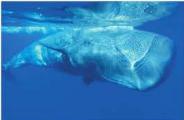
Sperm whales, just like bats, use echolocation to find prey. A sperm whale's vocal system creates a single sharp click, but the emitted sound consists of several equally spaced clicks of decreasing intensity. Researchers use the time interval between the clicks to estimate the size of the whale
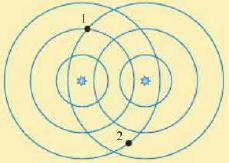
Sound waves spread out from two speakers; the circles represent crests of the spreading waves. The interference isA. Constructive at both points 1 and 2.B. Destructive at both points 1 and 2.C. Constructive at 1, destructive at 2. D. Destructive at 1, constructive at 2. 2
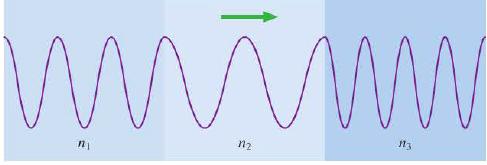
A light wave travels through three transparent materials of equal thickness. Rank in order, from the highest to lowest, the indices of refraction n1, n2 , and n3. 112 n\ 113
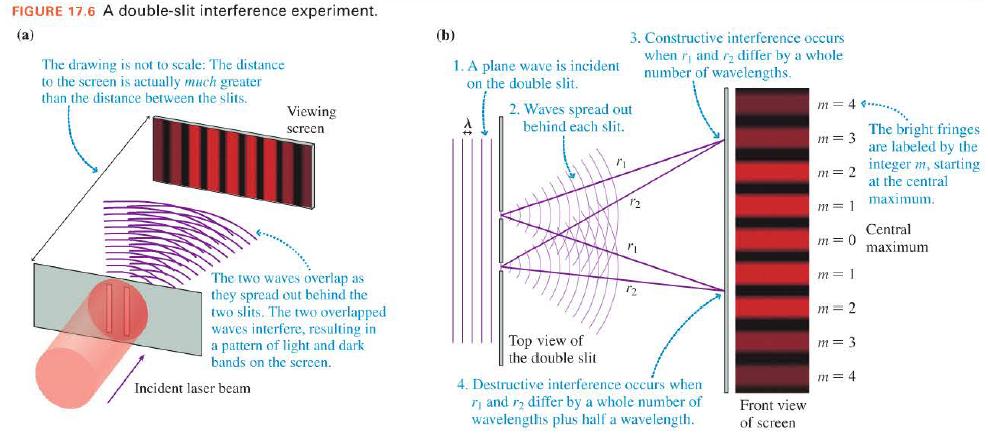
In Figure l 7.6b, suppose that for some point P on the screen r1 = 5,002,248.5A and r2 = 5,002,25 l.5A, where A is the wavelength of the light. The interference at point P is A. Constructive. B. Destructive. C. Something in between. FIGURE 17.6 A double-slit interference experiment. (a) The drawing
Light of wavelength λ1 illuminates a double slit, and interference fringes are observed on a screen behind the slits. When the wavelength is changed to λ2 , the fringes get closer together. Is λ2 larger or smaller than λ1?
White light passes through a diffraction grating and forms rainbow patterns on a screen behind the grating. For each rainbow, A. The red side is on the right, the violet side on the left.B. The red side is on the left, the violet side on the right.C. The red side is closest to the center of the
Reflections from a thin layer of air between two glass plates cause constructive interference for a particular wavelength of light A. By how much must the thickness of this layer be increased for the interference to be destructive?A. λ/8 B. λ/4c. λ/2 D. λ
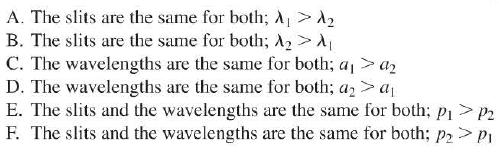
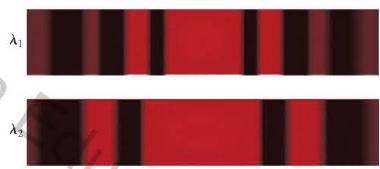
The figure shows two single-slit diffraction patterns. The distance between the slit and the viewing screen is the same in both cases. Which of the following could be true? A. The slits are the same for both; A> A B. The slits are the same for both; A > A C. The wavelengths are the same for both; a
Rank in order the following according to their speeds, from slowest to fastest: (i) 425 -nm-wavelength light through a pane of glass, (ii) 500-nm-wavelength light through air, (iii) \(540-\mathrm{nm}-\) wavelength light through water, (iv) \(670-\mathrm{nm}\)-wavelength light through a diamond, and
The wavelength of a light wave is \(700 \mathrm{~nm}\) in air; this light appears red. If this wave enters a pool of water, its wavelength becomes \(\lambda_{\text {air }} / n=530 \mathrm{~nm}\). If you were swimming underwater, the light would still appear red. Given this, what property of a wave
Light with a wavelength of \(600 \mathrm{~nm}\) is incident on a diffraction grating that has 100 slits. The first-order maximum is observed at a point \(\mathrm{P}\) on a distant screen. How much farther does the light travel from the first slit of the grating to point \(\mathrm{P}\) than does the
White light is incident on a diffraction grating. What color is the central maximum of the interference pattern?
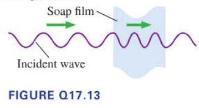
Figure Q17.13 shows a light wave incident on and passing through a thin soap film. Reflections from the front and back surfaces of the film create smaller waves (not shown that travel to the left of the film, where they interfere. Is the interference constructive, destructive, or something in
Reflected light from a thin film of oil gives constructive interference for light with a wavelength inside the film of \(\lambda_{\text {film }}\). By how much would the film thickness need to be increased to give destructive interference?A. \(2 \lambda_{\text {film }}\)B. \(\lambda_{\text {film
You want to estimate the diameter of a very small circular pinhole that you've made in a piece of aluminum foil. To do so, you shine a red laser pointer \((\lambda=632 \mathrm{~nm})\) at the hole and observe the diffraction pattern on a screen \(3.5 \mathrm{~m}\) behind the foil. You measure the
Two narrow slits are illuminated by light of wavelength \(\lambda\). The slits are spaced 20 wavelengths apart. What is the angle, in radians, between the central maximum and the \(m=1\) bright fringe?
Two narrow slits are \(0.12 \mathrm{~mm}\) apart. Light of wavelength \(550 \mathrm{~nm}\) illuminates the slits, causing an interference pattern on a screen \(1.0 \mathrm{~m}\) away. Light from each slit travels to the \(m=1\) maximum on the right side of the central maximum. How much farther did
In a double-slit experiment, the distance from one slit to the \(m=3\) bright fringe is \(2,000,198.2 \lambda\). What is the distance from this bright fringe to the other, more distant slit?
A 500 line/ \(\mathrm{mm}\) diffraction grating is illuminated by light of wavelength \(510 \mathrm{~nm}\). How many diffraction orders are seen, and what is the angle of each?
A film with \(n=1.60\) is deposited on glass. What is the thinnest film that will produce constructive interference in the reflection of light with a wavelength of \(550 \mathrm{~nm}\) ?
Antireflection coatings can be used on the inner surfaces of eyeglasses to reduce the reflection of stray light into the eye, thus reducing eyestrain.a. A 90-nm-thick coating is applied to the lens. What must be the coating's index of refraction to be most effective at \(480 \mathrm{~nm}\) ? Assume
Solar cells are given antireflection coatings to maximize their efficiency. Consider a silicon solar cell \((n=3.50)\) coated with a layer of silicon dioxide \((n=1.45)\). What is the minimum coating thickness that will minimize the reflection at the wavelength of \(700 \mathrm{~nm}\), where solar
For a demonstration, a professor uses a razor blade to cut a thin slit in a piece of aluminum foil. When she shines a laser pointer \((\lambda=680 \mathrm{~nm})\) through the slit onto a screen \(5.5 \mathrm{~m}\) away, a diffraction pattern appears. The bright band in the center of the pattern is
What is the width of a slit for which the first minimum is at \(45^{\circ}\) when the slit is illuminated by a helium-neon laser \((\lambda=633 \mathrm{~nm})\) ?
You want to photograph a circular diffraction pattern whose central maximum has a diameter of \(1.0 \mathrm{~cm}\). You have a heliumneon laser \((\lambda=633 \mathrm{~nm})\) and a 0.12 -mm-diameter pinhole. How far behind the pinhole should you place the viewing screen?
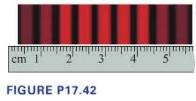
Figure P17.42 shows the light intensity on a screen \(2.5 \mathrm{~m}\) behind a double slit. The wavelength of the light is \(532 \mathrm{~nm}\). What is the spacing between the slits? cm FIGURE P17.42 5'
Showing 1600 - 1700
of 4913
First
10
11
12
13
14
15
16
17
18
19
20
21
22
23
24
Last
Step by Step Answers

 Get 50% OFF
Claim Now
Get 50% OFF
Claim Now