New Semester
Started
Get
50% OFF
Study Help!
--h --m --s
Claim Now
Question Answers
Textbooks
Find textbooks, questions and answers
Oops, something went wrong!
Change your search query and then try again
S
Books
FREE
Study Help
Expert Questions
Accounting
General Management
Mathematics
Finance
Organizational Behaviour
Law
Physics
Operating System
Management Leadership
Sociology
Programming
Marketing
Database
Computer Network
Economics
Textbooks Solutions
Accounting
Managerial Accounting
Management Leadership
Cost Accounting
Statistics
Business Law
Corporate Finance
Finance
Economics
Auditing
Tutors
Online Tutors
Find a Tutor
Hire a Tutor
Become a Tutor
AI Tutor
AI Study Planner
NEW
Sell Books
Search
Search
Sign In
Register
study help
sciences
college physics reasoning
College Physics A Strategic Approach 3rd Edition Randall D. Knight, Brian Jones, Stuart Field - Solutions
White light \((400-700 \mathrm{~nm})\) is incident on a 600 line \(/ \mathrm{mm}\) diffraction grating. What is the width of the first-order rainbow on a screen \(2.0 \mathrm{~m}\) behind the grating?
A miniature spectrometer used for chemical analysis has a diffraction grating with 800 slits \(/ \mathrm{mm}\) set \(25.0 \mathrm{~mm}\) in front of the detector "screen." The detector can barely distinguish two bright lines that are \(30 \mu \mathrm{m}\) apart in the first-order spectrum. What is
The shiny surface of a CD is imprinted with millions of tiny pits, arranged in a pattern of thousands of essentially concentric circles that act like a reflection grating when light shines on them. You decide to determine the distance between those circles by aiming a laser pointer (with
If sunlight shines straight onto a peacock feather, the feather appears bright blue when viewed from \(15^{\circ}\) on either side of the incident beam of sunlight. The blue color is due to diffraction from the melanin bands in the feather barbules, as was shown in the photograph on page 549 . Blue
Light emitted by element \(X\) passes through a diffraction grating that has 1200 slits \(/ \mathrm{mm}\). The interference pattern is observed on a screen \(75.0 \mathrm{~cm}\) behind the grating. First-order maxima are observed at distances of \(56.2 \mathrm{~cm}, 65.9 \mathrm{~cm}\), and \(93.5
Light of a single wavelength is incident on a diffraction grating with \(500 \mathrm{slits} / \mathrm{mm}\). Several bright fringes are observed on a screen behind the grating, including one at \(45.7^{\circ}\) and one next to it at \(72.6^{\circ}\). What is the wavelength of the light?
A laboratory dish, \(20 \mathrm{~cm}\) in diameter, is half filled with V. water. One at a time, \(0.50 \mu \mathrm{L}\) drops of oil from a micropipette are dropped onto the surface of the water, where they spread out into a uniform thin film. After the first drop is added, the intensity of \(600
A diffraction grating has 500 slits \(/ \mathrm{mm}\). What is the longest wavelength of light for which there will be a third-order maximum?
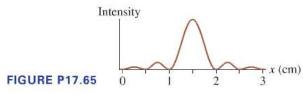
Figure P17.65 shows the light intensity on a screen behind a single slit. The wavelength of the light is \(500 \mathrm{~nm}\) and the screen is \(1.0 \mathrm{~m}\) behind the slit. What is the width (in \(\mathrm{mm}\) ) of the slit? Intensity x (cm) FIGURE P17.65 0 2 3
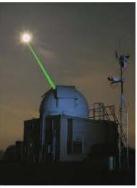
In the laser range-finding experiments of Example 17.10, the laser beam fired toward the moon spreads out as it travels because it diffracts through a circular exit as it leaves the laser. In order for the reflected light to be bright enough to detect, the laser spot on the moon must be no more
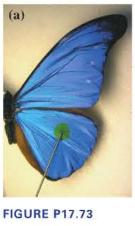
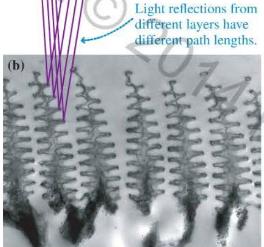
The coloring of the blue morpho butterfly is protective. As the butterfly flaps its wings, the angle at which light strikes the wings changes. This causes the butterfly's color to change and makes it difficult for a predator to follow. This color change is because A. A diffraction pattern appears
The change in color when acetone is placed on the wing is due to the difference between the indices of refraction of ace-tone and air. Consider light of some particular color. In acetone, A. The frequency of the light is less than in air.B. The frequency of the light is greater than in air.C. The
The scales on the butterfly wings are actually made of a transparent material with index of refraction 1.56. Light reflects from the surface of the scales because A. The scales' index of refraction is different from that of air.B. The scales' index of refraction is similar to that of glass.C. The
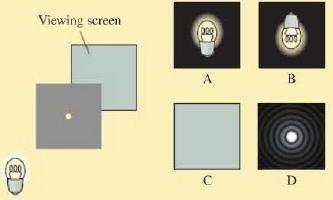
The dark screen has a 2-mm-diameter hole. The bulb is the only source of light. What do you see on the viewing screen? Viewing screen 000 000 A B C D
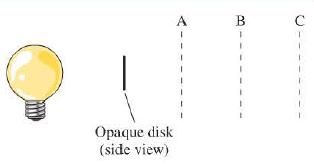
The only source of light in a room is the lightbulb shown. An opaque disk is placed in front of the bulb.A screen is then placed successively at positions A, B, and C. At which screen position(s) does the disk cast a shadow that is completely dark at the center? Opaque disk (side view) A B
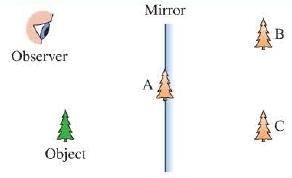
An object is placed in front of a mirror. The observer is positioned as shown. Which of the points, A, B, or C, best indicates where the observer would perceive the image to be located? Observer Object Mirror B Ac
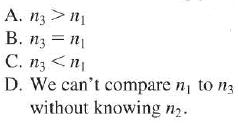
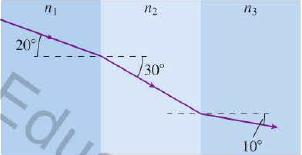
A light ray travels from medium l to medium 3 as shown. For these media, A. nz > n 13 B. n3 = n nz C. n3
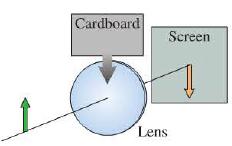
An object and lens are positioned to form a well-focused, inverted image on a viewing screen. Then a piece of cardboard is lowered just in front of the lens to cover the top half of the lens. Using what you've learned from Figure 18.30, what happens to the image on the screen?A. Nothing B. The
A Jens produces a sharply focused, inverted image on a screen.What will you see on the screen if the lens is removed?A. The image will be inverted and blurry.B. The image will be upright and sharp.C. The image will be upright and blurry.D. The image will be much dimmer but otherwise unchanged.E.
A concave mirror of focal length ∫ forms an image of the moon. Where is the image located?A. At the mirror's surface B. Almost exactly a distance ∫ behind the mirror C. Almost exactly a distance ∫ in front of the mirror.D. At a distance behind the mirror equal to the distance of the moon in
A candle is placed in front of a converging lens. A well focused image of the flame is seen on a screen on the opposite side of the lens. If the candle is moved farther away from the lens, how must the screen be adjusted to keep showing a well-focused image?A. The screen must be moved closer to the
During a solar eclipse, the sun-a small but extended source-casts a shadow of the moon on the earth. Explain why the moon's shadow has a dark center surrounded by a region of increasing brightness.
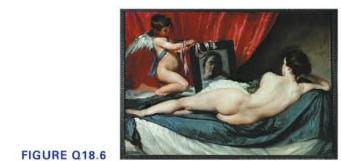
In The Toilet of Venus by Velázquez, we can see the face of Venus in the mirror. Can she see her own face in the mirror, when the mirror is held as shown in the picture? If yes, explain why; if not, what does she see instead? FIGURE Q18.6
A concave mirror brings the sun's rays to a focus at a distance of \(30 \mathrm{~cm}\) from the mirror. If the mirror were submerged in a swimming pool, would the sun's rays be focused nearer to, farther from, or at the same distance from the mirror?
You are looking straight into the front of an aquarium. You see a fish off to your right. Is the fish actually in the direction you're looking, farther to the right, or farther to the left? Explain.
A lens can be used to start a fire by focusing an image of the sun onto a piece of flammable material. All other things being equal, would a lens with a short focal length or a long focal length be better as a fire starter? Explain.
A piece of transparent plastic is molded into the shape of a converging lens, but it is hollow inside and has only a thin plastic wall. If immersed in water, would this air-filled lens act as a converging lens, act as a diverging lens, or not act as a lens at all?
From where you stand one night, you see the moon directly over a nearby streetlamp. You use a converging lens to get the moon's image sharply focused on a card; when you do so, the image of the lamp is a little out of focus. To bring the lamp's image into sharp focus, do you need to move the card
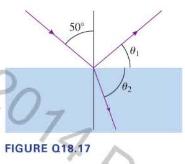
What is \(\theta_{1}\) ?A. \(40^{\circ}\)B. \(45^{\circ}\)C. \(50^{\circ}\)D. \(90^{\circ}\)Are concerned with the situation sketched in Figure Q18.17, in which a beam of light in the air encounters a transparent block with index of refraction \(n=1.53\). Some of the light is reflected and some is
What is \(\theta_{2}\) ?A. \(20^{\circ}\)B. \(30^{\circ}\)C. \(50^{\circ}\)D. \(60^{\circ}\)Are concerned with the situation sketched in Figure Q18.17, in which a beam of light in the air encounters a transparent block with index of refraction \(n=1.53\). Some of the light is reflected and some is
Is there an angle of incidence between \(0^{\circ}\) and \(90^{\circ}\) such that all of the light will be reflected?A. Yes, at an angle greater than \(50^{\circ}\)B. Yes, at an angle less than \(50^{\circ}\)C. No Are concerned with the situation sketched in Figure Q18.17, in which a beam of light
A \(2.0-\mathrm{m}\)-tall man is \(5.0 \mathrm{~m}\) from the converging lens of a camera. His image appears on a detector that is \(50 \mathrm{~mm}\) behind the lens. How tall is his image on the detector?A. \(10 \mathrm{~mm}\)B. \(20 \mathrm{~mm}\)C. \(25 \mathrm{~mm}\)D. \(50 \mathrm{~mm}\)
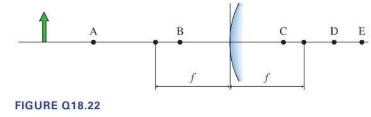
As shown in Figure Q18.22, an object is placed in front of a convex mirror. At what position is the image located? A B C DE FIGURE Q18.22
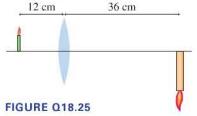
The lens in Figure Q18.25 is used to produce a real image of a candle flame. What is the focal length of the lens?A. \(9.0 \mathrm{~cm}\)B. \(12 \mathrm{~cm}\)C. \(24 \mathrm{~cm}\)D. \(36 \mathrm{~cm}\)E. \(48 \mathrm{~cm}\) 12 cm 36 cm FIGURE Q18.25
A converging lens of focal length \(20 \mathrm{~cm}\) is used to form a real image 1.0 m away from the lens. How far from the lens is the object?A. 20 ~cmB. 25 ~cmC. \(50 \mathrm{~cm}\)D. \(100 \mathrm{~cm}\)
You look at yourself in a convex mirror. Your image isA. Upright.B. Inverted.C. It's impossible to tell without knowing how far you are from the mirror and its focal length.
A 1.0-cm-thick layer of water stands on a horizontal slab of glass. A light ray in the air is incident on the water \(60^{\circ}\) from the normal. After entering the glass, what is the ray's angle from the normal?
A light ray travels inside a horizontal plate of glass, striking its upper surface at an angle of incidence of \(60^{\circ}\). This ray is totally internally reflected at the glass-air boundary. A liquid is then poured on top of the glass. What is the largest index of refraction that the liquid
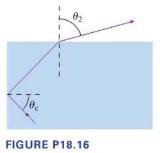
A light ray travels inside a block of sodium fluoride that has index of refraction \(n=1.33\) as shown in Figure \(\mathrm{P} 18.16\). The ray strikes the vertical wall at the critical angle, totally reflects, and then emerges into the air above the block. What is the angle \(\theta_{2}\) at which
A concave cosmetic mirror has a focal length of \(40 \mathrm{~cm}\). A 5 - \(\mathrm{cm}\)-long mascara brush is held upright \(20 \mathrm{~cm}\) from the mirror. Use ray tracing to determine the location and height of its image. Is the image upright or inverted? Is it real or virtual?
A light bulb is \(60 \mathrm{~cm}\) from a concave mirror with a focal length of \(20 \mathrm{~cm}\). Use ray tracing to determine the location of its image. Is the image upright or inverted? Is it real or virtual?
The illumination lights in an operating room use a concave mirror to focus an image of a bright lamp onto the surgical site. One such light has a mirror with a focal length of \(15.0 \mathrm{~cm}\). Use ray tracing to find the position of its lamp when the patient is positioned \(1.0 \mathrm{~m}\)
An object is \(12 \mathrm{~cm}\) in front of a convex mirror. The mirror creates an image that is \(75 \%\) as tall as the object. Use ray tracing to find the distance of the focal point from the mirror.
A 2.0 - \(\mathrm{cm}\)-tall object is \(40 \mathrm{~cm}\) in front of a converging lens that has a \(20 \mathrm{~cm}\) focal length.Calculate the image position and height.
If A 1.0-cm-tall object is \(10 \mathrm{~cm}\) in front of a converging lens that has a \(30 \mathrm{~cm}\) focal length.Calculate the image position and height.
A \(2.0-\mathrm{cm}\)-tall object is \(\mathbf{1 5} \mathrm{cm}\) in front of a converging lens that has a \(20 \mathrm{~cm}\) focal length.Calculate the image position and height.
A \(1.0-\mathrm{cm}\)-tall object is \(75 \mathrm{~cm}\) in front of a converging lens that has a \(30 \mathrm{~cm}\) focal length.Calculate the image position and height.
A 2.0-cm-tall object is \(15 \mathrm{~cm}\) in front of a diverging lens that has a \(-20 \mathrm{~cm}\) focal length.Calculate the image position and height.
A \(1.0-\mathrm{cm}\)-tall object is \(60 \mathrm{~cm}\) in front of a diverging lens that has a \(-30 \mathrm{~cm}\) focal length.Calculate the image position and height.
A 3.0-cm-tall object is \(15 \mathrm{~cm}\) in front of a convex mirror that has a \(-25 \mathrm{~cm}\) focal length.Calculate the image position and height.
A \(3.0-\mathrm{cm}\)-tall object is \(45 \mathrm{~cm}\) in front of a convex mirror that has a \(-25 \mathrm{~cm}\) focal length.Calculate the image position and height.
A 3.0-cm-tall object is \(15 \mathrm{~cm}\) in front of a concave mirror that has a \(25 \mathrm{~cm}\) focal length.Calculate the image position and height.
A 3.0-cm-tall object is \(45 \mathrm{~cm}\) in front of a concave mirror that has a \(25 \mathrm{~cm}\) focal length.Calculate the image position and height.
At what distance from a concave mirror with a \(35 \mathrm{~cm}\) focal length should an object be placed so that its image is the same distance from the mirror as the object?Calculate the image position and height.
Starting \(3.5 \mathrm{~m}\) from a department store mirror, Suzanne walks\(\mathbb{N} T\) toward the mirror at \(1.5 \mathrm{~m} / \mathrm{s}\) for \(2.0 \mathrm{~s}\). How far is Suzanne from her image in the mirror after \(2.0 \mathrm{~s}\) ?
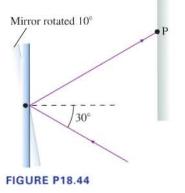
A laser beam is incident on a mirror at an angle of \(30^{\circ}\), as shown in Figure P18.44. It reflects off the mirror and strikes a wall \(2.0 \mathrm{~m}\) away at point \(\mathrm{P}\). By what distance does the laser spot on the wall move if the mirror is rotated by \(10^{\circ}\) ? Mirror
It A ray of light traveling through air encounters a 1.2-cm-thick sheet of glass at a \(35^{\circ}\) angle of incidence. How far does the light ray travel in the glass before emerging on the far side?
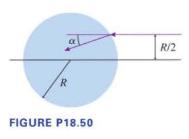
Figure P18.50 shows a tight ray incident on a glass cylinder. What is the angle \(\alpha\) of the ray after it has entered the cylinder? R FIGURE P18.50 R/2
You are standing in a \(1.5-\mathrm{m}\)-deep swimming pool at night. The water is very still. You hold a laser pointer just above the water's surface and shine it nearly parallel to the surface, but tilted slightly down so that the beam enters the water \(5.0 \mathrm{~m}\) from you. How far from
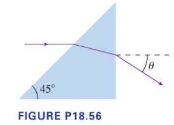
What is the exit angle \(\theta\) from the glass prism in Figure P18.56? 45 FIGURE P18.56 Jo
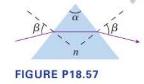
There is just one angle of incidence \(\beta\) onto a prism for which the light inside an isosceles prism travels parallel to the base and emerges at that same angle \(\beta\), as shown in Figure P18.57.a. Find an expression for \(\beta\) in terms of the prism's apex angle \(\alpha\) and index of
A 1.0-cm-thick layer of water stands on a horizontal slab of glass. Light from within the glass is incident on the glasswater boundary. What is the maximum angle of incidence for which a light ray can emerge into the air above the water?
You need to use a 24-cm-focal-length lens to produce an inverted image twice the height of an object. At what distance from the object should the lens be placed?
The moon is \(3.5 \times 10^{6} \mathrm{~m}\) in diameter and \(3.8 \times 10^{8} \mathrm{~m}\) from the earth's surface. The 1.2-m-focal-length concave mirror of a telescope focuses an image of the moon onto a detector. What is the diameter of the moon's image?
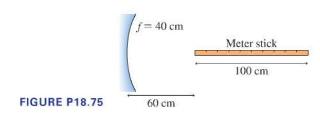
Figure P18.75 shows a meter stick held lengthwise along the optical axis of a concave mirror. How long is the image of the meter stick? 40 cm FIGURE P18.75 60 cm Meter stick 100 cm
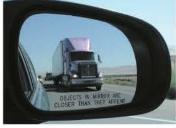
The writing on the passenger-side mirror of your car says "Warning! Objects in mirror are closer than they appear." There is no such warning on the driver's mirror. Consider a typical convex passenger-side mirror with a focal length of \(-80 \mathrm{~cm}\). A 1.5-m-tall cyclist on a bicycle is \(25
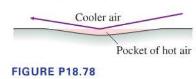
The pocket of hot air appears to be a pool of water because A. Light reflects at the boundary between the hot and cool air.B. Its density is close to that of water.C. Light refracts at the boundary between the hot and cool air.D. The hot air emits blue light that is the same color as the daytime
Which of these changes would allow you to get closer to the mirage before it vanishes?A. Making the pocket of hot air nearer in temperature to the air above itB. Looking for the mirage on a windy day, which mixes the air layersC. Increasing the difference in temperature between the pocket of hot
If you could clearly see the image of an object that was reflected by a mirage, the image would appear A. Magnified.B. With up and down reversed.C. Farther away than the object.D. With right and left reversed.There is an interesting optical effect you have likely noticed while driving along a flat
A converging lens creates a real, inverted image. For this to occur, the object must be A. Closer to the lens than the focal point. B. Farther from the lens than the focal point. C. At the focal point.
The screen in a pinhole camera is moved farther away from the pinho le. The image on the screen will A. Become larger.B. Become smaller.C. Remain the same size.
Kara has a near-point distance of 40 cm. So that she can focus on a book 25 cm away, her corrective lenses should create A. A virtual image of the book 40 cm from her eye.B. A real image of the book 40 cm from her eye.C. A virtual image of the book 25 cm from her eye.D. A real image of the book 25
With her right eye, Maria can focus on a vase 0.5 m away, but not on a tree 10 m away. What could be the eyeglass prescription for her right eye?A. +3.0 D B. + 10 D C. - 5.0 D D. -1.5 D
A student tries to use a diverging lens as a magnifier. She observes a coin placed at the focal point of the lens. She sees A. An upright image, smaller than the object.B. An upright image, larger than the object.C. An inverted image, smaller than the object.D. An inverted image, larger than the
A biologist rotates the turret of a microscope to replace the 20× objective with a 10× objective. To keep the magnification the same, the focal length of the eyepiece must A. Be doubled. B. Be halved. C. Remain the same.D. The magnification cannot stay the same if the objective power is changed.
A red apple is viewed through a green filter. The apple appears A. Red. B. Green. C. Yellow. D. Black.
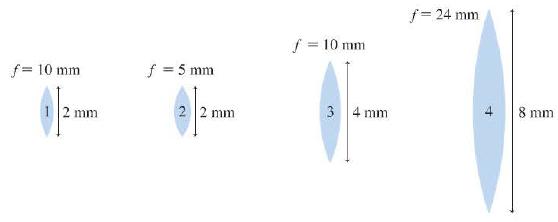
Four lenses are used as microscope objectives, all for light with the same wavelength A. Rank in order, from highest to lowest, the resolving powers RP1 to RP4 of the lenses. f = 10 mm f=24 mm f= 10 mm f = 5 mm 12 mm 32mm 22 mm 3 4 mm 8 mm
A photographer focuses his camera on his subject. The subject then moves closer to the camera. To refocus, should the lens be moved closer to or farther from the detector? Explain.
The object for a magnifier is usually placed very close to the focal point of the lens, creating a virtual image very far away where it can be viewed with the relaxed eye. But the object could be placed so that the image is at the eye's near-point distance. In this case, the image can be viewed
A friend lends you the eyepiece of his microscope to use on your own microscope. He claims that since his eyepiece has the same diameter as yours but twice the focal length, the resolving power of your microscope will be doubled. Is his claim valid? Explain.
A student makes a microscope using an objective lens and an eyepiece. If she moves the lenses closer together, does the microscope's magnification increase or decrease? Explain.
A collector notices a rare beetle on a tree \(1.0 \mathrm{~m}\) away. From this vantage point, the beetle has an angular size of \(0.69^{\circ}\). What would its angular size be if the collector approached it and looked at it with a magnifier having a \(5.0 \mathrm{~cm}\) focal length?A.
A microscope has a tube length of \(20 \mathrm{~cm}\). What combination of objective and eyepiece focal lengths will give an overall magnification of 100 ?A. \(1.5 \mathrm{~cm}, 3 \mathrm{~cm}\)B. \(2 \mathrm{~cm}, 2 \mathrm{~cm}\)C. \(1 \mathrm{~cm}, 5 \mathrm{~cm}\)D. \(3 \mathrm{~cm}, 8
The distance between the objective and eyepiece of a telescope is \(55 \mathrm{~cm}\). The focal length of the eyepiece is \(5.0 \mathrm{~cm}\). What is the angular magnification of this telescope?A. -10 B. -11 C. -50 D. -275
A nearsighted person has a near point of \(20 \mathrm{~cm}\) and a far point of \(40 \mathrm{~cm}\). What refractive power lens is necessary to correct this person's vision to allow her to see distant objects?A. \(-5.0 \mathrm{D}\)B. \(-2.5 \mathrm{D}\)C. \(+2.5 \mathrm{D}\)D. \(+5.0 \mathrm{D}\)
A 60-year-old man has a near point of \(100 \mathrm{~cm}\), making it B10 impossible to read. What refractive power reading glasses would he need to focus on a newspaper held at a comfortable distance of \(40 \mathrm{~cm}\) ?A. \(-2.5 \mathrm{D}\)B. \(-1.5 \mathrm{D}\)C. \(+1.5 \mathrm{D}\)D.
A person looking through a \(-10 \mathrm{D}\) lens sees an image that appears \(8.0 \mathrm{~cm}\) from the lens. How far from the lens is the object?A. \(10 \mathrm{~cm}\)B. \(20 \mathrm{~cm}\)C. \(25 \mathrm{~cm}\)D. \(40 \mathrm{~cm}\)
40,000 J of heat is added to 1.0 kg of ice al - 10°C. How much ice melts?A. \(0.012 \mathrm{~kg}\)B. \(0.057 \mathrm{~kg}\)C. \(0.12 \mathrm{~kg}\)D. \(1.0 \mathrm{~kg}\)
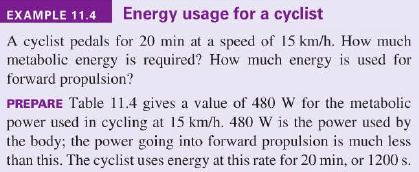
a. How much metabolic energy is required for a \(68 \mathrm{~kg}\) runner to run at a speed of \(15 \mathrm{~km} / \mathrm{h}\) for \(20 \mathrm{~min}\) ?b. How much metabolic energy is required for this runner to walk at a speed of \(5.0 \mathrm{~km} / \mathrm{h}\) for \(60 \mathrm{~min}\) ?
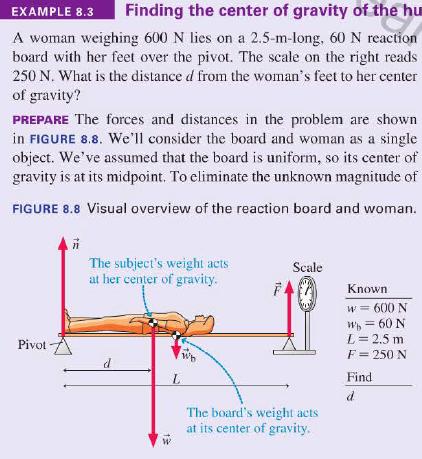
Consider the procedure for measuring a woman's center of gravity given in Example 8.3. The \(600 \mathrm{~N}\) woman is in place on the board, with the scale reading \(250 \mathrm{~N}\). She now extends her arms upward, in front of her body. This raises her center of gravity relative to her feet by
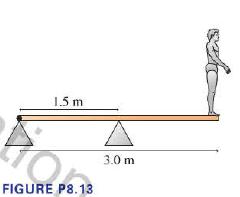
A \(60 \mathrm{~kg}\) diver stands at the end of a \(30 \mathrm{~kg}\) springboard, as shown in Figure P8.13. The board is attached to a hinge at the left end but simply rests on the right support. What is the magnitude of the vertical force exerted by the hinge on the board. 1.5 m FIGURE P8.13 3.0
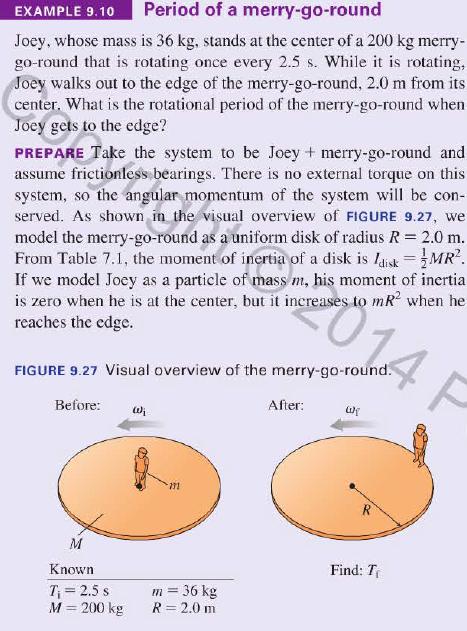
Joey, stands at rest at the outer edge of the frictionless merry-go-round of Figure 9.27. The merry-goround is also at rest. Joey then begins to run around the perimeter of the merry-go-round, finally reaching a constant speed, measured relative to the ground, of \(5.0 \mathrm{~m} / \mathrm{s}\).
Running on a treadmill is slightly easier than running outside because there is no drag force to work against. Suppose a \(60 \mathrm{~kg}\) runner completes a \(5.0 \mathrm{~km}\) race in 18 minutes. Use the cross-section area estimate of Example 5.14 to determine the drag force on the runner
Running indoors on a treadmill is slightly easier than running outside because you aren't moving through the air and there is no drag force to oppose your motion. A \(60 \mathrm{~kg}\) man is running at \(4.5 \mathrm{~m} / \mathrm{s}\) on an indoor treadmill. To experience the same intensity
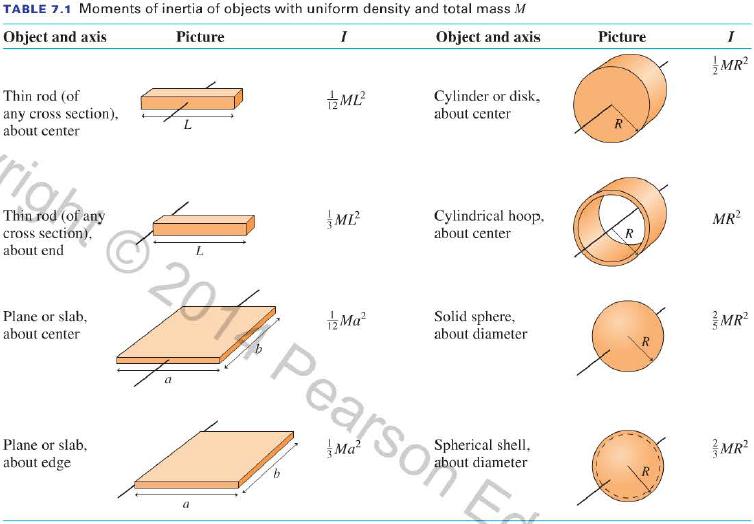
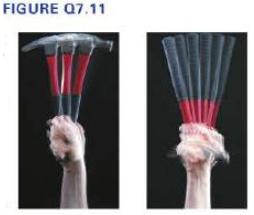
The two ends of the dumbbell shown in Figure Q7.11 are made of the same material. Is the dumbbell' s center of gravity at point 1, 2, or 3? Explain. FIGURE Q7.11
A \(1.00 \mathrm{~kg}\) block is attached to a horizontal spring with spring INT constant \(2500 \mathrm{~N} / \mathrm{m}\). The block is at rest on a frictionless surface. A \(10.0 \mathrm{~g}\) bullet is fired into the block, in the face opposite the spring, and sticks.a. What was the bullet's
We can make a static measurement to deduce the spring constant to use in the model. If a \(61 \mathrm{~kg}\) woman stands on a low wall with her full weight on the ball of one foot and the heel free to move, the stretch of the Achilles tendon will cause her center of gravity to lower by about \(2.5
If, during a stride, the stretch causes her center of mass to lower by \(10 \mathrm{~mm}\), what is the stored energy?A. \(3.0 \mathrm{~J}\)B. \(6.0 \mathrm{~J}\)C. \(9.0 \mathrm{~J}\)D. \(12 \mathrm{~J}\)We saw that a runner's Achilles tendon will stretch like a spring and then rebound, storing
If we imagine a full cycle of the oscillation, with the woman bouncing up and down and the tendon providing the restoring force, what will her oscillation period be?A. \(0.10 \mathrm{~s}\)B. \(0.15 \mathrm{~s}\)C. \(0.20 \mathrm{~s}\)D. \(0.25 \mathrm{~s}\)We saw that a runner's Achilles tendon
Given what you have calculated for the period of the full oscillation in this model, what is the landing-to-liftoff time for the stretch and rebound of the sprinter's foot?A. \(0.050 \mathrm{~s}\)B. \(0.10 \mathrm{~s}\)C. \(0.15 \mathrm{~s}\)D. \(0.20 \mathrm{~s}\)We saw that a runner's Achilles
Showing 1700 - 1800
of 4913
First
11
12
13
14
15
16
17
18
19
20
21
22
23
24
25
Last
Step by Step Answers

 Get 50% OFF
Claim Now
Get 50% OFF
Claim Now